


⚡ TL;DR
Losing power in part of a home does not prove that a breaker tripped, and a dark street does not identify the fault affecting your address. Check available utility information from a safe location, describe what has already stopped working, and report unusual conditions. A flashlight helps you move or read a record; it cannot establish electrical safety or diagnose hidden wiring.
📋 Table of Contents
- 1. Separate the observation from the explanation
- 2. What an outage and a tripped breaker actually describe
- 3. Partial power deserves a careful report
- 4. Use utility information without treating it as a complete answer
- 5. Decide who needs the information
- 6. A household report should be useful without a panel photograph
- 7. Choose lighting for movement and records
- 8. Keep other household needs from becoming an afterthought
- 9. When service returns, report what remains different
- 10. Prepare a contact sheet before the next interruption
- 11. Frequently asked questions
- 12. Give the next person observations they can use
Separate the observation from the explanation
Start with what you know: the kitchen went dark, a bedroom light stayed on, or several devices stopped together. Those are useful observations. “The breaker tripped” is an explanation that may or may not be established. Keeping the two separate makes your report more accurate and avoids turning an uncertain cause into a reason to manipulate electrical equipment.
| What you already notice | Useful information to record | What it does not prove |
|---|---|---|
| One room appears affected | Room, approximate time, and equipment already in use | That a particular breaker caused it |
| Some rooms have power and others do not | Which areas still work and whether lights behave unusually | That the utility supply is normal |
| Nearby homes look dark | Approximate area and any official outage information | That every home shares the same fault |
| A utility map shows an incident | Address coverage, update time, and reporting instructions | That no separate household problem exists |
| Power returns but the original problem remains | What changed and what did not | That the installation has been checked or repaired |
You do not need to explore every room to create a complete inventory before asking for help. Use observations you can make from ordinary safe locations. Do not cross a wet basement, enter a restricted service area, or approach damaged equipment to improve the report. A missing detail is better than information obtained by moving into a hazard.
If there is smoke or fire, leave and call emergency services from a safe location. Active sparking, a burning odor, or unusual electrical sizzling also needs prompt attention rather than a better photograph. Massachusetts fire-safety guidance identifies these as electrical warning signs requiring immediate help. Do not delay a call while comparing lights on your street or searching for a panel label.
What an outage and a tripped breaker actually describe
A power outage describes a loss of electrical supply. A tripped breaker describes a protective device interrupting a circuit. These descriptions answer different questions: one concerns the loss of service you experience, while the other concerns a device's state. They are not a simple pair of labels that can always be selected by looking at how many rooms are dark.
The cause of interrupted service can be outside the home, within the installation, or associated with particular equipment. Electrical protective devices also have different designs and purposes. A homeowner cannot reliably identify all of those possibilities from a room's light switch or a remembered diagram. The useful first task is describing the interruption and arranging the appropriate response.
An upstream interruption does not need to trip a home's breaker to leave the home without power. Likewise, an apparent household protection event does not prove that everything outside the affected circuit is operating normally. A visible control position is only one piece of information; it does not establish why the interruption happened or whether all equipment is safe.
Avoid assigning a cause solely because an appliance was running when the lights changed. The timing may be useful to the person investigating, but a coincidence is not a diagnosis. Record that the washing machine was operating during ordinary use, for example. Do not restart it repeatedly to find out whether the same change can be produced again.
Partial power deserves a careful report
Partial power means that electricity appears available in some parts of the home and unavailable in others. It can resemble a familiar branch-circuit problem, but the appearance alone does not settle the source. Utility reporting systems may provide a separate category for partial power or unusual voltage symptoms. Use the service provider's actual reporting channel rather than assuming that only a completely dark home qualifies.
Unusually bright lights in one area, dim lights elsewhere, or equipment behaving differently after service returns are important details. Tell the utility what you noticed and follow its guidance about the appropriate response. Do not deliberately switch on additional appliances to compare their behavior, and do not use a household lamp as an improvised test of electrical conditions.
Streetlights and neighbors' windows provide context without being a diagnostic instrument. A neighbor may use a generator or battery system, have different circuits affected, or simply have the lights switched off. You also may not know which utility equipment serves each property. Seeing light nearby is therefore not a reason to rule out a supply problem at your own address.
Keep the language concrete when reporting partial service. “The living room lights are dim, the bedroom light looks normal, and the kitchen is dark” is more useful than “half the phase is gone.” The first gives observations the responder can evaluate. The second names an electrical condition that has not necessarily been confirmed and may send the conversation in the wrong direction.
Keep different observations on the same timeline
Two adults can give different accounts without either being wrong. One may have seen a room light working before the interruption, while another noticed it later. Record the order rather than combining those accounts into a single snapshot. Knowing that a condition changed is useful even when nobody can provide an exact minute or explain why it changed.
Identify the object as well as the room. A battery-powered lamp still operating in the bedroom does not show that the bedroom's household electrical supply is available. Likewise, a phone continuing to play music does not show that the outlet beside it is energized. Describe the equipment you actually observed without creating a test to settle the question.
Give changed information a fresh entry instead of erasing the original. If an area that was dark appears restored while another concern remains, report that sequence. It can help the utility or property contact understand an evolving interruption. Do not recreate an earlier condition or operate additional controls to make the current scene match what someone remembers.
Use utility information without treating it as a complete answer
Check the utility's official outage page or reporting number using contact information already available on a bill, saved account record, or the provider's known website. An online search result is not the same as confirming that you have reached the actual service provider. Keep account and address details ready so a report can be tied to the correct location.
Look at the information's time as well as its map. An incident shown nearby may still be under assessment, and an estimate can change as crews learn more. Save the report or reference number and note when you received an update. A useful record distinguishes an estimated restoration time from a promise that your particular home will be back to normal at that moment.
A blank outage map does not prove that your installation is faulty. The problem may not yet be reported or fully reflected online. If service is interrupted or behaves unusually, use the provider's reporting instructions. Do not wait for another household to report it simply because someone in a group message assumes the utility already knows about the street.
When the utility reports restoration, compare that statement with the condition you actually observe. If part of your home remains without power or lights still behave unusually, report the remaining problem. Do not replace your own observation with a map's status. A regional incident being marked resolved does not establish that every individual service issue or household defect has been corrected.
Decide who needs the information
For an apparent supply interruption, partial power, or unusual service behavior, contact the electric utility through its designated reporting channel. Explain whether the whole home or only some areas appear affected. If you have already received a reference number, include it in the next conversation so the new observation can be connected with the existing report.
For recurring trips, damaged household fittings, or a concern that needs evaluation within the home, arrange a qualified electrician through the appropriate property contact. Do not describe a camera image, a flashlight inspection, or a previous reset as proof that the electrical system is safe. The professional needs the symptom history and access information, not a homeowner's guessed repair specification.
If there is an emergency, obtaining emergency help takes priority over deciding whether the utility or a contractor will eventually handle the repair. Explain the immediate warning clearly and give the location. Do not stay near sparking, smoke, or a burning smell to determine which company owns the affected equipment or to finish an online form.
Renters should notify the responsible landlord or property manager using the building's established emergency or maintenance process. Provide the address, unit, affected areas, and any urgent signs. Reporting to a property contact is separate from requesting emergency assistance when needed. Do not wait for an unanswered routine message when the situation calls for immediate help.
In a building with shared services, avoid entering locked electrical rooms or handling equipment that serves other occupants. Tell the property contact if a shared hallway, elevator area, or common facility appears affected from your normal location. The building manager can coordinate access and relevant professionals without an individual occupant trying to identify or operate shared controls.
Give the service location, not only the account holder's name. A rental property, detached unit, or building with several entrances can have an address that differs from the mailing details someone remembers. Use the information already available in the household's records. Do not enter a service area to find a meter number when a responsible contact can establish the correct location another way.
You may need to speak with more than one responsible party. Keep a short record of who was contacted, what was reported, and what advice was given. If responsibility remains unclear, ask directly who will investigate the remaining concern. An open utility ticket does not necessarily mean that the property manager has arranged an electrician, or the other way around.
A household report should be useful without a panel photograph
Write down the first time the problem was noticed and the last time service was known to be normal. If nobody knows the exact start, preserve that uncertainty. “Discovered when arriving home” is an honest observation. A blinking clock may show that power was interrupted, but it does not necessarily provide a reliable start time or the duration of every interruption.
List rooms and equipment in ordinary terms, using only what was already observed safely. Include whether there was a single interruption, repeated flickering, unusual brightness, or a continuing loss of power. Avoid repeatedly testing outlets or moving appliances from one area to another to complete the list. The person investigating can decide what additional checks are needed.
Mention relevant history without recreating it: recent professional electrical work, a newly installed appliance, storm damage already noticed from a safe place, or a previous similar incident. Keep records of that work available. None of these facts proves the cause, but they may help the responsible professional plan the assessment and understand why the household is concerned.
Do not open an enclosure, remove screws, or reach around a guard to photograph a breaker position or label. If an existing document or photograph is already available, it may help identify equipment without a new approach. Tell the responder when a requested detail cannot be obtained safely instead of treating the request as permission to enter a questionable area.
| Information to give | An accurate example | Avoid substituting |
|---|---|---|
| Time | “Noticed after returning home this evening” | An invented exact outage start |
| Affected area | “Kitchen dark; bedroom light remained on” | An unconfirmed wiring diagnosis |
| Unusual behavior | “Some lights became much brighter” | A guessed voltage measurement |
| Prior event | “An electrician worked here last month” | A claim that the earlier work caused this event |
| Contact history | “Utility report number recorded” | An assumption that another person arranged service |
Choose lighting for movement and records
The immediate lighting job is modest: see the ordinary walking route, read a phone or paper record, and communicate clearly from a safe location. More output cannot establish whether equipment is energized. Keep portable lights away from electrical openings and damaged fittings, and do not attach a magnetic light to a service panel to create a work position for your own investigation.
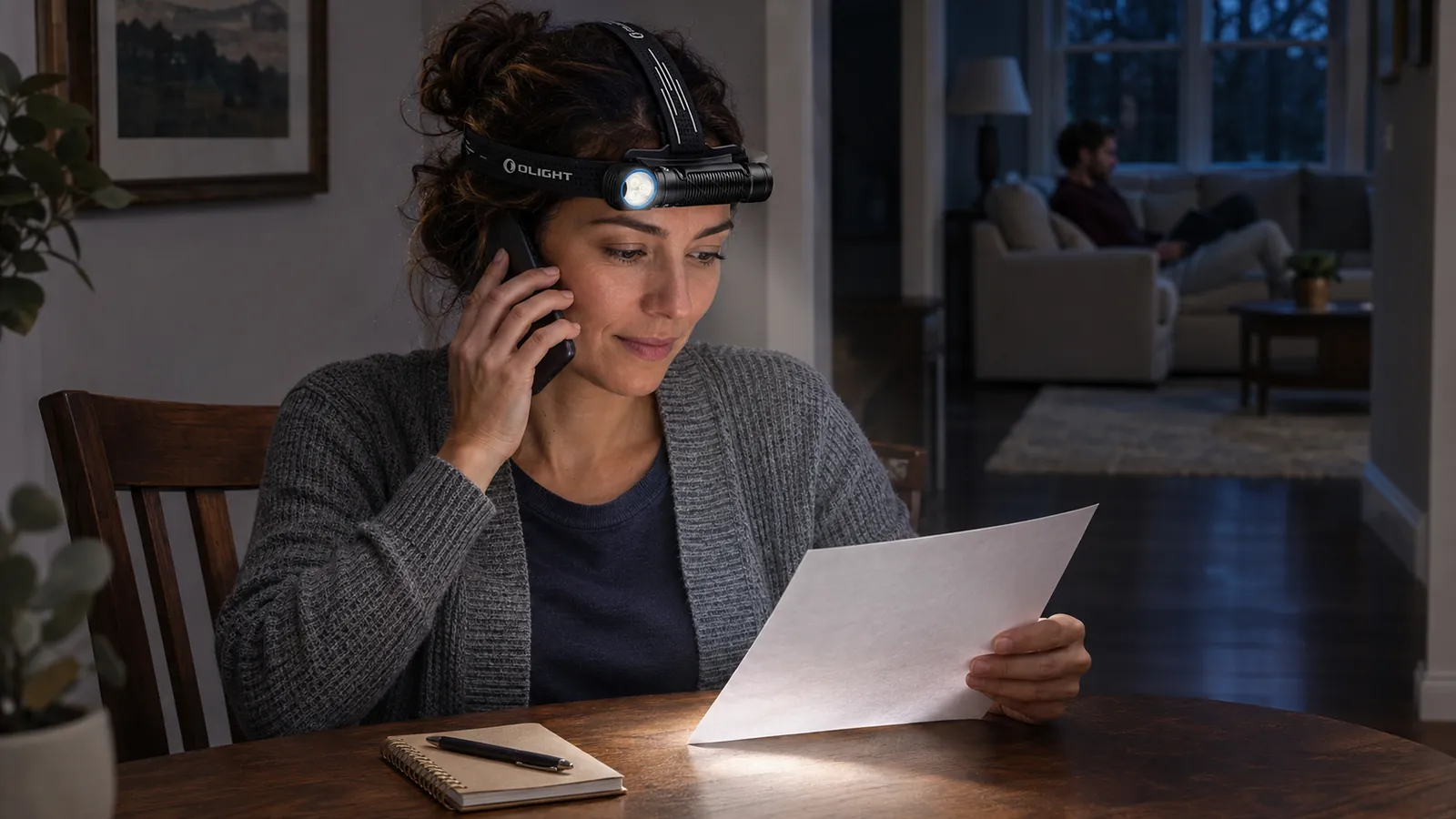
The Olight Perun 3, in its Black configuration, includes a headband as well as a clip, lanyard, and magnetic tail. A head-mounted format can leave an adult's hands available for ordinary tasks such as holding contact information or helping another person move along a clear route. That convenience is separate from permission to perform electrical work.

Official Perun 3 headband configuration. Hands-free reading still requires a clear route and keeping the beam away from another person's face.
A headlamp's beam follows the wearer's attention. Looking up from a notebook can direct it toward another person's face, while looking sideways can leave the walking surface less visible. Choose an appropriate documented setting, move thoughtfully, and stop in a safe place if the light needs adjustment. Hands being available does not remove the need for clear footing and a suitable route.
The Perun 3 provides white and red modes, with maximum white output listed at three thousand lumens. For reading a circuit directory that is already available on paper or writing a utility report, use suitable ordinary white light. Red light is an additional mode, not a guarantee that every colored label or marking will remain easy to distinguish. The highest setting is not automatically the most comfortable reading level.
Olight lists a five-thousand-milliamp-hour rechargeable battery and a maximum runtime measured on Moonlight. The long low-mode figure should not be combined with maximum brightness to plan an outage. Check the actual charge state and the mode you intend to use, and keep an appropriate second light available. A rechargeable system still needs compatible equipment and energy when it is time to recharge.
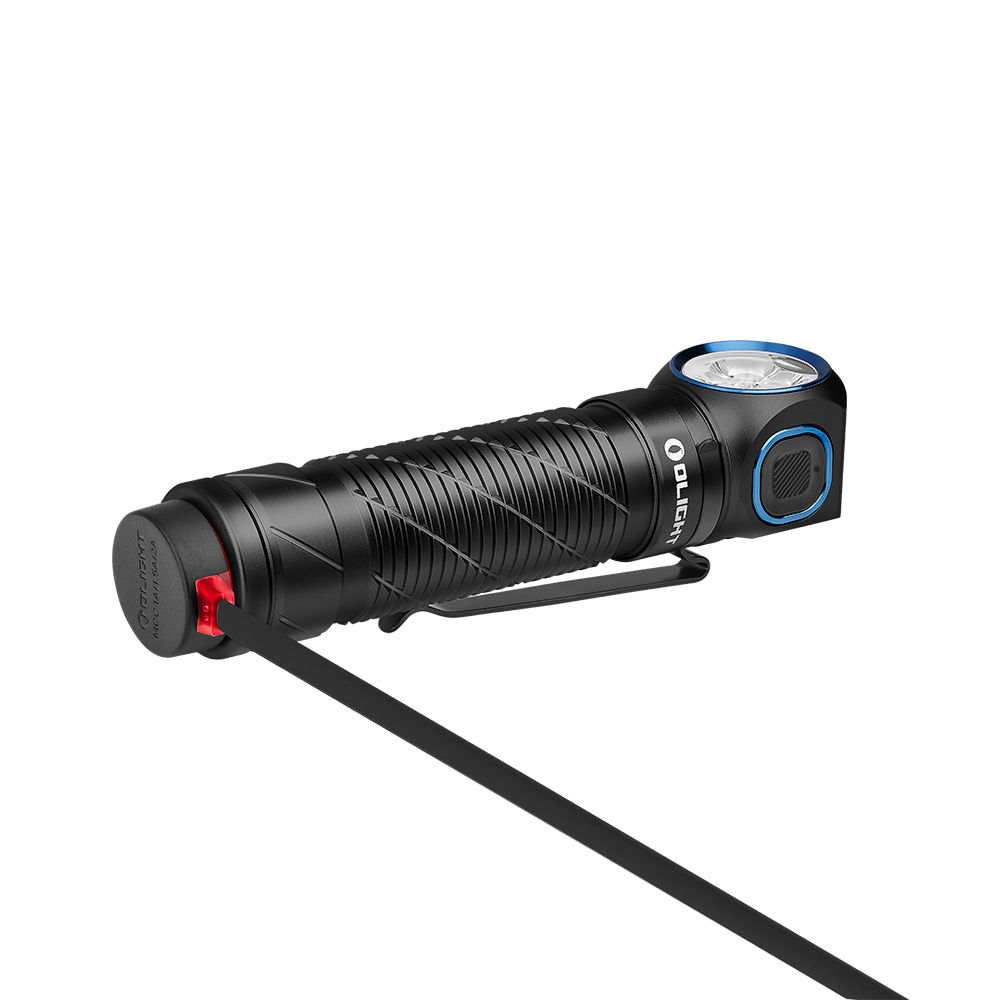
Official Perun 3 magnetic charging connection. Prepare compatible charging equipment before an interruption; do not use a questionable outlet.
Its large concave metal side button is intended for convenient handling and reduced unwanted activation. Button shape is not a lockout instruction or evidence that a light cannot switch on in storage. Learn the exact model's instructions before an outage. Olight also notes that repeatedly removing the light from its metal headband bracket can scratch its body, so keep the intended configuration organized instead of changing it without a reason.
If choosing another headlamp, consider the person and task before the peak specification. Can the adult identify the ordinary setting, keep the beam away from companions, and prepare the correct charging arrangement? A familiar lower working level can be more useful for a phone call and notebook than a maximum-output demonstration that produces glare from a nearby surface.
The Olight Arkfeld Pro, in Black cool white, offers a flat rectangular body, circular selector, and five-level battery indicator. Its shape can suit carrying between an ordinary household route and a separate record area. The charge indication helps an adult prepare before the next call instead of searching for charging equipment while trying to explain the incident.
The Arkfeld Pro combines white light, UV, and a green laser, but only ordinary white illumination serves this task. Neither UV nor a laser point can establish whether a wire is energized, identify the cause of a trip, or measure voltage. Identify the white-light selection using the correct instructions and keep unnecessary emitters out of the situation. Do not point the device at people or animals.
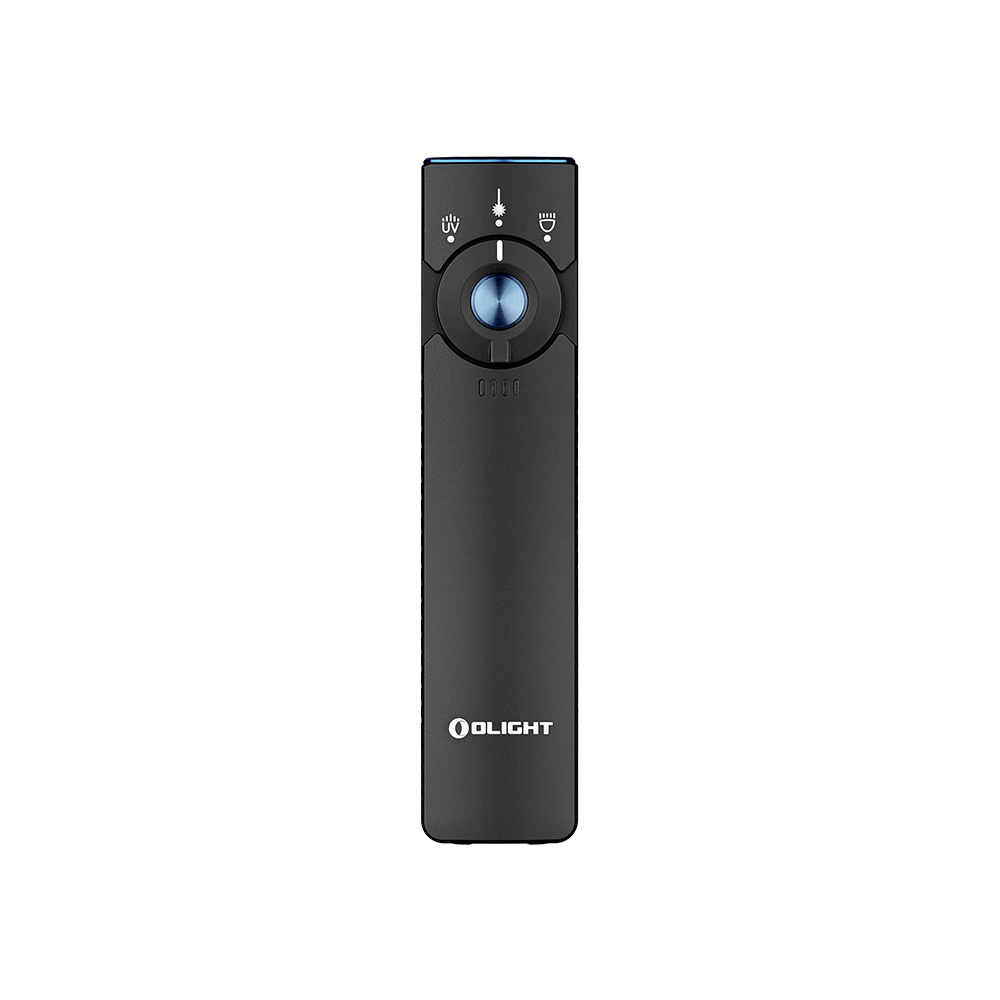
Official Black cool-white Arkfeld Pro control layout. Only ordinary white illumination serves this task; the other emitters are not electrical testers.
Its manufacturer-listed maximum white output is thirteen hundred lumens, supported by a fifteen-hundred-milliamp-hour battery. Those numbers describe output and stored energy, not the duration of a particular household interruption. Select a comfortable reading level and make a charging plan that does not depend on an affected or questionable outlet. Portable lighting should simplify the report rather than add a new uncertainty about equipment.
When comparing an EDC flashlight, consider whether the controls, carrying position, and charge indication are understandable to the adult who will use it. Do not place a light in your mouth to free a hand or rest it on suspect electrical equipment. A separate safe writing surface and a familiar personal light can keep the call organized without turning it into a repair attempt.
Keep other household needs from becoming an afterthought
Someone relying on powered medical equipment may need help before the cause of the outage is settled. Follow the person's established backup and emergency plan and seek urgent assistance when necessary. Do not let a debate about a breaker delay that response. The CDC's power-source preparedness guidance includes emergency lighting and planning for devices that depend on electricity.
Arrange the ordinary household tasks around the information you already have. Keep a phone available for updates, preserve a clear exit route, and communicate changes to the other adults. If the home cannot meet someone's immediate needs, follow appropriate local advice about a suitable alternative location. A partly working room is not a substitute for the person's actual power or care requirements.
Keep children away from the area of concern and explain who will help them move or find necessary items. Avoid sending a child to look for a breaker label, meter reading, or shared-building equipment. A person who needs assistance may also need an adult and a suitable light together; giving that person an unfamiliar device does not automatically create a usable plan.
Do not turn a temporary lighting arrangement into improvised electrical distribution. Running cords through doorways or borrowing a questionable supply from another part of the building creates a different set of problems. If normal power is unavailable for an essential need, use the appropriate prepared backup arrangements or obtain help rather than inventing a connection while the cause remains unknown.
When service returns, report what remains different
A light switching back on is useful information, but it is not a professional assessment of the installation. If unusual brightness, odors, sounds, repeated interruptions, or other concerns remain, report them. Do not interpret a utility's restoration notice as a requirement to resume using equipment that appears damaged or behaves abnormally. Tell the responsible contact exactly what persists.
Update the household record with the restoration time as observed, any remaining symptoms, and the next agreed step. If the exact time is unknown, record the time you discovered service had returned. Keep that distinction with any utility estimate. It can matter when someone later tries to reconstruct the interruption or understand whether a second event occurred.
If professional work is arranged, keep the appointment and findings connected with the original report. Ask who will explain any restrictions and confirm what follow-up is needed. Do not cancel an assessment simply because the fault stopped appearing while you waited, especially if warning signs were reported. Explain that the concern was intermittent and let the responsible professional advise on the next step.
For tenants, tell the property contact what has changed and confirm whether the maintenance request remains open. A brief message that “power is back” can leave important remaining conditions unstated. Include whether all affected areas appear restored and whether any unusual behavior persists, using observations rather than a conclusion that the building's wiring has been cleared.
Prepare a contact sheet before the next interruption
Keep the utility's reporting information, the property's emergency maintenance contact, and the household's relevant backup arrangements where an adult can find them without opening an electrical enclosure. Include the service address and unit number. A phone contact saved under a recognizable name and a simple paper copy can be more useful than relying on an internet search after the connection becomes unreliable.
Learn the portable light's ordinary controls while normal conditions allow. Store its compatible charging equipment with it, and check readiness according to the instructions. Keep the light and paperwork accessible without putting them in front of equipment that requires professional access. The goal is a familiar route to information and help, rather than a home kit organized around investigating hidden electrical parts.
Discuss who will contact the utility and who will notify the property manager or electrician. Those roles can be shared, but each report needs a clear owner. If one person is away, make the backup arrangement understandable. This prevents several people assuming somebody else made the call while the only record is a photograph in an unmonitored group conversation.
Frequently asked questions
Give the next person observations they can use
The most useful outcome is a clear report: where power appears affected, when the change was noticed, whether there are urgent warning signs, and who has been contacted. Keep portable lighting in its ordinary role of helping you move and read safely. Leave electrical access, testing, and diagnosis to the responsible professionals, and keep the household informed until the next step is actually arranged.
Changelog
- November 18, 2026: Product information and buying guidance reviewed.




