


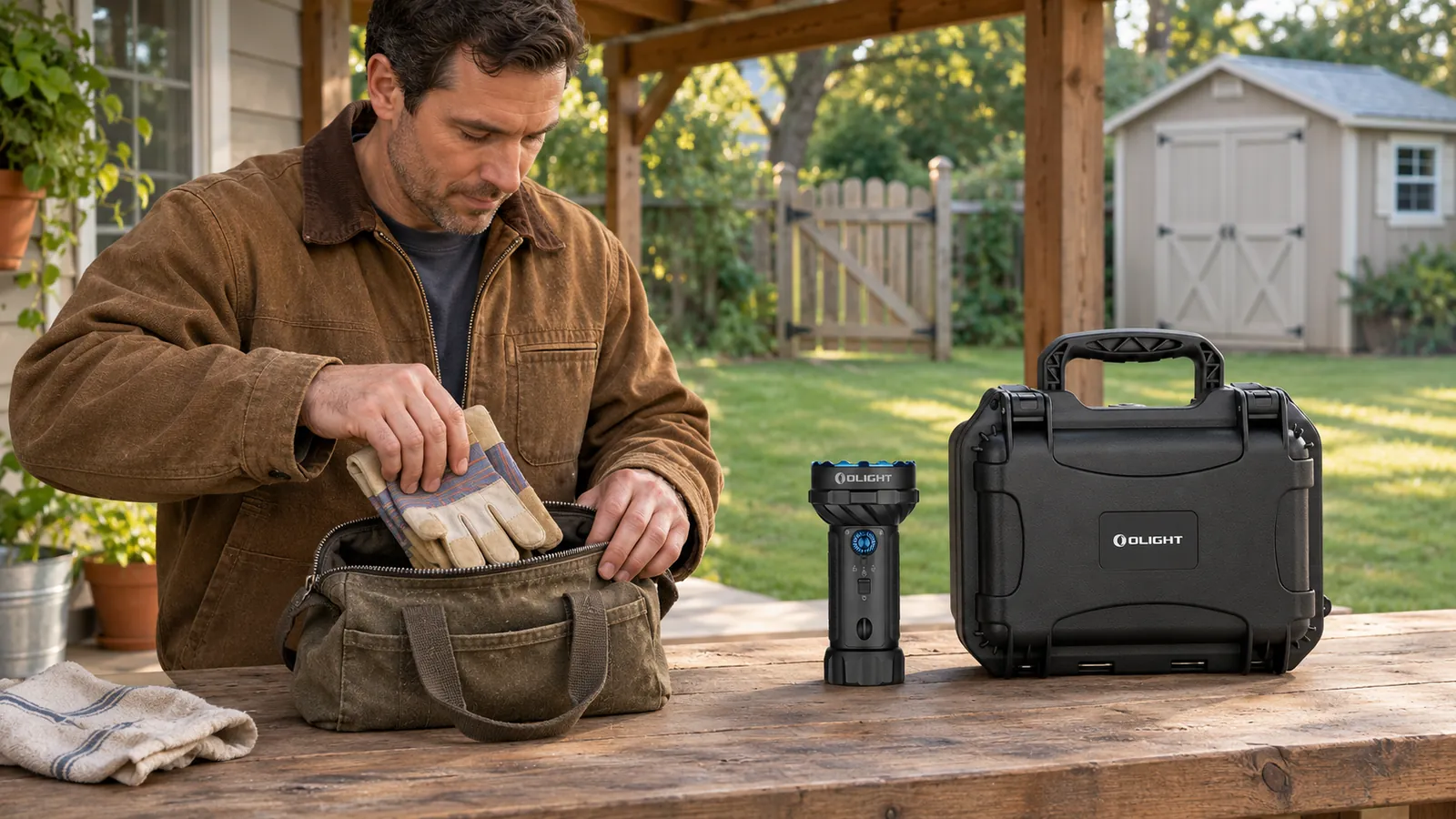
For these three Olight models, the Marauder Mini 2 has the highest published maximum flood output and the longest spotlight reach. The Warrior Ultra has the highest listed impact-resistance height. The Seeker Ultra offers a different balance of working output, rotary adjustment, and carrying weight. Those are separate advantages, not evidence of one universally strongest flashlight.
TL;DR: Define the job before comparing power. Lumens describe light output, candela describes intensity in a direction, and an impact rating describes a different property again. Match the exact mode and duration to the task, then check controls, charging equipment, packed size, and operating limits. A maximum-output claim alone cannot establish a useful view, sustained brightness, or resistance to every kind of damage.
📋 Table of Contents
- 1. Three useful meanings of strongest
- 2. Why the brightest flashlight may not reach farthest
- 3. Maximum output needs a duration beside it
- 4. What a stronger body does and does not establish
- 5. Controls and feedback are part of useful power
- 6. The complete kit changes the buying decision
- 7. Match the specification to the ordinary job
- 8. Check extraordinary claims before paying for them
- 9. Frequently asked questions
Three useful meanings of strongest
Three current product examples make the distinction concrete: the Olight Marauder Mini 2, the olive-green Olight Seeker Ultra, and the Stealth Grey Olight Warrior Ultra. Olight's published specifications answer different purchasing questions. The table below keeps those claims separate and identifies the configuration involved, rather than combining the best number from each row into an imaginary all-purpose specification.
| Olight specification | Marauder Mini 2 | Seeker Ultra | Warrior Ultra |
|---|---|---|---|
| Maximum white output | 10,000 lumens in floodlight | 4,800 lumens | 2,500 lumens |
| Maximum listed beam distance | 750 meters in spotlight | 265 meters | 320 meters |
| Listed impact resistance | 1 meter | 1.5 meters | 2 meters |
| One useful working-mode reference | Floodlight L2-1: 300 lumens, 13 hours, then a reduced stage | Medium: 300 lumens, 12.5 hours | Medium: 200 lumens, 13 hours |
| A practical distinction | Separate lighting configurations | Rotary adjustment and separate status displays | Tubular format with side and tail controls |
These are selected Olight specifications, not a survey establishing the world's most powerful flashlight. The manuals do not all identify the same edition of the performance standard, so the impact numbers should not be treated as results from a single controlled comparative trial. They can help establish what Olight actually states. They cannot supply a missing test protocol or predict which particular accident a light will survive.
For a buyer, “strongest” becomes useful when it is followed by a specific need. Lighting a broad nearby work area, examining an object farther away, and selecting a body for routine carrying are different decisions. Write down which problem is limiting the current light. That short description makes it easier to reject an impressive specification that does not address the reason for buying another flashlight.
A familiar brand-family name is not enough to preserve the comparison. The original Marauder Mini and Marauder Mini 2 are different models; Seeker Ultra and Seeker 4 Pro also have distinct specifications and charging arrangements. Keep the exact model and selected version attached to the figures. This guide concentrates on the three versions above so that the comparison stays tied to identifiable equipment rather than a mixture of generations.
Why the brightest flashlight may not reach farthest
Lumens and candela measure different properties. NIST's explanation of the candela distinguishes luminous intensity in a direction from the total light output described in lumens. A light can distribute substantial output across a broad area, while another directs less total output more intensely into a narrower part of the view. A larger lumen number does not, by itself, establish a longer useful viewing distance.
The Seeker Ultra and Warrior Ultra illustrate that distinction without requiring a homemade conversion. The Seeker Ultra's published maximum is 4,800 lumens with a 265-meter beam distance. The Warrior Ultra lists 2,500 lumens with a 320-meter distance. The lower-output model has the longer listed reach in this pair. That observation does not establish that its beam is better for every nearby task or that every object will be recognizable at that distance.
A broad illuminated area can help when the job involves several nearby objects: locating a latch, distinguishing tools in an open bag, or looking across a stationary work surface. A concentrated beam can place more attention on a narrower area farther away. Consider both the target and its surroundings. A central bright spot does not necessarily provide the peripheral information needed for a close, cluttered task.
Beam-distance figures also need a boundary. They are published performance references, not promises of identifying a person, reading a label, detecting an obstacle, or completing a task at the full stated distance. Weather, surface reflectivity, ambient light, the observer, and the object all affect the view. Do not turn a catalog distance into a guarantee of safe movement or a fixed recognition range.
The Marauder Mini 2 adds a configuration choice within one light. Its maximum floodlight output and maximum spotlight reach belong to different settings. Saying that it provides its full flood output at its maximum spotlight distance would merge specifications that describe different optical jobs. Read the mode name alongside the number. The combined spotlight-and-floodlight configuration has its own output table rather than inheriting both separate maxima.
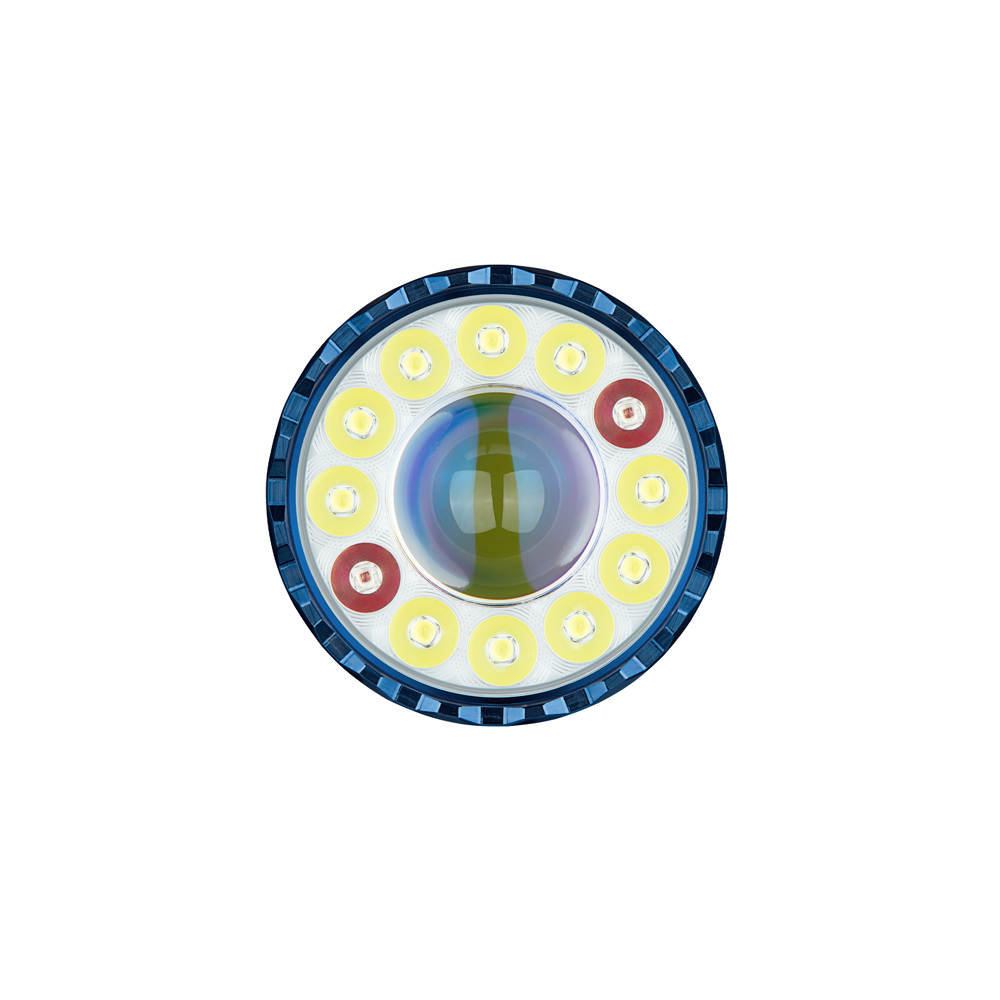
Official Marauder Mini 2 optical-head image. Separate optical elements help identify the different lighting configurations; the image is not a measured beam comparison or proof that maximum flood output and maximum spotlight distance occur together.
Maximum output needs a duration beside it
A maximum-output setting is useful information, but the time attached to it changes what it means. The Marauder Mini 2 floodlight table starts at 10,000 lumens for two minutes, followed by a reduced stage. The Seeker Ultra Turbo row begins at 4,800 lumens for 2.5 minutes before reductions. The Warrior Ultra likewise lists an initial 2,500-lumen Turbo stage lasting 2.5 minutes before lower output stages.
Those initial stages should not be multiplied by the entire listed runtime. A row containing several output stages describes a changing output profile. Adding the durations and presenting the sum as continuous maximum brightness would give a buyer the wrong expectation. Read from left to right, keeping the percentage changes with the corresponding time blocks. The lower mode selected for an ordinary task may be the more relevant comparison.
For a longer stationary task, a working-mode row provides a clearer starting point. The Seeker Ultra manual lists 300 lumens for 12 hours and 30 minutes on Medium. The Warrior Ultra manual lists 200 lumens for 13 hours on Medium. Similar durations do not make the outputs equal, and different outputs do not establish which is adequate for the reader's particular task. Keep both values in a comparison note.
The Marauder Mini 2's floodlight L2-1 row lists 300 lumens for 13 hours followed by three hours at a reduced level. That final stage belongs in the description if the complete duration is discussed. It should not become a claim of sixteen hours at the initial output. This is a useful example of why the small transition marks in a performance table matter as much as the large number printed at the start.
| Runtime question | What to read | A misleading shortcut to avoid |
|---|---|---|
| How bright is the maximum? | The exact Turbo or highest-level starting stage | Applying it to the longest advertised duration |
| How long does the task setting last? | Output and duration in the relevant mode row | Comparing duration without its output |
| Does output change during the row? | Every percentage and time block | Adding all stages and calling them constant brightness |
| Does this predict the actual outing? | Olight's published conditions and product limits | Treating a reference table as a field guarantee |
Olight's tables describe the stated reference conditions. They do not establish identical results with every battery condition, ambient temperature, airflow, or pattern of use. Treat a table as equipment information for planning, not a promise that an indicator will reach empty at a particular moment. Leave the wider activity independent of an assumed maximum-output duration, and keep appropriate backup illumination available.
What a stronger body does and does not establish
A body material, surface treatment, impact rating, and water-resistance rating describe different concerns. A scratch-resistant surface can be relevant to repeated contact with a storage pouch or ordinary equipment. An impact rating concerns another kind of stress. A water-resistance label concerns defined exposure conditions. None of these labels alone describes every component, seal, lens, switch, charging contact, or possible failure of the complete light.
Olight describes the Seeker Ultra's proprietary OAL body in terms of hardness and resistance to wear. The Warrior Ultra page also identifies an O-Aluminum body and resistance to scratches and dings. Those Olight descriptions should not be turned into a general multiplier for the strength of the complete flashlight. A material comparison is not proof that a light will survive twice the fall height or every repeated collision.
The listed impact heights in the opening table are more specific than the word “tough,” but they remain bounded references. The Marauder Mini 2 manual lists one meter, the Seeker Ultra lists one and a half meters, and the Warrior Ultra lists two meters. The manuals' different standard-edition references also limit how confidently those figures can be read as a direct ranking under identical conditions. They are not permission to deliberately drop equipment as a routine readiness check.
For ordinary ownership, consider how damage is likely to occur and whether it can be avoided. A light rolling off a crowded bench, loose equipment rubbing against its lens, or a heavy object pressing against a control presents a different problem from Olight's stated impact condition. A suitable pouch, correct holster, or stable storage position may address the actual carrying problem more directly than choosing solely by the highest impact number.
Check the light after an accidental impact in accordance with its instructions, especially before charging or relying on it for a later task. Visible battery damage, unusual behavior, or a compromised charging connection is not resolved merely because the beam still turns on. A specification printed on the box cannot certify the condition of an individual light after an unknown accident. Replace a broad toughness assumption with an actual condition check.
A damaged individual product and a design rating belong on different lines of a service conversation. Record the model, what happened, and any observed change, then contact Olight Support when inspection or repair is needed. Do not open an assembly or substitute an unapproved battery to prove that the body remains strong. Clear condition information is more useful to support staff than the assumption that a premium material rules out damage.
Controls and feedback are part of useful power
Power that is difficult to select can be inconvenient during a simple task. The Marauder Mini 2 has a lighting-configuration selector and rotary brightness control, with separate information about brightness and remaining battery level. That separation helps the owner distinguish “the light is set low” from “the battery is low.” It also means that learning the interface is part of owning the equipment, especially when more than one configuration is available.
The Seeker Ultra combines a metal rotary side control with separate brightness and battery indications. For someone alternating between a nearby object and a wider stationary work area, finer adjustment can be more useful than repeatedly reaching the maximum. The practical benefit is the ability to select a suitable level after considering the task. The control itself does not measure the illumination falling on the target or confirm that a chosen setting is adequate.
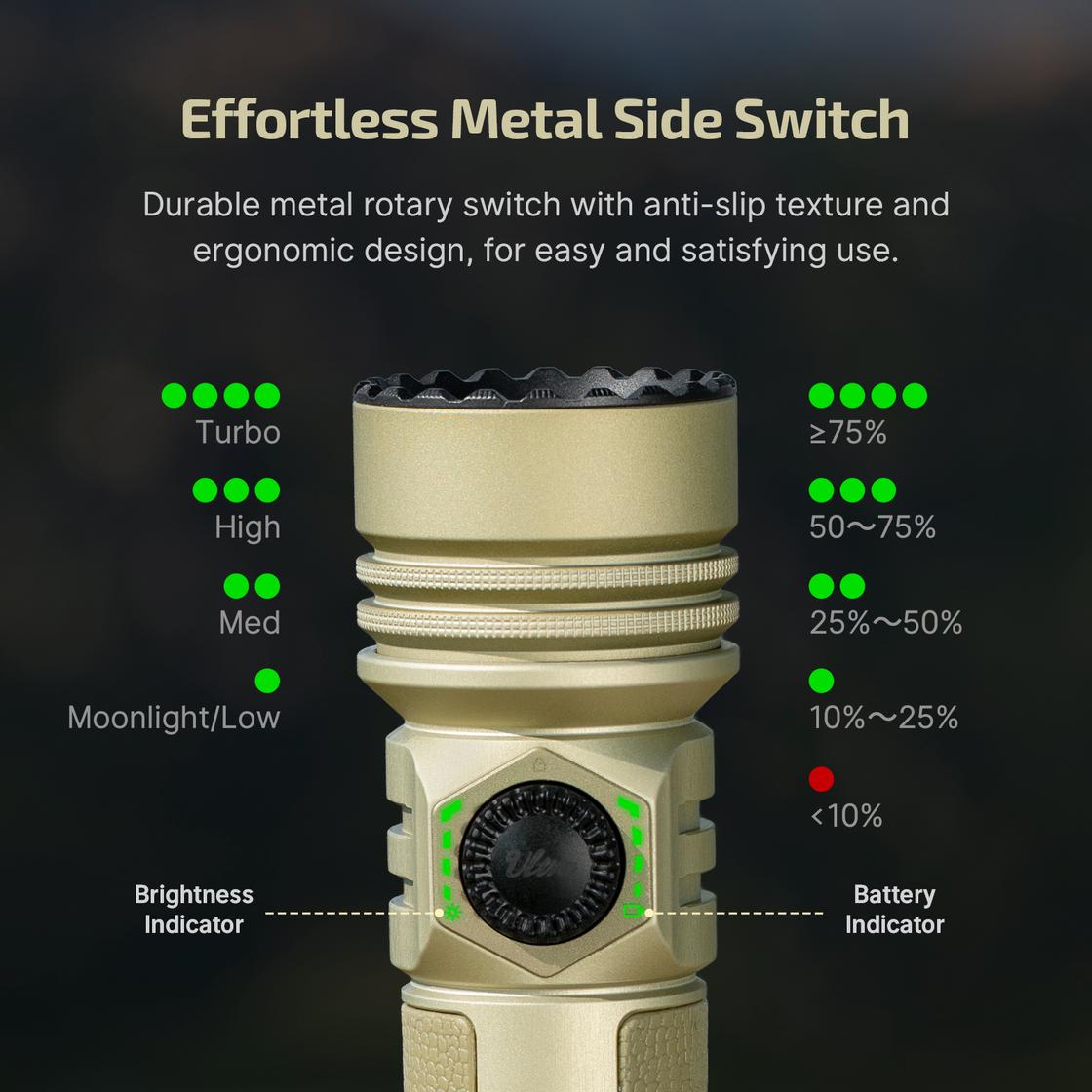
Official Seeker Ultra indicator diagram. Brightness and battery information are separate; the displayed segments are not a countdown of remaining task time. Follow the exact manual for starting states and control sequences.
The Warrior Ultra places controls on the side and tail of its tubular body. That layout offers a different handling choice from a larger rotary-controlled light. Learn which functions belong to each control in the selected configuration from the exact manual. A hand finding a familiar tail button does not establish that its behavior matches another Warrior model or that every press selects the same output.
Evaluate the actual grip and access needed for an ordinary task within product instructions. Consider whether the user can hold the body comfortably, recognize the controls, and read the relevant status information without repeatedly changing grip. Gloves, hand size, and limited dexterity can change that experience. A textured surface or enlarged control is a feature to assess, not a universal promise that every owner will operate the light equally easily.
A lockout feature also belongs in a high-output purchase decision. Correctly preparing a light for storage helps avoid an unintended activation in a packed bag. Follow the model-specific instructions rather than transferring a sequence from a different flashlight. A proximity sensor, where provided, does not replace that preparation or permit leaving an operating lamp against fabric. Keep the distinction between an additional protective feature and a complete safe-storage arrangement.
Indicator visibility also matters when another adult will borrow the equipment. Show that person where the battery information appears and where the correct instructions are kept before handing over a packed light. Do not assume that familiarity with a rotary control or tail switch transfers between products. An understandable handoff can prevent confusion over a deliberately selected low setting, a locked light, or the wrong charging cable without adding any output to the lamp.
The complete kit changes the buying decision
A flashlight is part of a group of items: battery, charging cable, suitable power source, intended carrying arrangement, and any independent backup. Compare the full configuration needed for the task. A product image may show an optional accessory alongside the lamp, while the selected package includes a different set. An attractive lamp price does not establish that all the equipment required for charging or carrying is already included.
The Marauder Mini 2 supports USB-C and magnetic charging, and its supplied lanyard also serves as a USB-C charging cable. The manual identifies the MCC3 magnetic cable as an optional accessory. This can be useful for someone who wants different charging arrangements in different places, but the compatibility and included equipment still need checking. A magnetic tail does not establish that every magnetic charging cable is appropriate.
The Seeker Ultra has USB-C and optional MCC3 charging arrangements too, but its equipment should be read as the Ultra configuration rather than borrowed from the Seeker 4 Pro. Its manual shows its own charging interface, vertical holster, and fixing bracket. Those components affect where the complete kit is stored and how it is kept together. Avoid turning a general family resemblance into a statement that all Seeker models use the same charging arrangement.
The Warrior Ultra manual specifies magnetic charging equipment with a USB-A power-source connection. That is a separate arrangement from assuming that a common USB-C cable plugs directly into the light body. Before choosing a rechargeable flashlight, identify the actual light-side interface, the required cable, and the source-side connection. A drawer full of cables may still lack the one required by a particular model.
Packing size includes the widest part of the head, the body, the holster or case, and the cable. The Marauder Mini 2 product page lists a 43-millimeter body diameter, while its manual lists a 66-millimeter overall diameter. Those figures describe different parts of the same light. A pouch chosen only from the smaller body dimension may not accommodate the complete head. Compare the actual stored profile instead of treating every diameter field as interchangeable.
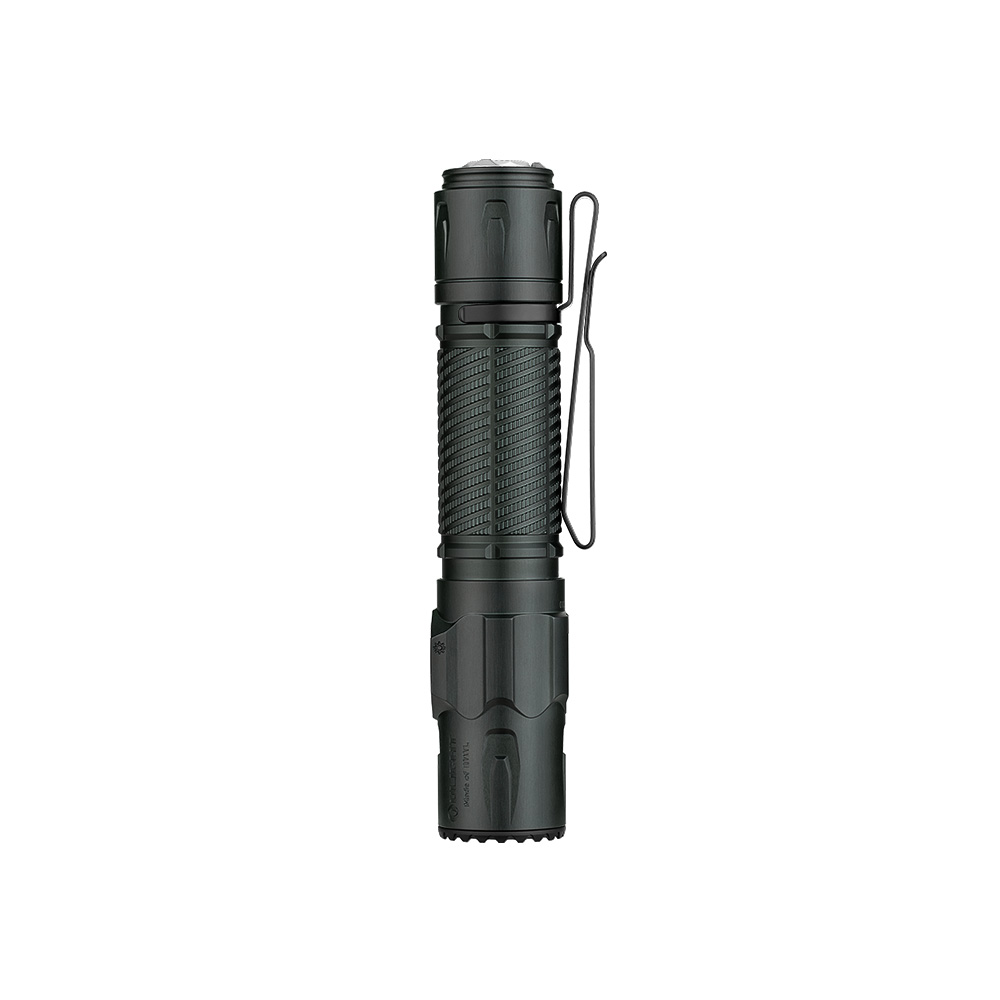
Official selected-SKU Warrior Ultra body view. The clip, textured grip, and tail-control layout help explain its carrying format; appearance alone does not prove impact resistance, wet-hand retention, or suitability for every attachment.
A separate backup remains a separate decision. The National Park Service's illumination guidance recommends hands-free lighting and carrying extra batteries as part of a broader essentials system. A large primary battery or several charging options do not provide illumination when the primary light is unavailable. Choose the backup for its own task and conditions rather than counting a charging cable as another light.
Battery capacity needs its own context in a comparison. A milliamp-hour figure is not an output or runtime rating, and the associated voltage matters when comparing stored energy. Different optical systems, modes, and electronics also affect how stored energy is used. A larger capacity can be a relevant feature without establishing that one flashlight is more efficient than another or will last longer at an equal useful illumination level.
Match the specification to the ordinary job
For a broad stationary work area, compare flood coverage, a useful working level, and whether nearby reflective objects create glare. The Marauder Mini 2's separate floodlight configuration addresses a different optical job from its spotlight. The Seeker Ultra offers another format with rotary adjustment and a published Medium reference. More output may be useful, but a lower level or a different position can be more helpful when the target is close.
For viewing a specific object farther across permitted property, compare the relevant directional performance and the practical view of that object. Keep people, roads, vehicles, and neighbors in mind when placing a beam. A longer listed distance does not authorize aiming at a driver or establish that an unclear object has been identified. If the view is inadequate, treat that as a limit rather than a reason to make unsupported assumptions.
For a light that will be carried frequently between ordinary tasks, assess the body profile, the intended pouch or clip arrangement, and access to the controls. The Warrior Ultra's tubular format offers a different carrying decision from the wider-headed Marauder Mini 2. A compact work bag may favor one arrangement, while a dedicated case may suit another. The choice should reflect how the light actually travels between uses, not just its performance at a single maximum setting.
For extended equipment preparation, do not let a maximum-output contest obscure control and charging convenience. A clear battery indication, the right cable kept with the light, and a comfortable working level can affect whether equipment is ready when needed. A flashlight that fits those routines may be a better purchase than one selected for a number that the actual task rarely requires.
| The buying problem | Put this evidence first | Keep this limitation attached |
|---|---|---|
| Broad nearby coverage | Flood configuration and working-level options | More output can also increase nearby glare |
| A more distant object | Directional intensity and listed beam distance | Distance is not a recognition guarantee |
| Longer stationary work | The relevant mode row and output stages | A published specification is not a trip-specific timer |
| Regular carrying | Full dimensions, grip, clip, holster, and case | Body diameter may omit a wider head |
| Resistance to routine wear | Exact material description and bounded ratings | Hardness is not a whole-product survival multiplier |
| Ready equipment | Correct charging parts, storage instructions, and backup | A cable is not an independent source of light |
A job requiring both hands may call for a different lighting arrangement altogether. A powerful handheld light still occupies a hand unless it is secured using an intended, appropriate support. Do not improvise a moving attachment or rely on an unstable placement simply to keep the highest-output model in the comparison. Decide whether the actual task is handheld viewing or hands-free work before treating any of these body formats as a complete solution.
Check extraordinary claims before paying for them
A very large lumen number on a marketplace listing is a starting point for verification, not sufficient evidence of performance. Find the identifiable manufacturer and exact model. Look for an accessible mode table, the duration attached to the maximum, dimensions, battery information, and a clear description of the test basis. A photograph of several LEDs or a dramatic white wall does not establish the claimed output.
Keep the exact product identity with any report being considered. A measurement of an earlier generation, another LED version, or a modified sample may be informative about that item without establishing the performance of the retail configuration being purchased. Check the battery and mode as well as the model name. This prevents a credible piece of information from being applied to the wrong product merely because two housings look similar.
A useful report explains its method and the equipment actually evaluated. It distinguishes total output from a reading at one point and keeps exposure settings with any comparative beam photographs. An unlabeled photograph cannot establish a lumen measurement, and a bright-looking camera image may be affected by automatic exposure. Do not reverse-engineer a precise performance claim from how impressive a promotional image appears on a screen.
Likewise, an alloy name, a military-style appearance, or an association with professional users does not establish a universal strength ranking. The relevant evidence is the product's stated properties and the conditions under which they apply. For an ordinary buyer, the useful question is whether the light's documented capabilities solve a real task. A claimed association does not replace output, duration, configuration, or safety information.
High-output lights also need deliberate handling. Follow the exact product warnings about hot surfaces, direct eye exposure, nearby materials, batteries, and charging. Do not point a beam at people or drivers to demonstrate how powerful it is. Keep a stored light prepared according to its instructions. If the equipment becomes damaged or behaves abnormally, stop treating a large specification as proof that it remains safe to use.
Compare the total purchase only after the required capabilities are clear. Include necessary carrying equipment, the approved charging arrangement, and a suitable independent backup where the activity requires one. A discount on the lamp body can be useful, but it cannot correct an unsuitable mode, missing interface, or unresolved operating limit. An accessory bundle has value when its contents solve an actual need, rather than simply increasing the number of items in the box.
The strongest purchase is a complete, understandable lighting arrangement for the intended job. Keep the exact version, relevant mode, duration, carrying format, required accessories, and unresolved limitations together in a short comparison note. This turns a vague search for maximum power into a decision that can be checked. It also makes it easier to recognize when a different configuration, a smaller light, or an independent backup would provide more useful value.
Frequently asked questions
Changelog
- November 18, 2026: Product information and buying guidance reviewed.




