


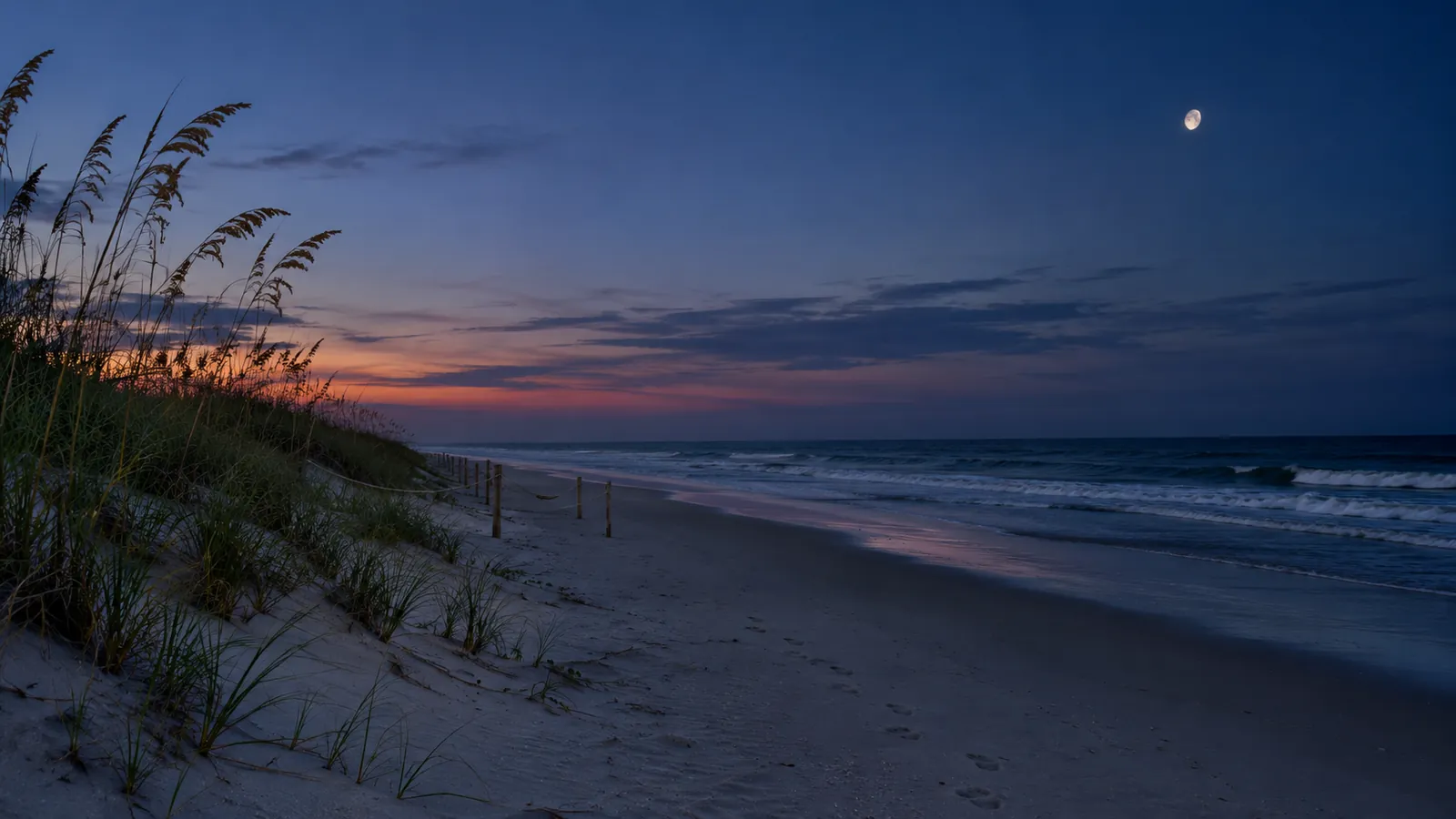
TL;DR: The search “why flashlights on beach at night” has no universal answer: rules depend on the exact beach, season, and activity. Artificial light can disturb sea turtles, so check local signs and current rules before going. A red beam does not automatically make its use lawful or harmless.
| Question | Practical answer |
|---|---|
| Are flashlights banned on every beach? | Rules differ by place, season, and activity; read the current local instructions. |
| Is a red flashlight always turtle-safe? | No. Color alone does not establish compliance or eliminate disturbance. |
| What should you check first? | Current beach signs, the managing agency, local code, and nesting-season notices. |
| What if you see a turtle or hatchling? | Turn off lights and screens, keep your distance, and do not touch, guide, or photograph it. |
📋 Table of Contents
- 1. Why the rules depend on the beach
- 2. What artificial light can do to sea turtles
- 3. Fixed beachfront lighting and handheld flashlights are different
- 4. Why red light is not a universal pass
- 5. Where to check the actual rule
- 6. A low-impact plan for an evening beach visit
- 7. If you encounter a turtle or hatchling
- 8. What are people looking for on the beach at night with flashlights?
- 9. Why use a red light on the beach at night?
- 10. What are people looking for with flashlights on Myrtle Beach?
- 11. Common misconceptions about beach flashlights
- 12. Frequently Asked Questions
- 13. A better question than “Which color can I use?”
Why the rules depend on the beach
The search “why flashlights on beach at night” does not have one answer for every shoreline. Some communities restrict lighting during a defined nesting season or on designated beaches; others regulate fixtures visible from the sand, while a park or refuge may set its own access and wildlife rules. The exact beach, date, and posted instructions matter more than a general claim that “flashlights are banned.”
That distinction matters because a handheld beam and a beachfront building light are not always covered by the same rule. A local ordinance may focus on property fixtures and light visible from the nesting beach. A park notice may address visitors carrying lights. A sign may close a stretch of sand at certain hours. One source cannot answer all three questions for every town.
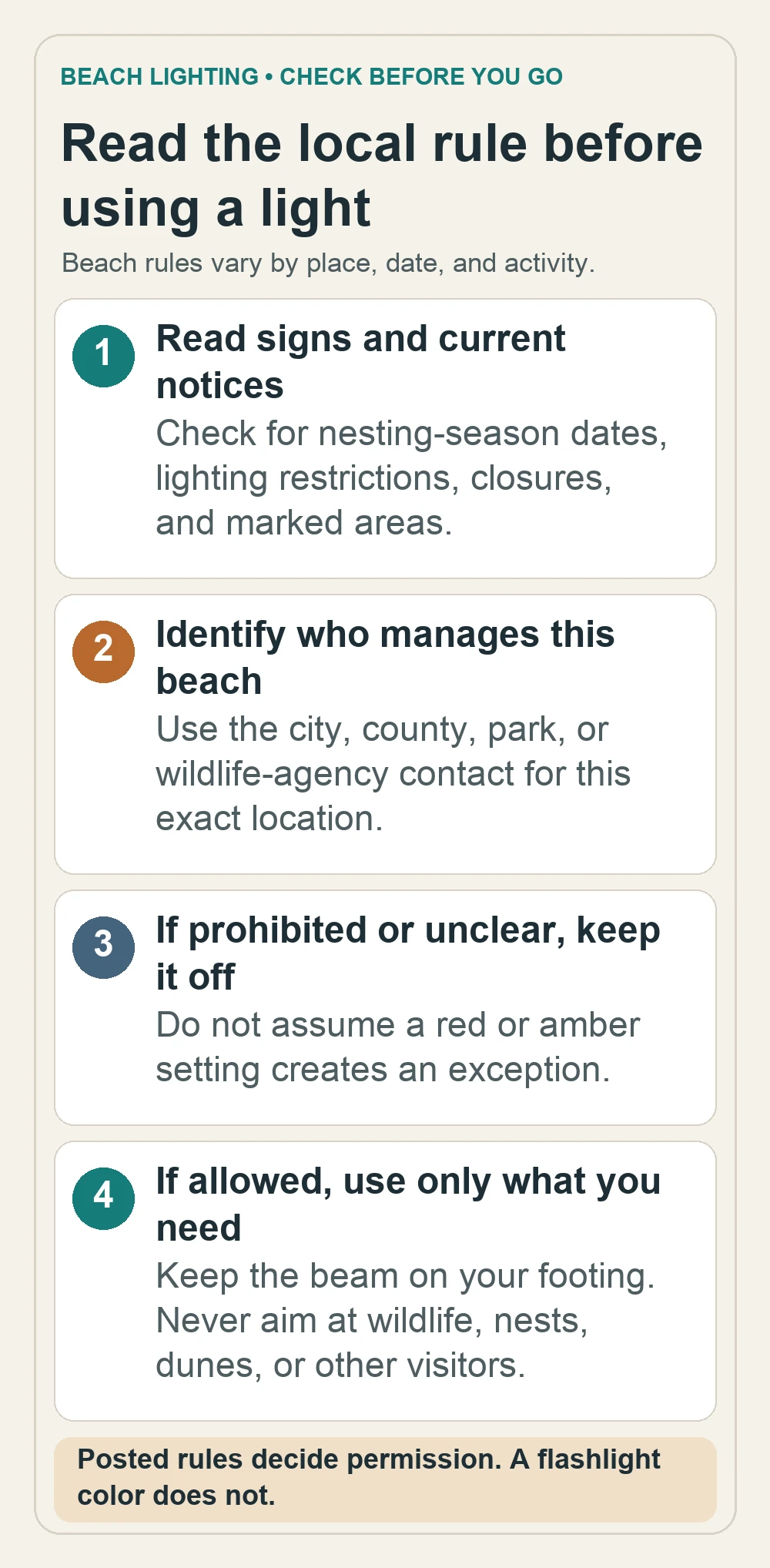
The safest useful habit is to identify who manages the beach before sunset. Look at entrance signs and the official city, county, state wildlife agency, park, or refuge page. Search the exact place name with terms such as “sea turtle lighting ordinance,” “beach access,” and “nesting season.” If an official rule is not clear, call the listed authority or follow the stricter posted instruction. Do not treat a visitor forum, product label, or an old social post as legal advice.
South Carolina’s Department of Natural Resources tells visitors not to approach hatchlings, shine lights on them, or use flash photography. That is state-specific encounter guidance, not a blanket rule for every beach in Florida, Texas, or Hawaiʻi. Read the exact beach notice and local code in addition to the wildlife agency’s advice. South Carolina DNR’s hatchling encounter guidance is a useful state-specific example.
What artificial light can do to sea turtles
Sea turtles use natural night cues during nesting and hatchling movement. Artificial light can alter what is visible from the beach, contribute to disorientation, or draw animals away from the route they would otherwise follow. South Carolina DNR explains that hatchlings may move toward artificial light rather than the ocean and tells visitors not to shine lights on them. Florida’s model ordinance addresses beachfront lighting in nesting areas, including controls on fixed fixtures and visible light from buildings.
These explanations support a practical conclusion: nighttime light near a nesting beach is not merely a matter of whether a person can see the sand. It can add a competing visual cue in an environment where darkness is part of the habitat. A beam aimed at an animal is especially intrusive, but light visible from a broader area can matter too. The ecological effect depends on the location, the source, and the circumstances; it is not accurately reduced to “white is bad, red is harmless.”
A hatchling is not a tiny adult responding to a flashlight in a predictable way. It is a wild animal moving through a vulnerable stage, and a person with a phone or light cannot reliably tell whether a nest is nearby, whether an emergence is underway, or which direction the animal should take. The appropriate response is not to test a theory by switching colors or moving closer. It is to stop adding light and give the animal space.
The same restraint applies to adult turtles. If one is crawling toward or from the water, do not approach, surround it, block its path, touch it, or use a camera flash. South Carolina DNR advises observers to keep their distance and avoid lighting or flash photography. Hawaiʻi guidance from the U.S. Fish and Wildlife Service similarly says to avoid bright lights near sea turtles and not to touch, feed, or chase them. Rules and reporting contacts differ by state, so use the local wildlife authority’s instructions rather than improvising a rescue. See the federal Hawaiʻi sea turtle guidance for that jurisdiction.
Fixed beachfront lighting and handheld flashlights are different
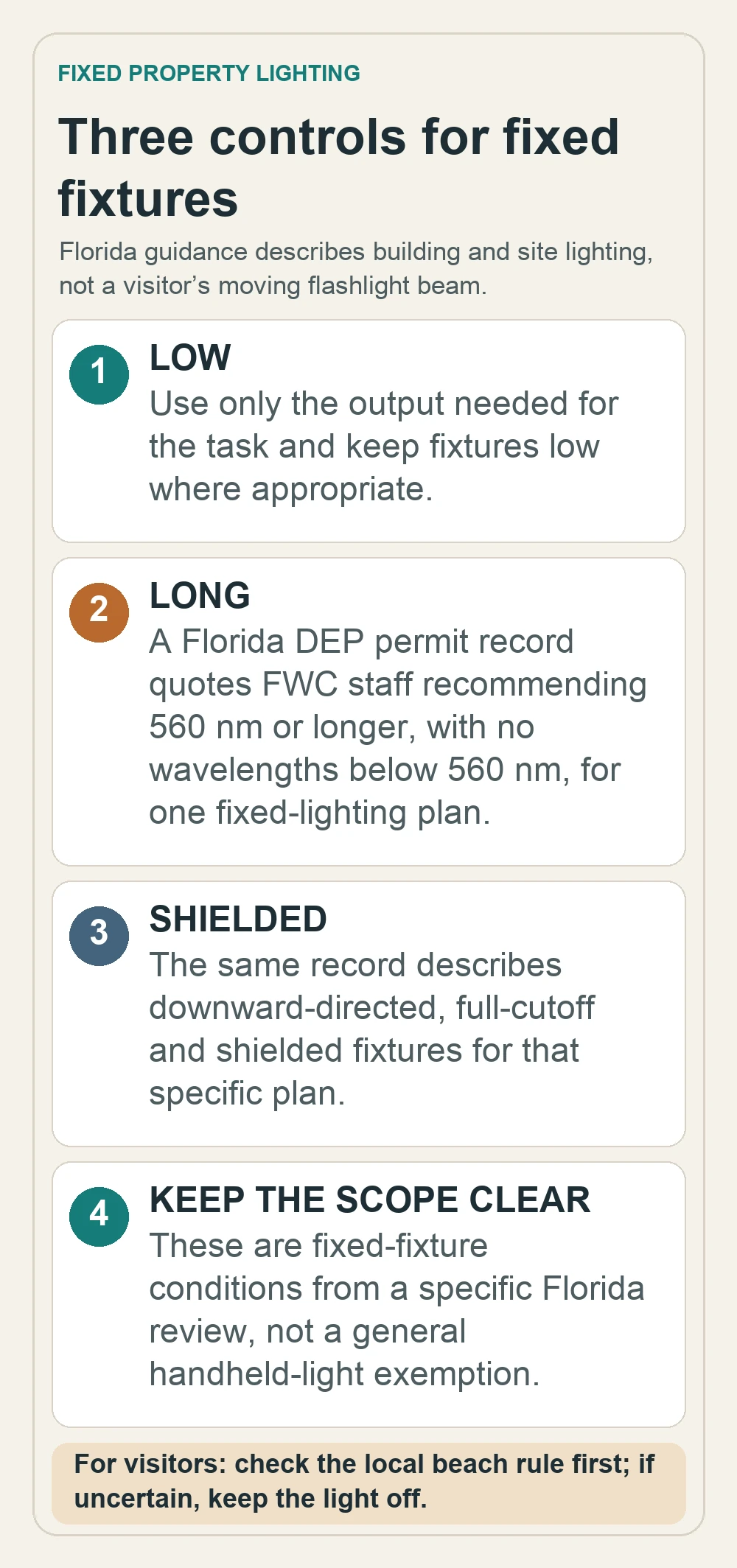
The phrase “turtle-friendly lighting” is often used for fixtures on homes, hotels, walkways, and other properties. Florida’s model sea-turtle lighting ordinance describes controls for fixed fixtures, including long-wavelength light, downward direction, full cutoff, and shielding. In a Florida DEP permit record, FWC staff also recommended that a specific exterior-lighting plan use full-cutoff, downward-directed fixtures and long-wavelength sources at 560 nm or higher, with no wavelengths below 560 nm. That documented fixture guidance does not approve a handheld flashlight marketed as red or amber.
A fixed fixture can be positioned, shielded, and assessed as part of a building or site. A handheld flashlight moves with its user. It can point toward the sand, dunes, a nest marker, a turtle, a home, or another visitor in seconds. Even a spectrum selected for a fixed outdoor fixture may not satisfy a local ordinance when used in a different way. Florida’s model ordinance addresses fixed beachfront lighting, not moving beams carried by visitors.
The three controls are still useful concepts for understanding why a community may restrict lighting, but they should not be converted into a personal-use loophole:
| Concept | What it means for fixed fixtures | What a beach visitor should not infer |
|---|---|---|
| Low | Mount the fixture as low as the task permits and use only necessary output. | A low flashlight setting is not automatically allowed. |
| Long wavelength | In one Florida coastal permit record, FWC staff recommended sources at 560 nm or higher with no wavelengths below 560 nm for fixed fixtures. | A red-looking beam or a red mode is not proof of a compliant spectrum. |
| Shielded | Direct light down and keep the glowing source from being visible from the beach. | Pointing a moving beam down does not override posted restrictions. |
For property owners, consult the local ordinance and the wildlife agency’s approved fixture criteria before replacing a bulb or installing a shield. Florida DEP lists Rule 62B-55 as a model ordinance that gives local governments guidelines for controlling beachfront lighting to protect hatching sea turtles. It is a starting point for checking Florida rules, not proof that every town adopted the same provisions. Florida DEP’s coastal rules and statutes identifies the model rule and its local-government scope.
Why red light is not a universal pass
A common question is whether a red flashlight is safe for turtles. A careful answer is that some long-wavelength lighting can be less disruptive in particular wildlife-lighting applications, but that does not make every red flashlight harmless, legal, or suitable for every beach. Light output, wavelength distribution, shielding, direction, distance, duration, season, and local rules all affect the decision. A product’s red mode alone does not tell you whether a given beach allows it.
The distinction between appearance and spectrum is important. “Red” as a visual label is not a full spectral specification. A Florida DEP permit record documents FWC staff’s recommendation for a particular exterior-lighting plan: long-wavelength sources at 560 nm or higher with no readings below that wavelength, paired with full-cutoff shielding and downward direction. This is a specific fixed-fixture review, not a certification of every portable lamp or phone setting.
Even a light that meets a technical criterion can still conflict with a beach rule or disturb wildlife if it is aimed at an animal or used in a closed area. South Carolina DNR’s public instruction for hatchlings is clear: do not shine any light on them, regardless of color. When the beach is posted “no lights,” do not reinterpret it as “red is fine.” When the sign or ordinance is ambiguous, contact the local manager or keep the light off. A Florida DEP permit record quoting FWC staff guidance shows those conditions together for a specific fixed-lighting plan; it does not grant handheld-use permission.
This is also why buying a new light is rarely the first answer to a turtle-lighting question. The first step is to learn whether light is allowed at that location and time. If an official authority specifically recommends a type of permitted light for a defined purpose, follow that authority’s exact conditions. Avoid inferring that a product feature, a review, or a general wildlife-friendly label settles local compliance.
Where to check the actual rule
Start at the beach, not with a broad internet search. Signs at parking areas, boardwalks, and access points may identify a seasonal closure, a marked nesting area, restricted hours, or a no-light instruction. Photograph the sign in daylight for your own reference, then open the official page named on it. If the sign appears old or unclear, ask the managing office before the visit rather than relying on assumptions after dark.
Next, determine the jurisdiction. The beach may be managed by a city, county, state agency, federal park or refuge, or a combination of them. A county ordinance can apply outside a city boundary; a state wildlife rule can coexist with local fixture rules; a federal refuge can have site-specific visitor restrictions. The most useful query combines the exact beach or municipality with “sea turtle lighting,” “beach rules,” or “night access.”
| Source to check | What it can answer | What it does not automatically answer |
|---|---|---|
| Entrance sign or posted closure | Current conditions at that access or protected section. | Rules for another beach or another season. |
| City or county code | Local restrictions, dates, enforcement authority, and covered activities. | A statewide rule unless the code says so. |
| State wildlife agency | Nesting guidance, wildlife protections, lighting criteria, or official reporting contacts. | Every city’s current ordinance. |
| Park, refuge, or beach manager | Site access, closures, and local visitor instructions. | Whether a different agency’s property has the same rule. |
Florida is a useful example of why this check matters. Florida DEP lists Rule 62B-55 as a model lighting ordinance that identifies coastal areas used or likely to be used for nesting and gives local governments guidance for regulating beachfront lighting. That framework does not mean every Florida town adopted the same provision, and it does not establish a statewide ban on every handheld flashlight. Read the local rule that applies to the exact beach and activity.
For South Carolina, use the state wildlife agency’s encounter instructions and the site-specific beach signs. Myrtle Beach visitors should check the City of Myrtle Beach’s official beach and boating regulations. The current city rules include beach-use provisions, but the cited page does not state that a handheld flashlight is universally permitted near turtles. If the question concerns surf fishing, the city page says a valid South Carolina surf-fishing license is required; that is a fishing rule, not a night-light authorization. Myrtle Beach Police Department’s beach regulations are the relevant local reference for that distinction.
Avoid relying on a fine amount copied from an old article. Penalties can depend on the exact ordinance, whether it covers a property fixture or visitor behavior, the season, the protected species, and the enforcement provision. Read the current code itself or ask the relevant agency. If you cannot verify the rule in time, choose a different activity or return in daylight.
Myrtle Beach illustrates why the exact page matters. The city’s published rules include Sec. 5-19, which prohibits sleeping on public beaches between 9 p.m. and 8 a.m., and Sec. 5-14(3), which prohibits leaving certain beach equipment there overnight from 7 p.m. to 8 a.m. The same page describes surf-fishing license requirements. Those are rules about specific activities; they should not be stretched into an answer about every portable light or another town’s beach. Check the current rules for the place where you will actually enter the sand.
Before calling an office, write down the access name, municipality, date, and the activity you plan to do. Ask one narrow question: “Are visitors allowed to carry and use a handheld flashlight at this access tonight, and are there nesting-season or wildlife restrictions?” If the answer distinguishes a fixed building light from a handheld beam, repeat the activity back to confirm you understood. Ask where the rule is posted or which code section applies. That short exchange is more useful than searching for a generic “turtle-safe flashlight” label, because the authority can answer for the place it manages.
A beach can also sit near a municipal boundary or within a separate park, refuge, or state-managed property. A city code may apply to its public beach while a neighboring access has a different manager. Use the sign at the exact entrance to identify the authority, then confirm the boundary if the signs or maps disagree. When the manager cannot be identified quickly, choose the conservative option: do not use the light there, stay out of closed or marked areas, and return in daylight.
A low-impact plan for an evening beach visit
A little planning reduces the chance of needing a flashlight in the first place. Check the sunset time, tide and weather from official sources relevant to the beach, confirm the access hours, and decide where the group will meet before it gets dark. Pack reflective or light-colored clothing for walking near roads where permitted; do not use this as a reason to enter a closed beach or illuminate wildlife. Keep children close enough to guide without sweeping a beam across the sand.
Set a simple group rule before leaving the parking area: no one points a light toward the dunes, marked nests, waterline wildlife, homes, or other visitors. Keep phones dim and avoid flash photography. A phone screen can also add light, so lowering brightness is not a substitute for an explicit no-light rule. If a person needs a light for a genuine safety issue, follow the beach authority’s instructions and use it only for the immediate task, aimed away from wildlife. Where rules prohibit use, do not switch it on.
Choose a route with stable public access and walk at a pace that lets everyone see footing without repeatedly scanning the beach. Sand changes, shells, holes, driftwood, and wet patches can make a path uneven. A beam swept across the horizon may feel helpful, but it also sends light farther than needed and can disturb other people. If visibility is poor, pause at the access point, use a permitted route, or turn back. The beach will still be there tomorrow; a twisted ankle and a wildlife encounter are poor souvenirs.
Leave the shoreline as you found it. Remove food wrappers, fishing line, tackle, and other gear. Do not dig into marked areas, move nesting barriers, or leave holes and beach equipment overnight. If a turtle or hatchling appears, stop and create distance rather than gathering a crowd. The next section gives a simple response that does not depend on identifying the species or guessing the right light color.
If you encounter a turtle or hatchling
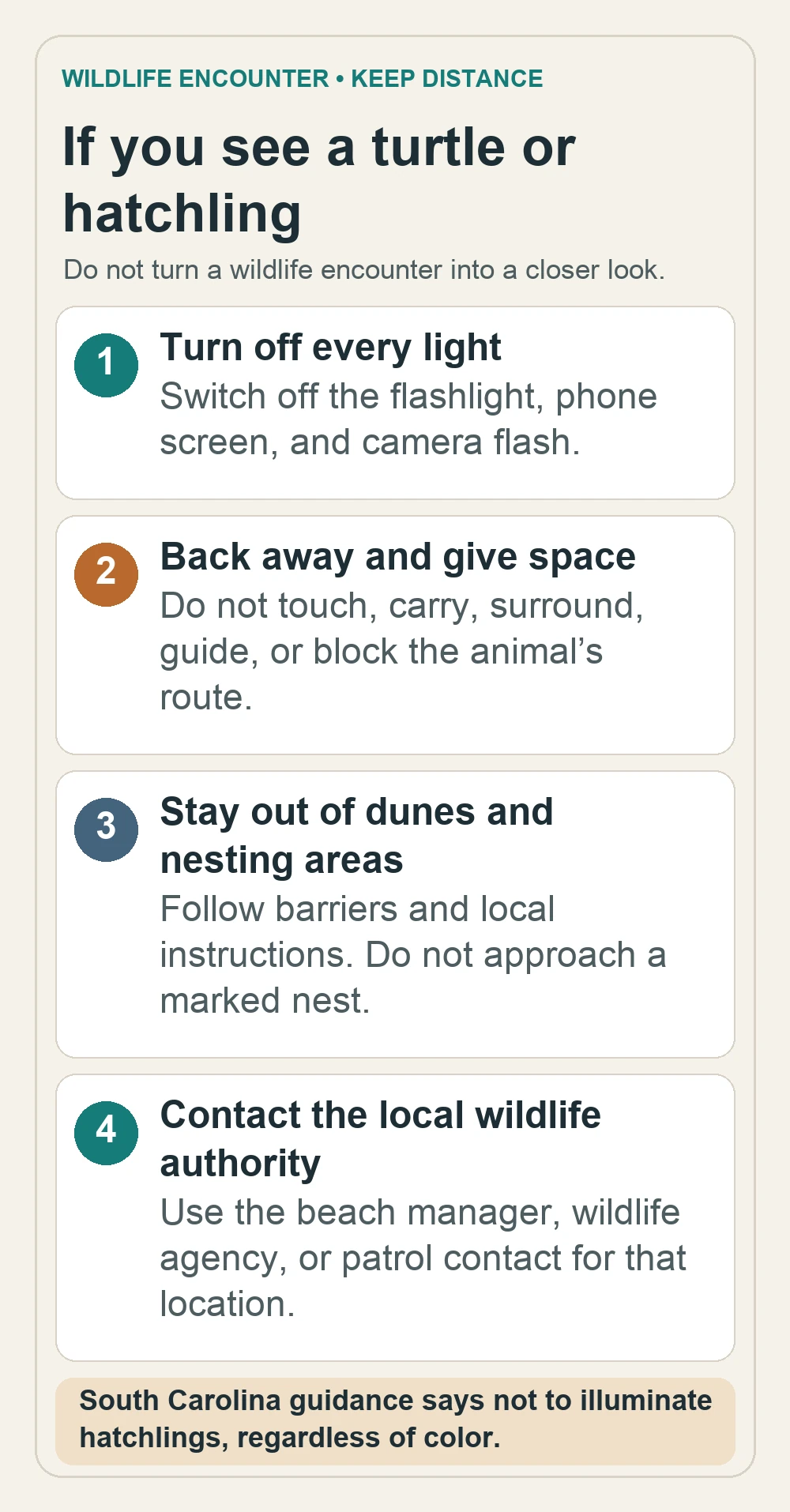
Turn off the flashlight, phone screen, and camera flash. Move back slowly and do not approach, touch, pick up, feed, chase, guide, block, or surround the animal. Keep pets and other visitors away without creating a commotion. Stay off dunes and marked nest areas. Do not place an object beside the animal to make a photograph look more dramatic.
If hatchlings are moving, do not carry them to the water or try to correct their direction. Their natural route can be difficult to see, and the state agency’s instructions may prohibit interference. South Carolina DNR says not to disturb hatchlings, not to stand or sit on dunes, and not to shine any light on them regardless of color. Those rules are specific to its guidance and jurisdiction; elsewhere, follow the local wildlife agency or park manager.
If a turtle is injured, trapped, or in immediate danger, use the local wildlife response number or beach patrol contact. Do not attempt to handle it while waiting. Provide a clear location, nearest public access, and what you observed. Keep the area quiet and dark as instructed. Do not post a precise nest location publicly; sharing it can attract unwanted attention and increase disturbance.
What are people looking for on the beach at night with flashlights?
Usually, a person carrying a flashlight is trying to see footing, find an item, walk along the waterline, or perform an activity such as permitted surf fishing. The question does not identify a single official attraction or explain why a particular beach allows lights. On a nesting beach, the relevant issue is whether the light is permitted and whether it could disturb wildlife. Check local rules first; never aim it at a turtle, nest, or hatchling.
Why use a red light on the beach at night?
Some wildlife-lighting programs specify long-wavelength sources for certain fixtures, but a red setting is not a universal permission slip. A Florida DEP permit record documents FWC staff’s wavelength and shielding recommendation for a specific fixed-lighting plan, while South Carolina DNR tells visitors not to shine any light on hatchlings regardless of color. Follow the exact rule for the beach you are visiting; if it prohibits lights, keep a red light off too.
What are people looking for with flashlights on Myrtle Beach?
Visitors may use a light to see the sand, walk, locate belongings, or fish where permitted; the City of Myrtle Beach says surf fishing requires a valid South Carolina license. That does not establish that every beach access allows nighttime flashlight use, especially near nesting turtles. Check current signs and city rules for the exact location, avoid dunes and wildlife, and never shine a beam at a turtle or hatchling. For a visitor, the most ordinary purpose is seeing the ground or finding a belonging; anglers may also need to manage gear where fishing is allowed. The official city-rules page confirms the license requirement but does not say that the license grants permission to use a flashlight near wildlife. Search the exact access and ask its manager rather than treating “Myrtle Beach” as one rule for the entire coast.
Common misconceptions about beach flashlights
| Misconception | More accurate explanation | Practical basis |
|---|---|---|
| “Flashlights are banned on every beach.” | Rules differ by jurisdiction, beach manager, season, and activity. | Official local codes and posted signs define the applicable rule. |
| “Red means turtle-safe.” | Red appearance alone does not establish wavelength, shielding, permission, or harmless use. | Florida’s permit record describes fixed-fixture conditions; SCDNR says not to light hatchlings at all. |
| “A quick phone photo cannot matter.” | Flash and screens add artificial light near a vulnerable animal. | State wildlife guidance says not to use flash photography or shine lights on turtles. |
| “A fixed-light guideline approves a handheld flashlight.” | Building fixtures and moving portable beams are different use cases. | Fixture criteria include mounting and shielding conditions. |
| “If no sign mentions turtles, any activity is allowed.” | Other access rules, seasonal restrictions, or wildlife protections may apply. | Check the managing authority and local code, not one sign alone. |
A few small choices can make the visit easier for everyone: check the rule before sunset, plan a route, keep the group together, and treat darkness as part of the habitat rather than an inconvenience to defeat. Where a light is allowed, use only what is required for the task and point it at the ground in front of you. Where it is not allowed or the rule is uncertain, put it away.
For a separate, permitted campsite away from a nesting beach, a camping lantern serves shared-area lighting, while Olight’s headlamps keep light with the person moving around camp. These are different off-beach needs; neither category changes the rules at a turtle beach.
Frequently Asked Questions
A better question than “Which color can I use?”
Start with “What does this exact beach allow tonight?” That question gets to the decision that matters: the local authority, the season, the access point, and the protected area. Once those conditions are clear, follow them without stretching a fixture guideline into a personal exception. If the beach says no lights, every color stays off. If the rules permit a light, keep it brief, low, and aimed only at the ground needed for safe movement.
The goal is not to make a nighttime walk complicated. It is to arrive informed, avoid disturbing wildlife, and leave the beach in good shape for the next visitor and the next hatchling. Local guidance is the right source for local rules; a general article can explain the reasoning, but it cannot replace the sign at the access point or the ordinance in force that night.
Changelog
- November 19, 2026: Product information and buying guidance reviewed.




