


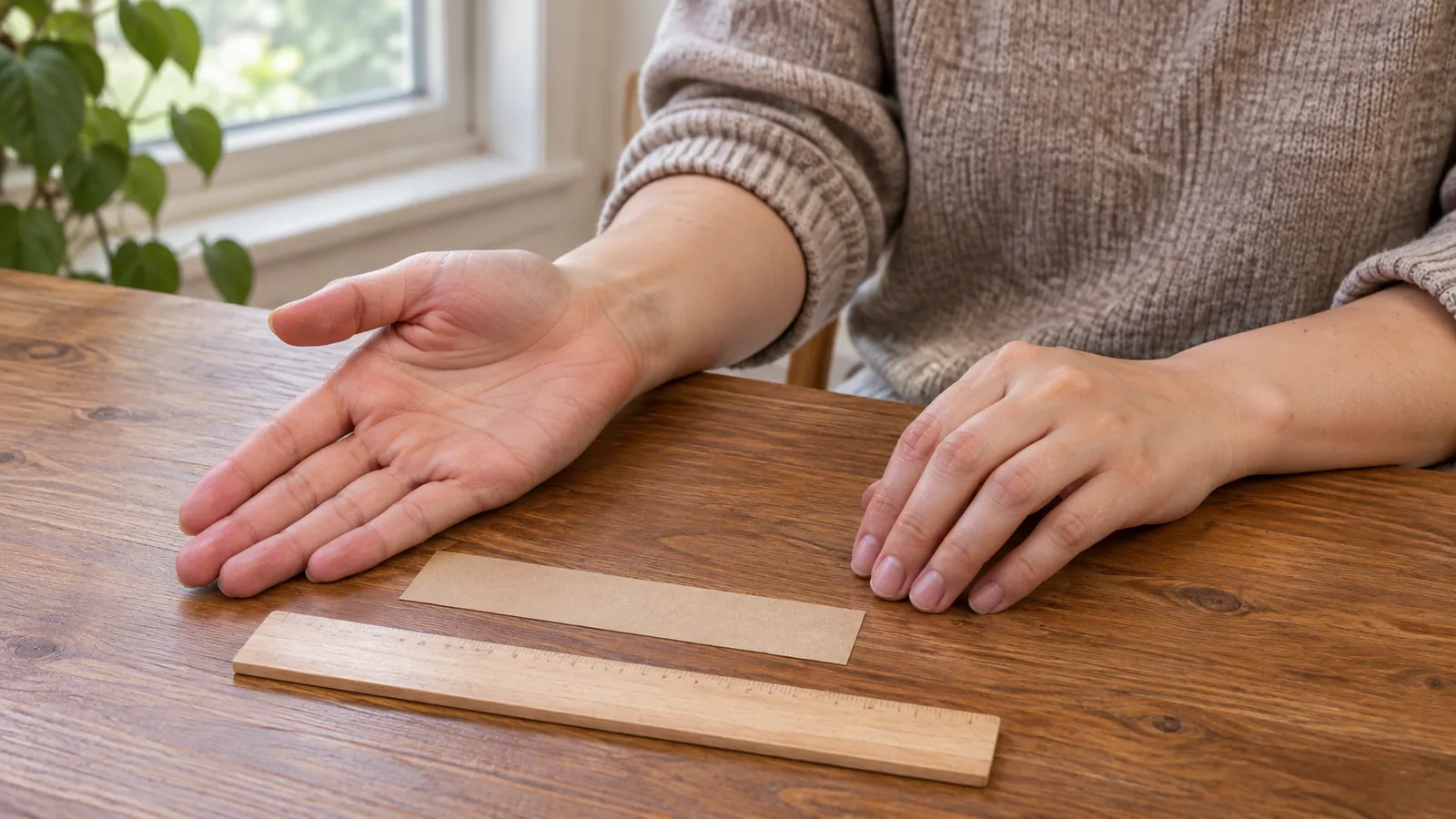
TL;DR: Start with a flashlight or ordinary handle you already hold comfortably. Compare the new light's grip width, usable length, and control location with that reference. Check the exact model and return terms before ordering. If the seller allows an indoor trial, use the light for one ordinary task before committing to it.
📋 Table of Contents
- 1. Start with the light you already reach for
- 2. How do you choose a flashlight for small hands?
- 3. Read the dimensions for the part you will hold
- 4. Is a smaller flashlight always easier to hold?
- 5. Is a twist or push-button flashlight easier to use?
- 6. Compare two examples with different grips
- 7. Read the return terms before ordering
- 8. Try one regular job before deciding
- 9. Frequently Asked Questions
Start with the light you already reach for
| What you want to improve | What to check before buying |
|---|---|
| The light sticks too far out of your hand | Compare body length around the part you actually grasp |
| Your thumb slides off the control | Compare where the control sits relative to the contact area |
| The light is small but disappears into your grip | Check pickup and storage with your usual carry items |
| You need both hands to turn it on | Check the action the control requires, then plan around the actual task |
Bring to mind the last time you wanted a light. Maybe you were reading a plug label beneath a desk or looking for a dropped earring in the entryway. Which hand did the light go into, and could you hold it at the height you needed? The answer is a better starting point than a product category called mini. A short barrel and a control you can't reach comfortably can make an ordinary job awkward.
If you already own a flashlight you like, set it on the table next to one you find awkward. Use a tape measure or ruler to compare the parts that meet the hand. Picture the light in the same grip you would use for the actual job. Note whether the awkward one feels too wide, whether the tail gets in the way, or whether it's hard to find the button from that position.
A reference can also be a familiar object such as a plain handle that sits comfortably in your palm. Its size helps you picture the scale of the new light. Its weight, texture, and shape may feel different, so keep those separate. A narrow pen can give you a sense of length or diameter without telling you how a head, clip, battery, or control will feel.
Use the picture in your own mind to identify the first thing you would trade away. If the light is long but comfortable, giving up length may be less useful than moving the control closer to your thumb. If the switch is fine but the whole body blocks a nearby reach, compare the overall envelope. Separate those observations before you search a product page. It will be easier to stop once you have enough information to pick a model.
Shop for the person who will use the light most. When two people share a utility drawer, one person's favorite grasp may put the switch beyond the other's reach. Ask each person to describe the job they do most often. A handle that feels comfortable for a short cupboard check might be less convenient for someone who needs to aim with their nondominant hand while holding a door open.
How do you choose a flashlight for small hands?
Choose a light whose grip and controls fit the task you want to do. Compare the width where your fingers rest and the distance to the control with a light you already know. Seek exact model information before buying. If you can try it first, check whether you can turn it on and aim without shifting to an awkward hold.
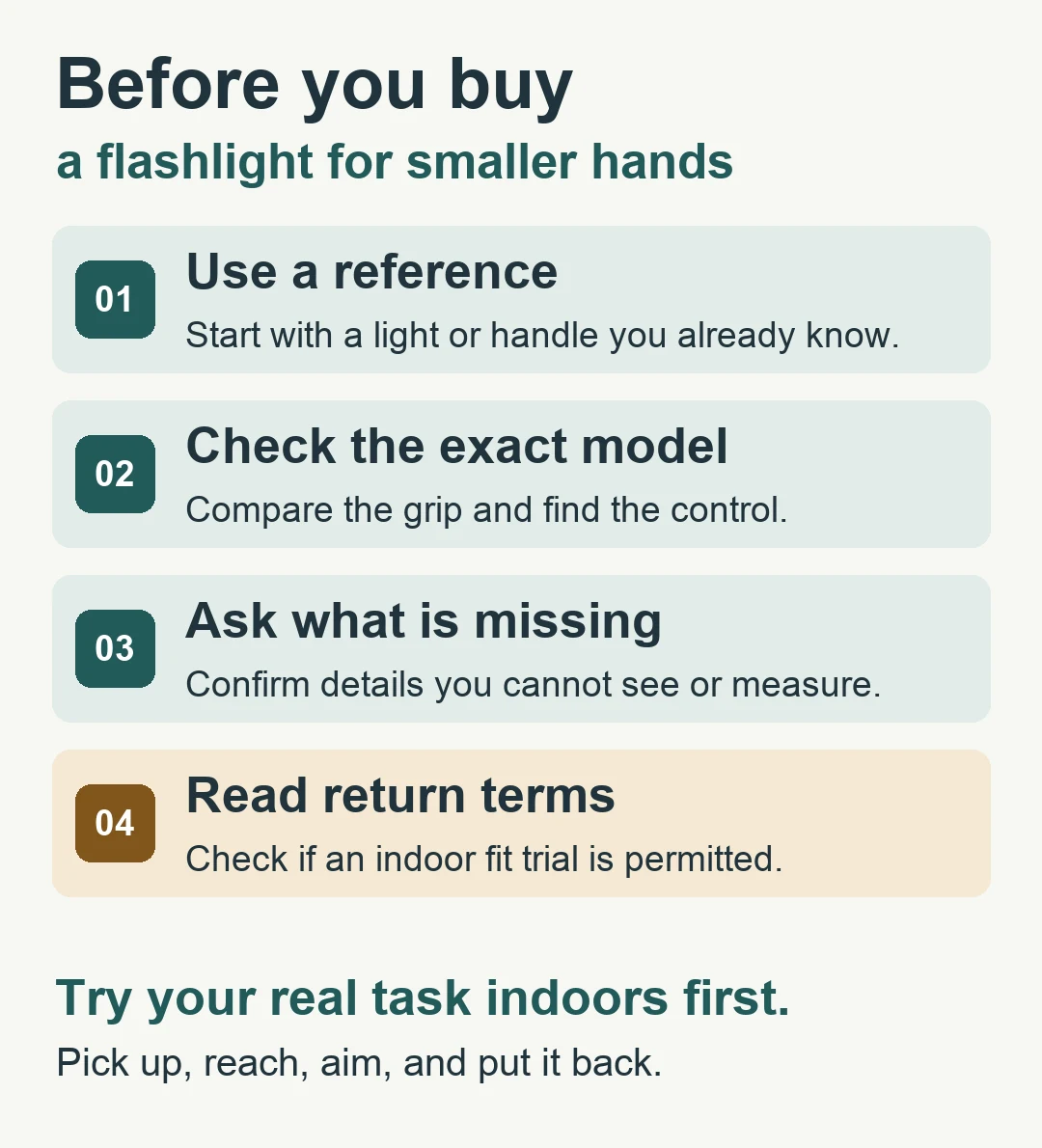
Use your existing grip as a reference before committing to an unfamiliar flashlight.
A NIOSH and Cal/OSHA guide to non-powered hand tools treats fitting the hand and fitting the task as separate considerations. The guide covers a different kind of equipment. For an everyday light, the same starting questions help organize a comparison. Can you hold the device comfortably? Can you use it in the position and space the job actually gives you?
You can measure your hand for your own notes if that helps. Try the distance from the base of the palm to your middle fingertip and the width across the palm, with the hand relaxed and flat. Use the same method each time you compare. Product pages usually describe the light rather than pairing the light with a specific covered hand size. Your measurements can help you talk to a seller, but use a familiar object and a real fit check as well.
A simple note can capture the part that matters without a ruler. Record where the front end of your reference sits when the grip feels natural, then record where your thumb touches the body. Keep the object still while you look. If you hold it differently every time, choose one recurring task and compare in that position. For an unfamiliar product, use photos to identify the control and ask for the measurement if the seller can provide it.
Add a note about which hand you normally use for the light. If the other hand holds the object you're trying to see, that's an important constraint. Check the angle you'll need around a door, cupboard, or counter edge. A grip that works at chest height can feel different when the hand is turned down. Make that observation with a light you already know and use it to decide which part of the new light to compare.
For recurring tasks, put the familiar setup into words. For example, you might hold the light in your left hand while looking into an organizer and want the control on the side facing your thumb. Or you might take the keys out with both hands available and need a light small enough to stay on that ring. Those are useful distinctions even when both shoppers describe their hands as small.
Read the dimensions for the part you will hold
A manufacturer can give you the total length without telling you how much straight body is available between a wider head and a clip. Check the drawing or photos for the region where your fingers wrap around. If the neck steps inward, notice where that step falls. A shorter cylinder can still be hard to hold securely if most of the usable length is taken up by edges or features.
When comparing a round light, find the body diameter and head diameter if both are published. For a shaped or flattened light, look for width and thickness separately. A single “width” in a listing may describe the widest point. If the measurement lacks a reference, ask where it was taken before treating it as a grip dimension. The product photos may be enough to see the layout even if they can't establish the measurement.
Total length matters when the body presses against the heel of your palm or projects out of a small compartment. Hold a familiar light or a smooth paper reference over a table to picture where the ends would land. A folded card can show approximate length or width. A rough scale reference cannot reproduce grip texture, spring pressure, or which way the weight feels when you tilt the light.
Product photos also vary in angle. A side view is the easiest place to look for a side button, while a photo straight on may show only the head. A clip can cover part of the area shown from one direction. Look at the available views together so you know what will actually contact your fingers. Choose the product from its documented shape and information instead of guessing exact measurements from a perspective image.
A manufacturer's image can make a key ring version and a much larger handheld look similar on a phone screen. Work from the listed dimensions for the exact choice. Save the model and finish name with your note so you can return to the same configuration. If a page changes images as you pick a finish or a bundle, check that the image and the specifications you're using still refer to the light in your cart.
Use weight on a consistent basis. If one figure includes its battery and a second figure leaves power out, the comparison will change after you install the battery. A listed weight may also leave out the key ring, pouch, or other items you actually carry. Check which items the supplier lists, and think about how much extra material will be under the fingers once everything is assembled.
| Detail on the listing | What to compare with your reference |
|---|---|
| Total length | Where the ends of the light would land in your normal hold |
| Body and head widths | The grip area and any larger part your fingertips have to clear |
| Control location and action | Where your thumb or other hand goes to turn the light on |
| Weight basis | Whether batteries and accessories are counted the same way |
| Included clip, ring, or case | What will sit around the light during pickup and storage |
A dimension is useful when you know which question it answers. For a drawer light, you may care about grasping it cleanly and locating the switch. For a light carried with a set of keys, you may care about clearing the other attachments and making it easy to take the ring out of a pocket. Wait to compare another feature until you know whether the size and control can work in the first task.
Is a smaller flashlight always easier to hold?
A smaller flashlight can fit a pocket and feel lighter, but it may leave less surface to grasp or room to reach a control. Check the part you hold and how you pick it up. If a tiny body disappears in a closed hand or requires an awkward pinch, a longer grip may be easier to use.
Take a light from where you would normally keep it and use it for a simple task. See how you pick it up if you reach in without looking directly at it. On a shelf, a touch of clearance around the light may be enough to take hold of it. In a crowded pouch, the same light can get buried among cords and change. A separate sleeve or the existing ring can make it easier to find without changing the model.
When a short light feels crowded, make a note of what you're touching. A clip across the fingertips and a tail pressing the heel of the hand are different problems. A longer body with more space for the fingers may solve the first one for some people. If a grip is already wide enough and the issue is a hard edge, choose a shape or arrangement with that edge away from the contact area.
If the light lives on your keys, consider all the objects attached to the ring. A key fob may hang beneath your hand or rest against the side of the light while you're aiming. Try rearranging the everyday attachments in a way that keeps the important items accessible. For someone who uses a small light almost entirely at home, a fixed place by the door may be easier than adding another item to a ring.
The ring is worth checking before you replace the light. If another key repeatedly catches the head when you pull it out, look at what is sharing the attachment point and whether the ring itself is easy to handle. Compare the same light alone and with the contents you carry. A change in the carry arrangement can make it possible to keep a model you already know works, especially when the problem occurs before you switch it on.
A new daily-use light doesn't have to occupy the same place as the old one. A slightly larger cylinder can be reasonable if you have a holder and regularly need to read labels. A small backup works well when you only need it occasionally and can find it easily. Use the intended storage and tasks to decide which trade-off is real for you.
Is a twist or push-button flashlight easier to use?
A push button can be simpler if you can reach it while holding the light. A twist control can suit an occasional light that you usually operate with both hands. Compare the exact controls with the task you do most often, and try the action at a table with the light directed away from people.
A twist-control light needs a stable hold while one part turns. Consider a key ring version used for checking which key to take out under a porch light. At home you can see if the ring shifts as you move the control. Confirm the normal travel in the manual, and use both hands if that helps you stay in control. Keep the assembled parts together during normal operation and avoid turning it farther than needed.
A side button asks you to find the right position along the body. Find the button with the light off, and see whether you can reach it with your usual grip. If you need to reposition the light each time, decide if that is acceptable for the job. An occasional adjustment at a table may be no problem. For reaching around a cabinet, you may prefer a model whose switch is already under your thumb when the beam points where you need it.
In cold weather, gloves change what you can feel and how far your fingers reach. Try the exact glove in a well-lit room if wearing one is part of the intended use. Move the light through the simple action you actually need, and keep it above a clear surface. If silicone, fabric, or a rigid seam gets in the way, another grip or switch may be a better fit. Avoid squeezing harder simply to make a light feel usable.
Think about returning the light after use too. Check whether you can turn it off, let it cool if necessary, and put it back without pulling the clip or closing a zipper across part of the light. Follow the manufacturer's storage instructions. Setting the light down at a clear spot can free your other hand to get a bag open without having to hold everything at once.
Compare two examples with different grips
The two examples here are ordinary lights with different controls and sizes. The listed lengths, grip dimensions, and weights help you picture the trade-off. Neither set of figures predicts comfort. A much shorter light can be an unobtrusive part of a key ring, while a larger button-operated light may give you more area to hold for an everyday drawer or bag task.
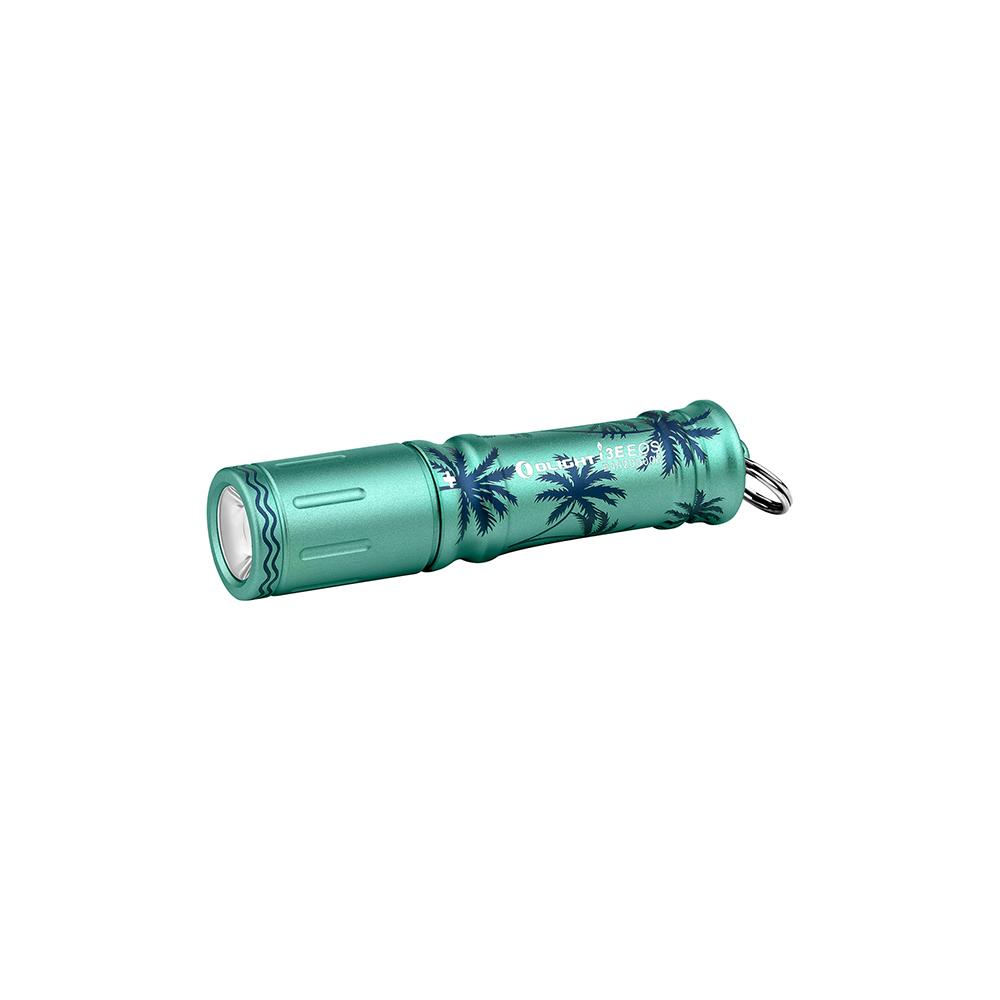
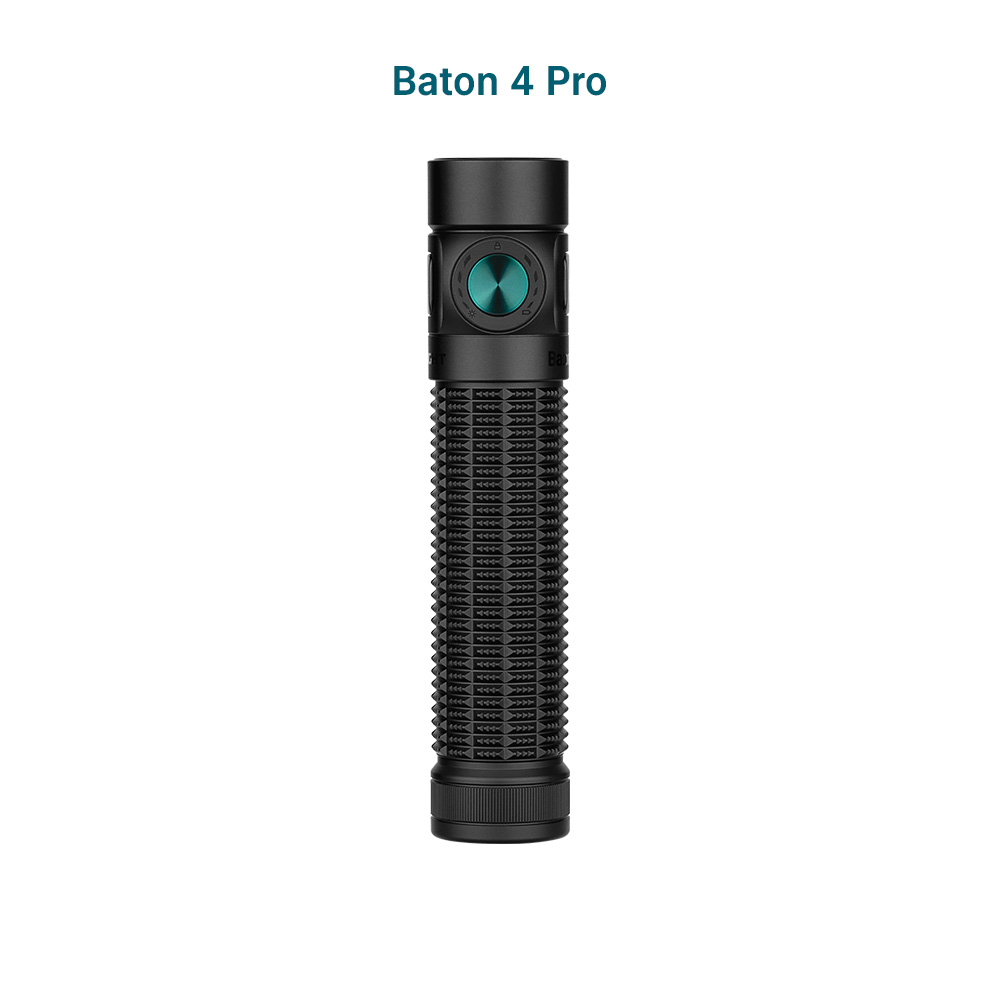
A compact flashlight may work for ordinary home or bag use when its controls fit the task. If you want a rechargeable flashlight, consider where it will charge and how often it needs to leave that place. A model that is comfortable in your hand should also fit the place you'll keep it and be usable when you pick it up.
The choice can be different if you're buying for someone else. Give them the exact dimensions and a picture of the actual control. Ask where they will keep it. A useful present fits what the person already does. If they keep a light near the back door, a bigger control may matter more than being able to attach it to a key ring.
Read the return terms before ordering
The California Attorney General's consumer information on refund policies suggests checking the store's return policy before buying and asking if it isn't clear. Check the terms that apply to the seller and item you're considering. Find out whether opening the package and trying the light indoors is allowed, when the return period starts, and whether there are costs or conditions to know about.
Save the exact model and terms with the order information. If a listing shows several styles, keep a note of which one you bought so you can compare it with the label on the arriving package. Check whether the policy asks you to keep the packaging, supplied accessories, or proof of purchase. This is especially useful if a gift recipient will be the one trying the light.
Ask a specific question if the details are missing. Give the model and selected finish, then ask for the diameter of the straight grip or which view shows the button. Save the response with the product information. If the seller can only give the length, work from that figure and leave the unanswered detail open. Gaps in a listing are a reason to try a display unit before buying if the detail is important to you.
Check how a store describes bundles. A sleeve, a different finish, or a gift set can appear under the same main listing as the plain light. Some of those choices may have separate conditions. Ask the seller about the version you actually want. If buying online leaves a needed fit detail unanswered and a return would be difficult, try a suitable demonstration unit in person or choose a model with clearer information.
Try one regular job before deciding
If the seller allows the trial you plan to do, start in a well-lit place with a clear surface. Use general lighting for setup, then turn the light on at a comfortable level pointed away from people. Choose a real task you can perform safely indoors, such as reading a tag in an open organizer. Keep your normal glasses or gloves if they're part of the task.
Take the light from your planned storage, find the control, aim it, and put it back after use. Try that sequence again when you can see where your fingers move. If you shift the grip just to reach the switch, ask whether shifting is comfortable and suits the job. If a clip or ring is what moves first, adjust its normal position and try again while stopped.
Pick a moment when you have time to read the instructions. Learn how to return the light to its usual setting before using it for a new task. For an indoor fit check, you can put the light down at any time and go back to the regular room light. That makes it easier to notice an awkward control or a grip that feels uncomfortable after a few uses without rushing to complete the job.
If you're deciding between two options, use the same simple task in the same place. Keep the usual carry attachments on each one if the trial conditions permit. A light can feel comfortable in a free hand and become less convenient once it has your keys hanging from the end. Observe the part that matters for the way you'll use it, such as picking it up, turning it off, or putting it away without losing track of the controls.
Pay attention to the second time you reach for it. Does it go back to the place where you expect to find it? Is the orientation easy to recognize? Could you set it down while opening the drawer and pick it up again without fumbling? Those first simple moments do a better job of showing whether a light fits your routine than a number from a generic size recommendation.
If you decide the light fits, keep your short comparison for the next purchase. An actual model name and a note about the part of the body you hold are more useful than a category label alone. Add the place you put it so another member of the household can find it. If you're replacing the light later, start from that known setup and change only the dimension or control that needs improvement.
Write down the reason you would keep or change the light. If the issue is switch placement, compare a different layout. If you can operate it but have trouble finding it in a bag, change where it rides. If it simply doesn't feel comfortable, use what you learned to check the next option rather than guessing another length.
Frequently Asked Questions
Changelog
- November 19, 2026. Checked the federal hand-tool guide's scope, California consumer guidance, the U.S. product manuals and exact gallery photos, and the original fit checklist.




