


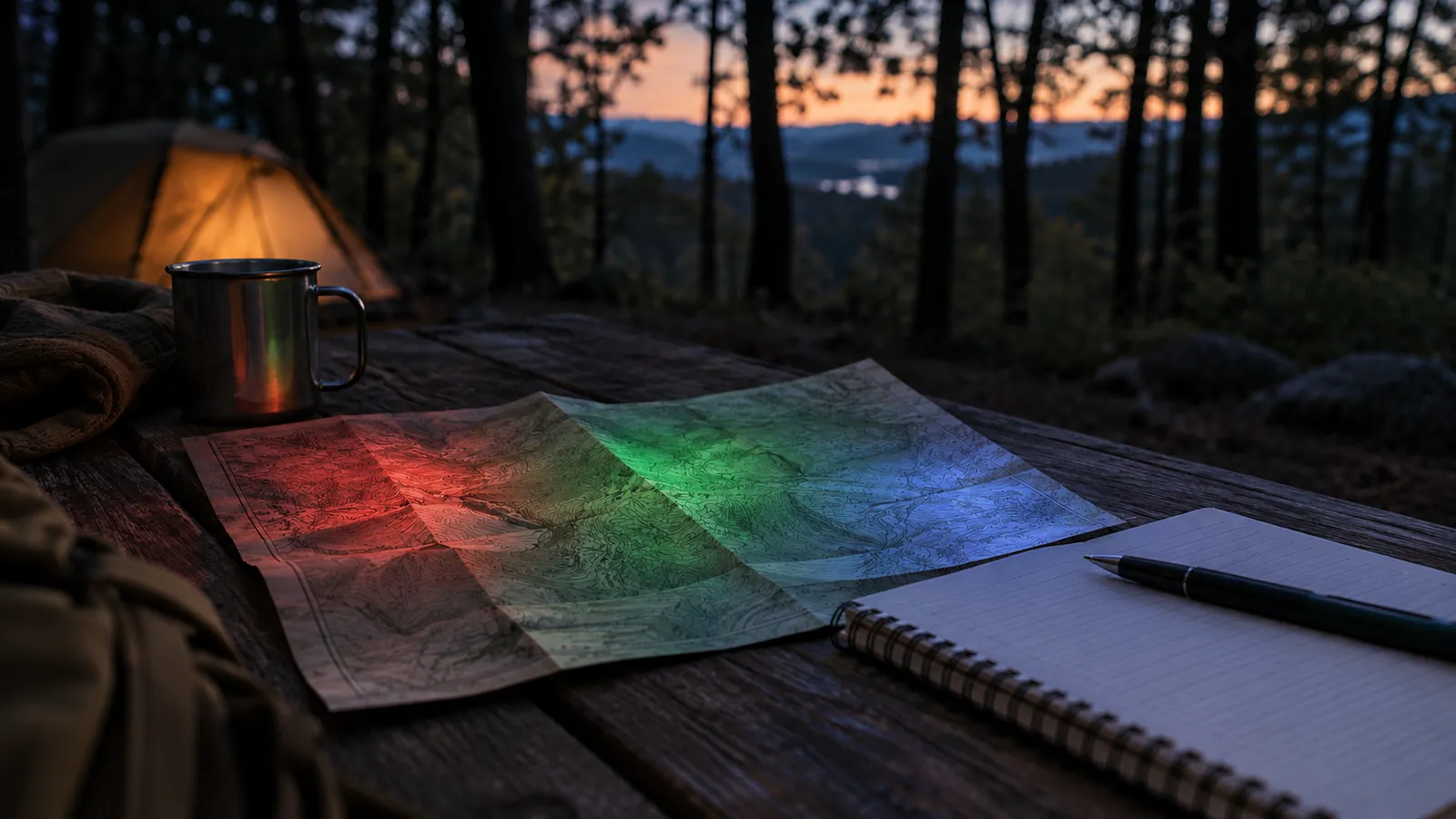
TL;DR: Use red for a close task when a broad white beam would bother others. Try green only when it improves a specific view for you; use blue to observe fluorescence, not identify an object. Keep white light and approved emergency equipment ready whenever accurate color recognition or dependable signaling matters.
📋 Table of Contents
- 1. RGB Flashlight Basics: Color Is a Choice of Viewing Conditions
- 2. Red Light: Useful for Close Tasks, Not a Night-Vision Guarantee
- 3. Green Light: Test the View, Not a Universal Claim
- 4. Can Color Keep Insects Away?
- 5. Blue Light and Fluorescence: What It Can Show, and What It Cannot
- 6. Color Filters and Native RGB LEDs Are Not the Same Setup
- 7. Emergency Signaling: Do Not Confuse Color With Certification
- 8. Olight Oclip Pro S: A Compact Example of RGB in a Real Product
- 9. A Simple RGB Flashlight Decision Routine
- 10. RGB Flashlight Mistakes That Make a Simple Task Harder
- 11. Frequently Asked Questions
- 12. What flashlight do Navy SEALs use?
- 13. Is a 200,000 lumen flashlight legal?
- 14. Which brand is the best for RGB lights?
- 15. Related Reading
RGB Flashlight Basics: Color Is a Choice of Viewing Conditions
An RGB flashlight is useful when its color modes fit a close task or observation goal, but color alone does not guarantee better visibility, preserve night vision, repel insects, identify a material, or qualify as a distress signal. Start with the lowest useful setting, switch to white for accurate identification, and use approved emergency gear when rules apply.
| Task | A sensible starting point | What the color cannot promise |
|---|---|---|
| Read a nearby map or find a zipper | A low red setting, aimed only at the task | Red does not make a person automatically night-adapted |
| Check a green item or surface | Try green briefly, then compare with white if needed | Green does not improve contrast for every object or every eye |
| Look for a fluorescent effect | Use a suitable light and compare the object in ordinary light | A color change cannot authenticate or identify a substance |
| Signal for help | Use the device and method accepted for the situation | An RGB flashlight is not automatically an approved distress signal |
Some RGB flashlights pair red, green, and blue with white light; others may differ, so check the exact model. A color changes the light reaching an object and returning to your eyes. It does not change the object itself, guarantee better contrast, or turn a general-purpose flashlight into specialized safety equipment.
That distinction is useful because many questions about colored light are really questions about a task: “Can I read this map without lighting the whole tent?” “Will green make this item easier to see?” “Does a blue beam show what this mark is?” “Can I use a flashing color as a distress signal?” Each deserves a different answer.
For ordinary close work, begin with the lowest useful level and point the beam at the task. If the color makes the detail harder to read, return to white. For navigating unfamiliar ground, recognizing a person, checking a label, or distinguishing a hazard, color fidelity can matter more than preserving a dim appearance. Carrying multiple colors is helpful only when the controls are easy to understand and the user knows when to switch back.
A useful mental model is to treat the available colors as options, not as a ranking. Red is often selected to reduce broad white spill during a small night task. Green can change how some green surfaces appear, but the result is highly dependent on what is being viewed. Blue can excite fluorescence in some materials, but the response depends on the material and light, and appearance alone proves very little. White remains the practical choice whenever accurate color recognition matters.
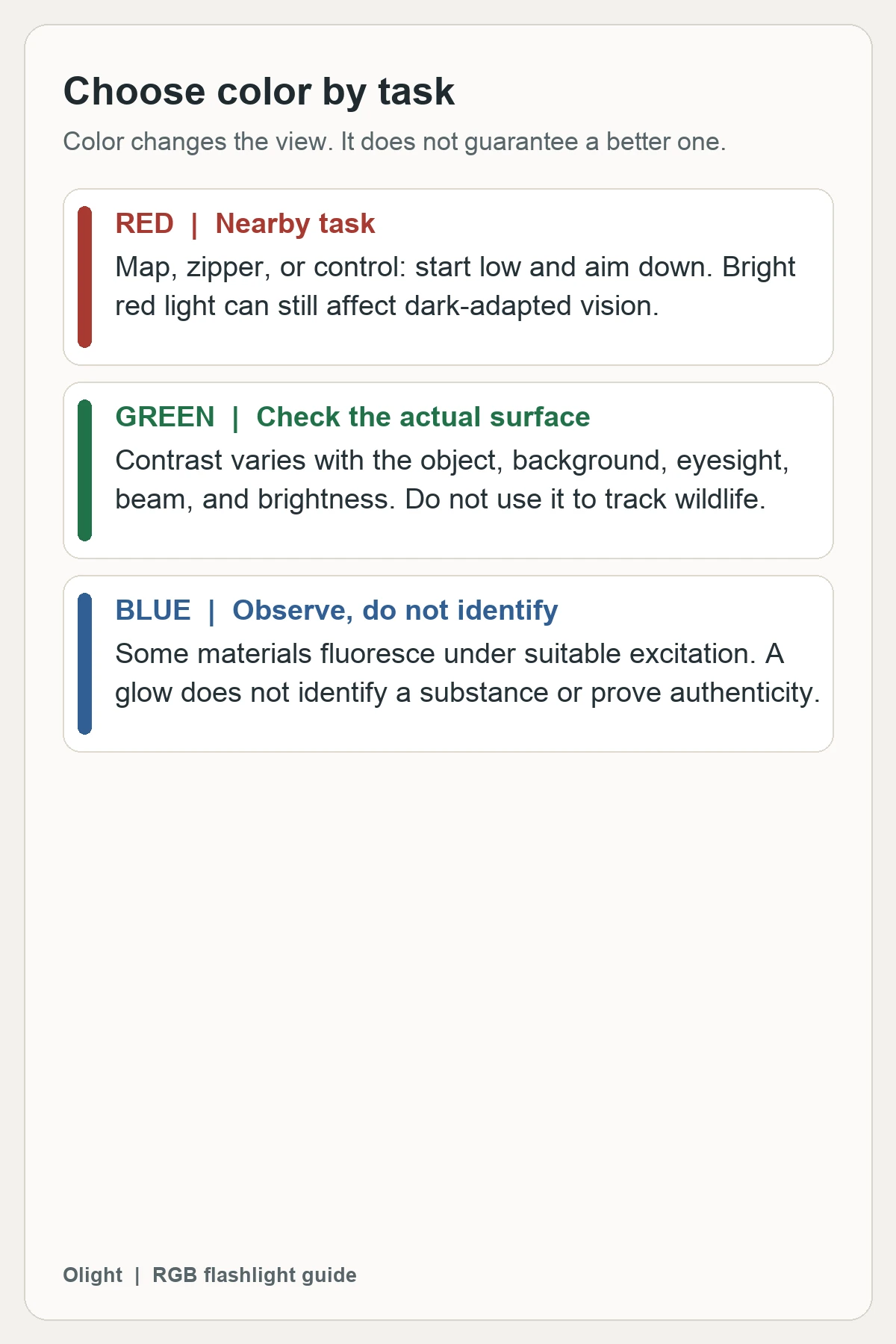
Quick reference for choosing a color by task; it does not rank color performance.
Red Light: Useful for Close Tasks, Not a Night-Vision Guarantee
Red light is commonly chosen for a map, a zipper, a nearby control, or a quick check of gear at a shared campsite. The benefit is practical: a person can direct a small colored pool at one nearby task instead of filling the whole area with bright white light. It can also reduce the chance of shining a broad white beam across a tent or into another camper’s eyes.
The important qualifier is “can.” Red does not preserve night vision automatically. The amount of light, the time spent looking at it, the contrast of the task, and the surrounding darkness all matter. The National Eye Institute explains that rod photoreceptors function better in dim light while cones work best in bright light. A light source of any color still stimulates the eye. A bright red beam can still be uncomfortable, distract a companion, or make it harder to transition back to darkness.
Try a low setting first. Angle the beam down at the map rather than across the campsite. Turn it off as soon as the task is finished. If you need to read fine print, identify a color-coded wire, inspect a first-aid label, or recognize a face, switch to white light. A small temporary increase in brightness can be more useful than straining through an inaccurate color view.
Red is also a courtesy setting, not a campsite rule. Follow posted instructions and the expectations of people sharing the space. At a campground, a lantern or headlamp pointed at the ground may be a better choice than sweeping a colored beam across neighboring sites. On a trail, keep the light on the route and use the color only if it actually helps the immediate task. Never assume that another person can see a colored beam clearly just because it is visible to you.
When Red Hides a Map Detail
Imagine a red trail marking that becomes hard to read under a red beam. Do not keep staring or assume the color will eventually help. Turn the light off, move to a spot where a brief white-light check will not bother others, and confirm the mark. Then tell your group the route information aloud so nobody has to rely on color alone.
Green Light: Test the View, Not a Universal Claim
Green light is sometimes described as a contrast enhancer, especially around vegetation. That description is too broad to serve as a buying rule. A leaf, dark fabric, painted sign, reflective marker, and skin do not respond identically to the same beam. The result also depends on the beam pattern, output setting, distance, background, ambient light, and the viewer’s color perception.
A practical approach is to test the light on the exact non-sensitive task in front of you. If green makes a map symbol or a nearby object easier for you to distinguish, use it briefly. If edges merge or the color makes the object harder to interpret, use white. There is no general rule that green will outperform white in vegetation, and no color can be used as a reliable substitute for visual confirmation.
Color vision varies among people. The NEI’s overview of types of color-vision deficiency describes conditions that can make some color distinctions difficult. That is one reason a colored cue should never be the only signal in a group. If a trip partner needs to distinguish a location or status, pair color with a word, a shape, a position, or a familiar light pattern rather than relying on hue alone.
Green can be useful for a close, brief check when the user likes the view it creates. It is not a promise of better reading, longer detection distance, or accurate identification. Avoid using a colored light to follow wildlife, locate animals, or disturb their resting or nesting behavior. A person trying to navigate should keep attention on the safe route, not on interpreting color effects on plants or animals.
Can Color Keep Insects Away?
Do not buy an RGB flashlight on the assumption that one color will repel insects. A peer-reviewed field study compared four household-style lights: tungsten, compact fluorescent, cool-white LED, and warm-white LED. The study found that LEDs attracted fewer aerial insects overall than the other sources. It found no significant difference between the cool- and warm-white LEDs. The University of Bristol research record links to the published paper. It did not test handheld RGB flashlights, so it cannot show that red, green, or blue modes repel bugs.
For a campsite, use practical barriers: keep food covered, use screens where available, and follow the label when using an approved repellent. Keep the light aimed at the task rather than shining it around the campsite. A red or green mode may change the look of a nearby surface; it is not a reliable insect-control method.
Pair Color With a Second Cue
For a group, agree on simple meanings before the light is needed. “Green means I am at the trail junction” is a clearer plan when paired with a spoken radio message or a visible position; color should not be the only cue. “Red means stop” can be misunderstood if someone cannot distinguish the color or sees only a reflected patch.
Use a label, a signal word, or a position as the primary information. A light can draw attention, but it should not carry the entire message. If the task is a real emergency, use the communication and signaling equipment intended for that setting.
Blue Light and Fluorescence: What It Can Show, and What It Cannot
Blue light can make some materials appear to glow because a material may absorb one wavelength and emit another. That effect is called fluorescence. It is a property of the material under particular illumination, not a universal feature of dirt, stains, fibers, or chemicals. The NIST glossary defines an excitation filter as passing wavelength bands capable of inducing visible fluorescence in various substrates. The underlying point is that a response depends on the interaction between source and material.
A blue flashlight is therefore not a general-purpose detector. A surface that glows is not automatically contaminated, counterfeit, or important. A surface that does not glow is not automatically clean or authentic. Ordinary room lighting, surface color, coatings, detergents, paper, and the light’s spectrum can all influence what a person sees. Without controlled reference samples and a validated method, visual appearance is only an observation.
For everyday use, keep the purpose narrow. A blue mode may be interesting for viewing a known fluorescent marker or demonstration material when the item’s instructions say that a blue source is suitable. Compare the object under ordinary white light. Keep the beam out of eyes and follow the product’s safety information. Do not use a blue mode to make medical, forensic, currency-authentication, or contamination claims.
Blue light also changes how familiar objects look. A white label can appear dim, a colored surface can shift, and fine print can become harder to read. When an accurate identification matters, switch back to white and inspect the label directly. If the matter has legal, medical, or safety consequences, use a qualified process instead of relying on a flashlight effect.
Fluorescence Is Not the Same as Phosphorescence
Fluorescence generally appears while suitable excitation light is present; phosphorescent materials can continue to glow after the excitation source is removed. Everyday packaging and novelty products sometimes use these words loosely. The visual effect alone may not tell you which process is occurring, what the material contains, or whether it has a particular safety property.
The useful question is not “What is this glowing thing?” but “What does the item’s reliable documentation say, and what other checks are appropriate?” A flashlight can help someone see an effect. It cannot supply a product label, a laboratory result, or a chain of custody.
Color Filters and Native RGB LEDs Are Not the Same Setup
A colored filter placed over a white flashlight changes the light that passes through it. A native RGB flashlight uses separate colored emitters or another designed color system. Both can produce a colored view, but that does not mean the output, brightness, beam shape, or appearance will match.
A filter can remove portions of a white source’s output. The resulting scene depends on the source and filter. A native RGB light may offer dedicated red, green, and blue settings, but the available steps and controls depend on the model. Neither type guarantees the same usable output as white mode. Do not infer performance from a product name or from a color label alone.
When comparing options, check five things: whether white light remains available; how the user selects and exits a color mode; whether the lowest setting is comfortable for nearby work; whether the beam is broad or focused enough for the task; and how the device is recharged or kept ready. If a family member or coworker may need the light, a control that can be explained in one sentence is more useful than a long mode list.
For a filter, consider whether it is securely attached and whether it can be removed quickly when color accuracy is needed. For native RGB, learn the sequence before going outside. If the user must cycle through several modes to return to white, practice in a familiar place rather than discovering the interface on a dark trail.
A flashlight for general tasks should still offer an easy path back to white. For a smaller item intended to ride on a pocket, pack, or strap, compare the real dimensions and clip placement of a compact flashlight before deciding that multiple colors are the main feature. Color versatility is secondary to dependable access, a clear control, and a beam suited to the task.
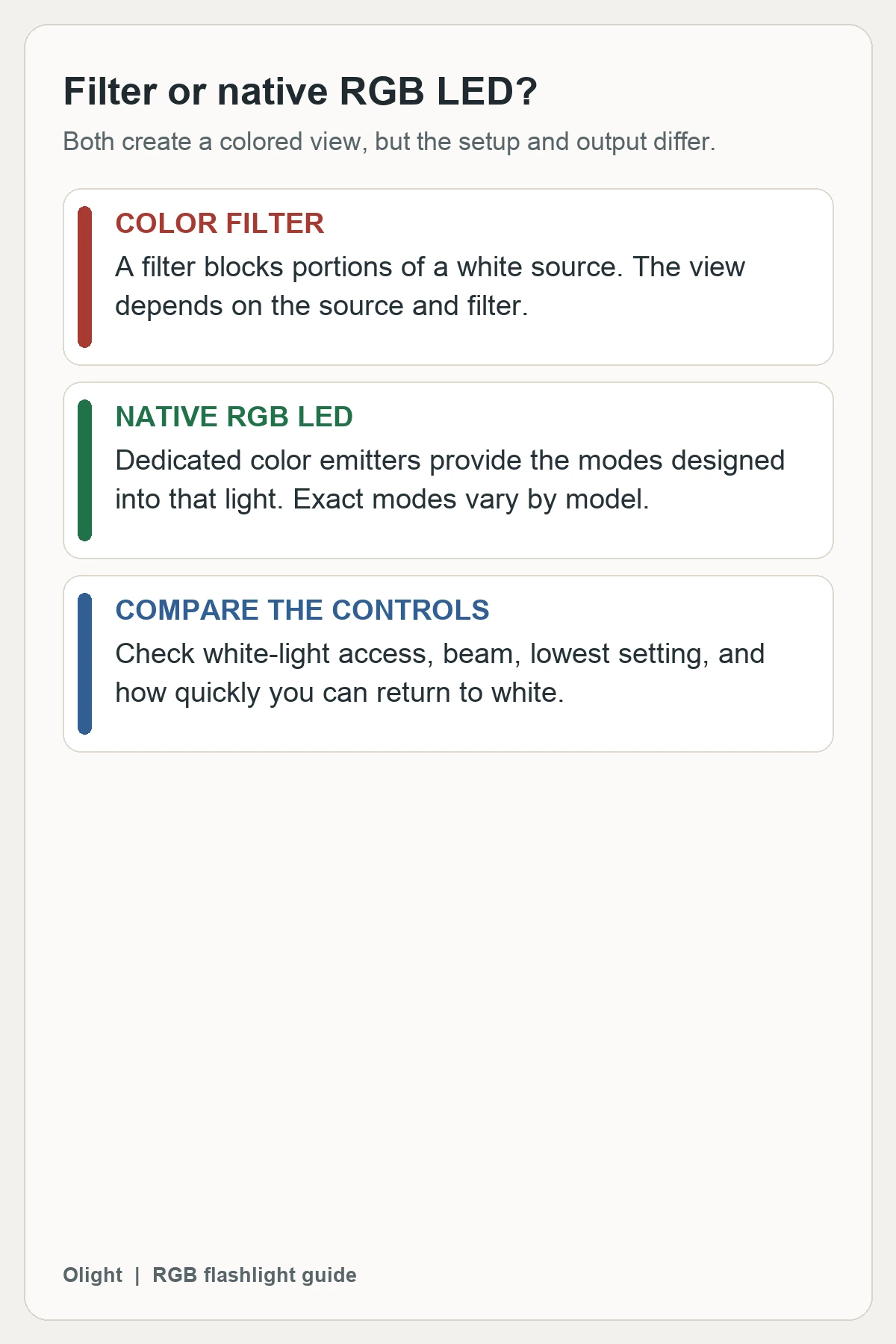
Concept diagram showing how a filter and dedicated color emitters differ.
Emergency Signaling: Do Not Confuse Color With Certification
A red or blue flash may attract attention, but that alone does not make a device an approved visual distress signal. Signaling requirements depend on the environment and, for boating, the applicable device standards and vessel rules. For boats subject to visual-distress-signal requirements, the federal visual-distress-signal rules define a qualifying signal as an approved or certified device and list an electric distress light meeting 46 CFR 161.013 among accepted devices. Requirements depend on the boat and waters. Check the current rule, the exact device marking, service condition, and instructions. Carry required equipment where it is accessible. Do not substitute a colored flashlight because it has an SOS-like blink or looks bright nearby.
On land, agree on a communication plan before a trip. A phone, radio, whistle, reflective marker, or approved beacon may be more appropriate than a flashlight, depending on coverage and the activity. A flashlight can support a signal, but battery reserve matters. If the primary task light is also the emergency light, keep enough charge for both uses and know the correct signal sequence before leaving.
A light pattern should be deliberate and unambiguous. Avoid inventing meanings that a rescue service or another group will not recognize. If a device is designed and labeled for a particular emergency signaling function, follow its instructions. If it is a general-purpose color light, describe it as a general-purpose light.
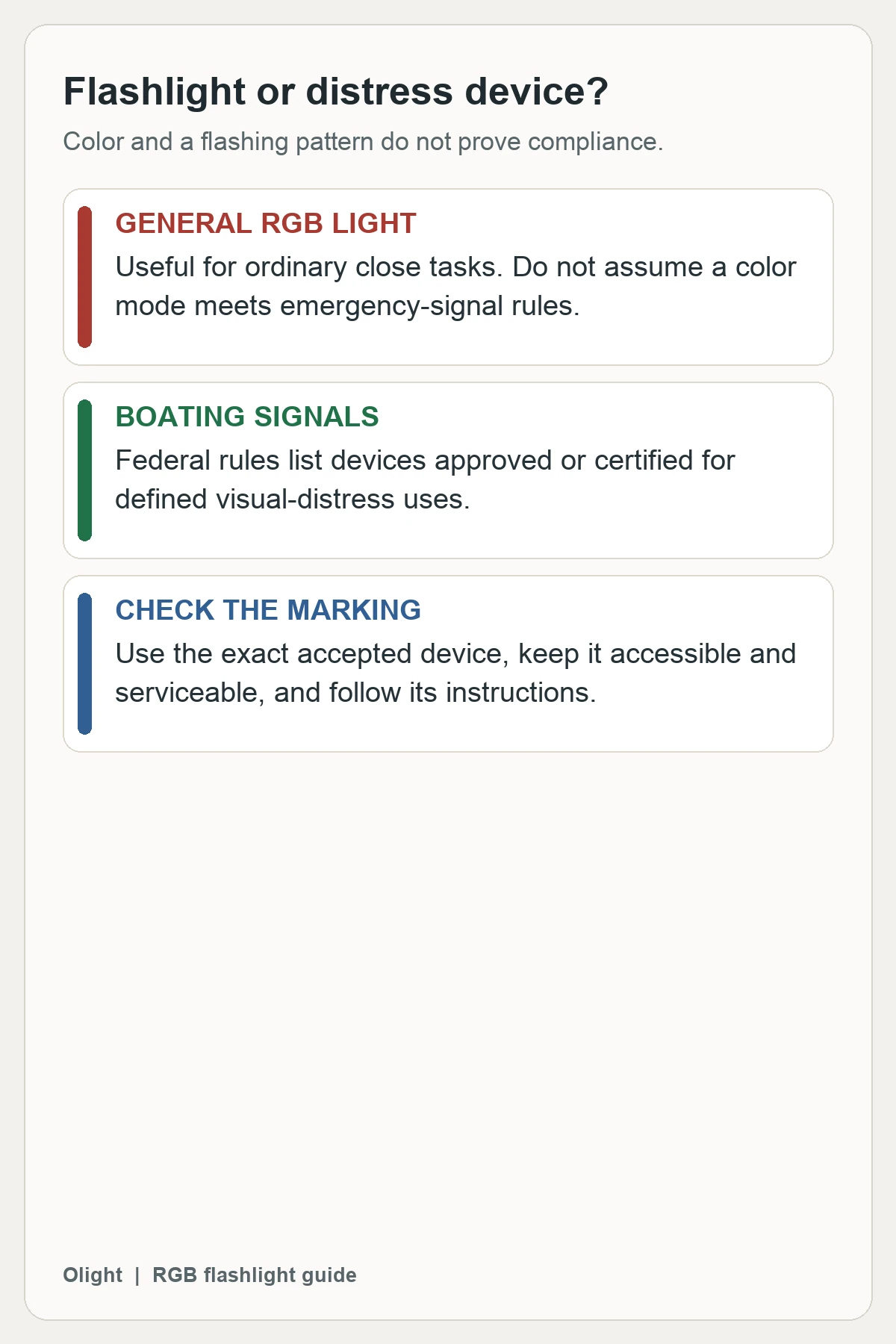
An RGB color or flash pattern alone does not establish that a light meets distress-signal rules.
Olight Oclip Pro S: A Compact Example of RGB in a Real Product
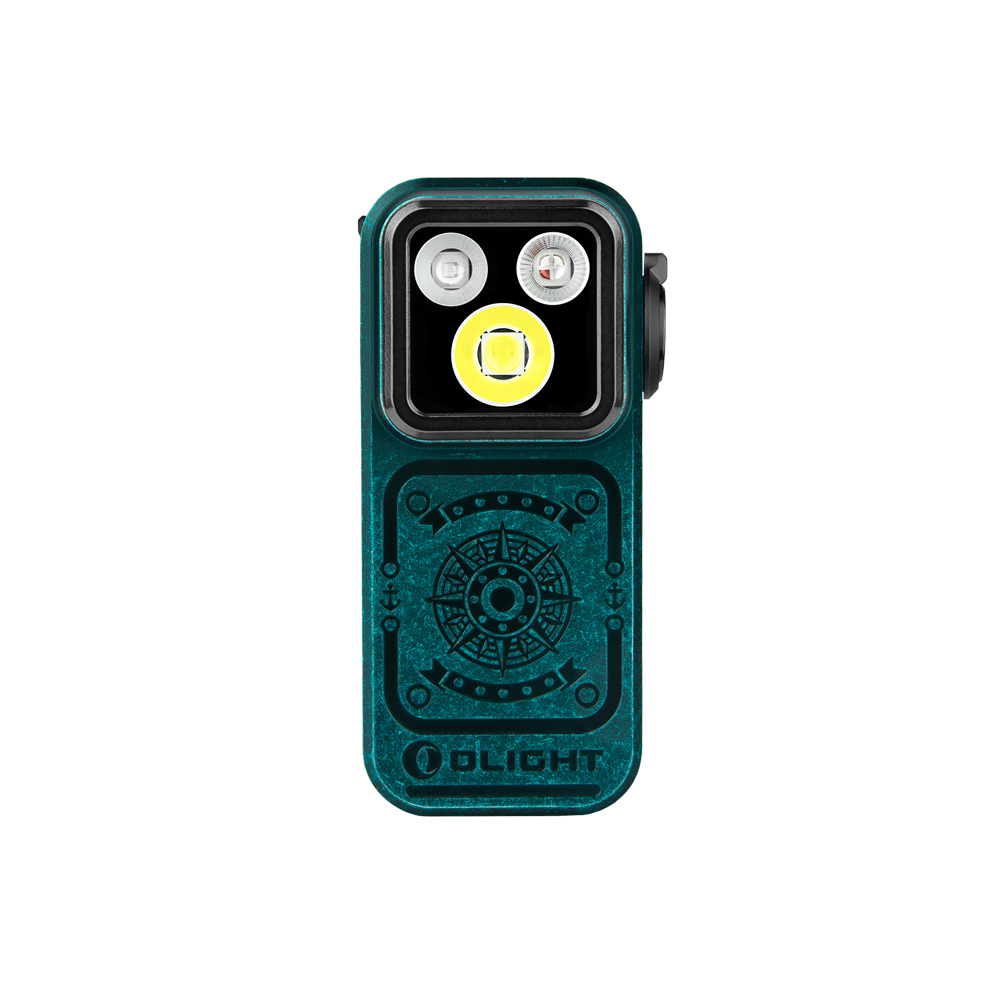
Olight’s current U.S. product page describes the Oclip Pro S as an RGB and UV clip light and lists a maximum white output of 600 lumens. Olight’s current comparison article distinguishes the Pro S from the Oclip Pro by listing Flood/RGB/UV for the Pro S and Flood/Spot/Red for the Pro. That distinction matters: similarly named models do not necessarily share the same colors or controls.
The Oclip Pro S is a compact example of a product that combines white light with dedicated color modes. Confirm the exact model, learn how to select each mode, and return to white when accurate color recognition matters.
A Simple RGB Flashlight Decision Routine
A repeatable routine prevents color modes from becoming a distraction. First, name the task in plain language: read a map, check a label, find a zipper, signal a companion, or inspect a documented fluorescent marker. Second, decide whether true color matters. Third, start with the lowest setting that lets you complete the task. Fourth, switch to white if the color makes details uncertain. Finally, turn the light off when the task is done.
That routine works better than memorizing claims such as “red is always best” or “green sees farther.” The right choice can change between two tasks on the same trip. Red may be comfortable for a short map check. White may be the better choice when reading small text. A colored beam can make a visible cue, while a radio or an approved signaling device handles the message.
| Question | Decision |
|---|---|
| Is the task close and familiar? | Try the lowest comfortable color setting, then stop when done. |
| Must the object be identified accurately? | Use white light and read the label or markings. |
| Is another person relying on the color? | Add a word, position, shape, or established communication cue. |
| Is this a legal or emergency signal? | Use the device and method approved for the setting. |
| Is the goal to identify a substance or prove authenticity? | Do not draw a conclusion from color appearance alone. |
A second routine is useful for groups: name the color and its intended meaning before the activity, test whether everyone can distinguish it, and choose a backup cue. If one member cannot reliably tell red from green, color alone is not a safe group code. The NEI color-vision resource is a useful reminder that people do not all perceive color boundaries in the same way.
For home preparedness, store the light where it can be found and check its charge according to the manufacturer’s instructions. Do not store the only emergency light in a bag that is difficult to reach. If the light’s mode sequence is complicated, place a short written reminder with the gear. The reminder should describe button operations for the exact product, not generic instructions copied from another model.
RGB Flashlight Mistakes That Make a Simple Task Harder
Starting Too Bright
A bright beam can create glare on a glossy map, label, or wet surface. Starting at a lower setting gives the user room to increase output only if needed. A bright colored pool can still overwhelm nearby vision and still bother someone sharing the area.
Assuming Color Equals Visibility
A colored beam may make one object stand out while hiding another. A red marker may become less distinct under red light; a green object may blend with its surroundings under a particular green setting. If the object matters, change the light and compare rather than assuming the chosen hue is helping.
Forgetting White-Light Identification
Colored modes are useful when they solve a defined task. They are a poor replacement for reading a label, recognizing a warning symbol, or checking a natural color. Switch to white for the final check.
Using a Flashlight as a Wildlife Tool
Do not shine lights at wildlife or use color to pursue, attract, or disturb animals. Follow park and local rules. Keep beams on the path and gear, and turn them off when they are not needed. A general-purpose light is for human tasks; it does not grant permission to approach animals or nests.
Treating an SOS Pattern as Certification
A recognizable pattern is not proof of compliance. For boating, consult the current visual-distress-signal requirements and the exact device listing. For other settings, follow the rules and emergency plan that apply there. A consumer light with several colors can be useful and still not be the correct emergency signal.
Buying on the Number of Colors Alone
A mode list does not show how simple the controls are or whether the light is comfortable to use. Look at the whole interaction: how it clips or sits in the hand, how white mode is reached, what happens when the battery is low, how it charges, and whether the device can be operated in gloves if that is part of the intended task. Choose the model that makes the important task easy, not the model with the longest list of modes.
Frequently Asked Questions
What flashlight do Navy SEALs use?
There is no single publicly confirmed model that can be treated as the universal answer for every unit or mission. Equipment can vary by task, procurement, and time. Civilian readers can choose more reliably by matching controls, beam, power plan, size, and carry format to the work they actually do.
Is a 200,000 lumen flashlight legal?
A lumen number alone does not answer a legal question. Location and intended use matter, and regulated signaling can require an approved or certified device. For boating, check the current rule and the exact device’s marking; do not assume a consumer RGB mode qualifies because it flashes.
Which brand is the best for RGB lights?
There is no single best brand for every user. Compare the exact color modes, access to white, control sequence, charging method, size, and documentation. Olight’s Oclip Pro S is one current option with RGB and UV modes; it is not a universal answer for every task or setting.
Related Reading
For a broader look at everyday applications, see Olight’s article on surprising ways to use an RGB flashlight in everyday life.
Changelog
- November 19, 2026: Verified Oclip Pro S specifications and updated references for colored light and boating distress signals.




