


⚡ TL;DR
Turn off unnecessary heat-producing or moving equipment through its normal user controls when it is safe and consistent with its instructions. Disconnect nonessential electronics where the manufacturer's guidance supports doing so. Keep medical needs and refrigeration separate from a blanket unplugging list. Do not open, reset, or investigate the electrical panel; use the appliance's exact instructions and obtain help for damaged or abnormal equipment.
📋 Table of Contents
- 1. Put people and immediate hazards ahead of the appliance list
- 2. Use the ordinary control, not an improvised electrical procedure
- 3. Separate devices that should not share one rule
- 4. Manufacturer examples show why the details matter
- 5. Keep medical and personal needs outside the nonessential list
- 6. Protect refrigeration without repeatedly checking the door
- 7. Do not invent a universal air-conditioner waiting time
- 8. Treat a restoration indication as a limited observation
- 9. Use a headlamp to read instructions, not to investigate wiring
- 10. Keep a short record that survives a change of person
- 11. Water and toilets depend on the system, too
- 12. Restore the household by confirming individual states
- 13. Frequently asked questions
- 14. Keep the decision attached to the device
Put people and immediate hazards ahead of the appliance list
Before deciding what to switch off, consider whether anyone needs powered medical equipment, a temperature-controlled environment, or another essential service. Follow that person's established backup and emergency plan. A general household checklist is not a reason to disconnect essential equipment casually or delay urgent help while somebody works through every room.
If there is smoke or fire, leave and call emergency services from a safe location. A burning odor, active sparking, damaged equipment, water around electrical fittings, or other warning signs also changes the situation. Do not handle plugs, controls, or appliances to complete this list when the area or equipment may be unsafe. The appropriate response is help, not a more thorough personal inspection.
An outage is not proof that every conductor or appliance is deenergized. Power may return unexpectedly, and some equipment may have another source of energy. Keep covers, guards, and service enclosures in place. This household guide concerns ordinary user decisions about equipment already safe to approach; it does not provide electrical isolation, voltage testing, repair, or circuit-breaker procedures.
The American Red Cross's power outage safety guidance supports reducing unnecessary connected loads and using portable lighting. Apply general preparedness advice alongside the actual equipment instructions and the needs of the household. A quick instruction to “unplug everything” leaves out important differences between a television, refrigerator, medical device, and installed heating system.
Choose one adult to keep a brief record of what was changed. Another person should not have to guess whether a device stopped because power failed or because somebody intentionally turned it off. A simple note about the item and its state can prevent an unnecessary restart, a missed essential need, or a second person reversing a deliberate decision.
Use the ordinary control, not an improvised electrical procedure
Identify the equipment and the instruction that applies before acting. A familiar countertop appliance with a normal Off control is different from hardwired equipment, a large appliance whose plug is inaccessible, or a device with a special shutdown process. Do not pull heavy furniture or an appliance out of place, reach behind questionable fittings, or enter a dark service area to find a connection.
If a nonessential device can be disconnected safely and its instructions support that action, keep the plug and cord protected rather than leaving them where someone can trip or spill liquid. Do not handle a hot, damaged, wet, or otherwise suspect connection. A plug fitting into a socket does not establish that the socket or equipment is ready to be used again when service returns.
A remote control, standby mode, appliance Off setting, and physical disconnection are not necessarily the same state. Use the terms that the manufacturer's instructions use, and record what you actually did. Do not label a piece of equipment “electrically safe” because its display is dark or its ordinary switch is off. That would make a claim the household check has not established.
When the correct action is unclear, preserve the question and contact the manufacturer, property contact, or appropriate professional. There is no benefit in guessing a hidden control sequence during an outage. A useful list can contain “instructions needed” as well as completed actions, provided an essential need or an urgent hazard receives the attention it requires.
Separate devices that should not share one rule
Think about what the equipment does when electricity becomes available again. Some devices remember the previous setting, some remain stopped until a user acts, and others have a programmed delay. The presence of a motor or a digital display alone does not tell you which behavior applies. Use the exact model, control type, and relevant manual rather than assigning every item in a category the same response.
| Equipment group | Question to resolve | What not to assume |
|---|---|---|
| Cooking and portable heating equipment | How should its normal controls be left, and can it resume operation? | Every control automatically returns to Off |
| Computers and nonessential electronics | What shutdown or disconnection does the manufacturer recommend? | A standby display proves isolation or surge protection |
| Refrigerator and freezer | What does this model require, while food remains protected? | Every refrigerator must be unplugged |
| Air conditioner or heat pump | Does it retain settings, delay restart, or require a model-specific response? | One waiting time suits all systems |
| Medical or other essential equipment | What is the person's established backup plan? | It belongs on a nonessential unplugging list |
| Pumps and sanitation systems | Which parts depend on power, and what does the responsible service recommend? | Normal water use is always available |
Do not turn this table into a compulsory sequence of physical tasks. Several items may require nothing beyond preserving their intended state and following their instructions. Others may need professional attention or an alternative arrangement. The point is to make the differences visible before somebody decides that speed means treating all equipment alike.
For shared equipment, identify who is responsible for it. A landlord, building manager, medical equipment provider, or household member may hold the relevant instructions and authority. Tell that person about the interruption rather than operating shared equipment yourself. This matters particularly when an appliance or system serves more than one unit or supports another person's needs.
Manufacturer examples show why the details matter
GE Appliances' refrigerator outage guidance says that its refrigerator does not need to be unplugged simply because of a power interruption. It also discusses returning electronic-control models to their selected temperature settings. That is a useful counterexample to a universal unplugging rule, but it is not an instruction for every brand or for a refrigerator with damage, water exposure, or unusual electrical symptoms.
The same manufacturer's electric cooking guidance distinguishes knob-controlled surface burners from digital touch controls. It warns that knob controls need to be left Off to prevent the burners returning to operation, while the described touch-controlled burners do not automatically restart. These differences can exist within one broad equipment category. Identify your appliance's actual controls and instructions rather than relying on the word “electric.”
GE also describes power-interruption recovery on many electronic window and built-in air conditioners. Models with that feature can recover the earlier setting. This does not establish the behavior of every central system, heat pump, or room unit. It shows why someone who wants equipment to remain off should understand its normal control and recovery behavior before a future interruption.
Use these as examples of how to read instructions, not as a substitute for your own model information. Record the manufacturer, model, relevant section, and what it says about an interruption and restoration. You do not need to copy the whole manual into the household plan. A short accurate entry with the location of the original instructions is easier for another adult to use.
If an article or generic checklist conflicts with a model's instructions, ask the manufacturer or appropriate service professional about the exact situation. Do not resolve the conflict by cycling power repeatedly, selecting a more aggressive setting, or experimenting with several online reset methods. A recovery feature is not a reason to bypass a warning, and an unfamiliar delay is not automatically a malfunction.
Keep medical and personal needs outside the nonessential list
The CDC's power-source preparedness guidance identifies the importance of emergency lighting and planning for devices, including medical equipment, that depend on electricity. Follow the affected person's established plan and the equipment provider's instructions. The household's first decision may be obtaining an appropriate alternative location or urgent help, rather than managing ordinary appliances.
Do not assume a power bank or portable light can supply an essential medical device. Compatibility, capacity, required power quality, and operating conditions belong to the device's approved arrangements. Keep the actual backup instructions and provider contact information accessible. If the prepared arrangement is unavailable or no longer meets the person's needs, seek the appropriate help instead of improvising an electrical connection.
A person can also need reliable heating or cooling without having a visibly plugged-in medical device. Consider the household's actual health and environmental needs when deciding whether it remains appropriate to stay. Follow local emergency advice and the person's care plan. Turning off equipment to reduce unnecessary loads should not obscure the more important question of whether essential needs can still be met.
Keep responsibility clear between adults. Someone should know whether the backup plan is active, who has contacted the provider, and what the next step is if the interruption continues. A note that “the living room still has power” does not describe the person's requirements. Record the actual arrangement and any advice received without declaring the electrical supply medically suitable yourself.
Protect refrigeration without repeatedly checking the door
Keep refrigerator and freezer doors closed as much as possible during the interruption. Do not repeatedly open them to see whether the interior lamp works or to look for a reassuring appearance. The lighting circuit and the condition of the food answer different questions. The appliance instructions govern its operation; food safety also depends on the food's time and temperature history.
The FDA's refrigerator thermometer guidance recommends an appliance thermometer and addresses uncertainty about warm exposure. A thermostat's chosen setting is not necessarily a current temperature reading. When power returns, a display becoming active does not reconstruct what happened while cooling was unavailable, and food becoming cold again does not erase an unacceptable earlier history.
Record the outage information and relevant observations without turning this appliance-state check into a full food-sorting exercise. Keep the appropriate food guidance available for the separate decision about what may be retained. Temperature-sensitive medicines also need their own product and provider advice. Do not apply a recommendation for one refrigerated food to every item stored in the appliance.
If the refrigerator does not appear to recover normally, follow the model's safe user guidance and obtain service where needed. Do not pull it out to investigate wiring or repeatedly disconnect and reconnect it to force a response. An automatic delay, a control setting, and a defect are different possibilities. The person providing service needs an accurate description, not a series of improvised reset attempts.
Do not invent a universal air-conditioner waiting time
Cooling equipment may have restart protection, setting memory, or another recovery behavior described by its manufacturer. The correct response depends on the exact unit and controls. A waiting period quoted for one room air conditioner is not automatically the rule for a central heat pump, a different controller, or another manufacturer's system. Keep any actual waiting instruction with its model information.
Allow the equipment's documented recovery process to operate without repeatedly issuing commands to hurry it. If it behaves unusually or fails to recover according to the instructions, contact the appropriate service provider. A dark display, a lit display, a fan starting, and a compressor running are not interchangeable observations. Describe what is known without using a household lamp or another appliance to test the supply.
For installed equipment, keep the decision at the ordinary user-interface level permitted by the instructions. Do not open a unit, reach into service areas, operate electrical disconnects, or reset a breaker as part of this guide. If access or electrical condition is uncertain, obtain qualified assistance. The appliance's comfort setting and an electrically safe work condition are entirely different matters.
Hot or cold indoor conditions may require a change in the household's plan before the equipment question is resolved. Follow appropriate local guidance and personal care needs. Waiting beside an unresponsive controller is not the only available choice, and a generic restart timer should not delay getting someone to a suitable environment when their health or safety requires it.
Treat a restoration indication as a limited observation
A normal household lamp receiving power can indicate that power reached that particular light at that moment. It does not establish that every circuit is restored, that voltage is normal, or that an appliance is ready to resume use. If your utility or prepared household plan uses a light as a restoration indication, keep its limited meaning clear rather than treating it as a safety instrument.
Use independent battery lighting for movement and records while the interruption continues. A phone can help with information, but repeated flashlight use can consume energy needed for calls or alerts. Prepare an appropriate portable light and its compatible charging arrangement beforehand. Do not create an improvised wiring or power-distribution arrangement just to make one room appear normally lit.
When service appears to return, compare the actual device states with the household record. Something deliberately turned off may remain off even though its supply has returned. Something with a recovery feature may resume a previous setting. Understanding those states prevents a second adult from treating every stopped appliance as broken or assuming every running appliance has been intentionally checked.
Unusual brightness, odors, noise, repeated interruptions, or other warning signs still require attention. A restoration alert is not an instruction to resume using damaged equipment. Report the remaining concern through the appropriate responsible contact. Do not recreate the event by switching on several devices or repeatedly operating a suspect appliance to produce a clearer explanation.
Use a headlamp to read instructions, not to investigate wiring
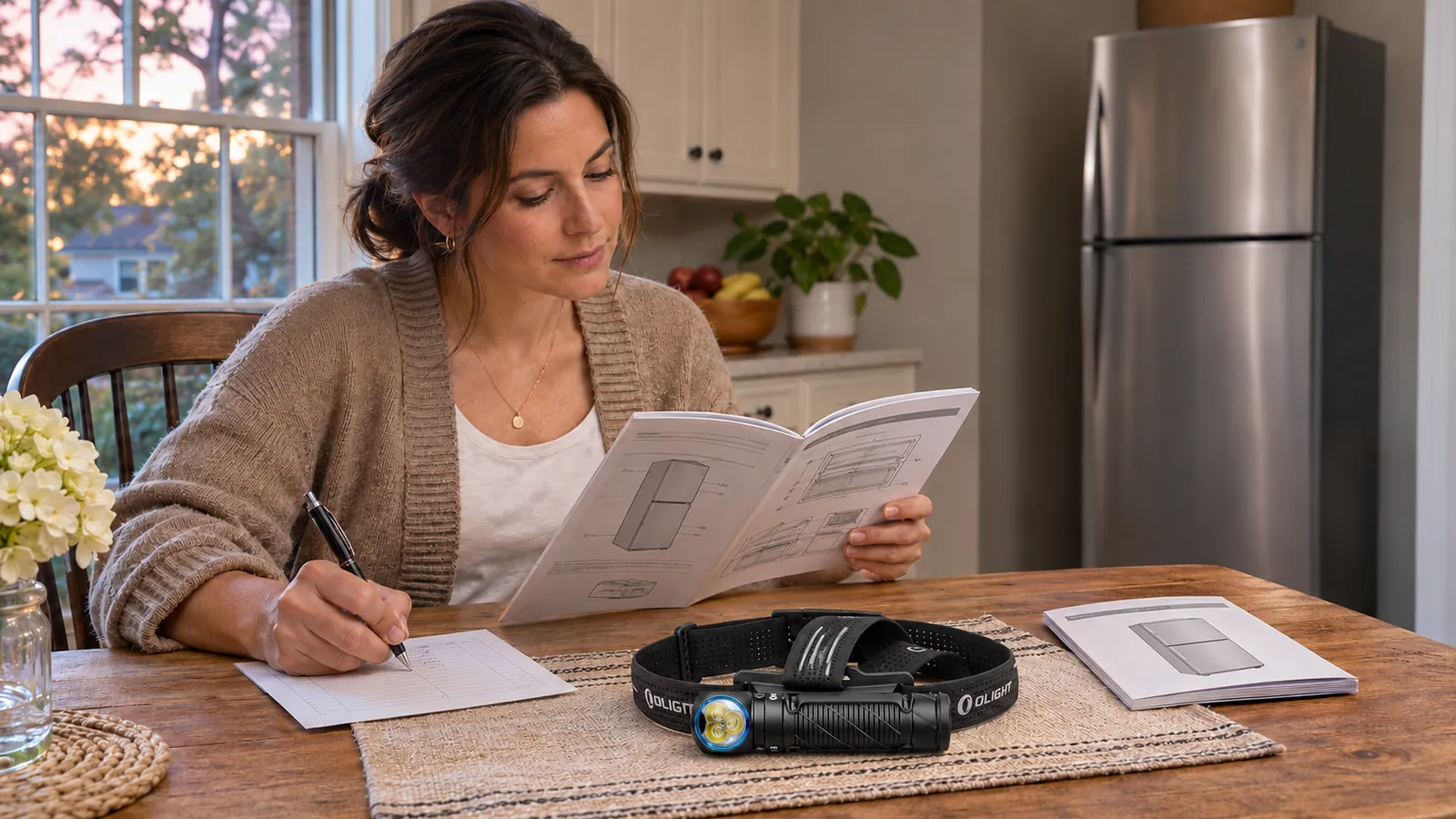
The Olight Perun 3, in its Black configuration, includes a headband, clip, lanyard, and magnetic tail. For this task, a headband can leave an adult's hands available to hold a manual, contact sheet, or other ordinary item at a safe location. The benefit is keeping information readable while managing a device-by-device record, not making electrical work permissible.

Official Perun 3 headband configuration. It can leave hands available for a manual, while the wearer must still manage the beam and footing.
The beam follows the wearer's head. Looking up from a page can direct light toward another person's face, while turning toward a control can leave the walking route darker. Stop in a suitable place to read or adjust the light. Hands being available does not remove the need for dry, clear footing and equipment that is appropriate to approach in the first place.
The Perun 3 offers five white-light modes and two red-light modes, with maximum white output listed at 3,000 lumens. Ordinary white light is the relevant starting point for reading labels, control markings, and instructions. Select a comfortable documented level for the surface and distance. Red light is another option, not a guarantee that every colored warning mark remains easy to distinguish.
Olight lists a 5,000 mAh rechargeable battery and a long runtime on Moonlight. Do not combine that low-mode duration with maximum output when planning an outage. Check charge readiness and the mode needed for the actual reading task, and keep another suitable light available. Battery capacity supports a finite amount of work; it does not establish the length of an interruption or replace a charging plan.
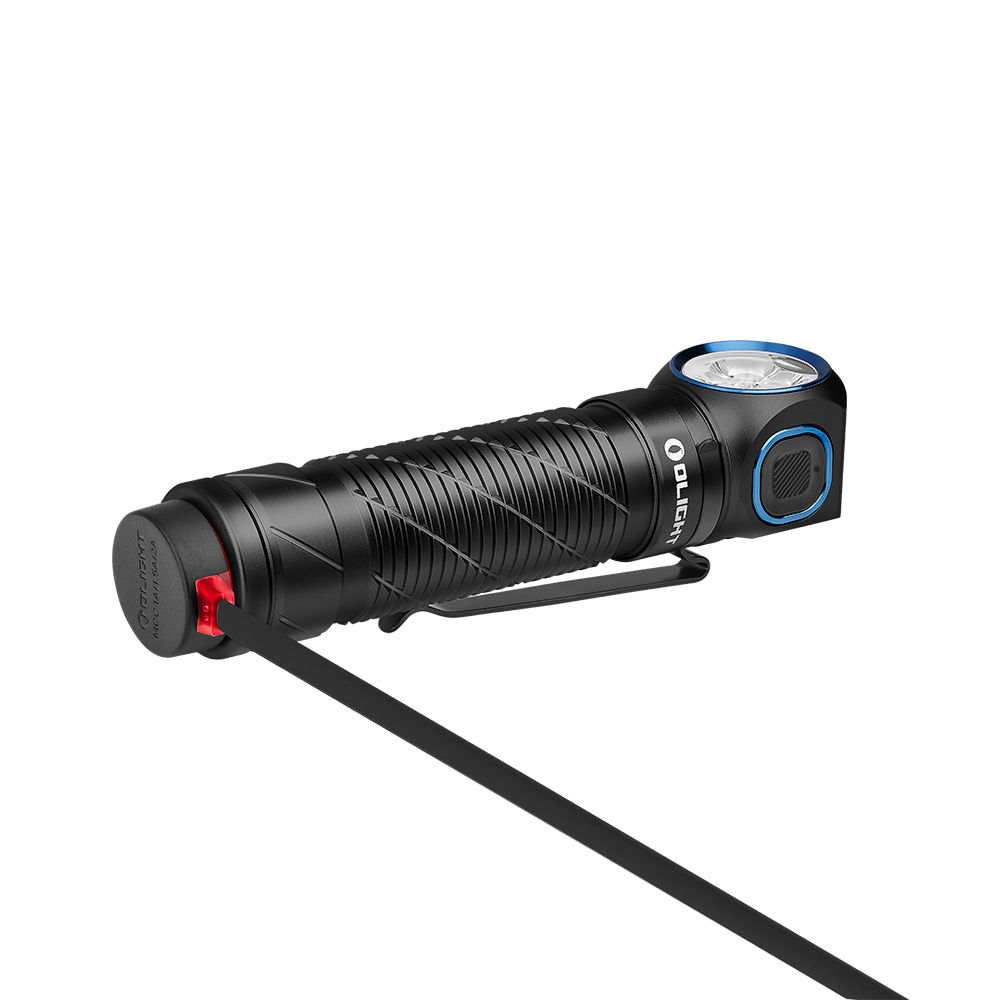
Official Perun 3 magnetic charging connection. Keep compatible charging equipment identifiable and use it only with an appropriate power source.
The large concave metal side button is intended for convenient handling and reduced unwanted activation. It does not establish a lockout procedure or prove that a packed light cannot activate. Learn the exact model's storage and control instructions before an outage, and keep compatible charging equipment identifiable. Do not reconnect it to an affected or questionable outlet merely because other lights have come back on.
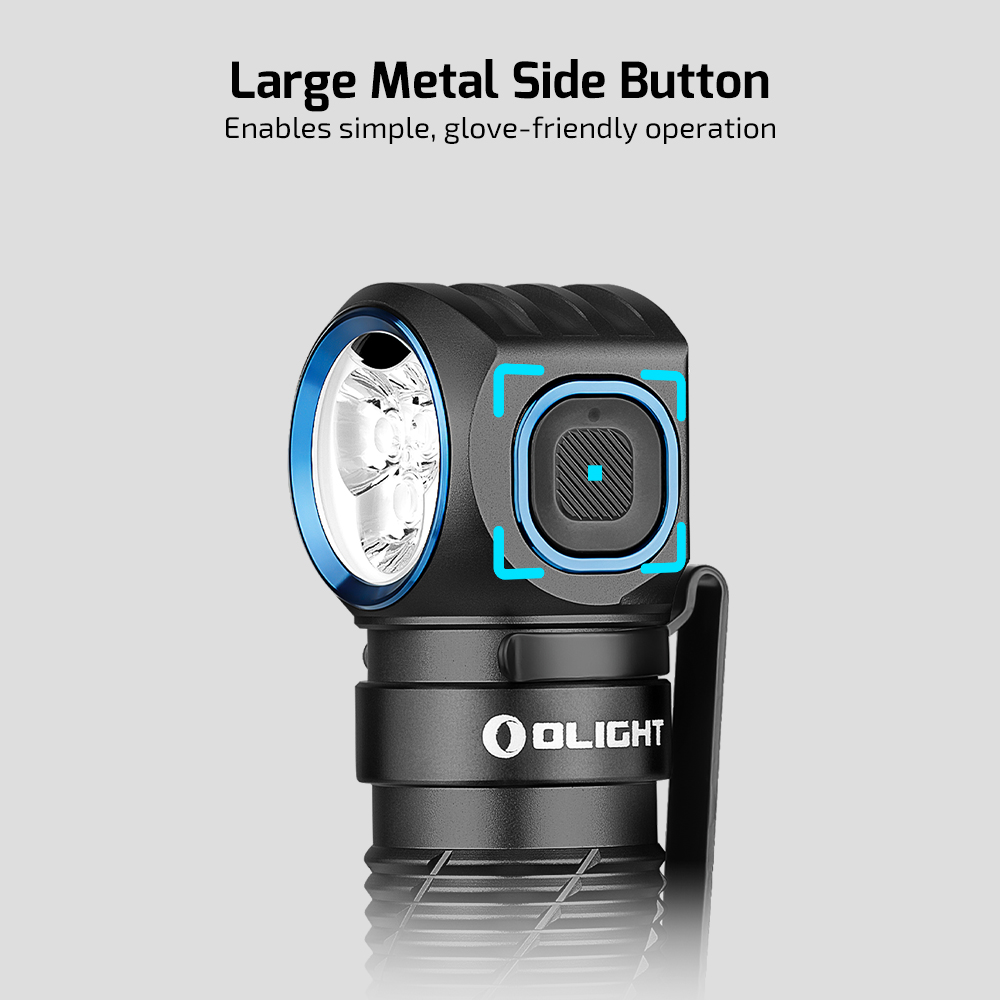
Official Perun 3 side-button detail. Button shape is not a lockout instruction; follow the exact model guidance for controls and storage.
The metal headband bracket can scratch the light's body when the light is repeatedly removed and reinserted, according to Olight's product note. Keep the intended configuration together instead of moving the headband into one bag and the light into another. A familiar arrangement that another adult can use is more useful here than a loose collection of accessories discovered in the dark.
If comparing another headlamp, consider how easily the intended user can select ordinary light, read a page without glare, and manage the beam around companions. If choosing a rechargeable flashlight instead, consider the hand needed to hold it and the exact charging setup. Neither format should be balanced on suspect equipment, held in the mouth, or attached to a service panel to create a repair position.
Keep a short record that survives a change of person
For each important device, note its normal role, the relevant instruction, the state in which it was left, and any follow-up required. A small table is enough. “Turned Off using the normal user control” communicates something different from “power unavailable.” Keep the language accurate so another person understands what was deliberately changed and what simply stopped during the outage.
Include the source of any special direction. A model manual, manufacturer response, medical provider plan, and utility instruction have different scopes. Note which applies to the device rather than blending several pieces of advice into one household rule. If the instructions are unavailable or contradictory, record the unresolved question and arrange the appropriate clarification.
Do not require a complete inventory before dealing with an urgent need. The record can begin with the devices that matter most to the household and expand during normal preparation afterward. Avoid walking through every room, moving appliances, or reaching behind furniture to prove that every connection has been accounted for. An honest incomplete list is preferable to a dangerous search.
Tell the next adult about changes rather than relying only on a mark on a page. If a device was disconnected, its cable moved, or a provider gave specific advice, make that information easy to find. The record should reduce repeated action and mistaken restarts. It should not become a substitute for following the instructions or obtaining help when conditions are unsafe.
Water and toilets depend on the system, too
A toilet is not an electrical appliance in every home, but the surrounding water or wastewater system can depend on electricity. King County's guidance for septic systems during outages explains why continued ordinary water use can cause a backup when powered parts cannot operate. That is a system-specific concern, not a universal number of permitted flushes for every household.
Follow your water utility, property manager, local health authority, and system provider's appropriate guidance. Do not assume that water arriving at a tap proves the wastewater system can handle normal use. If an alarm, backup, or other problem appears, avoid further use that could worsen it and obtain the responsible professional's advice. Do not enter pump chambers or operate electrical controls to investigate.
Plan this question before an outage if the home uses powered sanitation equipment. Keep the provider's instructions and contact details with the household record. A generic household appliance checklist cannot identify the design of a private system from a toilet's appearance. Flooding, sewage backup, or a local water advisory also creates conditions that need their own guidance rather than an improvised flushing method.
Restore the household by confirming individual states
Once normal service appears available and no warning condition makes the equipment unsafe, follow each item's actual restoration instructions. Review deliberate Off settings, any documented automatic recovery, and any remaining question. Do not start everything at once to find out whether the supply will cope, and do not invent a fixed delay that overrides the manufacturer's instructions.
Check what matters for the appliance's task. A refrigerator needs appropriate cooling conditions, not only a lit display. A cooking appliance needs deliberate user attention before cooking resumes. Medical equipment needs the person's approved arrangement. Treat the completion of one check as information about that item, not a blanket clearance for the whole home.
If a device behaves abnormally, leave troubleshooting within the safe user scope of its instructions and arrange appropriate assistance. Keep the symptom and timing in the record without repeated power cycling. An intermittent concern deserves an accurate report even if it stops appearing while someone is watching. Do not turn a temporary return to normal into a claim that the fault has been diagnosed.
After the interruption, update the household's preparation. Save the correct manuals, clarify which equipment remembers settings, and keep the portable light charged with its proper accessories. Resolve the unanswered model questions under normal conditions. The next outage is easier when the plan already distinguishes essential needs, ordinary appliance controls, and work reserved for responsible professionals.
Frequently asked questions
Keep the decision attached to the device
Base each device decision on the household's needs, the exact equipment instructions, and whether the item is safe to approach. Keep those facts with the device record, use ordinary lighting to read them clearly, and let the restoration process remain a series of supported decisions rather than a search for switches in the dark.
Changelog
- November 18, 2026: Product information and buying guidance reviewed.




