


⚡ TL;DR
During a power outage, check people's immediate needs, find independent lighting, and keep a clear route through the home. Give adults specific responsibilities for communication and household information. Preserve phone power for useful contact, keep refrigeration closed, and follow each device's instructions. Urgent hazards or essential medical needs take priority over finishing a checklist.
📋 Table of Contents
- 1. Start with people before assigning tasks
- 2. Bring light to the task without sending everyone searching
- 3. Give each adult a responsibility with a clear handoff
- 4. Make the light's home easier to explain
- 5. Baton 4 Pro: match the controls to a shared household job
- 6. Oclip 2 Pro: separate the attachment point from the beam direction
- 7. Protect the phone's communication role
- 8. Replace a light's job before taking it away
- 9. Keep the record short enough that someone will use it
- 10. Adjust the plan when one adult is managing the household
- 11. Decide the next step from conditions, not a countdown
- 12. Frequently asked questions
- 13. Leave the next adult an understandable arrangement
Start with people before assigning tasks
Ask who is home and whether anyone needs immediate help. A person using powered medical equipment, someone with limited mobility, and a child frightened by darkness may need different support. Establish where people are before sending adults in different directions. Avoid an arrangement in which everyone assumes somebody else stayed with the person who needs assistance.
Follow an established medical backup plan and the equipment provider's instructions. The CDC's power-source preparedness guidance identifies emergency lighting and backup arrangements for personal and medical equipment as separate needs. A charged flashlight can help someone read instructions; it cannot establish that a medical device has a suitable power supply or that a person can remain at home.
If you see smoke or fire, leave and call emergency services from a safe location. Keep away from damaged electrical equipment, floodwater, and fallen lines. A burning odor, suspected gas leak, or another warning condition takes precedence over finding every light or checking every appliance. Do not stay to complete household tasks when the appropriate action is getting people away from danger.
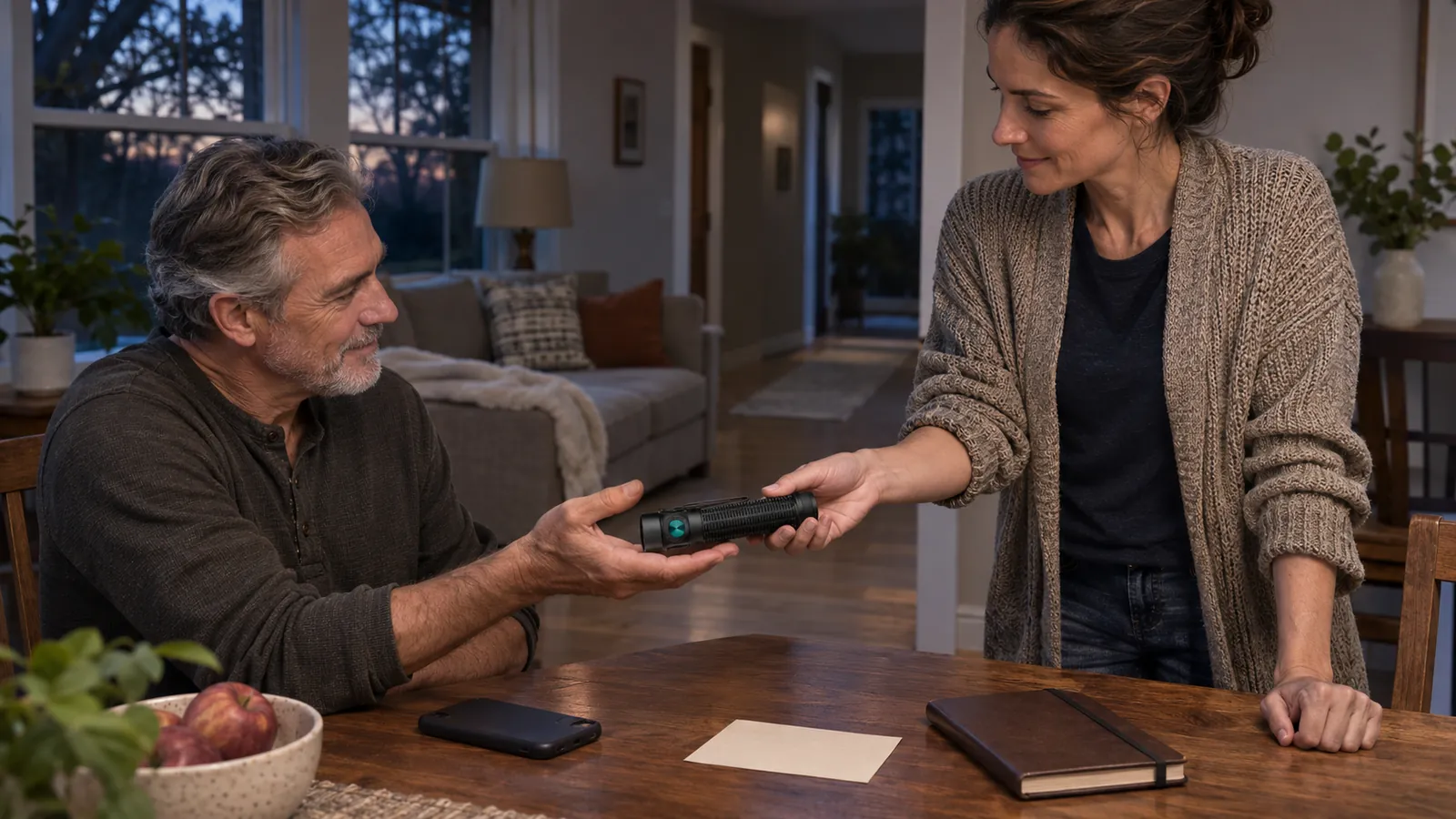
Give the household a simple immediate direction. For example, an adult can ask everyone to remain together in a suitable clear area while another retrieves the familiar light. Choose the location around actual conditions and accessibility. A room at the far end of stairs may be a poor meeting place for someone who cannot reach it comfortably.
Avoid treating elapsed time as a measure of success. A household with an essential power-dependent need may have to leave before discussing ordinary equipment. Another may have time to contact a support person and organize a calm evening. The next action should follow the need, rather than a promise to finish everything within a fixed number of minutes.
Bring light to the task without sending everyone searching
Use the nearest familiar, working portable light to make an immediate area and route visible. The phone flashlight can serve as a temporary bridge if it is what you have. Once another suitable light is available, keep the phone available for calls, alerts, and useful information. Avoid making one device responsible for every household function throughout an uncertain interruption.
Aim the beam toward the floor or the item someone needs to identify, away from faces and reflective surfaces. More output can create glare on a white wall, a mirror, or a glossy instruction sheet. Adjust the direction and choose a useful working level before assuming that the highest setting will make close tasks easier.
Keep an adult with anyone who needs assistance moving. A light left in a hallway does not provide supervision, and a child should not have to follow a distant beam through dark rooms. Describe a change of level or an obstacle before moving, and allow the person time to respond. Follow their usual mobility arrangements instead of improvising physical assistance.
The CDC's power outage safety guidance favors battery-powered lighting over candles to reduce fire risk. The same guidance warns about electrical hazards and combustion equipment. Keep generators and fuel-burning camping equipment out of the home and garage; a brighter portable light does not make an unsafe heating or power arrangement acceptable.
Avoid carrying an armful of lights, cables, and bags while helping someone through a doorway. Identify the immediate destination, bring the equipment needed for that task, and keep the route free of loose items. Later, when people are settled, another adult can organize the remaining supplies in a suitable location.
Give each adult a responsibility with a clear handoff
Assign work by what people can safely do, not simply by age or who usually handles household equipment. One adult may stay with children or a family member who needs help. Another can handle the phone and available official updates. If both tasks fall to one person, narrow the plan instead of expecting that person to cover the whole home at once.
Name the responsibility out loud. “Please stay here with Dad while I make this call” conveys more than “Can you help?” Confirm that the other adult heard and accepted the task. The goal is to prevent a gap in support while several people believe that someone else has already acted.
| Responsibility | Useful handoff | Common gap to avoid |
|---|---|---|
| People and immediate needs | Who is together, who needs help, and what the care plan requires | Two adults both leave to find equipment |
| Portable lighting | Which light is in use, where the spare is, and who has it | Someone takes the only light without telling others |
| Communication | Who contacted whom and what response came back | Several people make the same call or nobody makes it |
| Household record | What is known, what changed, and what still needs clarification | A guess becomes the next person's instruction |
Keep the assignment small enough to finish and report. Someone checking the utility's official update can return with the information available and its time. That person does not need to investigate the electrical panel or visit neighboring homes to prove the cause. Ordinary observations and an official estimate still have limits.
Agree on the next point of contact. If an adult moves to another suitable room, say where they will be and which light they are taking. If a support person is coming, identify who will communicate with that person. Revisit the assignments when the household's needs change, rather than keeping a role merely because it was the first one chosen.
Make the light's home easier to explain
Choose a consistent storage place during normal conditions. It should be accessible to the intended adult, compatible with the light's care instructions, and clear of clutter. Keep it separate from a location that requires opening a service enclosure or reaching around questionable electrical equipment. A familiar hook or organizer is useful only if people can reach it safely.
Describe the place in terms another adult can understand. “The black light in the entry organizer” works better than “the flashlight somewhere by my things.” If the item moves into a bag for a trip, tell the household and restore the usual arrangement afterward. A planned location that is often empty creates a new search instead of preventing one.
Store the appropriate charging equipment where its identity remains clear. A USB cable, a magnetic charging lead, and a charging accessory may serve different products. Give each its model name or an understandable label. Avoid leaving several similar cables together and assuming that the next person will recognize the right one in dim light.
Prepare a second suitable light with an independent energy source. Two charging cables attached to one empty flashlight do not provide two lights. Likewise, a spare that depends on borrowing the same removable battery may leave the household without a working backup. Check the actual configuration and make sure another adult knows which equipment is ready.
Baton 4 Pro: match the controls to a shared household job
The Olight Baton 4 Pro, in Matte Black CW, combines a side switch with a textured tail switch. Olight lists five brightness levels through the side switch and access to High and Turbo through the tail switch, with momentary and constant-on control. For household preparation, the useful distinction is knowing which control gives the intended ordinary light before someone picks it up during an outage.
A second adult may grip the light differently from its usual owner. Explain the controls using the actual model's instructions, and practice the ordinary working setting under normal conditions. Avoid handing over a powerful light with only “press the button” as an explanation when it has more than one switch. Keep the beam away from people while becoming familiar with it.
The listed maximum output is 1,600 lumens. Reading a contact sheet at a table usually presents a different lighting task from looking along a dark outdoor path. Choose a documented setting around the surface, distance, and people nearby. The maximum figure does not describe the brightness needed for every room or how long that brightness will last.
Olight describes the body's grip pattern as a combination of shallow grooves and deeper indentations. That texture can help an adult maintain an ordinary grip while moving the beam between nearby objects. It does not provide electrical protection or make it appropriate to hold the light against suspect equipment. Keep the grip clear of the lens and follow the product's handling instructions.
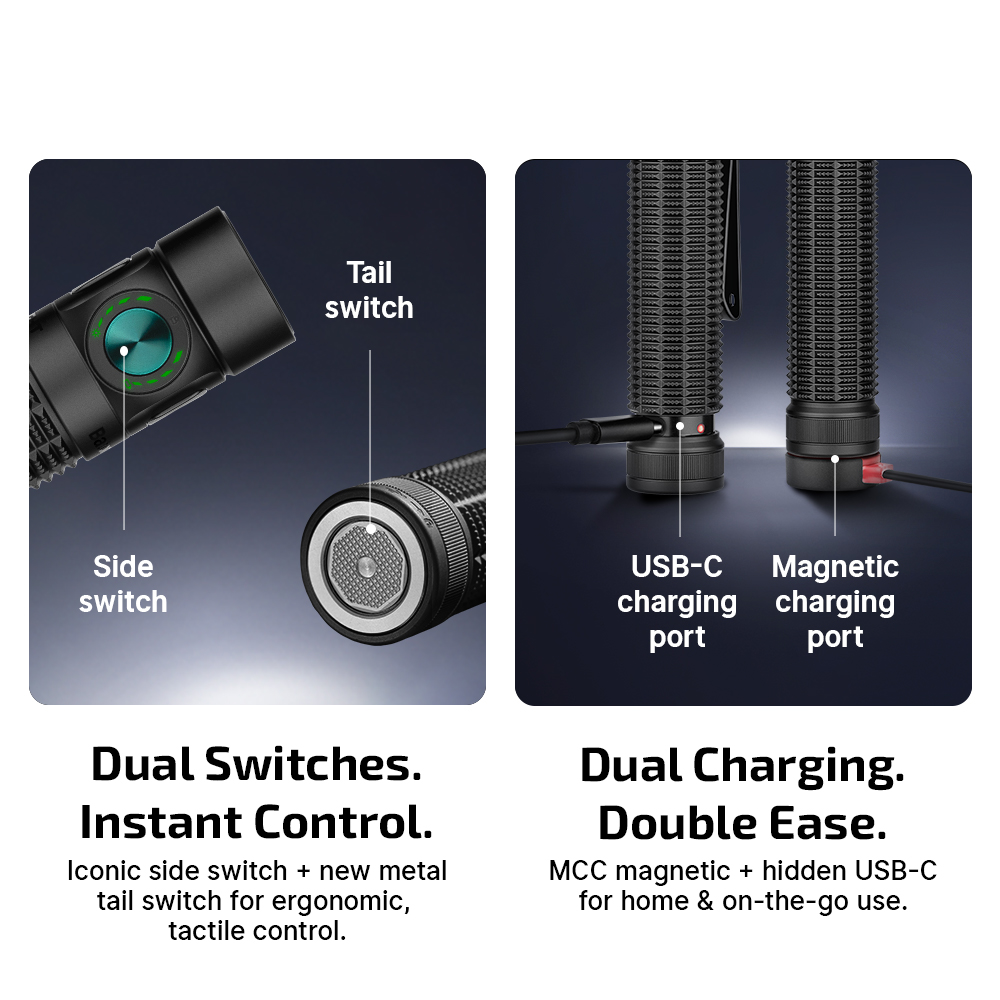
Official Baton 4 Pro diagram: the two switches and two charging connections occupy different parts of the light.
The Baton 4 Pro supports magnetic charging and has a USB-C port concealed by a rotating tailcap ring. This offers two charging approaches, but the household still needs a compatible power source and the appropriate equipment. Check what comes with the exact package instead of assuming that owning the flashlight includes every possible charging lead.
The covered port also creates a preparation task: show the next adult where the connection is, using the actual instructions, before the room is dark. Do not mistake an unfamiliar cover for a missing port or force a cable into another opening. Charge under the specified conditions and keep connections dry and undamaged.
Brightness, battery, and lockout indicators provide different information. A person who sees an unfamiliar icon should know where to find its meaning instead of deciding that the light is empty or broken. Learn the model's documented lockout behavior for carrying and storage; the presence of an icon alone does not establish the button sequence.
The listed battery capacity is 3,500 mAh, and Olight specifies up to 100 days on Moonlight. That duration belongs to that low mode, not to the maximum-output figure. For a household plan, identify the setting that makes the actual task readable and maintain a usable backup. Battery capacity does not tell you when utility service will return.
Oclip 2 Pro: separate the attachment point from the beam direction
The Olight Oclip 2 Pro, in its standalone Black configuration, uses a head that tilts through 115 degrees and a clip that rotates through 360 degrees. These adjustments can help an adult aim ordinary light toward a page or nearby object while keeping an appropriate attachment point. The available place to clip the light and the useful direction for its beam do not have to match.
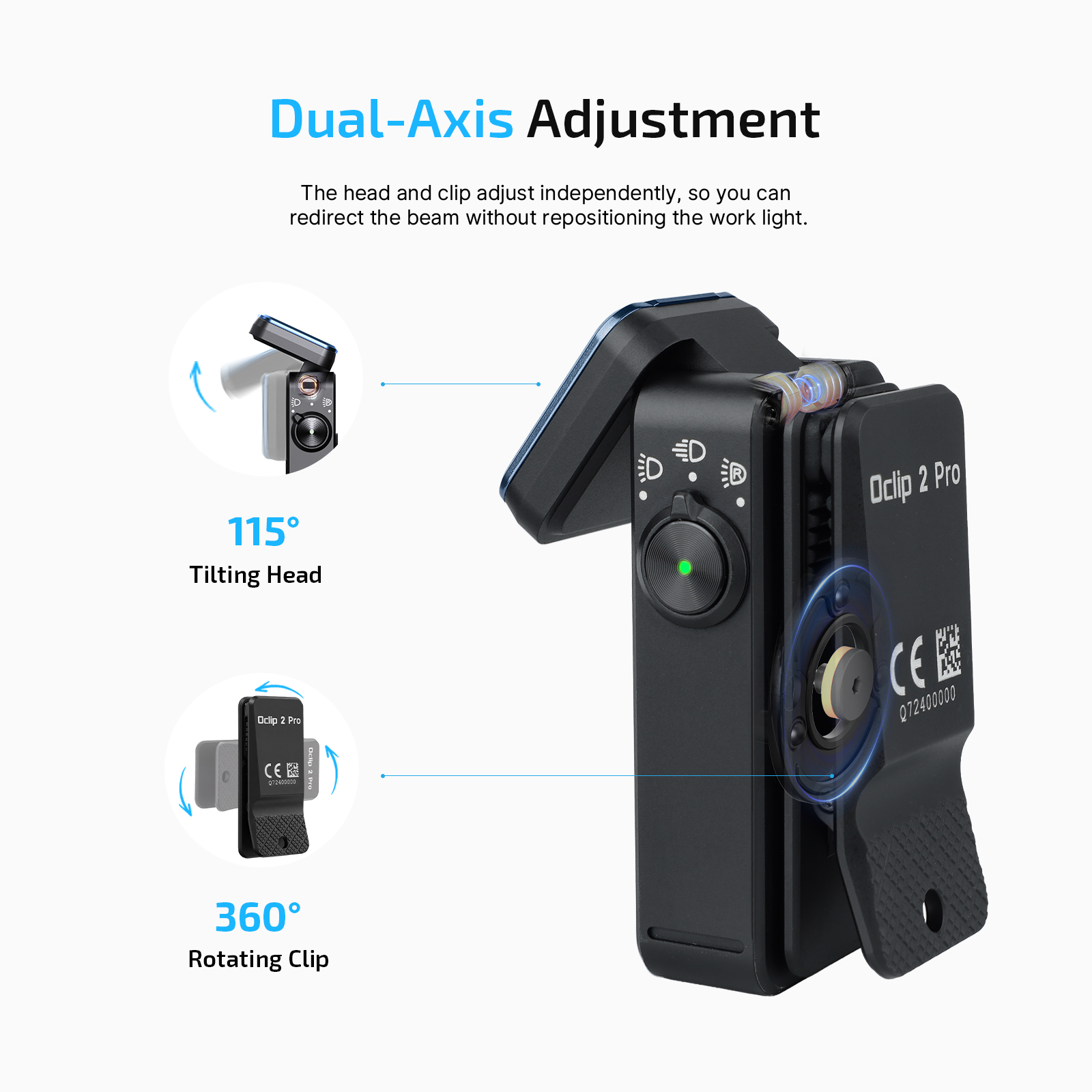
Official Oclip 2 Pro diagram. The head and clip adjust independently; a suitable support and stable attachment still need to be checked.
That benefit depends on the actual support. Olight lists a clip opening for objects up to 14 millimeters thick, but thickness alone does not establish that a particular fabric edge will hold it securely. Check the material, stability, and beam direction under normal conditions. Avoid a loose attachment that can swing toward someone's face, drop onto a hard floor, or disappear inside clothing.
For a seated adult holding a contact sheet, a suitable attachment can reduce the need to juggle a phone, paper, and handheld light. Keep the clothing and support clear of the light outlet, and use the product only in an arrangement its instructions permit. If the light moves while the person turns, pause and correct the position before continuing the task.
The selector offers floodlight, spotlight, and red light. Olight lists up to 530 lumens for the floodlight and a maximum 125-meter spotlight distance; those are different specifications for different light sources. A nearby household record calls for a suitable ordinary working setting, not an attempt to use the longest-distance figure indoors. Red light also changes how colored markings appear, so do not assume that it makes every label easier to interpret.
USB-C and magnetic charging provide charging options when compatible equipment and power are available. The Mobile Charging Dock described for the Premium version is a separate configuration. The standalone Black light should not be credited with an accessory merely because the product page also offers a kit. Check the exact version when assigning the light and charging equipment to a household member.
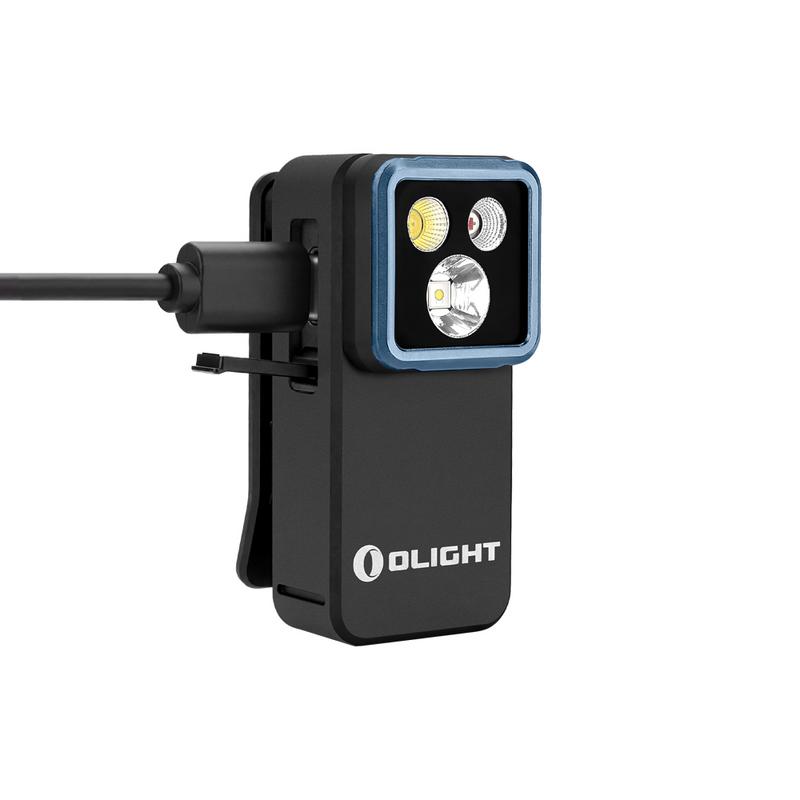
Official Oclip 2 Pro USB-C connection. Prepare compatible equipment for the selected version; this standalone light image does not include a Premium dock.
Neither the clip nor the magnets make a household electrical cabinet a recommended mounting location. Choose a suitable ordinary support away from service equipment, moisture, and surfaces that could damage the light or be affected by its heat. If no secure position suits the task, change the lighting arrangement rather than forcing an attachment.
Protect the phone's communication role
Use the phone light long enough to obtain the independent light when that is the available option. Then consider what else the phone needs to do: receive an official update, contact a provider, coordinate with relatives, or access an important record. Avoid leaving it illuminating a room while everyone repeatedly checks the same information on several other screens.
Pick one person to gather updates and share the relevant facts. Record when an estimate was issued and whether it has changed. A restoration estimate is useful planning information, but it does not guarantee that a particular home or device will be ready at that time. Continue to make decisions around essential needs and the conditions you can actually observe.
Agree on a concise message for relatives who do not need an emergency call. State who is together, whether help is needed, and how you will communicate next. Use an available channel that suits the situation; do not assume that a text, internet connection, or cellular service will always work. Seek emergency help through the appropriate available means when the situation is urgent.
Check power banks and charging leads as separate items. A charged power bank without the correct cable may not support the phone you need, while a cable connected to an unpowered wall adapter supplies no energy. Preserve the household's essential approved arrangements and avoid improvised wiring. Do not run a vehicle in a garage or another enclosed space to create a charging station.
Keep a paper copy of important contact information where the household can find it. The American Red Cross's household outage preparedness guidance includes a support network and a paper contact list. A printed number does not replace the ability to make a call, but it lets another adult identify the intended contact without first unlocking someone else's phone.
Replace a light's job before taking it away
Before an adult takes the working light to another room, identify what will illuminate the people staying behind. Say where the light is going and whether a suitable spare is available. The adult making a call may not notice that someone has removed the only light from the table. Check the arrangement before moving, rather than assuming the other person can finish in darkness.
If a light needs charging, make the change while a working source remains available. Confirm that the replacement provides usable illumination and that its intended user recognizes the controls. Then follow the first light's charging instructions in a suitable location. Keep the charging lead away from the walking route, and retain the connection's identity so another person does not disconnect it to borrow the cable without understanding what it serves.
An indicator can help prompt that handoff, but it does not measure how long the household can continue its present activity. The selected setting, actual battery condition, and time already in use affect the remaining work. Check the model's indication meanings and avoid a precise remaining-hours claim unless the device provides an appropriate documented estimate under the circumstances.
Return the light to its agreed place when the task ends, or tell the next adult where it remains in use. A clipped light still attached to a jacket can leave with its wearer, while a handheld light can disappear into a pocket. Include that change in the brief handoff. The household needs to know where the light is now, not only where it is usually stored.
Keep the record short enough that someone will use it
Write the time you noticed the interruption and the information actually available. Separate an observation from an explanation. “The room lights went out” tells the next adult what happened; “the main breaker failed” asserts a cause that an ordinary household observation has not established. Preserve uncertainty when you do not know.
List the responsibilities that somebody accepted and the actions that person reported back. Note which light is in use, where the spare is, and whether someone contacted a support person. If advice came from a utility, device provider, or emergency official, record its source and the relevant instruction. Keep personal information limited to what the household needs.
Distinguish an appliance that stopped with the power from one an adult deliberately left Off. Follow the exact device instructions when a safe ordinary user action is appropriate. Do not send somebody around the home to unplug everything, move heavy appliances, or operate the electrical panel merely to fill out the record. Essential equipment and refrigeration need their own supported decisions.
Keep refrigerator and freezer doors closed as much as possible. Record useful outage information for a later food-safety decision without repeatedly opening a door to inspect the interior light. Food and temperature-sensitive medicine require appropriate guidance beyond a lighting plan. A return of power or a cold appearance does not reconstruct their earlier temperature history.
Adjust the plan when one adult is managing the household
Keep people who need assistance within an appropriate supervised arrangement. A long list of jobs becomes impractical if completing one leaves a child or another dependent person alone in darkness. Use the support network and seek the help needed rather than assuming the household must handle every task without assistance.
Combine nearby tasks where it helps. Read a contact sheet at the place where people are already settled, and keep the phone and suitable light within reach. Avoid moving repeatedly between storage areas because several supplies have unrelated homes. During normal preparation, bring the necessary information and compatible charging equipment into an arrangement that another adult can understand.
Give children simple, age-appropriate directions that keep them with the responsible adult. Do not assign them to inspect dark rooms, operate unfamiliar appliances, handle loose batteries, or collect a hot light. For an adult with limited vision or mobility, use their normal communication and assistance preferences. Brightness alone does not resolve a route they cannot safely navigate.
If you must leave, take the items needed for the person's actual plan, communication, and safe movement without delaying an urgent departure to collect the full lighting kit. Keep the destination and contact arrangement clear. A flashlight is useful equipment, but it does not replace transportation, a suitable environment, or essential care.
Decide the next step from conditions, not a countdown
Reassess whether people can remain in the home as the interruption continues. Consider essential power needs, indoor heat or cold, accessibility, and official advice. Avoid treating a predicted restoration time as a reason to postpone help when the household's current arrangement no longer meets someone's needs.
If a facility, school, apartment building, or workplace has an emergency plan, follow the responsible person's instructions for that location. A household lighting checklist does not replace a facility's evacuation, accessibility, or equipment procedures. Ask for assistance through the designated contact instead of applying unfamiliar household steps to shared systems.
Keep ordinary lights and essential approved power arrangements distinct. A flashlight that has enough energy for a short walk may not suit a stationary task for the rest of the evening. For a rechargeable flashlight, plan the appropriate charging equipment and an independent backup around the task. Do not add together unrelated advertised runtimes and treat the total as household coverage.
When selecting an EDC flashlight, consider who will carry it, how the controls feel to that person, and whether its usual location is easy to explain. A familiar small light can help an adult reach the next appropriate decision without searching for a larger kit. Keep it maintained as part of normal household preparation rather than waiting for darkness to expose a missing cable or unfamiliar control.
Frequently asked questions
Leave the next adult an understandable arrangement
Keep the working light, the available spare, the contact information, and the household's next decision clear. Confirm who is staying with whom and which responsibilities have been accepted. Update the record when information or needs change. A useful outage plan helps the next adult continue the work without repeating a search, guessing what another person did, or treating a lighting tool as proof that the home is safe.
Changelog
- November 18, 2026: Product information and buying guidance reviewed.




