TL;DR: The best aviation flashlight is a dependable, easy-to-reach light that fits the aircraft and operator’s rules. White light is useful for ground inspection and reading when required; dim red may help preserve some dark adaptation, but it can distort chart colors. Carry a separate backup and follow the applicable checklist.
📋 Table of Contents
- 1. A Source-Based Way to Compare Night-Flying Flashlights
- 2. Dark Adaptation Takes Time, and Bright White Light Can Disrupt It
- 3. Red Light Can Distort Aeronautical Chart Colors
- 4. Plan White Light for the Preflight Walk-Around
- 5. Flashlight Requirements Depend on the Operation
- 6. Common misconception: a darker cockpit is always better
- 7. What is the best flashlight for airline pilots?
- 8. Is a 200,000 lumen flashlight legal?
- 9. What are the best flashlights for aviation?
- 10. Frequently Asked Questions
A Source-Based Way to Compare Night-Flying Flashlights
Choose a dependable light with a clearly understood control, a low usable setting, and a way to keep it within reach without interfering with approved cockpit equipment. A red option can support some low-light tasks, but white must remain available for color-dependent reading. A separate backup is useful when a single light is misplaced or unavailable.
| Task | Light choice to consider | Practical check |
|---|---|---|
| Ground inspection before flight | Controlled white light | Use the aircraft checklist and approved procedures. |
| Reading a chart or label | White when color matters | Red can distort chart colors. Use only lighting allowed for the task. |
| Hands-free task on the ground | A headlamp or clip light | Check compatibility with clothing and headsets. Do not assume cockpit approval. |
| Backup if the primary light is misplaced | A separate, familiar light | Check it before departure and keep it in a consistent place. |
The table is a comparison framework, not an approval list. A product feature can make a light easier to carry or operate, but it cannot determine whether that light is permitted in a particular aircraft, operation, or cockpit. The pilot’s operating handbook, operator procedures, aircraft limitations, and applicable rules take priority.
Night-flying equipment questions often mix three separate jobs: seeing outside, reading color-coded information, and keeping a light available if the primary one is not where expected. One flashlight may cover more than one job. That does not mean one beam color or one mounting style is right for every phase of a flight.
A good selection starts with the task and the rules that govern it. A compact light may be convenient on a walk-around. A red mode may feel less disruptive in a dark environment. A dim white mode may be the better choice for a page or label where color matters. A hands-free option may be convenient on the ground yet distracting or incompatible in a specific cockpit.
The FAA Airplane Flying Handbook, Chapter 11 discusses night operations and recommends having a reliable flashlight available. The FAA’s guidance is training material, not a product endorsement. The exact checklist and equipment requirements depend on the aircraft and operation.
Dark Adaptation Takes Time, and Bright White Light Can Disrupt It
Dark adaptation is gradual. The FAA’s Aeronautical Information Manual says complete adaptation can take at least 30 minutes in total darkness, while a moderate degree may develop within 20 minutes under dim red cockpit lighting. The same guidance warns that bright light can impair adaptation within seconds. These are general vision principles, not a promise that every pilot or cockpit will respond on a fixed timer.
“Wait 20 minutes and everything is solved” is too simple. The FAA’s numbers describe degrees of adaptation under stated conditions. They do not mean a pilot can substitute a stopwatch for training, a cockpit procedure, or the ability to see the required information. Fatigue, age, health, ambient light, and the particular task may all affect what a person notices. The FAA Aeronautical Information Manual section on vision in flight explains that night vision becomes more sensitive in darkness and that bright illumination can quickly reduce that adaptation.
The practical lesson is to plan for more than one kind of viewing. If a task requires color or small print, adequate white illumination may be necessary. If a pilot needs to preserve some outside night vision, dimmer lighting may be preferred when it still allows the task to be completed. Neither choice should override an aircraft manual or operator rule.
A light’s lowest setting matters only if it is low enough for the actual task and easy to select without confusion. A control with several modes can be useful, but only after the user understands the sequence. Before a flight, learn the light’s controls in a safe, ordinary setting. Avoid testing an unfamiliar control while attention belongs elsewhere.
It can also help to separate preparation from flight. Before leaving the ramp, place a primary light and backup where they can be reached without searching. Confirm that each works and that the chosen control is understood. During flight, use the applicable checklist and operator procedures rather than experimenting with brightness settings or accessories.
A bright light does not need to point directly into someone’s eyes to create a problem. Reflection from a shiny surface can produce glare. A beam that bounces from a windshield, polished panel, or glossy page may be more distracting than its output number suggests. Use a setting and position consistent with the aircraft procedures, and do not reposition equipment in a way that distracts from an active task.
Why red is not a universal night-vision setting
Red light can help preserve some dark adaptation under conditions described by FAA guidance. That does not make it the best setting for every indoor aviation task. The FAA notes that red light can severely distort colors, particularly on aeronautical charts, and can make it harder to focus on objects inside the aircraft. White cockpit lighting must be available when needed for maps and instruments, especially under instrument flight rules.
That is why “red is always better at night” is not a safe rule. It ignores what the person needs to see. A red mode can be one option for a low-light task. A chart, colored mark, warning label, or instrument may require a different light. A device that offers both red and white gives options, but the person still needs to choose a mode appropriate to the task and permitted by procedure.
If a colored mark on a chart seems hard to distinguish under red illumination, do not assume the chart is missing the information or that the light is defective. The color rendering may have changed. Switch to the illumination and method allowed for that reading task. Avoid making decisions from a color that is not being reproduced reliably.
This matters beyond charts. Red illumination can change how colored labels, wires, containers, or status indicators appear. If a ground inspection involves identifying a color, use white light when the relevant procedure allows it. If the procedure specifies a different method, follow that method. The flashlight is there to help someone see, not to replace the document or inspection standard.
Red also does not guarantee a person will retain useful night vision. A high setting, a reflective surface, or a sudden close-range flash can still be disruptive. A red LED may be more comfortable in some settings, but the beam’s brightness, direction, duration, and environment matter. The practical comparison is not “red safe, white unsafe.” It is “which permitted light lets the user complete the task while creating the least avoidable glare?”
Use the FAA’s advice without turning it into a product test
The FAA’s publications discuss human vision and night procedures. They do not compare consumer flashlight models or certify their modes for use in aircraft. A product page may identify colors, outputs, or controls. Those details are not the same as a flight test, cockpit compatibility test, or FAA approval.
This guide does not measure a beam on a chart, photograph disappearing marks, or rank products by lux readings. Such a result would depend on the exact chart, distance, surface, ambient illumination, camera, exposure, and viewing angle. A phone photograph cannot reproduce how a pilot sees colored information. The useful answer here comes from the FAA’s published guidance and the manufacturer’s documented product information.
That distinction keeps a reader from treating a marketing number as a decision rule. More lumens do not automatically mean better chart reading. A higher output may be useful for some ground tasks, but the environment and permitted use still matter. A low setting may be easier to manage in a dark space, but its exact usefulness depends on the task and the person.
Red Light Can Distort Aeronautical Chart Colors
Red illumination changes the apparent contrast of colors that contain red. The FAA specifically warns that red light severely distorts colors on aeronautical charts and may make focusing on objects inside the aircraft difficult. A chart mark can become difficult to distinguish even though it remains printed on the page. The light changes the viewing conditions; it does not alter the chart.
Charts contain information in more than one visual form. Color may work together with symbols, line styles, labels, and position. If a red lamp makes a colored distinction less clear, do not infer that the information is absent or unimportant. Use the lighting method appropriate to the chart task and verify the information against the chart legend and applicable source. A flashlight does not make a chart current or substitute for checking its effective date.
A useful everyday example is a red annotation written on a white page. Under red light, the mark can lose contrast with the surrounding background. Similar effects can occur with printed maps, colored instrument marks, or safety labels. This is why an aircraft’s available white cockpit lighting matters even when a pilot prefers red for a different low-light task.
White light has its own tradeoff. A bright white beam can be uncomfortable, create glare, or interfere with dark adaptation. That is not a reason to avoid white whenever color matters. It is a reason to use an appropriate amount of light, aim it only as permitted, and avoid lighting shiny surfaces in a way that creates distracting reflections.
A red setting may help with a quick look at a monochrome note but be a poor choice for interpreting a color-coded display. A white setting may help reveal a color but be unnecessarily intense for a different task. A useful flashlight is therefore one that provides a range of controlled choices and can be operated predictably. No mode removes the need to understand the material being read.
Do not let the camera make the decision
A phone camera is not a reliable proxy for human chart vision. Automatic exposure and white balance can brighten a dim frame, shift hues, or flatten differences. A phone’s night mode may combine frames. A photo can therefore make a chart look easier or harder to read than it was to the person in the room.
The same limitation applies to a screenshot of a product review or a side-by-side web comparison. A screen may use a different display, brightness, color profile, or filter. It cannot establish that a particular red flashlight preserves the chart’s color information. For the same reason, the article does not present a “red versus white” photo as proof of visibility.
The useful procedure is documentary, not experimental: identify what the FAA says about red light and charts, identify what the product’s official manual says about its modes, and then ask whether the aircraft or operator permits the proposed light. Keep those claims separate. Do not make a product claim appear to follow from a general FAA vision principle.
When white light is the right tool
White light can be the appropriate choice when a task depends on color, a label is hard to read, or the available approved lighting does not provide enough detail. That does not mean a flashlight should be turned on automatically. The aircraft procedure or operator rule decides how and when lighting may be used. In some settings, built-in cockpit lighting may be the right source.
A pilot reading a colored chart may need white illumination even after using red lighting for another task. A person checking a ground item may also need white to identify a color or surface detail. If white light creates glare, adjust the task or light only in a way consistent with the procedure. The goal is readable information, not maximum brightness.
Plan White Light for the Preflight Walk-Around
A flashlight is a support tool for an inspection, not the inspection procedure itself. The airplane’s checklist and any required maintenance or operator guidance determine what to examine. A beam can help illuminate a surface, but it cannot prove that an item is serviceable, reveal every defect, or replace the required observation method.
For a ground task, consider whether the light is easy to hold, whether a hands-free format is permitted and practical, and whether its controls are familiar. A headlamp can leave both hands available. A clip light can attach to clothing or a permitted bag. A handheld flashlight can be directed separately from the user’s gaze. Those are format differences, not guarantees of inspection quality.
Avoid placing a magnet, clip, or loose object on aircraft surfaces, instruments, controls, or other equipment unless the aircraft/operator guidance explicitly permits it. A product’s magnet or clip is designed for everyday use, not necessarily aircraft hardware. The article does not recommend attaching a flashlight to an aircraft panel, flight control, wiring, compass, headset, or any other flight equipment.
A systematic walk-around is guided by the aircraft checklist. Lighting should help the pilot see the task area without changing or skipping the checklist. If the light is unstable, has an unfamiliar control, or makes a reflection worse, stop and use the approved alternative. Do not improvise an inspection technique based on a product advertisement or a general flashlight guide. Readers comparing portable cockpit lighting with maintenance tasks can also review Olight’s aviation mechanic flashlight guide, which focuses on lighting tasks around aircraft on the ground.
A high-output mode can make a large area visible, but a lower setting may be easier to control near a surface. A broad beam can illuminate a wider area; a narrower beam can concentrate light. Those are common beam characteristics, not a guarantee that one pattern will reveal a particular defect. The correct method depends on the inspection and aircraft instructions.
The key setup decision is access. Keep a working light in a location where it can be retrieved without searching through loose items. If a second light is carried, give it a separate, predictable location. If a light is rechargeable, check its charge before departure and follow the manufacturer’s storage instructions. If a light uses replaceable batteries, check condition and orientation according to its manual. Do not depend on a battery indicator alone as evidence that the light will remain available for every intended task.
Choose the beam pattern for the object, not the headline
Product pages often lead with a maximum output or a beam distance. Those figures describe specific manufacturer conditions. They do not tell a pilot exactly how a beam will appear on a particular aircraft surface, chart, or cockpit material. The distance, angle, background, surface finish, and ambient light all change what can be seen.
A flood beam can illuminate a broad nearby area. A spotlight concentrates light into a narrower region. Some lights offer both. A user who wants to inspect a broad surface and then look at a small label may value having options. However, a wide beam can also light nearby reflective surfaces, and a narrow beam can create a bright spot that feels intense. The mode should suit the task and the permitted setting.
Mode names do not standardize brightness across brands or products. “Low” on one device is not automatically equivalent to “Low” on another. Exact lumen figures may describe output at the source, not the light arriving at a page or panel. For this reason, a comparison table should list manufacturer-published information without inventing a matched-condition test.
Carry format: handheld, clip-on, or headlamp
A headlamp keeps a light attached to a headband and can leave both hands free. That feature may be useful on the ground when allowed by the operator and when it does not interfere with other equipment. In a cockpit, a headband, lamp body, strap, or beam can conflict with a headset or field of view. There is no universal claim that it is allowed or preferred.
A clip-on flashlight can be convenient to carry on clothing or a bag. The clip can make the light easier to find, but it does not secure the tool to every garment or prove that the garment is suitable. Test retention in ordinary, safe handling conditions before relying on it. Use a carry point approved for the setting, and do not clip a light to a control, panel, or safety equipment.
A handheld light gives the user control over beam direction without requiring a headband or clip. It still needs a storage location and a predictable return point. If it is set down between tasks, it may be harder to find in the dark. A lanyard or pocket may help with retention, but accessories should not interfere with movement or aircraft equipment.
The right headlamp is not automatically the right cockpit light. A headlamp can be useful during a ground task, while a hand-carried option may be more suitable for other situations. Decide how and where it will be used before selecting a format. Follow operator procedures, and avoid using an accessory in a way that blocks a view or occupies a control.
A small clip flashlight can also be a convenient carry format, but a clip’s everyday convenience does not establish aircraft compatibility. Review the product’s official attachment design and the aircraft/operator instructions separately. Never rely on a clip or magnet to retain a light on a moving aircraft component.
| Format | Potential advantage | Question to resolve before use |
|---|---|---|
| Handheld | Beam can be directed independently | Where will it be stored and returned between tasks? |
| Clip-on | Can be carried on clothing or a bag | Is the specific attachment point permitted and secure for the task? |
| Headlamp | Can leave hands free during some ground tasks | Does the band or beam interfere with headset, vision, or operator rules? |

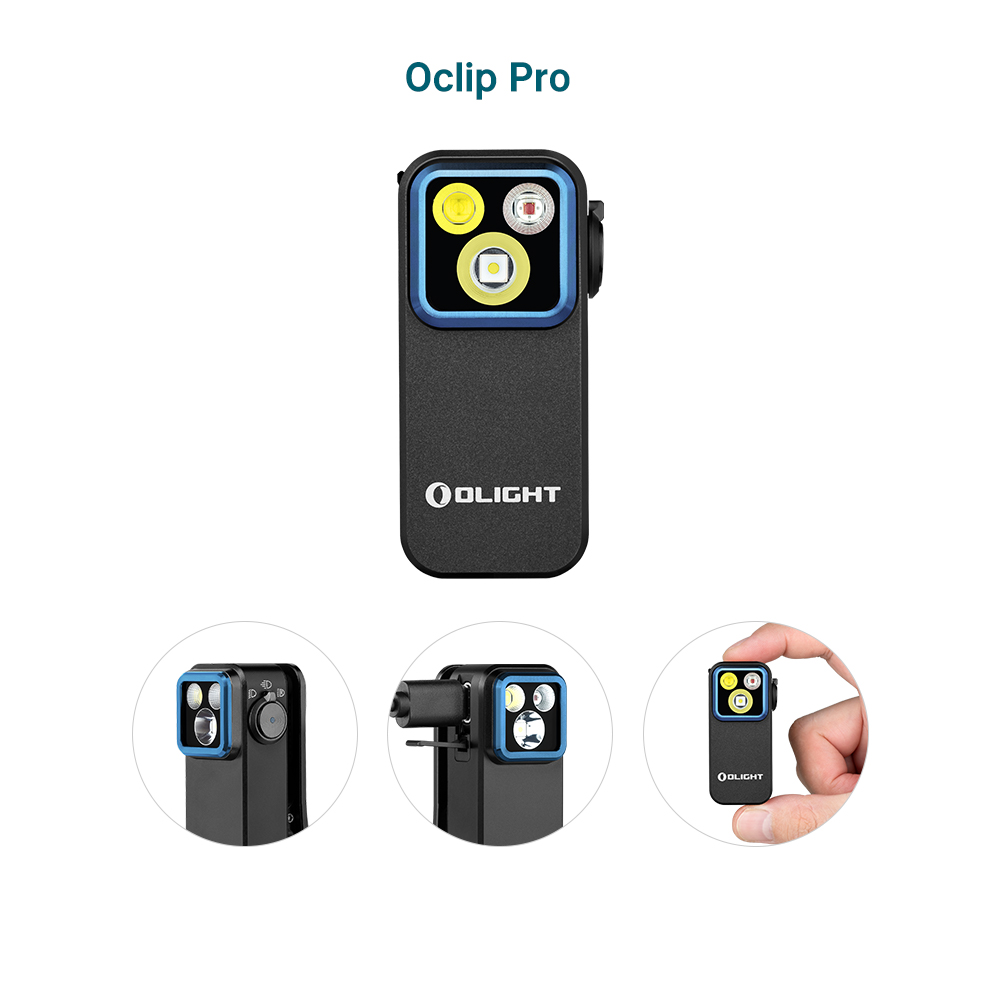
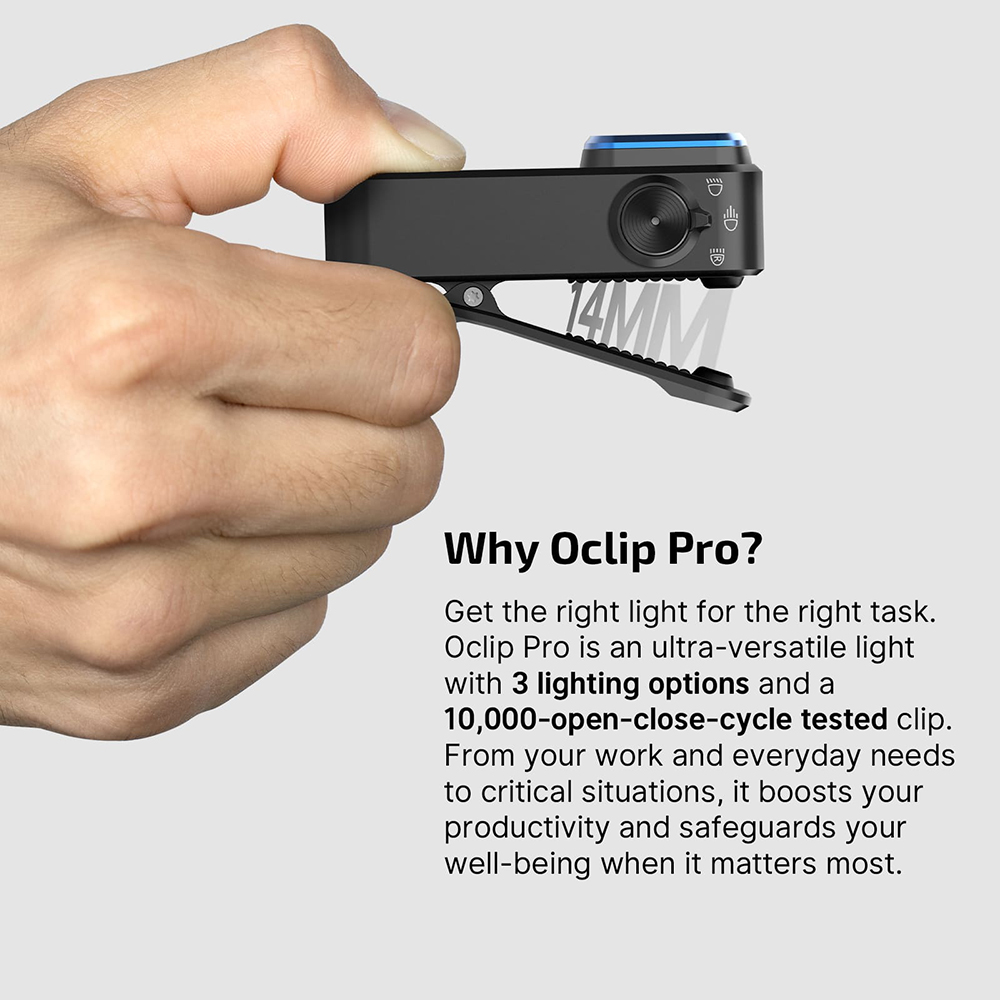
Official Black Oclip Pro gallery photo showing the open spring clip and side selector. The image does not establish aircraft retention.
The detail view helps identify the physical clip and the front emitters. It does not demonstrate verified cockpit fit, retention under aircraft movement, or a measured beam on a chart. Those conditions depend on the aircraft, task, clothing, and operating rules. If a product’s clip or magnet is not explicitly permitted for a particular attachment point, do not use that attachment point.
Flashlight Requirements Depend on the Operation
There is no single answer for every aircraft and operation. The current federal rules must be read within their applicability. For example, 14 CFR §91.503, located in Subpart F of Part 91, lists a working flashlight with at least two size-D cells or equivalent among the flying equipment and charts that the pilot in command must ensure are accessible at the pilot station. Section 91.501 defines the aircraft and operations covered by that subpart. That is not the same as saying §91.503 applies to every Part 91 night flight.
Section 135.159 addresses aircraft carrying passengers under VFR at night or under VFR over-the-top conditions. Its paragraph (f) is expressly headed “For night flights”; within that nighttime provision, paragraph (f)(3) lists a flashlight with at least two size-D cells or equivalent. Read the flashlight item in that night-flight context, rather than applying it to every daytime VFR-over-the-top operation. Operator manuals and aircraft-specific requirements may add details.
The FAA’s general night-operations guidance and the regulatory text serve different purposes. A training handbook may recommend a reliable flashlight as useful night-flight equipment. A regulation sets requirements for the operations within its scope. Neither statement approves a particular commercial model or proves that every light mode, attachment, battery, or cockpit use is acceptable.
The safest way to answer a personal compliance question is to identify the exact operation, aircraft, certificate, and applicable manuals, then check current official requirements with a qualified aviation professional or the responsible operator. This article cannot determine which rule applies to a particular flight. It also cannot replace a pilot operating handbook, an operations manual, or legal advice.
The 2026 text of 14 CFR Part 91 contains §§91.501 and 91.503. The 2026 text of 14 CFR Part 135 contains §135.159. Check the version and applicability relevant to the operation instead of relying on an isolated product description or a short online summary.
The checklist is not a shopping filter
A rule that names a flashlight with “two size D cells or equivalent” should not be casually translated into “any rechargeable flashlight is equivalent.” The legal wording requires the specified capability for the operations it covers. This article does not determine what counts as equivalent for a given operator, aircraft, or approved program.
A smaller rechargeable device may be convenient, but convenience alone does not establish equivalence. A product’s output, battery chemistry, included cell, or marketing claim does not change the rule. If a requirement applies, ask the operator or an aviation authority how that exact device satisfies it. Do not assume from a product page that a light is compliant.
A similar caution applies to a pilot’s personal preference. A person might like a dim red mode but need another source to meet a requirement. Another may carry a larger battery-powered light because that is specified by the operation. Both choices need to be considered against the governing rules, not just comfort or convenience.
Keep the aircraft’s approved equipment separate from personal lighting
Aircraft instrument lights, emergency lights, landing lights, position lights, and a portable flashlight serve different roles. The aircraft’s required lighting systems are not replaced by a handheld flashlight. A flashlight does not make an inoperative installed light acceptable, and a portable product’s brightness does not count as an aircraft lighting system.
This distinction matters because people often search “flashlight legal for night flying” and find information about aircraft lighting rules. A rule requiring an aircraft to have a landing light is not a rule approving a flashlight. Conversely, a regulation mentioning a portable flashlight does not mean that it can be used in every way or at every moment.
Check the applicable aircraft and operator documentation. If an installed light is not working, follow the required maintenance and operational process. Do not use a personal flashlight as a workaround for a required aircraft component.
Common misconception: a darker cockpit is always better
Reducing unnecessary glare can be helpful, but darkness is not the goal by itself. A cockpit must remain usable for the task. The FAA says white light must be available when needed for map and instrument reading, and it warns that red can distort chart colors. A dim room that leaves required information unreadable is not improved simply because it feels darker.
Likewise, turning every light up is not a solution. Excessive illumination can create reflections and glare. A bright source can make it harder to see beyond the illuminated area. The FAA discusses glare from light reflected off the canopy and surfaces, as well as discomfort and temporary visual effects. The practical aim is controlled, sufficient illumination under the applicable procedure.
The idea that a red light “preserves night vision” without qualification leaves out brightness and exposure. The FAA’s guidance refers to dim red lighting and describes a moderate degree of adaptation. A bright red output can still be disruptive. A product’s color label does not guarantee the setting is dim enough for a particular situation.
The idea that a flashlight with the highest lumen claim is best leaves out beam shape, reflections, and task. A maximum output may be useful outdoors or for other tasks, but it does not tell a reader whether a chart will be readable inside an aircraft. Avoid using peak lumens as a substitute for understanding the use case.
Another misconception is that a headlamp is automatically safer because both hands are free. Hands-free lighting can help on the ground. In a cockpit, a headband or light may interfere with a headset, block part of a view, or be restricted by an operator. Confirm the actual setting and rules before assuming an accessory is suitable.
A final misconception is that a consumer flashlight is “FAA approved” because an FAA document recommends carrying a light. The FAA handbook does not endorse the Perun 3, Oclip Pro, or any other brand. General guidance about having a flashlight is not product certification. Olight product pages document features; they do not establish aviation approval.
What is the best flashlight for airline pilots?
The best choice for an airline pilot is the light that the operator’s procedures permit, the aircraft’s documentation allows, and the pilot can use predictably without interfering with required equipment or duties. A red mode may help in a low-light task, while white remains important for color-dependent reading. No product in this guide is described as approved for airline cockpit use.
For a professional crew, a personal preference cannot replace company procedures. The operations manual, aircraft checklist, and crew coordination determine what equipment is carried and how it is used. A light that is acceptable in one aircraft or role may not be appropriate in another. If there is uncertainty, ask the operator before purchasing or using a device as flight equipment.
A useful selection discussion can still compare ordinary product features: a headband versus a clip, white and red options, control familiarity, battery type, and whether the device has a separate low mode. These are inputs to a decision, not a substitute for flight-specific approval.
Is a 200,000 lumen flashlight legal?
The cited flashlight provisions in §§91.503 and 135.159 specify a flashlight and battery-capacity language, not a numerical lumen limit. That does not establish that every 200,000-lumen product is legal or suitable in every cockpit. Other rules, aircraft limitations, and operator procedures can govern lighting and its use. Treat any claimed output as a manufacturer claim, not a legal clearance.
A very high output may create glare, reflections, or distraction in a confined space. This practical concern does not create a universal legal threshold. The decision remains dependent on the applicable operation and procedures. Avoid aiming high-output light at other people, aircraft, or traffic. Keep any lighting use within official instructions.
What are the best flashlights for aviation?
There is no universal aviation winner based on the material reviewed here. For a user comparing consumer products, a model with documented white and red modes may offer useful choices. A headlamp and a clip light solve different carry problems. Before selecting one, check the exact U.S. model, the manufacturer’s manual, battery format, controls, and the aircraft or operator’s requirements.
The Perun 3 documents both white and red modes in a headlamp format. Oclip Pro documents spotlight, floodlight, and red light in a clip format. Those product features can help a reader compare form and mode options. Neither product is represented as FAA-approved or suitable for a particular aircraft without separate verification.
For regulatory equipment, use the regulation that applies to the operation. For aircraft-specific use, use the aircraft’s manuals and the operator’s procedures. For general visual effects at night, use the FAA’s published guidance. Keeping those sources separate is more reliable than relying on an informal “best aviation flashlight” ranking.
Frequently Asked Questions
Changelog
- November 20, 2026: Replaced proposed product testing with a source-based aviation lighting guide and checked the cited FAA guidance and current U.S. product documentation.