



TL;DR: For a collector’s first look, choose a documented 365 nm long-wave UV flashlight, then use it only to observe how a glass surface responds. A bright yellow-green fluorescence can support a uranium-glass lead, but fluorescence, color, and a pocket light cannot identify the glass’s chemistry or establish its radiation level.
📋 Table of Contents
- 1. What kind of UV light for uranium glass?
- 2. Can you check uranium glass with UV light?
- 3. What kind of flashlight do you need to find uranium glass?
- 4. Uranium glass, Vaseline glass, and Depression glass are different kinds of labels
- 5. How to check a piece at an antique shop without overreading the glow
- 6. Why fluorescence color is not an identification chart
- 7. Comparing two documented Olight 365 nm options
- 8. Radiation questions need a different tool and evidence
- 9. Use UV deliberately and protect the object and the viewer
- 10. A simple note template for a promising piece
- 11. Frequently Asked Questions
What kind of UV light for uranium glass?
Start with long-wave UV near 365 nm when comparing handheld lights for a collector’s visual screening. Olight’s U.S. specifications document 365 nm UV modes on the Arkfeld Pro and ArkPro. The wavelength helps describe the source, not a guaranteed result. It does not make a fluorescent glass piece an identified uranium sample, and it does not measure radiation.
| What you need to decide | A useful starting point | Keep in mind |
|---|---|---|
| Which UV wavelength to shop for | A handheld light with a clearly documented 365 nm UV mode | Wavelength does not turn a visual response into a material test |
| Which light to carry | Compare a flat body, selector, size, and handling in the exact U.S. product listing | Similar model names can have different controls and specifications |
| Whether a piece is uranium glass | Treat the fluorescence as one observation and verify the object separately | A UV flashlight is not a radiation meter or a chemical analyzer |
For a broader explanation of source types and the distinctions between 365 nm and other black-light wavelengths, see Olight’s guide to what a UV flashlight does. A second useful read is Olight’s UV flashlight guide, which helps compare black-light styles before a shop visit. A light with a stated wavelength gives you a more useful starting point than a listing that says only “black light.” You still need to consider controls, visible-light spill, form, and the product’s own operating directions.
A National Park Service conservation guide says the object should help determine whether long-wave or short-wave UV is appropriate. It also notes that lamp type, intensity, and filtration affect how easy fluorescence is to see. That is good context for a collector, but it is not a universal prescription for every glass, finish, repair, or viewing condition. A handheld 365 nm flashlight is a convenient screening tool, not a replacement for the specialist methods used to examine an object’s composition.
If a seller or listing promises that a certain UV wavelength will prove an item’s age or chemistry, ask what evidence supports that conclusion. The wavelength tells you something about the light. It does not tell you what elements are in the glass. Keep those two statements separate when comparing products and evaluating a promising find.
Can you check uranium glass with UV light?
Yes, UV can show a fluorescence response that is useful as a clue. The U.S. Environmental Protection Agency says uranium in Vaseline or canary glass causes a bright green glow under a black light. But a glow is not an identity check: glass can fluoresce for other reasons, and its response changes with composition, concentration, wavelength, light intensity, visible-light leakage, and viewing angle. Use UV to decide what question to ask next, not to certify the piece.
Start by observing the glass under ordinary light. Note the color, pattern, seams, wear, chips, and any seller information. If the shop allows a UV check, direct the beam toward the glass only, use the light as its manual instructs, and record what is visible without turning a color impression into a chemical conclusion. The object’s visible color and its fluorescence are two separate observations.
A useful note format might read, “Pressed yellow-green tumbler. Seller card says ‘Vaseline glass.’ Selected mode: 365 nm UV. Shop light: bright. Observation: green response near the base, purple reflection on the rim.” That format keeps the seller’s label separate from the observer’s description. It does not assert that the glass contains uranium. If the identification would affect a purchase price, insurance, resale, or an important collection record, seek documentation or an examination suited to that question.
If there is no noticeable response, that also does not prove the glass is ordinary. Ambient light, the angle, the source, the piece’s surface, and its ingredients can all affect what reaches your eyes. A negative-looking observation should be recorded with its conditions, not promoted into a universal rule about the object.
What kind of flashlight do you need to find uranium glass?
Choose a handheld model with a clearly stated long-wave UV wavelength, a control you can select deliberately, and a shape you can direct without handling the glass. The current U.S. Arkfeld Pro and ArkPro pages list 365 nm UV modes. Their body shape, size, and selector layout are useful shopping differences. Neither flashlight can confirm uranium content or radioactivity; the observation stays visual.
A small, self-contained light is easier to bring to an antique shop than a bench lamp, but portability is only one part of the decision. A focused control can help avoid switching modes accidentally. A wide, flat profile may be comfortable in a pocket, while a conventional handheld feel may suit someone who prefers that shape. Read the exact U.S. page and its manual instead of assuming that products with similar names share an emitter, wavelength, mode sequence, or safety note.
Do not shop by advertised output alone. Brightness figures, UV output values, and white-light lumen numbers are not interchangeable. A maximum output figure does not state how much visible violet light reaches the object, whether fluorescence will be easier to distinguish in a given shop, or whether that wavelength suits every material. A straightforward comparison of exact wavelength, controls, body size, and directions is more useful than a winner label unsupported by comparable sample observations.
The practical choice is a light whose specification you can verify, whose mode you can set intentionally, and whose handling fits your collection routine. If a smaller compact flashlight is part of your carry preference, compare its exact documented control and wavelength details with the flat-body options in the table rather than assuming compact means suitable for every viewing setup. If the product page omits a relevant value or uses conflicting labels, do not fill the gap with a guess. Choose another documented option or ask the manufacturer for clarification before relying on the feature.
Uranium glass, Vaseline glass, and Depression glass are different kinds of labels
“Vaseline glass” and “canary glass” are collector terms associated with yellow or yellow-green uranium glass. The U.S. Environmental Protection Agency explains uranium’s contribution to the color and its bright green fluorescence under UV. That is useful background, but a seller’s label is not a lab result. It may reflect a previous owner’s description, a pattern name, a family attribution, or a visual impression.
“Depression glass” is a broad collector label associated with glassware and patterns, not a statement about a single colorant. A piece may be described with more than one collecting term. Those terms can help you search a pattern guide or ask a dealer a better question, but they cannot tell you which element produced a color or what a surface will do under a particular wavelength.
This distinction matters at a shop counter. If a card says “Vaseline glass,” that is a useful lead to follow. It is not independent proof that the tumbler contains uranium. If a piece is called Depression glass, do not infer from that label that it is or is not uranium glass. Ask for the maker, pattern, date range, provenance, or a reference the seller used. A direct answer might point you to a catalog or a known pattern. A vague answer is simply a gap in the record, not evidence for or against the item.
The same restraint applies to color. Yellow, green, amber, clear, or pink glass can look different under changing room light and can be described differently by different collectors. A UV response may add an observation, but it does not collapse these labels into one verified material identity. Record the listing language separately from your own visual notes so that later readers can tell who made each claim.
How to check a piece at an antique shop without overreading the glow
A useful shop check starts with permission and a plan. You are in someone else’s store, with someone else’s merchandise and lighting. Ask before switching off a display light, moving a piece, or using UV. Many sellers will have a preferred way to handle a delicate object. If they do not allow a UV check, respect that and use the information available in ordinary light.
- Identify the exact piece. Note the listing card, pattern or maker name, color, shape, and any seller statement. If several similar items are together, ask which one the label describes. Do not move a display or separate a set without permission.
- Look in ordinary light first. Observe the whole piece and then the area that prompted your question. Check whether the color is uniform, whether there are seams or repairs, and whether chips or cracks change how the object should be handled. Do not touch a damaged edge to investigate it.
- Ask before changing the viewing conditions. A bright shop or a glass case can make fluorescence harder to see. If permission is given, ask the seller to adjust the lighting or let you inspect the piece in a suitable area. Do not darken a shared sales floor or shine a light around other customers.
- Use one documented mode. Confirm the exact model’s UV setting before the visit. Select that mode intentionally and direct the light at the object, not at a person. Keep the light’s stated wavelength with your note. If you are unsure which mode is selected, stop and consult the manufacturer’s instructions.
- Separate the glow from reflected light. A visible purple patch on the surface can come from the flashlight’s visible output rather than fluorescence from the glass. Change your viewing angle modestly if the seller permits, and compare the observation with the room’s reflections. Do not treat a phone photograph as a calibrated color measurement.
- Record the conditions. Write down the product and wavelength, mode, approximate room-light condition, viewing angle, and the location of the response. Say “green response visible” rather than “confirmed uranium” unless independent evidence supports the latter.
- Decide what would justify a purchase. If the seller’s description, pattern reference, condition, and UV observation all fit your collecting goal, you may have enough information for a personal buying decision. If a chemical identification or radiological claim matters, a flashlight cannot settle it. Request documentation or pause the purchase.
A quick check should remain quick. Repeatedly changing the angle, moving the object, or cycling through unrelated modes does not convert a visual impression into a laboratory measurement. In a busy shop, keep the conversation respectful and let the seller control the merchandise. The best outcome may be an answer, a pattern reference, or a note to research the item later.
Why fluorescence color is not an identification chart
Fluorescence is light emitted by a material after it absorbs light at a different wavelength. A viewer sees the emitted light, but the color by itself does not identify a single ingredient. The Corning Museum of Glass explains that common glass constituents such as uranium, lead, manganese, and antimony can fluoresce. The response depends on the elements and their concentrations, the exciting wavelength and intensity, and other conditions. The museum also cautions readers not to confuse a reflection of visible purple light with fluorescence.
That means two practical errors are easy to make. One is treating a particular green tone as a unique signature. The other is treating a different color or a weak response as proof that uranium is absent. Even the same piece may look different under a different lamp, ambient light, filter, or angle. The response is an observation of a combined object-and-light setup, not a direct readout of chemical content.
Glass also has a history beyond its original recipe. The National Park Service’s conservation guide to ultraviolet examination describes how UV can reveal some repairs or fills in glass and ceramics, while noting that not all repairs are visible. A different-looking line or patch may be a useful clue to ask about a repair, but not every surface variation is a restoration. The shop observer does not need to solve that question at the counter.
Use words that preserve uncertainty. “A bright green response appeared near the base” is more accurate than “the base is uranium.” “A seam fluoresced differently from the surrounding area” is more useful than “the bowl was repaired.” Those observations can help a conservator, knowledgeable dealer, or materials specialist decide what to examine next. They also make your own collection notes useful months later, when you may no longer remember the shop lighting or the exact angle.
Comparing two documented Olight 365 nm options
Both products below have a published 365 nm UV mode in their U.S. product information. The comparison is about documented form and controls, not a contest in which one light has been proved to identify glass better. Current product availability and price can change, so check the exact U.S. listing before purchase.
| Model | Published UV wavelength | Published size and weight | Control and form | A reasonable fit |
|---|---|---|---|---|
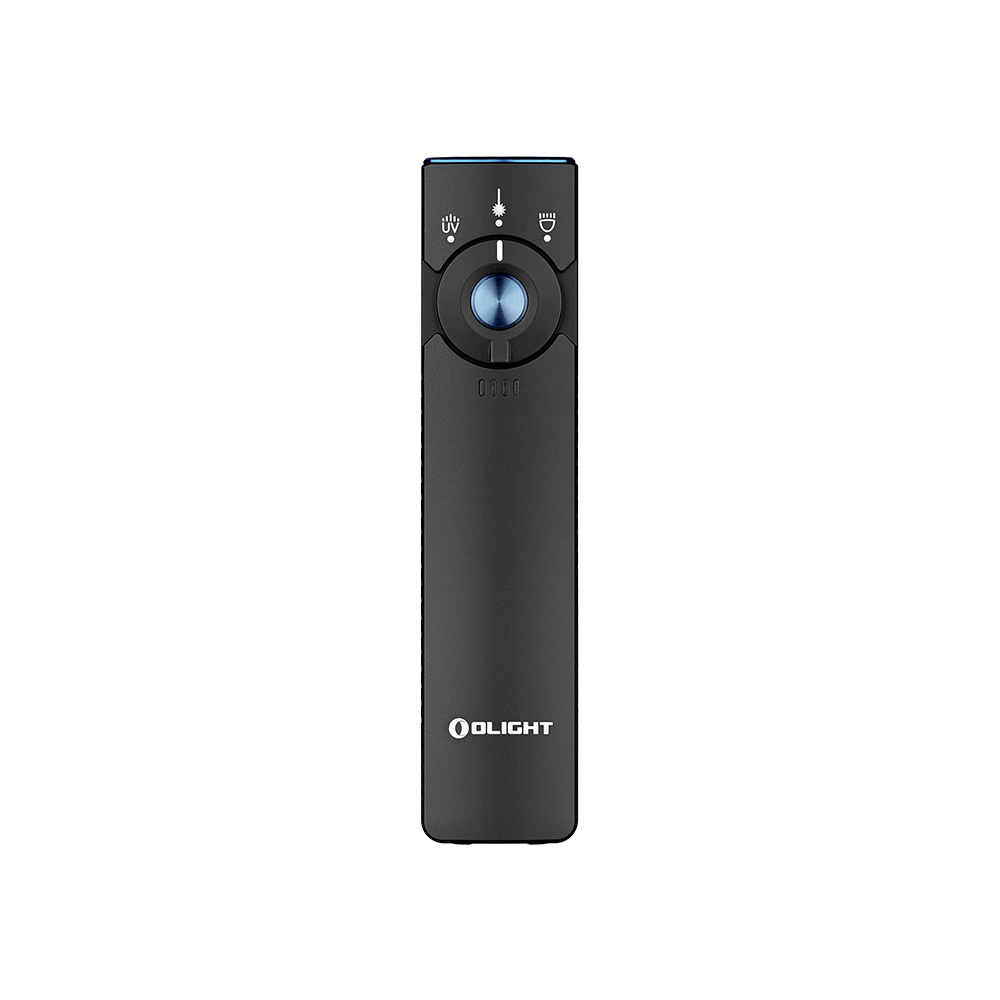
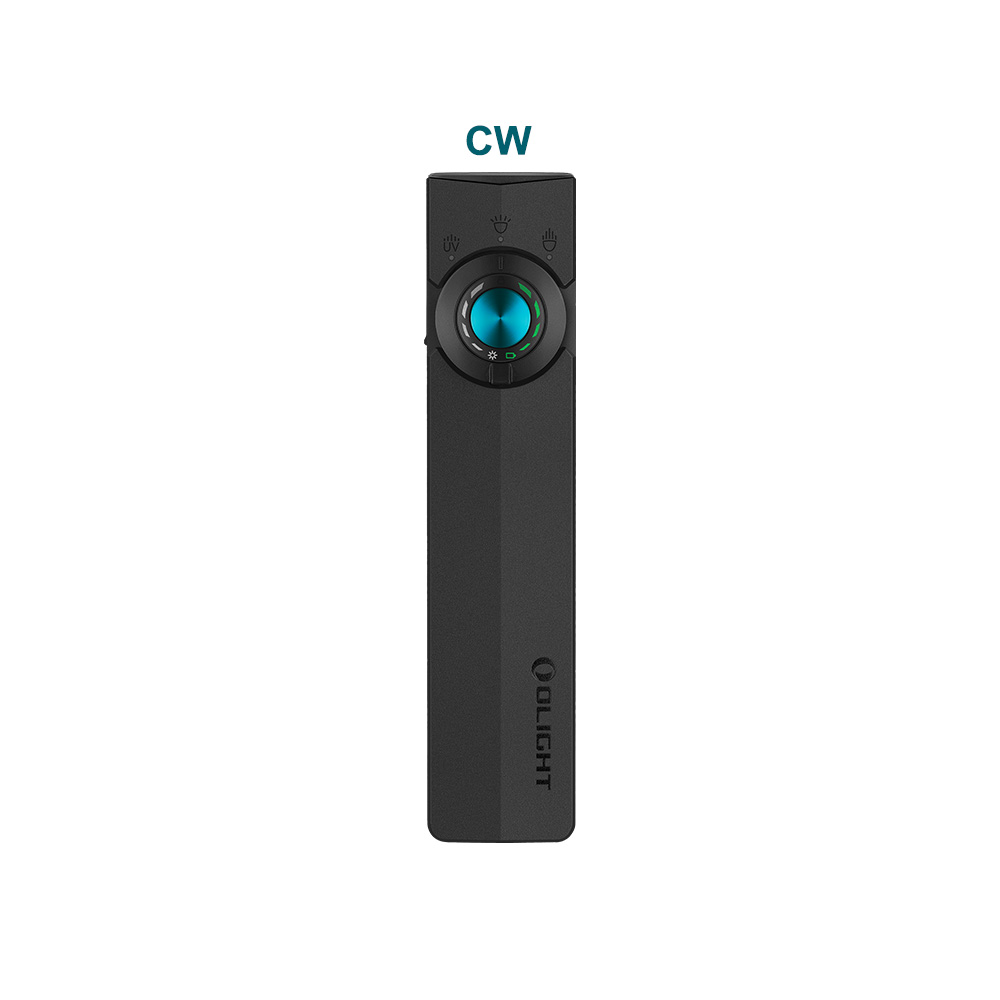
| Arkfeld Pro, Black CW | 365 nm | 120 × 27 × 16 mm; 111 g with battery | Flat profile and rotary selector for white light, laser, and UV positions | Collectors who prefer a flat pocket shape and a clearly marked selector |
| ArkPro, Black | 365 nm | 124 × 27 × 16 mm; 120 g with battery | Flat profile with a selector and side-control layout | Collectors who prefer the ArkPro body and its documented multi-light layout |
The published specifications help you compare body form and controls, but they do not rank either flashlight for viewing glass. Both list a 365 nm UV mode. Choose the control layout you can operate confidently, and apply the same observation limits whichever model you carry.
The rear gallery view below shows the clip and flat back profile. It is useful for considering how the product carries, not for inferring anything about the glass you inspect.
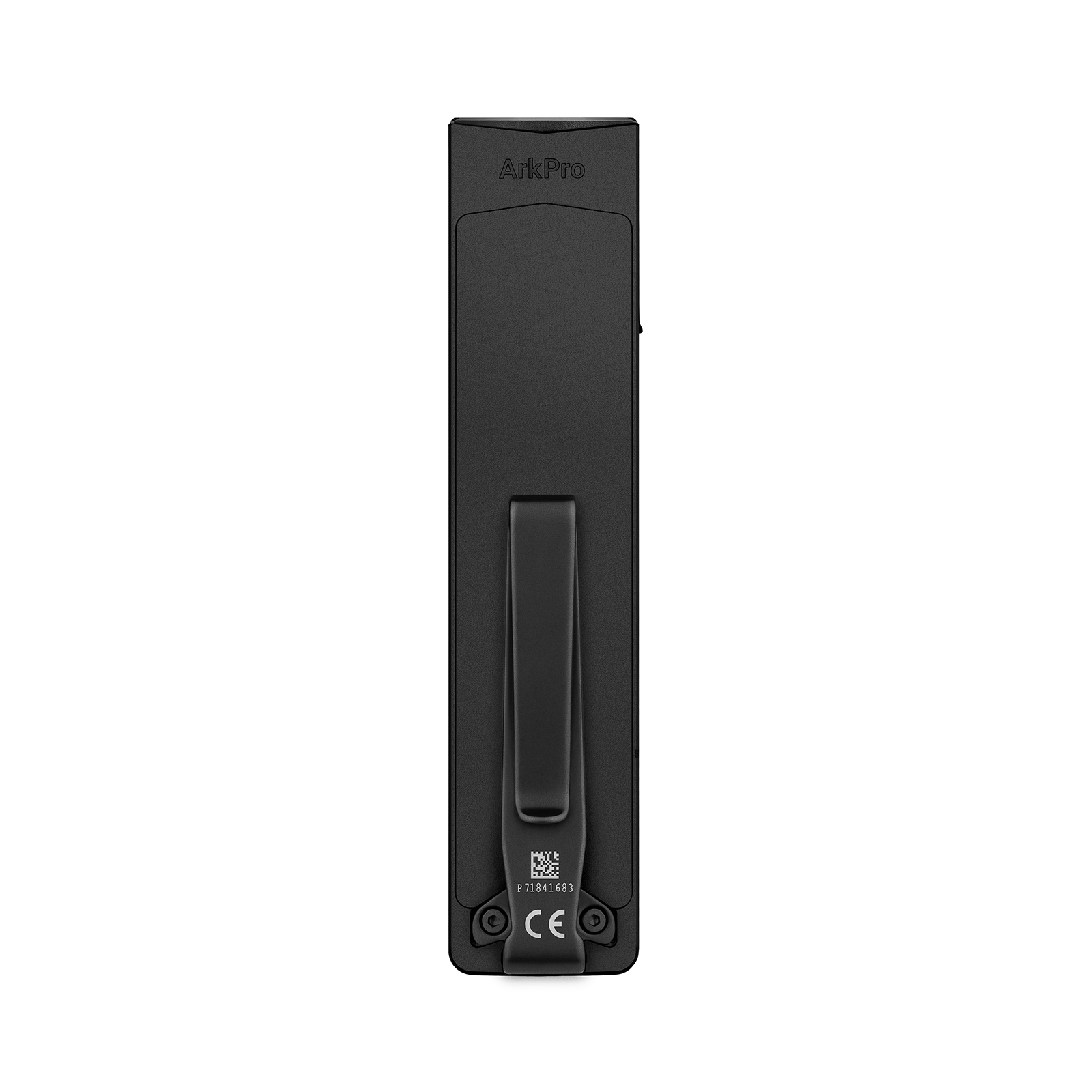
Official Black ArkPro gallery view showing the back and clip.
Radiation questions need a different tool and evidence
A UV flashlight emits ultraviolet light. Its glow on a glass surface is not a radiation measurement of that glass. The two topics are easy to blend together because collectors use the UV lamp to look for a visual response, while uranium is a radioactive element. But the lamp does not measure ionizing radiation, identify an isotope, or quantify the amount of uranium in a piece.
The EPA’s overview of radioactive antiques notes that some antiques contain materials used for color, and that Vaseline or canary glass can contain uranium. It describes such antiques as usually not a health risk when intact and in good condition. The same guidance says not to use Vaseline glass to hold food or drink because chips can allow particles to be ingested, and it advises contacting a state or local radiation-control program about broken radioactive antiques. Those are general consumer recommendations. A flashlight observation cannot determine whether an individual piece meets those descriptions.
A collector should avoid both extremes: there is no reason to declare every glowing glass object dangerous based on appearance, and no reason to give an object a safety clearance from a UV check. Condition, intended use, quantity, handling, and the actual material question matter. A harmless-looking color is not a radiation instrument, and a bright response is not a dose estimate.
If a piece is cracked, chipped, flaking, or otherwise damaged, do not use it for food or drink. Ask the seller about its condition and history. For a broken antique or a situation that raises a specific radiological question, consult the relevant state or local radiation-control office for advice. A qualified instrument and person are needed for a measurement; the color of a glow is not a substitute.
Use UV deliberately and protect the object and the viewer
Follow the exact light’s operating manual. Both U.S. manuals warn users not to look directly at the light source or shine it into eyes. Point the beam at the glass only, keep other people out of the beam path, and turn the mode off when you finish. Do not let the product’s laser mode be mistaken for UV. On a shared sales floor, ask permission before using the light and stop if the seller or another shopper is uncomfortable.
The National Park Service’s conservation guide discusses eye protection when working with UV examination lamps. The setting in an antique shop is not a conservation lab, but the principle is useful: avoid treating UV as a harmless novelty just because a handheld light is small. Do not stare at the source or bring it close to your face. Use the product as directed and stop if you cannot operate the intended mode confidently.
The object deserves care too. Do not touch a fragile, cracked, or unstable piece without permission. Do not put the lamp against glass or leave it on the surface. Keep any test brief and focused. A camera image can document where you pointed the light, but phone sensors, automatic exposure, and white balance change how the resulting color appears. A photograph is a record of an image, not proof of a wavelength, material, or radiation reading.
At home, store the flashlight so a child or an uninformed visitor cannot activate UV or the laser accidentally. Use its lockout function if its manual describes one. Do not leave UV shining into a display cabinet unattended. If the goal is to display a collection, ordinary display lighting can show the object without repeated UV exposure. A UV inspection can be an occasional, deliberate observation rather than a permanent display effect.
A simple note template for a promising piece
A useful record is specific enough that you or another collector could understand it later. It does not need to sound technical. Record the seller’s wording as a quotation or label, then keep your own observation separate. If the seller points you to a pattern guide, write down the name or page so you can return to it.
| Record field | What to write down |
|---|---|
| Piece | Shape, pattern, color, and a short identifier |
| Seller description | Exact label or attribution, clearly marked as the seller’s wording |
| Light | Exact model, selected UV mode, and published wavelength |
| Conditions | Ordinary or reduced ambient light, reflections, angle, and visible violet spill |
| Observation | Where the fluorescence appeared and what color you saw, without assigning chemistry |
| Condition | Visible chips, cracks, seams, or repairs; do not probe them |
| Open question | Maker, pattern, date, material, or safety question that still needs evidence |
Before comparing two promising pieces, write each observation in the same order. Begin with the seller’s exact wording, then identify the light, selected mode, room conditions, and visible response. This prevents the first object from receiving a more favorable description simply because the display area was darker or the beam angle was different. It also makes the limitations obvious when the notes are reviewed later.
If two pieces look similar in ordinary light but respond differently, resist the urge to use the response as a scorecard. Differences can reflect the glass itself, but they can also reflect source angle, reflections, ambient light, distance, or where the beam lands. Record the difference and ask the seller about maker, pattern, and provenance. A consistent note is more useful than a confident ranking based on two uncontrolled shop observations.
For a higher-value purchase, decide in advance what kind of evidence would change the decision. That could be a reliable pattern reference, documented provenance, a condition report, or an examination by a qualified specialist. If none is available, the choice is still yours, but label it as a collecting judgment rather than a verified material identification. This distinction helps protect both the buyer and the next person who reads the collection record.
Imagine a shopper sees a handwritten “uranium glass” card beside a yellow-green tumbler. A brief, permitted UV look shows a bright response, but the price is higher than similar unmarked pieces. Before treating the label as a premium claim, ask what supports it: a maker or pattern reference, dated purchase records, an earlier collection inventory, or a specialist’s written description. Ask whether the seller is identifying a pattern, repeating an earlier owner’s label, or making a claim about the material. Those are different kinds of evidence. Record the answer in the seller-description field, then keep your own observation separate. If the only support is the glow, you still have a useful clue, but the clue has not resolved the purchase question. You can decide whether the piece is worth its price as an attractive object without paying for certainty that the evidence does not provide.
A different question matters if you would use a glass for serving. The EPA advises against using Vaseline glass for food or drink because chips can allow particles to be ingested. A smooth-looking rim does not tell you what material a particular piece contains or whether it has hidden damage. If serving use is part of the appeal, ask for documentation that addresses that use and inspect condition without scraping, tapping, or handling a fragile piece. If the seller cannot answer, treat “uranium” as an attribution rather than a safety finding and choose a decorative use, or pass on the item. A shop-floor UV observation can help you decide what to ask next; it cannot settle chemistry, condition, provenance, or radiological risk.
A good entry might read: “Pressed yellow-green tumbler, seller card says ‘Vaseline glass.’ Arkfeld Pro, UV mode, 365 nm; green response visible around the base under store light. A purple reflection was visible on the rim. No material identification was recorded.” That note is more valuable than a confident but unsupported “uranium verified” label because it preserves what the observer actually knows.
If you later compare a catalog image or ask a specialist, add that evidence as a separate entry with its source and date. Do not overwrite the first observation. A later explanation may answer the question, but the original record helps distinguish what the light showed from what the research established.
Frequently Asked Questions
Changelog
- November 20, 2026: Verified U.S. product specifications and revised the article to distinguish fluorescence screening from material identification.




