⚡ TL;DR
A UV flashlight is a handheld light that emits long-wave ultraviolet (UV-A) light, usually rated at 365 or 395 nanometers. You can't see UV-A itself, but it makes certain materials fluoresce, so pet urine stains, scorpions, currency security threads and leak-detection dye can glow in a dark room. For the clearest glow, choose 365 nm.
The table below answers the questions most people ask first.
| Question | Short answer |
|---|---|
| What does it emit? | Long-wave UV-A, the 315–400 nm band, usually with a 365 nm or 395 nm peak |
| What is it good for? | Revealing fluorescent materials: pet urine stains, scorpions, leak-detection dye, currency security threads, minerals |
| 365 nm or 395 nm? | 365 nm for clearer fluorescence and less purple glare; 395 nm costs less but gives off more visible violet light |
| Is it a black light? | Yes. It's commonly sold as one; "black light" is the everyday name for a lamp that emits UV-A |
| Can it disinfect? | No. Germicidal lamps use UV-C, a different band |
| Is it safe? | With care. Never look into the emitter or shine it at anyone's eyes |
📋 Table of Contents
- 1. What Are UV Flashlights Good For?
- 2. 11 Things a UV Flashlight Reveals
- 3. How Does a UV Flashlight Make Things Glow?
- 4. Is 365nm or 395nm Better?
- 5. Are a Black Light and a UV Light the Same?
- 6. Why Does a Filter Matter on a UV Flashlight?
- 7. Is 365nm UV Bad for Your Eyes?
- 8. What Can't a UV Flashlight Do?
- 9. How to Choose a UV Flashlight
- 10. FAQ
What Are UV Flashlights Good For?
UV flashlights are good for finding things that fluoresce but are hard or impossible to see in normal light. The most practical uses are tracking down pet urine stains, spotting scorpions at night, tracing leaks marked with fluorescent dye, checking the security thread in U.S. bills, and confirming that fluorescent cleaning marks were actually wiped away.
This table sums up the 11 uses covered below, with how dependable each result is and the main caveat.
| What glows | Why it glows | How dependable | Main caveat |
|---|---|---|---|
| Pet urine stains | Natural fluorescent compounds such as flavins | Good for searching | Glow strength varies; many other substances glow too |
| Scorpions | A substance in a thin layer of the exoskeleton | Very dependable | Newly molted scorpions glow only after their shell ages |
| U.S. currency security threads | A fluorescent thread in current-design bills from $5 up | Dependable on current designs | Older designs differ; confirm with a second feature |
| Fluorescent minerals | Activators such as manganese, or the mineral's own chemistry | Varies by specimen | Most respond far better to shortwave UV |
| Uranium glass | Uranium in the glass | Dependable | Some uranium glass doesn't fluoresce |
| A/C and refrigeration leak dye | Fluorescent dye added to the system | Dependable when dye is present | Finds only leaks in systems that contain dye |
| Diamonds | Natural fluorescence in some stones | Informational | Most diamonds don't fluoresce |
| Tonic water | Quinine | Dependable | Only drinks that contain quinine |
| White paper and fabric | Optical brighteners | Dependable | Shows brighteners, not dirt |
| Cleaning verification marks | Fluorescent gel placed before cleaning | Dependable | Works only if marks were placed first |
| Repairs on paintings and antiques | Aged varnishes, oils and adhesives fluoresce; retouching often looks dark | Informational | Can't date or authenticate; some modern paints glow too |
11 Things a UV Flashlight Reveals
A UV flashlight reveals materials that absorb ultraviolet energy and re-emit it as visible light. Each of the 11 below is backed by a museum, university, government agency, journal or industry source, and each note explains what the glow does and doesn't tell you. Use a dark room for all of them, because ambient light washes out faint fluorescence.
1. Pet Urine Stains
Urine contains naturally fluorescent compounds, including flavins and pterins, according to a 2023 study of dried stains in Scientific Reports, which is why a UV flashlight is a practical way to find accidents on carpet, grout and upholstery. Search at night or in a room with blackout curtains, since darker conditions make stains easier to see. A glow is a lead to check, not proof: laundry detergent, milk and oils also fluoresce, and the same study found that urine's fluorescence varies widely from one donor to the next, likely because of food, cosmetics or medicines.
2. Scorpions
All scorpions fluoresce under ultraviolet light, according to Arizona State University's Ask A Biologist program. The National Park Service notes that Arizona bark scorpions glow a bright bluish color under UV light, which makes them easy to spot at night. The glow comes from a substance in a thin outer layer of the exoskeleton, and newly molted scorpions don't glow until the new shell has aged. Bark scorpions are the most venomous scorpion in North America, so look but don't handle.
3. Security Threads in U.S. Currency
Current-design U.S. bills from $5 up carry an embedded security thread that sits in a different position on each denomination and glows a different color under UV light, according to the U.S. Currency Education Program. A UV flashlight makes that check quick at a register. All U.S. currency remains legal tender regardless of when it was issued, and features differ between designs, so compare a note with the program's guide for its design and confirm with a second feature, such as the watermark. For a walkthrough, see how to spot counterfeit bills with a UV flashlight.
4. Fluorescent Minerals
Minerals such as willemite, calcite and scheelite can glow vivid colors because electrons absorb ultraviolet energy and re-emit part of it as visible light. The Sterling Hill Mining Museum in New Jersey explains that willemite's green glow comes from manganese present as an impurity, while scheelite's blue glow comes from its own chemistry. Results vary by specimen and by wavelength. The Fluorescent Mineral Society estimates that shortwave UV makes perhaps 90% of fluorescent minerals glow, while only about 15% respond well to longwave UV, so a UV-A flashlight will light up some rocks and miss many classic shortwave specimens.
5. Uranium Glass
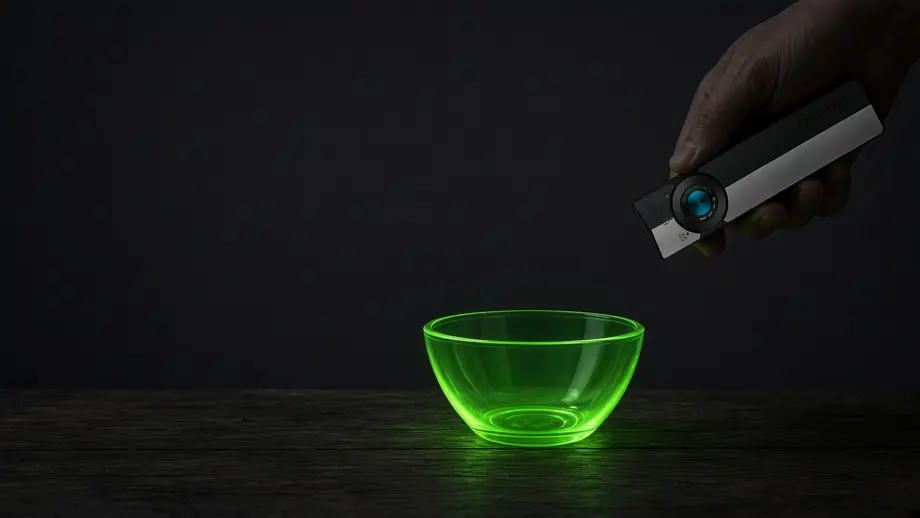
Glass colored with uranium, including the transparent yellow to yellow-green type collectors call Vaseline glass, glows a rich green under ultraviolet light. The Museum of Radiation and Radioactivity at Oak Ridge Associated Universities describes that green glow as the way to tell whether a piece contains uranium, and explains why yellow Vaseline glass can look greenish outdoors. The museum also notes exceptions: some uranium-containing glass doesn't fluoresce.
6. Leak-Detection Dye in A/C and Refrigeration Systems
Technicians inject a small amount of fluorescent dye into air-conditioning and refrigeration systems. As Spectroline, a maker of leak-detection equipment, explains, the dye circulates with the refrigerant, collects wherever it escapes, and glows green or yellow when scanned with a UV lamp. The method finds leaks only in systems that already contain dye; a UV flashlight can't reveal an undyed refrigerant leak on its own.
7. Diamond Fluorescence
About 25% to 35% of diamonds show some fluorescence under long-wave UV, and in more than 95% of those the glow is blue, according to GIA. A UV flashlight lets you see whether a stone fluoresces, a trait that appears on grading reports. GIA also found that for the overwhelming majority of diamonds, fluorescence has no widely noticeable effect on appearance, so the glow says little about how a stone looks in everyday light.
8. Tonic Water
Tonic water glows blue because quinine absorbs UV energy and re-emits it as visible light, a classic example of fluorescence that the UCAR Center for Science Education uses to teach how ultraviolet light works. It also makes a handy test for your flashlight: pour tonic water into a clear glass in a dark room, and a UV light at either 365 or 395 nm should make it glow blue. The test confirms UV output but can't tell the two wavelengths apart.
9. Optical Brighteners in Paper and Fabric
Many white papers, fabrics and cleaning products contain optical brighteners, which absorb ultraviolet light and re-emit it as blue light so whites look whiter, as color-measurement company X-Rite explains. Under a UV flashlight they glow brightly. That is why a white shirt or printer paper lights up under a black light, and why detergent residue can show up during a search for stains.
10. Cleaning Verification Marks
Hospital infection-prevention teams can check cleaning with fluorescent gel markers that are visible only under UV light. Dots are placed on high-touch surfaces, and after cleaning, a UV light shows which ones were wiped away. The CDC recommends these markers as one tool for evaluating environmental cleaning, according to a study in Infection Control & Hospital Epidemiology. The same idea works for a business or a home, as long as the marks go down before the cleaning does. Travelers also carry UV lights when checking a hotel or Airbnb room, though without marks placed beforehand, a light can show stains but can't confirm a room was cleaned.
11. Repairs and Retouching on Paintings and Antiques
Art conservators examine objects under ultraviolet light because many organic materials, including varnishes, oils and adhesives, fluoresce. Later repairs often stand out: the University of Delaware's art conservation program notes that retouching will often appear dark under UV, because recently restored areas haven't aged enough to fluoresce strongly. A UV flashlight can point you to spots on a painting or antique that deserve a closer look. It can't date or authenticate an object, and some modern materials, such as paints containing zinc white, glow brightly too.
How Does a UV Flashlight Make Things Glow?
A UV flashlight makes things glow through fluorescence. Certain materials absorb invisible ultraviolet energy and re-emit part of it as lower-energy visible light, so they appear to shine in the dark. The flashlight's beam itself looks dim or faintly purple; the bright color you see comes from the material, not from the light.
Ultraviolet light covers wavelengths from 100 to 400 nanometers, and the World Health Organization divides it into the three bands shown below. UV flashlights work in the longest band, UV-A.
| Band | Wavelength | Where you meet it | In a UV flashlight? |
|---|---|---|---|
| UV-A | 315–400 nm | About 95% of the UV that reaches Earth's surface | Yes: 365 nm and 395 nm lights |
| UV-B | 280–315 nm | Sunlight, mostly absorbed by the atmosphere | No |
| UV-C | 100–280 nm | Completely filtered by the atmosphere; used in germicidal lamps | No |
Because the glow is faint compared with room lighting, darkness matters as much as the flashlight. Turn off the lights, close the blinds and give your eyes a minute to adjust before you start searching.
Is 365nm or 395nm Better?
365 nm is better for most detection work. A 365 nm LED puts nearly all of its energy into invisible UV-A, so fluorescent materials stand out against a dark background with little violet glare. A 395 nm LED also emits a lot of visible violet light that washes out faint fluorescence, but it costs less.
The difference comes from how LEDs emit. A UV LED doesn't produce a single wavelength; it emits a spread around its peak. According to Waveform Lighting, a 395 nm LED also puts out considerable energy at 400 and even 410 nm, which is visible violet light. A 365 nm LED's output tails off before 400 nm, leaving only a dull bluish-white leak of visible light. Waveform also notes that 365 nm chips are less efficient and more expensive to make, which is why 365 nm lights cost more.
This table compares the two wavelengths for everyday detection jobs.
| Factor | 365 nm | 395 nm |
|---|---|---|
| What the beam looks like | Dim, bluish-white | Bright violet-purple |
| Visible light mixed in | Very little | A significant share, reaching about 410 nm |
| Fluorescence | Clearer for many materials, such as fluorescent minerals | Violet glare can hide faint glows |
| Cost | Higher | Lower |
| Best for | Pet stains, scorpions, minerals, currency, leak dye | Budget use where a visible purple beam doesn't matter |
One forensic study backs this up for a specific task. In a 2020 Journal of Forensic Sciences paper, 365 nm light detected even small amounts of blood plasma and serum, while 395 nm light did not. Both wavelengths fall inside the UV-A band, so they carry the same basic safety precautions.
Are a Black Light and a UV Light the Same?
A black light is a type of UV light. "Black light" is the everyday name for a lamp that emits long-wave UV-A while giving off little visible light, so 365 nm and 395 nm UV flashlights are both sold as black lights, even though a 395 nm light gives off noticeably more violet. "UV light" is the broader term: it also covers UV-B and UV-C, which UV flashlights don't produce.
Traditional black-light bulbs used Wood's glass, a deep violet-blue filter glass containing nickel oxide that blocks most visible light while passing UV, which is why they give off so little visible light. American physicist Robert Williams Wood invented it in 1903, and the same filtered-UV principle survives in the Wood's lamp that doctors use today.
Why Does a Filter Matter on a UV Flashlight?
A visible-light filter improves contrast. Even a 365 nm LED leaks a little bluish-white light, and a 395 nm LED emits plenty of violet, which lands on the surface you're inspecting and competes with the glow you're trying to see. A Wood's-glass-type filter absorbs most visible light while passing UV-A, so fluorescence stands out more clearly.
Waveform Lighting notes that for demanding uses such as UV photography, even the small visible leak from a 365 nm LED can be a nuisance that calls for extra filtering. For household searches, a clean 365 nm light without heavy violet spill already makes a clear difference. A quick check: shine the light on a dark, matte surface. A 365 nm beam looks dim and bluish, while a 395 nm beam looks bright purple.
Is 365nm UV Bad for Your Eyes?
365 nm UV can harm your eyes with direct or prolonged exposure, as can any UV-A source. The American Academy of Ophthalmology warns that anyone's eyes can be damaged by ultraviolet light, regardless of age or skin pigmentation. Never look into a UV flashlight's emitter, never shine it at people's or pets' eyes, and keep the beam on the surface you're checking.
Skin needs care too. The World Health Organization notes that UV-A penetrates into the deeper layers of the skin, contributes to skin aging and may enhance the development of skin cancers, so avoid holding a UV light on your skin for long periods.
This table sums up the safety habits worth following every time.
| Risk | What to do |
|---|---|
| Eye exposure | Never look into the emitter or aim it at faces, including pets'; use UV-blocking glasses for long sessions |
| Skin exposure | Keep the beam on surfaces, not hands or arms |
| Photosensitizing medication | Some antibiotics, birth control pills and other drugs make eyes and skin more sensitive to light; ask your doctor and limit exposure |
| Children | Use UV lights only with adult supervision and store them out of reach |
| Lasers on combo lights | Never aim a laser at a person's or animal's eyes or at aircraft |
| Mistaken disinfection | Don't use a UV-A flashlight to sanitize anything |
Disinfecting UV devices use UV-C: the U.S. Food and Drug Administration describes UV wands as products that give off UV-C radiation to disinfect surfaces, and warns that some can injure skin and eyes within seconds. A UV-A flashlight is a detection tool, not a sanitizer.
What Can't a UV Flashlight Do?
A UV flashlight can't disinfect surfaces, prove that a bill or gem is genuine, or diagnose a skin condition, and it won't make every stain visible. It shows only materials that fluoresce under UV-A. Anything that doesn't fluoresce, or that absorbs UV instead, stays dark no matter how powerful the light is.
Blood is a common example. A 2020 study in the Journal of Forensic Sciences found that blood serum fluoresces under 365 nm light, but that the fluorescence is masked in whole blood and appears only after the blood separates. Forensic teams instead treat suspected bloodstains with chemical reagents such as luminol, which produce a brief blue glow that can be photographed. Likewise, a currency thread is one security feature among several, and many fluorescent minerals need shortwave UV that a UV-A flashlight can't supply.
How to Choose a UV Flashlight
Choose a UV flashlight by checking five things: a stated 365 nm wavelength, low violet spill, a rated UV output in milliwatts, a separate white light for finding your way and seeing what you found, and a battery and water rating that suit where you'll use it.
This table explains what to look for in each spec and why it matters.
| Check | What to look for | Why it matters |
|---|---|---|
| Wavelength | 365 nm stated on the spec sheet | Clearer fluorescence and less glare for most detection work |
| Violet spill | A dim, bluish beam rather than bright purple | Visible light hides faint glows |
| UV output | A rated figure in mW, plus a runtime | Stronger UV makes faint glows easier to spot |
| White light | A separate white LED | Light your path, then see a stain's true color |
| Build | Rechargeable battery, IPX6 or better | Under sinks, in yards and in the rain |
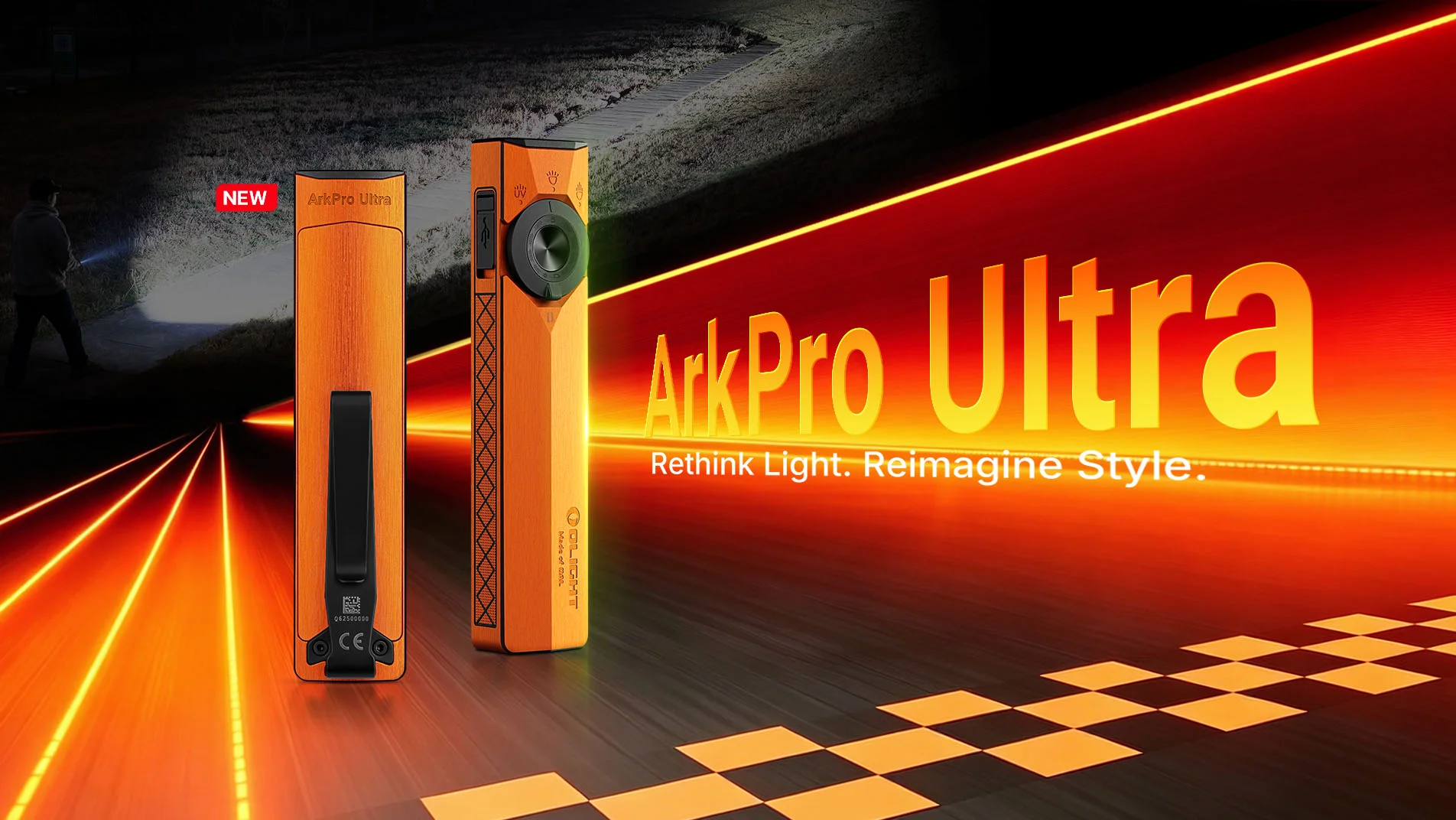
Olight, which publishes this guide, makes the UV-equipped lights below. The ArkPro and ArkPro Ultra belong to Olight's ArkPro lineup of UV flashlights, and each model name in the table links to its own product page. Specs come from Olight's product pages, checked on September 14, 2026, and prices were checked on September 15, 2026.
| Light | UV wavelength | Max UV output | White light | Other features | Water rating | Price |
|---|---|---|---|---|---|---|
| Olight ArkPro | 365 nm | 1,200 mW | 1,500 lm | Green laser, 5 mW max | IPX7 | from $99.99 |
| Olight ArkPro Ultra | 365 nm | 1,200 mW | 1,700 lm | Green laser, 5 mW max | IPX7 | $129.99 |
| Olight Arkfeld Pro | 365 nm | 900 mW | 1,300 lm | Class 3R green laser | IPX7 | $89.99 |
| Olight Arkfeld Ultra | Not listed | 900 mW | 1,400 lm | Class 3R green laser | IPX7 | $119.99 |
| Olight Oclip Pro S | 365–370 nm | 800 mW | 600 lm | Red, green and blue light; clip and magnet | IPX6 | from $39.99 |
| Olight Oclip Ultra | Not listed | 800 mW | 530 lm flood, 450 lm spot | Clip and magnet | IPX6 | $49.99 |
The Olight ArkPro (365 nm UV at up to 1,200 mW, 1,500-lumen white light, IPX7) and the Olight ArkPro Ultra share the highest rated UV output here: 1,200 mW for 5 minutes, then 580 mW for 300 minutes, with a 360 mW low mode that lasts 8 hours. The Olight Oclip Pro S (365–370 nm UV at up to 800 mW, 600-lumen white light, IPX6) is the lowest-priced option and clips on or attaches by magnet, holding 800 mW for 3 minutes and then 300 mW for 130 minutes. The ArkPro, ArkPro Ultra, Arkfeld Pro and Arkfeld Ultra also carry green lasers. Never aim a laser at a person's or animal's eyes or at aircraft, and keep these lights away from children.
FAQ
Changelog
- September 2026: First published. Specs checked September 14, 2026; prices checked September 15, 2026.