⚡ TL;DR
No. A phone flashlight can't replace a UV flashlight, because a phone's white LED puts out almost no ultraviolet light. That LED starts with a blue chip near 450 nm and adds yellow from a phosphor. Tape, color filters and "UV light" apps only tint visible light purple. For real UV-A, you need a flashlight with a 365 nm emitter.
This table compares the three phone options with a dedicated 365 nm light.
| Method | What actually comes out | Real UV-A? | What to expect |
|---|---|---|---|
| Phone flashlight | White light from a blue LED plus a phosphor | No | Ordinary light; UV-reactive features stay dark |
| Phone flash under blue and purple tape | Dimmer blue and violet visible light | No | A faint glow from some highlighter inks, little else |
| "UV light" app | A violet color on the screen | No | A purple screen with no UV output |
| 365 nm UV flashlight | Ultraviolet light centered near 365 nm | Yes | Glowing security threads, brighteners and other UV-reactive materials |
📋 Table of Contents
- 1. Can I Use My Phone Flashlight as a UV Light?
- 2. Why Doesn't a Phone Flash Emit UV Light?
- 3. Do UV Flashlight Apps Work?
- 4. Does the Tape-and-Marker Black Light Hack Work?
- 5. When Is a Phone Light Good Enough?
- 6. How Do I Tell if My Flashlight Is UV?
- 7. What Can I Use Instead of a UV Light?
- 8. How to Use a UV Light Safely
- 9. FAQ
Can I Use My Phone Flashlight as a UV Light?
Not in any useful way. Most phone camera flashes are phosphor-converted white LEDs: a gallium nitride chip emits blue light, and a phosphor coating converts part of it to yellow, which your eyes read as white. White LEDs "do not generally emit any ultraviolet radiation," according to the International Commission on Non-Ionizing Radiation Protection, so the beam gives UV-reactive materials almost nothing to work with.
That matters because fluorescence depends on the wavelength that reaches a material. Optical brighteners in laundry detergent and white paper absorb ultraviolet light, usually around 340 to 370 nm, and re-emit it as blue light, which is why they glow under a black light. The security thread in a U.S. $100 bill glows pink under ultraviolet light, according to the U.S. Currency Education Program. A white phone flash doesn't supply those wavelengths, so neither feature responds the way it does under UV.
Why Doesn't a Phone Flash Emit UV Light?
Ultraviolet was never part of its design. UV-A covers 315 to 400 nm, according to the World Health Organization, while the blue chips inside white LEDs typically peak around 450 nm, well inside the visible range. The phosphor absorbs some of that blue and re-emits it at longer wavelengths, such as yellow, so virtually none of the white beam reaches down into the UV-A band.
This table places a phone's light sources, the three UV bands and the two common UV flashlight wavelengths on one scale.
| Band or light source | Wavelength | What to know |
|---|---|---|
| UV-C | 100–280 nm | Absorbed by the atmosphere in sunlight; used in germicidal lamps |
| UV-B | 280–315 nm | Mostly absorbed by ozone; responsible for sunburn |
| UV-A | 315–400 nm | The main UV that reaches the ground, and the band UV flashlights use |
| 365 nm UV flashlight | 365 nm | Deeper in UV-A, with less visible light |
| 395 nm UV flashlight | 395 nm | Close to visible light, with a noticeable purple glow |
| Phone flash (blue LED chip) | About 450 nm | Visible blue, mixed with phosphor light to make white |
| Phone display (blue subpixels) | About 445–450 nm | Visible blue |
The shortest-wavelength light a phone produces sits above the 400 nm edge of UV-A. No tape, filter or app can shift that light to a shorter wavelength.
Do UV Flashlight Apps Work?
No. A "UV light" app only turns your screen violet. Phone displays build every color from red, green and blue subpixels, and even the blue subpixels emit visible blue light. A spectrometer study of an AMOLED phone screen measured its blue band centered at 445 nm, so a violet screen is ordinary visible light. One such app calls itself "only for fun & not intended for producing real ultraviolet Light" in its Google Play listing.
A screen also spreads its light across a wide, flat area instead of focusing it into a beam, so even materials that respond to blue or violet light get too little of it to glow noticeably. LCD phones work the same way: their white LED backlights also peak in visible blue, at about 450 nm.
Does the Tape-and-Marker Black Light Hack Work?
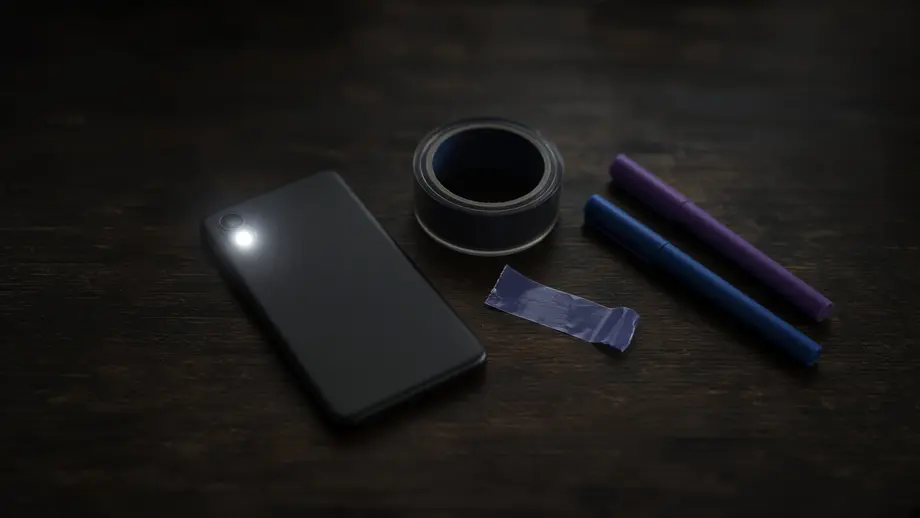
Only partly, and only on some materials. Coloring clear tape with blue and purple marker and layering it over the flash turns the tape into a blue-violet filter. The Orlando Science Center explains that this filtered light can make highlighter ink fluoresce "even though there is minimal UV light actually present."
The trick has a hard limit. Color filters work by selective absorption, as HyperPhysics at Georgia State University explains: they absorb some wavelengths and pass the rest. Tape and marker ink can only remove light from the white beam. They can't create shorter wavelengths, and they block much of the flash's output along the way.
Blue light does make certain materials glow. Forensic investigators use tuned light sources, such as 450 nm blue light viewed through an orange filter, to find some body fluids, according to HORIBA. HORIBA also notes that under an ordinary UV black light, clothing and sheets glow too, which can hide those stains. A phone behind colored tape has neither the narrow band nor the matched filter. Don't rely on a taped phone light to check currency, confirm a cleaning job or look for stains when you need a reliable answer.
This table shows which common glowing materials a phone hack can reach and which are documented for ultraviolet light.
| Material | Why it glows | Under blue-violet phone light |
|---|---|---|
| Highlighter ink | Fluorescent dyes | Can glow faintly |
| Laundry and paper brighteners | Absorb mostly at 340–370 nm and emit blue | Unlikely to glow; they absorb mainly in the UV |
| U.S. bill security threads | Glow a set color under UV light | Not a valid check; the feature is defined for UV light |
| Tonic water | Quinine glows blue under UV light | Not a valid check; the glow is documented under UV light |
When Is a Phone Light Good Enough?
A phone light is fine whenever you only need to see, such as finding dropped keys or reading a label in the dark. It is the wrong tool when the answer depends on fluorescence, such as checking a bill's security thread or looking for stains, because those checks need concentrated UV or filtered narrow-band light that a phone doesn't provide.
This table sorts common tasks by the light they actually need.
| Task | Phone flashlight | Phone under blue-violet tape | 365 nm UV flashlight |
|---|---|---|---|
| Finding dropped keys or reading a label | Works | Works, but dimmer | Works if the light also has a white mode |
| Making highlighter ink glow | Looks like ordinary ink | Faint glow | Bright glow |
| Checking a bill's security thread | Not possible | Not reliable | The thread is designed to glow under UV |
| Looking for pet urine and other stains | Not reliable | Not reliable | Can reveal many urine stains, but detergents and fabrics glow too |
| Checking a hotel room for cleanliness | Visual check only | Not reliable | A quick screen only; many clean surfaces also glow under UV |
If you need both kinds of light, a flashlight with white and UV modes saves carrying two.
How Do I Tell if My Flashlight Is UV?
Check three things: the listed wavelength, the glow of a known UV-reactive target, and how much visible purple the beam gives off. A true UV flashlight states a wavelength inside the 315 to 400 nm UV-A band, usually 365 nm or 395 nm. Under it, the security thread in a U.S. bill of $5 or more should glow its assigned color, and tonic water should glow blue.
This checklist turns those three tests, plus the output rating, into specific things to look for.
| Check | What to look for | Why it works |
|---|---|---|
| Listed wavelength | A figure between 315 and 400 nm, most often 365 nm or 395 nm | That range is UV-A, as defined by WHO |
| UV output rating | A radiant output in milliwatts alongside the wavelength | Many makers of dedicated UV lights publish it; Olight's ArkPro, Arkfeld Pro and Oclip Pro S spec pages list both |
| Known UV target | A bill's security thread glowing its set color ($5 blue, $10 orange, $20 green, $50 yellow, $100 pink), or tonic water glowing blue | The U.S. Currency Education Program documents the thread colors, and UCAR documents the tonic water glow |
| Visible purple | A 365 nm light with a visible-light filter looks dim; a bright purple glow is only the beam's visible tail | Your eyes can't see UV, so apparent brightness says little about UV output; a ZWB2 filter blocks visible leakage |
A bright purple beam is not proof of strong UV. According to 1Lumen's UV flashlight guide, 365 nm sits deeper in the UV spectrum with less visible light, and a ZWB2 filter "blocks out any visible light a UV LED may produce." In the same guide, 385 nm lights left bills looking purple unless the viewer wore UV glasses. Tonic water glows because its quinine absorbs UV, as the UCAR Center for Science Education explains. Our UV flashlight guide explains what these lights can reveal.
What Can I Use Instead of a UV Light?
Use a dedicated 365 nm UV flashlight, or a flashlight that includes a 365 nm UV mode. Low-cost single-purpose UV flashlights exist, and multi-light EDC flashlights add UV to a regular white beam. Blue-violet light from a taped phone or a colored filter works only on materials that also respond to visible light, such as some highlighter inks.
Here are three Olight options with 365 nm-class UV, from lowest to highest price as of September 15, 2026.
The Olight Oclip Pro S (600 lumens, 365–370 nm UV, IPX6, $39.99) clips to a pocket or cap brim and adds red, green and blue light to its white beam. Its UV mode starts at 800 mW for 3 minutes, then holds 300 mW for 130 minutes. IPX6 covers rain and water jets, not submersion.
The Olight Arkfeld Pro (1,300 lumens, 365 nm UV, IPX7, $89.99) pairs its white beam with a UV emitter rated at 560 to 900 mW and a Class 3R green laser in a flat body. Olight lists fluorescent agent detection, stain detection and hotel cleanliness checks among its intended uses.
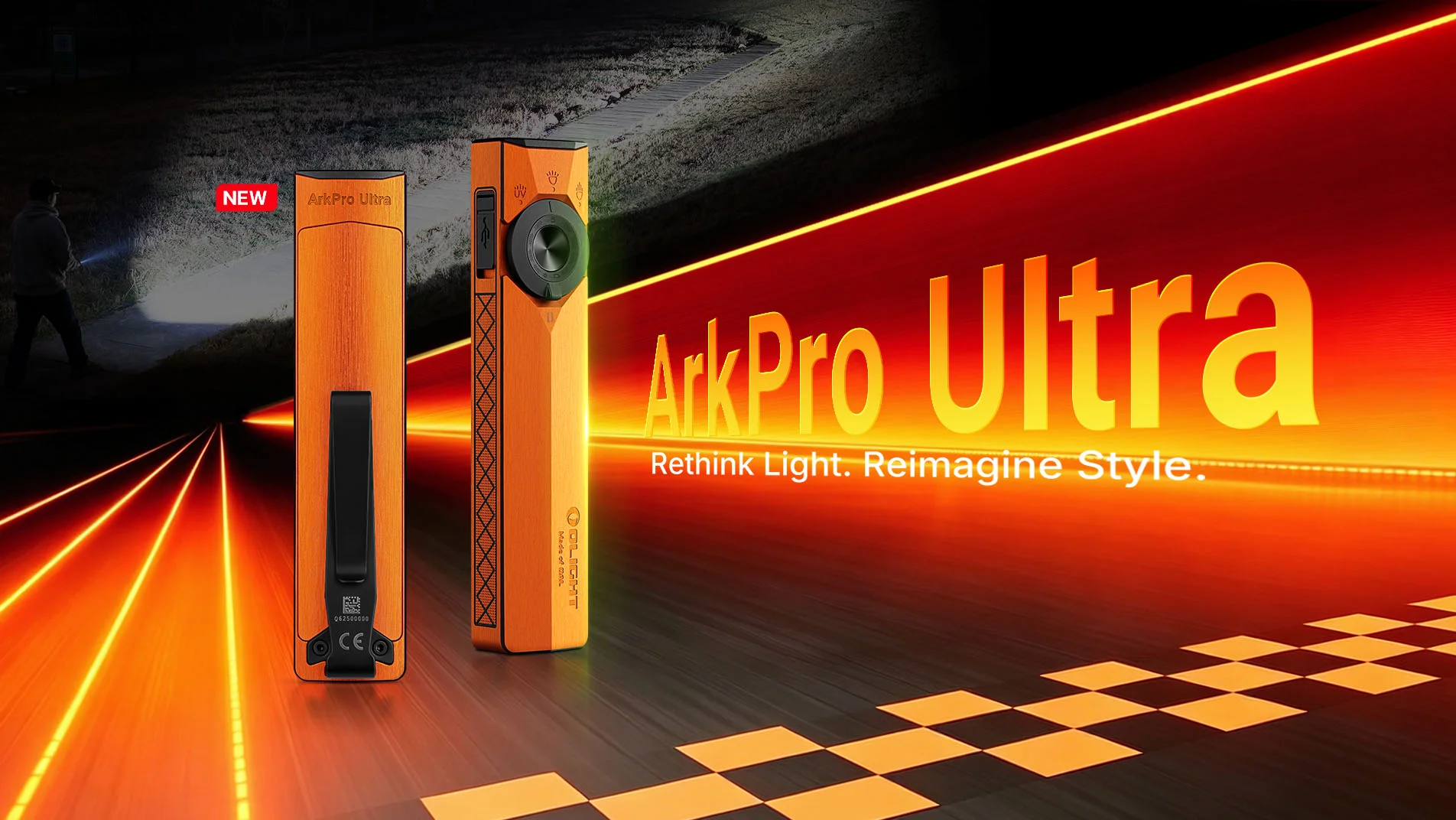
The Olight ArkPro (1,500-lumen flood, 800-lumen spot, 205 m throw, 365 nm UV, IPX7, from $99.99) has the highest UV output of the three. Its UV mode starts at 1,200 mW for 5 minutes and then holds 580 mW for 300 minutes, and its green laser is rated at no more than 5 mW. Never aim either laser at a person's or animal's eyes or at aircraft. You can compare Olight's flat multi-light UV flashlights side by side on the ArkPro series page.
How to Use a UV Light Safely
Handle a UV flashlight with more care than a white light. UV-A carries less energy than UV-B or UV-C, but ultraviolet exposure can still harm the eyes, and the World Health Organization cites snow blindness, or photokeratitis, as a UV hazard. Don't look into the emitter, don't aim it at anyone's eyes or at mirrors, windows or tile, and keep UV lights away from children unless an adult is supervising.
UV-A also penetrates into the deeper layers of the skin and contributes to skin aging, according to the World Health Organization, so avoid shining a UV light on bare skin for long periods. A taped phone flash adds no UV exposure, but it also can't do the job, so treat any result from it as a guess.
FAQ
Changelog
- September 2026: First published. Olight UV specifications checked September 14, 2026; prices checked September 15, 2026.