



⚡ TL;DR
A headlamp’s battery life is how long it can provide useful light for the task, not the longest number beside its dimmest mode. Compare the exact output mode, runtime endpoint, battery, temperature, and any step-down. For an overnight outing, choose a practical mode and plan a reserve light or battery before its stated runtime ends.
| If your priority is… | Compare… | A useful planning move |
|---|---|---|
| A long trail after dark | Runtime in the mode you will actually use | Carry a second light and set a turn-around or recharge point |
| Reading or camp chores | Low and red-light mode descriptions | Use only the level that lets you work without washing out nearby night vision |
| A cold-weather trip | Battery type, storage, and manufacturer guidance | Keep a charged spare protected from cold, then rotate it as needed |
| Hands-free work | Fit, switch access, and mounting stability | Test the strap and controls at home with gloves and the task posture |
📋 Table of Contents
- 1. Can a spec sheet identify the headlamp with the longest battery life?
- 2. Why the longest runtime number can mislead
- 3. What does 100 lumens tell you?
- 4. How to read a runtime table
- 5. Runtime curves, step-downs, and useful light
- 6. Cold weather and battery planning
- 7. Replaceable batteries or rechargeable headlamps
- 8. Perun 3: multiple jobs from one right-angle light
- 9. Perun 3 Mini: compact carry and charging choices
- 10. Build a realistic overnight lighting plan
- 11. Common runtime mistakes
- 12. What headlamps do navy SEALs use?
- 13. Which battery-powered headlamp is best?
- 14. How long does a 10,000 lumen flashlight battery last?
- 15. Frequently Asked Questions
Can a spec sheet identify the headlamp with the longest battery life?
A specification table can show how long one model is listed to run in each stated mode. It cannot establish that a headlamp with the longest battery life is the market winner unless competing models are measured at comparable output levels, under the same conditions, and to the same endpoint. Compare each model’s documented modes and treat any missing measurement detail as a limit on the claim.
Why the longest runtime number can mislead
Headlamp runtime is not one fixed property. A model can offer several outputs, and every mode puts a different demand on its battery. The same lamp may have a short high-output burst, a longer medium setting, and a very long low setting. Those figures answer different questions. The longest one answers, “How long can this product operate under the specified low-output conditions?” It does not automatically answer, “How long can I follow a rocky trail with enough light to see footing?”
That distinction matters on trips where darkness is part of the plan rather than an inconvenience. A low setting can be a smart choice inside a tent or when sorting gear. It may be a poor choice when you need to see roots, wet stones, trail junctions, or a person several steps ahead. At the other extreme, running maximum output continuously can drain a battery much faster than a moderate setting that is adequate for the task. Good planning is about matching the mode to the work, then preserving a margin.
“Longest battery life” search results often blend different products and measurement conditions. One brand may quote runtime until the light turns off; another may report time until output falls to a specified fraction of its initial level. Some products step down from a brighter level after a short period. A comparison that omits those details can look precise while comparing unlike measurements.
A useful headlamp comparison therefore starts with the manual or product page, not a single headline number. Find the mode name, output, runtime, conditions note, battery configuration, and behavior after a step-down. If one of those details is missing, treat the number as a limited manufacturer specification, not a universal promise for every trip.
What does 100 lumens tell you?
Lumens describe total visible light emitted by a source. They do not show exactly where that light lands, how concentrated the beam is, or how well it reveals a particular surface. Beam shape, optics, distance, contrast, weather, and the user’s surroundings all affect what a person can see. A broad flood beam and a tighter beam can feel very different at the same lumen value.
That is why 100 lumens can be a useful comparison reference only when products are genuinely measured at that output using a consistent method. A product’s labeled “low” or “medium” mode may be 30, 120, or 600 lumens; those are not all 100-lumen measurements. Interpolating a runtime between two modes is not a published result. Nor does the same lumen count guarantee that different beams illuminate the same trail area equally.
For shopping, treat a target such as 100 lumens as a question to ask, not a magic threshold: “Does the manufacturer publish runtime at a mode near the level I expect to use, and does the beam suit my task?” If the answer is no, compare the listed modes separately and consider the product’s beam description and intended use. Do not rank a 5-lumen mode against a 120-lumen mode as though both were providing equivalent trail light.
Olight’s Perun 3 manual lists named modes with specified output and runtime, including 120 lumens for Medium, 30 lumens for Low, and 5 lumens for Moonlight, plus higher settings. Those are useful model-specific reference points. They do not establish a standardized 100-lumen runtime against competing headlamps. The honest comparison is the published mode table, with its labels intact.
How to read a runtime table
Before comparing two runtime numbers, check what each number measures. A table may state a mode’s output and total operating time but not explain what brightness remains near the end. Another may show a curve or describe a step-down. The method matters because users often need a minimum amount of usable light, not merely an indicator that the electronics remain on.
| Detail to check | What it means | Why it changes your decision |
|---|---|---|
| Mode and output | The named setting and stated lumens | Lets you compare similar tasks rather than just model names |
| Runtime endpoint | Time to shutoff or time to a stated output threshold | A lamp may still be on after it has dimmed substantially |
| Step-down behavior | Whether a bright mode decreases after a period | Helps distinguish a brief boost from a sustainable setting |
| Battery configuration | Cell type, capacity, and whether the pack is included | A different battery can change charging and replacement planning |
| Conditions | Temperature and measurement standard, when disclosed | Lab figures and cold-weather field expectations are not identical |
| Recharge method | Cable, charging case, or replaceable cell | Determines whether you can replenish power during the trip |
Read the footnotes. A runtime measured under a stated standard and indoor conditions is a controlled product specification, not a guarantee for freezing weather, repeated turbo use, or a battery that has aged through many cycles. A manual may also state that runtime varies with temperature or ventilation. That note belongs next to the table in your thinking, even if it does not appear in the short marketing summary.
Do not assume batteries with the same nominal capacity will power every headlamp for the same duration. Drivers, LEDs, output levels, thermal behavior, and circuitry differ. Capacity is one part of a system, not a direct substitute for a model’s runtime data. Likewise, a larger battery can add weight; whether that trade is worthwhile depends on the route and how long the lamp must remain ready.
Runtime curves, step-downs, and useful light
A runtime curve plots output over time. It can reveal behavior that a single number hides: a bright mode may start high, step down as the lamp manages heat or battery draw, and then continue at a lower level. Another mode may hold a steadier output for longer. Neither pattern is automatically better. A quick burst can help with a brief check, while stable medium light may be more useful for hours of walking.
The curve’s axes and measurement method need attention. Is the vertical scale lumens, relative output, or another measure? How often were readings taken? Is the graph based on one run or a defined protocol? Without that context, a chart may illustrate a general pattern without supporting a precise head-to-head ranking.
For a real trip, convert the curve into practical questions. How long does the mode stay near the brightness needed for the task? What happens after it steps down? Does the lamp warn about low battery? Can a spare or charging source restore the light? Are you likely to use the top mode repeatedly, or only for short inspections?
The Perun 3 manual publishes a mode table and notes that its reference measurements were collected indoors at 25°C under windless conditions, with the reference runtime values potentially affected by temperature and ventilation. Its Turbo chart lists 3,000 lumens for 2 minutes, then 27% output for 180 minutes, followed by 20% output for 30 minutes. The manual does not label those later Turbo phases with additional lumen figures, so the percentages should remain percentages. This is why a headline “Turbo runtime” should not be read as continuous 3,000-lumen operation for the entire period.
That sequence is model-specific. It should not be transferred to the Perun 3 Mini, another Perun product, or a competitor. When a manual does not provide a comparable curve or mode table, say only what that source establishes. A missing curve is not evidence that output stays constant or that it drops at a particular time.
Cold weather and battery planning
Cold conditions can affect battery behavior, but the amount depends on cell chemistry, insulation, exposure, state of charge, workload, and the lamp’s design. The Perun 3 manual lists a working temperature of 0–40°C (32–104°F); that is an operating range, not a cold-weather runtime result. A product’s indoor runtime specification should not be treated as a cold-weather guarantee. If the manual identifies operating temperature or notes temperature effects, use that language accurately. Avoid converting a general caveat into a made-up percentage loss.
For a winter hike, plan around the possibility that a cold battery may provide less practical reserve. Start with a fully charged lamp, keep any spare protected from direct exposure, and rotate batteries only in ways the manufacturer permits. A pocket close to the body can help keep a spare warmer than an outside pack pocket, but the safe location depends on the battery and clothing system. Keep contacts clean and protected from moisture. Do not carry loose cells where metal objects can bridge their terminals.
A backup is useful only if it is ready and compatible. Check its charge before departure, confirm that the cable or charger actually fits, and know how to read the battery indicator. If the trip is long enough that charging will matter, bring the power source and cable you intend to use, not an assumed universal accessory. A charging plan should include time to recharge and a dry place to do it.
Cold-weather decisions also involve how light is used. At camp, switch down for nearby tasks when that gives enough visibility. On uneven ground, use a level that reveals the surface safely. Keep a handheld light or second headlamp available if the primary light is lost, damaged, or needed by another person. Red light can be useful for some close-range tasks, but it does not make every detail easier to see and should not replace appropriate white light for route finding.
Replaceable batteries or rechargeable headlamps
A replaceable-cell design can make a long trip easier to plan when compatible spare batteries are available. It also means you must manage cell type, polarity, storage, and safe transport. A built-in rechargeable battery avoids swapping cells in the dark, but you need a charging path and enough time to restore power. Neither arrangement is universally superior.
| Trip pattern | Replaceable battery may suit you when… | Rechargeable setup may suit you when… |
|---|---|---|
| Overnight outing | You want a charged compatible spare ready to swap | One full charge is enough for the planned modes and you can recharge afterward |
| Several nights away | You can carry protected spare cells and know their fit | You have a dependable power bank, correct cable, and realistic recharge time |
| Shared household use | Different people need a quick replacement plan | A central charging location makes battery status easy to check |
| Cold-weather route | You can keep compatible spares protected and rotate them | The battery and charging instructions fit your conditions and schedule |
The practical question is not just “Which battery is bigger?” It is “What will I do when the first charge is no longer enough?” That answer should be specific: swap a known compatible spare, recharge from a power supply you know is compatible, use a second light, or shorten the route. Avoid depending on an accessory whose exact compatibility has not been confirmed.
Charging features also deserve a closer look. A magnetic charging cable, USB-C port, or separate case can change convenience, but the connector alone does not tell you how long a full recharge takes. Check the product’s included accessories and manual. If you use a case with other devices, verify the model compatibility before planning around it. The size of a power bank does not automatically tell you how many full charges it will provide; conversion losses and the devices’ actual battery capacities matter.
Perun 3: multiple jobs from one right-angle light
Olight Perun 3 is a right-angle rechargeable light supplied with a headband, and its official U.S. product information lists white and red light modes, a 5,000 mAh rechargeable battery, a magnetic tail, clip, and lanyard. The official description states up to 3,000 lumens and 160 meters of throw, while its Moonlight mode is listed at 5 lumens with up to 20 days of runtime. These are product specifications with distinct modes, not a claim that the maximum output lasts for days.

The Perun 3’s manual gives more detail than a single maximum-output figure. It lists 120 lumens for Medium, 600 for High, 3,000 for Turbo, 30 for Low, and 5 for Moonlight. The listed runtimes are 25 hours at Medium, 300 minutes at High before a further 30 minutes at 20% output, 89 hours at Low, and 20 days at Moonlight. For Turbo, the manual reports 2 minutes at 3,000 lumens, then 180 minutes at 27% output and 30 minutes at 20%; it does not assign lumen values to those later phases. Its conditions note identifies 25°C, indoor, windless conditions and says temperature and ventilation can affect results. A hiker can use these mode-specific values to decide whether a published setting resembles the intended task and avoid planning a multi-hour route around a brief top-output period.
The mode controls and body shape matter too. A right-angle light can be worn on the headband or used by hand, and the magnetic tail can attach to a suitable ferrous surface. That flexibility can reduce the need to keep a second light on for every camp chore. But a magnetic attachment is not a substitute for secure placement: choose a stable, appropriate surface and avoid putting a light where it can fall, overheat, or obstruct work.
As a headlamp, fit affects perceived usefulness. A beam that points where the wearer looks can free both hands for setting up a tent, checking a map, or repairing gear. Adjust the strap before the trip and confirm it remains stable when the wearer looks down or turns. The lamp’s listed weight includes the battery in the manual; decide whether the loaded weight is comfortable for the planned duration rather than judging by an unmounted product photo.
The headlamps hub is a useful starting point for comparing current headlamp options, while the Perun series page groups the family. This article does not rank the Perun 3 as the longest-running headlamp on the market. Its documentation supports a model-specific explanation of modes, accessories, and the published reference conditions.
Perun 3 Mini: compact carry and charging choices
Olight Perun 3 Mini is a smaller right-angle light that can be configured with a headband and is also described as a handheld light. Its official U.S. page lists white and red light, multiple brightness modes, and a charging case option. The exact kit and color matter: confirm which package is being considered before assuming the charging case or an accessory is included.
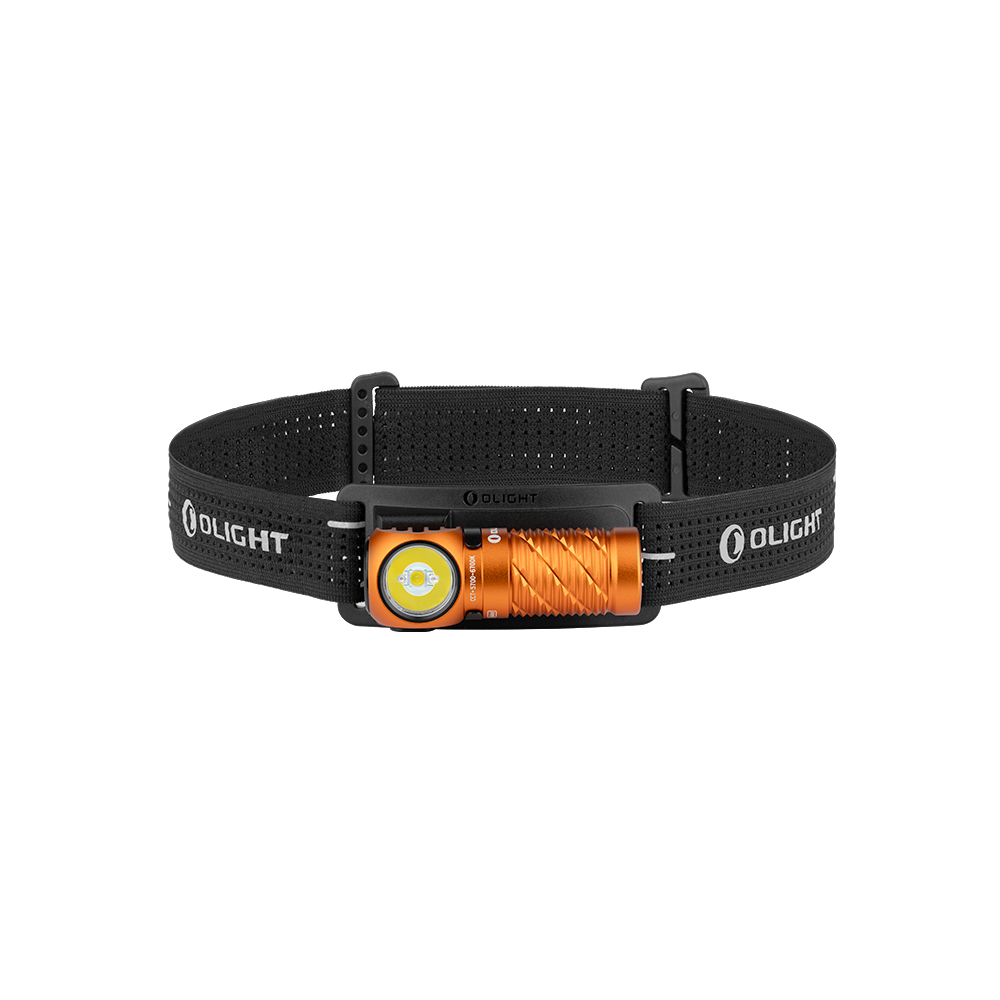
The Mini’s value for a user who prioritizes compact carry comes from format and setup, not a generalized promise of longest runtime. Its smaller body can make it easier to keep in a pocket or a compact kit. The tradeoff is that users should pay close attention to the exact published modes and plan a reserve accordingly. Do not infer that its runtime is the same as the Perun 3’s because the products share a family name. The official gallery also shows a battery-status indicator; that visual cue helps identify charge state, but it does not replace a mode-specific runtime plan.
A battery indicator is most useful as one part of a routine: check the charge before leaving, notice how it changes during use, and decide what reserve you will carry. It does not predict an exact number of remaining hours, because runtime still depends on the selected mode and conditions. Treat indicators as status cues rather than substitutes for the model’s documented mode table.
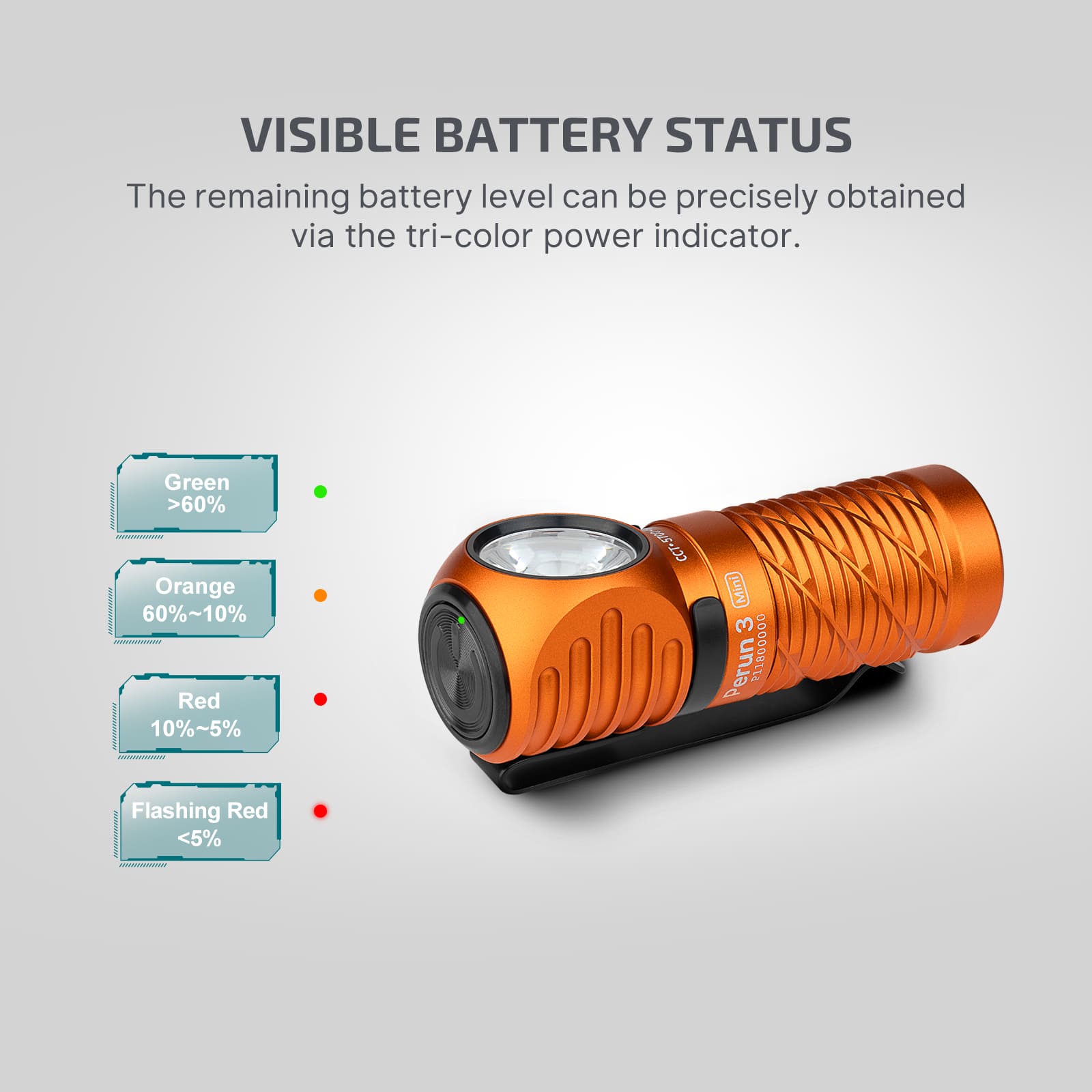
Official Olight gallery image showing the Perun 3 Mini battery-status indicator.
For night walking, a compact lamp still needs a stable band, accessible switch, and a beam appropriate to the route. Put it on and operate it at home before departure. Practice the lockout and brightness changes according to the manual, especially if the light may be packed in a pocket or bag. A tiny control you can find with gloves is more useful than a mode you cannot reliably select when tired.
Build a realistic overnight lighting plan
An overnight plan should begin with the route and schedule. Estimate how many hours you expect to move after dark, then add time for delays, navigation, breaks, and a slower return. The planned runtime should cover the full period at the setting you expect to use, with a margin. If the manual gives only a long low-mode figure, that is not enough evidence to plan several hours of trail use at a brighter setting.
Next, identify the consequences of losing the primary light. On a familiar, short campground path, the fallback may be another person’s lamp and a phone kept charged for emergency use. On a remote or technical trail, a dedicated backup light and a conservative turn-around time may be more appropriate. Phone flashlights can help in a pinch, but they are not a substitute for a planned headlamp: using one can drain the phone needed for maps or communication, and holding it occupies a hand.
Create a simple mode plan rather than leaving the lamp at maximum output. Use a lower setting for close tasks where it is sufficient; move to a brighter mode for terrain checks or route decisions; return to a lower mode when the task changes. Avoid staring into the beam or shining it into another person’s eyes. If you are hiking with a group, agree on a signal for stopping or regrouping so one person’s brighter beam does not become everyone’s only navigation cue.
Before leaving, check these items:
- Charge the headlamp fully and confirm its battery indicator.
- Inspect the headband, clip, charging contacts, cable, and lens.
- Confirm the lockout or storage procedure in the manual.
- Pack only batteries and accessories confirmed for the exact model.
- Keep the backup light accessible rather than buried under other gear.
- Decide in advance when to turn back if the reserve is lower than expected.
After the trip, recharge promptly, dry the lamp and strap as directed, and store it in the manufacturer’s recommended condition. Check the battery periodically if the light sits for months. A lamp that was fully charged last season may not be ready for a long outing now.
Common runtime mistakes
Comparing the highest number in one table with the lowest number in another. Maximum lumens and maximum runtime describe different modes. Put mode, output, runtime, and endpoint in the same row before comparing.
Treating “up to” as a guaranteed trip duration. Product pages and manuals describe defined conditions. Temperature, airflow, battery condition, repeated high-output use, and real operating patterns can change what happens outside those conditions.
Assuming the light remains equally bright until it shuts off. A timed step-down or gradual decline can leave the device running while the beam is less useful for the task. Read the runtime graph or sequence if it is provided.
Using battery capacity as a substitute for runtime. A capacity figure does not show the lamp’s efficiency, electronics, beam, or output profile. Use the exact model’s mode data.
Planning around a mode name. “Low” is not standardized across brands. Compare the lumens shown beside the mode, if published, and consider the beam pattern.
Expecting one brightness to work everywhere. Close-range camp tasks, trail navigation, and searching for a trail marker have different needs. Use the lowest setting that still supports the task safely, then change modes when the task changes.
Skipping the backup plan. A second light is a small amount of redundancy that can matter if a lamp is dropped, misplaced, or depleted. Match the backup to the trip rather than assuming a phone will always be available.
What headlamps do navy SEALs use?
Reliable public information does not establish a single headlamp model used by all Navy SEALs. Unit equipment can vary by mission, procurement, and time, and unsupported online lists should not be treated as official. For civilian use, choose a headlamp by its documented modes, fit, controls, battery plan, and the task you need it to handle.
Which battery-powered headlamp is best?
The best battery-powered headlamp is the one whose beam, controls, weight, and documented runtime match the job. For a multi-hour walk, compare a usable mode rather than the longest low-mode claim; for camp chores, portability and a stable hands-free setup may matter more. Confirm battery and charging compatibility, then carry a backup suited to the route.
How long does a 10,000 lumen flashlight battery last?
A 10,000-lumen rating alone cannot answer runtime. Duration depends on the exact model, battery, mode, thermal step-down, and the manufacturer’s runtime endpoint. A lamp may sustain its top output briefly and then step down. Check the model’s own runtime table or curve; do not apply a different light’s battery figures or infer hours from lumens alone.
Frequently Asked Questions
Changelog
- November 19, 2026: Product information and buying guidance reviewed.




