


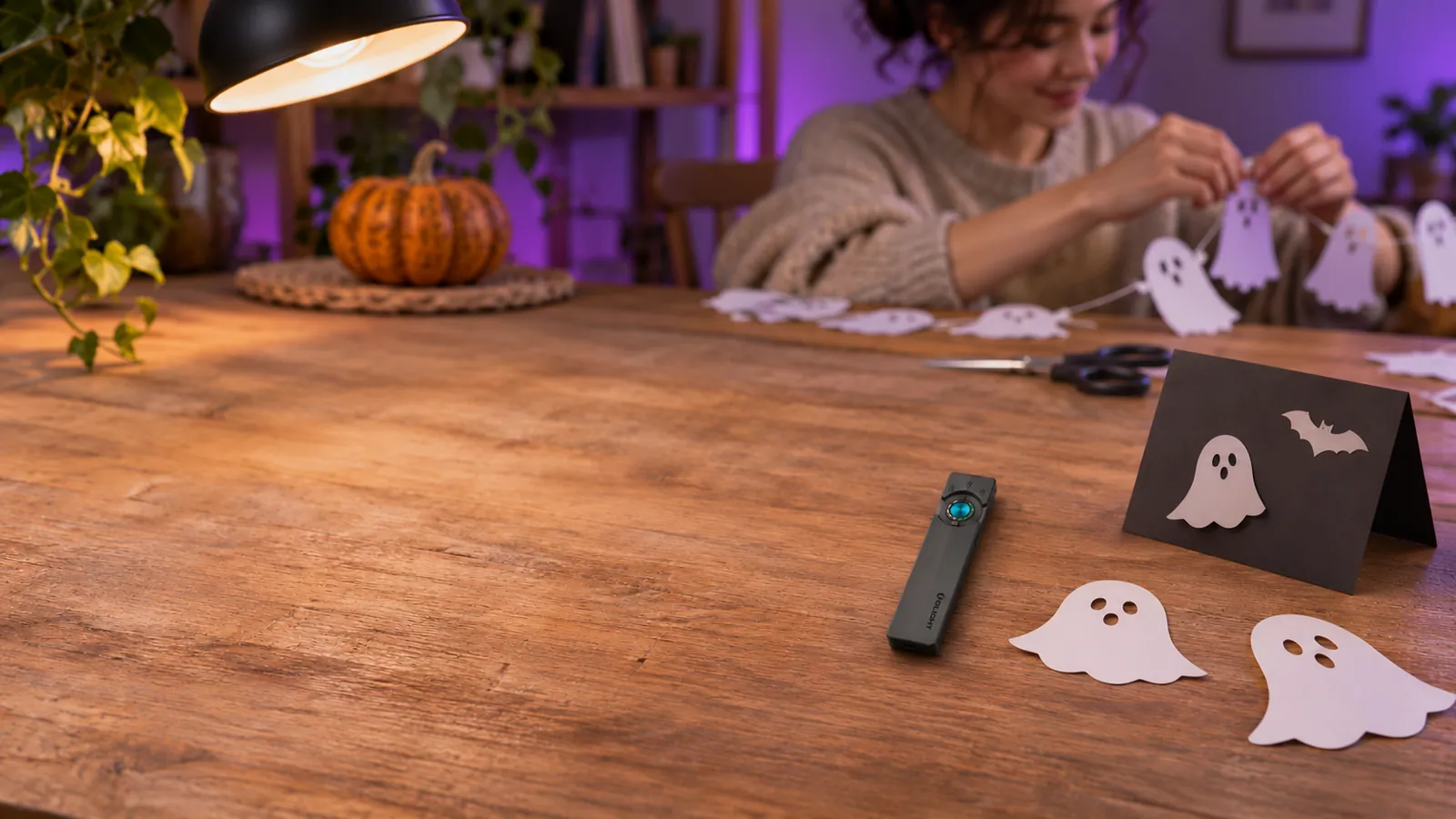
TL;DR: Build a Halloween black-light display around a small, clearly defined decoration area, materials labeled for the intended effect, and ordinary lighting for movement. Use an appropriate UV flashlight for controlled checks of objects, not as a guest-operated toy. Plan the effect around paper props and removable decorations before considering wearable materials.
📋 Table of Contents
- 1. Start with one decoration area and a visible walking route
- 2. Choose materials by their labels and actual appearance
- 3. Make a paper ghost display that works with the room
- 4. Build a reveal card with an ordinary-light fallback
- 5. Use a tabletop scene instead of a dark-room search
- 6. Consider an exact handheld light for object checks
- 7. Keep a handheld check separate from room lighting
- 8. Learn the indicators and put the light away deliberately
- 9. Prepare the charging arrangement before decorating
- 10. Keep UV off people and out of guest-operated games
- 11. Separate costume appearance from material suitability
- 12. Give the display an operator and a simple fallback
- 13. Photograph the decoration before guests gather
- 14. Finish with ordinary Halloween setup checks
- 15. What blacklight is best for Halloween?
- 16. Do glow sticks work under UV?
- 17. What makes fake blood glow under blacklight?
- 18. Frequently Asked Questions
- 19. Keep the effect focused on the decoration
Start with one decoration area and a visible walking route
| Halloween idea | What to prepare | What to confirm before guests arrive |
|---|---|---|
| A paper ghost display | Removable card shapes and materials labeled UV-reactive | The exact materials respond under the intended light and remain readable in the room |
| A reveal card | A large paper card with a visible prompt and a separate decorative reveal | The operator can illuminate the card without directing the source at people |
| A tabletop story scene | A few clearly separated props on a stable surface | The display leaves normal walking routes, exits, and useful room lighting intact |
The most useful Halloween black light ideas begin with an object that has a reason to change appearance. A simple ghost shape, a large reveal card, or one decorative detail can carry the idea. Filling the whole room with unfamiliar equipment creates additional placement, power, and supervision questions before it improves the decoration.
Choose the display location while the room is normally lit. Identify where people will stand, where a door opens, and where someone will put down a bag or drink. Keep the effect away from those activities. A decoration that works only when guests stand in a walking route is asking the room to serve two incompatible purposes.
Give ordinary lighting its own job. People still need to see furniture edges, changes in floor level, and the way out. The decoration may benefit from less competing light at its surface, but the room does not need to become completely dark. Adjust the display location before reducing lighting that people need for movement.
For the underlying equipment question, Olight's guide to what a UV flashlight is explains the broader category. Here the decision is narrower: how to prepare an ordinary Halloween decoration without assuming that every material glows or that every ultraviolet source belongs at a party.
Choose materials by their labels and actual appearance
Fluorescence depends on the material, not just the presence of a purple-looking light. The Nagoya City Science Museum's fluorescence explanation describes fluorescent material absorbing ultraviolet radiation and emitting visible light. It also distinguishes phosphorescence, where an object can continue emitting light after the illuminating source stops.
That distinction helps when shopping for decorations. A package marked fluorescent or UV-reactive and a package marked glow-in-the-dark may be describing different behavior. Read the actual instructions rather than expecting the two phrases to promise the same display. Neither description tells you that an unrelated paint, fabric, or liquid can be substituted.
Begin with a small amount of the exact material intended for the project. Put it against the planned background under the actual room conditions. Check whether the shape or message remains understandable from the intended viewing position. This is a preparation decision about the decoration, not a reason to increase exposure or keep moving the light closer until an unsuitable material appears brighter.
A useful preparation note identifies the product, its intended surface, and the observed appearance. Avoid a notebook entry that says only that white paper or orange paint works. Another sheet or another formulation may behave differently. Keeping the exact packaging with the project makes later replacement more reliable than trying to remember a broad color category.
The published guide to objects that glow under a black light provides background examples. Treat those examples as starting points for understanding materials. For a particular decoration, the exact item, its permitted use, and its appearance in the planned arrangement still decide whether it belongs in the display.
Make a paper ghost display that works with the room
Choose a few large shapes instead of many small pieces. Paper ghosts, stars, or simple lettering can give the display a readable outline in ordinary light. Keep the pieces on a removable backing so the project can be moved if the original location conflicts with a door, seating, or the route through the room.
Select any coating or decorative material for its stated use on the chosen surface. Follow its drying, handling, ventilation, and cleanup instructions. A product intended for a craft surface should stay on that surface. Do not turn a paper-decoration idea into an experiment with skin, food, drink containers, or pet accessories.
Arrange the shapes before applying the special effect. A simple silhouette against a contrasting background should already communicate the theme. Then add the UV-reactive detail where it contributes to the design. This keeps the project usable if the ambient room lighting changes or the chosen material produces a subtler appearance than expected.
Position the completed backing where an adult can check it without shining toward the audience. Keep the source, the decoration, and the viewing position understandable as separate parts of the setup. If a guest has to lean over the operating light to see the effect, change the arrangement rather than asking everyone to follow a complicated viewing routine.
Build a reveal card with an ordinary-light fallback
A reveal card gives the light a clear purpose: showing one additional decorative element on a prepared object. Start with a large card that is readable under the room's normal lighting. Put the visible prompt on the front and reserve a separate area for the additional shape or message, using materials labeled for the intended paper application.
Keep the reveal simple enough that a guest can understand it from their normal position. A large symbol or short answer is easier to organize than a dense paragraph in tiny writing. The aim is a shared moment around a decoration, not a reason for guests to crowd around the emitter or inspect a surface at an awkward distance.
Prepare the card before the event and confirm the exact material's behavior. If the extra element is unclear, make the design larger or change the background within the material's instructions. Avoid solving every visibility problem by extending illumination or bringing the source toward someone holding the card.
Keep an ordinary-light version available. A separate printed answer or a normal visible drawing lets the activity continue if someone prefers not to participate in the UV effect. It also makes the project less dependent on a single battery, one viewing angle, or a room that remains exactly as it was during preparation.
Use a tabletop scene instead of a dark-room search
A small scene can tell a story with three or four distinct props: a paper doorway, a ghost shape, a removable sign, and a decorative background. Choose pieces that remain identifiable without the special effect. Place the added fluorescent detail on one intended surface rather than treating every object on the table.
Keep food service separate from the craft display. Drinks, open snacks, paints, adhesives, and charging equipment do not need to share the same crowded surface. A clearly separate display area makes it easier to preserve the material instructions and to remove the decoration without moving unrelated party supplies.
Let an adult operate a brief reveal while guests view the scene from its intended side. Do not make finding the decoration depend on searching a dark room, reaching behind furniture, or handling an unfamiliar light. A small scene can be engaging through its sequence and visible story without requiring a room-wide scavenger hunt.
Think through the return to ordinary lighting. The operator should be able to switch off, put the light away, and continue the activity without leaving the source on the table for anyone to pick up. A defined end to the reveal is easier to manage than an effect that continues while the operator turns to another task.
Consider an exact handheld light for object checks
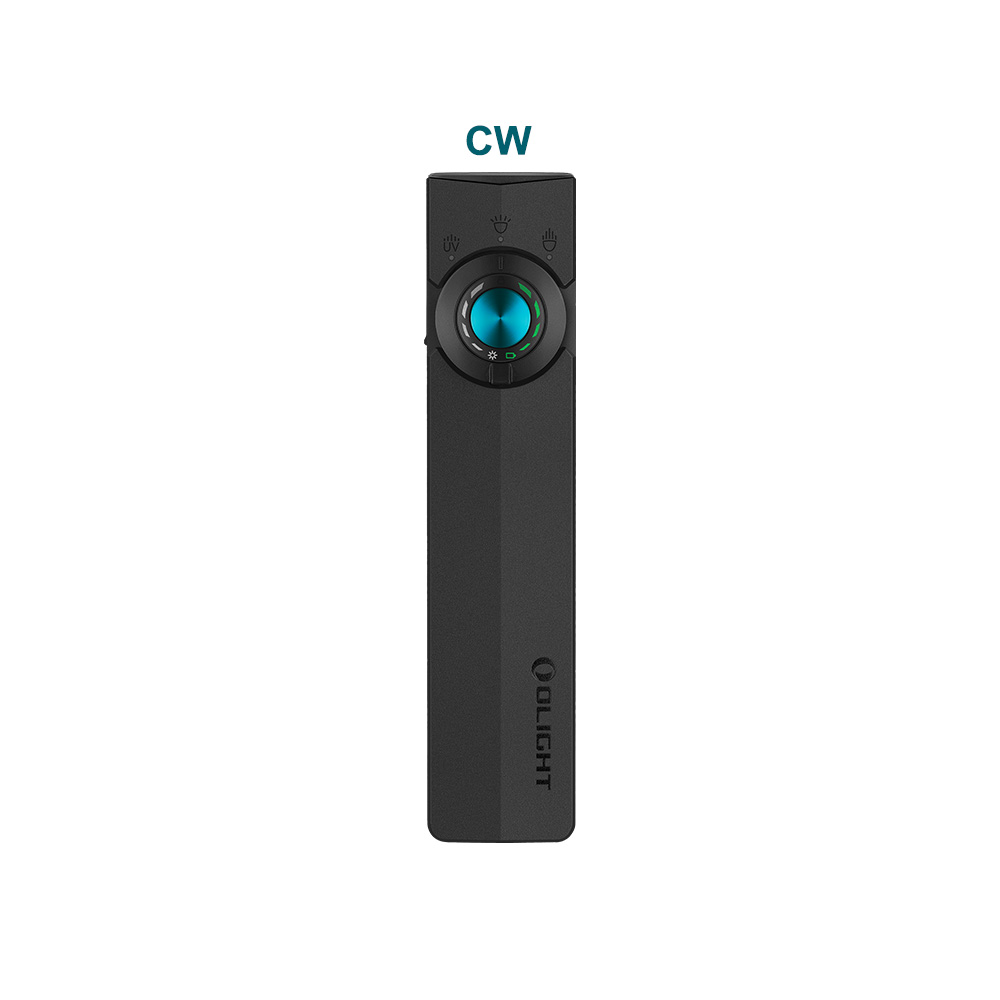
A handheld source lets the operator direct attention to a particular object and finish the check when that task is complete. That is different from choosing equipment for a large, continuously illuminated wall. Decide which job is needed before assuming that a pocket product should cover the entire room or remain running throughout a party.
Read the instructions for the exact configuration and identify the intended control before turning it on. Do not learn an unfamiliar selector by cycling through functions while facing guests. The relevant question is whether the operator can deliberately select and stop the intended mode while keeping the source directed at the display.
For a broader explanation of choosing a black light flashlight, the existing guide addresses the category's limitations. The handheld example here is an equipment option for a defined object-checking role, not a promise that the decoration will fluoresce or that the light is appropriate for unsupervised use.
Keep a handheld check separate from room lighting
A handheld check and an installed lighting arrangement have different responsibilities. One follows the operator's attention for a particular task. The other needs a suitable mounting location, a documented power arrangement, and conditions appropriate to the room. A familiar connector or a description such as black light does not settle those questions.
If an existing decorative fixture is part of the plan, follow that exact product's instructions for placement and use. Do not improvise a mounting method for a handheld light to imitate a fixture. Tape, fabric, a crowded shelf, or a decorative enclosure can introduce conditions that the light's instructions do not permit.
Separate any effect lighting from the lighting that makes the room usable. Guests should not need the special effect to locate a chair or find the door. If reducing ambient light makes movement difficult, revise the decoration or leave the normal lights on. A seasonal display can be smaller without losing its purpose.
When browsing rechargeable flashlight options, keep the task description beside the product information. Object checks, ordinary walking illumination, and installed decorative lighting are different needs. A feature list becomes useful only after the equipment has a defined role and the required instructions can be followed.
Learn the indicators and put the light away deliberately
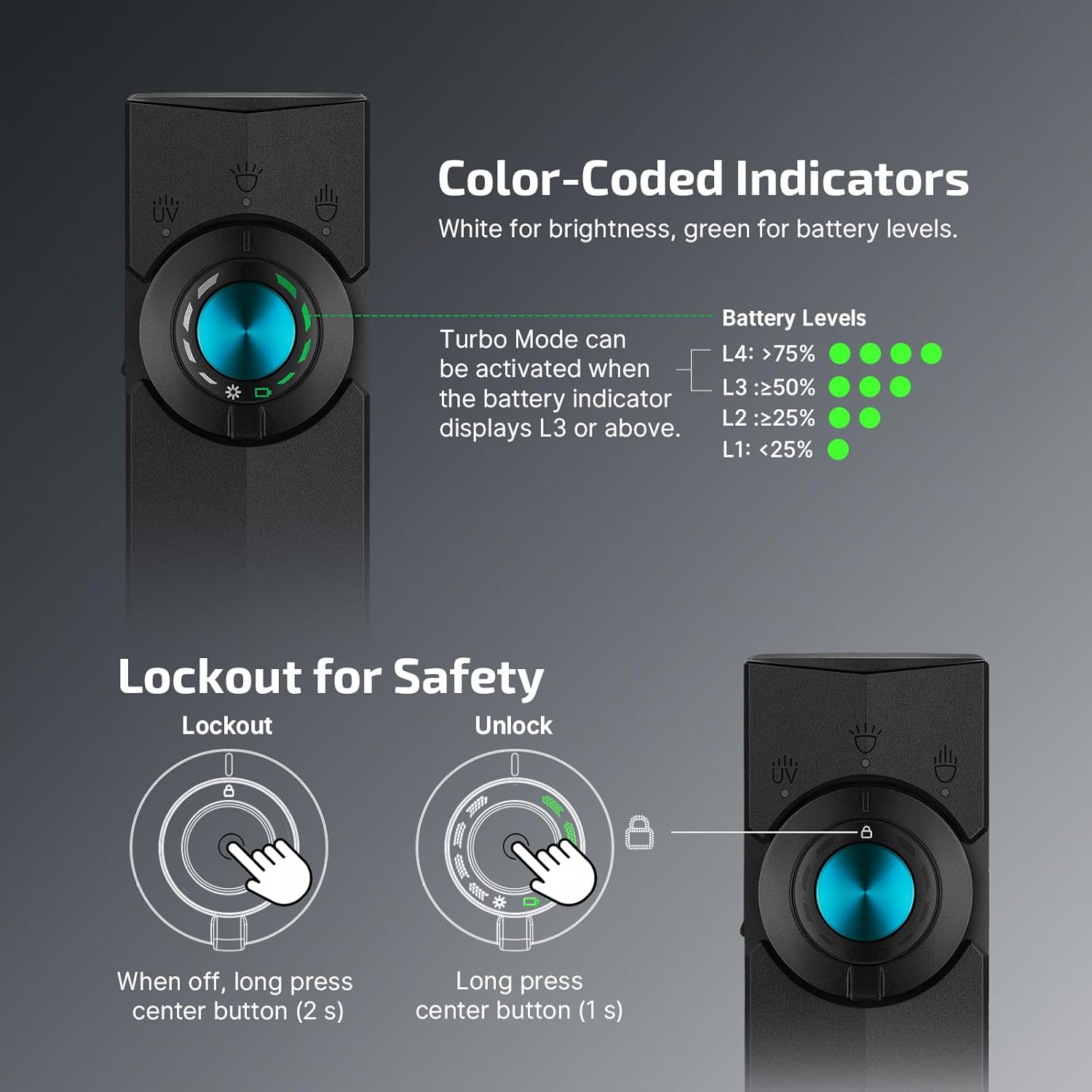
Official ArkPro control detail: learn the documented indicators and lockout before setup and storage.
Read the indicator explanation before preparation becomes busy. A battery indication and a brightness indication are different information. Neither should be interpreted as a measure of the ultraviolet exposure at a particular object or person. The exact model's instructions explain the controls; a room decoration does not provide that missing measurement.
Use the documented lockout arrangement when appropriate for transport or storage, and keep the equipment in a location controlled by the adult responsible for it. Lockout is one part of handling the product. It does not replace storage that prevents a child or an unprepared guest from accessing an unfamiliar light.
For an edc flashlight used occasionally for seasonal preparation, everyday carry and party equipment should remain distinct decisions. Decide where the light goes after the last object check. Leaving it beside decorative props can make a working tool look like another item intended for guests to handle.
Prepare the charging arrangement before decorating
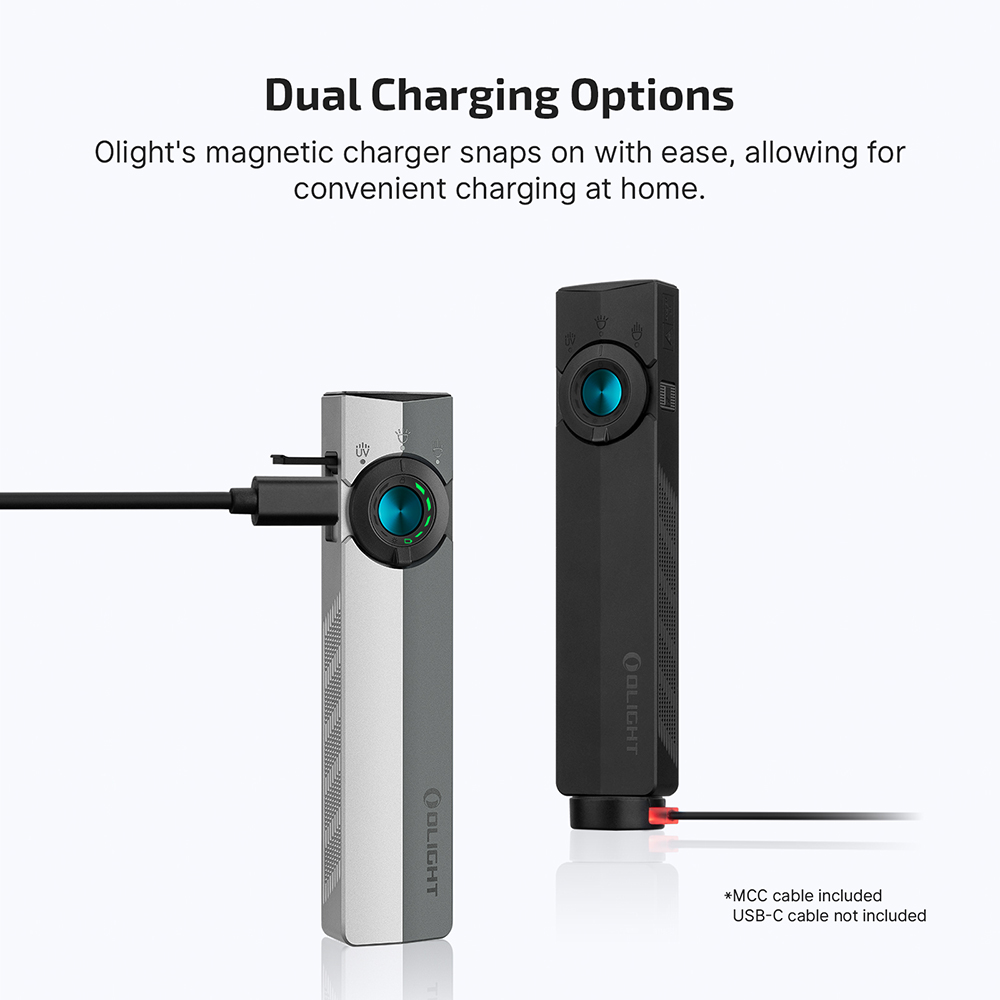
Official ArkPro charging image: available connections and included equipment must be checked for the exact package.
The gallery illustrates USB-C and magnetic charging arrangements. Check the exact package contents and required equipment instead of assuming every cable pictured with a family of products is included with every purchase. Have the appropriate power source available before organizing the display rather than turning the event table into a charging station.
The ArkPro manual says not to use the product while charging and to keep the charging port clean and dry. Keep those conditions attached to the plan. A cable connection is not a way to turn a handheld decoration check into an indefinitely powered effect, and a nearby drink is a reason to choose a different charging location.
Keep charging equipment away from the movement around the activity. A person viewing the decoration should not have to step over a cable or reach around a connected light. Finish preparation with the equipment in its intended operating condition, then store unused cables so the display remains understandable and uncluttered.
Keep UV off people and out of guest-operated games
The World Health Organization's UV health guidance describes effects on skin and eyes and notes the greater sensitivity of children's eyes. A festive color does not make an ultraviolet source harmless. Follow the exact equipment warnings; do not stare into the emitter or direct it at people.
Plan around inanimate decorations rather than illuminating faces, skin, or animals. Do not turn a costume contest into an inspection of participants under a handheld UV source. If a proposed activity needs that sort of exposure to work, choose a different activity using ordinary visible lighting.
Keep the device under adult control and make participation optional. For children, select activities that do not require them to handle the source or remain in its beam. Pets should not be part of the effect or encouraged to chase it. A paper reveal with a normal-light alternative keeps the seasonal idea focused on the decoration.
Do not invent a safe number of minutes, a universal distance, or a protection rating from a casual setup check. Those questions depend on information beyond how bright a surface looks. When the equipment's conditions cannot be established or followed, leave out the UV portion and use ordinary lighting for the display.
Separate costume appearance from material suitability
A fabric decoration and a material worn against skin are different applications. A craft label that permits use on paper or a prop does not establish suitability for clothing, skin, hair, eyes, or lips. Keep each product within its labeled use, and do not add household chemicals to make a costume appear brighter under a light.
For an ordinary costume display, arrange an unworn accessory or removable decorative piece on a suitable surface. Check the material and its instructions without putting a person in the beam. Preserve the costume's ordinary-light appearance, visibility, and movement rather than making the entire design depend on an ultraviolet effect.
If makeup is part of a separate costume plan, its own labeling and instructions govern that use. A light does not validate a cosmetic, and a claimed UV response does not establish that a product belongs near the eyes or mouth. Keep this decoration project separate from experimenting with body treatments or homemade formulations.
For a fake-blood prop, choose a labeled theatrical product appropriate to the actual surface and desired effect. An ordinary red product should not be assumed to fluoresce. If the label does not establish the intended appearance and application, use a different decorative element rather than trying to alter it with dyes, cleaners, or glow-stick contents.
Give the display an operator and a simple fallback
Consider a living room where one adult welcomes guests while another manages the decoration. Give the light and the reveal cards to the person responsible for the effect, rather than leaving both on a general activity table. The host at the door can continue helping people find seats without also trying to locate the equipment. If only one adult is available, run the reveal when that person can give it attention, then put the equipment away before returning to hosting.
Prepare the materials in the order they will be used. Keep the first card, any normal-light answer, and the container for finished props together. There is little value in an elaborate reveal that requires the operator to search through bags while guests wait. A short sequence with a clear beginning and end is easier to repeat without leaving tools or unused materials spread across the room.
Decide what stays if the special effect is unavailable. The paper ghosts can remain ordinary decorations; the reveal card can become a visible guessing game; the tabletop scene can be discussed under normal lighting. These alternatives use the same prepared objects. They avoid making the evening depend on acquiring another light at the last moment or treating an unfamiliar piece of equipment as an interchangeable replacement.
Separate reusable pieces from disposable craft materials when packing up. Keep the exact product information with any material that will be used again, and store the light according to its instructions rather than inside a mixed box of seasonal props. Next year's preparation is more straightforward when the contents can be identified without guessing which paint, cable, or light belongs to a particular effect.
Before buying additional equipment, identify the remaining gap in plain language. A larger readable card, a suitable background, or better placement may solve the problem more directly than a different source. If the actual need is a documented installed lighting arrangement, investigate that category separately. Buying another handheld product does not by itself provide a suitable mounting method, a new power plan, or supervision for an unattended display.
Photograph the decoration before guests gather
Frame the object, not the source. Choose a position where the camera can see the prepared decoration while the operator keeps the light directed at its intended surface. Move clutter out of the composition and confirm that the photograph's background does not hide the shape or message.
Begin with the phone's ordinary photo controls and review the result on the screen. Focus on the important detail and adjust the available exposure control if the bright area loses its shape. Different phones, materials, room lighting, and distances can produce different results, so one fixed combination of settings should not be treated as a universal recipe.
Keep the phone steady using an appropriate support if the selected mode needs it. Leave normal room lighting available for positioning the camera and moving equipment. A dramatic photograph is not a reason to stand in a dark walking route or to operate an unfamiliar light near another person's face.
Make a normal-light photograph as well if it helps communicate the project. The pair can show the design and the intended decorative effect without implying a calibrated comparison. Do not present edited colors, a simulated glow, or a photograph of one material as proof that another purchase will look identical.
Finish with ordinary Halloween setup checks
The Texas Department of Insurance's Halloween fire-safety guidance recommends flameless alternatives in pumpkins and keeping decorations out of exit paths. It also addresses appropriate outdoor cords and damaged equipment. These basic arrangements still matter when the display includes a special lighting effect.
Check the room after the decorations are in place, not only when the table is empty. Look at the door swing, the route between seats, and the space where people will gather. Remove anything that turns a decoration into an obstacle. Keep paper and fabric clear of the ArkPro's light outlet. If the light gets hot, switch it off and let it cool before storing it. Follow the materials' own handling instructions as well.
Give the event a shutdown routine. An adult turns off and stores the light, returns ordinary room lighting, removes temporary equipment, and deals with craft materials according to their labels. That routine should remain possible even if the activity ends earlier than planned or the room is needed for another purpose.
What blacklight is best for Halloween?
Choose a source documented for the actual job and conditions, then pair it with materials labeled for the intended effect. A handheld UV light can serve a controlled object-checking role; it should not automatically become a room fixture or guest-operated toy. Keep ordinary lighting available for movement, and follow the exact product's warnings and placement instructions.
Do glow sticks work under UV?
An activated chemical glow stick produces light through a chemical reaction, called chemiluminescence; it does not need a black light for that reaction. Published glow-stick research also describes UV-induced fluorescence in intact sticks. That response is different from chemical activation and depends on the item. Keep the stick sealed and follow its label rather than using its contents as a craft ingredient.
What makes fake blood glow under blacklight?
Fluorescent ingredients absorb UV and emit visible light; ordinary red color alone does not establish that effect. Choose a product explicitly labeled for the desired appearance and the actual application, then follow its instructions. Do not modify ordinary fake blood with household chemicals, glow-stick liquid, or unidentified dyes. A paper prop can provide the seasonal effect without treating skin or clothing.
Frequently Asked Questions
Keep the effect focused on the decoration
A clear paper shape, a simple reveal, and a deliberate operating routine can give the display its Halloween character. Select materials for their actual use, keep the equipment under responsible control, and preserve ordinary room lighting and clear routes. The most useful effect is one that fits the room and can be ended as easily as it begins.
Changelog
- November 19, 2026: Product information and buying guidance reviewed.




