⚡ TL;DR
Many everyday things glow under a black light because they contain fluorescent compounds that turn invisible UV-A into visible light. This guide lists 27 of them, from tonic water and freshly washed white shirts to ripe bananas, scorpions and dried urine, with the cause of each glow where it's known and a published source for every entry.
The table below groups the 27 items and shows what makes each group glow.
| Group | Examples | What you typically see | Why it glows |
|---|---|---|---|
| Household and garage (13 items) | Tonic water, petroleum jelly, white paper, white T-shirts, highlighters, ripe bananas | Mostly blue or blue-white; green from uranium glass, leak dye and the $20 thread; ink colors from highlighters | Quinine, optical brighteners, fluorescent dyes and pigments |
| Nature and minerals (9 items) | Scorpions, flying squirrels, fluorite, aragonite, ruby, diamonds | Bluish bark scorpions, pink flying squirrels, blue fluorite, red chlorophyll | Natural fluorescent substances and mineral impurities |
| Body, hygiene and cleaning (5 items) | Urine, semen, saliva, teeth, cleaning markers | Blue for semen; varies for the rest | Natural fluorescent compounds and tracer dyes |
| Stays dark | Blood, flour, soda water, colored paper, green bananas | No visible glow | Named as non-glowing by the sources below |
📋 Table of Contents
- 1. Why Do Things Glow Under a Black Light?
- 2. What Household Items Glow Under Blacklight?
- 3. Why Do White Clothes Glow Under UV?
- 4. What Naturally Glows Under Black Light?
- 5. What Bodily Fluids Show Up Under a Blacklight?
- 6. Does Urine Glow Under a Blacklight?
- 7. What Doesn't Glow Under a Black Light?
- 8. How to Photograph Things That Glow Under UV Light
- 9. What Do You Need to See These Glows?
- 10. How to Use a Black Light Safely
- 11. FAQ
Why Do Things Glow Under a Black Light?
Things glow under a black light through fluorescence. A material absorbs ultraviolet energy and releases it as visible light, so it appears to shine in a dark room. Tonic water is the classic example: the quinine in it absorbs UV and releases the energy as a visible blue glow, as the UCAR Center for Science Education explains.
The glow lasts only while the light is on, which separates fluorescent materials from glow-in-the-dark ones. DayGlo, which makes fluorescent pigments, says: "With no light source, fluorescent color has no color." Phosphorescent pigments work differently, storing energy from light and releasing it slowly after the light goes off.
A darker room makes a faint glow easier to see, and the color comes from the material rather than the lamp. That is why one black light can make a shirt glow blue, a leak dye glow green and a flying squirrel glow pink.
What Household Items Glow Under Blacklight?
Common household items that glow under a black light include tonic water, petroleum jelly, white paper, freshly washed white clothes, highlighters, ripe bananas and the security thread in a current-design $20 bill. Some white plastics, security-marking pens and fluorescent paints glow too, and collectibles and garage items add uranium glass and leak-detection dye.
This table lists the 13 household and garage items, with what you see and what causes it.
| Item | What you see | What causes it | Source |
|---|---|---|---|
| Tonic water | A blue-white glow | Quinine | Science World, UCAR |
| Petroleum jelly | A bright blue glow | Not explained by the source | Science World |
| White paper | A glow from paper made after 1950 | Fluorescent chemicals such as optical brighteners | Science World, X-Rite |
| Freshly washed white T-shirt | A blue glow | Whiteners from detergent | Science World, X-Rite |
| Some laundry detergents | A blue glow | Optical brighteners | Science World, X-Rite |
| Highlighters | A bright glow in the ink's color | Fluorescent chemicals in the ink | West Texas A&M University |
| Security-marking pens | Markings that show up under a black light | Fluorescent ink | Science World |
| Some white plastics | A glow on parts that look plain white in normal light | Added optical brighteners | X-Rite |
| Ripe bananas | A bright blue glow on the peel | Linked to fluorescent breakdown products of chlorophyll | ScienceDaily, Angewandte Chemie |
| Current-design $20 bill | A green glow from the security thread | A fluorescent security thread | U.S. Currency Education Program |
| Fluorescent paints and posters | A vivid glow in the pigment's color | Fluorescent pigments | DayGlo |
| Uranium glass, including Vaseline glass | A rich green glow | Uranium in the glass | Oak Ridge Associated Universities |
| A/C and refrigeration leak dye | A green or yellow glow at leak sites | Fluorescent dye added by a technician | Spectroline |
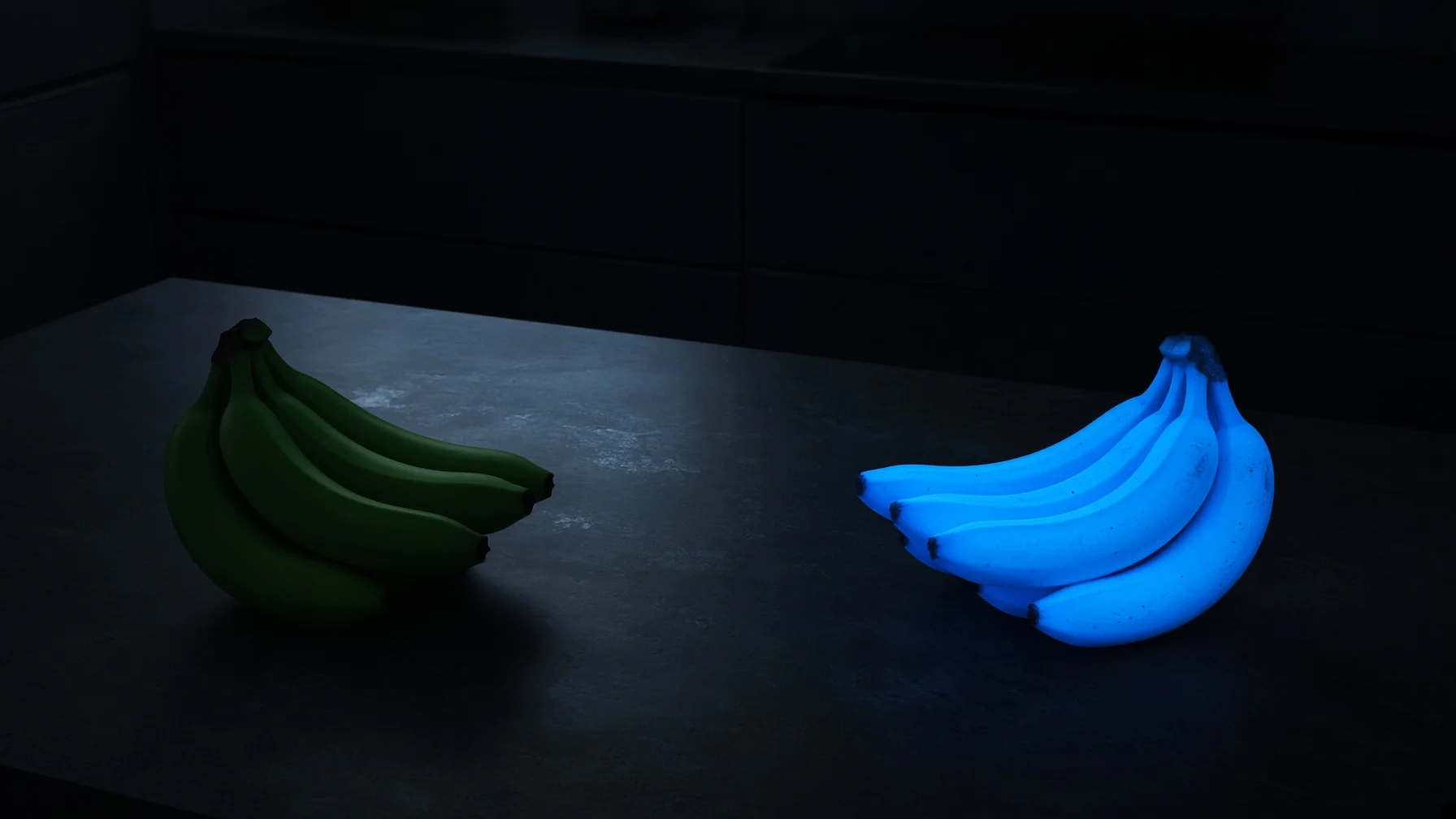
Bananas are the oddest entry here. Researchers from the University of Innsbruck and Columbia University reported in 2008 that ripening bananas glow bright blue under UV light, and linked the glow to colorless but fluorescing breakdown products of chlorophyll that collect in the peel. The glow tracks the loss of green pigment and fades as ripening continues, and Science World lists green bananas among the things that don't glow.
Security-marking pens use fluorescence on purpose. Science World describes pens with fluorescent ink used to "invisibly" mark belongings, so a black light can reveal the marks if the items are ever stolen.
Spills can light up too. If you search a kitchen floor or a carpet for pet stains, Preventive Vet warns that milk, honey, canola or olive oil, ketchup and antifreeze can glow along with urine, so check any glowing spot under normal light before you decide what it is.
For collectors, the green glow of uranium glass is a useful clue rather than proof. Oak Ridge Associated Universities says glass that glows a rich green contains uranium, and it also notes that some uranium-containing glass doesn't fluoresce at all.
Why Do White Clothes Glow Under UV?
White clothes glow under UV because white fabrics and laundry detergents can contain optical brighteners. X-Rite, a color-measurement company, explains that these chemicals absorb ultraviolet light and re-emit it as visible blue light, so whites look whiter and glow under a black light. Science World lists a recently washed white T-shirt as glowing and a colorful T-shirt as not.
Manufacturers add optical brightening agents to paper, plastics, textiles and cleaning products such as laundry detergents to boost whiteness and reduce yellowing. Under a black light, those agents turn invisible UV into the blue glow you see on a shirt collar or a stack of printer paper.
The same chemistry causes false alarms. Detergent residue on a carpet or a bedsheet can glow under UV light, which is one reason a glowing spot doesn't prove that a stain is urine or anything else. HORIBA, a scientific instrument maker, notes that clothing and sheets glowing under an ordinary black light can make body-fluid stains on them harder to pick out.
What Naturally Glows Under Black Light?
In nature, scorpions, New World flying squirrels, many fluorite specimens, some calcite, aragonite, sodalite and ruby specimens, and roughly a quarter to a third of diamonds glow under UV light. Chlorophyll glows red as well, though an ordinary flashlight shows it better. Colors range from the bluish glow of Arizona bark scorpions to the bright pink of flying squirrel fur.
The table below gives the color and, where the source explains it, the cause for each of the 9 natural items.
| Item | What you see | What causes it | Source |
|---|---|---|---|
| Scorpions | A bright bluish glow on Arizona bark scorpions | An unidentified substance in a thin layer of the skin | Arizona State University, National Park Service |
| New World flying squirrels | A bright pink glow on the fur | Not yet explained | Smithsonian Magazine on Journal of Mammalogy research |
| Fluorite | Blue under longwave UV, rarely red or other colors | The mineral's fluorescence; not every specimen glows | Fluorescent Mineral Society |
| Calcite (some specimens) | Many possible colors; a Terlingua calcite glowed pink under 365 nm in one test | Impurities such as manganese, which produces red; pure calcite doesn't fluoresce | Fluorescent Mineral Society, Sterling Hill Mining Museum |
| Aragonite | Hot pink under a filtered 365 nm light in one test | Not explained by the source | Fluorescent Mineral Society test |
| Afghan sodalite | Orange under a filtered 365 nm light in one test | Not explained by the source | Fluorescent Mineral Society test |
| Ruby | A dull red under a filtered 365 nm light in one test | Not explained by the source | Fluorescent Mineral Society test |
| Chlorophyll extracted from green leaves | A red glow, which a bright white flashlight brings out better than a black light | Absorbed light released as red fluorescence | National Science Teaching Association |
| Diamonds | Some fluorescence in about 25% to 35%, most often blue | Natural fluorescence in some stones | GIA |
Scorpions are the easiest wild glow to find, because Arizona State University's Ask A Biologist says every species fluoresces. Bark scorpions are also the most venomous scorpion in North America, according to the National Park Service, so keep your distance.
Flying squirrels were a chance discovery. A Northland College forestry professor pointed a UV flashlight at a flying squirrel at a bird feeder in Wisconsin, and his team later found the pink glow in museum specimens of New World flying squirrels. Eastern gray, fox and American red squirrels showed no such glow.
Mineral results depend on the specimen and the light. The Fluorescent Mineral Society cautions that not every specimen of a fluorescent mineral will glow, and the Sterling Hill Mining Museum explains that pure calcite doesn't fluoresce until a little manganese is present. In one society member's side-by-side test, an aragonite specimen glowed hot pink, Afghan sodalite orange and a ruby dull red under a filtered 365 nm flashlight.
Chlorophyll is a special case. The National Science Teaching Association explains that up to 32% of chlorophyll molecules in an extract re-emit absorbed light as red fluorescence, compared with about 1% or less in a healthy leaf. Because chlorophyll absorbs visible light more strongly than UV, NSTA notes that a bright ordinary flashlight brings out the red glow better than a black light.
What Bodily Fluids Show Up Under a Blacklight?
Urine, semen and saliva can all show up under a black light. HORIBA, which makes forensic light sources, says nearly all body fluids are inherently fluorescent and that semen fluoresces blue under light between 300 and 450 nm. Blood is the exception: HORIBA notes it doesn't fluoresce enough for the human eye to see.
Here are the five body, hygiene and cleaning entries, with the source for each.
| Item | What you see | What causes it | Source |
|---|---|---|---|
| Urine | Old stains become easier to spot | Fluorescent compounds including pterins, flavins and porphyrins | Preventive Vet, Scientific Reports |
| Semen | A blue glow | Natural fluorescence | HORIBA |
| Saliva | Some fluorescence | Natural fluorescence | HORIBA |
| Teeth | Natural fluorescence; most resin fillings in one study glowed more | Tryptophan in dentin collagen contributes | Materials |
| Fluorescent cleaning markers | Marks left behind on surfaces that weren't cleaned | A tracer placed before cleaning | CDC |
A black light is a screening tool here, not a test. Forensic teams use tuned light sources and filters because fabrics and cleaning products also glow under an ordinary black light, and HORIBA adds that most body fluids must dry before they fluoresce, with urine a possible exception. For what a black light can and can't confirm about bed bugs, mold and disinfection, see our guide to what a black light can and can't detect.
Teeth fluoresce too, and fillings can stand out. A 2024 study in the journal Materials, which used a violet dental light peaking near 402 nm rather than a 365 nm black light, found that a natural tooth displayed very little fluorescence compared with the resin composites in the study. The paper notes that dentin fluoresces up to three times more than enamel because of tryptophan in its collagen.
Cleaning markers are the one entry in this group that someone adds on purpose. A hospital team marks surfaces with a fluorescent tracer, and after cleaning, the CDC describes checking with UV light to see whether any tracer is left.
Does Urine Glow Under a Blacklight?
Yes. Urine stains can show up under a black light, which is why pet owners use UV lights to find accidents. Preventive Vet says a black light makes it easier to spot old stains, and a 2023 study in Scientific Reports lists pterins, flavins and porphyrins among the fluorescent compounds in urine. How strongly a stain glows can vary.
The glow is common but hard to judge by eye. In a 2005 study in the American Journal of Emergency Medicine, physicians examined 150 urine samples from children with no poisoning exposure under a Wood lamp. One group reported fluorescence in 80.7% of the samples and the other in 69.3%, and agreement between physicians on which samples glowed was poor.
A few habits make a search more productive:
- Make the room as dark as possible. Preventive Vet says "a blacklight works best the darker the room is."
- Hold the light close and move slowly across carpet edges, baseboards and the areas a pet uses.
- Check every glowing spot under normal light, because detergent and other spills can glow too.
For urine specifically, the goal is to find stains so you can clean them. A black light can't tell you whether a stain is fresh, how much urine is in it or whether cleaning removed it completely.
What Doesn't Glow Under a Black Light?
Plenty of things stay dark. Science World lists soda water, flour, colorful T-shirts, colored paper, green bananas, regular pens and Monopoly money as items that don't glow, and HORIBA notes that blood doesn't fluoresce enough to see. Some shortwave minerals and most diamonds can also stay dark under a longwave UV flashlight.
This table lists items that stay dark or may not glow, and why that matters.
| Item that stays dark | Why it stays dark or may not glow | Source |
|---|---|---|
| Soda water | Listed as non-glowing, while tonic water, which contains quinine, glows | Science World |
| Flour, colored paper and colorful T-shirts | Listed as non-glowing items | Science World |
| Green bananas | The glow appears as chlorophyll breaks down during ripening | Science World, ScienceDaily |
| Monopoly money | Listed as non-glowing in a classroom test | Science World |
| Blood | Doesn't fluoresce enough for the human eye to see | HORIBA |
| Minerals listed as shortwave fluorescent, such as scheelite | Results under a longwave flashlight vary by specimen | Fluorescent Mineral Society |
| Most diamonds | About 65% to 75% show no fluorescence under a long-wave UV lamp | GIA |
| Some uranium glass | Some uranium-containing glass doesn't fluoresce | Oak Ridge Associated Universities |
| Newly molted scorpions | They glow only after their skin has aged a while | Arizona State University |
Rock hunters should expect mixed results. The Fluorescent Mineral Society lists minerals such as scheelite and willemite as shortwave fluorescent, and in the society member's test, Franklin willemite glowed under a filtered 365 nm flashlight but not under a filtered 395 nm one.
Glow alone isn't proof of anything. The security thread in a current-design $20 bill glows green under UV light, according to the U.S. Currency Education Program, but it is only one of several security features, and older $20 designs differ.
How to Photograph Things That Glow Under UV Light
To photograph fluorescence, shoot in the darkest room you can, keep the camera still for a longer exposure and keep reflective surfaces out of the frame. A 2022 paper in the Journal of Imaging calls fluorescence imaging extremely sensitive to ambient light and explains why serious setups place a UV-blocking filter in front of the lens.
The paper's reasoning is useful even for phone photos. Camera lenses can fluoresce under UV light, and shiny subjects can bounce UV back into the lens or its filter, which can then fluoresce and add color casts that weren't part of the glow. The author notes that a slight color cast from the filter can be corrected with white balance.
For everyday photos with a phone:
- Turn off the room lights and the phone's own flash, so the only light comes from the black light and the glowing object.
- Brace the phone on a table or small tripod, because low light calls for longer exposures.
- Angle the black light so it doesn't reflect straight off glossy surfaces into the lens.
- Adjust white balance afterward if the image looks too purple or green compared with what you saw.
What Do You Need to See These Glows?
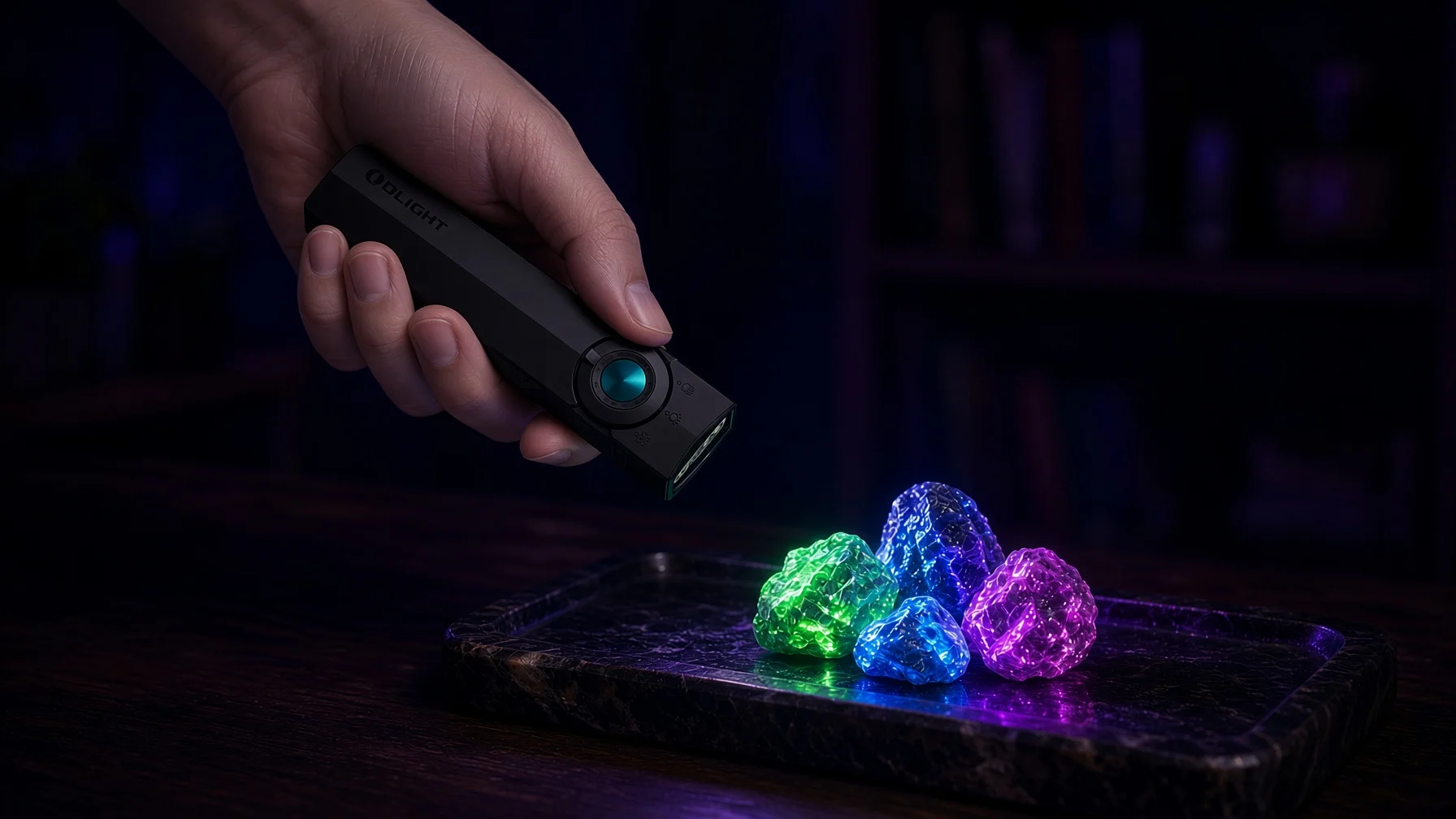
A flashlight with a true UV-A emitter will show strongly fluorescent items on this list, such as tonic water, highlighter ink and white paper. Faint glows, including old urine stains and some minerals, are easier to see in a fully dark room with the light held close. Our 365 nm vs 395 nm UV flashlight guide explains how to choose a wavelength.
Olight makes several UV lights that pair a 365 nm-class UV emitter with white light, so you can find a glowing spot and then see it in normal light.
The Olight ArkPro (1,500 lumens white light, 365 nm UV up to 1,200 mW, IPX7, from $99.99) holds 1,200 mW for 5 minutes, then 580 mW for 300 minutes, and adds a green laser rated at no more than 5 mW. Never aim the laser at a person's or animal's eyes or at aircraft. If you'd rather carry one black light flashlight for both glow hunting and everyday tasks, start with the ArkPro series.
The Olight Oclip Pro S (600 lumens white light, 365–370 nm UV up to 800 mW, IPX6, from $39.99) costs less. Its UV mode holds 800 mW for 3 minutes, then 300 mW for 130 minutes, and it clips to a pocket or strap or holds on with its magnet, so both hands stay free while you search. Prices were checked on September 15, 2026.
How to Use a Black Light Safely
Use a black light flashlight for short searches and treat it as a UV source. Never look into the emitter or shine it at anyone's eyes, including a pet's, and keep the beam on the surface you're checking rather than on your skin. Keep UV lights away from children unless an adult is supervising.
UV-A can penetrate into the deeper layers of the skin, contributes to skin aging and may enhance the development of skin cancers, according to the World Health Organization, which is a good reason not to hold any UV light on bare skin for long. Laser-equipped models need extra care: never aim a laser at people, animals or aircraft.
FAQ
Changelog
- September 2026: First published. Sources checked September 15, 2026; Olight specifications checked September 14, 2026 and prices September 15, 2026.