


TL;DR: Compare handheld flashlights by the task, useful output over time, beam coverage, controls, charging routine, and carry fit. Read the exact model's manual alongside its specifications. A higher maximum lumen figure cannot answer every question. Choose the light whose documented behavior fits the work, rather than awarding a winner to an entire brand.
📋 Table of Contents
- 1. Start with a job the flashlight must do
- 2. Read lumens and beam information together
- 3. Compare the output that remains useful
- 4. Compare switch reach, starting state, and everyday operation
- 5. A compact example: Olight Baton 4 Pro
- 6. Compare the complete charging routine
- 7. A control-focused example: Olight Warrior 3S
- 8. Build a shortlist with actual decisions
- 9. Turn the shortlist into an ordinary handling check
- 10. Check the ownership details before ordering
- 11. Frequently asked questions
Start with a job the flashlight must do
A useful flashlight comparison starts with a sentence about the work. Reading a utility label inside a cabinet, checking the end of a driveway, and carrying a light during an evening walk create different demands. State what needs to be visible, how long the task lasts, and what the other hand will be doing. These details give every later specification a purpose.
For example, a household inspection might involve nearby labels, reflective surfaces, several short stops, and a pocket between uses. The relevant questions concern a comfortable working setting, a control that is easy to find, and a practical charging arrangement. A distant object across a yard creates another question about beam concentration. Neither situation requires treating the largest advertised output as the whole decision.
| Civilian task | What deserves attention first | A useful purchasing question |
|---|---|---|
| Reading a cabinet label | Nearby beam coverage and lower settings | Can the working output be selected without starting at maximum? |
| Checking a dark yard | Beam placement and useful sustained output | Does the documented beam suit the target and surrounding area? |
| Carrying a light in a pocket | Body dimensions, clip, and controls | Will it fit the actual pocket and remain secured during movement? |
| Keeping a household backup ready | Charging equipment and storage instructions | Can the household maintain the specified power arrangement? |
| Sharing a light with someone else | Starting state and switch behavior | Can another user learn the everyday control routine clearly? |
A task description also prevents an unfair comparison between very different packages. A compact pocket light and a larger handheld light may solve different problems even when their headline numbers overlap. Compare models that a person would actually consider carrying for the same job. If the larger package would stay in a drawer, its extra capability may contribute little to that person's daily routine.
Keep a second requirement for the inconvenient day. A light used mainly for short household checks may occasionally be needed for a longer interruption. Decide whether that means a longer working runtime, a second charged light, or a different carry arrangement. This turns a vague wish for something powerful into a concrete plan that can be checked against published operating information.
Read lumens and beam information together
Lumens describe total visible light output; candela describes luminous intensity in a particular direction. The National Institute of Standards and Technology's explanation of the candela distinguishes intensity from the total light quantity represented by lumens. The distinction matters when two handheld lights distribute their output differently. A total-output figure alone does not describe where that light will go.
For nearby work, inspect how the illuminated area relates to the task. A small bright center can be useful for locating something, yet the surrounding coverage also matters when reading a wider panel. For an outdoor check, consider both the object of interest and the nearby ground. Describe the desired coverage before deciding which specification should carry the most weight in the comparison.
A published beam-distance figure is another piece of information, rather than a promise that every detail will be easy to recognize at that distance. Actual surroundings, the target, and the observer affect a task. Use distance information to understand the model's intended reach, then ask whether its beam arrangement suits the much more ordinary distance at which the light will usually be used.
Product photographs can help identify a reflector, lens, or specified optic, but a photograph of the flashlight's front does not establish a measured beam pattern. Likewise, an attractive outdoor beam picture depends on camera settings and the scene. Look for the conditions attached to any comparison image. An unexplained photograph should not become a numerical claim about one brand outperforming another.
When browsing rechargeable flashlight options, keep the beam question separate from the charging question. Rechargeable describes the power arrangement; it does not tell a buyer whether the beam is broad or concentrated. A useful shortlist answers both questions. This avoids choosing a convenient charging system and only later discovering that the optical arrangement is awkward for the intended work.
Compare the output that remains useful
Maximum output and useful working output belong in separate parts of a decision. A brief stronger setting can help with a quick outdoor check, while reading labels for an extended period may call for a lower setting. Find the output levels in the exact manual and consider which one will carry most of the work. The relevant comparison is between those operating choices, not simply between two maximum figures.
Read any staged runtime entry in order. If a manual lists an initial output followed by a lower output, both stages matter. Do not attach the entire listed duration to the initial maximum. A buyer expecting continuous work needs to know what the light does after that first stage, and whether the later output still suits the task. Keep the manufacturer's stated conditions with the numbers.
Baton 4 Pro provides a concrete example. Its standard cool-white manual lists Turbo at 1,600 lumens followed by 600 lumens, with corresponding stages of two minutes and 198 minutes under the specified test conditions. That entry describes an output sequence. It does not mean that the highest output continues for the combined duration, nor does it guarantee the same result in every household or outdoor situation.
A longer total runtime can also be attached to a setting that is unsuitable for a particular job. Someone comparing two lights should therefore ask which setting provides useful illumination for the planned task and how that setting behaves over time. A long low-output figure and a short maximum-output figure answer different questions. Keep those rows distinct rather than combining them into one overall endurance score.
If the available documents do not establish comparable operating conditions, preserve that uncertainty in the buying decision. A retailer's summary may leave out an output step or the battery used. Consult the manufacturer's current instructions before treating two numbers as equivalent. Missing conditions are a reason to narrow a conclusion, not an invitation to estimate a winning margin from unrelated specifications.
Compare switch reach, starting state, and everyday operation
A switch arrangement becomes useful when the owner can select the intended light without reconstructing a sequence in the dark. Consider where the hand naturally rests, where the control sits, and which action selects the ordinary working mode. A side control and a tail control can support different hand positions. Neither location is automatically the better choice for every user or every household task.
Begin with the light off when learning a documented sequence, unless the manual specifies another starting state. Then distinguish a quick press, a sustained press, and any sequence used to change a setting. Two lights can have similar-looking buttons while responding differently. A comparison that records only the number of switches misses the behavior that the user will actually need to remember.
Momentary operation and constant-on operation also serve different routines. Momentary light is associated with holding the relevant control under the specified arrangement; constant-on can continue after the control is released. For brief checks, releasing a control may be convenient. For sustained work, a suitable constant-on setting may reduce the need to keep pressure on a button. Verify the exact action rather than guessing from the button's shape.
For a shared household light, the easiest routine to explain may matter more than an additional shortcut. Show another user how to reach the ordinary setting, identify the charge indication, and switch the light off. If the product offers different configurations, identify the active one. The household should not have to discover a configuration difference while already trying to solve a problem in darkness.
Before placing any light into a bag or pocket, follow its actual lockout and storage instructions. Lockout behavior varies, so a familiar button sequence from another model should not be assumed to apply. The buying question is whether the owner understands and can maintain the storage routine. A protective electronic feature does not remove the need to keep an operating lamp away from materials it could heat.
A compact example: Olight Baton 4 Pro
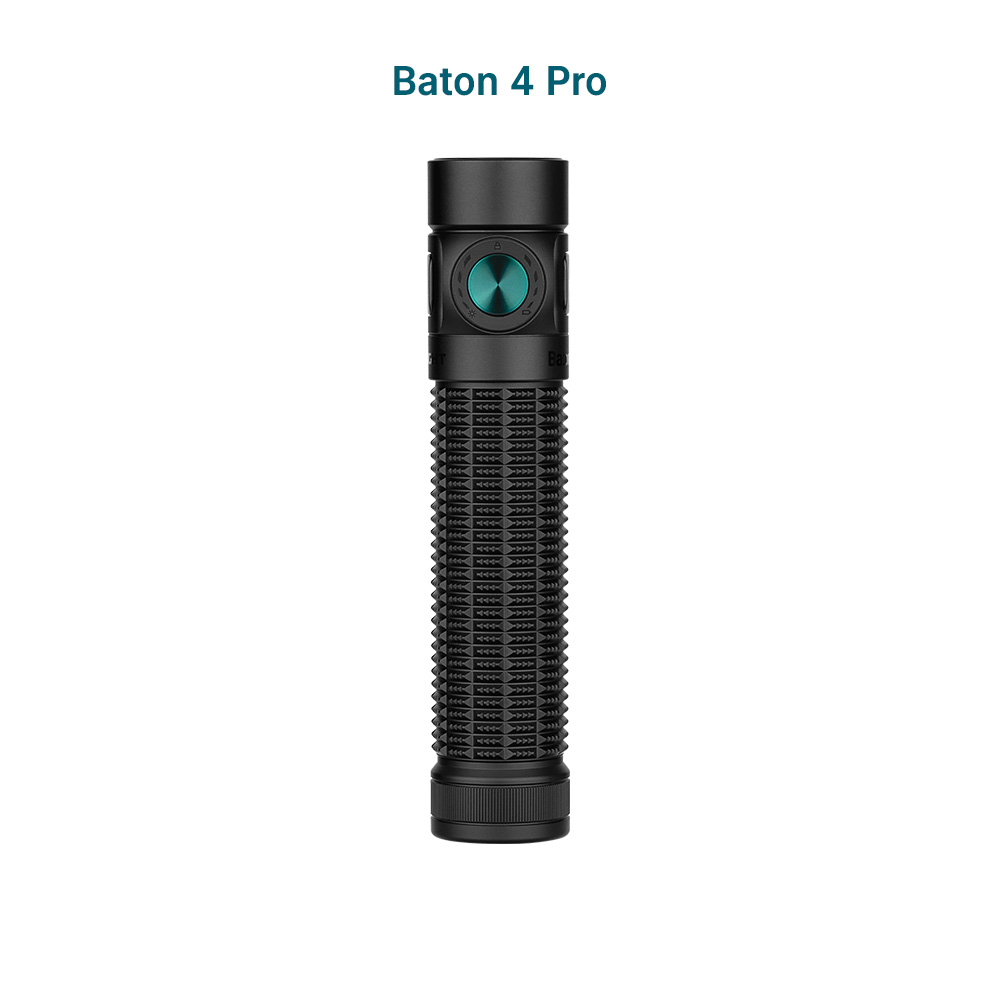
The standard Baton 4 Pro is 111 millimeters long and 23 millimeters in diameter. Those dimensions give a more useful starting point for pocket planning than a product image alone. Compare the required space with the pocket opening and the other objects normally carried there. A cylindrical body can be easy to understand in the hand while still taking more room than expected in a crowded pocket.
The model combines a rechargeable 18650 battery, a side switch, and a tail switch. The side control provides five brightness levels, while the tail control offers access to High and Turbo with momentary and constant-on behavior. This gives a buyer a specific question to consider: which control will serve routine nearby checks, and which documented action will be useful for a brief stronger output?
Its grip texture is visible in the official full-body photograph. The practical decision concerns where the fingers will rest relative to the control and whether the body fits the intended carry arrangement. A photograph can show the location and shape of the texture. It cannot establish a measured grip advantage over another product or guarantee handling under conditions that have not been documented.
Baton 4 Pro also has separate brightness and battery indications and a lockout icon. These address different questions: what operating state is selected, and what does the light report about charge? Learn the meanings in the manual rather than treating every illuminated symbol as another brightness level. Status feedback is most useful when the owner can recognize it before the next task begins.
Compare the complete charging routine
A charging connector is only one part of keeping a light ready. Consider the approved cable, the compatible power source, where charging will happen, and whether the owner will remember to return the light there. A connection that fits a regular home location may work well for a household light. A traveler may place more value on which suitable charging equipment is already being packed.
Baton 4 Pro supports magnetic charging and a USB-C port concealed beneath a rotating tailcap ring. The two connections offer a practical choice of arrangements. A regular magnetic connection can serve a familiar home location, while the port provides another route when an appropriate cable and supply are available. The presence of both options does not mean that every cable or charger is approved for the job.
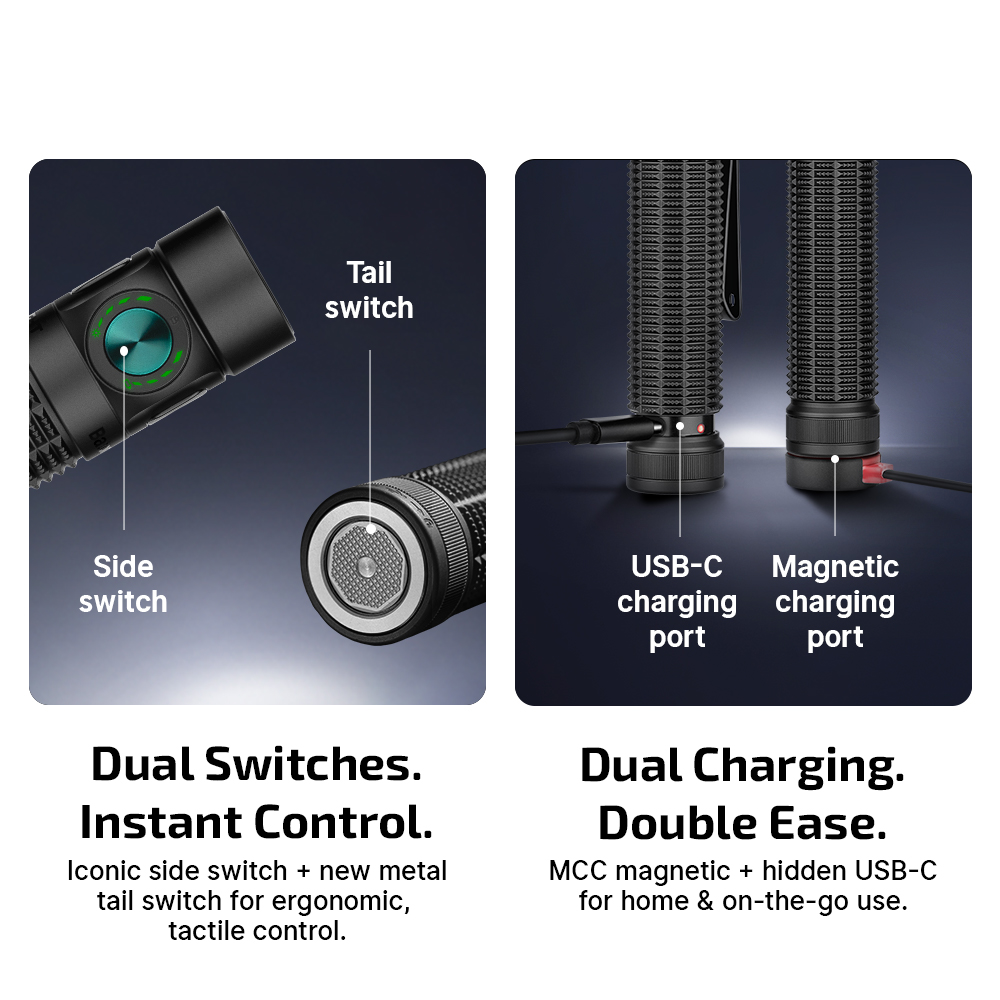
Official Baton 4 Pro detail: compare the actual controls and charging points rather than assuming every circular feature serves the same purpose.
For any brand, find the charging instructions before deciding what equipment must be purchased or carried. Confirm whether the required cable is included in the exact package being considered; bundles can differ. A product photograph showing a cable is not a substitute for the package list. The relevant cost is the equipment needed for a working routine, including anything the owner does not already have.
A replaceable cell also requires an exact compatibility check. A battery with similar dimensions or a familiar size label may differ in approved chemistry, electrical characteristics, or construction. Use the model's specified battery and charging arrangement. Do not turn a cross-brand comparison into a search for interchangeable cells unless the relevant manufacturer explicitly supports that compatibility.
For a household backup, decide who will check readiness and where the instructions will remain accessible. A light stored far from its charging equipment can be inconvenient even when its specifications are attractive. A simple, maintainable routine is easier to assess than a promise that the battery will always be full. Build the routine around the actual product rather than around an ideal charging habit that rarely happens.
A control-focused example: Olight Warrior 3S
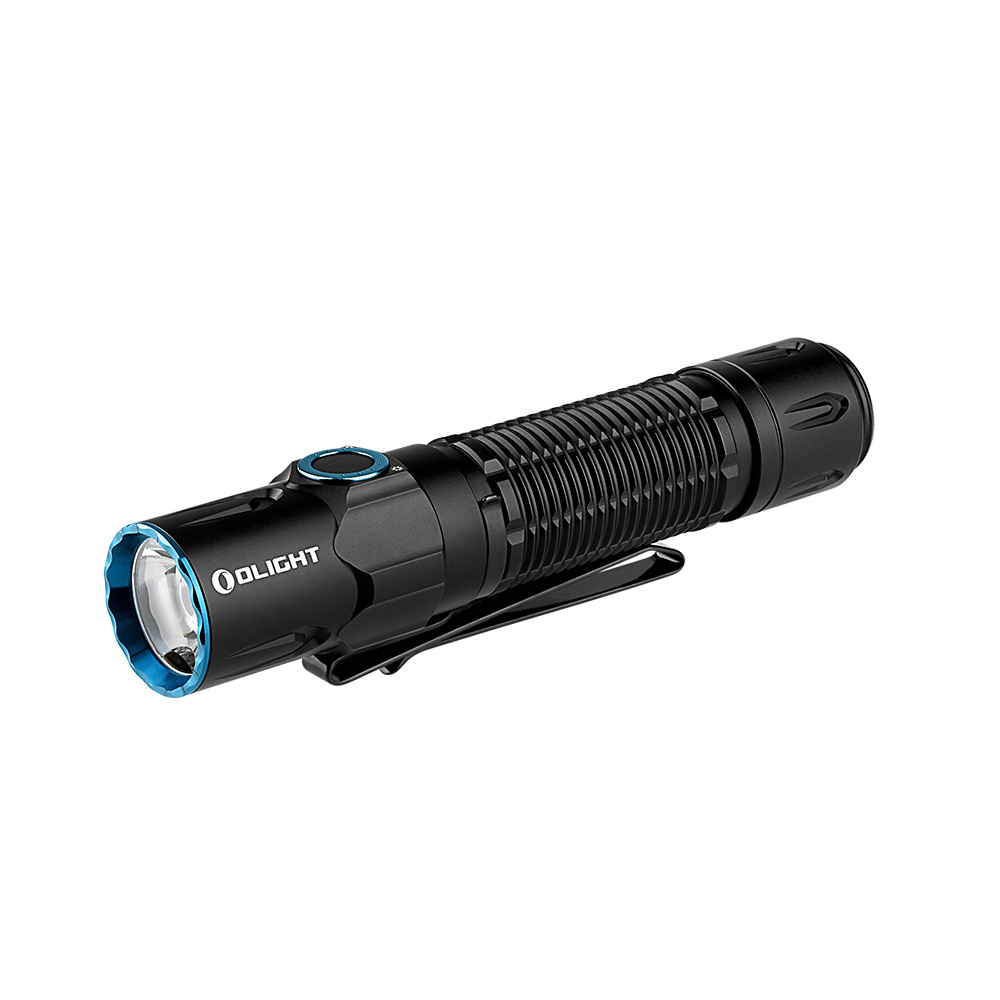
The Warrior 3S uses a cool-white LED and a TIR optic. Its side-switch area includes separate four-level brightness and battery indicators. These features make a useful example because they show how much information can be missed by a comparison built only around maximum output. The owner must still understand the display, the controls, and the intended working setting.
With the flashlight off and the factory-default tail-switch configuration selected, a half press selects Medium and a hard press selects Turbo. The manual distinguishes a quick press and release for on or off from holding the tail switch for momentary light. Those conditions belong with the instruction. Removing the starting state or configuration would make a short comparison less useful and potentially misleading.
For a person checking a dark yard, the meaningful question is whether that control behavior fits the ordinary sequence of use. For someone sharing the light, the question also includes how easily the active configuration can be explained. A documented shortcut has value when the user knows what it will do. More available actions are not automatically an improvement for a person who needs a simpler routine.
The model's proximity sensor reduces brightness when an obstruction is detected under the specified higher-output conditions. Treat that as a conditional protective feature, not permission to leave an operating light against fabric or another obstruction. Read its limitations and follow the storage instructions. Comparing protective features requires understanding when they operate as well as recognizing that the feature appears on a specification list.
These two Olight examples illustrate different details to investigate; they do not establish a ranking of competing brands. The same questions can be taken to another manufacturer's exact model and manual. Preserve the distinction between a documented feature, its plausible role in a household task, and a measured performance result. Each deserves a different level of confidence in the final decision.
Build a shortlist with actual decisions
Consider a person who walks between a house and a detached garage, occasionally reads nearby labels, and charges devices at a kitchen counter. The initial shortlist should favor a package that will be carried, a suitable nearby working setting, and an easy replenishment routine. A maximum-output advantage matters only after those needs are satisfied. A light that is inconvenient to carry or keep charged has a practical disadvantage for this particular person.
For that routine, the Baton example offers specific facts to investigate: its published body dimensions, separate controls, and two charging connections. The next step is to check pocket fit and learn the approved charging setup. This is a concrete decision path based on documented features. It is not a claim that the model produces a better beam or a longer measured runtime than an unnamed competitor.
Now consider someone who wants a handheld light for occasional outdoor inspections and values knowing the current brightness and battery state. The Warrior example provides a specific control and indicator arrangement to examine. The next questions concern the active tail-switch configuration, the appropriate working mode, and where the compatible magnetic charging equipment will live. The decision remains tied to a routine rather than to a brand's general reputation.
| Decision point | Documented example | What it helps decide |
|---|---|---|
| Space available for carry | Baton 4 Pro: 111 mm long, 23 mm diameter | Whether the body suits the intended pocket |
| Replenishment arrangement | Baton 4 Pro: USB-C and magnetic connections | Which approved equipment fits the charging routine |
| Reading the operating state | Warrior 3S: separate four-level indicators | Whether the status layout suits the user |
| Learning a tail control | Warrior 3S: two configurations described in its manual | Whether the user understands the active configuration |
| Expectation of maximum output | Baton 4 Pro: staged Turbo entry | Whether the later output suits the planned duration |
A shortlist does not need a universal points total. Some requirements are decisive: a light may not fit the pocket, the charging arrangement may be inconvenient, or the operating sequence may be unsuitable for the intended user. State that reason directly. Giving a model fewer points without explaining the underlying task can hide the very tradeoff the buyer needs to understand.
Turn the shortlist into an ordinary handling check
Before choosing, use the published dimensions to picture the light alongside the objects already carried. A paper strip marked to the stated length can help explain the space involved without pretending to reproduce the product's weight, texture, or balance. Compare that outline with the actual pocket opening and depth. If the light would displace keys or another essential item, decide where those objects will go before ordering.
If a retailer permits handling a demonstration unit, begin with the light off and ask how the everyday control works. Notice whether the control is easy to identify in the intended hand position, without pointing the lamp toward anyone's face. Keep the visit focused on fit and operating clarity. A brief handling impression can inform a personal preference, but it does not establish waterproofing, impact resistance, or long-term reliability.
A household handoff can be equally concrete. Ask the intended user to explain which control starts the normal working setting and how to switch the light off. Review the documented lockout separately. If that explanation requires an awkward sequence for the person who will actually use the light, consider whether another model's routine would be easier to maintain. Ease of explanation is a user requirement, rather than evidence that a more complex product is defective.
Look at the charging location as part of the same decision. Identify an appropriate power source, a place where the specified cable can remain accessible, and a position that follows the product's charging instructions. Consider whether the light will be returned there after an evening task. This check can reveal a practical inconvenience that a connector name alone would miss, especially when several people share the charging area.
For beam selection, describe the surface that needs light before looking at an impressive demonstration. A utility panel is wider than a single screw head; a path includes nearby footing as well as the object ahead. Ask for relevant beam information or a permitted demonstration in an appropriate setting. Do not stare into the lamp or use an uncontrolled outdoor comparison to claim a precise performance advantage.
Finally, write the purchase reason in one useful sentence: the body fits the planned pocket, the documented working setting suits the household task, and the approved charging arrangement fits the counter location. Add any condition that still matters, such as learning a particular configuration. That sentence gives the buyer a clear acceptance check when the package arrives, while leaving laboratory performance claims to evidence that actually supports them.
Check the ownership details before ordering
For broader context, the guide to choosing among flashlight brands offers a related framework. Keep this particular decision centered on the exact handheld model and documented operating details. A general brand discussion is useful navigation, while the current manual and package information supply the conditions needed to choose a specific light.
Read the current return terms and warranty for the exact market and seller before completing a purchase. Consider the return window, eligibility conditions, required purchase evidence, and the steps for requesting help. Keep those contractual details separate from a discussion of beam or controls. A strong general impression of a brand cannot replace the terms that apply to the particular transaction.
Compare the complete package rather than only the advertised item price. A suitable charger, approved spare, carry accessory, or shipping charge can affect what the owner must spend to use the light as planned. Confirm compatibility instead of assuming that an accessory pictured with one model will work with another. The most useful total is the cost of the specific working arrangement being considered.
When reading a review, identify what evidence supports its conclusion. A clear description of button behavior may be useful without being a durability study. A runtime graph needs conditions and an identified model. A comment about comfort describes one person's hands and carry method. Match the strength of the evidence to the claim before treating a personal preference as a conclusion about an entire brand.
For an edc flashlight, everyday ownership also includes what happens between uses. Think about the actual pocket, lockout routine, charging location, and access to the manual. The best-supported choice is the one whose documented behavior and ownership requirements fit that routine. Keep the final reason specific enough that another household member can understand why that model was selected.
Frequently asked questions
Changelog
- November 19, 2026: Product information and buying guidance reviewed.




