


TL;DR: David Misell patented a recognizable tubular flashlight design in 1899. Its history combines portable batteries, small electric lamps, and practical controls. The patent date identifies a documented milestone; it does not establish every claim about invention priority. Modern pocket lights retain the portable-light idea while changing the source, power system, and controls.
📋 Table of Contents
- 1. Who invented the flashlight? Start with the patent
- 2. What the early flashlight drawing actually shows
- 3. Dry cells made portable electric lighting more practical
- 4. Were flashlights invented in 1923?
- 5. Why do they call a flashlight a flashlight?
- 6. What did they use before flashlights?
- 7. What did a 1920s flashlight look like?
- 8. Flashlight history: filament lamps and the LED change
- 9. Modern pocket lights: what changed around the LED?
- 10. Modern controls still require a deliberate choice
- 11. Comparing an old flashlight with a modern one fairly
- 12. Frequently asked questions
Who invented the flashlight? Start with the patent
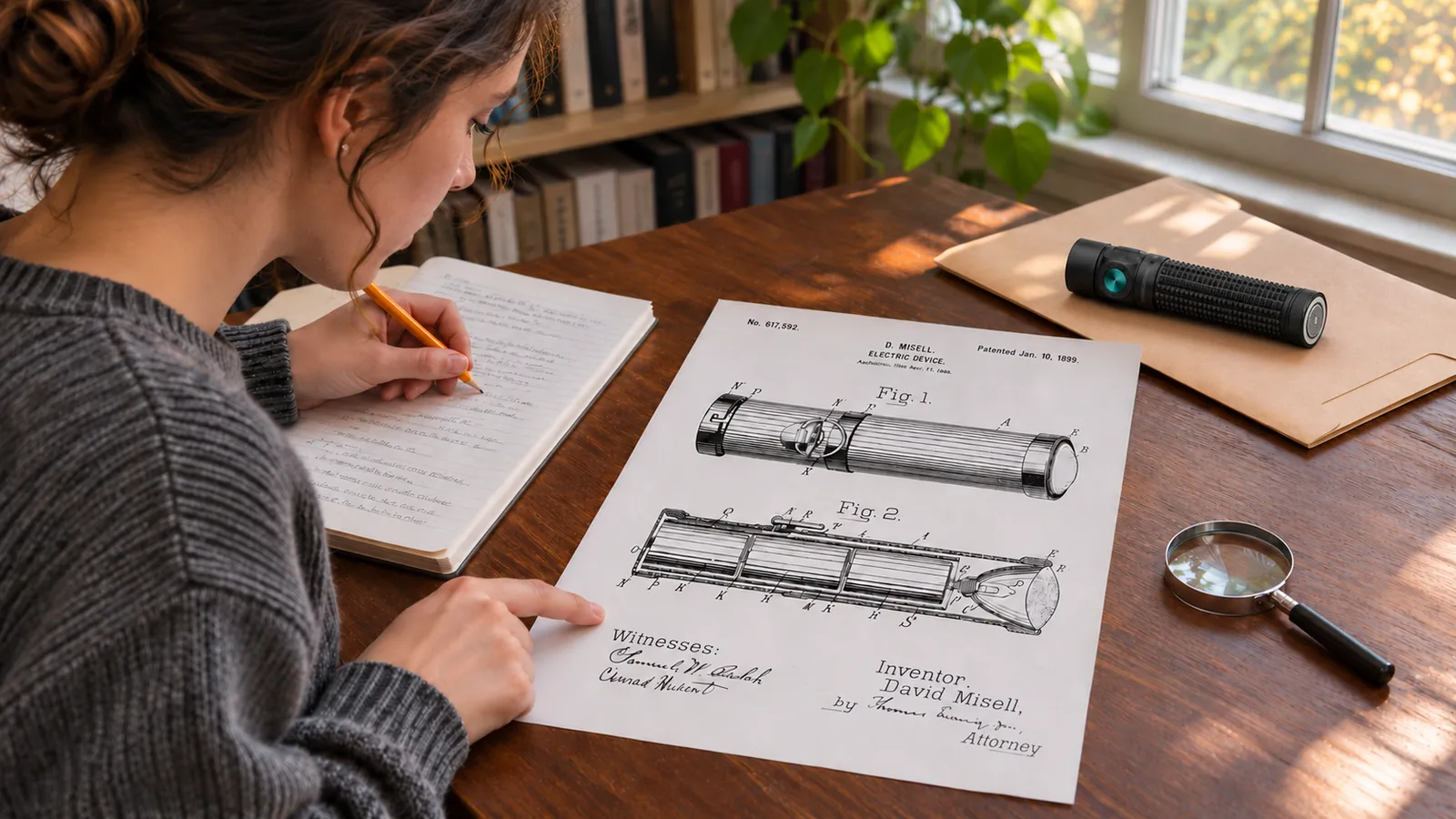
David Misell is the named inventor on U.S. Patent No. 617,592, titled Electric Device, issued January 10, 1899. The drawing records an application filed March 12, 1898. A patent facsimile preserved on a university website shows the familiar arrangement: a long handheld casing, cells inside, and a lamp at one end. That is a precise, documented answer to a question that often collects several different dates.
| Historical question | Documented answer | How to interpret it |
|---|---|---|
| Who is named as inventor? | David Misell on Patent No. 617,592 | A specific patented design |
| When was that application filed? | March 12, 1898 | Earlier than the issue date |
| When was the patent issued? | January 10, 1899 | A dated patent milestone |
| Did flashlights begin in 1923? | The illustrated patent predates that year | A later date needs a narrower explanation |
| What changed in modern lights? | Light sources, batteries, and controls | Compare complete systems and intended tasks |
The signature block also names Conrad Hubert as a witness. Those are different roles on this document. Keeping the labels attached to the names avoids turning a business association or a familiar historical name into an unsupported statement about inventorship. For a school report, the useful sentence is that Misell received this patent on the stated date, followed by the patent number and the source. It says more than an unqualified claim that someone invented every form of electric portable lighting.
Three questions deserve separate answers: who devised a particular mechanism, who received a particular patent, and who helped manufacture or distribute a product. A short history can connect those activities, but it should identify the evidence for each one. An inventor signature establishes one role. A witness signature establishes another. An advertisement establishes that someone promoted a product under the wording it displays. None of those records alone answers every question about earlier experiments or commercial success.
That distinction also makes the history useful when comparing an antique with a present-day rechargeable flashlight. The early drawing identifies the components that needed to travel together. A modern specification describes how one particular product supplies and controls light. The documents answer different questions, so neither should be forced into a claim it was never designed to support.
What the early flashlight drawing actually shows
The most revealing part of the patent illustration is its cutaway. Three cylindrical cells occupy much of the body. At the front, a small lamp sits within a reflector, behind the front optical element. A control appears on the outside of the tube. Even without reading every lettered part, the arrangement explains why the long cylindrical body became such a recognizable flashlight shape: it provides a place for the power source and a surface to hold while aiming the light.
Read the outside view and cutaway together. The outside view answers where a hand might meet the case and control. The section answers what occupies the volume beneath that surface. Looking at only the outer silhouette can make the design seem unchanged today. Looking inside reveals the more important question: how much of the package is devoted to energy storage, light production, electrical connection, and controlling the beam?
A patent drawing is a description of a design, not a photograph of every product sold afterward. It does not supply a measured beam pattern, continuous runtime, or the condition of a surviving example. Likewise, the apparent relative sizes of parts in a drawing should not become a set of measured dimensions. For an artifact comparison, record actual dimensions from the object's own catalog entry or from a properly documented measurement.
The drawing also offers a better comparison than simply asking which light is brighter. The user must carry the power supply, direct the lamp, and reach a control without losing the grip. Those requirements remain recognizable. Modern lights can solve them with different switches, optical systems, charging connections, or attachment points, while still addressing the same ordinary need to put usable light where a person is looking.
Dry cells made portable electric lighting more practical
The battery story helps explain why this design appeared in the late nineteenth century. The American Chemical Society's history of the dry cell describes the movement from liquid-filled cells toward sealed portable power. It identifies Carl Gassner's dry-cell work in the 1880s and the introduction of a mass-manufactured sealed consumer dry cell in 1896. A battery that could travel without the handling demands of an open liquid cell made portable household electrical devices more practical.
Here, dry describes a battery construction; it does not mean that chemistry has disappeared from the power source. The important historical change was the package a user could carry and handle. A clever portable lamp still needed a portable supply. Improving one component without considering the other would leave the device awkward for a coat pocket or for a person moving between rooms.
That is also why the battery's invention date and a flashlight patent's date should not be combined into a single event. A battery can exist before a particular lighting design uses it. A lamp can exist before someone makes its power supply and enclosure convenient to carry. The flashlight's history becomes clearer when those developments remain connected but separately dated.
For a classroom explanation, draw a boundary around the complete portable system. Inside it are the battery, lamp, electrical path, switch, and enclosure. Ask what each part contributes. The battery supplies electrical energy; the lamp produces light; the control allows the user to choose when the circuit operates. The case keeps the arrangement together and gives the user something to aim. This component-based explanation is more informative than assigning the entire history to a single isolated part.
Were flashlights invented in 1923?
No. Misell's dated patent drawing establishes that a recognizable tubular electric light existed well before 1923. A claim about that later year might refer to a particular product, an improvement, or a different event. It cannot replace the earlier patent date as the beginning of this documented design.
When a date appears in a family story or an online caption, first identify what the date describes. It could be a patent date stamped on the case, the date of an advertisement, the year a family member acquired the light, or a museum's estimated manufacturing range. These are useful clues, but they are not interchangeable. A flashlight bought in a certain year might have been manufactured earlier, and its patent marking may refer to an earlier feature.
A patent date on an old flashlight is not automatically its manufacturing date. For a collector's record, copy the wording exactly and label it as a marking. Keep the proposed manufacturing date in a separate field with its own supporting record. That small habit prevents a precise-looking year from traveling through later descriptions as an unsupported fact.
Why do they call a flashlight a flashlight?
The Rowan-hosted reproduction pairs U.S. Patent No. 617,592, granted January 10, 1899, with an advertisement headed “The ‘Ever Ready’ Electric Flash Light.” The patent provides a dated record of the design. The advertisement's date and the term's origin remain uncertain.
The word itself does not require a modern flashlight to blink. Keep the history of the name separate from the operating behavior of present-day lights: momentary operation and a strobe setting describe different functions.
In product instructions, momentary operation means light appears while the relevant control is held, under the specified control arrangement. Constant-on operation means it can remain on after the user releases the control. Those describe user actions and operating behavior. Neither term tells you the total energy stored in the battery. That vocabulary remains useful even when the light source, battery chemistry, and electronics are very different from those in the early drawing.
What did they use before flashlights?
Portable flame-based lights, including candles and fuel-burning lanterns, supplied light before battery-powered flashlights became available. Fixed lighting also mattered, but it could not always follow someone into an unlit space. The useful comparison is between a source that stays in one place and a light a person can carry and aim where needed.
For a household task, that change affects more than the source of illumination. Someone checking a dark corner wants light at the place being inspected. Someone carrying an object may also need to keep a hand available. A handheld electric light can direct a beam, but it still occupies a hand unless the particular design provides a suitable way to support or attach it. Portability and hands-free use are related needs with different solutions.
Avoid treating every earlier lighting tool as a direct ancestor of the same pocket device. A lantern that lights the area around it has a different job from a narrow beam aimed along a path. A fixed lamp depends on where it is installed. Comparing those jobs explains why different forms continue to exist rather than suggesting that each new invention immediately removed all earlier choices.
For a history display, give each object a task label alongside its date. For example, distinguish area lighting from a light intended to inspect a particular spot. A visitor can then understand both the technical change and the human reason for carrying the object. The most useful historical comparison explains what a person could do with the light, not just whether its power source was older.
What did a 1920s flashlight look like?
There was no single shape that can safely identify every flashlight from that decade. Museum records help show the range while also showing why dates need care. An early dry-battery torch in the Science Museum Group collection is cataloged to about 1900–1910 and retains its original tubular carton. Its record notes patent dates from January 1899. The catalog date and the marked patent dates perform different jobs.
A separate Science Museum Group torch cataloged to 1920–1940 is reddish-brown molded phenol formaldehyde, with an original box. The entry records dimensions of 30 by 100 by 70 millimeters. That broad date range includes the 1920s and later years; it should not be shortened to an exact year. It also demonstrates that an old electric torch need not be a long metal tube.
If you have inherited a flashlight, begin with observation rather than a date guess. Photograph the complete object, the control, the lamp end, and any wording you can read without forcing parts apart. Include an ordinary scale in a separate documentation photograph. Record whether the body appears cylindrical or flat, whether there is a carrying feature, and what parts are present. Describe uncertainty plainly in the private record instead of polishing a guess into a confident caption.
The original box can be as useful as the object because its wording may identify a model or an intended use. Keep that wording distinct from your interpretation. A box found near a light is a lead to investigate; it is not automatically proof that the two were originally paired. A museum record that explicitly describes the original carton gives a stronger connection than a resemblance between two loose objects.
Finish an identification attempt with a short evidence table of your own: observed marking, matching catalog feature, and remaining uncertainty. This makes it easier to ask a museum or a knowledgeable collector a focused question. It also protects the family history. A careful description of an undated object can remain useful even if later research changes its proposed age.
Flashlight history: filament lamps and the LED change
The Department of Energy's history of the light bulb describes carbon-filament development, tungsten-filament improvements beginning in the early twentieth century, and later work with gases inside incandescent bulbs. It also records a visible red LED milestone in 1962. These are lighting-technology milestones, rather than a single worldwide schedule for when every flashlight adopted a new source.
Incandescent lamps make light by heating a filament. Replacing a carbon filament with tungsten changes the lamp, while changing the gas inside a bulb is another design choice. A krypton or xenon label on a filament bulb therefore should not be treated as proof that it has the same light-producing mechanism as an LED. An LED produces light using a semiconductor. Identify the source before comparing the surrounding package.
| Feature being compared | What to record | What the record helps answer |
|---|---|---|
| Light source | Filament bulb or LED | Which light-producing system is present? |
| Power source | Exact battery designation and approved chemistry | What supply does this design require? |
| Optical arrangement | Reflector, lens, or specified optic | How is the light directed? |
| Control | Documented switch behavior | How does the user select and hold an output? |
| Physical package | Measured dimensions and stated weight conditions | Is it practical for the intended carry method? |
This approach avoids an easy mistake in a history-of-flashlights timeline: placing different technologies in one row as if every improvement replaced the entire device at once. A manufacturer can change the bulb while retaining a familiar enclosure. Another design can change the battery or controls at the same time. Similar-looking flashlights may therefore belong to different technical arrangements, while quite different-looking lights may share the same general source technology.
For the practical differences between light sources, the guide to LED, incandescent, and HID flashlights compares those categories. The closer look at the change from incandescent to LED flashlights follows how modern components work together. The historical question here is narrower: which dated evidence supports a claim, and what can the object or drawing actually tell you?
Modern pocket lights: what changed around the LED?
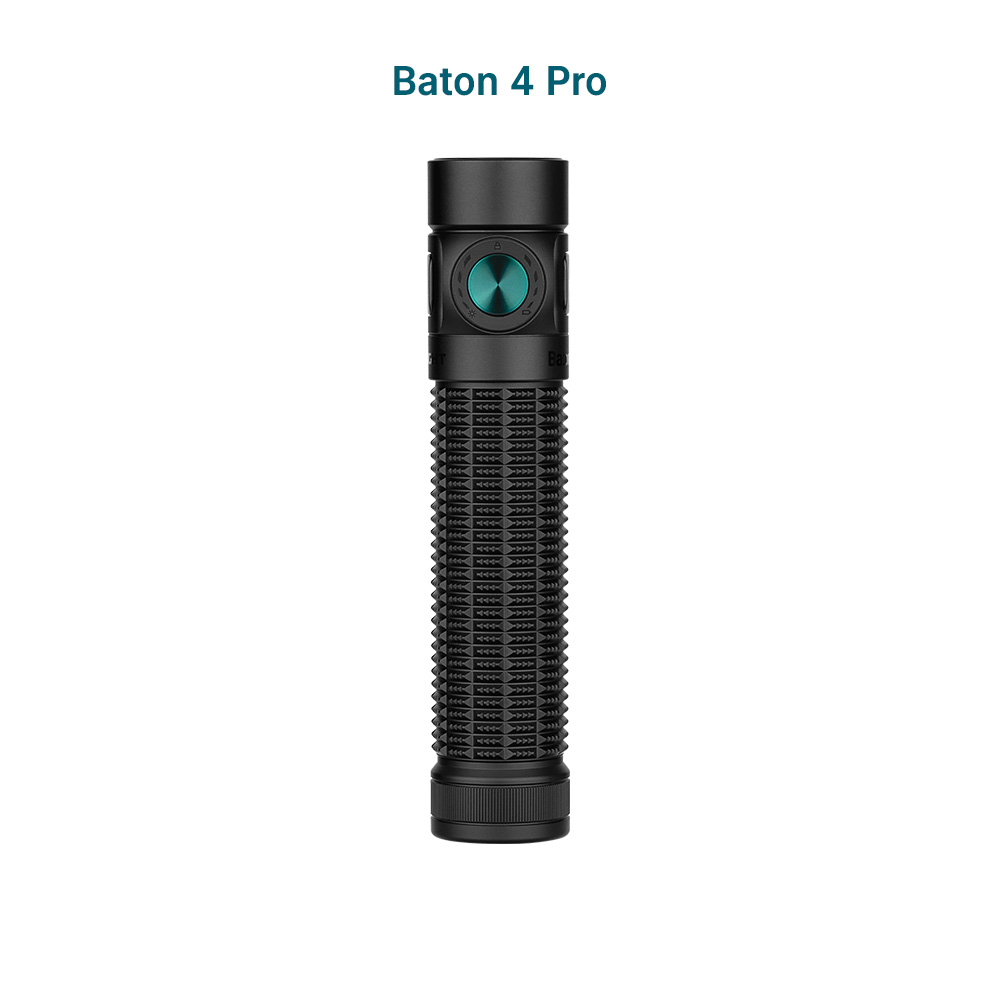
The Olight Baton 4 Pro provides a concrete modern example. The standard cool-white model combines an LED light source with a rechargeable 18650 battery, a side switch, and a tail switch. Its side switch offers five brightness levels. The tail switch provides access to High and Turbo, with momentary and constant-on control. A familiar tube now contains a more varied set of operating choices.
The standard Baton 4 Pro measures 111 millimeters long and 23 millimeters in diameter. The full-body image makes the relationship between the grip surface, side control, and tail end easier to see than a close-up alone. Its knurling combines shallow grooves with deeper indentations. When comparing pocket lights, consider where your fingers will rest and how easily you can find the intended control. The manufacturer's dimensions provide a size reference; the product photograph should not be used as a scale drawing.
That separation can help during an ordinary evening task. A person reading a label or checking a cabinet needs an output that suits a nearby surface. Someone briefly looking farther along a dark route may want quick access to a stronger setting. Different controls let the product address those needs, but the owner still needs to learn which switch performs each action. More choices add value when their operation becomes familiar.
Charging is another substantial difference from simply placing replacement cells in an early tube. Baton 4 Pro supports magnetic charging and has a USB-C port concealed by a rotating tailcap ring. The practical benefit is a choice of charging arrangements: a magnetic connection can fit a regular home location, while the port offers another option when packing an appropriate cable. The correct connection, cable, and power source still need to be available when the light needs charging.
The ring also makes the port's location part of the design. A reader comparing photographs should look for how the cover opens and where the connection sits, rather than assuming that every circular feature is a switch. On a crowded desk or in a travel bag, understanding the actual charging point matters more than recognizing a general connector name. Learn the arrangement in good light before depending on it after dark.
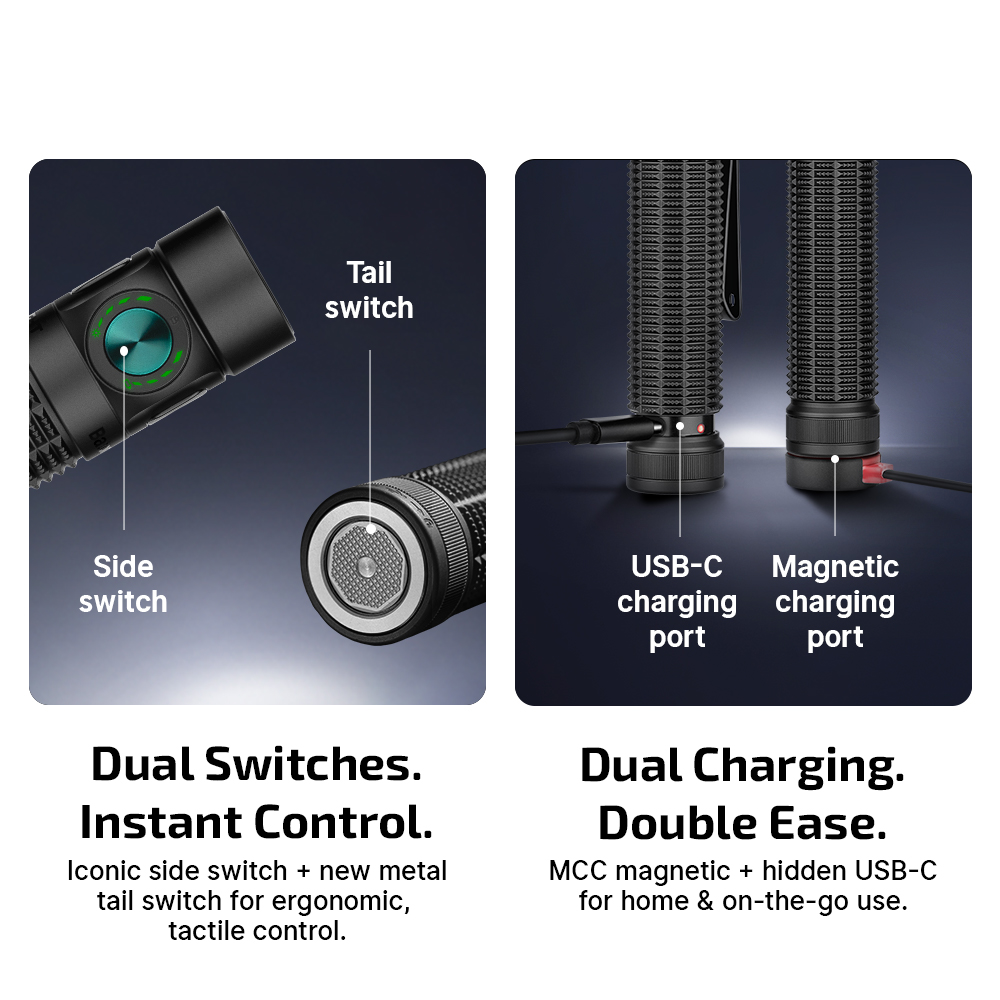
Official Baton 4 Pro detail image: separate controls and two charging connections change how a compact light fits daily use.
The brightness and battery indicators address another user question that a plain silhouette cannot answer: what state is the light in now? Baton 4 Pro includes separate status indications and a lockout icon. These help distinguish a selected operating state from available battery charge. An indicator is useful feedback, but it should not be read as an exact promise of how many minutes remain for an unchanging task.
Its rated maximum output is 1,600 lumens, but the manual describes staged output on Turbo: 1,600 lumens followed by 600 lumens, with two minutes followed by 198 minutes in the listed test conditions. This is why a headline maximum and a runtime belong together. A buyer planning prolonged work needs the operating stage that fits that work. The very brightest initial output does not describe the entire listed run.
Modern controls still require a deliberate choice
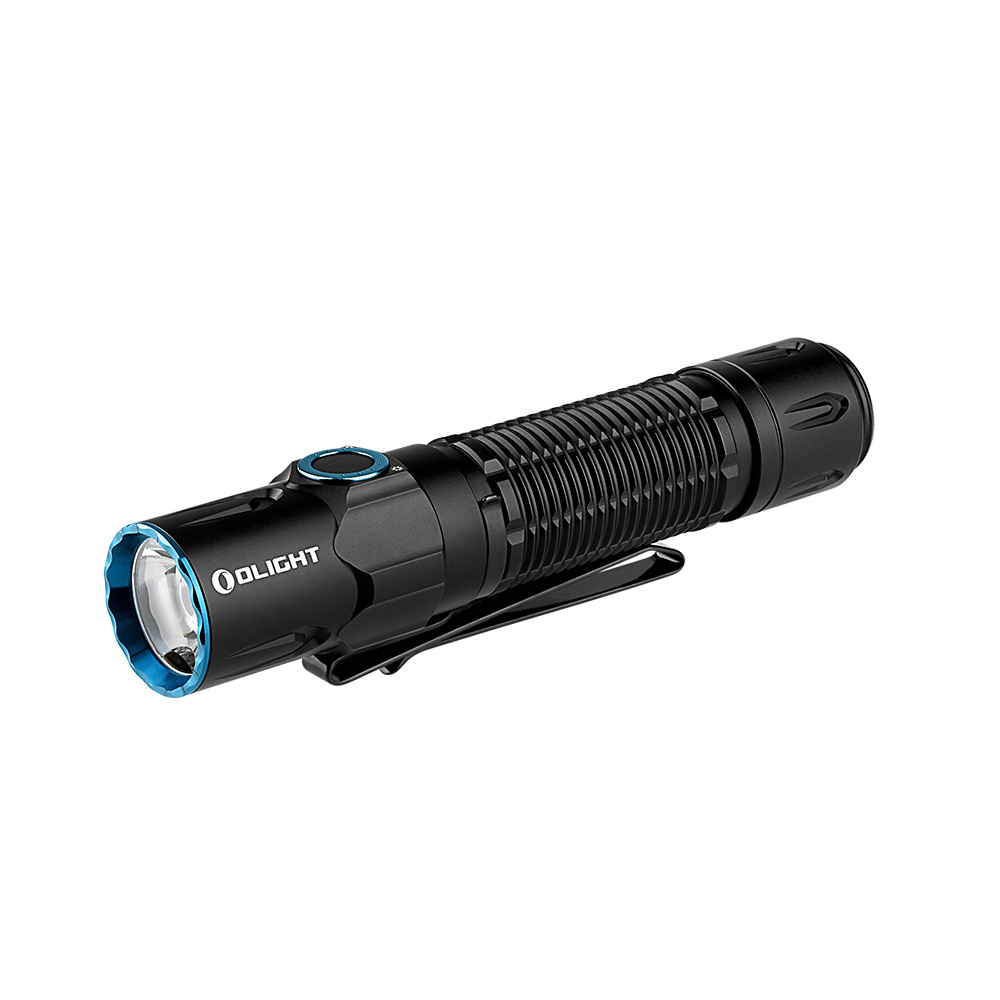
The Olight Warrior 3S shows a different modern control arrangement. Its cool-white LED works with a TIR optic, and the side-switch area includes separate four-level battery and brightness indicators. The manual describes a side switch for routine operation and a two-stage tail switch with two program configurations. These details explain far more about handling the light than the fact that it is cylindrical.
With the flashlight off and the factory-default tail-switch configuration selected, a half press selects Medium and a hard press selects Turbo. The manual distinguishes a quick press and release for on or off from holding the tail switch for momentary light. A person accustomed to another flashlight should check that behavior before assuming that every tail button responds the same way. The chosen configuration matters as well as the physical switch.

Official Warrior 3S control image: the side indicators report brightness and battery state, while tail-switch behavior depends on the selected configuration.
For a homeowner inspecting a dark outdoor area, this can make quick output selection convenient. For someone sharing the light with a family member, it creates a teaching task. Show the intended everyday control and explain the starting state. A brief demonstration during daylight is more useful than expecting a new user to reconstruct the control sequence while already dealing with darkness.
Warrior 3S also has a proximity sensor that reduces brightness when an obstruction is detected under the specified higher-output operating conditions. That feature addresses a nearby-object condition, but it does not make it reasonable to leave an operating light pressed against fabric. The owner still needs to keep the lamp end unobstructed and follow the manual's storage and operating warnings. A protective feature supports careful handling; it does not remove the need to choose a suitable place to put a hot or active light.
When considering an edc flashlight, include the control layout in the carry decision. Think about whether you can find the intended switch, whether you understand the lockout, and how the light will sit among other belongings. A product that offers the desired beam but is awkward to carry or operate may spend more time at home than expected. The useful modern improvement is the one that fits the actual routine.
Comparing an old flashlight with a modern one fairly
Start by deciding what the comparison is meant to explain. A historical display can compare construction, source technology, and control placement. A purchasing decision needs useful brightness, charging arrangements, and the effort of carrying the light. Combining those purposes without naming them can produce a misleading contest between an aging artifact and a new product designed for different expectations.
For an artifact, document condition separately from design. A damaged contact, a replaced bulb, or a missing component may affect what the object does now. That does not establish how a sound original example performed when it was made. Equally, a successful demonstration today does not establish the battery condition, lamp condition, or operating environment of its historical owner. Keep what you observe separate from what you infer.
For a modern light, read the exact model's operating information rather than collecting the largest numbers from neighboring products. Maximum lumens, beam distance, and runtime describe different aspects of performance. A distant target and a nearby page place different demands on the beam. A reader comparing old and new lights should state the task first and then select the relevant information, instead of treating a larger figure as a complete account of progress.
The same discipline applies to photographs. A beam photograph depends on exposure, surroundings, distance, and the condition of the lights being photographed. Without those details, it can illustrate a scene but cannot establish a measured performance ratio. A patent drawing, a museum object photograph, and an official product detail image each have a useful purpose. Labeling the image correctly helps the reader understand what it can actually demonstrate.
Frequently asked questions
Changelog
- November 19, 2026: Product information and buying guidance reviewed.




