



TL;DR: A refurbished flashlight can be a sensible buy when the seller identifies who refurbished it, what work was completed, the battery’s status, what accessories are included, and the exact return and warranty terms. The word “refurbished” alone does not answer any of those questions. Compare the complete price and support terms with a new flashlight that fits the same job, then buy only when the written details make the trade-off clear.
📋 Table of Contents
- 1. The short answer: when is a refurbished flashlight worth it?
- 2. Refurbished, used, and open-box are different descriptions
- 3. Read a condition grade as a description, not a promise
- 4. What gets replaced? Ask for the parts list
- 5. Warranty and returns: the paperwork is part of the product
- 6. Battery condition deserves its own answer
- 7. Compare the complete cost, not the discount headline
- 8. Compare two same-model offers under the same conditions
- 9. A seven-part inspection after delivery
- 10. Who benefits from refurbished, and who may prefer new?
- 11. Which flashlight do Navy SEALs use?
- 12. What is the brightest flashlight you can legally own?
- 13. What is the most reliable flashlight brand?
- 14. A decision checklist before checkout
- 15. Frequently Asked Questions
- 16. The best value is the offer with clear terms
The short answer: when is a refurbished flashlight worth it?
A refurbished flashlight is worth considering when three things line up: the lower total cost matters to you, the seller can explain the product’s condition and work history, and the return and warranty terms are usable for the way you plan to use it. If any one of those pieces is vague, a lower listing price may simply move the uncertainty onto the buyer.
The category is broad. A retailer may call an item refurbished after inspection, repair, cleaning, testing, or some combination of those steps. A buyer starting with an Olight flashlight should still evaluate the actual seller and condition terms for the particular offer. Another seller may use the same word for a returned product that received only a quick function check. The label does not, by itself, tell you whether a battery was replaced, whether a charging component was checked, or whether the original accessories are in the box.
That is why “Is refurbished worth it?” has no single answer for every flashlight or seller. The useful comparison is between two specific offers: the exact item in the condition described, and a new light that meets the same needs. Before deciding, review the seller’s written warranty terms, the return period, and the condition description. The FTC recommends asking about return policies and keeping copies of order details and warranties when shopping online, including for used or refurbished goods (online shopping guidance).
A concise rule helps: buy the documented item, not the reassuring adjective. “Factory refurbished,” “certified,” “renewed,” and “open box” are useful only when the listing explains what the seller means by them. If the seller cannot answer basic questions before checkout, the buyer cannot reliably compare risk against savings.
Refurbished, used, and open-box are different descriptions
These labels are not interchangeable. Sellers may define them differently, so the exact listing and terms matter more than a broad assumption about the word. The table below is a reading guide, not a universal legal definition.
| Listing description | What it may indicate | What still needs a written answer |
|---|---|---|
| Refurbished or reconditioned | A returned or previously owned item was inspected, repaired, cleaned, or checked under a seller’s process | Who performed the work, which parts were replaced, what passed inspection, and who supports it afterward |
| Used | The item had a previous owner or prior use | Actual condition, known faults, included accessories, battery status, and return rights |
| Open box | Packaging was opened; the item may have been handled, returned, or simply unboxed | Whether it was powered or carried, whether anything is missing, and whether coverage differs from a new item |
| New | Offered as new under the seller’s stated condition policy | Exact model, included parts, current warranty terms, return period, and seller identity |
A listing may combine terms, such as “open-box refurbished.” That phrase should prompt a clarifying question, not a guess. Ask the seller to state the actual condition in plain language and identify the work performed. Save the listing and the seller’s written answer with the order record.
The U.S. Federal Trade Commission has guidance on warranties and consumer shopping. The specific rights that apply can depend on the seller, the written terms, and state law. A blog post cannot replace the actual terms for a particular offer. Read those documents before payment and keep the version that applied on the day of purchase.
Read a condition grade as a description, not a promise
A condition grade can help organize an offer, but it is not a technical standard unless the seller defines it. “Excellent,” “good,” and “fair” may refer to cosmetic appearance, operation, packaging, or all three. Ask which dimensions the grade covers. If a seller’s “excellent” means only that the exterior looks clean, that does not answer whether the battery holds charge or whether the included cable works.
Compare the written grade with photos of the actual item whenever possible. A stock photograph can illustrate the model but cannot document the condition of the particular unit being shipped. Ask for clear views of the lens, switch, charging area, body, battery compartment if user-serviceable, and any visible wear that the listing mentions. For a batch sale, find out whether the photographs show the exact unit or a representative example. “Representative” may be acceptable, but it changes what the buyer can verify before delivery.
A description should separate appearance from function. A scratch may be cosmetic; a cracked lens, damaged thread, loose switch, or corroded battery contact can affect operation or future maintenance. The buyer does not need to diagnose every mark from a photograph. The seller should disclose known defects and describe whether the item was checked for basic operation. If the visual grade and the written fault description do not match, ask for clarification before buying.
Packaging condition is another separate detail. A replacement box can be perfectly reasonable, but it does not prove the light is new or refurbished. Likewise, an original box does not establish that the unit has never been used. Treat packaging as an accessory and shipping protection question; treat condition and service history as their own questions.
A useful listing makes it possible to compare the description with the delivered product. Keep the original page, its images, and any seller replies. If the delivered unit differs materially, those records help the buyer explain the mismatch and use the stated return or support process.
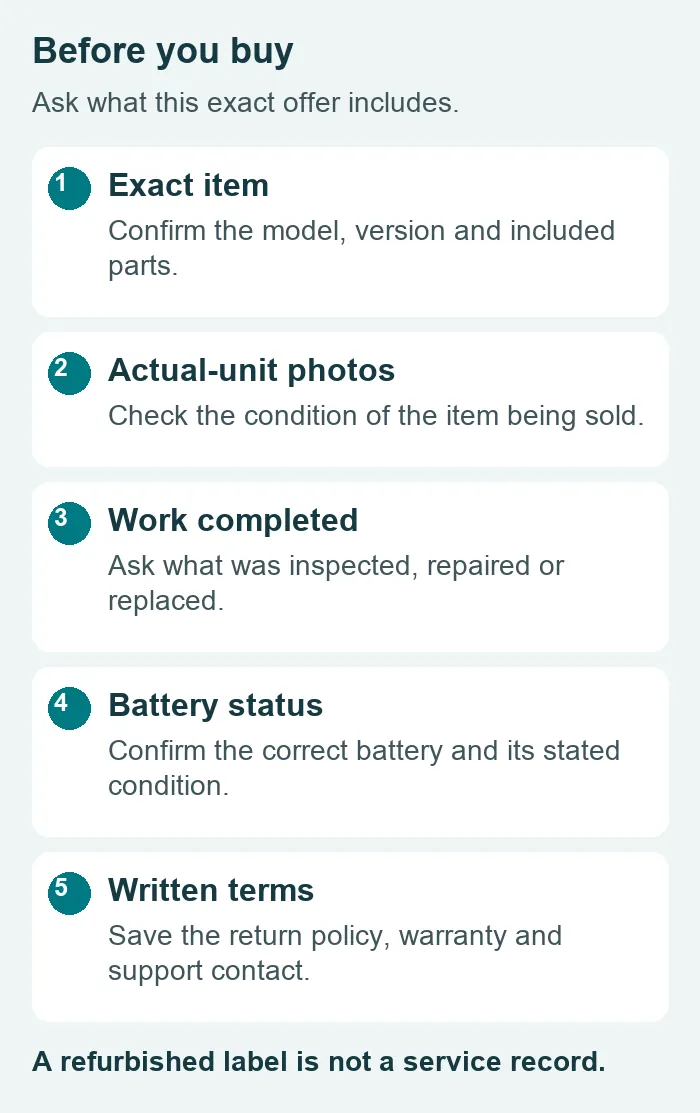
Evidence map for evaluating a refurbished flashlight listing before checkout.
What gets replaced? Ask for the parts list
There is no dependable universal list of parts that every refurbished flashlight receives. One seller may replace a damaged switch or charging component; another may clean and inspect the light without replacing any part. A battery may be included, omitted, retained, or replaced depending on the product and the seller’s process. None of those outcomes should be inferred from a generic label.
Ask for the refurbishment record in writing. It should identify the exact product and the work completed on that unit or on that model’s refurbishment batch. If a part was replaced, ask which part and whether it is an original or approved replacement. If no parts were replaced, ask what the inspection covered. The purpose is not to demand a repair history the seller does not have; it is to establish what the seller is actually promising.
A clear answer might separate “cleaned,” “checked for on/off operation,” and “replaced with a new battery.” Those are different claims. A vague phrase such as “fully restored” does not tell you which functions were checked or what changed. Ask whether the seller assessed the switch, charging connection, battery compartment, lens, seals, and included cable where relevant to that model.
The answer should also identify what was not included or changed. A missing holster, clip, charging cable, mounting piece, or battery can make a discounted light less useful or add a cost after checkout. “Includes standard accessories” is not enough if the listing does not name them. Compare the package contents with the exact model’s current documentation or official product page, then ask about any difference.
A seller’s refurbishment process is not automatically the manufacturer’s process. A third party may be qualified to service a product, but the buyer should not assume that the manufacturer inspected it or stands behind the third party’s work. The listing should name the responsible seller and the contact for service. That distinction matters if a problem appears after the return window closes.
Warranty and returns: the paperwork is part of the product
A warranty is only useful when its scope, duration, provider, and claim process are clear. Read the full document before purchase. Check whether it covers the whole light, only selected components, or only the seller’s repair. Look for exclusions, shipping responsibilities, proof-of-purchase requirements, and the steps needed to open a claim.
Do not assume that the warranty for a new product transfers unchanged to a refurbished or third-party-sold unit. The relevant terms may depend on the purchase channel, product condition, region, and seller. For an Olight product, check the current Olight warranty information and ask Olight or the seller how the exact item and seller channel are treated before relying on coverage. The answer should be specific to the item being offered; a general statement about a brand’s warranty does not settle the status of a particular refurbished listing.
A return policy answers a different question. It describes what the buyer may do if the delivered item does not match the listing or does not meet expectations. Check the length of the return window, when the clock starts, who pays return shipping, whether a restocking fee applies, and whether the seller requires an authorization before shipment. Save a copy of the product page and terms because online listings can change.
Keep the receipt, order number, product description, condition grade, written answers, warranty, and return instructions together. The FTC recommends saving warranty documents and receipts; that record helps establish what was purchased and which terms were offered. A screenshot or downloaded PDF can be useful if the listing is later edited or removed.
For a private-party purchase, the protection and support structure may differ from a merchant sale. The seller may not have a formal repair process or a written warranty. Ask what remedy is available if the flashlight arrives with a fault, and make sure the agreement is documented before sending payment. If the answer is “message me if anything happens,” treat that as a risk to price, not a substitute for a defined process.
Battery condition deserves its own answer
A flashlight can look nearly new while its power source has a different history. Ask whether the battery is included, whether it is the original cell, whether it is replaceable, and what evidence supports the seller’s description of its condition. For models with a built-in battery, ask what service options exist if capacity declines or charging becomes unreliable. Do not assume that “checked” means the seller measured capacity or cycle count.
When a seller provides battery measurements, ask how they were obtained and what the numbers refer to. Capacity, voltage, charge retention, and cycle count are not interchangeable. A single voltage reading does not establish how much usable energy remains. A device’s displayed battery icon may show a rough state rather than a laboratory capacity measurement. The seller should explain the method, instrument, condition, and date if those measurements are being used to justify a price or condition grade.
For a removable cell, check its exact size, chemistry, and model compatibility in the flashlight’s documentation. Similar dimensions do not prove that two cells are interchangeable. If a listing does not name the included cell or the approved replacement, do not choose a substitute based only on a marketplace title. Use the exact product manual or ask the manufacturer’s support team to confirm the correct battery. When considering a rechargeable flashlight, compare the documented cell and charging setup for each exact model.
Battery condition matters to cost as well as runtime. If the buyer may need a replacement cell or charging accessory soon, add that cost before comparing the refurbished offer with a new one. Include tax, shipping, and any required accessories. A low headline price can lose its advantage once the light needs an unlisted battery or cable.
Storage and handling also matter. Follow the product manual for charging, storage, and battery replacement. Do not open a sealed pack or attempt an improvised repair to verify a seller’s claim. If a battery is swollen, leaking, unusually hot, physically damaged, or otherwise abnormal, stop using or charging it and follow the manufacturer’s safety guidance for that product.
Compare the complete cost, not the discount headline
The fair comparison is the amount required to own and use the item for the intended task. Start with the checkout price, then add costs the listing excludes. Compare that total with the price of a new light that meets the same practical requirements. Do not compare a refurbished specialty model with a new general-purpose light simply because both are flashlights.
A simple worksheet makes the trade-off visible:
| Cost or value item | Refurbished offer | New alternative |
|---|---|---|
| Item price | Listed price | Current official or authorized-seller price |
| Shipping and tax | Add actual checkout amount | Add actual checkout amount |
| Battery or charging item | Add only if missing, worn, or incompatible | Include what comes in the package |
| Required accessories | Add the exact parts needed for the task | Include package contents and optional accessories separately |
| Support | Record provider, coverage, and claim steps | Record the exact warranty and seller channel |
| Return terms | Record window, shipping, and fees | Record window, shipping, and fees |
| Condition uncertainty | Note unanswered questions and evidence quality | Note the new-item terms and current documentation |
This is not a formula that assigns a dollar value to every risk. It is a way to expose missing information before a purchase. If the refurbished offer saves money but has unclear support, the buyer can decide whether that uncertainty is acceptable. If the savings are small after the necessary battery, cable, or accessory is added, a new unit may be easier to evaluate.
A “30% off” claim is meaningful only when the comparison price is appropriate and the item condition is clear. Compare the same model and configuration when possible. If the exact model is no longer sold new, compare with the closest current light only after confirming that it suits the same use. A discontinued model’s old retail price may not reflect its current value or replacement cost.
Also consider how costly failure would be. A backup light for an occasional household task has a different role from a primary light needed for scheduled work or an essential outdoor activity. This does not mean the more expensive option is always better. It means the buyer should weigh price against the consequence of a fault, the available backup, and the time needed to resolve a warranty claim.
Compare two same-model offers under the same conditions
When both new and refurbished versions of the same model are available, compare them as matching configurations. Confirm the model name, battery type, color or revision, package contents, and included charging equipment before looking at price. A different battery or accessory package can change both the purchase cost and what the light can do. If an identical new model is no longer available, say clearly that the comparison is with a different model and describe the differences relevant to the intended task.
A useful comparison has two parts: an offer review and an operation review. The offer review records what the seller promises about condition, included components, and support. The operation review follows the exact manual and uses the same safe conditions for each light. The goal is to identify a meaningful difference, not to stage a contest that turns one unit’s best moment into a general product conclusion.
For a simple owner-level check, use the same charged battery specification, the same selected output, the same room or outdoor area, and the same distance from the same target. Record whether the controls respond consistently, whether the charging arrangement matches the manual, and whether anything changes unexpectedly during ordinary use. Do not infer maximum output, runtime, water resistance, or impact performance from a brief side-by-side look. Those require the appropriate method and equipment, and should be reported only when actually measured under stated conditions.
If battery data is part of the comparison, distinguish the label on a cell from a measured result. Record what was measured, how it was measured, the instrument, and the conditions. A cycle count can mean different things depending on the device that reports it and the definition used. A buyer can ask for this information, but should not treat a number without method or context as a dependable measure of remaining service life.
The comparison should also include the administrative details. Record the quoted price, shipping, tax, accessories, warranty provider, return window, and seller response time if stated. A table with two columns makes it easier to see whether the refurbished unit offers a real advantage or just a lower starting figure. Keep the comparison limited to evidence available for both offers; do not fill an empty cell with an assumption.
| Same-model comparison point | Refurbished item | New item |
|---|---|---|
| Exact revision and power source | Confirm from the listing and delivered label | Confirm from the official product page and package |
| Included equipment | List every included component | Compare with the official package contents |
| Operation check | Use the same manual steps and conditions | Use the same manual steps and conditions |
| Battery evidence | Record the seller’s stated method and result | Record the documented battery specification |
| Support route | Identify the refurbisher or seller | Identify the applicable official or authorized channel |
| Total purchase cost | Include tax, shipping, and missing accessories | Include tax, shipping, and any optional accessories |
This kind of same-model comparison can be useful to a buyer, but only if both units are actually available and the conditions are repeatable. Do not advertise a personal check as a controlled laboratory result. If the seller does not provide comparable information, leave that dimension unranked rather than inventing a winner.
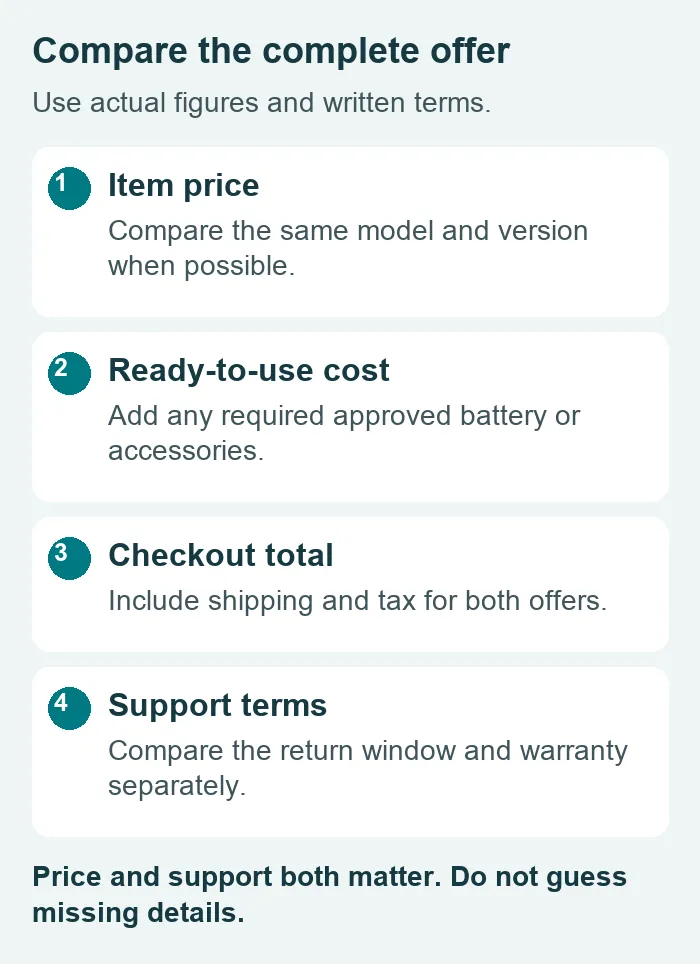
Cost comparison framework. Add actual checkout and support details for the two offers being considered.
A seven-part inspection after delivery
Before using a refurbished flashlight for a demanding task, compare the delivered item with the written listing and product documentation. Keep the packaging until the initial inspection is complete. A careful check can identify a mismatch while the return period is still open.
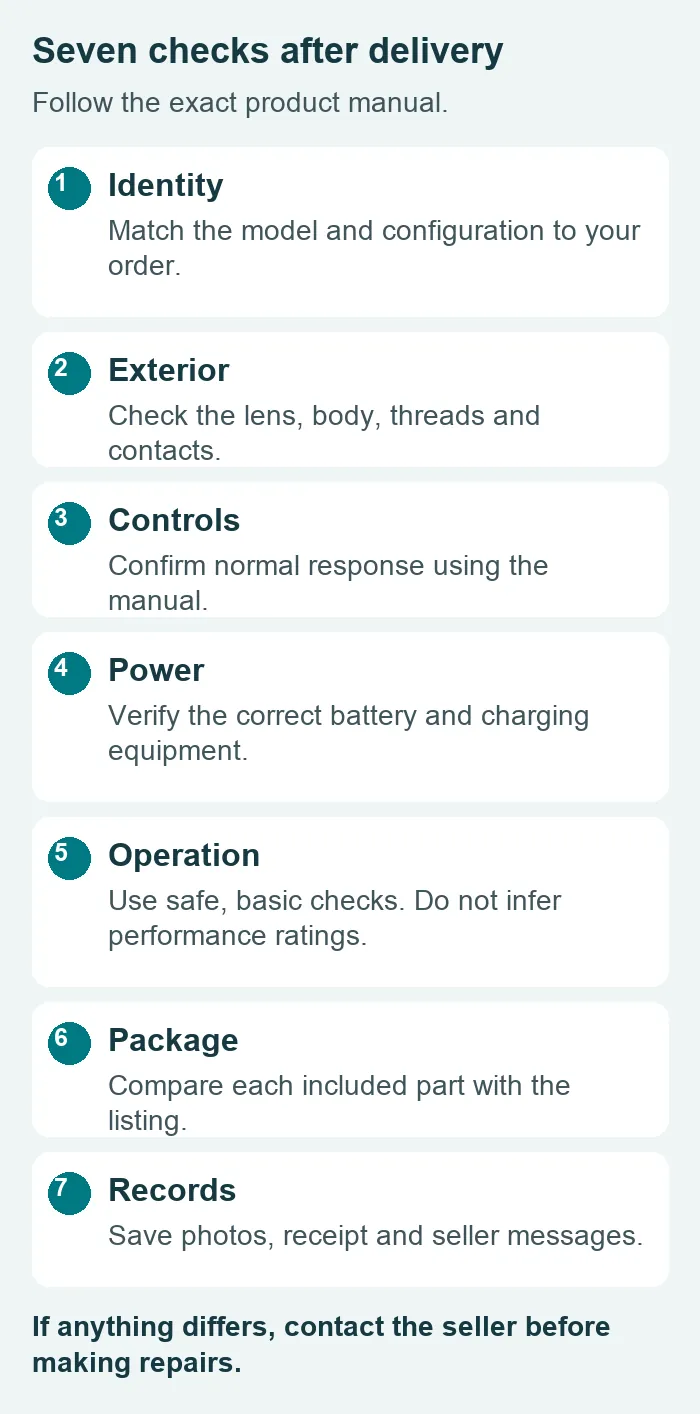
Receiving checklist for comparing an item with its listing and documentation.
- Confirm the identity. Match the model name, configuration, color, serial or product identifiers where available, and included battery to the order record. Similar product names can describe different versions. Photograph the label and package if the identifying information matters to a warranty or service request.
- Check the exterior and lens. Look for cracks, deep dents, corrosion, damaged threads, loose parts, or lens damage. Cosmetic marks should match the stated grade. Do not disassemble the light to inspect internal parts unless the manufacturer’s instructions specifically permit that service.
- Check controls in ordinary conditions. Follow the exact manual to turn the light on and off and to select its normal modes. Note any inconsistent response, sticking button, unexpected shutoff, or indication that differs from the manual. Avoid shining a beam into anyone’s eyes or testing close to flammable material.
- Check the power arrangement. Confirm that the cell, charging cable, dock, or adapter named in the listing is present and matches the model’s documentation. Inspect connectors for visible damage. Use only approved charging equipment and follow the manual’s instructions.
- Check the light’s basic operation. In a safe area, confirm that the listed modes operate as described. A short check is not a measurement of maximum output, runtime, water resistance, or impact performance. Do not infer a rating from one quick power-on.
- Compare the package contents. Lay out the listed accessories and compare them with the order record. Note anything missing before disposing of packaging. A missing small part can affect carry, charging, or compatibility even when the flashlight itself works.
- Save the evidence and act promptly. Keep clear photographs of the received condition, packaging, and contents. If the item differs from its description, contact the seller through the documented channel before making repairs. Follow the seller’s return instructions and keep messages with the order record.
A checklist is not a substitute for a specialist inspection or a manufacturer’s service procedure. It helps a buyer document what arrived and decide whether to keep, return, or seek support for the item. If the light behaves abnormally, stop the check and follow the exact manual rather than repeatedly activating it to force a result.
Who benefits from refurbished, and who may prefer new?
A refurbished flashlight may suit a buyer who values a lower upfront cost, understands the condition grade, and can accept a limited accessory package or seller-specific support path. It can also be appropriate for a secondary light where the owner has another suitable option and the refurbished item’s condition is clearly documented.
A new purchase may be easier to assess when the buyer needs a complete, predictable package, wants the current model and accessories, or relies on a clear manufacturer support path. A new item is not automatically the right choice; the buyer still needs to confirm the product, seller, warranty, and suitability for the task. The practical advantage is usually clearer condition documentation, not a guarantee that every future issue disappears.
A refurbished item is a poor fit when the seller cannot identify the exact model, answer what work was done, explain the battery, or provide written return terms. It is also a poor fit when the user cannot tolerate delay or uncertainty and has no backup. These are not judgments about every refurbished product. They are reasons to avoid an offer whose documented terms do not fit the buyer’s needs.
The right decision can differ within the same household. One person may want an inexpensive spare for a drawer; another may need a dependable light for regular work. Define the job first, then identify the minimum acceptable output, beam shape, control layout, power source, carry method, and support expectations. This prevents a discount from turning into a purchase of features the buyer does not need, or an unsuitable light chosen only because it is cheap.
If comparing a new light for a second role, consider the job and power system together. Olight’s guide to choosing a second flashlight helps frame the role question, while the 21700 and 18650 battery guide discusses battery-platform trade-offs. Those pages do not establish the condition or warranty of a refurbished listing; use the seller’s own written terms for that decision.
Which flashlight do Navy SEALs use?
A unit name is not a substitute for a product specification. Public anecdotes and undated gear lists do not establish a current, universal equipment choice for every member or task. A consumer comparing a refurbished flashlight should focus on the actual light’s condition, fit, power source, support, and the task it needs to serve. Choose from documented product facts, not an unsupported claim that a particular unit uses a particular model.
What is the brightest flashlight you can legally own?
That question cannot be answered responsibly with one lumen number for every person and location. The answer depends on what device is being discussed, how it is configured and used, and which local rules apply. For an ordinary handheld light, consider the intended task and use the correct mode responsibly. For a device with additional functions or a use governed by local rules, check the law that applies where it will be used rather than relying on a seller’s blanket “legal” claim.
Brightness alone is not a complete measure of usefulness. Beam shape, distance, runtime at the chosen mode, control access, and battery condition all affect the result. A high maximum-output figure does not tell you how long that mode lasts or whether it is suitable for close work. Read the exact product specifications and manual.
What is the most reliable flashlight brand?
There is no useful brand ranking without a defined test, comparable models, and a stated measure of reliability. A more practical question is whether the exact model suits the task, whether the seller documents its condition, and whether the written support terms are clear. Compare like with like: model, battery arrangement, package, condition, price, and warranty channel.
For an Olight item, review Olight’s current official product and warranty information alongside the seller’s terms. A third-party refurbishment is a separate service history from a new purchase made through an official channel. The two should not be treated as identical merely because the product carries the same brand name.
A decision checklist before checkout
Use this short checklist to keep the decision grounded in facts:
- Is the exact model and configuration identified?
- Does the seller explain what “refurbished” means for this listing?
- Are replaced parts named, and is the battery’s status described clearly?
- Is the package contents list specific enough to compare with the manual?
- Are the return window, shipping responsibility, and fees written down?
- Does the warranty name its provider, covered parts, duration, exclusions, and claim steps?
- Does the total price still make sense after shipping, tax, and required accessories?
- Is the light suitable for the actual task, including the desired controls and carry arrangement?
- Can the buyer document the item and contact the seller promptly if it arrives differently?
If several answers are missing, pause before paying and request the information. A seller who can explain the item clearly makes the choice easier; a listing that hides condition behind a label does not.
Frequently Asked Questions
The best value is the offer with clear terms
A refurbished flashlight can be a smart purchase when condition, replacement work, battery status, package contents, return terms, and warranty are documented well enough to compare with a new alternative. It is a poor bargain when the lower price depends on the buyer guessing what was inspected or who will help if something fails.
The word “refurbished” is a starting point for questions. It is not a parts list, a battery report, or a warranty. Ask what changed, what remains included, and which written terms apply to this exact sale. Then compare the total cost against a new light that fits the same task. When the evidence is specific and the trade-off is acceptable, the buyer can make the decision with confidence. When the answers stay vague, the discount has not resolved the uncertainty; it has only put a number beside it.
Changelog
- November 19, 2026: Product information and buying guidance reviewed.




