Olight makes the lights recommended here. Olight specs and regular prices come from its US product pages and user manuals as of September 2026; other brands' specs come from their makers. Lux, watt-hour, coverage and cost figures are our own arithmetic from those published numbers.
⚡ TL;DR
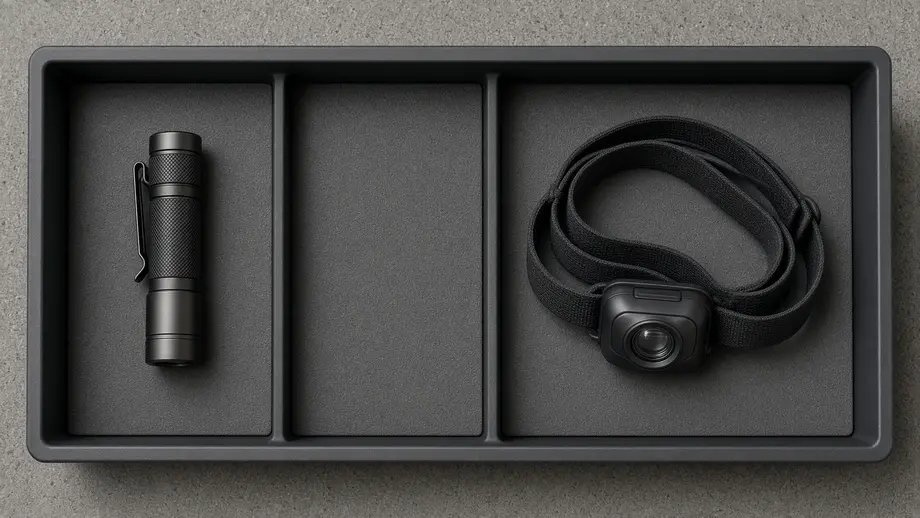
A second flashlight should fill a gap your first light leaves, in form or in beam, not repeat it with more lumens. If your first light is a pocket EDC light, add a headlamp or a long-throw light. If it is a big handheld, add a keychain light. If it is a headlamp, add a pocket light or a thrower.
The trap is buying "the same light, but brighter." You end up with two handhelds that both need a free hand, both light the same 150 meters and both sit in a drawer while your phone does the real work. The fix is to name the job your first light fails at, then buy the light built for that job.
This table matches the first light you own with the second flashlight that adds the most, scored on eight scenarios defined later in this guide.
| First light you own | Best second light | Gap it fills | Scenarios the pair covers (of 8) | Regular price of the second light |
|---|---|---|---|---|
| Only your phone | Olight Baton 4 | A rated 170 m beam that doesn't drain your phone | 2 (a Perun 3 would cover 5, but won't ride in a pocket) | $54.99 |
| A pocket EDC light, such as a Baton 4 | Olight Perun 3 | Hands-free light, red light and all-night runtime | 6 | $89.99 |
| A full-size handheld, such as a Seeker 4 Pro | Olight i1R 2 Pro | A 22 g light that stays on your keys | 5 | $21.99 |
| A headlamp, such as a Perun 3 | Olight Baton 4 or Marauder Mini 2 | Pocket carry, or reach out to 750 m | 6 with either | $54.99 or $219.99 |
The next table shows what "brighter" buys compared with "different" when your first light is a Baton 4 and you are weighing a Seeker 4 Pro against a Perun 3.
| Dimension | A: Seeker 4 Pro (brighter handheld) | B: Perun 3 (headlamp) | Which is better | By how much |
|---|---|---|---|---|
| Max output | 4,600 lumens | 3,000 lumens | A | 1.5 times the lumens |
| Peak intensity | 16,895 candela | 6,400 candela | A | 2.6 times the candela |
| Rated beam distance | 260 m | 160 m | A | 100 m farther |
| Hands-free use | Holster and wall bracket, no headband | Headband, magnetic tail and clip | B | Only B frees both hands on the move |
| Red light | None listed | 60 lm for 14 h; 15 lm for 70 h | B | Only B has red |
| Medium-mode energy | 300 lm for 11 h (3,300 lumen-hours) | 120 lm for 25 h (3,000 lumen-hours) | Tie | Same 5,000 mAh 21700 class |
| New scenarios added to a Baton 4 | 2 | 4 | B | Twice as many |
| Weight | 205 g | 150 g | B | 55 g lighter |
| Regular price | $139.99 | $89.99 | B | $50 less |
📋 Table of Contents
- 1. Second Flashlight Quick Answer: Fill a Gap, Not a Lumen Count
- 2. Which Second Flashlight Fits the First One You Own?
- 3. Form Comparison: Handheld Plus Headlamp, Big Plus Small
- 4. Beam Comparison: How Much Farther Does a Throw Light Reach?
- 5. Should Two Flashlights Share a Battery and Charger?
- 6. Do I Need Two Flashlights, or Should I Upgrade the One I Have?
- 7. How Should You Build a Three-Light Setup?
- 8. What Is the Best 2x AA Flashlight?
- 9. Where Is My Flashlight on This Phone?
- 10. What Flashlights Do Navy SEALs Carry?
- 11. Second Flashlight Checklist: 6 Steps Before You Buy
- 12. FAQ
Second Flashlight Quick Answer: Fill a Gap, Not a Lumen Count
The best second flashlight is the one that does a job your first light can't: free both hands, reach farther, ride on your keys, run all night or keep your night vision with red light. Extra lumens rarely fill a gap on their own. The best pairs that differ in form or beam cover 6 of our 8 scenarios, while two handhelds (Baton 4 plus Seeker 4 Pro) cover 4.
Start by writing down the last three times your first light let you down. "I needed both hands to change a tire" points to a headlamp. "I couldn't see the end of the pasture" points to a high-candela thrower. "I left it at home" points to a keychain light. "It died halfway through the outage" points to a bigger battery with a long low mode.
Then shop by that gap. Olight's full range of flashlights spans keychain lights, pocket lights, headlamps and large search lights, so the same brand can cover every form in this guide. What matters is that the second light's official specs answer the specific failure, not that its headline lumen number is bigger.
Which Second Flashlight Fits the First One You Own?
The right second light depends on the first. A Baton 4 owner gains most from a Perun 3 headlamp (6 of 8 scenarios covered), a Seeker 4 Pro owner from an i1R 2 Pro keychain light (5 of 8), and a Perun 3 owner from a Baton 4 or Marauder Mini 2 (6 of 8). Phone-only owners should start with a pocket light.
To make "gap" measurable, we defined eight common night-time scenarios and a pass rule for each, using only published specs. A light passes when its official rating meets the rule; a phone passes none, because phone makers don't publish ANSI-style beam or runtime ratings for the flashlight.
This framework table lists the eight scenarios, the pass rule, and which of the five Olight lights in this guide pass.
| # | Scenario | Pass rule (from official specs) | Lights that pass |
|---|---|---|---|
| 1 | Daily pocket carry | Weighs 60 g or less with battery | Baton 4 (52.5 g), i1R 2 Pro (22 g) |
| 2 | Always on your keys | Weighs 25 g or less | i1R 2 Pro |
| 3 | Both hands free while moving | Headband included | Perun 3 |
| 4 | Lighting a wide area up close | 1,000+ lumens with under 5 candela per lumen, or a dedicated floodlight | Perun 3, Seeker 4 Pro, Marauder Mini 2 |
| 5 | Seeing to the end of a yard or trail | Rated beam distance of 150 m or more | Baton 4, Perun 3, Seeker 4 Pro, Marauder Mini 2 |
| 6 | Searching a field or shoreline | Rated beam distance of 500 m or more | Marauder Mini 2 |
| 7 | Lighting a whole night | One steady mode of 50+ lumens for 10+ hours | Perun 3, Seeker 4 Pro, Marauder Mini 2 |
| 8 | Keeping night vision | A red light mode | Perun 3, Marauder Mini 2 |
This table adds up the scenarios each pair covers, with the pair's regular price and the cost per covered scenario.
| Pair | Scenarios covered | Coverage | Pair price (regular) | Cost per covered scenario |
|---|---|---|---|---|
| Phone + Baton 4 | 1, 5 | 2 of 8 (25%) | $54.99 | $27.50 |
| Phone + Perun 3 | 3, 4, 5, 7, 8 | 5 of 8 (62.5%) | $89.99 | $18.00 |
| Baton 4 + Perun 3 | 1, 3, 4, 5, 7, 8 | 6 of 8 (75%) | $144.98 | $24.16 |
| Baton 4 + Seeker 4 Pro | 1, 4, 5, 7 | 4 of 8 (50%) | $194.98 | $48.75 |
| Baton 4 + Marauder Mini 2 | 1, 4, 5, 6, 7, 8 | 6 of 8 (75%) | $274.98 | $45.83 |
| Seeker 4 Pro + i1R 2 Pro | 1, 2, 4, 5, 7 | 5 of 8 (62.5%) | $161.98 | $32.40 |
| Seeker 4 Pro + Perun 3 | 3, 4, 5, 7, 8 | 5 of 8 (62.5%) | $229.98 | $46.00 |
| Perun 3 + Marauder Mini 2 | 3, 4, 5, 6, 7, 8 | 6 of 8 (75%) | $309.98 | $51.66 |
Two results stand out. The Baton 4 and Perun 3 pair covers the most scenarios for the least money per scenario among pairs that include a pocket light. And the Seeker 4 Pro adds nothing to a Perun 3 on these eight tests: the Perun 3 alone already passes 5, and the pair still passes 5. That is what an overlapping second flashlight looks like on paper.
If your only light today is your phone, the math favors the Perun 3, but a headlamp won't be in your pocket at 9 p.m. in a parking lot. Our comparison of a phone flashlight vs real flashlight covers why a pocket light with a rated beam is the usual first step up.
Form Comparison: Handheld Plus Headlamp, Big Plus Small
A form gap is the easiest one to spot. Handheld lights occupy a hand, headlamps sit on your head, big lights stay home and small lights come along. Pairing opposite forms, such as a pocket light with a headlamp or a large light with a 22-gram keychain light, covers more situations than two lights of the same shape.
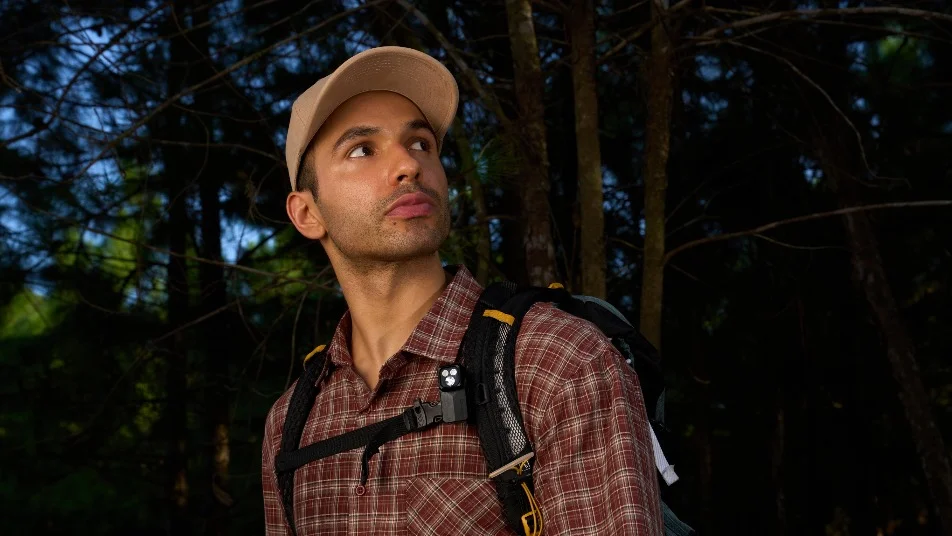
The hands-free case has official backing. The National Park Service's Ten Essentials guidance says of lighting: "Headlamps are the recommended light source because they are hands-free. Be sure to pack extra batteries." If your first light is a handheld, a headlamp is the second light that changes what you can do at night, from changing a tire to carrying firewood.
The Olight Perun 3 headlamp ($89.99, regular price, September 2026) fills that gap for a Baton 4 owner. Olight lists a headband, magnetic tail, clip and lanyard, so it works on your head, stuck to a car door or in your hand. Its Medium mode is 120 lumens for 25 hours, and its red light runs 60 lumens for 14 hours or 15 lumens for 70 hours. The limit is size: at 150 g and 116.8 mm long, it is not a pocket light. For headlamps from other makers ranked on weight and runtime, see our guide to the best headlamps.
The opposite gap is "the big light stayed home." A Seeker 4 Pro weighs 205 g and lives best in its holster by the door. The Olight i1R 2 Pro keychain light ($21.99, regular price, September 2026) weighs 22 g and is 51.3 mm long, so it rides on your keys. It gives 180 lumens for 23 minutes or 5 lumens for 12 hours, with a 48 m rated beam. That is a finder light, not an outage light: it has no strobe and no mode between 5 and 180 lumens. Our keychain flashlight guide explains how much light fits on a key ring.
Between those two sits the pocket light. Olight's EDC flashlights category collects lights built for daily carry, and the Baton 4 is the reference point in this guide: 52.5 g, 63 mm long, 1,300 lumens and a 170 m rated beam.
Tip: Put your two lights in different places. A second light in the same drawer as the first fails at the same moment the first one does: when you are somewhere else.
Beam Comparison: How Much Farther Does a Throw Light Reach?
A throw light reaches much farther than a pocket light because reach follows candela, not lumens. On official ratings, the Marauder Mini 2's 140,000-candela spotlight puts 14.0 lux on a target 100 m away, about 19 times the 0.72 lux a 7,225-candela Baton 4 delivers there. Lumens tell you total light; candela tells you how far it goes.
The math is simple. Illuminance falls with the square of distance, so lux on target equals candela divided by distance squared. The ANSI/PLATO FL 1 standard defines beam distance as "the distance from the device at which the light beam is 0.25 lux," according to Streamlight's summary of ANSI/PLATO FL 1. Solve for distance and you get beam distance = 2 × √candela. Every rating below checks out against that formula.
This table lists the official FL1-style ratings for the five lights, recomputes beam distance from candela, and adds the calculated light on a target at 100 m.
| Light | Max lumens | Peak candela | Rated beam distance | 2 × √candela | Candela per lumen | Lux at 100 m (calculated) |
|---|---|---|---|---|---|---|
| Baton 4 | 1,300 | 7,225 | 170 m | 170 m | 5.6 | 0.72 |
| Perun 3 | 3,000 | 6,400 | 160 m | 160 m | 2.1 | 0.64 |
| Seeker 4 Pro | 4,600 | 16,895 | 260 m | 260 m | 3.7 | 1.69 |
| Marauder Mini 2 (spotlight) | 1,350 spot; 10,000 flood | 140,000 | 750 m | 748 m | 104 (spot) | 14.0 |
| i1R 2 Pro | 180 | 580 | 48 m | 48 m | 3.2 | 0.06 |
Read the table two ways. First, the Seeker 4 Pro has 3.5 times the Baton 4's lumens but only 2.3 times its candela, so its beam reaches 1.5 times as far (260 m vs 170 m). More lumens mostly bought width. Second, the Perun 3 has more than twice the Baton 4's lumens yet slightly less reach, because its low 2.1 candela-per-lumen ratio spreads light wide for close work. For the full method, see our explainer on flashlight throw vs flood.
If your first light is flood-leaning and you need reach, the Olight Marauder Mini 2 flashlight ($219.99, regular price, September 2026) is the beam-gap answer in this guide. It pairs a 10,000-lumen floodlight with a 750 m spotlight, plus red and side lights, from a 7,500 mAh battery. The trade-offs are real: 465 g, a 66 mm head and a listed working temperature of 0~40 ℃, so it is a truck or base-camp light, not a winter pocket light.
Warning: A 140,000-candela beam is intense at close range. Olight's i1R 2 Pro user manual carries a warning that applies to every light here: "DO NOT shine the light directly into human eyes. This may cause temporary blindness, or permanent damage to the eyes."
Should Two Flashlights Share a Battery and Charger?
Sharing a charger is convenient, but sharing a single point of failure is not. Pick the second light for the job first, then check charging: the Perun 3 and Seeker 4 Pro both accept an MCC3 magnetic cable, while the Baton 4 uses an MCC 1A cable. For outages, a second light with a large battery and a long low mode matters more than matching cables.
Battery size sets how long a light can help. Using each battery's official voltage and capacity, a Baton 4's 3.6 V, 650 mAh cell holds about 2.34 Wh (3.6 × 0.65), while the 3.6 V, 5,000 mAh 21700 cell in a Perun 3 or Seeker 4 Pro holds about 18 Wh (3.6 × 5.0). That is 7.7 times the energy. Olight lists the Marauder Mini 2 battery at 27.75 Wh.
This table converts each light's longest steady mode of 50 lumens or more, and its lowest mode, into 10-hour nights.
| Light | Battery (Olight spec) | Energy | Charging | Steady mode for a full night | 10-hour nights at that mode | Nights at the lowest listed mode |
|---|---|---|---|---|---|---|
| Baton 4 | Customized 16340, 650 mAh, 3.6 V | About 2.34 Wh | MCC 1A magnetic cable | Med 60 lm for 8 h | 0.8 | 72 (Moon 0.5 lm, 30 days) |
| Perun 3 | Customized 21700, 5,000 mAh, 3.6 V | About 18 Wh | MCC3 magnetic cable | Med 120 lm for 25 h | 2.5 | 48 (Moon 5 lm, 20 days) |
| Seeker 4 Pro | Customized 21700, 5,000 mAh, 3.6 V | About 18 Wh | USB-C with holster, or MCC3 | Low 50 lm for 60 h | 6.0 | 36 (Moon 5 lm, 15 days) |
| Marauder Mini 2 | Customized 32650, 7,500 mAh, 3.7 V | 27.75 Wh (Olight) | USB-C or MCC | Level 1-1 floodlight, 50 lm for 83 h | 8.3 | 5 months in moonlight (Olight) |
| i1R 2 Pro | Built-in 10220, 130 mAh, 3.7 V | About 0.48 Wh | USB A-C cable | None (High 180 lm lasts 23 min) | 0 | 1.2 (Low 5 lm, 12 h) |
The Baton 4 is a strong pocket light and a weak outage light: its 60-lumen Medium mode lasts 8 hours, so it doesn't reach dawn on a 10-hour night. That is the honest case for pairing it with an 18 Wh light. The Olight Seeker 4 Pro flashlight ($139.99, regular price, September 2026) runs 50 lumens for 60 hours, and its Seeker 4 Pro user manual describes "one step locking": "When the flashlight is off, it will be locked if put back to the holster." Mount the holster by the door and it stays charged and ready.
Ready.gov's basic emergency supply kit lists a flashlight, extra batteries, and a "Cell phone with chargers and a backup battery." A rechargeable second light keeps that last item free for calls.
What you can't share is batteries. Olight lists the Perun 3 and Seeker 4 Pro cells as "Customized," and neither product page calls them interchangeable, so treat each light's battery as its own. One shared system does exist at the small end: Olight says the Baton 4 Premium charging case "is fully compatible with Baton 4, Baton 3, Perun 3 Mini." The Perun 3 Mini, though, is listed as Sold Out at Olight's US store as of September 2026, which is why the Perun 3 is the headlamp pick here.
Note: Two lights on two different charging systems is not a flaw. If one cable goes missing, the other light still charges.
Do I Need Two Flashlights, or Should I Upgrade the One I Have?
You need two flashlights when your first light fails at a different job, such as hands-free work, long reach or a full night of runtime. You should upgrade instead when it fails at its own job: it was lost, broke, no longer holds a charge, or its runtime at your working brightness runs short for the same task every time.
A quick test separates the two. Ask whether you would retire the old light after buying the new one. If yes, it is an upgrade, and you should buy the better version of the same form. If no, because the old light still has a job, it is a second light, and you should buy the opposite form or beam.
The Seeker 4 Pro and Perun 3 example shows why "brighter" is a weak reason. Next to a Perun 3, a Seeker 4 Pro adds 1,600 lumens and 100 m of reach but zero new scenarios on our eight-scenario scorecard. Next to a Baton 4, the same Seeker adds only two. A Perun 3 adds four.
This table sorts readers by what went wrong and shows the better move with an example from this guide.
| If this sounds like you | Second flashlight or flashlight upgrade? | Example from this guide |
|---|---|---|
| Your only light is lost, broken or won't hold a charge | Upgrade: replace it | A Baton 4 as a new pocket light |
| You use one light for one job and it runs out mid-task | Upgrade: same form, bigger battery | Baton 4 (2.34 Wh) to Seeker 4 Pro (18 Wh) for house use |
| You keep holding a light in your teeth to use both hands | Add a headlamp | Perun 3 with its headband |
| You need to see past 300 m | Add a thrower | Marauder Mini 2 with its 750 m spotlight |
| Your big light is always at home when you need it | Add a keychain light | i1R 2 Pro at 22 g |
| You camp, fish or stargaze and hate losing night vision | Add a light with red | Perun 3 red at 15 lm for 70 h |
How Should You Build a Three-Light Setup?
A three-light setup works best when each light owns one form: a keychain light that is always with you, a pocket light for daily tasks, and a headlamp or large light for long jobs. On our eight scenarios, Baton 4, Perun 3 and i1R 2 Pro together cover 7 of 8 for $166.97 at regular prices, adding up to 224.5 g across keys, pocket and pack.
The only scenario that trio misses is searching past 500 m. Swap the i1R 2 Pro for a Marauder Mini 2 and you cover a different 7 of 8 (losing the keyring slot) for $364.97. Add all four and you pass 8 of 8, but most of that last $219.99 buys a single job.
Think of each added light as a slot, not a spare. The keychain slot catches the moments you didn't plan for. The pocket slot handles the dog walk and the dropped earring. The head or base slot handles the outage, the flat tire and the campsite. A fourth light only earns its place if it opens a scenario the first three can't reach.
Keep the lights where their jobs happen: keychain on keys, pocket light on you, headlamp in the car or pack, big light holstered by the door. And run each one for a minute every month so a dead battery shows up before the night you need it.
Tip: Lock lights that ride in bags. The Baton 4 user manual explains that when the light is off, you "press and hold the button (for about 2 seconds) until the Moonlight mode turns on and off" to lock it, which keeps it from waking up in a backpack.
What Is the Best 2x AA Flashlight?
The best 2x AA flashlight for a second light is one that publishes its ratings on AA cells, lists which AA chemistries it accepts, and has a low mode for long runtime. AA makes sense as a second light when you want batteries you can buy anywhere. Lithium AA cells suit cold-weather and long-storage backups better than alkaline.
Energizer's data sheets show why chemistry matters. The Energizer L91 lithium AA data sheet lists an operating temperature of -40°C to 60°C, a 25-year shelf life at 21°C and a typical weight of 15 grams. The Energizer E91 alkaline AA data sheet lists -18°C to 55°C, a 10-year shelf life and 23.0 grams. Two lithium cells weigh 30 g against 46 g for two alkalines.
Read the fine print on "dual-fuel" lights. Acebeam, for example, rates its TAC 2AA at 1,600 lumens, 181 m and 8,190 cd in its TN LED versions, and recommends its included 14100P rechargeable battery while listing the light as "compatible with 2 x AA Alkaline / Ni-MH batteries." Lithium AA is not on that list, so check each maker's approved cells before you stock spares.
None of the five Olight lights in this guide runs on AA; all use rechargeable lithium-ion cells. If AA supply is your main reason for a second light, treat that as a battery-platform choice and pick the light around it.
Before you buy any 2x AA light, run it through four checks:
- Find the output rating measured on AA cells, not only on the included rechargeable. If the maker lists one set of numbers, assume it applies to the battery in the box.
- Confirm the approved chemistries in the manual: alkaline, Ni-MH, lithium or all three.
- Look for a low mode of roughly 50 lumens or less with a listed runtime, since that is the mode an outage or a long walk actually uses.
- Weigh the full load. Two L91 cells add 30 g, which is more than an entire i1R 2 Pro keychain light at 22 g.
If you store AA spares for a second light, keep them in the original package or a case so the terminals can't touch keys or coins, and write the purchase year on the pack so you rotate them before the shelf-life date.
Where Is My Flashlight on This Phone?
On an iPhone, open Control Center and tap the flashlight button, according to Apple. On a Samsung Galaxy, swipe down from the top right of the screen to open Quick settings, then tap the Flashlight icon. Both let you change brightness, and both drain the same battery you need for calls during an outage.
Apple's guide to the iPhone flashlight adds three more ways to switch it on: ask Siri, press the flashlight button on the Lock Screen if your iPhone has one, or set the Action button to it. To dim it, you drag up or down on the flashlight image after it turns on.
Samsung's Galaxy flashlight help page says the feature "uses the phone's camera LED as a bright light." It notes that you may need to swipe left to find the icon, and that you can tap and hold the icon to reach a brightness slider.
If your phone is your first flashlight, a pocket light is the natural second light: it adds a rated beam and its own battery in a body shorter than most phones are wide. The Olight Baton 4 ($54.99, regular price, September 2026) is 63 mm long and 52.5 g, with 1,300 lumens and a 170 m rated beam. Its limit is sustained output: Turbo runs 1,300~600~300 lumens for 1.5 + 2.5 + 73 minutes, so plan on 300 lumens after the first four minutes.
What Flashlights Do Navy SEALs Carry?
There is no public, official list of the flashlights Navy SEALs carry, and brand lists found online are not published by the Navy. What civilians can borrow is the method: compare lights on standardized ratings, carry more than one light, and match each light to a task instead of a brand.
The ratings part is public. Streamlight describes ANSI/PLATO FL 1 as a standard whose information "is useful to consumers across a variety of industries and interests, including firefighters, paramedics, police, military, security, outdoor sports and activities, agriculture, and mining." It also notes that "adherence to these standards and reporting results is strictly voluntary." Lumens, candela, beam distance and runtime on a spec sheet are the numbers to compare.
The redundancy part is simple to copy. Keep one light on your body and one in your pack or vehicle, in different forms, so losing or draining one never leaves you in the dark. That is the same pairing logic this guide applies to everyday owners.
Here is how that looks with the lights in this guide. A Baton 4 on your belt or in a pocket handles the first minutes of any problem: 1,300 lumens on demand and a 170 m rated beam. A Perun 3 in the glovebox or pack takes over when the job runs long, with a headband, 120 lumens for 25 hours and a red mode. Each covers what the other lacks, and neither depends on the other's battery or cable.
The weak point in any carry plan is the light you never check. Set a monthly reminder, switch each light on at its highest and lowest modes, and top up the charge. A light that shows a low battery on the first of the month is a minor chore; one that dies on a dark roadside is the failure a second light was meant to prevent.
Safety note: Flashlights in this guide are for seeing, signaling and working. Never aim a high-output beam at drivers, pilots or anyone's eyes.
Second Flashlight Checklist: 6 Steps Before You Buy
Before you buy, list your first light's failures, name the gap, and match it to a form or beam. Then check the numbers that prove the fit: rated beam distance for reach, a steady 50-lumen-plus mode for runtime, a headband for hands-free use, and weight for carry. Finally, store the two lights in different places.
- Write down the last three times your first light fell short, and what you were doing.
- Label each failure as a form gap (hands, carry, size) or a beam gap (reach, width, red light).
- Pick the form that closes the biggest gap: headlamp, keychain light, pocket light or large handheld.
- Confirm the fix on the spec sheet: candela for reach, the runtime table for your working brightness, and weight with battery.
- Check charging: one extra cable is fine; a second charging method is a small insurance policy.
- Store the second light where the first one isn't, and switch both on once a month.
If you want one default answer, a pocket light plus a headlamp covers the most everyday situations per dollar in this guide. Compare more options in our roundup of the best flashlights.
FAQ
Changelog
- September 23, 2026: First published.