Olight makes some of the lights discussed here. Olight specs and regular prices come from its US product pages as of September 2026; other brands' specs come from their makers.
⚡ TL;DR
Flashlight throw vs flood comes down to two numbers on the spec sheet. Peak candela sets how far the beam reaches, while lumens and beam angle set how wide an area it lights. Pick a throw light, with high candela for its lumens, for search, fence lines and long trails. Pick flood for camp chores, repairs and close-range walking.
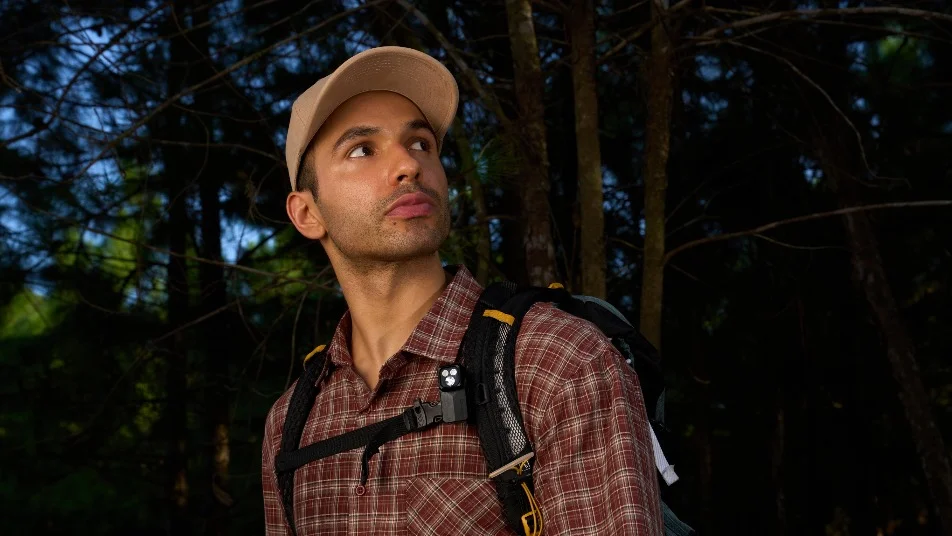
Here is the problem this guide solves. Two lights both promise close to 3,000 lumens, so they look equal on a product page. Yet the Olight Perun 3 headlamp (3,000 lumens) is rated to reach 160 m, and the Olight Warrior X 4 (2,600 lumens) is rated at 630 m. The lumen number hides that gap. The candela number shows it.
This table sums up flashlight throw vs flood using those two lights, which have similar lumens but opposite beam shapes.
| Dimension | Throw: Warrior X 4 | Flood: Perun 3 | Which wins | By how much |
|---|---|---|---|---|
| Max output | 2,600 lumens | 3,000 lumens | Flood | 15% more total light |
| Peak beam intensity | 99,310 candela | 6,400 candela | Throw | 15.5 times the intensity |
| Rated beam distance (ANSI FL1) | 630 m | 160 m | Throw | 3.9 times the reach |
| Light on a target 100 m away (calculated) | 9.9 lux | 0.64 lux | Throw | 15.5 times brighter |
| Candela per lumen | 38.2 | 2.1 | Depends on job | High = narrow beam, low = wide beam |
| Close-range coverage | Tight hotspot with spill | Wide beam | Flood | Lights more of the area near you |
| Regular price (September 2026) | $129.99 | $89.99 | Flood | $40 less |
The pattern holds across every light in this guide: when you need reach, compare candela; when you need coverage close by, compare lumens and look for a low candela-per-lumen figure.
📋 Table of Contents
- 1. Quick Answer: Candela Sets Reach, Lumens and Beam Angle Set Coverage
- 2. What Does Flashlight Throw Mean?
- 3. How Does ANSI FL1 Define Beam Distance?
- 4. How Do You Convert Candela to Beam Distance?
- 5. Candela vs Lumens: Which Number Tells You Throw or Flood?
- 6. Reflector vs TIR Lens: How Optics Shape the Beam
- 7. Why Does Beam Distance Drop After Turbo?
- 8. Which Is Better, Floodlight or Spotlight?
- 9. What Is the Best Flashlight for Both Throw and Flood?
- 10. What Flashlight Has the Farthest Throw?
- 11. Olight Flashlights Compared on Two Axes: Lumens and Candela
- 12. Flashlight Throw vs Flood: A 5-Step Check Before You Buy
- 13. FAQ
Quick Answer: Candela Sets Reach, Lumens and Beam Angle Set Coverage
Throw depends on peak candela, and flood depends on how many lumens a light has and how wide its beam spreads them. Neither number works alone. A 1,000-lumen light with a narrow beam can outreach a 3,000-lumen light with a wide one, and a high-candela light can still leave the ground at your feet in shadow. Read both numbers before you buy.
Think of lumens as the amount of water in a bucket and candela as the pressure at the nozzle. The same bucket can soak a lawn with a sprinkler head or hit a fence with a jet. A reflector or lens is that nozzle. It cannot create extra light, but it decides where the light goes.
That is why lumens alone mislead. Olight's own lineup shows it plainly. The Seeker Ultra puts out 4,800 lumens and is rated at 265 m. The Warrior X 4 puts out 2,600 lumens and is rated at 630 m. The Seeker Ultra has more total light. The Warrior X 4 has more light in the center of its beam.
When you browse flashlights, write down three figures for each light before you look at anything else: maximum lumens, peak candela and beam distance in meters. The rest of this guide shows how to turn those three numbers into a buying decision.
What Does Flashlight Throw Mean?
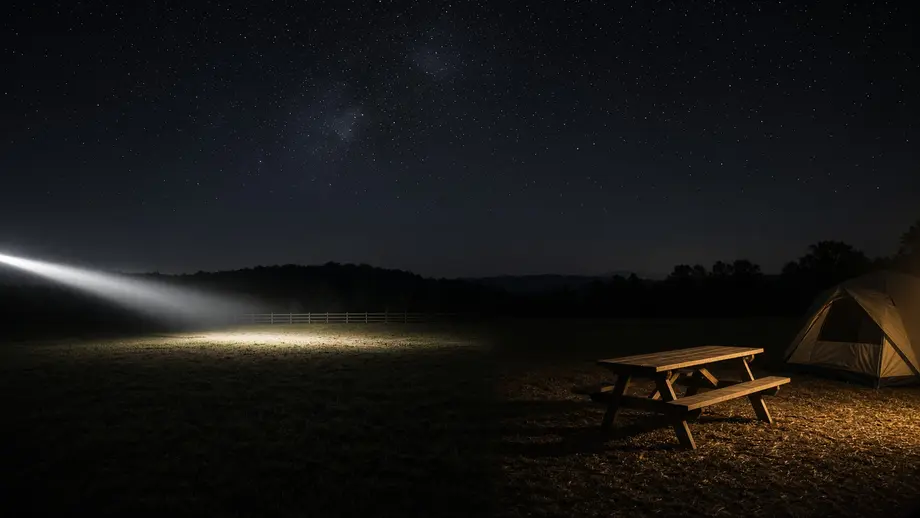
Flashlight throw is how far a beam reaches while it still lights a target, and it is set by peak beam intensity in candela, not by total lumens. A thrower squeezes its light into a narrow, intense hotspot. A flood light spreads the same lumens into a wide cone that lights more ground near you but fades sooner with distance.
Three words describe what you see when you switch a light on:
- Hotspot: the bright center of the beam. Its intensity is the peak candela figure on the spec sheet.
- Spill: the dimmer ring around the hotspot. It lights your peripheral vision and the path near your feet.
- Beam profile: how the hotspot and spill balance. A "thrower" has a small, intense hotspot and little spill. A "floody" light has a large, soft center and plenty of spill.
Throw is a measure of intensity in one direction. Flood is about coverage across many directions. A light can be good at one, or balanced between both, but a single optic cannot maximize both at once. Squeezing the beam raises the hotspot and shrinks the area it covers. Opening it up does the reverse.
This matters because your eyes need light on the object itself. If you are scanning a field for a lost dog, a wide beam that lights the grass at 15 meters does nothing for the dog at 150 meters. If you are changing a tire, a tight hotspot that lights one lug nut and leaves the rest of the wheel dark is just as unhelpful.
How Does ANSI FL1 Define Beam Distance?
Under the ANSI/PLATO FL1 standard, beam distance is the distance at which a flashlight's beam drops to 0.25 lux, which is roughly the light of a bright full moon. It is calculated, not paced out: labs measure peak beam intensity in candela, then take the square root of candela divided by 0.25. That simplifies to 2 times the square root of candela.
Streamlight's summary of the standard defines beam distance as "the distance from the device at which the light beam is 0.25 lux" and peak beam intensity as "the maximum luminous intensity typically along the central axis of a cone of light," reported in candela. The same summary defines runtime from an initial reading taken 30 seconds after the light is turned on.
The distance figure is derived, not observed. Nitecore's guide to the standard states that beam distance "is calculated from peak beam intensity" and describes the 0.25 lux threshold as illuminance "equivalent to a full moon on a clear night." Because illuminance equals candela divided by distance squared, a lux reading at the center of the beam at a known distance gives the candela figure, and the 0.25 lux distance follows from it.
This table translates the FL1 numbers on a box into what each one tells you about throw and flood.
| FL1 figure | Unit | What it measures | What it tells you about throw vs flood |
|---|---|---|---|
| Light output | Lumens | Total light leaving the light | Size of the light budget, not where it goes |
| Peak beam intensity | Candela | Brightness at the center of the beam | The best single number for throw |
| Beam distance | Meters | Where the center of the beam falls to 0.25 lux | Throw restated as a distance; always 2 times the square root of candela |
| Runtime | Hours or minutes | Time until output drops to 10% of the 30-second reading | How long any beam lasts, not how far it reaches |
Note: Beam distance is the point where the target gets full-moon light, not the point where you can identify it. Plan on seeing useful detail well inside the rated distance. Our guide to the ANSI FL1 standard covers the other ratings on the box.
Turbo figures are getting clearer. PLATO announced in February 2026 that the revised ANSI/PLATO FL 1-2025 standard adds a test method for "Short-Duration Elevated Brightness", the modes marketed as turbo or boost, with a new stopwatch-style icon. That matters for throw, because the peak candela on a spec sheet is the light's maximum, and on every light in this guide that maximum comes from a turbo or high stage lasting 1.5 to 4 minutes.
How Do You Convert Candela to Beam Distance?
To convert candela to ANSI beam distance, take the square root of candela and multiply by 2. A 10,000-candela light reaches 200 m, and a 100-meter target needs only 2,500 candela. Because light falls with the square of distance, doubling your reach takes four times the candela, which is why long throw gets heavy and expensive fast.
The square law comes from geometry. HyperPhysics at Georgia State University explains that for a point source, the amount of light per unit area at 1 meter is "one fourth as much at 2 meters". So illuminance on a target equals candela divided by distance squared. Three formulas cover almost every beam question you will have:
- Lux on a target = candela ÷ (distance in meters)²
- ANSI beam distance in meters = 2 × √candela
- Candela needed = target lux × (distance in meters)²
Full-moon light (0.25 lux) is the FL1 threshold, but you may want more than that on the thing you are looking at. This table uses the formulas above to show how much candela each distance needs at three brightness targets: the FL1 threshold, four times it (1 lux) and sixteen times it (4 lux).
| Distance to target | Candela for 0.25 lux (FL1) | Candela for 1 lux | Candela for 4 lux |
|---|---|---|---|
| 25 m (82 ft) | 156 | 625 | 2,500 |
| 50 m (164 ft) | 625 | 2,500 | 10,000 |
| 100 m (328 ft) | 2,500 | 10,000 | 40,000 |
| 150 m (492 ft) | 5,625 | 22,500 | 90,000 |
| 200 m (656 ft) | 10,000 | 40,000 | 160,000 |
| 300 m (984 ft) | 22,500 | 90,000 | 360,000 |
| 500 m (1,640 ft) | 62,500 | 250,000 | 1,000,000 |
| 750 m (2,461 ft) | 140,625 | 562,500 | 2,250,000 |
| 1,000 m (3,281 ft) | 250,000 | 1,000,000 | 4,000,000 |
Read the table in two directions. Going across, each step up in target brightness multiplies the candela by four. Going down, each doubling of distance multiplies it by four again. A simple rule falls out of that: if you want four times the light on a target, you get half the distance. A light rated at 630 m puts 1 lux on a target at about 315 m.
You can use the formula to check any spec sheet. The Warrior X 4's 99,310 candela gives 2 × √99,310 = 630 m, matching Olight's rating. The Seeker Ultra's 17,600 candela gives 265 m, and the Baton 4's 7,225 candela gives 170 m. Both match their product pages. For a deeper walk through the units, see our explainer on beam distance, candela and lux.
Tip: Before you shop, open a map app and measure the real distances you care about: your back fence, the far side of the pond, the end of the driveway. Plug the longest one into the 1 lux column and you have a minimum candela figure to shop by.
Candela vs Lumens: Which Number Tells You Throw or Flood?
Lumens measure all the light a flashlight emits, while candela measures intensity in the single brightest direction. Divide peak candela by maximum lumens and you get a candela-per-lumen ratio, a quick score for beam shape. The Olight Perun 3 scores 2.1, a flood beam. The Warrior X 4 scores 38.2, a throw beam.
The SI system links the two units. NIST lists the lumen as a candela multiplied by a steradian (lm = cd sr), a unit of solid angle, and the lux as one lumen per square meter. In plain terms, lumens are candela spread over an angle. Squeeze the angle and the same lumens produce more candela.
Nitecore's FL1 guide makes the same point for buyers: the candela per lumen ratio "can be used to determine if a flashlight has a spot- or flood-type beam." It also gives reference points: "well-focused spot beams can be over 100 cd/lm, tactical flashlights are typically between 20-100 cd/lm, and work lights are less than 10 cd/lm." The bands below follow those points and add a 10 to 20 middle band for all-round lights. That middle band is our own grouping, not part of FL1.
This table shows the candela-per-lumen bands used in this guide to sort beams, with an Olight example for each.
| Candela per lumen | Beam character | What it is good at | Olight example (rated cd ÷ lm) |
|---|---|---|---|
| Under 10 | Flood | Camps, repairs, walking a lit path, reading a map | Perun 3: 6,400 ÷ 3,000 = 2.1 |
| 10 to 20 | Balanced | Everyday carry, yards, trails at moderate range | Baton Ultra: 22,500 ÷ 1,800 = 12.5 |
| 20 to 100 | Throw | Fence lines, fields, search at a few hundred meters | Warrior X 4: 99,310 ÷ 2,600 = 38.2 |
| Over 100 | Dedicated spot channel | Long-range search from a dual-beam light | Marauder 3 spotlight: 250,000 ÷ 1,500 = 167 (estimated) |
One trap applies to dual-beam lights. Their maximum lumens usually come from the floodlight, so dividing the two headline numbers mixes channels. The Marauder Mini 2 lists 10,000 lumens and 140,000 candela, which gives 14 and looks balanced. But the 10,000 lumens belong to the floodlight. Olight does not say which beam the 140,000 candela comes from. Its 750 m spotlight rating matches 2 × √140,000, so the figure most likely belongs to the spotlight, which tops out at 1,350 lumens. On that assumption, the spot channel scores about 104. The same reasoning gives the Marauder 3 spotlight about 167.
The ratio also explains the pain point from the start of this guide. At 100 m, the Perun 3 puts 6,400 ÷ 100² = 0.64 lux on a target. The Warrior X 4 puts 9.9 lux there. That is a 15-fold difference in the light that lands on whatever you are trying to see. For a sense of what total output looks like in a room or yard, our lumens guide answers how bright is 2000 lumens and other common levels.
Reflector vs TIR Lens: How Optics Shape the Beam
The optic, not the LED alone, decides whether a flashlight throws or floods. A reflector bounces light off a curved mirror, while a TIR lens guides it through solid clear material using total internal reflection and refraction. Either type can make a spot or a flood. What matters most is how small the LED's glowing surface is compared with the size of the optic.
LED optics maker LEDiL notes that lenses and reflectors "control light through reflection or refraction," and that a larger light-emitting surface "generally makes it more difficult to achieve ultra-narrow beams." The same article adds that narrow beams "produce a higher candela peak and can achieve high intensity with fewer lumens than wider beams." That is the physics behind a thrower.
TIR stands for total internal reflection. HyperPhysics explains that when light hits the boundary to a material with a lower index of refraction at more than a critical angle, all of it reflects back inside. A TIR optic uses that effect on its side walls to catch light that would otherwise leak sideways, then sends it forward.
This table lists the optic each Olight light in this guide uses, according to its product page, next to its beam score.
| Olight light | Optic listed by Olight | Candela per lumen | Beam result |
|---|---|---|---|
| i3E EOS | PMMA TIR lens with a Philips LUXEON TX LED | About 5.4 (candela not listed; 44 m implies about 484 cd ÷ 90 lm) | Keychain light; Olight says the lens focuses the light to 44 m |
| Baton 4 | TIR optic lens | 5.6 | Flood leaning |
| Seeker 4 Pro | TIR optic lens | 3.7 | Flood leaning |
| Seeker Ultra | Four LEDs with a premium TIR lens | 3.7 | Flood leaning |
| Marauder Mini 2 | Converging lens and TIR lens | About 104 (spotlight channel, estimated) | Separate flood and spot |
| Marauder 3 | Aspheric lens and TIR lens | About 167 (spotlight channel, estimated: 250,000 cd ÷ 1,500 lm) | Separate flood and spot |
Beam angle is the other half of flood. LEDiL defines the common FWHM beam angle as the width of the light distribution at 50% of peak intensity. Olight does not publish beam angles for these lights, so you cannot read coverage straight off the spec sheet. Geometry still tells you how big a beam gets. This table shows the approximate width of a beam at four distances for five full beam angles, using width = 2 × distance × tan(angle ÷ 2).
| Full beam angle | Width at 10 m | Width at 25 m | Width at 50 m | Width at 100 m |
|---|---|---|---|---|
| 10° (tight spot) | 1.7 m | 4.4 m | 8.7 m | 17.5 m |
| 20° | 3.5 m | 8.8 m | 17.6 m | 35.3 m |
| 40° | 7.3 m | 18.2 m | 36.4 m | 72.8 m |
| 60° | 11.5 m | 28.9 m | 57.7 m | 115.5 m |
| 90° (wide flood) | 20.0 m | 50.0 m | 100.0 m | 200.0 m |
A 10° hotspot is only 1.7 m wide at 10 m, about the width of a car's hood. That is why a pure thrower feels like looking through a tube when you walk with it. A 90° flood covers a 20 m circle at the same distance, but on a flat wall it spreads the same lumens over roughly 130 times the area of the 10° spot, so each square meter gets far less light.
Why Does Beam Distance Drop After Turbo?
Beam distance drops after turbo because rated throw is taken at maximum output, and every high-output Olight light in this guide steps down within minutes to control heat. With the same optic, candela falls in proportion to lumens, and reach falls with the square root. A light that keeps 38% of its output keeps about 62% of its rated distance.
Olight publishes these step-downs in its runtime format. The Warrior X 4's high mode reads 2,600~1,000~300 lumens for 3 + 140 + 20 minutes. So the light spends 3 minutes at full output, then about 140 minutes at 1,000 lumens. If you plan a long search, the 1,000-lumen stage is the beam you will actually use. The rated 630 m is the first 3 minutes.
This table estimates candela and beam distance at each published stage, assuming candela scales with lumens because the optic does not change. These are our calculations from Olight's ratings, not Olight figures.
| Light and mode | Output stage (Olight) | Time at stage (Olight) | Estimated candela | Estimated beam distance |
|---|---|---|---|---|
| Warrior X 4, regular high | 2,600 lumens | 3 minutes | 99,310 (rated) | 630 m (rated) |
| Warrior X 4, regular high | 1,000 lumens | 140 minutes | 38,196 | 391 m |
| Seeker Ultra, turbo | 4,800 lumens | 2.5 minutes | 17,600 (rated) | 265 m (rated) |
| Seeker Ultra, turbo | 1,000 lumens | 150 minutes | 3,667 | 121 m |
| Marauder Mini 2, spotlight level 4-2 | 1,350 lumens | 4 minutes | 140,000 (rated maximum, assumed to be the spotlight) | 750 m (rated) |
| Marauder Mini 2, spotlight level 4-2 | 600 lumens | 170 minutes | 62,222 | 499 m |
| Perun 3, turbo | 3,000 lumens | 2 minutes | 6,400 (rated) | 160 m (rated) |
| Perun 3, turbo | 800 lumens | 180 minutes | 1,707 | 83 m |
Two lessons come out of this table. First, the sustained stage of a thrower still outreaches the turbo stage of a flood light: the Warrior X 4 at 1,000 lumens (about 391 m) beats the Seeker Ultra at 4,800 lumens (265 m). Second, flood lights lose less useful distance in absolute terms because they never had much. If you want to understand why lights step down at all, our article on the thermal step down flashlight problem explains the heat side.
Safety note: A throw beam that is comfortable at 300 m is blinding at 3 m. Keep high-candela lights pointed away from people's eyes, including your own when you check a hot head. A light that has run on turbo can get hot enough to be uncomfortable to hold, so let it cool before you pocket it or hand it to someone else.
Which Is Better, Floodlight or Spotlight?
Neither is better in general. A spotlight, or throw beam, is better when the thing you need to see is far away, and a floodlight is better when it is close and spread out. Searching, checking a fence line or following a long trail favors throw. Camp chores, car repairs and walking the dog favor flood. Hunting often needs both at different moments.
The question to ask is not "how bright" but "how far, and how wide." Use this four-step method with the tables above:
- Name the task and the farthest object you need to see during it.
- Measure that distance in meters.
- Choose a brightness target for the object: 0.25 lux to notice something is there, 1 lux or more to make out what it is.
- Multiply the lux target by the distance squared to get the candela you need, then shortlist lights with at least that much candela in a mode they can sustain.
This table applies the method to five common users, with the beam type, a candela target and an Olight light that fits it.
| Who you are | Farthest thing you need to see | Beam to choose | Candela target (our calculation) | Olight fit |
|---|---|---|---|---|
| Searcher or property owner checking a field | 200 to 300 m | Throw or dual beam | 40,000 to 90,000 cd for 1 lux | Warrior X 4 or Marauder Mini 2 |
| Hunter walking in and scanning | 50 m on the trail, 200 m to scan a field edge | Throw handheld plus a flood headlamp | 2,500 cd for 1 lux at 50 m; 40,000 cd for 1 lux at 200 m | Warrior X 4 plus Perun 3 headlamp |
| Camper around a site | 10 to 25 m | Flood | Under 1,000 cd is plenty; lumens matter more | Perun 3 headlamp |
| DIYer or mechanic | Under 2 m | Flood, hands free | Candela barely matters | Perun 3 headlamp |
| Everyday carrier | Across a parking lot, about 50 m | Flood leaning or balanced | 2,500 cd for 1 lux at 50 m | Baton 4 |
Hunters face a specific mix. You walk in with a light at your feet, then may need to scan a field edge or follow a blood trail. One way to cover both is to split the job: a handheld for distance and a floody headlamp for the ground at your feet. Olight groups its long-reach options under hunting flashlights. Build the lights into your hunting season gear check so batteries and spares are ready before opening day.
Warning: State rules on using a light while hunting differ on legal hours, weapons in possession and target species. Read your state wildlife agency's current regulations before you carry a thrower into the woods, and see our overview of hunting with a light laws for how the rules vary.
What Is the Best Flashlight for Both Throw and Flood?
The best flashlight for both throw and flood is a dual-beam light with separate floodlight and spotlight channels, because one optic cannot be wide and narrow at the same time. The Olight Marauder Mini 2 pairs a floodlight rated up to 10,000 lumens with a spotlight Olight rates at a 750-meter throw, lists 140,000 candela as the light's maximum intensity and fits it all in a body 133 mm long.
The Olight Marauder Mini 2 flashlight lists five lighting configurations: floodlight, spotlight, combined spotlight and floodlight, red light and side light. That lets you light the ground around you with the flood and then switch to the spot to check something 300 m away, without carrying two lights. Its 7,500 mAh 32650 battery runs the 150-lumen floodlight for 27 hours, according to Olight's runtime table.
It has limits. It weighs 465 g with its battery, nearly twice the weight of the Warrior X 4 (249 g), so it rides in a pack or on a belt rather than in a pocket. Olight lists its working temperature as 0~40 ℃, so it should not be your only light on a late-season hunt below freezing. Its regular price is $219.99 (regular price, September 2026). The 10,000-lumen floodlight lasts 2 minutes before stepping down to 2,500 lumens.
If you want one beam that does a bit of both, a balanced single-beam light is the lighter option. Olight describes the Olight Warrior X 4 tactical flashlight as balancing "the spot and spill well," with 99,310 candela and 630 m of throw from a 26 mm body. Its 38.2 candela per lumen puts it in the throw band, so it is still a thrower at heart. Up close it lights a smaller patch than a flood headlamp, so pair it with one for close work. Its regular price is $129.99 (regular price, September 2026).
What Flashlight Has the Farthest Throw?
The flashlight with the farthest throw is the one with the highest peak candela, not the most lumens. In Olight's current US lineup, that is the Olight Marauder 3, rated at 250,000 candela with a spotlight Olight says reaches up to 1,000 meters. For comparison, Imalent lists its 200,000-lumen MS32 at 655,000 candela and 1,618 m.
Those two lights show why lumens are a poor guide to reach. Imalent's MS32 product page lists 200,000 lumens, eight times the Marauder 3's 25,000. Yet its 655,000 candela is only 2.6 times the Marauder 3's figure, so its rated distance is only 1.6 times longer. Its candela per lumen is 3.3, a flood-leaning score. Much of its extra output lights the area close to you.
The Olight Marauder 3 flashlight splits the job into two channels. Its floodlight reaches 25,000 lumens, and its spotlight tops out at 1,500 lumens. Olight lists an aspheric lens and a TIR lens for the light. Olight does not tie the 250,000 candela to one beam, but the spotlight's 1,000-meter rating is exactly 2 × √250,000. Dividing 250,000 candela by those 1,500 spotlight lumens gives about 167 candela per lumen, the most concentrated beam in this guide. Its spotlight runs 1,500~750~500~250 lumens for 3 + 700 + 200 + 200 minutes at level 7. During the 700-minute stage at 750 lumens, we estimate its reach at about 707 m.
The trade-offs are size and cost. It weighs 840 g with its built-in 31,900 mAh battery, and its regular price is $369.99 (regular price, September 2026). Olight lists a working temperature of 0~40 ℃. If you need 1 lux at 300 m, you need 90,000 candela, and the Warrior X 4 at 99,310 candela already meets that for its first 3 minutes at a third of the weight. Buy the Marauder 3 when you genuinely need to see past 500 m.
Olight Flashlights Compared on Two Axes: Lumens and Candela
Plotting Olight flashlights on two axes, lumens for coverage and candela for reach, sorts them into flood, throw and dual-beam groups far better than lumens alone. The Seeker Ultra has the most lumens of the single-beam lights here, yet the Warrior X 4 has about half its lumens and more than twice its reach.
This table lists Olight's rated figures for each light, our 2 × √candela check of the beam distance and the candela-per-lumen score, with regular prices from Olight's US store in September 2026.
| Olight light | Max lumens | Peak candela | Rated beam distance | 2 × √cd check | Candela per lumen | Beam group | Regular price |
|---|---|---|---|---|---|---|---|
| Marauder 3 | 25,000 (flood) | 250,000 | 1,000 m | 1,000 m | About 167 (spot channel, estimated) | Dual beam | $369.99 |
| Marauder Mini 2 | 10,000 (flood) | 140,000 | 750 m | 748 m | About 104 (spot channel, estimated) | Dual beam | $219.99 |
| Warrior X 4 | 2,600 | 99,310 | 630 m | 630 m | 38.2 | Throw | $129.99 |
| Seeker Ultra | 4,800 | 17,600 | 265 m | 265 m | 3.7 | Flood leaning | $169.99 |
| Seeker 4 Pro | 4,600 | 16,895 | 260 m | 260 m | 3.7 | Flood leaning | $139.99 |
| Baton 4 | 1,300 | 7,225 | 170 m | 170 m | 5.6 | Flood leaning | $54.99 |
| Perun 3 (headlamp) | 3,000 | 6,400 | 160 m | 160 m | 2.1 | Flood | $89.99 |
Every rated distance matches the FL1 formula within rounding, so the spec sheets are internally consistent. The groups tell you more than the rankings do. If your nights involve open ground past 200 m, a throw light or a dual-beam light is the only group that reaches. If they involve a campsite, a garage or a dark stairwell, the flood group puts more of its light where you are.
The Olight Seeker Ultra flashlight is a good example of a light that suits one job and not the other. Its four LEDs behind a TIR lens make a wide, bright beam for yards, hillsides and work areas, and Olight rates its 300-lumen medium mode at 12.5 hours. It is not the light to buy for spotting something at 400 m, because its 17,600 candela puts only 0.11 lux on a target that far away. For that job, the Warrior X 4 costs $40 less and reaches more than twice as far.
Flashlight Throw vs Flood: A 5-Step Check Before You Buy
To settle flashlight throw vs flood for your own use, run five checks on any spec sheet: the distance you need, the candela that distance requires, the candela-per-lumen score, the sustained output after turbo and the weight you will carry. The steps take five minutes and need nothing more than the product page and a calculator.
- Measure your farthest real distance. Use a map app to measure the fence, field edge or shoreline you care about. Write it down in meters.
- Turn distance into candela. Multiply the distance squared by 1 for a clear look (1 lux) or by 0.25 for the FL1 minimum. Shortlist only lights at or above that candela figure.
- Score the beam shape. Divide peak candela by maximum lumens. Under 10 means flood, 10 to 20 balanced, 20 to 100 throw and above 100 a dedicated spot. For dual-beam lights, divide the rated candela by the spotlight's lumens, and check that the spotlight's rated distance matches 2 × √candela before you trust the result.
- Check the sustained stage. Read the runtime line for turbo or high. Multiply the rated candela by the sustained lumens divided by peak lumens, then take 2 × √ of that to see the reach you will have after the first few minutes.
- Match weight to carry. A thrower that lives in a truck can weigh 800 g. One that rides in a pocket should be closer to 200 g. If you need both reach and close coverage, a throw handheld plus a flood headlamp often weighs less than one large dual-beam light.
If you only remember one thing, remember this: lumens tell you how much light you bought, and candela tells you where it goes. Compare both before you buy.
FAQ
Changelog
- September 23, 2026: First published. Olight specs and regular prices reflect Olight's US product pages in September 2026.