⚡ TL;DR
Lumens measure the total light a flashlight emits, candela measures how intense the beam is in one direction, and lux measures how much light lands on a surface. For flashlights, lumens predict how much area you can light, while candela predicts reach, and ANSI FL1 beam distance works out to 2 × √candela meters.
This table sums up the three units and the flashlight question each one answers.
| Unit | Symbol | What it measures | How it is defined | Flashlight question it answers |
|---|---|---|---|---|
| Lumen | lm | Total visible light emitted in all directions (luminous flux) | 1 lm = 1 cd × 1 sr | How much light does it put out overall? |
| Candela | cd | Light intensity in one direction (luminous intensity) | SI base unit | How far will the beam reach? |
| Lux | lx | Light arriving on a surface (illuminance) | 1 lx = 1 lm per m² | How bright is the target at a given distance? |
📋 Table of Contents
- 1. What Is the Difference Between Lumens and Candela?
- 2. Definitions and Conversion Formulas for Lumens, Candela and Lux
- 3. How Is Beam Distance Measured?
- 4. What Does 100,000 Candela Mean?
- 5. Candela per Lumen: Why Lumens Don't Predict Reach
- 6. Where Flashlight Spec Sheets Can Mislead
- 7. Which Flashlight Spec Should You Check First?
- 8. FAQ
What Is the Difference Between Lumens and Candela?
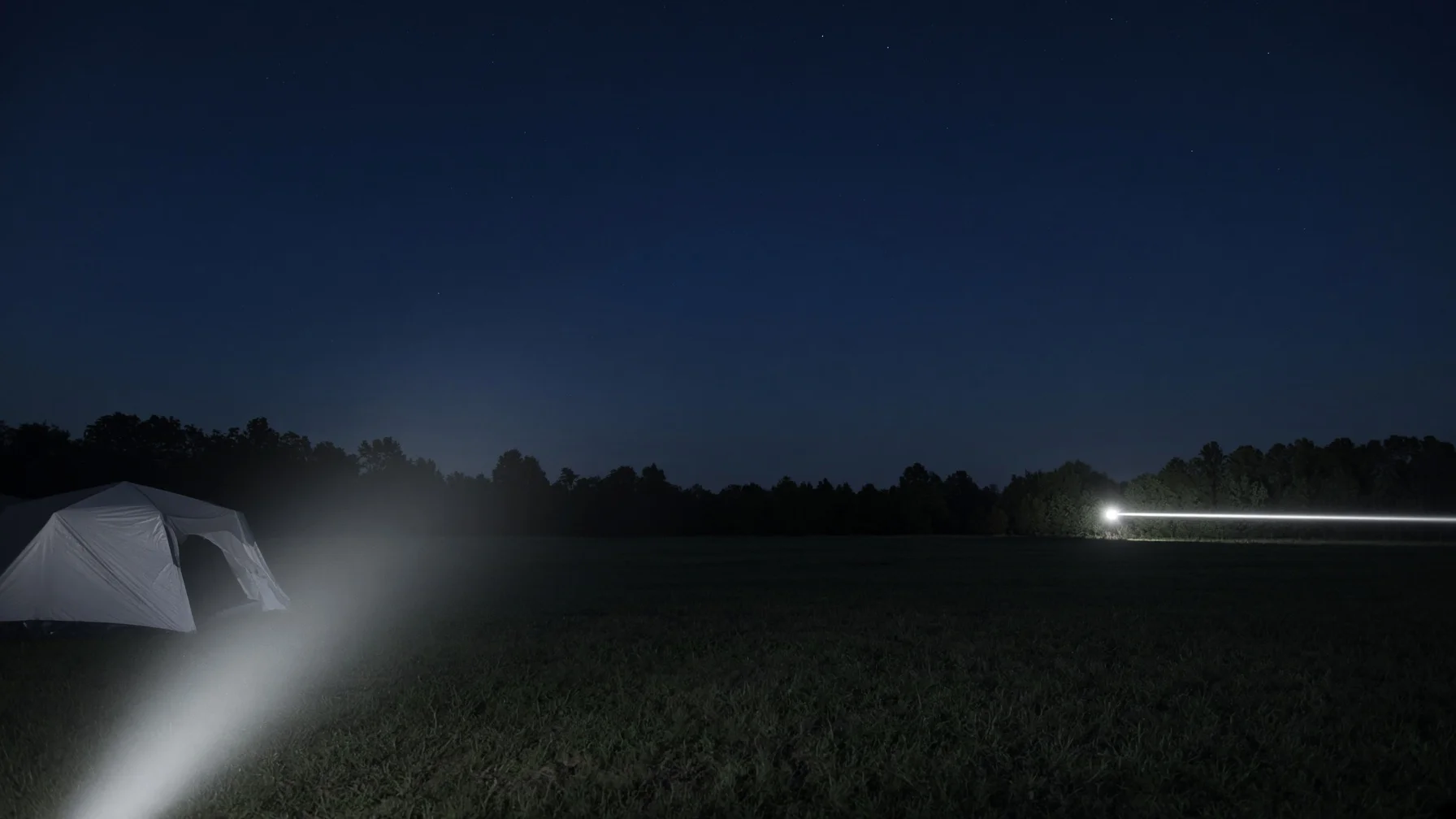
Lumens count all the light a flashlight produces, no matter where it goes, while candela measures how concentrated that light is in the beam's brightest direction. Two lights with similar lumens can have very different candela. Squeeze the light into a narrow beam and candela rises. Spread the same light into a wide flood and candela falls, even though total lumens stay the same.
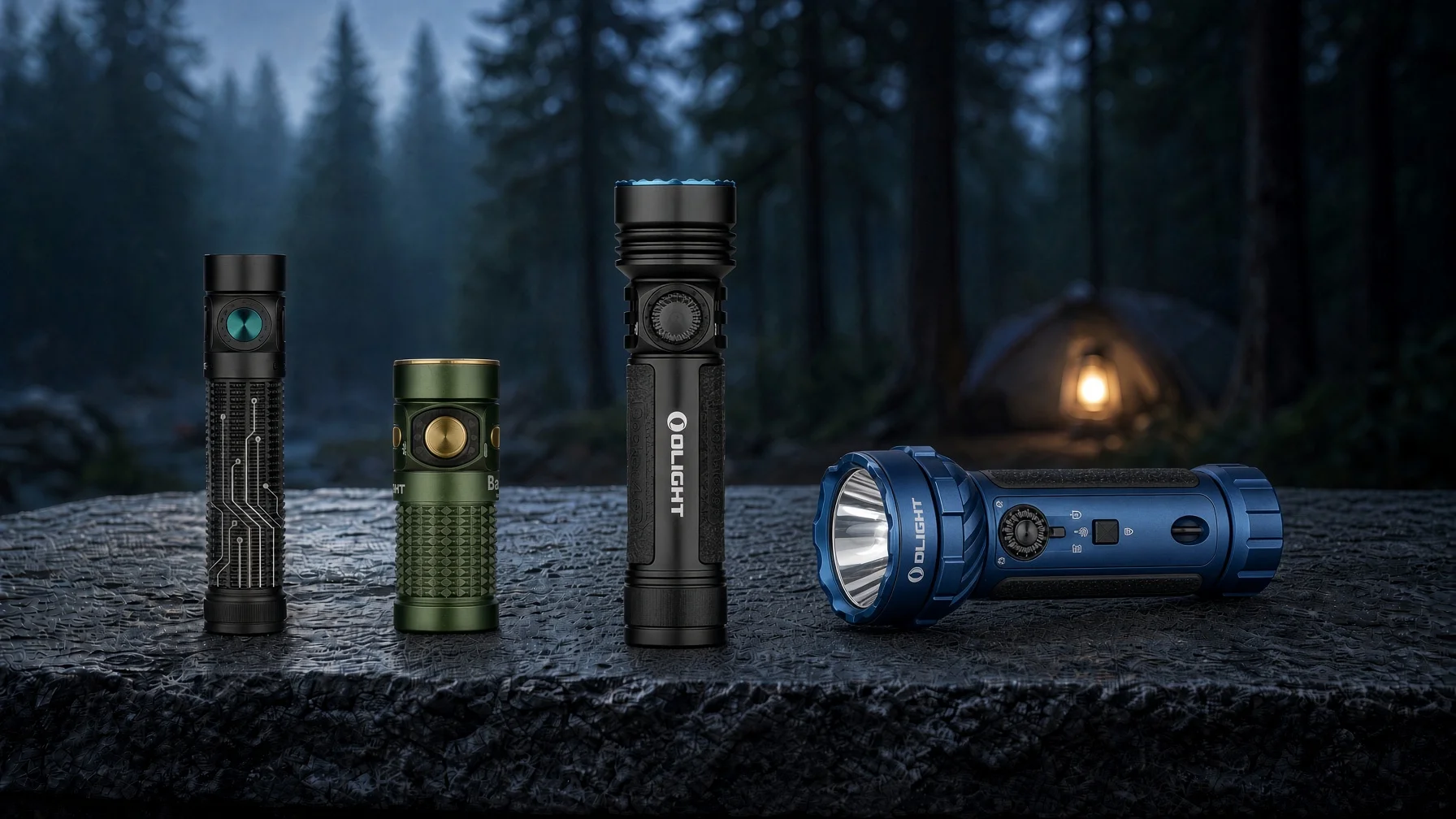
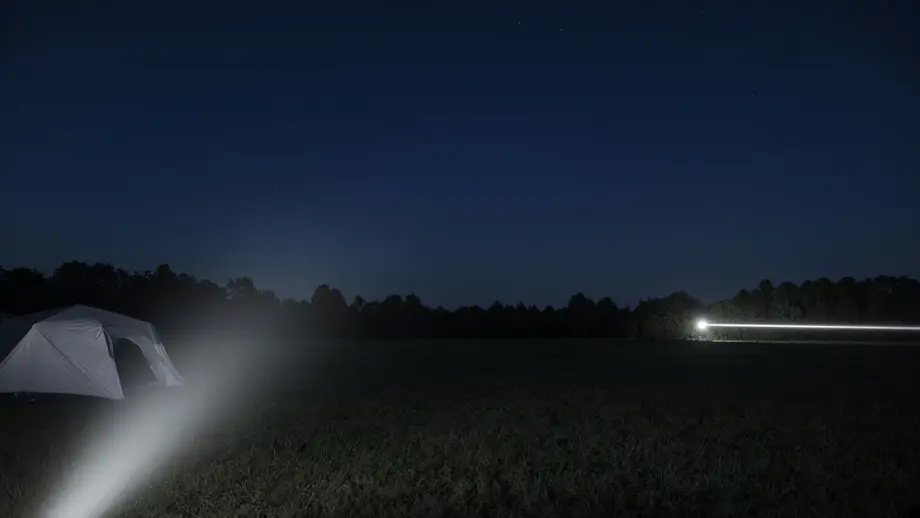
Olight's official specs show how far apart the two can be. The Olight Perun 3 (3,000 lumens, 6,400 candela, 160 m) emits 30% more light than the Olight Warrior 3S (2,300 lumens, 23,000 candela, 300 m). Yet the Warrior 3S has 3.6 times the candela and a rated beam distance nearly twice as long. The Perun 3 spreads its light across a campsite, while the Warrior 3S concentrates it into a beam that reaches down a trail or across a parking lot.
The candela is the SI base unit of luminous intensity, and the lumen and lux are derived from it. NIST describes one candela as roughly the light given off by a single candle, which gives you a rough reference: a 23,000-candela beam center is about as intense as the combined glow of 23,000 candles.
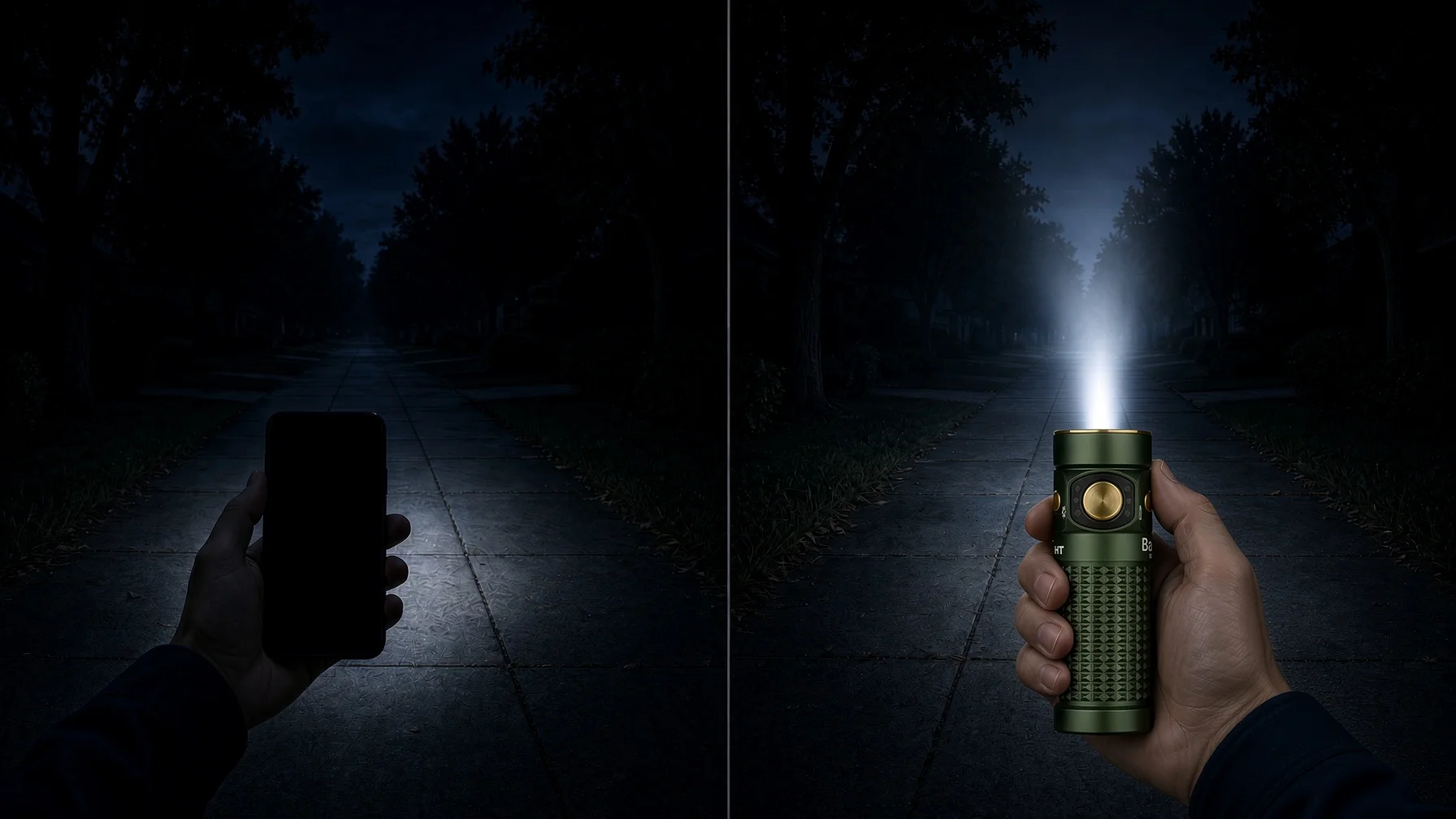
A simple way to keep the two apart: lumens tell you how much light leaves the lens, and candela tells you how tightly it is aimed. You want a wide, high-lumen beam for close work and moving around a campsite, and a high-candela beam when the thing you need to see is far away. For what different lumen levels look like in everyday use, see how bright 2,000 lumens really is.
Definitions and Conversion Formulas for Lumens, Candela and Lux
The three units connect through geometry. One lumen is one candela spread over one steradian, the solid angle cut out of a sphere by a patch of surface whose area equals the radius squared. One lux is one lumen per square meter. Farther out, light from a small source spreads over an area that grows with distance squared, so lux at the target equals candela divided by distance in meters squared.
This table collects the formulas you need, each with a worked example.
| Relationship | Formula | Worked example |
|---|---|---|
| Lumens from candela over a solid angle | lm = cd × sr | 1,000 cd spread evenly over 0.1 sr = 100 lm |
| Lux from lumens over an area | lx = lm ÷ m² | 1,000 lm spread evenly over 2 m² = 500 lx |
| Lux on a target from candela | lx = cd ÷ d² | 23,000 cd at 50 m = 9.2 lx |
| ANSI FL1 beam distance | d = √(cd ÷ 0.25) = 2 × √cd | 10,000 cd gives 200 m |
| Candela needed for a beam distance | cd = (d ÷ 2)² | 500 m needs 62,500 cd |
| Luminance of a surface or screen | cd per m² (nits) | A 1,000-nit screen gives 1,000 cd per square meter |
A full sphere contains 4π steradians, about 12.57. That gives the only lumen-to-candela conversion that needs no extra information: a source glowing equally in every direction produces about 12.57 lumens for every candela. Flashlights work differently. Reflectors and TIR optics push most of the light forward, so a flashlight's candela is far higher than its lumens divided by 12.57. The Warrior 3S would reach only about 183 candela if its 2,300 lumens were spread in every direction. Its official rating is 23,000.
For a real beam, you need the beam angle. A cone with a full angle θ covers 2π × (1 − cos(θ ÷ 2)) steradians. If 30,000 candela were spread evenly across a 10° cone, that cone would hold about 717 lumens; across a 20° cone, about 2,864 lumens. Real beams have a bright hotspot and a dimmer spill, so treat these figures as rough estimates, and use the maker's published candela whenever one exists.
Nits are the common name for candela per square meter, the unit of luminance. Luminance describes how bright a glowing or lit surface looks, which is why phone and TV screens are rated in nits while flashlights are rated in lumens and candela. Keep nits and lux apart: lux counts light landing on a surface, in lumens per square meter, while nits count light coming off a surface toward your eye, in candela per square meter.
How Is Beam Distance Measured?
ANSI/PLATO FL1 defines beam distance as the distance from the flashlight at which the beam falls to 0.25 lux. Peak beam intensity is rated in candela, and because illuminance equals candela divided by distance squared, the distance to 0.25 lux works out to 2 × √candela. That is why beam distance and candela move together on any spec sheet that follows FL1.
The math takes three steps:
- FL1 sets the threshold: illuminance at the end of the beam is 0.25 lux.
- The inverse square law links illuminance to intensity: lux = candela ÷ distance².
- Solve for distance: distance = √(candela ÷ 0.25) = 2 × √candela.
You can check any spec sheet against it. Olight's official figures line up: the Warrior 3S lists 23,000 candela and 300 m (the formula gives 303 m), the Olight Baton 4 Pro (1,600 lumens, 10,000 candela, 200 m) lists exactly what the formula gives, and the Olight Marauder Mini 2 (10,000 lumens, 140,000 candela, 750 m) lists 750 m against a calculated 748 m.
The 0.25-lux threshold is dim. Researchers who reviewed moonlight measurements put the brightest possible full moon at about 0.3 lux, reached only under ideal conditions, and put typical moonlight at about 0.05 to 0.10 lux at temperate latitudes in summer. So FL1 beam distance marks where the beam fades to roughly the brightest moonlight, not where you can pick out details.
Because distance grows with the square root of candela, doubling a light's reach takes four times the candela. A stricter yardstick you can calculate yourself is the 1-lux distance, which equals √candela, exactly half the rated beam distance. This table shows both distances for common candela levels.
| Peak intensity | Distance to 1 lux (√cd) | ANSI FL1 beam distance (2 × √cd) | Official example |
|---|---|---|---|
| 1,000 cd | 32 m | 63 m | None |
| 6,400 cd | 80 m | 160 m | Olight Perun 3 (rated 160 m) |
| 10,000 cd | 100 m | 200 m | Olight Baton 4 Pro (rated 200 m) |
| 23,000 cd | 152 m | 303 m | Olight Warrior 3S (rated 300 m) |
| 50,000 cd | 224 m | 447 m | None |
| 100,000 cd | 316 m | 632 m | None |
| 140,000 cd | 374 m | 748 m | Olight Marauder Mini 2 (rated 750 m) |
| 250,000 cd | 500 m | 1,000 m | None |
How to Estimate Candela With a Lux Meter
FL1 peak beam intensity is taken with a lux meter at the brightest point of the beam and converted to candela, and you can do a rough version at home. In a dark yard or other open space away from light-colored walls, which bounce extra light onto the sensor, stand the light a measured distance from the meter, aim the hotspot at the sensor, and multiply the reading by the distance squared.
A reading of 900 lux at 5 m means 900 × 25 = 22,500 candela, which predicts a 300 m beam distance. Take the reading between 30 seconds and 2 minutes after switching on, the window FL1 uses, and before the light steps down. Measure from several meters away so the beam has fully formed.
What Does 100,000 Candela Mean?
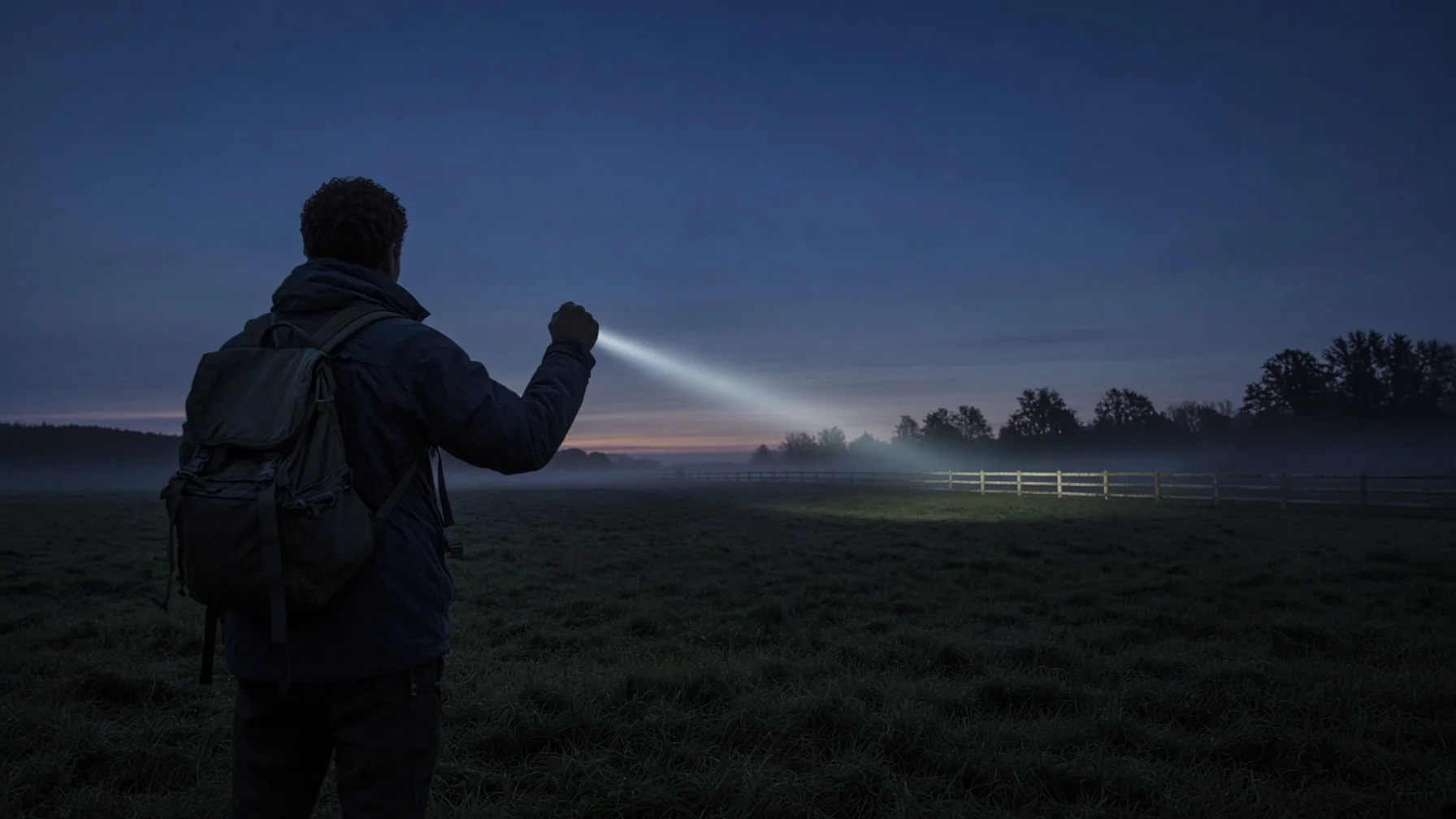
A flashlight rated at 100,000 candela has a beam center roughly as intense as the combined glow of 100,000 candles. Under ANSI FL1, that works out to a beam distance of about 632 meters, where the light falls to 0.25 lux. At 100 meters, the center of the beam still delivers 10 lux, and at 10 meters it delivers 1,000 lux.
This table shows how the beam center dims with distance for a 100,000-candela light and for a 25,000-candela light, which reaches exactly half as far.
| Distance | 100,000 cd at beam center | 25,000 cd at beam center |
|---|---|---|
| 10 m | 1,000 lx | 250 lx |
| 25 m | 160 lx | 40 lx |
| 50 m | 40 lx | 10 lx |
| 100 m | 10 lx | 2.5 lx |
| 200 m | 2.5 lx | 0.63 lx |
| 316 m | 1.0 lx | 0.25 lx |
| 632 m | 0.25 lx | 0.06 lx |
Three cautions apply. First, the figures describe the center of the beam in clear air, and fog, rain, dust and smoke scatter light and cut real-world reach. Second, a high candela rating can come with a narrow hotspot, so the lit patch far away may be small. Finally, read a light's headline figures together. For the Marauder Mini 2, Olight lists a 10,000-lumen maximum for the wide floodlight, a separate spotlight of up to 1,350 lumens, and one maximum light intensity of 140,000 candela for the light, without stating which beam that intensity comes from.
Candela per Lumen: Why Lumens Don't Predict Reach
Dividing candela by lumens gives a quick read on beam shape. A low ratio means the light is spread wide for close work, and a high ratio means it is focused for distance. The ratio is not an FL1 metric, but it uses only published figures, so you can calculate it for any flashlight that lists both numbers.
This table ranks Olight lights by candela per lumen, using Olight's official ratings.
| Light and beam | Max lumens | Peak intensity | Beam distance | Candela per lumen | Suits |
|---|---|---|---|---|---|
| Olight Oclip Ultra, floodlight | 530 | 505 cd | 45 m | 1.0 | Close work, room lighting |
| Olight Perun 3 | 3,000 | 6,400 cd | 160 m | 2.1 | Campsites, work areas |
| Olight Seeker 4 Pro | 4,600 | 16,895 cd | 260 m | 3.7 | Broad coverage with moderate reach |
| Olight Baton 4 Pro | 1,600 | 10,000 cd | 200 m | 6.3 | All-round pocket use |
| Olight Oclip Ultra, spotlight | 450 | 4,225 cd | 130 m | 9.4 | Scanning a path or yard |
| Olight Warrior 3S | 2,300 | 23,000 cd | 300 m | 10.0 | Duty and security |
| Olight Baton Ultra | 1,800 | 22,500 cd | 300 m | 12.5 | Pocket light with long reach |
The two Oclip Ultra rows are the cleanest comparison because they come from one light. The Olight Oclip Ultra (530-lumen floodlight, 450-lumen spotlight) has a spotlight that emits fewer lumens than its floodlight, yet it has more than eight times the candela and a rated reach of 130 m instead of 45 m.
The Baton line shows the same effect across two models of nearly the same size. The Olight Baton Ultra (1,800 lumens, 22,500 candela, 300 m) puts out only 200 more lumens than the Baton 4 Pro, but it has 2.25 times the candela and 100 m more rated reach. Olight lists a different LED for each model: a high-performance LED in the Baton 4 Pro and its self-developed EIP 1 LED in the Baton Ultra. The Olight Seeker 4 Pro (4,600 lumens, 16,895 candela, 260 m) shows the reverse: it has the most lumens in the table but only 3.7 candela per lumen, so more of its output goes into a broad beam than into extra reach. The Marauder Mini 2 is left out of the table because Olight publishes a single maximum light intensity of 140,000 candela for the whole light but separate lumen maximums for its floodlight and spotlight, so there is no matching pair of figures to divide.
Where Flashlight Spec Sheets Can Mislead
FL1 standardizes how lights are measured, but each number captures one moment or one condition. Light output is read shortly after switch-on, beam distance reflects peak intensity, runtime counts down to 10% of initial output, and the depth behind an IPX8 rating is set by the maker. Each figure is accurate for the condition it describes, which is narrower than most shoppers assume.
This table shows what each FL1 figure records, what it leaves out, and what to check instead.
| Spec | What the rating records | What it doesn't tell you | What to check instead |
|---|---|---|---|
| Light output (lumens) | Total output measured 30 seconds to 2 minutes after switch-on | How long that output lasts | The runtime table and the level after the first step-down |
| Beam distance | Distance to 0.25 lux at peak intensity | Reach after a step-down, or beam width | The 1-lux distance (√cd) and separate spot and flood figures |
| Runtime | Time until output falls to 10% of its 30-second value | How bright the light was for most of that time | Runtime for the mode you will actually use |
| Water resistance | IPX4 for splashes, IPX7 for 1 m for 30 minutes, IPX8 for 4 hours at a depth the maker states | The IPX8 depth, unless the maker lists it | The stated depth for IPX8 lights |
| Impact resistance | Six drops onto concrete from the rated height | Repeated drops or drops from higher up | Whether the rated height matches how you carry the light |
A step-down changes reach as well as brightness. Olight's runtime table for the Warrior 3S shows 2,300 lumens for 2.5 minutes, then 805 lumens for 160 minutes. If the beam shape stays the same, candela falls in proportion to output, so after the step-down the beam distance shrinks from 300 m to about 180 m (300 × √(805 ÷ 2,300)). That lower figure is the reach you get for the next 160 minutes.
PLATO published a revised standard, ANSI/PLATO FL 1-2025, in February 2026. According to PLATO, the revision adds a test method for short bursts of elevated brightness, the modes brands call turbo or boost, along with a stopwatch-style icon for that rating. Until that figure appears on spec sheets, the step-down stages in a runtime table are the best guide to how long peak output lasts. For more on how lumen ratings are produced, see our explainer on ANSI FL1 lumen ratings.
Which Flashlight Spec Should You Check First?
Check the spec that matches your distance. For close work and moving around indoors, lumens and a wide beam matter most. For trails and campsites, look for a balance of lumens and candela. For duty use, prioritize candela and sustained output, and for search work or open ground, candela comes first because it sets reach.
This table ranks the specs to check for five common uses, with a reference point and an official example for each.
| Use | Check first | Then check | Reference point | Official example |
|---|---|---|---|---|
| Home, repairs, close work | Lumens and a wide beam | Low modes and hands-free mounting | A beam distance under 100 m is enough | Olight Oclip Ultra floodlight: 530 lm, 45 m |
| Camping and hiking | A balance of lumens and candela | Runtime on medium and low | 150 m to 250 m rated distance (5,600 cd to 15,600 cd) | Olight Perun 3: 3,000 lm, 160 m |
| Everyday carry | Candela for its size | Output after the first step-down | About 10,000 cd, or 200 m | Olight Baton 4 Pro: 10,000 cd, 200 m |
| Security and duty | Candela | Sustained output and a tail switch | 20,000 cd or more, or about 283 m or more | Olight Warrior 3S: 23,000 cd, 300 m |
| Search, large property, open ground | Candela | Runtime at high levels and separate spot and flood figures | 100,000 cd or more, or 630 m or more | Olight Marauder Mini 2: 140,000 cd, 750 m |
Once you know which number matters, compare specific models side by side in our guide to the best flashlights of 2026, or browse all Olight flashlights.
FAQ
Changelog
- September 2026: First published. Olight specs checked September 14, 2026.