⚡ TL;DR
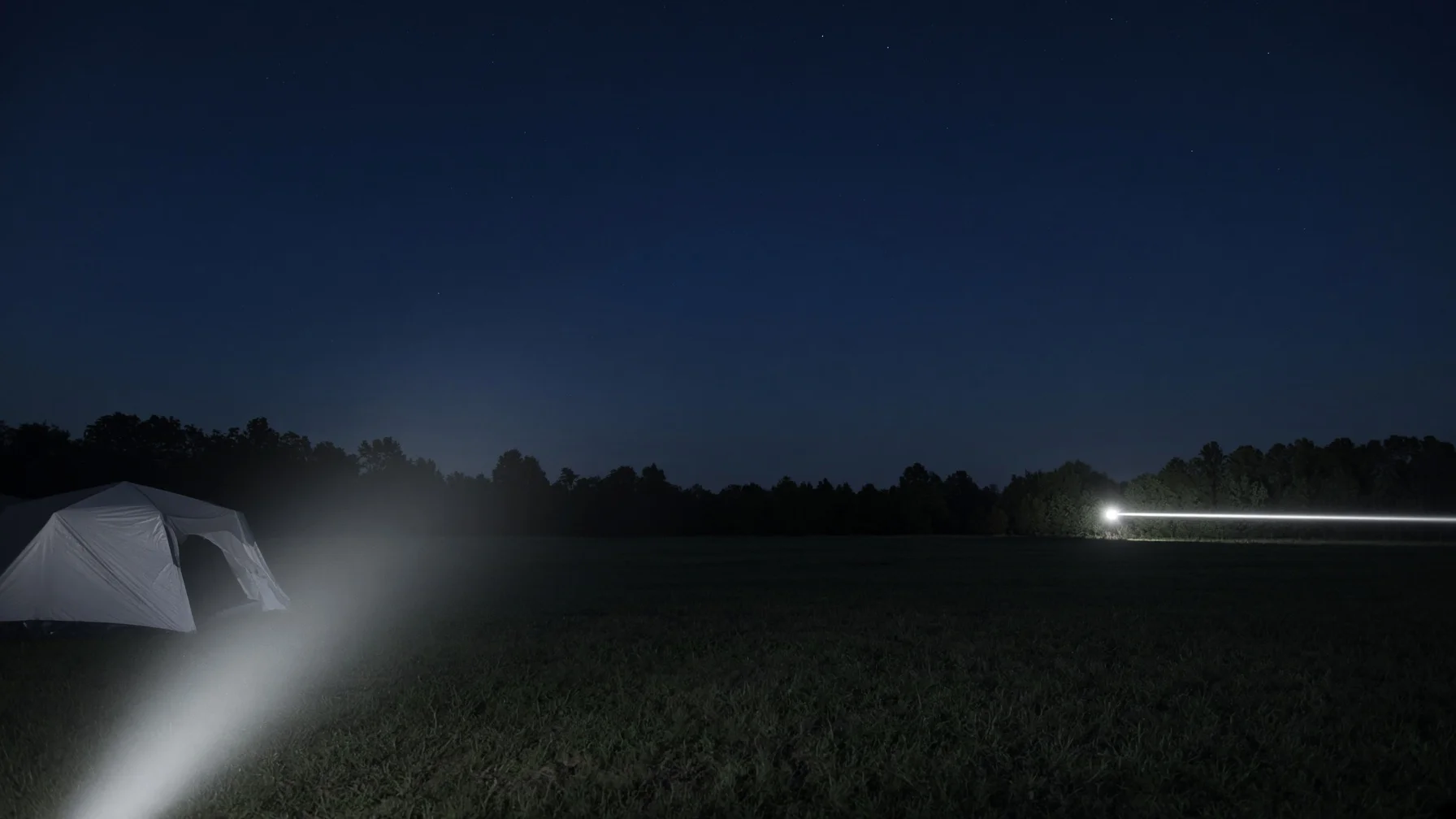
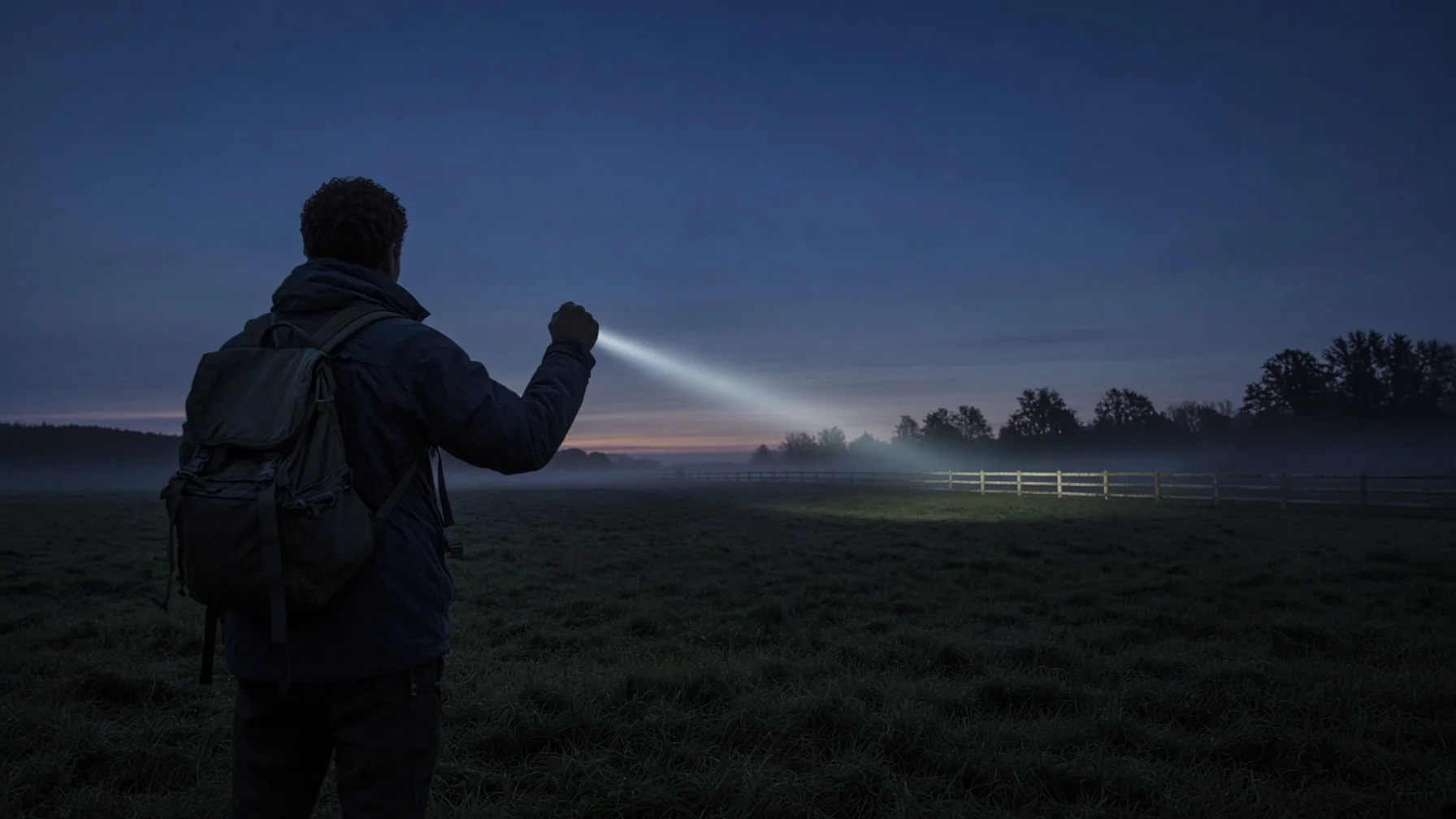
2,000 lumens is about 2.5 times the light of a 60-watt incandescent bulb and roughly 1.5 times the output of one H11 halogen headlight bulb. For a flashlight, what matters more is how that light is shaped. The four 2,000- to 3,000-lumen flashlights compared in this guide reach from 160 to 380 meters, depending on candela.
This table puts 2,000 lumens next to light sources with published lumen ratings.
| Light source | Rated output | 2,000 lumens compared |
|---|---|---|
| 60-watt incandescent bulb | About 800 lm | 2.5 times as much light |
| Philips Vision H11 halogen headlight bulb | 1,350 lm ±10% | About 1.5 times |
| Philips X-tremeVision Pro150 H7 halogen headlight bulb | 1,500 lm ±10% | About 1.3 times |
| Olight Baton 4 at turbo | 1,300 lm | About 1.5 times |
| Olight Seeker 4 Pro at turbo | 4,600 lm | Less than half |
| Olight Marauder Mini 2 floodlight | 10,000 lm | One-fifth |
Flashlight figures in this guide are maker ratings, checked on September 14, 2026.
📋 Table of Contents
- 1. What Is 2000 Lumens Equivalent To?
- 2. The Lumens Scale from 10 to 10,000
- 3. How Far Can 2000 Lumens Shine?
- 4. How Much Area Will 2000 Lumens Cover?
- 5. Is 2000 Lumens Too Bright for Indoor Use?
- 6. Why Does a 2000-Lumen Flashlight Get Dimmer After a Few Minutes?
- 7. How Many Lumens Is a Car Headlight?
- 8. How to Choose a 2000-Lumen Flashlight
- 9. FAQ
What Is 2000 Lumens Equivalent To?
In household terms, 2,000 lumens equals the output of about two and a half 60-watt incandescent bulbs, since the Federal Trade Commission puts a traditional 60-watt bulb at about 800 lumens. It is also a third to a half more than one halogen headlight bulb. Philips rates its Vision H11 headlight bulb at 1,350 lumens and its X-tremeVision Pro150 H7 bulb at 1,500 lumens.
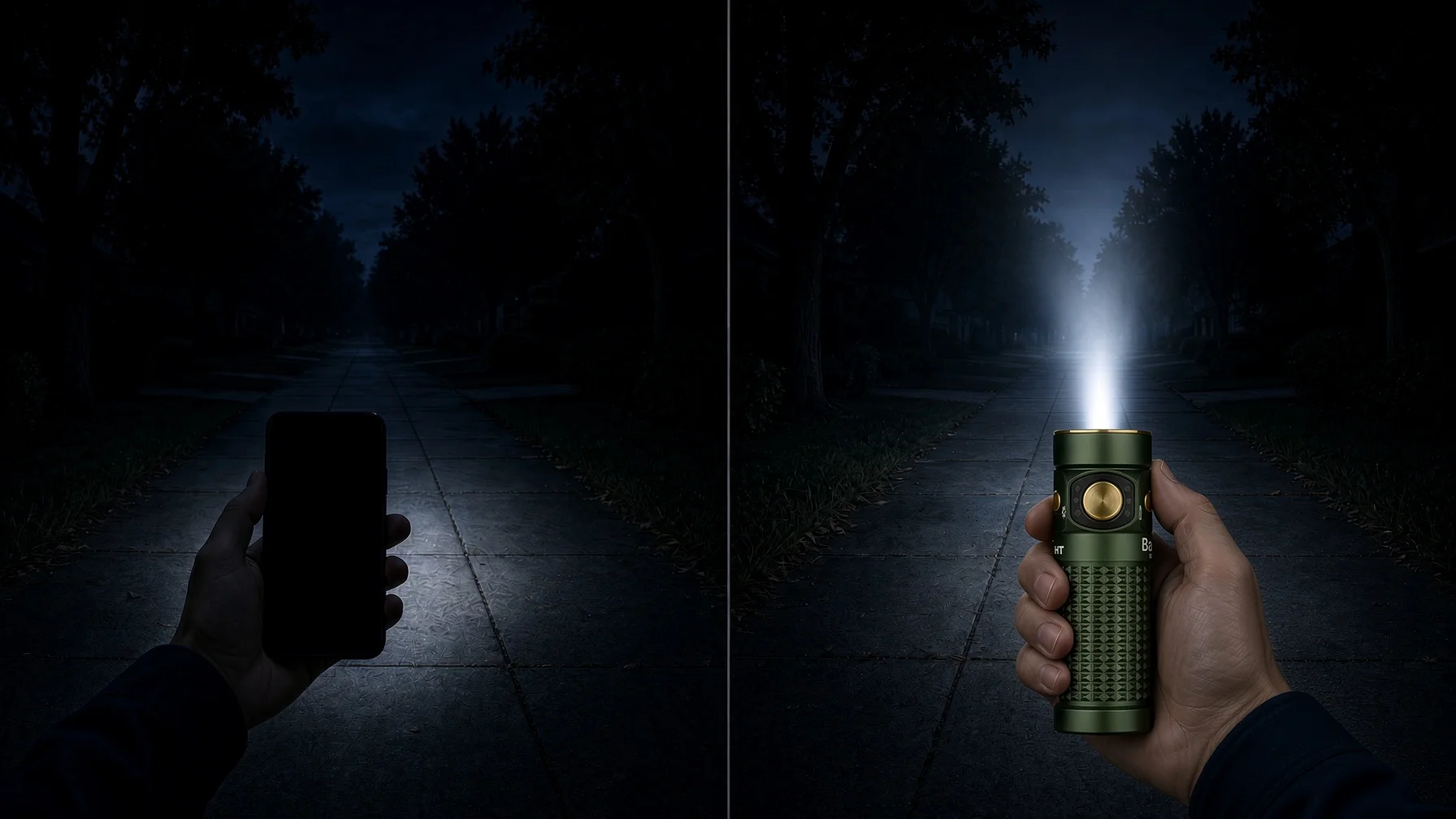
Those comparisons describe total light, which is all a lumen rating measures. A household bulb sends its 800 lumens out in nearly every direction, while a flashlight gathers its output into a beam with a reflector or lens. A 2,000-lumen flashlight pointed at a wall or a tree line therefore looks much brighter than a few household bulbs, because a similar amount of light lands on a far smaller area.
A lumen rating also says nothing about how long a light holds that output. Flashlight makers normally rate lumens to the ANSI/PLATO FL1 standard, which measures output between 30 seconds and 2 minutes after the light is switched on. The Olight lights in this guide rated at 2,000 lumens or more hold their maximum for 2 to 2.5 minutes, as the step-down section below shows. For more on how those ratings are produced, see how ANSI FL1 lumen ratings work.
The Lumens Scale from 10 to 10,000
A lumen figure is easier to picture next to a real light mode. The scale below pairs each step with a flashlight mode that Olight or Ledlenser rates at or near that output, plus a comparison with a 60-watt bulb. Going from 10 to 10,000 lumens is a thousandfold increase in total light, and most of the lights below spread their modes across a large part of that range.
This table lists each step, a rated mode that matches it, and the bulb comparison.
| Output | Example mode (maker rating) | Compared with a 60-watt bulb (about 800 lm) | Typical use |
|---|---|---|---|
| 10 lm | Olight Perun 3 Mini low mode, 30 hours | About 1/80 | Reading in a tent, finding things in a bag |
| 100 lm | Olight Baton 4 Pro medium mode, 120 lm, 18.5 hours | About 1/7 | Walking through a dark house |
| 500 lm | Olight Baton 4 Pro high mode, 600 lm | About three-quarters | Camp chores, checking a yard |
| 1,000 lm | Olight Seeker 4 Pro high mode, 1,200 lm | About 1.5 times | Lighting a driveway or trail |
| 2,000 lm | Ledlenser P7R boost mode, 2,000 lm | 2.5 times | Scanning a field or large yard |
| 5,000 lm | Olight Seeker 4 Pro turbo, 4,600 lm | Almost 6 times | Short bursts while searching |
| 10,000 lm | Olight Marauder Mini 2 floodlight, 10,000 lm | 12.5 times | Large open areas, brief use |
Low modes are where the long runtimes are. The Olight Perun 3 Mini (1,250 lumens, 6,000 candela, 155 m) runs 30 hours at 10 lumens but only 2 minutes at its maximum before stepping down. The highest outputs come from larger lights. The Olight Marauder Mini 2 (10,000 lumens, 140,000 candela, 750 m) uses a 465-gram body and a 7,500 mAh 32650 battery, and it holds its 10,000-lumen floodlight level for 2 minutes.
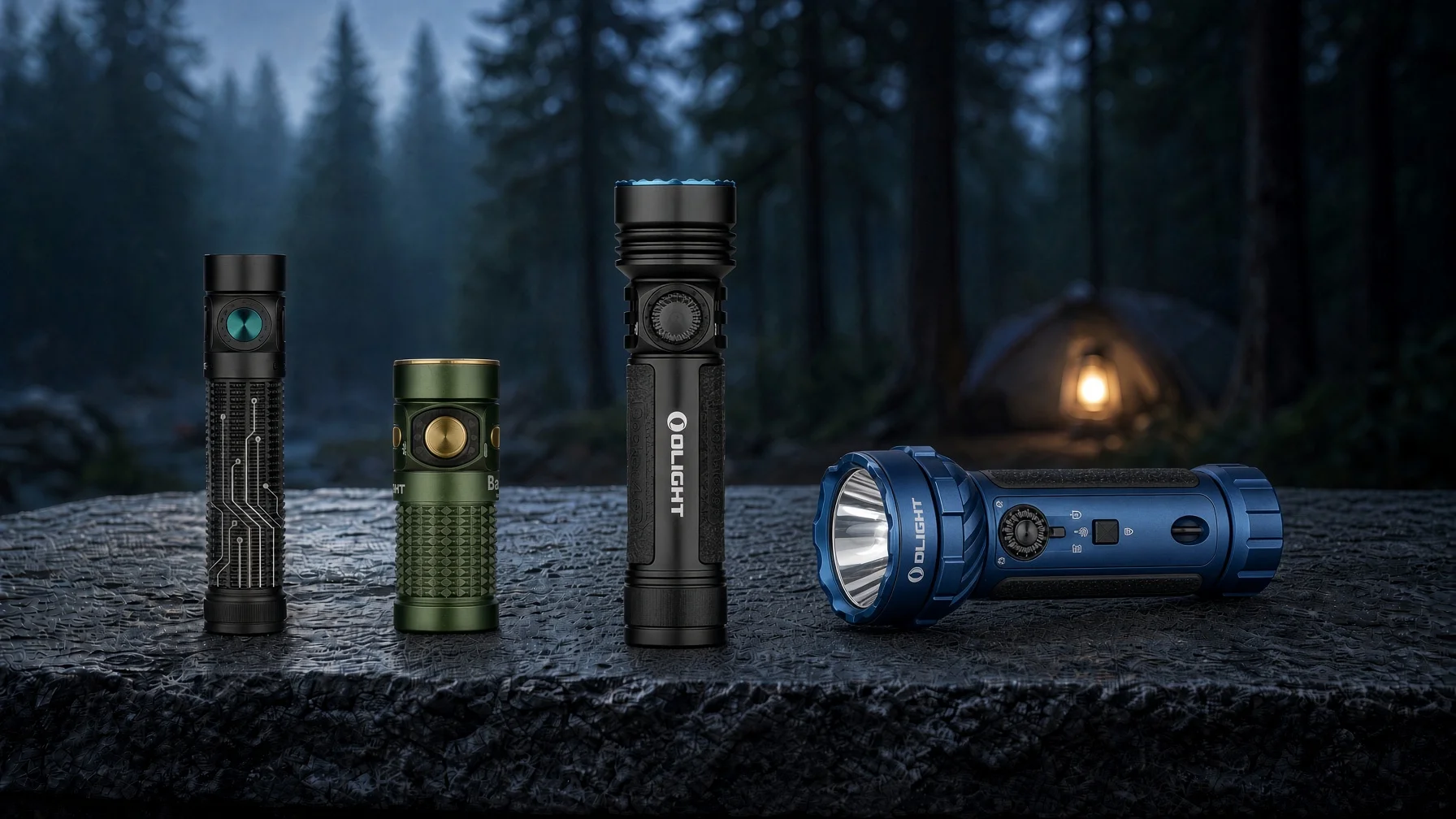
Middle modes trade output for runtime. The Olight Baton 4 Pro (1,600 lumens, 10,000 candela, 200 m, IPX8) runs 120 lumens for 18 hours 30 minutes, and the Olight Seeker 4 Pro (4,600 lumens, 16,895 candela, 260 m) runs 300 lumens for 11 hours. If you are deciding how much output your own tasks call for, our guide to how many lumens you need matches lumen ranges to activities.
How Far Can 2000 Lumens Shine?
A 2,000-lumen flashlight can reach anywhere from about 160 to 380 meters, and the lumen number alone won't tell you which. Reach depends on peak beam intensity, measured in candela. Among the lights compared here, rated beam distances run from 160 meters for the wide-beam Olight Perun 3 (3,000 lumens, 6,400 candela) to 380 meters for the focused Fenix PD36R PRO (2,800 lumens, 36,600 candela).
ANSI/PLATO FL1 defines beam distance as the distance at which the beam falls to 0.25 lux. That is close to the brightest moonlight. Researchers writing in Astronomy & Geophysics put the maximum illuminance from a full Moon at about 0.3 lux. Because light from a flashlight spreads out with distance, illuminance at the center of the beam equals candela divided by the distance squared. Setting that equal to 0.25 lux gives the rated beam distance: 2 times the square root of the candela figure.
This table compares four lights rated between 2,000 and 3,000 lumens. The last column shows how much of each light's output is concentrated into the center of the beam.
| Light | Max output | Peak intensity | Rated beam distance | Candela per lumen |
|---|---|---|---|---|
| Olight Perun 3 | 3,000 lm | 6,400 cd | 160 m | 2.1 |
| Olight Warrior 3S | 2,300 lm | 23,000 cd | 300 m | 10.0 |
| Olight Warrior Ultra | 2,500 lm | 26,000 cd | 320 m | 10.4 |
| Fenix PD36R PRO | 2,800 lm | 36,600 cd | 380 m | 13.1 |
The Olight Perun 3 (3,000 lumens, 6,400 candela, 160 m, IP68) puts out more lumens than the Olight Warrior 3S (2,300 lumens, 23,000 candela, 300 m, IPX8) yet reaches about half as far, because its optic spreads the light across a wide area. That suits a headlamp lighting a campsite or an engine bay. The Warrior 3S concentrates its output into a narrower beam, which is what you want for checking a fence line or a trail far ahead. The Olight Warrior Ultra (2,500 lumens, 26,000 candela, 320 m, IPX8) adds 200 lumens and 20 meters of rated reach over the Warrior 3S.
Beam distance is also only the end point of the beam. The same formula shows how quickly light falls off along the way. This table gives the calculated illuminance at the center of each beam, assuming clear air.
| Distance | Olight Perun 3 (6,400 cd) | Olight Warrior 3S (23,000 cd) | Fenix PD36R PRO (36,600 cd) |
|---|---|---|---|
| 10 m | 64 lux | 230 lux | 366 lux |
| 50 m | 2.6 lux | 9.2 lux | 14.6 lux |
| 100 m | 0.64 lux | 2.3 lux | 3.7 lux |
| 160 m | 0.25 lux | 0.90 lux | 1.4 lux |
| 300 m | 0.07 lux | 0.26 lux | 0.41 lux |
At 50 meters, the Warrior 3S puts more than three times as much light on its target as the Perun 3, even though the Perun 3 is rated for 700 more lumens. Doubling the distance cuts the light to one quarter, so a light that looks strong across a yard can look dim at the far end of a field.
How Much Area Will 2000 Lumens Cover?
Spread perfectly evenly, 2,000 lumens lights 2,000 square meters to 1 lux, 200 square meters to 10 lux, or about 67 square feet to 30 foot-candles, the minimum OSHA's construction standard sets for offices. Real flashlight beams are never that even, so treat these figures as upper limits. The center of the beam gets far more light and the edges far less.
Illuminance in lux is lumens divided by area in square meters, and illuminance in foot-candles is lumens divided by area in square feet. NIST lists one foot-candle as 10.76 lux. So the area a light can cover at a given brightness is its lumen output divided by the target light level.
This table shows how much area 2,000 lumens could light at several reference levels, including minimums from OSHA's construction standard, assuming every lumen lands evenly on the surface.
| Target light level | Where that level comes from | Area 2,000 lm could cover evenly |
|---|---|---|
| 0.25 lux | ANSI FL1 beam-distance threshold | 8,000 m² (about 2 acres) |
| 1 lux | Round reference value | 2,000 m² (about half an acre) |
| 3 foot-candles (32 lux) | OSHA construction-standard minimum for excavation and waste areas, access ways and loading platforms | About 62 m² (670 ft²) |
| 5 foot-candles (54 lux) | OSHA construction-standard minimum for indoor warehouses, corridors and hallways | About 37 m² (400 ft²) |
| 30 foot-candles (323 lux) | OSHA construction-standard minimum for first aid stations, infirmaries and offices | About 6.2 m² (67 ft²) |
A 12-by-12-foot bedroom has 144 square feet of floor, so 2,000 lumens spread evenly across it would give about 14 foot-candles, or roughly 150 lux. For scale, that is above the 5-foot-candle minimum OSHA's construction standard sets for hallways and below its 30-foot-candle minimum for offices.
Actual beams fall short because some light misses the surface and a focused beam piles most of its output into a small circle. A wide-beam light like the Perun 3 comes closer to the even-spread figures than a focused light like the Warrior 3S. If you need to light a work area evenly, a floodlight mode or a headlamp gets you nearer to these numbers than a narrow spot beam.
Is 2000 Lumens Too Bright for Indoor Use?
For lighting a room, 2,000 lumens is not excessive; it is about two and a half 60-watt bulbs' worth of light. The issue indoors is concentration. The Olight Warrior 3S puts about 5,750 lux on a wall 2 meters away at maximum, nearly 18 times the 30 foot-candles that OSHA's construction standard sets as a minimum for offices. Bounce the beam off a ceiling or switch to a lower mode.
Glare is the practical reason to step down indoors, and eye safety is the more serious one. Olight's user manual for its Odin S rail-mounted light warns: "Do not look directly at the light source or shine to eyes, because it may cause temporary blindness or permanent damage to the eyes." Keep the beam out of people's eyes on any setting.
This table uses rated candela and the far-field inverse-square estimate to show how much light each flashlight puts on a surface 2 meters away at maximum, alongside a lower mode that suits indoor use.
| Light | Max output | Center of beam at 2 m on max (calculated) | Lower mode for indoor use | Runtime at that mode |
|---|---|---|---|---|
| Olight Warrior 3S | 2,300 lm | About 5,750 lux | 200 lm | 13 hours |
| Olight Seeker 4 Pro | 4,600 lm | About 4,220 lux | 300 lm | 11 hours |
| Olight Baton 4 | 1,300 lm | About 1,810 lux | 60 lm | 8 hours |
| Olight Perun 3 | 3,000 lm | About 1,600 lux | 120 lm | 25 hours |
Lumens alone are a poor guide indoors. The Olight Seeker 4 Pro has twice the lumen rating of the Warrior 3S, yet it puts less light on a nearby wall because its beam is wider. The Olight Baton 4 (1,300 lumens, 7,225 candela, 170 m, IPX8) and the Perun 3 are easier to use around the house for the same reason. The Baton 4 Pro is another option, with a 120-lumen mode rated at 18 hours 30 minutes. The Warrior 3S also has a proximity sensor that lowers output when the head is close to an object on high, turbo or strobe.
For a power outage, a medium mode aimed at a light-colored ceiling spreads the light around the room. The Seeker 4 Pro's 300-lumen mode, for example, runs for 11 hours, and its neutral-white version has a warmer tint (4,000 K to 5,000 K) than the standard cool white.
Why Does a 2000-Lumen Flashlight Get Dimmer After a Few Minutes?
A 2,000-lumen flashlight dims after a few minutes because it is designed to step down and control heat. The Olight lights in this guide hold maximum output for 1.5 to 2.5 minutes. A report published by Pacific Northwest National Laboratory for the U.S. Department of Energy explains that without enough heat sinking, LED temperature rises and light output drops, and continuous high-temperature operation causes permanent loss of output.
A flashlight has little room for a heat sink, so makers use an automatic step-down. The same report notes that the effects of short-term exposure to high temperatures can be reversed, which fits the way flashlights are built: a short burst at maximum, then a lower level the light can sustain.
Olight publishes each stage of the step-down for its lights. This table shows how long each one holds maximum output and what it drops to.
| Light | Max output | Time at max | Next level and how long |
|---|---|---|---|
| Olight Baton 4 | 1,300 lm | 1.5 min | 600 lm for 2.5 min, then 300 lm for 73 min |
| Olight Warrior 3S | 2,300 lm | 2.5 min | 805 lm for 160 min |
| Olight Perun 3 | 3,000 lm | 2 min | 800 lm for 180 min |
| Olight Seeker 4 Pro | 4,600 lm | 2.5 min | 1,200 lm for 122 min |
| Olight Marauder Mini 2 (floodlight) | 10,000 lm | 2 min | 2,500 lm for 90 min |
On a two-hour walk, the Warrior 3S spends most of its time at about 805 lumens, roughly a 60-watt bulb's worth of light pushed into a focused beam. The Seeker 4 Pro follows the same pattern with more headroom: 4,600 lumens for 2.5 minutes, 1,200 lumens for 122 minutes, then 600 lumens for 35 minutes. When you compare high-output lights, look at that second level and how long it lasts. ANSI FL1 runtime counts until output falls to 10% of the initial reading, so a long rated runtime can include long stretches well below the headline figure.
How Many Lumens Is a Car Headlight?
A halogen car headlight bulb in the H11 or H7 size is rated at about 1,350 to 1,500 lumens, based on Philips' published ratings. Philips rates its Vision H11 bulb, sold for low- and high-beam use, at 1,350 lumens and its X-tremeVision Pro150 H7 bulb at 1,500 lumens, each per bulb at 12 volts and 55 watts. A 2,000-lumen flashlight puts out about 1.3 to 1.5 times the light of one of these bulbs.
This table sets two halogen headlight bulbs next to flashlights near the same output.
| Light | Rated output | Power or battery |
|---|---|---|
| Philips Vision H11 | 1,350 lm ±10% | 55 W, 12 V |
| Philips X-tremeVision Pro150 H7 | 1,500 lm ±10% | 55 W, 12 V |
| Olight Baton 4 | 1,300 lm | 16340, 650 mAh |
| Olight Baton 4 Pro | 1,600 lm | 18650, 3,500 mAh |
| Olight Warrior 3S | 2,300 lm | 21700, 5,000 mAh |
A pocket-size Baton 4 is rated within about 4% of an H11 bulb at its maximum, though the bulb draws 55 watts from the car's electrical system for as long as it is switched on, while the Baton 4 holds 1,300 lumens for 1.5 minutes. A bulb's rating covers the bare bulb; the headlight's reflector or projector then shapes that light into a beam pattern on the road. These figures cover two halogen bulb types; other types are rated differently, and LED headlamps vary by vehicle and are not compared here.
How to Choose a 2000-Lumen Flashlight
Choose a 2,000-lumen flashlight by the job the beam has to do. For distance, look for 20,000 candela or more, which works out to about 280 meters of rated reach. For lighting an area around you, a wide beam with lower candela works better. Then check how bright the light stays after it steps down and how long its medium mode runs.
This table turns those checks into specific numbers, with examples from the lights in this guide.
| Check | What to look for | Example (maker rating) |
|---|---|---|
| Reach | 20,000 cd or more for about 280 m | Olight Warrior 3S: 23,000 cd, 300 m |
| Area lighting | A wide beam with lower candela | Olight Perun 3: 3,000 lm, 6,400 cd |
| Sustained output | The level after the first step-down | Olight Seeker 4 Pro: 1,200 lm for 122 min |
| Everyday runtime | A medium mode that lasts 10 hours or more | Olight Perun 3: 120 lm for 25 hours |
| Indoor use | A mode of about 200 lm or less | Olight Baton 4: 60 lm (medium) for 8 hours |
The highest outputs need bigger batteries. The Warrior 3S (176 grams) and Perun 3 (150 grams) each run on a 5,000 mAh 21700 battery, while the 10,000-lumen Marauder Mini 2 weighs 465 grams and uses a 7,500 mAh 32650 battery. If you want a smaller light and can accept less output, the Baton 4 weighs 52.5 grams. To compare more options side by side, see our roundup of the best flashlights of 2026 or browse all flashlights.
FAQ
Changelog
- September 2026: First published. Lumen, candela and runtime figures checked against maker ratings on September 14, 2026.