⚡ TL;DR
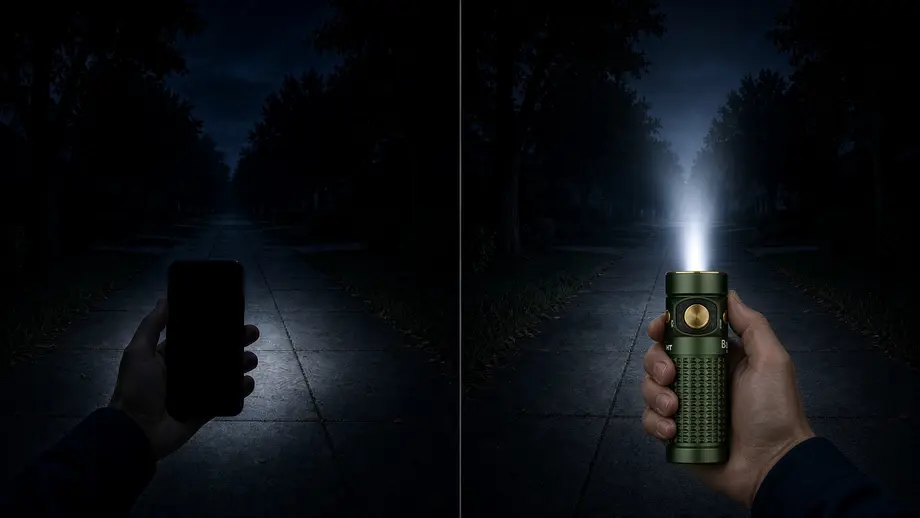
A phone flashlight is fine for finding keys, reading a menu or checking under a car seat. It falls short when you need light for hours, at a distance or with both hands free. iPhone and Galaxy flashlights are reported at roughly 30 to 60 lumens, and every minute of light drains the battery you need for calls.
The table below shows where a phone light is enough and where a dedicated light does the job better.
| Situation | Phone flashlight | Dedicated flashlight |
|---|---|---|
| Finding keys, reading a menu | Works well | More light than you need |
| Walking outside after dark | Diffuse light with no rated beam distance | Olight Baton 4: 1,300 lumens, 170 m rated beam |
| Power outage lasting hours | Uses the battery you need for calls | Olight i3E EOS: 90 lumens on one AAA battery |
| Repairs that need both hands | Needs a stand or someone to hold the phone | Olight Perun 3 Mini: 1,250 lumens, headband included |
| Rain or snow | Water resistance can decrease with normal wear | Lights rated IPX8, such as the Baton 4 |
| Aiming light into an engine bay or over a ledge | A slip can mean a phone repair bill | Olight Oclip Pro S: 600 lumens, clips on so the phone stays in your pocket |
📋 Table of Contents
- 1. Where Is the Flashlight on My Phone?
- 2. How Many Lumens Is a Phone Flashlight?
- 3. What Is a Phone Flashlight Good For?
- 4. 8 Jobs a Real Flashlight Does Better
- 5. What Happens If You Rely on a Phone Flashlight During a Power Outage?
- 6. Can a Phone Flashlight Replace a Real Flashlight?
- 7. When Should You Carry a Real Flashlight?
- 8. FAQ
Where Is the Flashlight on My Phone?
On an iPhone, the flashlight button is in Control Center and may also appear on the Lock Screen, or you can ask Siri to turn it on. On a Samsung Galaxy phone, tap the Flashlight icon in the Quick settings panel, which opens when you swipe down from the top right of the screen.
On an iPhone
Apple's iPhone User Guide (iOS 26 and iOS 18) gives these options:
- Open Control Center and tap the flashlight button. Tap it again to turn the light off. If you don't see the button, add it by customizing Control Center.
- If your Lock Screen shows a flashlight button, press it to turn the light on or off.
- Ask Siri something like "Siri, turn on the flashlight."
- If your iPhone has an Action button, set it to turn the flashlight on or off.
- To change brightness, turn the flashlight on, then drag up or down on the flashlight image that appears on the screen.
On a Samsung Galaxy Phone
Samsung's support page for Galaxy phones gives these steps:
- Swipe down from the top right of the screen to open the Quick settings panel. You may need to swipe left to find the Flashlight icon.
- Tap the Flashlight icon to turn the light on, and tap it again to turn it off.
- To change brightness, tap and hold the Flashlight icon, turn on the switch, then drag the slider.
On a rugged Galaxy XCover6 Pro, you can also program the XCover key or Top key to turn the flashlight on instantly. Menus shift between software versions, so if the icon has moved, search your phone's settings for "flashlight."
How Many Lumens Is a Phone Flashlight?
iPhone and Samsung Galaxy flashlights put out roughly 30 to 60 lumens, according to figures headlamp maker Petzl says came from Apple and Samsung support teams: about 30 lumens for the iPhone 17 Pro, around 40 for the iPhone 17, and 40 to 60 for Galaxy S-series phones. Neither company lists flashlight output in its published product specs.
This table sets those reported phone figures next to the maker ratings of two small Olight flashlights.
| Light | Output | Rated beam distance | Power source |
|---|---|---|---|
| iPhone 17 Pro | About 30 lumens (reported) | Not rated | Phone battery |
| iPhone 17 and iPhone Air | Around 40 lumens (reported) | Not rated | Phone battery |
| iPhone 16 | 30–40 lumens (reported) | Not rated | Phone battery |
| Samsung Galaxy S series | 40–60 lumens (reported) | Not rated | Phone battery |
| Samsung Galaxy A series | 40–50 lumens (reported) | Not rated | Phone battery |
| Olight i3E EOS | 90 lumens | 44 m | One AAA battery |
| Olight Baton 4 | 1,300 lumens | 170 m | Rechargeable 16340 battery |
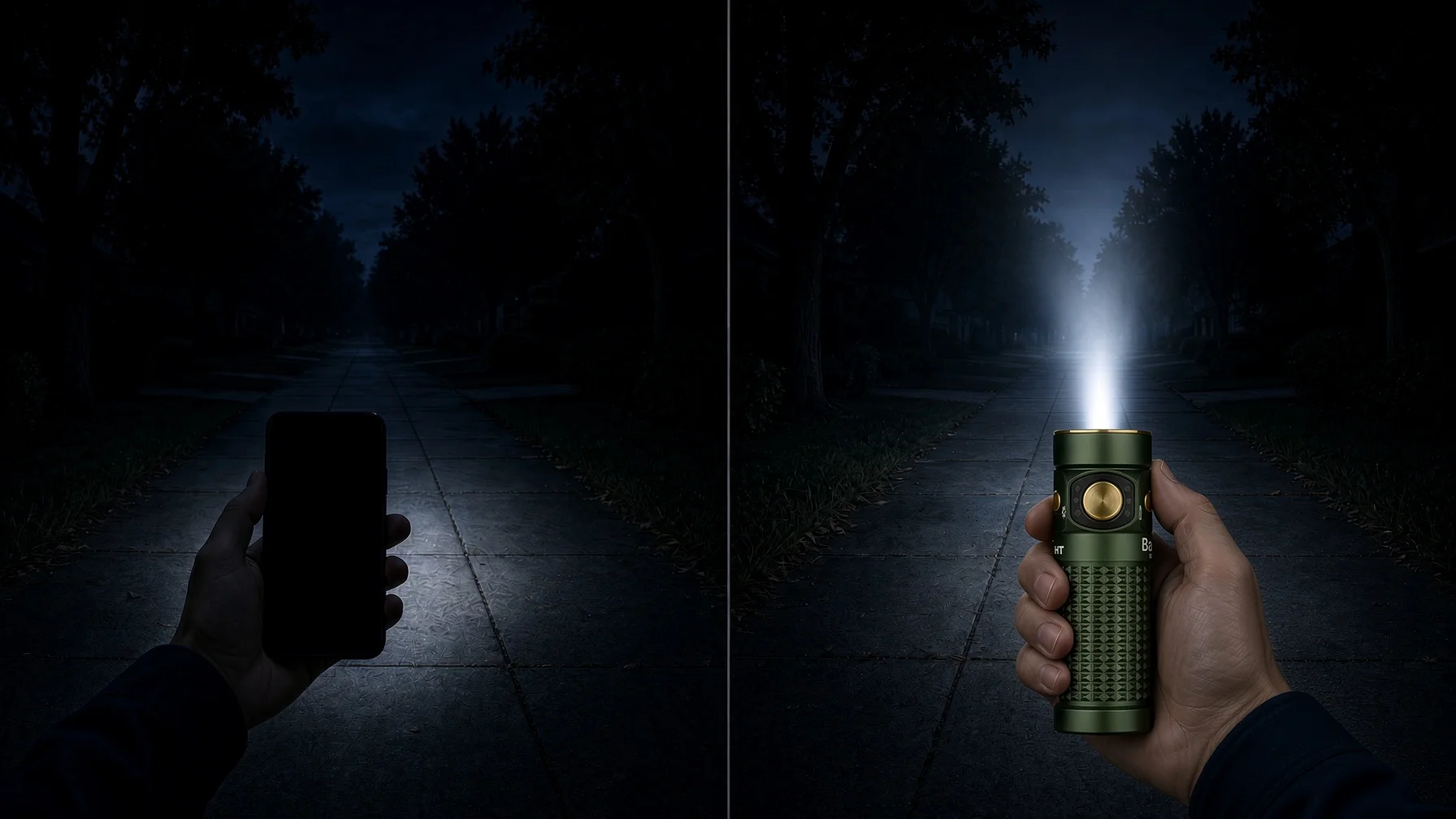
The phone figures are not ANSI FL1 ratings, so treat them as ballpark numbers. The bigger difference is the beam. Petzl describes a phone's light as unfocused and dispersed, a weak glow that barely extends a few feet ahead. A flashlight concentrates its output with optics, such as the TIR lens in the Baton 4.
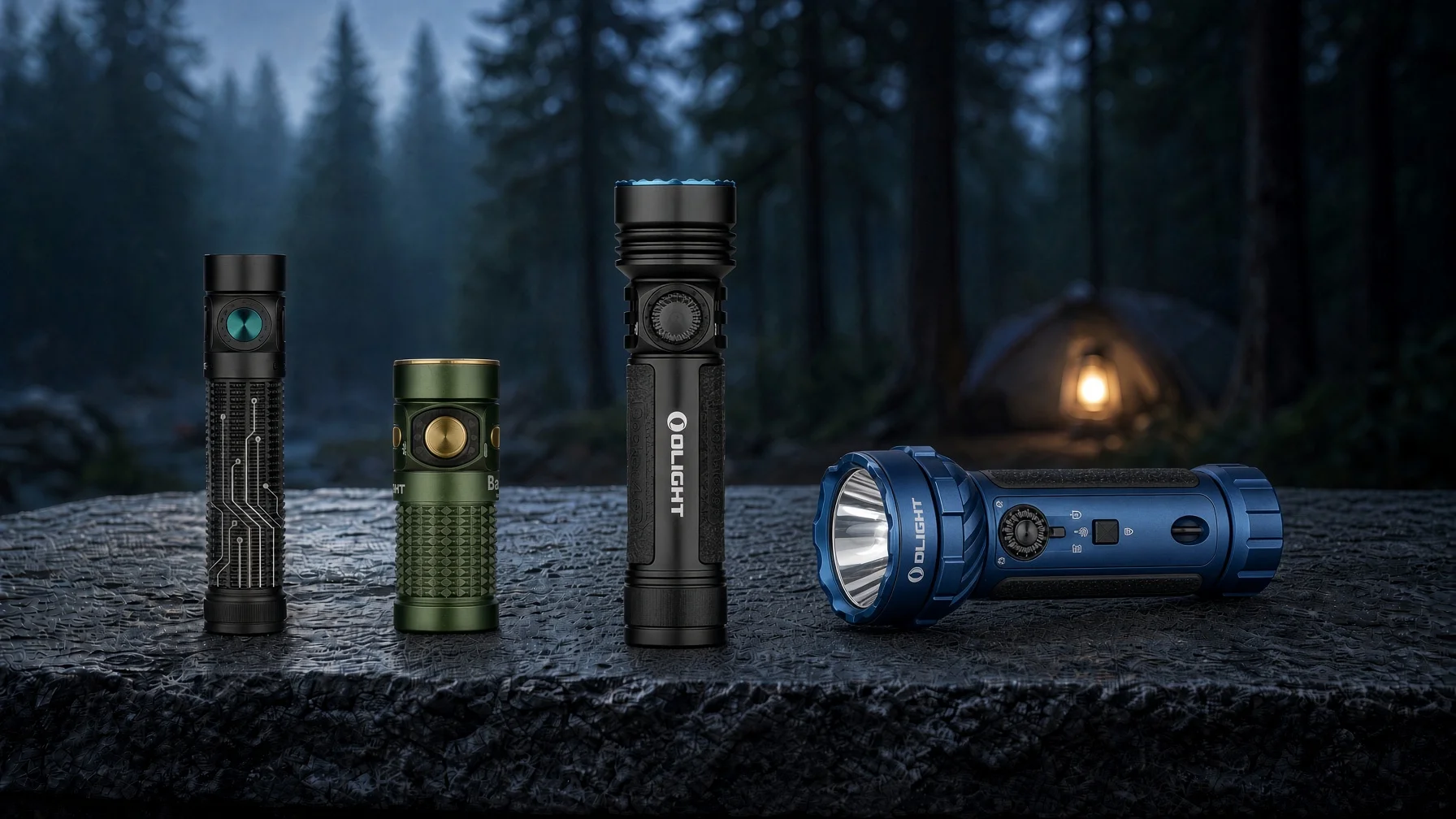
The Olight i3E EOS (90 lumens, 44 m, IPX8) costs $12.99, runs on a single AAA battery and turns on with a twist of the head. The Olight Baton 4 (1,300 lumens, 7,225 candela, 170 m, IPX8) is 63 mm long and weighs 52.5 grams. To see how much light different tasks need, read our flashlight lumens guide.
What Is a Phone Flashlight Good For?
A phone flashlight is good for close, short tasks where any light beats none: finding keys in a bag, reading a label or a restaurant menu, or checking a dark closet for a few seconds. It is always in your pocket, costs nothing extra and adjusts in brightness, so for these jobs a dedicated light adds little.
Its wide, unfocused spread even helps up close, because it lights a whole shelf or the floor around your feet without a bright hotspot. Once a task takes longer, reaches farther or gets wet, the gaps below start to matter.
8 Jobs a Real Flashlight Does Better
A phone flashlight lights what is right in front of you, and that is close to its limit. It has no rated reach, no power source of its own and no way to mount on your head or clothing without an accessory. Its built-in controls offer no strobe, red or UV mode, and every drop or soaking puts the phone itself at risk.
1. Reach Beyond a Few Feet
Apple and Samsung publish no beam distance for their phone lights. Flashlight makers rate beam distance under the ANSI/PLATO FL1 standard as the point where the beam falls to 0.25 lux, and that distance depends on peak intensity in candela rather than total lumens. The Olight Baton 4 is rated at 7,225 candela and 170 meters, and Olight says even the tiny i3E EOS reaches 44 meters.
2. Run for Days Without Draining Your Phone
A phone light draws on the same battery that runs your calls, maps and emergency alerts. A flashlight carries its own power. The Baton 4 runs 35 hours on its 12-lumen low mode and 30 days on moon mode, and the i3E EOS keeps going as long as you have spare AAA batteries.
Ready.gov's basic disaster kit lists a flashlight and extra batteries separately from a cell phone with chargers and a backup battery. With its own light, your household doesn't have to spend phone power to see.
3. Free Up Your Hands
The Olight Perun 3 Mini (1,250 lumens, 155 m, IPX8) weighs 54 grams and comes with a headband and headlamp base, so the beam follows your eyes. Olight also lists magnetic mounting, so you can stick it to a steel surface when you work on a car. Olight listed the Perun 3 Mini as sold out at its US store on September 15, 2026, so check stock or use the Oclip Pro S below.
The Olight Oclip Pro S (600 lumens, 80 m, IPX6) weighs 53 grams, and it clips to a pocket or strap or holds on with its magnet, so the light stays where you put it.
4. Strobe at Full Output
The flashlight controls described in Apple's and Samsung's support guides turn the light on and off and change its brightness. Neither guide lists a strobe mode. The Baton 4 strobes at 13 Hz at its full 1,300 lumens, and the Oclip Pro S strobes at 13 Hz at 600 lumens, which helps when you need to be seen by a passing car or flag down help.
5. Switch to Red Light
The National Park Service explains that a few seconds of bright light breaks down rhodopsin, the light-sensitive pigment behind night vision, and that night vision takes 20 to 40 minutes to build back up. Deep red light doesn't trigger that breakdown, which is why astronomers and safety officials use red lights at night.
A phone flashlight only makes white light. The Perun 3 Mini has a red mode that runs 150 minutes at 45 lumens or 19 hours at 5 lumens, and the Oclip Pro S has a 40-lumen red mode that runs 3.5 hours.
6. Show Stains and Marks Under UV Light
Phone flashlights are white LEDs, and the built-in flashlight controls on iPhone and Galaxy phones include no UV mode. Checking for fluorescent marks takes a dedicated ultraviolet emitter.
The Olight ArkPro (1,500 lumens, 205 m, IPX7) includes a 365 nm UV light that Olight lists for spotting stains, verifying documents and detecting oil leaks, and the Oclip Pro S has a 365–370 nm UV mode for fluorescence checks. Don't look into a UV emitter or shine it at anyone's eyes. The ArkPro also has a green laser: never aim it at people's or animals' eyes or at aircraft.
7. Get Wet Without Risking Your Phone
Recent iPhones are water resistant. Apple rates the iPhone 16 and iPhone 17 models at IP68 to a maximum depth of 6 meters for up to 30 minutes. Apple also notes that this resistance is not permanent and can decrease with normal wear, and that liquid damage is not covered under warranty. The Baton 4 and i3E EOS are both rated IPX8, so the flashlight can do the wet work while your phone stays in a dry pocket.
8. Keep Your Phone Out of a Fall
Under the ANSI/PLATO FL1 standard, a flashlight passes its impact resistance test only if it is dropped onto a solid surface from the rated height and comes away with no cracks or breaks, still fully working. Where a maker has run that test, the drop height appears on the spec sheet. If no rating is listed, don't assume the light has one.
A separate light also keeps your phone out of the risky spot. A phone that slips while you aim it into an engine bay or over a deck railing can mean a repair bill, while a clip light like the Oclip Pro S lights the job and the phone stays in your pocket.
What Happens If You Rely on a Phone Flashlight During a Power Outage?
You spend the phone battery you need for weather alerts, calls and updates, and a long outage can outlast it. Federal preparedness guidance lists flashlights as their own supply. Ready.gov says to have flashlights for every household member, and the CDC recommends battery-powered flashlights and lanterns rather than candles, gas lanterns or torches to reduce fire risk.
This table collects the official outage guidance that applies to lighting and phones.
| Guidance | Source | What it means for your phone |
|---|---|---|
| Have flashlights for every household member | Ready.gov | One phone light doesn't cover a household |
| Keep a flashlight and extra batteries in a basic kit | Ready.gov | Spare batteries keep light going without a charger |
| Keep a cell phone with chargers and a backup battery | Ready.gov | Save phone power for communication |
| Use battery-powered flashlights and lanterns rather than candles | CDC | A flashlight is the safer light source |
A light that stays in its charging holster is fully charged when an outage begins. The Olight Seeker 4 Pro (4,600 lumens, 260 m, IPX8) charges in its wall-mountable holster and runs 60 hours at 50 lumens or 15 days on moon mode. For a full household setup, see our guide to emergency flashlights for home power outages.
Can a Phone Flashlight Replace a Real Flashlight?
For quick, close-range tasks, a phone flashlight is enough. For anything that lasts more than a few minutes, happens outdoors or needs both hands, it is a poor substitute. A phone light has no rated beam distance, no red or UV mode and no battery of its own, and using it spends the power you may need to call for help.
Carrying a real light takes little effort. An i3E EOS on a key ring weighs 19.4 grams, and a Baton 4 is 63 mm long and weighs 52.5 grams, so either can ride along every day. To compare sizes and outputs, browse the full range of flashlights or see our best flashlights of 2026 by use case.
When Should You Carry a Real Flashlight?
Carry a dedicated flashlight whenever you might need light for longer than a few minutes, farther than a few feet or with your hands busy. Five everyday situations meet that test: power outages, walking after dark, roadside breakdowns, camping and hiking, and repairs in attics, crawlspaces or under sinks.
The table below matches each situation to the feature that matters.
| Situation | Why a phone falls short | What to carry | Olight example |
|---|---|---|---|
| Power outage | The phone battery is needed for alerts and calls | A light with long low-mode runtime | Seeker 4 Pro: 50 lumens for 60 hours |
| Dog walks or the walk home | No rated beam distance | A pocket light with a rated beam distance | Baton 4: 170 m |
| Roadside breakdown | You need both hands and a way to be seen | A clip light with a strobe | Oclip Pro S: clip-on, 13 Hz strobe |
| Camping and hiking | Hours of use, and night vision matters | A headlamp with a red mode | Perun 3 Mini: red light, 19 hours at 5 lumens |
| Attic, crawlspace or under-sink repairs | Tight spaces with little room to hold a light | A headlamp or clip light | Perun 3 Mini or Oclip Pro S |
Pick the power source to match how you store the light. A light that sits in a drawer or glovebox for months suits AA or AAA batteries you can swap, like the i3E EOS. A light you carry daily suits a rechargeable cell: the Baton 4 Premium edition's charging case can fully recharge the light five times. The Seeker 4 Pro stays topped up in its charging holster.
FAQ
Changelog
- September 2026: First published.