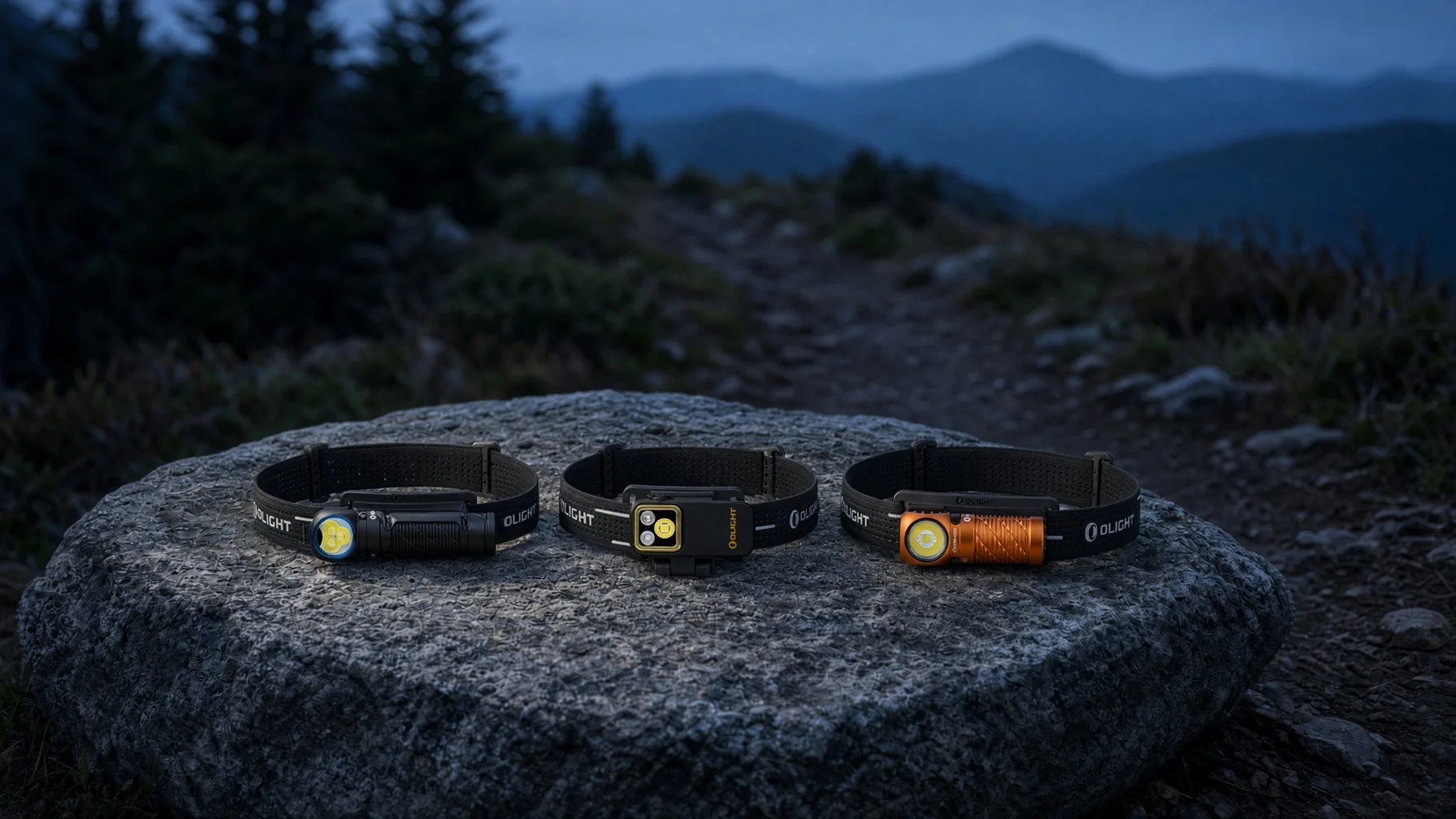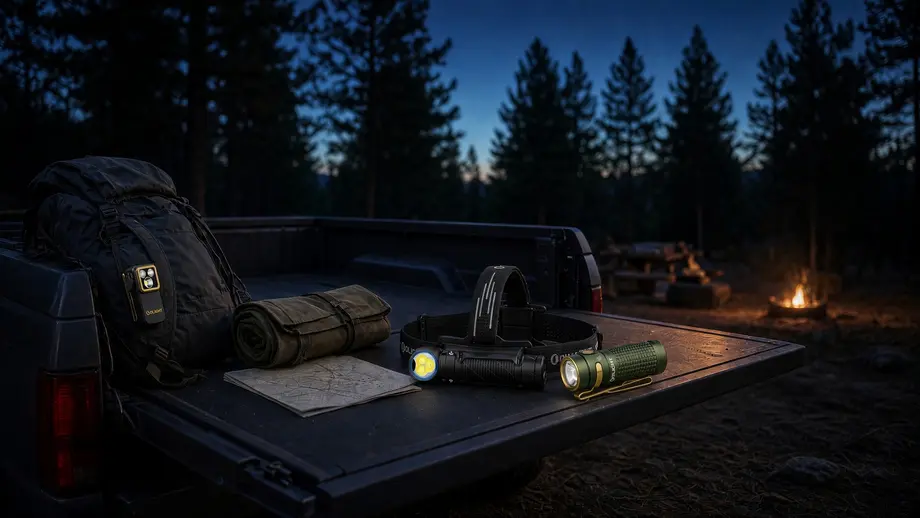
Olight publishes this guide. Specs and prices come from Olight's official product pages, checked on September 15, 2026.
⚡ TL;DR
No single design wins every hands-free job. A headlamp is best when the light has to turn with your head, a right angle flashlight is best when you want to clip or stick the light in place and still have the option of a headband, and a handheld is best for reach, precise aiming and walking in fog.
The table below matches common situations to the design that handles them best.
| Situation | Best design | Why |
|---|---|---|
| Cooking at camp, reading, pitching a tent | Headlamp | The beam lands wherever you look |
| Working under a sink or an engine hood | Right angle or clip-on light | Clip it or stick it to steel, then aim the beam at the work |
| Scanning a yard or a trail far ahead | Handheld | You can point it exactly where you need to see |
| Fog, rain or falling snow | Handheld | You can lower the beam instead of shining it from eye level |
| Talking with people around you | Right angle, clip-on or handheld | The beam doesn't swing across faces when you turn your head |
📋 Table of Contents
- 1. Is a Headlamp Better Than a Flashlight?
- 2. What Is a Right Angle Flashlight Used For?
- 3. How Do Headlamps, Right Angle Lights and Handhelds Differ?
- 4. How Can You Wear or Mount a Light Hands-Free?
- 5. Can You Clip a Headlamp to a Hat?
- 6. Is a Headlamp Good for Reading?
- 7. How Much Do Weight and Size Matter for Hands-Free Use?
- 8. Which Two-Light Setups Make Sense?
- 9. FAQ
Is a Headlamp Better Than a Flashlight?
A headlamp is better than a flashlight when you need both hands and light wherever you look, such as cooking at camp, reading a map or changing a tire at night. A flashlight is better when you need to aim a beam precisely, reach far down a trail, keep glare down in fog or avoid shining light into other people's faces.
The difference comes down to where the light sits. A headlamp moves with your head, so the brightest part of the beam lands on whatever you are looking at. The trade-off is that the light can only point where your head turns, and it sits just above your eyes.
That position works against you in fog, heavy rain or falling snow. The National Weather Service tells drivers never to use high beams in fog because "Using high beam lights causes glare, making it more difficult for you to see what's ahead of you on the road." A bright headlamp aimed straight ahead from your forehead runs into the same kind of glare. With a handheld, you can hold the light near waist height and aim it low, which keeps the light source well below your line of sight. A headlamp can tilt down, but the beam still starts just above your eyes.
A headlamp also points at whoever you look at. Around a campsite or a job site, that means shining light into the face of the person you are talking to unless you switch to a low or red mode first. Bright light has a cost for night vision, too. The National Park Service explains that "It only takes a few seconds of bright light to cause the rhodopsin to decay into two parts with a photosensitive reaction, and the rods stop working," and adds that "a dim red light is best for maximizing after-dark eye behavior."
The Olight Perun 3 (3,000 lumens, 6,400 candela, 160 m, IP68) shows how one light can cover both roles. Its red light runs 14 hours at 60 lumens or 70 hours at 15 lumens, so you can drop to the dimmer red setting around camp and keep white light out of people's eyes, then take it off and use it as a handheld when you need to aim.
What Is a Right Angle Flashlight Used For?
A right angle flashlight is used for hands-free work and for carrying light on your body. Its head sits at 90 degrees to the body, so the body can clip to a pocket, strap or belt, or stick to steel, while the beam points forward instead of up at the sky. Some right-angle lights, including Olight's Perun series, also fit a headband, which lets one light work as a headlamp, a work light and a handheld.
A straight flashlight clipped to a shirt pocket points straight up or straight down, and a headlamp can only point where you look. A right angle light can sit on a pack strap and light the trail ahead, cling to a steel panel under the hood while you work with both hands, or go back in your hand when you need to search. For a closer look at the design itself, read why we recommend a right angle flashlight.
Olight lists a headband, magnetic tail, clip and lanyard for the Perun 3, so it can be worn on your head, attached to an iron or steel surface, clipped to clothing or carried in your hand. The Olight Perun 3 Mini (1,250 lumens, 6,000 candela, 155 m, IPX8, cool white version) is the smaller version: Olight describes a pocket clip, magnetic tailcap and lanyard hole, and the Standard edition includes a headband and headlamp base. Olight listed the Perun 3 Mini as sold out at its US store on September 15, 2026.
This table shows common jobs for a right angle light and the mounting option that makes each one work.
| Job | How a right angle light helps | Mounting option used |
|---|---|---|
| Car repairs | Lights the engine bay while you use both hands | Magnetic tail on a steel panel |
| Walking at night with a pack | Lights the ground ahead without a hand on the light | Clip on a shoulder strap or jacket |
| Camp chores and cooking | Works like a headlamp, then comes off for a quick search | Headband |
| Home repairs in a cabinet | Lights the work from a nearby surface | Magnet on steel, or clip on clothing |
| Power outage at home | Lights a kitchen from a fridge or range door that holds a magnet | Magnetic tail |
How Do Headlamps, Right Angle Lights and Handhelds Differ?
Headlamps, right angle lights and handhelds differ in where the beam points and how you carry the light. A headlamp aims wherever your head turns, a right angle light aims wherever you clip or stick it, and a handheld aims wherever your hand points. Clip-on lights are a close cousin of the right angle design: they sit on a pocket or strap and light what is in front of you.
This table compares the four designs on the points that decide which one fits a job.
| Design | Where the beam points | How you carry it | What it does best | Main limit |
|---|---|---|---|---|
| Headlamp | Wherever your head turns | Headband | Close tasks you watch the whole time | Light sits above your eyes and lands on faces |
| Right angle light | Forward from a clip, magnet or headband | Clip, magnet, headband or hand | Switching between hands-free and handheld use | The beam follows the mount, not your head |
| Clip-on light | Forward from where the clip sits | Clip, magnet, hanging loop or strap | Light on your chest, pocket or a nearby surface | Shorter reach than a pocket handheld |
| Handheld | Wherever your hand aims | Hand or pocket clip | Reach and precise aiming | Uses one hand |
A handheld remains the best tool for reach and control. The Olight Baton 4 (1,300 lumens, 7,225 candela, 170 m, IPX8) measures 63 × 21 × 21 mm and comes with a pocket clip, so it rides in a pocket and reaches farther than the clip-on lights in this guide. You can point it at a noise in the yard, check a house number from the street or hand it to someone else. Compare more EDC flashlights if pocket size is your priority.
Clip-on lights trade reach for convenience. The Olight Oclip Pro S (600 lumens, 1,600 candela, 80 m, IPX6) lets you "Clip, hang, or magnet-mount it for easy access and hands-free use," in Olight's words, and weighs 53 grams. The Olight Oclip (300 lumens, 1,156 candela, 68 m, IPX5) weighs 30 grams, and Olight says users can "clip, hang, or magnetically attach the light to metal objects."
How Can You Wear or Mount a Light Hands-Free?
You can wear or mount a light hands-free in five ways: on a headband, with a clip, with a magnet, from a hanging loop or lanyard, or with a pocket clip on clothing. The right choice depends on whether the light needs to turn with your head, stay aimed at a fixed spot, or ride on your body while you walk.
This table lists each mounting method, how it works and the Olight lights whose official descriptions include it.
| Method | How it works | Olight examples | What to check |
|---|---|---|---|
| Headband | The light rides on your forehead and points where you look | Perun 3 (headband included); Perun 3 Mini Standard edition (headband included); Oclip Pro, Oclip Pro S and Oclip Ultra with the Oclip Series Headlamp Strap | Which models the strap or headband lists |
| Clip | The light grips a pocket, strap or belt | Oclip (holds objects up to 14 mm thick); Oclip Pro S; Perun 3; Perun 3 Mini; Baton 4 | How thick an item the clip can hold |
| Magnet | The light sticks to iron or steel | Perun 3 magnetic tail; Perun 3 Mini magnetic tailcap; Oclip; Oclip Pro S | Magnets hold on iron and steel, but not on aluminum, copper, wood, plastic or some stainless-steel appliance fronts |
| Hanging | The light hangs from a hook, branch or loop | Oclip; Oclip Pro S | Whether the beam still points where you need it |
| Lanyard | The light hangs from your wrist, ready to grab | Perun 3 lanyard; Perun 3 Mini lanyard hole | A lanyard keeps the light close but not aimed |
Olight sells two head-worn accessories. The Oclip Series Headlamp Strap costs $7.99, and Olight's product highlights list it as compatible with the Oclip Pro, Oclip Pro S and Oclip Ultra. The Headband for Perun Series costs $9.99 and comes in versions for the Perun 3, Perun 3 Mini, Perun 2 Mini and Perun Mini. Olight describes it as a replacement strap, so it won't turn other lights into headlamps.
Can You Clip a Headlamp to a Hat?
You can if the light has a clip that fits the brim. Olight says the Oclip's clip holds objects up to 14 mm thick, so a thin cap brim is within that range, though Olight doesn't list hats as a use. A headband is the other route: it fits over a knit hat, and the Perun 3 Mini ships with its own headband.
Check two things before you rely on a brim. First, measure the brim: a thick or stiff brim may not fit the clip, and a floppy one lets the light tip down. Second, switch the light on after you clip it and check where the beam lands. A clip made for pockets and straps can aim the beam at the ground or the sky when it sits on a flat brim, so adjust or move it before you walk.
If you want the light to move with your head, a strap is more secure than a brim. The Oclip Pro S fits the Oclip Series Headlamp Strap, and the Perun 3 and Perun 3 Mini come with headbands. For helmets, follow the helmet maker's guidance on what can be attached before you clip anything to it.
Is a Headlamp Good for Reading?
Yes, a headlamp is good for reading, because the beam lands on the page wherever you look and a low mode gives plenty of light. Use the lowest setting that lets you read comfortably, and tilt the page or your head slightly so light from glossy pages or a map case doesn't bounce straight back toward your eyes.
A low or red mode also matters when someone else is trying to sleep in the same tent or room. This table lists the low, moon and red modes of the hands-free Olight lights in this guide, using Olight's official runtime ratings.
| Light | Low mode | Moon mode | Red light |
|---|---|---|---|
| Olight Perun 3 | 30 lm for 89 hours | 5 lm for 20 days | 60 lm for 14 hours; 15 lm for 70 hours |
| Olight Perun 3 Mini (CW) | 10 lm for 30 hours | 2 lm for 10 days | 45 lm for 150 minutes; 5 lm for 19 hours |
| Olight Oclip Pro S | 10 lm for 27 hours | 1 lm for 144 hours | 40 lm for 3.5 hours |
| Olight Oclip | 10 lm for 12 hours | 1.5 lm for 30 hours | 4 lm for 5 hours |
For reading, start with the lowest steady white mode and step up only if the page looks too dim. Red light is easier on anyone nearby and, per the National Park Service guidance above, better for keeping your night vision. The Perun 3 Mini's 5-lumen red setting lasts 19 hours.
How Much Do Weight and Size Matter for Hands-Free Use?
Weight matters more on your head than in your pocket, because a headband holds it against your forehead for as long as you wear it. The five lights in the table below range from 30 grams for the Oclip to 150 grams for the Perun 3, a fivefold difference, and the heaviest, the Perun 3, also carries by far the biggest battery.
This table lists Olight's published weight, battery and size for each light, alongside its maximum output and beam distance.
| Light | Weight | Battery | Size | Max output | Beam distance |
|---|---|---|---|---|---|
| Olight Perun 3 | 150 g | 21700, 5,000 mAh | 116.8 mm long | 3,000 lm | 160 m |
| Olight Perun 3 Mini (CW) | 54 g with battery (Standard edition) | 16340, 650 mAh | 64.3 × 22 × 20.6 mm | 1,250 lm | 155 m |
| Olight Baton 4 | 52.5 g with battery | 16340, 650 mAh | 63 × 21 × 21 mm | 1,300 lm | 170 m |
| Olight Oclip Pro S | 53 g with battery | Included, USB-C charging | 57 × 28 × 27 mm | 600 lm | 80 m |
| Olight Oclip | 30 g with battery | Included, USB-C charging | 48.5 mm long | 300 lm | 68 m |
The battery gap is even wider. The Perun 3 carries a 5,000 mAh 21700 cell and runs 89 hours on its 30-lumen low mode, while the Perun 3 Mini uses a 650 mAh 16340 cell and runs 30 hours at 10 lumens. For all-night use at camp, the heavier light lasts longer; for a quick run or a walk with the dog, the lighter one adds less weight to your head.
Size also shapes how you carry a light. The Oclip is 48.5 mm long and weighs 30 grams, so it adds little bulk on a pocket or strap, while the 116.8 mm Perun 3 comes with a headband and magnetic tail for head-worn or steel-mounted use.
Which Two-Light Setups Make Sense?
A two-light setup covers the jobs in this guide: one hands-free light and one handheld. Pair a headlamp or right angle light for close work with a pocket handheld for reach, or combine a clip light, its headlamp strap and a pocket light to get three ways of carrying light from two lights. Pick the combination that matches where you spend your nights.
This table prices four Olight setups using the lowest listed price for each product, checked on September 15, 2026.
| Setup | Lights | Total | What it covers |
|---|---|---|---|
| Camping pair | Perun 3 ($89.99) + Oclip ($29.99) | $119.98 | Headlamp and handheld in one, plus a clip light for the tent or a pack strap |
| Car and home pair | Perun 3 Mini ($64.99) + Baton 4 ($54.99) | $119.98 | A magnetic right angle light for repairs, plus a pocket handheld for reach |
| Work kit | Oclip Pro S ($39.99) + Oclip Series Headlamp Strap ($7.99) + Baton 4 ($54.99) | $102.97 | Clip-on, head-worn and handheld light from two lights |
| Budget pair | Oclip ($29.99) + Olight i3E EOS (90 lm, 1 × AAA, $12.99) | $42.98 | A clip light plus a keychain backup |
The car and home pair uses the Perun 3 Mini at its listed $64.99 price, but Olight showed it as sold out on September 15, 2026. Until it returns, the Oclip Pro S ($39.99) covers the same magnetic, hands-free role at a lower price.
The Olight i3E EOS (90 lumens, 44 m, IPX8) in the budget pair runs on one AAA battery, so it works as a spare that doesn't need charging. For more hands-free work options, see our guide to work headlamps for mechanics, or browse Olight's full head light collection.
FAQ
Changelog
- September 2026: First published. Olight specs and prices checked September 15, 2026.