Olight makes some of the lights discussed here. Olight specs and prices come from its product pages and user manuals as of September 2026. State rules are quoted from state agencies and state codes; this guide is general information, not legal advice.
⚡ TL;DR
On hunting season opening weekend, keep a low white headlamp on while you walk into public land so other hunters can see you, then switch to red or off once you are settled and your orange is on. When another light appears near your route, speak up before you move. Read your state's orange and light rules in its own text.
This hunting season opening weekend gear list covers the jobs a crowded public-land morning asks of your lights and clothing, with minimum specs and one Olight option per row at its regular price as of September 2026.
| Use | Recommended type | Minimum spec worth having | Olight option (regular price) |
|---|---|---|---|
| Walk-in main light | Rechargeable headlamp with a low white mode and red | Low white of about 30 lumens or less with 10+ hours of runtime, a steady red mode, IPX4 or better | Olight Perun 3: Low 30 lumens for 89 hours, Red Light (Low) 15 lumens for 70 hours, IP68 ($89.99) |
| Rear marker for hunters behind you | Clip light with red, worn facing back | Steady red for the whole walk, clips to a pack strap or collar | Olight Oclip 2 Pro: red 4 lumens for 27 hours, 360° clip rotation, IP66 ($54.99) |
| Walk out and landmark checks | Handheld with a Moonlight start and stepless dimming | Starts at 5 lumens or less; 250 m or more of rated beam distance | Olight Seeker 4 Pro: Moon 5 lumens, 260 m, IPX8 ($139.99) |
| Daylight identification | Fluorescent orange hat and upper-body garment | Your state's minimum, such as 250 square inches in Pennsylvania when orange is required | Not a light: buy it from any outfitter |
| Stand or blind marker | Orange band or panel | Pennsylvania: 100 square inches within 15 feet of a blind in firearms seasons; Minnesota: 144 square inches per side of a public-land ground blind | Not a light |
The hard part of opening morning is not finding the woods. It is the lot with a dozen trucks at 4:30 a.m., the one trail everyone uses, and the headlamp bobbing toward the tree you scouted in August. Go dark and the hunter behind you cannot tell you are a person. Go bright and you blind the hunter already on the ridge. This guide works through the middle path, with the math and rule text behind it.
📋 Table of Contents
- 1. Why Do Hunters Walk Into Each Other When Deer Season Opens on Public Land?
- 2. How Far Away Can Other Hunters See a Headlamp on Low?
- 3. How Far Does a Low Mode Light the Trail?
- 4. Walking In: Low Constant Light and Speaking Up
- 5. When Should You Turn Your Light Off, and How Do You Mark Your Spot?
- 6. Which Headlamp Settings Matter Most for a Crowded Walk-In?
- 7. How Much Battery Does an Opening Weekend Use?
- 8. Blaze Orange and Light Rules: Where Do You Find Your State's Text?
- 9. What Should You Do When You See Another Hunter's Light?
- 10. Is Walking In Without a Light Safer?
- 11. What Is Open Season in Hunting?
- 12. What Hunting Season Is Open Right Now in PA?
- 13. How Do You Avoid Other Hunters on Public Land Opening Weekend?
- 14. Hunting Season Opening Weekend Action Checklist
- 15. FAQ
Why Do Hunters Walk Into Each Other When Deer Season Opens on Public Land?
When deer season opens, public land can put many hunters on the same trails in the same dark hour, and daylight safety tools do not work yet. Blaze orange is a daylight color, so before legal light your headlamp is what marks you as a person. In hunter education data, failure to identify the target is the most common cause of hunting incidents.
The IHEA-USA hunter education standards, citing 2007 NSSF industry reports, list the most common causes of hunting incidents as failure to identify the target (15.5%), shooter swinging on game (12.8%), careless handling of a firearm (11.4%) and "Victim out of sight of shooter (8.3%)." The same standards say "Wearing hunter orange allows an individual to be more easily seen and identified as a human."
The Pennsylvania Hunting and Trapping Digest for 2026-27 specifies "daylight fluorescent orange material." Before sunrise, a hat and vest are hard to pick out until a light lands on them, so for the walk in, your light has to do the job orange does after daybreak.
The crowd changes the math. On a hunting season opening weekend, you share the approach trail with hunters who scouted the same funnels and parked at the same gate. The Pennsylvania Game Commission's safe hunting tips say "Never shoot at sounds or movement," and they describe each hunter's zone of fire as spanning "about 45 degrees directly in front of the hunter." Your job on the walk in is to never be a sound or movement that somebody has to guess about.
For kit, Olight groups its long-throw handhelds and spotlights under hunting flashlights, and our hunting season gear check covers batteries, stand inspection and back-timing. This guide starts where that one ends: at the gate, in the dark, with other people around.
How Far Away Can Other Hunters See a Headlamp on Low?
A headlamp on its lowest white mode can be seen far beyond the distance it lights, when someone looks straight at it with nothing in the way. By the federal formula for navigation lights, about 0.002 candela is enough at 100 meters in clear air, and a 5-lumen Moonlight mode puts out roughly 10 candela on axis. Trees and beam direction limit visibility, not brightness.
The navigation-light formula
The U.S. Coast Guard's Inland Navigation Rules publish a formula for how bright a light must be to be seen at a given range. 33 CFR 84.14 sets the minimum luminous intensity as I = 3.43 × 10^6 × T × D² × K^-D, where T "is threshold factor 2 × 10^-7 lux," D is the range in nautical miles, and K "shall be 0.8" for atmospheric transmissivity. The same section gives a check value: a light seen at 1 nautical mile needs 0.9 candela.
Worked example for 100 m, which is 0.054 nautical miles because one nautical mile is 1,852 m: 3.43 × 10^6 × (2 × 10^-7) × 0.054² × 0.8^-0.054 = 0.686 × 0.00292 × 1.012 ≈ 0.0020 candela. As a cross-check, at short range the atmospheric term is almost 1, so the formula reduces to threshold lux times distance squared: 2 × 10^-7 × 100² = 0.002 candela. The two agree.
This table sets the threshold beside rough on-axis estimates for the lowest white modes of three Olight lights. The estimates are based on Olight's rated maximum candela and lumens, not measured, and assume the beam keeps the same shape when dimmed.
| Distance to the other hunter | Threshold intensity to be seen (33 CFR 84.14 formula, clear air) | Perun 3 Moonlight, 5 lm (about 10.7 cd on axis) | Oclip 2 Pro spotlight Moon, 1 lm (about 9.8 cd on axis) | Seeker 4 Pro Moon, 5 lm (about 18.4 cd on axis) |
|---|---|---|---|---|
| 50 m (55 yd) | 0.0005 cd | Above threshold | Above threshold | Above threshold |
| 100 m (109 yd) | 0.0020 cd | Above threshold | Above threshold | Above threshold |
| 200 m (219 yd) | 0.0082 cd | Above threshold | Above threshold | Above threshold |
| 400 m (437 yd) | 0.0336 cd | About 318 times threshold | About 292 times threshold | About 548 times threshold |
How the on-axis estimates were made: the Perun 3 is rated at 6,400 candela at 3,000 lumens, or 2.13 candela per lumen, so 5 lumens × 2.13 ≈ 10.7 candela. The Oclip 2 Pro is rated at 3,906 candela, and its spotlight tops out at 400 lumens, giving 9.77 candela per lumen, so 1 lumen ≈ 9.8 candela. The Seeker 4 Pro is rated at 16,895 candela at 4,600 lumens, or 3.67 candela per lumen, so 5 lumens ≈ 18.4 candela.
Three caveats apply. First, the formula assumes clear air and no trees. Second, it assumes dark-adapted eyes. An article on the National Park Service site notes that night vision takes "from 20 to 40 minutes" to build and that "It only takes a few seconds of bright light" to undo it. A hunter who just stepped out of a lit truck cab sees far less than the formula assumes. Third, on axis means facing the person. A headlamp aims forward and down, so a hunter behind you sees only the glow on the ground around your boots, and your head and pack block the lens itself.
Tip: Brightness is not the gap in most walk-ins; direction is. A headlamp covers the people in front of you. A small red light clipped to the back of your pack covers the people behind you.
How Far Does a Low Mode Light the Trail?
A low mode lights far less trail than it can be seen from. By the ANSI/PLATO FL 1 beam-distance definition, the Perun 3's 30-lumen Low mode reaches about 16 meters at 0.25 lux, and its 120-lumen Med mode reaches about 32 meters. For a slow walk on a known trail, 15 to 30 meters of reach is enough; the rest of your light is for being seen.
The Olight manuals for the Perun 3 and Seeker 4 Pro say their figures are "tested per ANSI/PLATO FL 1-2019 standard in Olight's labs for reference." The standard has since been revised as ANSI/PLATO FL 1-2025, which, according to PLATO, adds a separate method for short Turbo-type modes while "preserving the standardized testing and reporting framework." The full text is sold, so we rely on published summaries. Streamlight's summary of the ANSI/PLATO FL1 standard defines beam distance as "The distance from the device at which the light beam is 0.25 lux." Because illuminance equals candela divided by distance squared, beam distance in meters is the square root of candela divided by 0.25, or 2 × √candela. Our guide to the ANSI FL1 numbers explains the other five figures on a spec sheet.
Our ANSI FL1 guide already checks rated candela against rated distance, so this guide applies the formula in the other direction: to the dim modes you actually walk with. One published figure needs a note first. The Oclip 2 Pro page lists its throw as "426.5 ft (125 m)," but 426.5 feet is about 130 m. The Oclip 2 user manual lists 125 m for the Pro and 130 m for the Oclip 2 Ultra, and the Pro's 3,906 candela works out to 125 m, so 125 m is the figure to use.
This table estimates reach for the modes you would actually walk with. Values are based on Olight's rated lumens and maximum candela, scaled per mode, not measured.
| Light and mode | Rated output | Estimated on-axis intensity | Estimated reach at 0.25 lux | Rated runtime |
|---|---|---|---|---|
| Perun 3, Moon | 5 lumens | 10.7 cd | 6.5 m (21 ft) | 20 days |
| Perun 3, Low | 30 lumens | 64 cd | 16 m (52 ft) | 89 hours |
| Perun 3, Med | 120 lumens | 256 cd | 32 m (105 ft) | 25 hours |
| Oclip 2 Pro spotlight, Low | 9 lumens | 87.9 cd | 18.7 m (61 ft) | 25 hours |
| Oclip 2 Pro spotlight, Medium | 90 lumens | 879 cd | 59.3 m (195 ft) | 3 hours 45 minutes |
| Seeker 4 Pro, Moon | 5 lumens | 18.4 cd | 8.6 m (28 ft) | 15 days |
| Seeker 4 Pro, Low | 50 lumens | 184 cd | 27.1 m (89 ft) | 60 hours |
| Seeker 4 Pro, Med | 300 lumens | 1,102 cd | 66.4 m (218 ft) | 11 hours |
The Perun 3 on Low lights about 16 meters of trail, plenty for a careful pace on a path you walked in daylight, yet it is visible from hundreds of meters through any gap in the trees.
Walking In: Low Constant Light and Speaking Up
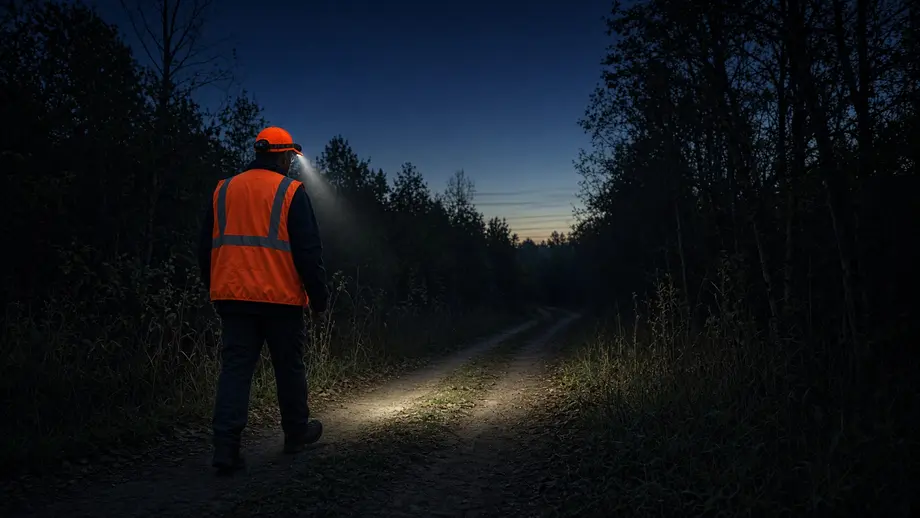
Walk in with a low white light on and steady, pointed at the ground a few steps ahead, and never swept across the woods. Keep it on from the truck to your stand. When you see or hear another hunter, say so in a normal voice before you move closer. A steady light plus a human voice leaves nothing for anyone to guess about.
A routine for a crowded morning (a practical habit, not a legal rule):
- At the truck: put your orange on now. In Pennsylvania, when orange is required, the digest says "the full amount of orange required for that season must be worn while moving from one hour prior to the start of legal hunting hours and for one hour past the closing of legal hunting hours."
- Set the headlamp before you leave the lights of the lot: choose Low white, tilt it so the center of the beam lands a few steps ahead, and switch on the rear marker if you carry one.
- Count lights, not trucks: before you step off, look up the trail. Lights already moving ahead of you tell you which direction to avoid.
- Walk with the beam down and steady: no sweeping and no switching off to save battery. A light that vanishes and reappears is harder to read than a steady one; if you want less light, go dimmer, not dark.
- Announce yourself when you see a light or hear steps: a plain "Morning, hunter walking in" tells them you are a person and lets them say where they are set up.
- Leave the trail only where you planned to: if a light is already stopped near your planned turnoff, take your backup spot.
- At the stand: keep the light on through the climb or setup, then go to red, then off.
This scene parameter table shows how each part of the morning changes what you need from a light. The figures are planning suggestions, not legal or manufacturer requirements.
| Part of the morning | Light job | Output that works | Runtime to plan for | Water rating worth having |
|---|---|---|---|---|
| Parking lot and gate | Be seen by drivers and other hunters | Low white, 10 to 30 lumens | 10 minutes | IPX4 or better |
| Main trail walk-in | Light your feet and mark you as a person | Low white, 10 to 30 lumens, steady | 30 to 60 minutes | IPX4 or better |
| Last stretch off trail | Find the stand without flashing the ridge | Low white or Moon, beam on the ground | 5 to 15 minutes | IPX4 or better |
| Creek or wet-brush crossing | Keep the light working when soaked | Low white | A few minutes | IPX7 or IPX8 if it may go underwater |
| Climb and setup | Hands free, low glare | Red low or Moon | 10 to 20 minutes | IPX4 or better |
| Walk out after legal hours | Find landmarks and the trail | Med white, 100 to 300 lumens; handheld for 100 m checks | 30 to 60 minutes | IPX4 or better |
The Pennsylvania Game Commission's advice for spring turkey season makes the same point about voices: "Shout 'STOP' to alert approaching hunters. Never move, wave or make turkey sounds to alert others of your position." It is written for turkey hunters, but the logic carries into a dark deer woods: a voice is unambiguous, movement is not.
Safety note: Unload before the lot, not at the stand. The Pennsylvania Game Commission's safety tips say "Always make sure firearms are unloaded before putting them in a vehicle. Never put a loaded firearm in or against a motor vehicle or any attachments, even if the vehicle is stationary," and tell tree-stand hunters to "Use a haul line to bring gear up." Maine's 12 M.R.S. 11212-A says a person may not "have a loaded firearm or crossbow while in or on a vehicle," except as the statute allows.
When Should You Turn Your Light Off, and How Do You Mark Your Spot?
Turn your light off once you are seated, clipped in if you are elevated, and your orange is visible, which in most setups is 15 to 30 minutes before legal shooting light. Before that, switch to red for gear. In a ground blind or enclosed stand, mark it with orange where your state requires it, because once your light is off, the orange does the talking.
Pennsylvania and Minnesota both have rules for this moment. The Pennsylvania digest says that when using "a blind or enclosed tree stand during the regular firearms deer, bear or elk seasons, a minimum of 100 square inches of fluorescent orange material (orange alert band) must be displayed within 15 feet of the blind or stand and visible from 360 degrees." Minnesota's statute, Minn. Stat. 97B.071, requires a person hunting deer "in a fabric or synthetic ground blind on public land" to have either "a blaze orange safety covering on the top of the blind that is visible for 360 degrees around the blind" or "at least 144 square inches of blaze orange material on each side of the blind."
Put those areas in everyday terms. A 100-square-inch band is a 10-by-10-inch square; 144 square inches is a 12-by-12-inch square, so a four-sided blind in Minnesota needs 4 × 144 = 576 square inches of orange in total if you use side panels.
For the last minutes of dark:
- Seated and set: switch to red low to hang a pack or find a call.
- Orange check: hat and vest outside any camouflage layer; blind panel facing all directions where required.
- Light off, but handy: keep the headlamp around your neck. If someone approaches, turn it on, point it at the ground in front of you and speak.
Note: The Park Service article explains that "deep red lights do not trigger the neutralization of the rhodopsin" that powers night vision. The flip side is that a dim red light does little for a dark-adapted hunter looking your way. Use red for chores after you are set, not as your only marker while you are moving.
Which Headlamp Settings Matter Most for a Crowded Walk-In?
For a crowded walk-in, the settings that matter are a white mode of about 30 lumens or less with long runtime, a steady red mode, a switch you can operate with gloves without flashing Turbo, and a lockout for the pack. Output above a few hundred lumens adds little to being seen and a lot to annoying the hunter already on the ridge.
Button noise is a real concern on a quiet ridge, but Olight does not publish a sound rating for any switch, so the table lists switch type and the maker's own description instead. Try each switch at home in a quiet room, with gloves on.
This comparison table uses Olight's published specs for four lights, including the Perun 3 Mini as a smaller reference point.
| Spec that matters | Olight Perun 3 (headlamp) | Olight Perun 3 Mini (headlamp, reference) | Olight Oclip 2 Pro (clip light) | Olight Seeker 4 Pro (handheld) |
|---|---|---|---|---|
| Lowest white mode | Moon 5 lumens, 20 days | Moon 2 lumens, 10 days | Moon 1 lumen, 144 hours (flood or spot) | Moon 5 lumens, 15 days |
| Walking mode | Low 30 lumens, 89 hours | Low 10 lumens, 30 hours | Floodlight Low 10 lumens, 25 hours | Low 50 lumens, 60 hours |
| Red modes | 60 lumens for 14 hours; 15 lumens for 70 hours | 45 lumens for 150 minutes; 5 lumens for 19 hours | 40 lumens for 4 hours; 4 lumens for 27 hours | None |
| Maximum output | 3,000 lumens, 6,400 cd, 160 m | 1,250 lumens, 6,000 cd, 155 m (CW) | 530 lumens flood; spotlight 3,906 cd, 125 m | 4,600 lumens, 16,895 cd, 260 m |
| Switch | Large metal side button, "concave to avoid unwanted activation" | Not listed in the spec table | Side switch plus a mode selector | Rotary knob switch with stepless dimming |
| Water rating | IP68 | IPX8 | IP66 | IPX8 |
| Weight with battery | 5.29 oz (150 g) | 1.9 oz (54 g) | 2.66 oz (75.5 g) | 7.23 oz (205 g) |
| Regular price | $89.99 | $64.99 | $54.99 | $139.99 |
The Perun 3 Mini page's highlights describe "3 red light modes," while its spec table lists two red levels, so the table shows the two with published runtimes. The Perun 3 Mini is listed for reference only: its product page showed it as sold out in September 2026, so it is not a pick here.
Olight Perun 3: the walk-in headlamp
The hard part of a crowded walk-in is holding a low, steady light for an hour without worrying about the battery. The Olight Perun 3 headlamp runs 30 lumens on Low for 89 hours and 15 lumens of red for 70 hours on its 5000 mAh 21700 battery, and its IP68 rating covers rain and creek crossings.
Its limits: at 5.29 oz it weighs about 2.8 times the 1.9 oz Perun 3 Mini, and its manual lists a working temperature of 0-40°C, so expect less runtime on a hard-frost opener. Learn the button sequence for Low, red and lockout at home so you never pass through its 3,000-lumen Turbo on a crowded trail. For more headlamp options, see our roundup of the best headlamps or browse Olight's headlamps.
Olight Oclip 2 Pro: the rear marker
The gap a headlamp leaves is behind you. The Olight Oclip 2 Pro clip light clips to objects "up to 14 mm thick, including collars, straps, and MOLLE webbing," and pairs "a 115° head tilt with 360° clip rotation," so it can ride on a pack strap and face backward. Its red light runs 4 lumens for 27 hours and is reached with the same selector as the floodlight and spotlight. The Oclip 2 user manual adds a caution for anyone with an implanted heart device: "If you have an ICD or pacemaker, avoid close or prolonged contact with this product to prevent possible interference."
Its limits: the 600 mAh battery is small, the IP66 rating covers powerful water jets but not submersion, and it has a strobe mode, including a 20-lumen red strobe. Leave it on steady red. It doubles as a backup walking light.
Olight Seeker 4 Pro: the walk out and landmark checks
On the walk out, you may need to find a trail marker or a creek crossing at 100 m or more, which a headlamp cannot light well. The Olight Seeker 4 Pro flashlight is rated at 16,895 candela and 260 m. Its user manual says "While off, press and hold the switch for 1s to enter Moonlight mode," so it can start at 5 lumens instead of a bright burst, and the rotary knob dims steplessly.
Its limits: it is a 7.23 oz handheld with no red mode and no headband, so it ties up a hand. It also has a 13 Hz strobe at 4,600 lumens. Never point it toward a hillside where someone may be sitting. The manual adds a pack feature: "When the flashlight is off, it will be locked if put back to the holster."
On opening weekend, the Seeker 4 Pro is a walking light, not a scanning light. A dedicated field light for night sits is a different job, and our guide to the best rechargeable spotlight for hunting covers it, including where night scanning is legal. Both guides land on the same rule for Pennsylvania: spotlighting is closed for the whole regular firearms deer season, so during that season a handheld stays on the trail.
How Much Battery Does an Opening Weekend Use?
An opening weekend of two dark walk-ins and two walk-outs uses only a small share of a full-size headlamp battery. Based on Olight's rated runtimes, not measured, a Perun 3 run on Low in, red for setup and Med out uses about 9% of a charge over two days. The smaller Perun 3 Mini run the same way uses about 43%.
Each day assumes 60 minutes of walking in, 15 minutes of setup on red, and 45 minutes of walking out after legal hours end. Each segment's share of the battery is its duration divided by the rated runtime for that mode.
- Perun 3, per day: Low 60 min ÷ 89 h = 1.12%; Red Low 15 min ÷ 70 h = 0.36%; Med 45 min ÷ 25 h = 3.00%. Total 4.48% a day, or about 9.0% for the weekend.
- Perun 3 Mini, per day: Low 60 min ÷ 30 h = 3.33%; Red Low 15 min ÷ 19 h = 1.32%; Med 45 min ÷ 4.5 h = 16.67%. Total 21.3% a day, or about 42.6% for the weekend.
- Oclip 2 Pro as a rear marker: red 4 lumens for 105 minutes a day (walk in plus walk out) ÷ 27 h = 6.5% a day, or about 13.0% for the weekend.
This table turns the same numbers into a planning view.
| Light and role | Share of battery per day | Share over a two-day opener | What it means |
|---|---|---|---|
| Perun 3 as main headlamp | 4.5% | 9.0% | Charge once before the weekend; no mid-weekend charging needed |
| Perun 3 Mini as main headlamp | 21.3% | 42.6% | Fine for a weekend on a full charge, tight for a week of hunting |
| Oclip 2 Pro as rear marker | 6.5% | 13.0% | Plenty left to act as a backup walking light |
Rated runtimes are lab figures, and cold shortens them; our hunting season gear check suggests planning on about half on a frosty morning. Even at half, the Perun 3 weekend budget stays under 20%.
Blaze Orange and Light Rules: Where Do You Find Your State's Text?
Find your state's blaze orange rules, opening dates, legal hours and lighting rules in the wildlife agency's current digest or the state code, and read the actual sentence rather than a summary. Rules differ by season, weapon, land type and even blind style, so a friend's rule from another state may not apply to you. The tables below use Pennsylvania, Minnesota and Maine as examples.
This regulation table compares Pennsylvania, Minnesota and Maine using each state's digest or statute text as of September 2026. It does not replace your own state's current text.
| State | Who must wear orange (paraphrased) | Amount and placement | Public land or blind rule | Source |
|---|---|---|---|---|
| Pennsylvania | Small game seasons and firearms seasons for deer, bear and elk, including archery hunters in those seasons | 250 square inches on head, chest and back, visible from 360 degrees; worn while moving from one hour before legal hours | Orange required on State Game Lands Oct. 1 to Jan. 31 unless lawfully hunting without an orange requirement; 100-square-inch band near a blind in firearms seasons | 2026-27 Hunting and Trapping Digest |
| Minnesota | Anyone hunting or trapping in the open season where deer may be taken by firearms | Visible cap and outer clothing above the waist, excluding sleeves and gloves; camouflage counts if at least 50 percent blaze orange or pink per foot square | Ground blinds on public land: orange on top visible 360 degrees, or 144 square inches per side | Minn. Stat. 97B.071 |
| Maine | Anyone hunting with firearms or crossbows during the open firearm season on deer | Two articles: a solid orange hat and a torso garment at least 50% orange, visible from all sides | Waterfowl hunters in boats, blinds or with decoys are exempt | 12 M.R.S. 11203 |
Pennsylvania's full text is in the 2026-27 digest's orange section linked above. For public land, the digest adds: "It is unlawful to be on State Game Lands from Oct. 1-Jan. 31 and April 20-May 31, including Sundays, without wearing a minimum of 250 square inches of fluorescent orange-colored material on the head, chest and back combined, or a fluorescent orange hat, unless engaged in lawful hunting, trapping or fishing that does not require the use of orange."
Minnesota's statute opens: "a person may not hunt or trap during the open season where deer may be taken by firearms under applicable laws and ordinances, unless the visible portion of the person's cap and outer clothing above the waist, excluding sleeves and gloves, is blaze orange or blaze pink."
Maine's 12 M.R.S. section 11203 says "A person may not hunt with firearms or crossbows during the open firearm season on deer unless that person is wearing 2 articles of hunter orange clothing that are in good, serviceable condition and visible from all sides." It specifies that "One article of clothing must be a solid-colored hunter orange hat," and the other "must be a minimum of 50% hunter orange in color."
Opening dates, legal hours and light rules in the same three states
Orange is only half of the rulebook for a dark walk-in. The other half is when the season opens, the minute legal hours begin, and what the state says about artificial light before that minute. This table takes each item from the state's own 2026 or 2026-27 text for the firearms deer opener.
| State | Firearms deer opener (season) | Legal hours for deer | Light rule that covers the pre-dawn walk | Sunday on opening weekend | Source |
|---|---|---|---|---|---|
| Pennsylvania | Sat., Nov. 28, 2026; season runs Nov. 28 to Dec. 13 | Half an hour before sunrise to half an hour after sunset | Recreational spotlighting only from sunrise to 11 p.m., and closed through the regular firearms deer season; no spotlighting while holding a gun or bow | Open (Sunday, Nov. 29) | 2026-27 Hunting Hours Table, General Hunting Regulations, Sunday Hunting page |
| Minnesota | Sat., Nov. 7, 2026; opening weekend Nov. 7 and 8 | Half an hour before sunrise to half an hour after sunset (big game) | No light to spot, locate or take a wild animal while holding a gun or bow; no shining to locate animals from two hours after sunset until sunrise | Open (Sunday, Nov. 8) | 2026 Minnesota Hunting Regulations; Minn. Stat. 97B.081 |
| Maine | Sat., Oct. 31, 2026 (residents only); general season Nov. 2 to Nov. 28 | Hunting barred from 30 minutes after sunset to 30 minutes before sunrise | No artificial light to "illuminate, jack, locate" wildlife from half an hour after sunset to half an hour before sunrise, Sept. 1 to Dec. 15; no light to hunt deer | Closed: no hunting on Sunday | Maine IFW 2026 season dates; 12 M.R.S. 11205, 11206 and 11214 |
Here is the wording behind each row.
Pennsylvania (2026-27). The digest's 2026-27 hunting hours table says "Legal Hunting Hours for all small and big game are from ONE-HALF HOUR BEFORE SUNRISE TO ONE-HALF HOUR AFTER SUNSET." The digest's general hunting regulations make it unlawful to "spotlight wildlife while in possession of a firearm, bow and arrow, or other device capable of killing wildlife," and add that "Spotlighting closes at 11 p.m. on the day before the regular firearms deer season. Spotlighting is prohibited at all times through the season." The same page defines spotlighting as including "handheld lights" when "intentionally used to locate or view wildlife."
Minnesota (2026). The 2026 Minnesota Hunting Regulations list "Statewide firearms: 100 series and 604, 679, and 684 Nov. 7-22," refer to "the opening weekend of the statewide firearms season (November 7-8)," and state that "Shooting hours for big game are ½ hour before sunrise to ½ hour after sunset." Minn. Stat. 97B.081 (2025 Minnesota Statutes) says a person "may not cast the rays of a spotlight, headlight, or other artificial light" in "a field, woodland, or forest, to spot, locate, or take a wild animal" while holding a firearm or bow. Its separate no-shining hours, from two hours after sunset until sunrise, do not cover light used for "outdoor recreation" that "is not related to spotting, locating, or taking a wild animal."
Maine (2026). Maine's 2026 season dates page lists the "Maine Resident Only Day" on October 31, 2026, and the firearms season from November 2 to November 28, 2026. 12 M.R.S. 11205 says a person may not "Hunt wild animals or wild birds on Sunday," so Maine's opener is a Saturday with no Sunday after it. 12 M.R.S. 11206 bars hunting "from 30 minutes after sunset to 30 minutes before sunrise of the following day." 12 M.R.S. 11214 bars using "artificial lights between 1/2 hour after sunset and 1/2 hour before sunrise the next day to illuminate, jack, locate, attempt to locate or show up wild animals or wild birds from September 1st to December 15th," and using "an artificial light" to "hunt deer or moose."
The light-law clock for an opening morning
Put those rules on one clock and a pattern appears. Take a 6:45 a.m. sunrise as a worked example and swap in the sunrise for your own spot:
| Time (6:45 a.m. sunrise) | Pennsylvania firearms deer opener | Minnesota firearms deer opener | Maine firearms deer opener |
|---|---|---|---|
| 5:15 a.m. (90 minutes before sunrise) | Orange on for moving, one hour before legal hours | Blaze orange or pink cap and upper clothing whenever you hunt | Two orange articles whenever you hunt with a firearm |
| 5:15 to 6:15 a.m. (the walk in) | Spotlighting closed all season; a light is for walking only | No shining to locate animals until sunrise | No light to locate wildlife until 6:15 a.m. |
| 6:15 a.m. (30 minutes before sunrise) | Legal hours begin | Shooting hours begin | Hunting allowed from this minute |
| 6:45 a.m. (sunrise) | Spotlighting stays closed through the season | No-shining hours end; shining to locate animals while holding a gun or bow stays banned at any hour | Using a light to hunt deer stays banned at any hour |
The whole walk in falls inside every state's no-shining window. In all three states, your headlamp is legal as a travel light and nothing more. Keep the beam on the trail, and never sweep a field or a ridge to look for deer or for the hunter who got there first. Our guide to hunting with a light laws compares spotlighting rules in more states. If you are unsure how your own state treats a headlamp on the walk in, follow your state's current rules and call its wildlife agency.
Warning: Rules change every season. Pennsylvania's 2026-27 seasons now include Sundays for most species, so its opener is a full weekend, while Maine still bars Sunday hunting. Read this season's digest, not last year's printout.
What Should You Do When You See Another Hunter's Light?
When you see another hunter's light, stop, keep your own light on and pointed down, and speak before you move. If the light is stationary near your planned spot, assume that hunter got there first and go to your backup. If it is moving toward you, call out so they know you are there. Never answer a light by pointing yours at it.
This decision table covers the common encounters on a crowded opening morning. The actions are a practical protocol based on the safety rules quoted above, not a legal standard.
| What you see | What it probably means | What to do |
|---|---|---|
| A light moving ahead of you on the same trail | Another hunter heading in | Keep your distance, keep your light on, and let them turn off first |
| A light stopped near your planned turnoff | Someone is setting up in or near your spot | Speak once if you are close, then take your backup spot; do not set up in their zone of fire |
| A light coming toward you on the trail | A hunter walking in from another access point, or walking out | Stop, say "hunter here," and keep your beam on the ground between you |
| A light switching off after you pass | A hunter settling into a stand | Move on quietly, and plan your walk out to avoid their field of view |
| A red light low to the ground | A hunter doing gear chores in a stand or blind | Detour well around the likely shooting lanes, at least out of the 45-degree wedge in front of them |
| A bright beam sweeping fields before legal hours | Likely illegal: all three example states ban shining to locate wildlife before legal hours in deer season | Do not confront and do not shine back; note time, place and vehicle, and report to the state wildlife agency |
Is Walking In Without a Light Safer?
No. Walking in dark makes you invisible to other hunters at the one time orange cannot help you, and it makes a fall or a wrong turn into someone's setup more likely. A low, steady light is the safer choice on crowded public land; keep glare down with the lowest white mode, then red once you arrive.
The common mistakes behind that myth, with a fix for each:
- "Deer see my light, so I go dark." The National Deer Association's summary of University of Georgia vision research says the red and orange colors deer lack a cone for "aren't invisible to deer, but rather are perceived differently." Dim and steady beats dark and stumbling.
- "Red makes me invisible to hunters." A red light is still a light, but deep red does little for the night-adapted eyes of a hunter looking your way, as the Park Service article on rhodopsin explains. Use it after you are set, not as your only marker while you move.
- "Brighter is safer." A 1,000-lumen beam in someone's eyes wipes out their night vision, since, per the Park Service, "It only takes a few seconds of bright light" to break it down. Being seen takes a steady, low light.
- "Orange goes on at the stand." In Pennsylvania, when orange is required, it goes on for moving "from one hour prior to the start of legal hunting hours." Put it on at the truck.
What Is Open Season in Hunting?
Open season is the legal window when you may hunt a particular species, defined by dates, hours, area and method. Texas law, for example, defines it as "the period of time during which it is lawful to hunt a specified animal, game animal, wild fowl, or bird." Opening weekend is the first weekend of that window.
The Texas Parks and Wildlife Code, Section 62.001, pairs that with its opposite: "Closed season" means "the period of time during which it is unlawful to hunt a game animal, wild fowl, or bird." An open season is rarely a single date; it is a set of layers:
- Species: squirrel, deer, bear and waterfowl each have their own seasons.
- Method: archery, muzzleloader and firearms dates differ for the same species.
- Area: Pennsylvania, for one, sets some seasons by Wildlife Management Unit.
- Hours: each state sets legal hours, and they can change within a season. In Pennsylvania's 2027 spring gobbler season, for example, "From May 1-16, legal hunting hours are one-half hour before sunrise until noon."
What Hunting Season Is Open Right Now in PA?
In late September 2026, Pennsylvania's open seasons include squirrel (from Sept. 12), bobwhite quail, woodchuck, crow on Thursdays through Sundays, coyote, and archery deer and black bear in WMUs 2B, 5C and 5D (from Sept. 19). Statewide archery deer opens Oct. 3, and the regular firearms deer season opens Nov. 28, 2026.
This table lists fall openers from the Pennsylvania Game Commission's final 2026-27 seasons. Migratory bird seasons are set under federal frameworks and announced separately, so they are not listed.
| Season (Pennsylvania, 2026-27) | Dates | Open today in late September 2026? | Orange while hunting? |
|---|---|---|---|
| Squirrel | Sept. 12 to Dec. 24, then Dec. 26 to Feb. 28, 2027 | Yes | Yes, small game |
| Archery deer, WMUs 2B, 5C and 5D | Sept. 19 to Nov. 27, then Dec. 26 to Jan. 24, 2027 | Yes | No, archery season |
| Archery elk (license holders) | Sept. 12 to 27 | Yes, through Sept. 27 | No, archery season |
| Archery deer, statewide | Oct. 3 to Nov. 20, then Dec. 26 to Jan. 24, 2027 | Opens Oct. 3 | No, archery season |
| Regular firearms elk, first segment (license holders) | Oct. 3 to 11 | Opens Oct. 3 | Yes, firearms elk season |
| Antlerless muzzleloader deer | Oct. 17 to 25 | Not yet | Yes |
| Ruffed grouse and rabbit | Oct. 17 to Dec. 24 | Not yet | Yes, small game |
| Regular firearms deer | Nov. 28 to Dec. 13 | Not yet | Yes |
The Game Commission says "All 2026-27 seasons include the Sundays that fall within their listed start and end dates," with an exception for migratory game birds. That means the statewide archery opener runs Saturday, Oct. 3, and Sunday, Oct. 4, a true opening weekend. The orange column follows the digest, which says "No fluorescent orange is required during archery seasons when hunting for deer, bear or elk," but also notes that "Even when orange isn't required, the Game Commission highly recommends the use of orange."
So a bowhunter on State Game Lands on Oct. 3 is exempt from the State Game Lands orange rule while lawfully hunting, but squirrel hunters on the same ground are not. In the elk range, the first regular firearms elk segment opens the same Saturday for license holders, and the digest says that "In firearms seasons for deer, bear or elk (regular, special and extended), orange is required, regardless of the sporting arm carried." An orange hat on the walk in costs nothing; before shooting light, your headlamp matters more.
How Do You Avoid Other Hunters on Public Land Opening Weekend?
To avoid other hunters on public land during opening weekend, pick two or three spots in daylight, reach your first choice earlier than usual, and treat any light already there as a closed door. Use access points and routes others skip, keep your light low and steady so they can avoid you too, and agree with your party on who sits where.
Avoiding people is mostly daylight planning. This framework puts it in order:
- Scout three spots, not one. Mark a first choice, a backup within a short walk, and a third on a different access route. If a truck is parked at your gate, switch plans in the lot, not on the ridge.
- Map the approach, not only the stand. Note where each route crosses other trails; that is where you will meet other lights.
- Set a departure time and keep it. Back-time from legal shooting light so you are settled before others arrive. The hunting season gear check linked above walks through back-timing.
- Read the lot. Count vehicles and watch where the lights on the trail are heading.
- Mark yourself, then stay put. Once you are set, avoid moving between stands until full daylight, and walk out the way you came, so you cross the fewest setups.
Group hunts need one more step. The Pennsylvania Game Commission advises that hunters in a party "should be spaced 25 to 40 yards apart, and always in sight of one another." You cannot control strangers, but you can keep your own group predictable: agree on stands and shooting lanes the night before.
Hunting Season Opening Weekend Action Checklist
Use this checklist the night before and at the truck. It condenses the guide into steps: charge lights, set modes, put orange on at the vehicle, walk with a low steady light, speak to every light you meet, mark your blind, and turn off only when you are settled and visible.
- Night before: charge the headlamp, rear marker and handheld; practice each switch with gloves on; save your state's current orange and hours pages; pick three spots.
- At the truck: orange on; headlamp on Low white, beam a few steps ahead; rear marker on steady red; firearm unloaded.
- On the trail: light steady the whole way, no sweeping; speak to every light you meet; take the backup if your spot is taken.
- At the stand: set up with the light on, switch to red, then off once you are seated and your orange is visible.
This is the whole method for hunting season opening weekend on crowded public land: be seen while you move, be orange once you stop, and let your voice do the rest.
FAQ
Changelog
- September 23, 2026: First published.