Olight makes some of the lights discussed here. Olight specs and prices come from its product pages and user manuals as of September 2026. Standard definitions come from published summaries by PLATO, the standard's developer, and by flashlight makers, because the full FL1 text is sold, not posted.
⚡ TL;DR
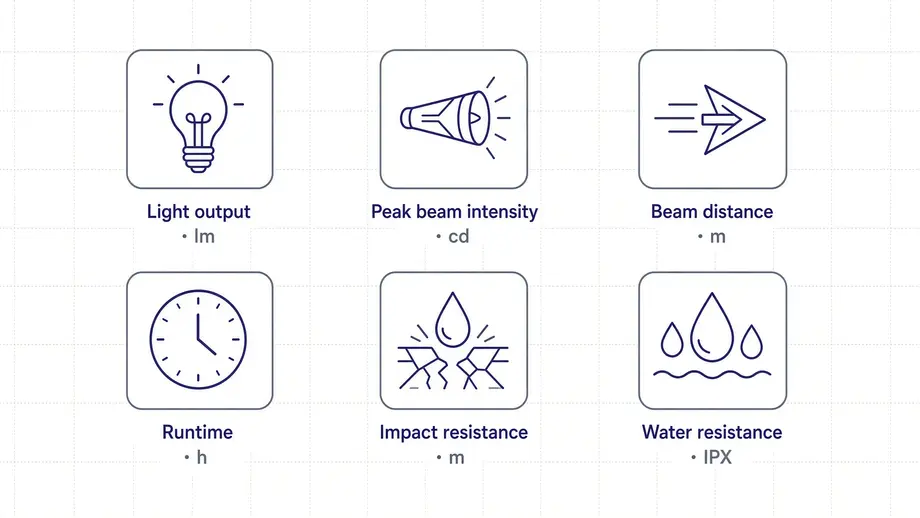
ANSI FL1 is the voluntary U.S. standard that tells flashlight makers how to measure and label six numbers: light output, peak beam intensity, beam distance, runtime, impact resistance and water resistance. It decides whether two spec sheets can be compared at all. When you shop, read output and beam distance together, then check how long the light holds its level after the first step-down.
This quick reference answers the core ANSI FL1 questions before the details.
| Question | Short answer |
|---|---|
| What is ANSI FL1? | A measurement and labeling method for portable lights, now published as ANSI/PLATO FL 1-2025 |
| Is it required by law? | No. It is voluntary, and makers who use it test their own lights unless they pay for certification |
| Which six numbers does it define? | Light output (lumens), peak beam intensity (candela), beam distance (meters), runtime (hours), impact resistance (meters), water resistance (IPX) |
| Which number is easiest to misread? | Runtime, because it counts down to 10% of the starting output |
| Which numbers must agree with each other? | Candela and beam distance: beam distance in meters equals 2 × √candela |
| What does FL1 leave out? | Color rendering, color temperature, beam width and how bright a light stays after a step-down |
Here is the problem this guide solves. One box says 4,600 lumens and 260 meters, another says 2,500 lumens and 320 meters, and a third says it runs "up to 55 days." Each maker leads with a different number, so it is hard to tell which light is brighter, which reaches farther and which lasts longer. Knowing how FL1 produces each figure tells you which ones you can compare and which ones need a second look.
📋 Table of Contents
- 1. What Is the ANSI FL1 Standard?
- 2. Flashlight Specs Explained: The Six ANSI FL1 Numbers and Their Test Conditions
- 3. How Are Lumens Measured Under ANSI FL1?
- 4. Why Does FL1 Runtime End at 10% of Initial Output?
- 5. Where Does the 0.25 Lux Beam Distance Come From?
- 6. Impact and Water Resistance: What the Drop and IPX Numbers Promise
- 7. Four Ways a Spec Sheet Can Look Better and Still Follow ANSI FL1
- 8. How to Compare Two Flashlights Using FL1 Icons
- 9. Is a 200,000 Lumen Flashlight Legal?
- 10. What Flashlights Do Pilots Use?
- 11. Is 7000 Lumens a Lot for a Flashlight?
- 12. Your ANSI FL1 Spec-Sheet Checklist
- 13. FAQ
What Is the ANSI FL1 Standard?
The FL1 standard is a set of test methods and package icons for portable lights, now maintained by the Portable Lights American Trade Organization (PLATO), which describes itself as an ANSI-accredited standards developer. It defines how to measure output, beam intensity, beam distance, runtime, impact resistance and water resistance, so that a lumen figure from one brand means the same thing as one from another.
The standard began as ANSI/NEMA FL 1-2009. Nitecore's guide to ANSI/NEMA FL 1-2009, written for that first edition, notes that "Adherence to the FL1 Standard is voluntary," and it credits the standard with replacing vague packaging claims such as "3W LED" and "1 million candlepower." PLATO's history page says it released the revised ANSI/PLATO FL 1 2016 Standard in late 2016 and updated it again in late 2019, when area lights were added.
The newest edition is ANSI/PLATO FL 1-2025. PLATO announced its publication on February 2, 2026 and called it "the most significant update in the Standard's history." The biggest change is a separate method for turbo and boost modes, covered later in this guide. Lights already on the market still carry figures tested to earlier editions: Olight's user manual for the Seeker 4 Pro, for example, says its data "are tested per ANSI/PLATO FL 1-2019 standard in Olight's labs for reference," while the Marauder Mini 2 manual cites the 2009 edition. Check which edition a manual names before you compare two lights, especially their turbo figures.
That last phrase matters. FL1 defines the method, not an inspector. A maker can run the tests itself, as Olight states it does, or pay for third-party certification. PLATO lists a UL/PLATO certification program, UL S8001, which includes "Confirmation that products meet ANSI/PLATO FL-1 2019 standard requirements and proper usage of designated icons." Either way, the numbers follow the same rules, which is what makes them comparable.
Flashlight Specs Explained: The Six ANSI FL1 Numbers and Their Test Conditions
The six FL1 numbers are light output in lumens, peak beam intensity in candela, beam distance in meters, runtime in hours and minutes, impact resistance as a drop height in meters, and water resistance as an IPX rating. Each one records a single condition, so each answers one narrow question. The table below states the condition behind every number.
The full standard is sold, not posted, so the definitions below are as restated by makers. Streamlight publishes a one-page ANSI/PLATO FL1 summary, filed under a 2018 name, before the 2019 revision, with plain definitions. According to that summary, FL1 defines light output as "the total quantity of emitted overall light energy," beam distance as the distance "at which the light beam is 0.25 lux," and runtime as the time from the output reading "30 seconds after the light is turned on with fresh batteries" until output "drops to 10% of the initial value." Nitecore's guide to the 2009 edition adds that output is measured "using an integrating sphere" and that impact drops go onto "a concrete surface at the specified height with all intended accessories, including batteries, installed."
This table lines up each FL1 number with its definition, unit and the unit code you would use to publish it as structured data.
| FL1 number | What is measured | Unit | UN/CEFACT unit code | Condition that shapes the result |
|---|---|---|---|---|
| Light output | Total light leaving the front of the light, captured in an integrating sphere | Lumen (lm) | LUM | Read 30 seconds to 2 minutes after switch-on with fresh batteries |
| Peak beam intensity | Brightest point of the beam, usually the center | Candela (cd) | CDL | Taken in the same window as output |
| Beam distance | Distance at which peak intensity falls to 0.25 lux | Meter (m) | MTR | Calculated from candela, not paced out in a field |
| Runtime | Time from the 30-second reading until output falls to 10% of it | Hour (h) or minute (min) | HUR or MIN | Includes every automatic step-down along the way |
| Impact resistance | Drop height onto concrete after which the light has no cracks or breaks and still works | Meter (m) | MTR | Batteries and intended accessories installed |
| Water resistance | Splashing, temporary immersion or continuous immersion | IPX rating | None (IPX is a code, not a unit) | For IPX8 the maker states the depth |
The codes come from UN/CEFACT Recommendation 20, reproduced in the Peppol code list, where LUM is lumen, CDL is candela, MTR is metre, HUR is hour and MIN is minute. Schema.org's unitCode property expects exactly this: "The unit of measurement given using the UN/CEFACT Common Code (3 characters) or a URL." Water resistance has no unit, so it is published as text, such as "IPX8."
The next table turns each number into a buying test, using the range published for the four Olight lights compared in this guide.
| FL1 number | Range across the four Olight lights here | How to judge whether it is enough |
|---|---|---|
| Light output | 1,600 to 10,000 lumens at maximum | Look at the level after the first step-down, not only the peak |
| Peak beam intensity | 10,000 to 140,000 candela | Higher candela means a more concentrated beam and more reach |
| Beam distance | 200 to 750 meters | Divide by 2 and square it; the result should be close to the rated candela |
| Runtime at turbo | 92 to 203.5 minutes, adding the published stages | Check how many of those minutes are spent at the peak |
| Impact resistance | 1.5 m or 2 m where Olight publishes it | Match it to how the light is carried: pocket, belt or vehicle |
| Water resistance | IPX8 on all four | IPX8 depth is set by the maker, so read the stated depth where one is given |
How Are Lumens Measured Under ANSI FL1?
Under ANSI FL1, as the published summaries restate it, lumens are measured by switching the light on with fresh batteries, placing it in an integrating sphere, a hollow ball coated to scatter light evenly onto a sensor, and reading output between 30 seconds and 2 minutes after switch-on. Runtime starts from the 30-second reading. A flashlight's rated lumens therefore describe its first two minutes at most, not its first hour.
Why wait at least 30 seconds rather than read the number at switch-on? Neither Streamlight nor Nitecore states the committee's reasoning. Olight's own explainer on how flashlight brightness is measured restates the window: light output "is measured between 30 and 120 seconds after the light is turned on." The delay means the reading comes after the LED has started to warm up. A U.S. Department of Energy fact sheet on thermal management of white LEDs explains the heat side: "The short-term (reversible) effects are color shift and reduced light output." A reading at switch-on would record a cold LED and a full battery, a level the light holds only for moments.
The 30-second rule also created a gap for turbo modes that last only seconds. PLATO's own explainer, ANSI/PLATO FL 1-2025: What Changed and Why It Matters, says earlier editions "did not provide a method for testing and reporting performance results for modes lasting less than 30 seconds." The 2025 edition adds one. For these short bursts, "Lumen output, beam distance and peak beam intensity are measured between one and 10 seconds," and the mode gets a stopwatch icon and a shaded table row. PLATO adds that the existing procedures still apply to standard operating modes.
Here is how to read this on a spec sheet you already own. On Olight's pages, a turbo line such as "4,600~1,200~600 lumens" with "2.5 + 122 + 35 minutes" gives each stage of the step-down. The first number is the FL1 output. The second is what you actually use on a long walk. If you want to picture those levels, our answer to how bright is 2000 lumens compares them with household bulbs and car headlights. For why the drop happens at all, see our guide to the thermal step down flashlight.
Note: A spec sheet that lists only one lumen figure and no runtime stages gives you the peak and nothing else. Olight publishes the full stage breakdown on its product pages, and you can browse every model's numbers across its range of flashlights.
Why Does FL1 Runtime End at 10% of Initial Output?
FL1 runtime ends when output falls to 10% of the 30-second reading because the standard needs a fixed, repeatable end point that works for every light, whether it holds a flat level or fades slowly. The trade-off is that the rated runtime counts minutes spent far below the peak. A light rated at 2,500 lumens can still be "running" under FL1 at 250 lumens.
Nitecore's guide to the 2009 edition calls the runtime rating "the biggest limitation" of the standard, and explains that to see how a light behaves, "runtime must be presented as a graph, which is not required by the FL1 Standard." Olight's product pages don't publish graphs, but they do publish every step-down stage. That lets you rebuild the curve yourself and put a number on how the flashlight runtime is spent.
The method is simple. Add the stage times to get the total. Multiply each stage's lumens by its minutes and add those products to get lumen-minutes, the total light delivered. Divide by the total time to get the average output over the whole run. Here is the calculation for the Seeker 4 Pro's turbo line:
- Total runtime: 2.5 + 122 + 35 = 159.5 minutes.
- Light delivered: (4,600 × 2.5) + (1,200 × 122) + (600 × 35) = 11,500 + 146,400 + 21,000 = 178,900 lumen-minutes.
- Average output: 178,900 ÷ 159.5 = about 1,122 lumens.
- Time at the peak: 2.5 ÷ 159.5 = about 1.6% of the run.
- FL1 end point: 10% of 4,600 = 460 lumens. The last published stage, 600 lumens, sits above it.
This table applies the same method to the turbo line of each Olight light in this guide, using Olight's published stages.
| Light and mode | Published turbo stages | Total runtime | Average output over the run | Share of the run at peak | 10% end point | Last stage as % of peak |
|---|---|---|---|---|---|---|
| Olight Baton 4 Pro, Turbo | 1,600~600 lumens; 2 + 198 minutes | 200 min | 610 lm | 1.0% | 160 lm | 37.5% |
| Olight Seeker 4 Pro, Turbo | 4,600~1,200~600 lumens; 2.5 + 122 + 35 minutes | 159.5 min | 1,122 lm | 1.6% | 460 lm | 13% |
| Olight Warrior Ultra, Turbo | 2,500~800~250 lumens; 2.5 + 162 + 39 minutes | 203.5 min | 715 lm | 1.2% | 250 lm | 10% |
| Olight Marauder Mini 2, Level 4-2 floodlight | 10,000~2,500 lumens; 2 + 90 minutes | 92 min | 2,663 lm | 2.2% | 1,000 lm | 25% |
Two things stand out. First, every light spends less than 2.5% of its turbo runtime at the headline figure, and 91.8% to 97.4% of the light it delivers comes after the peak. Second, the Warrior Ultra's final stage is 250 lumens, exactly 10% of 2,500, so its last 39 minutes sit right at the FL1 end point. That is a fully compliant rating, and it is also a reminder to read the middle number: the Warrior Ultra holds 800 lumens for 162 minutes, which is the level you will use on a patrol or a long walk.
Tip: When you compare two lights, compare the second number in the turbo line and the minutes attached to it. On the Seeker 4 Pro that is 1,200 lumens for 122 minutes; on the Baton 4 Pro it is 600 lumens for 198 minutes.
Where Does the 0.25 Lux Beam Distance Come From?
FL1 beam distance is the distance at which the center of the beam falls to 0.25 lux, which Nitecore describes as "equivalent to a full moon on a clear night." It is calculated from peak beam intensity rather than measured outdoors: because illuminance equals candela divided by distance squared, the distance to 0.25 lux is the square root of candela divided by 0.25, or 2 × √candela in meters.
Nitecore is blunt about what that means: "Beam distance is calculated from peak beam intensity, so there is actually no new information here." That makes beam distance a built-in consistency check. Halve the rated distance and square it, and you should land close to the rated candela. If the two numbers disagree badly, one of them did not come from an FL1 measurement.
This table runs the check on the four Olight lights, using their published candela and beam distance.
| Light | Rated peak intensity | Rated beam distance | 2 × √candela | Candela implied by the distance, (m ÷ 2)² | Agreement |
|---|---|---|---|---|---|
| Olight Baton 4 Pro | 10,000 cd | 200 m | 200.0 m | 10,000 cd | Exact |
| Olight Seeker 4 Pro | 16,895 cd | 260 m | 260.0 m | 16,900 cd | Within 0.1% |
| Olight Warrior Ultra | 26,000 cd | 320 m | 322.5 m | 25,600 cd | Rated distance is 2.5 m shorter than the formula gives |
| Olight Marauder Mini 2 (spotlight) | 140,000 cd | 750 m | 748.3 m | 140,625 cd | Within 0.3% |
All four agree within rounding. The Warrior Ultra's published 320 m is slightly under the 322.5 m its candela implies, so the rounding runs in the conservative direction.
A published lab report shows why the rated figure is still an average rather than a guarantee. An ANSI/PLATO FL 1-2019 test report from Underwriters Laboratories, prepared for Werkz LLC and posted by retailer Low Light Defense, lists two samples of the same handheld. Sample A measured 21,292 cd and sample B 38,912 cd, so sample B was about 83% more intense. The report lists beam distance as "calculated from peak beam intensity": 291.8 m and 394.5 m, averaging 343 m. Light output was far closer, 784.1 and 773.0 lumens. The report doesn't explain the gap, but the lesson holds: between these two units, candela varied far more than lumens did.
There is a subtle math lesson in that report too. Averaging the two distances gives 343 m, but the distance calculated from the average candela, 2 × √30,102, is about 347 m. Both are correct arithmetic. They answer slightly different questions, which is why a small mismatch between a published candela and distance is not by itself a red flag.
Beam distance also shrinks after a step-down. If the beam shape stays the same, candela falls in proportion to output, so reach scales with the square root of the output ratio. After its turbo stage, the Seeker 4 Pro reaches about 133 m (260 × √(1,200 ÷ 4,600)), the Warrior Ultra about 181 m (320 × √(800 ÷ 2,500)) and the Baton 4 Pro about 122 m (200 × √(600 ÷ 1,600)). Those are the distances you can plan around for more than a few minutes.
Impact and Water Resistance: What the Drop and IPX Numbers Promise
FL1 impact resistance is the height, in meters, from which a light with its batteries installed can be dropped onto concrete and still pass: Streamlight's summary says samples "must not exhibit any cracks or breaks and must remain fully functional." Water resistance uses IPX codes for splashing, temporary immersion or continuous immersion. Both are pass-or-fail limits under set conditions, not promises about every fall or every dive.
For water, Nitecore's guide to the 2009 edition lists the three ratings flashlights use: "IPX4 – water-resistant, or water splashed from all directions," "IPX7 – water-proof, or temporary submersion at 1 meter for 30 minutes," and "IPX8 – submersible, or continuous submersion at some specified depth for 4 hours." That four-hour rule has now changed. PLATO says the 2025 edition drops the fixed duration: "Previous editions specified a fixed four-hour testing duration. The revised standard allows testing depth and duration to vary, aligning the approach more closely with ANSI/IEC 60529." The 2025 edition also adds dust ratings, IP5X and IP6X.
This table shows the durability figures Olight publishes for the four lights, and where each figure comes from.
| Light | Impact resistance | Where it is stated | Water resistance |
|---|---|---|---|
| Olight Baton 4 Pro | 1.5 m | Olight user manual (Baton 4 Pro and Baton Ultra) | IPX8 |
| Olight Seeker 4 Pro | 1.5 m | Olight user manual | IPX8 |
| Olight Warrior Ultra | 2 m | Product page ("built to withstand 2-meter drops") and user manual | IPX8 |
| Olight Marauder Mini 2 | Not listed on its product page | None | IPX8 |
Read the drop height against how you carry the light. A pocket or belt light falls from about waist height, while a light used on a ladder or roof can fall much farther than any rated height. None of the four Olight pages states an IPX8 depth, so treat IPX8 here as protection for rain, puddles and an accidental dunk, and don't take any of them diving.
Warning: A drop rating covers one set of test drops on a new light. Nitecore's guide advises treating LED flashlights "like any other electronic device and avoid drops or other damage if possible," because repeated impacts can damage the driver even when the body looks fine.
Four Ways a Spec Sheet Can Look Better and Still Follow ANSI FL1
A spec sheet can follow FL1 to the letter and still flatter the light in four ways: a peak that lasts minutes, a runtime that counts a low tail, beam figures that reflect good samples, and a durability rating whose conditions the maker sets. None of these is cheating. Each is built into how the standard defines its numbers, so the fix is knowing where to look.
Here are the four, with what to check for each:
- A short peak. Output is read within the first 2 minutes, so a light can hold its rated lumens for two minutes and then step down. Check the stage times.
- A long tail. Runtime runs to 10% of the starting output, so the last stage can be a fraction of the peak. Check the lumens attached to the longest stage.
- Sample spread. Candela can vary widely between units, as the UL report above shows. Check that candela and beam distance agree, and treat a small difference as rounding.
- Maker-set conditions. The maker chooses the drop height to test and, for IPX8, the depth. Check for a stated depth and a stated drop height.
The misconceptions below come up often when people compare spec sheets. Each row gives the fact and where it comes from.
| Misconception | What FL1 actually says | Source |
|---|---|---|
| "Rated lumens are what the light produces all the time." | Output is read 30 seconds to 2 minutes after switch-on | Olight EDC Academy explainer; Streamlight FL1 summary |
| "A 3-hour runtime means 3 hours at full brightness." | Runtime ends when output falls to 10% of the 30-second reading | Streamlight FL1 summary |
| "Beam distance was measured in a field." | It is calculated from peak beam intensity | Nitecore FL1 guide; UL test report |
| "Twice the candela looks twice as bright." | Nitecore estimates that "four times the intensity is required" to look twice as bright | Nitecore FL1 guide |
| "IPX8 always means 4 hours underwater." | The 2025 edition lets depth and duration vary | PLATO 2025 explainer |
| "FL1 is checked by a government agency." | It is voluntary; certification such as UL S8001 is optional | Nitecore FL1 guide; PLATO certification page |
This table shows how the standard itself has changed between the edition behind most current spec sheets and the new one.
| Topic | ANSI/PLATO FL 1-2019 and earlier | ANSI/PLATO FL 1-2025 | What changes for you |
|---|---|---|---|
| Turbo or boost modes | No method for modes lasting less than 30 seconds | Measured between 1 and 10 seconds; runtime runs until output drops to 90% of the highest reading in the first 10 seconds | Short bursts get their own clearly marked figure |
| Lumen icon | Output figure | Adds a "MAX" designation | Signals the highest output for the claimed mode |
| IPX8 | Fixed four-hour test | Depth and duration can vary, closer to ANSI/IEC 60529 | Read the stated depth and time |
| Dust | Not rated | IP5X and IP6X ratings and icons | Dust claims become comparable |
| Standard modes | Existing procedures | Unchanged | Older and newer figures for normal modes stay comparable |
How to Compare Two Flashlights Using FL1 Icons
To compare two flashlights with FL1 icons, line up the same six numbers side by side, confirm that candela and beam distance agree, then compare the level each light holds after its first step-down and for how long. Finish with drop height and water rating for how you will carry it. This takes about five minutes with two product pages open.
Use this seven-step checklist:
- Confirm the method. Look for the FL1 icons or a line in the manual naming ANSI/PLATO FL 1. If a light gives only a lumen figure and nothing else, you have nothing to compare.
- Check reach. Halve the beam distance and square it. It should be close to the rated candela.
- Find the sustained level. Read the second number in the turbo line and its minutes.
- Work out average output. Multiply each stage by its minutes, add them and divide by the total time.
- Estimate reach after the drop. Multiply rated distance by the square root of sustained lumens divided by peak lumens.
- Match durability to carry. Compare drop height and water rating with where the light will live.
- Weigh the result against size and price. A smaller light that holds its level can be worth more than a bigger peak.
Here is the checklist applied to two lights of similar size and price. The Olight Seeker 4 Pro (4,600 lumens, 16,895 cd, 260 m, 205 g, $139.99 regular price as of September 2026) and the Olight Warrior Ultra (2,500 lumens, 26,000 cd, 320 m, 178 g, $139.99 regular price as of September 2026) both pass the candela check.
The Seeker 4 Pro wins on light delivered: it averages about 1,122 lumens over its turbo run against about 715 for the Warrior Ultra, and holds 1,200 lumens for 122 minutes. The Warrior Ultra wins on reach and toughness: 26,000 cd, about 181 m after its step-down against about 133 m, and a 2 m drop rating against 1.5 m. Its limit is sustained output, 800 lumens, and its final stage sits at the 10% end point. Pick the Seeker 4 Pro for lighting an area on a long walk, and the Warrior Ultra for a belt light that must reach down a street and survive a fall.
Is a 200,000 Lumen Flashlight Legal?
We found no U.S. federal rule that caps how many lumens a handheld flashlight may produce, so owning a very bright light is generally legal. The limits that do exist target how a light is used. For example, the federal statute on aiming at aircraft, 18 U.S.C. § 39A, is written for laser pointers, and hunting with lights is set by each state.
Three kinds of rule matter in practice. First, aircraft: 18 U.S.C. § 39A makes it a crime to knowingly aim "the beam of a laser pointer at an aircraft." A flashlight isn't a laser pointer under that law's definition, but never point any bright beam at an aircraft or a driver. Second, hunting: state hunting with a light laws differ by species, land and method, as our guide to hunting with a light laws explains. Third, people: Olight's Marauder Mini 2 user manual carries the caution "Do not stare at operating light source."
Before trusting a 200,000-lumen claim, ask which FL1 method produced it. Under the 2025 edition, a burst mode is measured between 1 and 10 seconds and gets its own stopwatch icon, while a standard mode is read from 30 seconds after switch-on. A number with no method, no runtime and no beam distance is not an FL1 rating. By comparison, Olight's highest-output light in this guide, the Marauder Mini 2, is rated at 10,000 lumens with a published runtime for every stage.
What Flashlights Do Pilots Use?
FAA rules and training material point pilots to a dependable flashlight with a dim setting for reading charts and checklists, and some operators must carry one by rule. FAA regulations require a flashlight "having at least two size 'D' cells, or the equivalent" in large airplanes and turbojet-powered multiengine airplanes, and require every airline crewmember to have "a flashlight that is in good working order."
The rules come from three parts of Title 14. 14 CFR § 91.503 lists "A flashlight having at least two size 'D' cells, or the equivalent, that is in good working order" among the equipment the pilot in command must have at the pilot station. Under 14 CFR § 121.549, "Each crewmember shall, on each flight, have readily available for his use a flashlight that is in good working order." And 14 CFR § 135.159 requires, for night flights carrying passengers under VFR, "A flashlight having at least two size 'D' cells or equivalent." The rules don't state "equivalent" in lumens, so ask your operator how it applies them.
How a pilot uses the light matters as much as which one. The FAA's Pilot's Handbook of Aeronautical Knowledge, Chapter 17, advises: "When it is necessary to read maps, charts, and checklists, use a dim white light flashlight and avoid shining it in your or any other crewmember's eyes." That puts the low modes, not the lumen peak, at the top of a pilot's spec list.
Read a pilot light's FL1 table from the bottom up. The Olight Baton 4 Pro (1,600 lumens, 10,000 cd, 200 m, 114 g, $69.99 regular price as of September 2026) lists 15 lumens for 155 hours and a Moon mode below 1 lumen for 100 days, with 120 lumens for 18 hours 30 minutes for a walk-around. Its limit in the cockpit is color: it has no red mode, which some pilots prefer. The FAA handbook's advice is a dim white light, so use the Moon or Low level and aim it at the page. If you want red, the Marauder Mini 2 has a 25-lumen red setting rated for 84 hours, but at 465 g it is a flight-bag light, not a pocket one.
Is 7000 Lumens a Lot for a Flashlight?
Yes. 7,000 lumens is a lot for a handheld flashlight: it is about 8.75 times the 800 lumens that the Federal Trade Commission says a traditional 60-watt incandescent bulb produces (7,000 ÷ 800 = 8.75). That is enough to light a large yard or a hillside, though the Olight settings near that level in this guide hold it for 2 to 4 minutes before stepping down.
The FTC's guide to shopping for light bulbs gives the comparison point: "a traditional 60-watt incandescent bulb produces about 800 lumens of light." By the same math, a 1,600-lumen pocket light equals two such bulbs and a 4,600-lumen light about 5.75.
The Olight Marauder Mini 2 shows what sits around that level in a real FL1 table. Its combined floodlight and spotlight settings are rated at 8,000~1,800 lumens for 2 + 120 minutes and 6,000~1,800~1,000 lumens for 4 + 120 + 60 minutes. Its floodlight turbo is 10,000~2,500 lumens for 2 + 90 minutes, and the spotlight's 140,000 cd gives its 750 m rating. It weighs 465 g and costs $219.99 regular price as of September 2026. Its limit is size: at 133 mm long with a 66 mm head, it is a search light, not a pocket light.
Safety note: At several thousand lumens, a beam bounced off a nearby wall can dazzle you, and a direct beam can dazzle others. Keep high modes for open spaces and never aim them at people, drivers or aircraft.
Your ANSI FL1 Spec-Sheet Checklist
Use FL1 as a comparison tool, not a promise of constant brightness: check that candela and beam distance agree, read the second stage of the turbo line, calculate average output, and match drop and water ratings to how you carry the light. Those four checks turn a page of numbers into a clear choice in a few minutes.
Your action list:
- Write down all six FL1 numbers for each light you are considering.
- Run the candela check: (beam distance ÷ 2)² should be close to rated candela.
- Circle the second number in the turbo line and its minutes.
- Calculate average output: add lumens × minutes for each stage and divide by total minutes.
- Estimate reach after the step-down with the square-root rule.
- Look for a burst icon on newer packaging, and read its figure as a 1-to-10-second rating.
- Confirm the drop height and IPX rating fit where the light will live.
If you are still choosing a light, our guide to the best flashlights compares 14 models by use case with the same FL1 numbers laid side by side.
FAQ
Changelog
- September 23, 2026: First published.