Olight sells some of the products discussed here. Olight specs come from its product pages and user manuals as of September 2026; other brands' specs come from their makers' own pages.
⚡ TL;DR
A knife with flashlight built in works when your night jobs are short and happen in order: light the box, then cut the tape. It falls short for long searches, wet work and freezing weather. Choose a combo if you want one item that handles quick cuts in the dark. Carry a separate light and knife if either job regularly runs longer than an hour.
The problem is familiar to anyone who carries both. A knife rides in one pocket, a flashlight in another, and your phone light ends up doing the lighting because it is the thing already in your hand. Combos promise to fix that, but a lot of them have a dim light, a thick handle or a battery that runs out in the middle of a job.
This guide looks at what really changes when one body holds both tools. It uses published specs, a few calculations you can check yourself and the laws that decide where you can carry a blade. This table gives the short version: when a knife with flashlight is enough, and what fills each job when it isn't.
| Use | Recommended type | Minimum spec to look for | Olight example |
|---|---|---|---|
| Opening packages and mail at night | Knife with a built-in light | Locking blade, 300+ lumen light, USB-C charging | OKNIFE LK (2.48 in blade, 400-lumen main light) |
| Cutting cord or zip ties in a dark garage | Knife with a built-in light, or a knife plus clip light | Low mode of 10 lumens or more with an hour or more of runtime | OKNIFE LK Zombie Green (400 lm, D2 blade) |
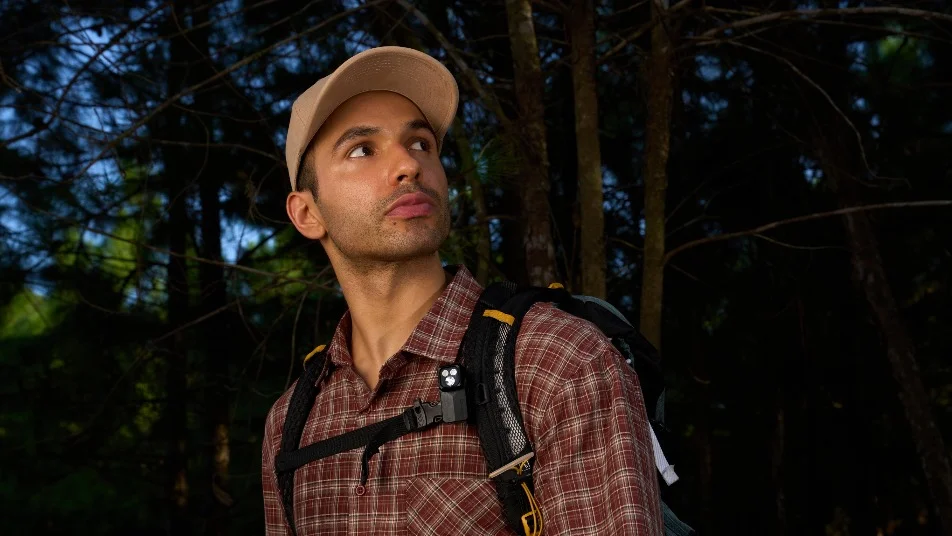
| Hands-free light while you cut | Clip light plus a separate knife | Tilting head, clip, 100-lumen mode that lasts 3+ hours | Oclip 2 Pro (115° head tilt, 100 lm for 3 hours 45 minutes) |
| Lightest possible pair | Tiny light plus a small folding knife | Under 45 g for the light, waterproof body | i3T 2 EOS (41.8 g, IPX8) |
| Pliers, screwdrivers and a blade | Multitool plus a separate light | Locking main blade, pocket clip | NexTool F12 (13 tools, 79 g) |
📋 Table of Contents
- 1. What Is a Knife With Flashlight, and When Does the Combo Make Sense?
- 2. Three Night Tasks, Walked Through Step by Step
- 3. Where Is the Light on a Knife With Flashlight, and Why Does It Matter?
- 4. What Do You Give Up When the Knife and Light Share One Body?
- 5. Carrying Them Separately: Weight and Pocket Space Compared
- 6. Is It Illegal to Carry a Tactical Knife?
- 7. Is There a Swiss Army Knife With a Flashlight?
- 8. What Is a Texas Toothpick?
- 9. EDC Knife Light Combo or Multitool With Light: Who Should Pick Which?
- 10. FAQ
What Is a Knife With Flashlight, and When Does the Combo Make Sense?
A knife with flashlight is a folding knife whose handle holds an LED, a battery and a switch, so one tool lights and cuts. It makes sense when you cut in the dark a few times a week, for a minute or two each time, and you would rather carry one item than two. It makes less sense for long searches or repair work.
Built-in lights come in two kinds. Older designs put a tiny coin-cell LED in the handle scale, mostly for finding a keyhole. Newer ones, such as the OKNIFE LK folding pocket knife with flashlight, use a rechargeable lithium-ion cell and a real main beam. Olight lists the LK's white main light at 400 lumens, with USB-C charging and a 2.48 in (62.9 mm) M390 tanto blade. You can compare it with the rest of Olight's folding EDC knives on the category page.
The combo trades flexibility for convenience. You have one clip, one charging cable and one thing to remember at the door. But the knife now has a battery, so it has a charge level, a working temperature range and water limits that a plain knife does not have. The rest of this guide shows how much those limits matter for each job.
Three Night Tasks, Walked Through Step by Step
Three common jobs show where a knife with flashlight earns its place and where it falls behind: opening a delivery on a dark porch, dealing with a jammed seatbelt or strap in a car, and freeing a knotted guy line at a campsite. The combo handles the porch well, the car only with a caveat about heat, and the campsite only in dry weather above freezing.
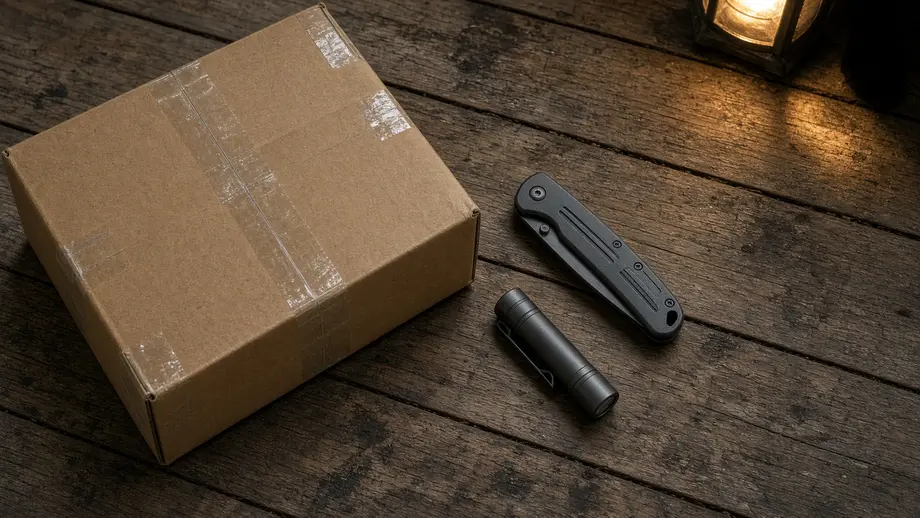
Night delivery on the porch. You need light for about 30 seconds, then a short, controlled cut through tape. With the LK, press the switch once for the spotlight, tilt the box toward the beam, then open the blade with the flipper. Low (10 lumens) is enough at arm's length and keeps your eyes adjusted to the dark. Close the blade before you carry the box inside.
A strap or seatbelt in the car. Here the combo runs into a storage problem, not a cutting problem. The OKNIFE LK user manual says not to place, charge or use the light in a car where the inside may exceed 60°C (140°F). The National Weather Service notes that a dark dashboard or seat can reach 180 to over 200°F in the sun. A knife-light left in a glovebox all summer breaks that warning, so carry it on your body and take it with you when you leave the car.
The cut itself also argues for a simple routine. For a cargo strap or a tangled tie-down, turn on Low or High first and check where the strap runs, so you don't cut the wrong line or nick a seat. Then pull the strap tight and away from the upholstery, open the blade, and cut outward, away from your body and your other hand. A 2.48 in folding blade handles a strap. For a seatbelt emergency, a dedicated belt cutter mounted where you can reach it while buckled in is a better plan than a folding knife in a pocket.
A knotted guy line at camp. A wet knot at 11 p.m. can take several minutes. You need light on the knot while both hands work, which a handheld knife-light can't give you once the blade is out. This is where a clip light on your jacket or cap brim does better, and where the combo's water and cold limits matter.
This table lists what each sub-scenario asks of the light, based on the steps above.
| Scenario | Light needed at the task | Time on per use | Water exposure | Combo verdict |
|---|---|---|---|---|
| Porch package | 10 to 100 lumens at arm's length | Under 1 minute | Light rain possible | Works well |
| Car strap or seatbelt | 100 lumens, aimed at your lap | 1 to 3 minutes | Low | Works if carried on your body, not stored in the car |
| Campsite cord | 100 lumens, hands free | 5 to 15 minutes | Rain, dew, puddles | Clip light plus knife is better |
| Garage zip ties and boxes | 100 lumens, often hands free | 5 to 30 minutes | Low | Either works; clip light gives more runtime |
| Winter hunting camp | 10 to 100 lumens | Varies | Snow | Separate light; see the cold limit below |
Safety note: Light the work first, then open the blade. Close the blade before you reach for the switch again. On a combo, the switch and the blade are close together, so fumbling in the dark with an open edge is the main way people get hurt.
Where Is the Light on a Knife With Flashlight, and Why Does It Matter?
On a knife-light combo, the LED sits in the handle, so the beam lights whatever the handle faces, not the cutting edge. The OKNIFE LK user manual's diagrams show the main LED and a ring of 16 RGB LEDs in a round window on the flat face of the handle, near the butt end and away from the pivot. The USB-C port sits on the butt end itself.
There are two common layouts, and each lights a different spot:
- Lens on the handle face (the LK layout). The beam leaves the side of the handle. With the blade closed, you hold it like a flat pocket light and aim the face at the task. With the blade open and edge down in a normal grip, the face points to the left or right, so the beam lights the area beside your cut, not the edge itself.
- Lens at the tip of the handle or on the spine, aimed along the blade. The beam follows the edge, so the spot you cut is the spot you light. The cost is a lens that sits closer to the work and to tape residue, and a light that is awkward to use as a flashlight with the blade closed.
The face-mounted layout has a clear upside: the light works fully with the blade closed, so it doubles as a pocket flashlight. The downside shows up during a cut, because turning your wrist to aim the lens also turns the edge. The practical fix is to light and cut in sequence. Look first with the blade closed and note where the tape seam runs. Then set the box under a second light source, such as a porch light or a clip light, or cut along the seam you already found.
Olight also describes the LK's flat profile as stable on a flat surface. Because the lens is on the face opposite the pocket clip in the manual's drawings, the closed knife can lie clip side down with the lens facing up. On Low, that bounces soft light off a tent roof or a low car ceiling. It is a handy way to light a small space, not a way to light a cut.
Brightness at the task is easy to estimate from the published peak intensity. Illuminance in lux equals candela divided by distance in meters squared. The LK manual lists 3,000 candela and a 110 m beam distance. Streamlight's published summary of the ANSI/PLATO FL1 standard defines beam distance as the point where the light falls to 0.25 lux. The check works: 3,000 ÷ 110² = 0.248 lux, which matches the rated 110 m.
This table applies that formula at working distances, with the lens aimed straight at the task. The High and Low candela figures are our estimate: Olight lists candela only at Turbo, so we assume the beam shape stays the same and intensity scales with lumens (100 ÷ 400 × 3,000 = 750 cd for High; 75 cd for Low).
| Distance | Turbo, 400 lm (3,000 cd listed) | High, 100 lm (about 750 cd, estimated) | Low, 10 lm (about 75 cd, estimated) |
|---|---|---|---|
| 0.5 m (arm's length) | 12,000 lux | about 3,000 lux | about 300 lux |
| 1 m | 3,000 lux | about 750 lux | about 75 lux |
| 3 m (across a garage) | 333 lux | about 83 lux | about 8 lux |
| 10 m (yard) | 30 lux | about 7.5 lux | under 1 lux |
The practical takeaway: Low puts hundreds of lux on a box at arm's length, so Turbo is wasted on close cutting and only drains the small battery faster. Save Turbo for looking across a yard. For more on how candela sets reach, see our explainer on beam distance.
What Do You Give Up When the Knife and Light Share One Body?
Combining the tools costs three things: blade length, grip room and battery capacity. The handle must hold a cell and a circuit, so the blade stays short and the handle gets thicker. The LK's 2.48 in blade and 0.65 in (16.6 mm) handle are the result. Its 340 mAh cell also runs the High mode for 1 hour 30 minutes, while a dedicated clip light runs longer.
Blade length. A 2.48 in blade handles tape, zip ties, cord and food packaging. It isn't a camp chopper or a game-processing knife. The short blade has one advantage: it sits well under common legal limits, covered in the law section below.
Grip. Olight lists the LK at 6.3 in (159.9 mm) open, 0.98 in (25.0 mm) wide and 0.65 in (16.6 mm) thick, weighing 3 oz (86 g). A thick, flat handle fills the hand, but the switch lives where your fingers wrap, which is why Olight includes a lockout: hold the switch for more than 2 seconds with the light off, according to the user manual. Lock it before it goes in a pocket.
Battery. The manual lists a 340 mAh, 3.7 V cell (1.258 Wh), charged over USB-C in about 60 minutes. Its runtimes are Turbo 400 lumens for 1 minute, then 50% for 50 minutes; High 100 lumens for 1 hour 30 minutes; Low 10 lumens for 13 hours. The RGB light runs 7 lumens for 3 hours.
To compare lights with different mode tables, multiply lumens by hours. The result, lumen-hours, is a rough measure of how much useful light one charge delivers at a given mode. This table does that math for the LK and two separate lights, using each maker's listed step-downs.
| Light | Mode | Listed output and runtime | Lumen-hours per charge (calculated) |
|---|---|---|---|
| OKNIFE LK | Turbo | 400 lm for 1 min, then 200 lm for 50 min | 6.7 + 166.7 = about 173 |
| OKNIFE LK | High | 100 lm for 1 h 30 min | 150 |
| OKNIFE LK | Low | 10 lm for 13 h | 130 |
| Oclip 2 Pro | Medium floodlight | 100 lm for 3 h 45 min | 375 |
| Oclip 2 Pro | Low floodlight | 10 lm for 25 h | 250 |
| i3T 2 EOS (AAA) | High | 200 lm for 7 min, then 100 lm for 28 min | 23.3 + 46.7 = 70 |
| i3T 2 EOS (AAA) | Low | 5 lm for 21 h | 105 |
At the same 100 lumens, the Oclip 2 Pro runs 2.5 times longer than the LK (225 minutes vs 90). That fits their batteries: Olight lists 600 mAh for the Oclip 2 Pro against the LK's 340 mAh. Charge planning follows directly. At 10 minutes a night on High, the LK lasts about 9 nights per charge (90 ÷ 10). On Low it lasts about 78 nights (13 hours = 780 minutes, ÷ 10). Our guide to flashlight runtime explains why real runtimes drift from these listed figures.
Note: The LK manual says only the high brightness level is available while charging, and it warns against switching on Turbo several times in a row, to avoid surface overheating. Plan short Turbo bursts, not long ones.
Carrying Them Separately: Weight and Pocket Space Compared
Carrying a separate knife and light is not always heavier. A tiny AAA light plus a slim traditional folder can weigh less than one combo, while a clip light plus a multitool weighs almost twice as much. The combo's real advantage is one clip and one item to remember, not fewer grams, so compare the pair you would actually carry.
This table adds up published weights. Volumes are simple box or cylinder math from listed dimensions, rounded, and marked where a maker doesn't list enough to calculate.
| Setup | Items and listed weights | Total weight | Pocket volume (calculated) | Blade | Light output |
|---|---|---|---|---|---|
| OKNIFE LK alone | 86 g | 86 g | 97 × 25 × 16.6 mm = about 40 cm³ | 2.48 in M390 | 400 lm |
| OKNIFE LK Zombie Green alone | 87 g | 87 g | Not listed separately | D2 steel | 400 lm |
| i3T 2 EOS + Case Small Texas Toothpick | 41.8 g + 1 oz (about 28 g) | about 70 g | Light: 15 mm × 89 mm cylinder = about 16 cm³; knife 3.0 in closed, width not listed | 2.25 in clip blade | 200 lm |
| i3T 2 EOS + NexTool F12 | 41.8 g + 79 g | 120.8 g | Light about 16 cm³; F12 not listed | 8Cr14MoV locking main blade | 200 lm |
| Oclip 2 Pro + NexTool F12 | 75.5 g + 79 g | 154.5 g | Light: 60.2 × 28 × 35 mm = about 59 cm³; F12 not listed | 8Cr14MoV locking main blade | 530 lm |
Two points stand out. First, the lightest pair (about 70 g) is 16 g lighter than the LK, but its light is 200 lumens and Case's listing for the knife doesn't mention a lock. Second, the heaviest pair buys you pliers, drivers, a tilting head and hands-free light, which matters more to a tradesperson than 68 extra grams. If you are building a full kit on a budget, see our best EDC under 100 guide.
Is It Illegal to Carry a Tactical Knife?
Carrying a "tactical" knife is not illegal in itself, because tactical is a marketing word, not a legal category. Knife laws usually turn on blade length, how the blade opens and where you carry it. A small folding knife with a manual opening is legal to carry in many places, but state law, city rules and posted building rules decide, so check yours first.
Federal law targets automatic knives, not tactical styling. Under 15 U.S.C. § 1241, a switchblade is a knife whose blade "opens automatically" by pressing a button or other device in the handle, or by inertia, gravity or both. Olight describes the LK as opening by a flipper tab with a button lock, a manual opening, and doesn't describe it as automatic.
State law sets most of the everyday rules. Take Texas as an example: the Texas Penal Code, Chapter 46, defines a "location-restricted knife" as one with a blade over five and one-half inches and bans those knives in listed places such as school premises. Other states draw their lines differently, so read your own state's current statute text rather than a summary.
Opening mechanism can matter more than length. California is a clear example. California Penal Code § 17235 defines a switchblade as a knife with a blade two or more inches long that can be released automatically, for example "by a flick of a button, pressure on the handle, flip of the wrist or other mechanical device." It excludes a knife that opens with one hand using thumb pressure on the blade or a thumb stud, provided a detent or similar mechanism resists opening. Under California Penal Code § 21510, carrying such a switchblade on your person, or having it in the passenger or driver area of a vehicle in a public place, is a misdemeanor.
Two details in that text matter for a knife-light. First, the LK's 2.48 in blade is over the two-inch line, so its opening method decides which rule applies. Second, the exception names thumb pressure and thumb studs but doesn't name flipper tabs. Olight describes the LK as opening by a flipper tab with a button lock and the Zombie Green by a "bearing-assisted flipper"; neither product page describes a spring or automatic opening. How a given state treats a flipper is a question for that state's statute and case law, not for a product page.
To check your own state, follow this path:
- Find your state legislature's official code site and search for "knife," "switchblade" and "automatic."
- Note any blade-length number and whether it applies everywhere or only in listed places such as schools, courts or bars.
- Read the definition section to see whether your opening method (thumb stud, flipper, spring assist, automatic) is covered.
- Check your city or county code, since some cities set tighter carry rules than the state.
- Check the posted rules at your workplace and any building you visit often.
This table collects the rules a knife-light owner runs into most often, with where each one comes from.
| Rule | What it says | What it means for a knife-light combo |
|---|---|---|
| Federal switchblade definition (15 U.S.C. § 1241) | Covers blades that open automatically by button, inertia or gravity | Manual flipper openers fall outside that definition; check any assisted or automatic model separately |
| Federal switchblade penalty (15 U.S.C. § 1243) | Bans making, selling or possessing switchblades in U.S. territories, Indian country and special federal jurisdictions; up to $2,000 fine or 5 years | Applies to automatic knives in those places |
| Texas location-restricted knife (Penal Code §§ 46.01, 46.03) | Blade over 5.5 in; banned in listed places such as school premises | A 2.48 in blade is well under the length line, but school and other building rules still apply |
| California switchblade (Penal Code §§ 17235, 21510) | Automatic-opening blade of 2 in or more; carrying one on your person or in a vehicle's passenger area is a misdemeanor | Length alone doesn't clear you; the opening method decides, so confirm how your model opens |
| TSA carry-on rule | Knives: carry-on no, checked yes, sheathed or wrapped | The combo can't ride in the cabin, so neither can its light |
| FAA lithium device rule | Devices with rechargeable lithium batteries may be checked only if completely powered off and protected from accidental activation | Use the lockout before packing it in a checked bag |
Air travel is the rule that hurts a combo most. The TSA lists knives as not allowed in carry-on bags, and says sharp objects in checked bags should be sheathed or securely wrapped. It lists flashlights as allowed in carry-on bags. The FAA adds that rechargeable lithium devices in checked bags must be completely powered off and protected from accidental activation. Fly with a combo and you land with no light in your pocket; fly with a separate light and it stays with you.
Warning: Knife laws change and vary by city as well as state. This article is general information, not legal advice. Check your state's current statute and local ordinances before you carry any knife, and follow posted rules at schools, courthouses and workplaces.
Is There a Swiss Army Knife With a Flashlight?
Yes. Victorinox makes Swiss Army Knife models with an integrated LED. Its emergency-tools announcement describes the Signature Lite, with eight functions including a small blade, scissors, a nail file with screwdriver, an LED light and a pressure ballpoint pen, and the Huntsman Lite, with 23 functions that include an LED light, a whistle and a fire starter.
In its Victorinox emergency tools announcement, the company says the integrated LED "provides orientation during power outages." It also notes the fluorescent yellow, glow-in-the-dark handles on both emergency versions. The announcement doesn't list lumens or runtime, so judge those lights as locator and keyhole lights rather than a main flashlight.
The two approaches solve different problems. A Swiss Army Knife with a light spreads its value across many small tools and treats the LED as a helper. A combo like the LK puts a 400-lumen main light and a single locking blade first. If you want scissors and tweezers more than beam distance, the Swiss Army route fits. If you want one thing that works as a real flashlight, you need a larger battery and a proper main LED.
What Is a Texas Toothpick?
A Texas toothpick is a slim folding pocketknife pattern with a long, narrow clip-point blade. It is a traditional design with no built-in light. W.R. Case & Sons, for example, lists its Small Texas Toothpick with a 2.25 in long clip blade, a 3.0 in closed length and a weight of 1 ounce.
The pattern shows up in this topic for a reason: it is one of the slimmest, lightest ways to carry a blade. Case's Small Texas Toothpick listing describes a "small design that fits well into pockets or purses" and says the clip blade is "preferred for detail work." Pair a knife that size with a small AAA flashlight and you get the lightest two-item carry in the weight table above.
The tradeoff is the lock. Case's product listing doesn't mention a locking blade, so treat a traditional toothpick as a light-duty knife for slicing and opening, not for prying or hard pushing cuts. For more ideas on pairing a classic knife with a modern light, see our list of unique EDC gear for men.
EDC Knife Light Combo or Multitool With Light: Who Should Pick Which?
Pick an EDC knife light combo if your night cutting jobs are short, you want a single clip and you don't fly often. Pick a separate light and knife, or a multitool with a clip light, if you work hands free, get wet, face freezing weather or need pliers and drivers. Five yes-or-no questions below settle it for most people.
Answer these in order. The first "no" usually points you to separate tools.
- Are most of your dark-condition cuts under 3 minutes of light? If yes, the LK's 1 hour 30 minutes on High covers weeks of use per charge.
- Do you stay above freezing? The LK manual says the product will be unavailable in environments below 0°C (32°F) and can't be charged below 0°C or above 40°C.
- Do you stay out of standing water? The LK user manual lists IPX5 and says not to immerse the product. The i3T 2 EOS is rated IPX8 and the Oclip 2 Pro IP66.
- Can you keep it on your body instead of in a hot car? The manual's 60°C (140°F) vehicle warning rules out glovebox storage in summer.
- Do you rarely fly with only carry-on bags? If you often do, the TSA knife rule strips you of the light too.
If you answered yes to all five, the combo fits. The OKNIFE LK in M390 ($124.99 regular price, September 2026) pairs the 400-lumen light with an M390 blade and a deep-carry clip. The OKNIFE LK Zombie Green ($79.99 regular price, September 2026) keeps the 400-lumen main light and RGB light with red signaling, uses a D2 tool steel blade and weighs 87 g. The steel is the main difference for the $45 gap. Neither is the right pick for a kayaker, an ice fisher or anyone who needs light for an hour straight.
A knife-light combo is also an adult tool. The LK user manual says the knife is extremely sharp and asks you to store it out of the reach of children, and school premises are exactly where rules such as the Texas list above apply. For a student's backpack, leave the blade out entirely. For young children, even a small flashlight needs adult supervision: the i3T 2 EOS user manual, for example, says not to give the product to children to play with, to avoid accidental swallowing. Keep any knife, combo or not, with an adult.
If you work hands free, use the Olight Oclip 2 Pro clip light ($54.99 regular price, September 2026) with any knife you like. Its 360° rotating clip and 115° head tilt let you aim the beam at the knot or the box while both hands work, and its Medium floodlight runs 100 lumens for 3 hours 45 minutes. Its limit is size: at 75.5 g and about 35 mm deep, it is bulkier in a pocket than a slim knife. The Oclip 2 user manual adds a caution for anyone with an implanted heart device: "If you have an ICD or pacemaker, avoid close or prolonged contact with this product to prevent possible interference."
If you want the lightest pair, the Olight i3T 2 EOS ($19.99 regular price, September 2026) weighs 41.8 g, runs on an included AAA battery and is rated IPX8. Its High mode steps from 200 to 100 lumens over 7 + 28 minutes, so it suits short jobs, not long searches.
If you need a multitool with light, know that most compact multitools have no light of their own. The NexTool F12 multitool ($34.98 regular price, September 2026) has 13 tools, a locking 8Cr14MoV main blade and a glow-in-the-dark insert, not a flashlight, at 79 g. Pair it with the i3T 2 EOS for 120.8 g total. Browse Olight's EDC flashlights if you want a different light for that pair.
Tip: Whatever you choose, lock the light out before it goes in a pocket or bag. The LK manual asks you to lock the product when it is carried or transported, and a hold of more than 2 seconds does it.
Your action checklist:
- Count your dark-condition cuts for one week and note how long the light stays on each time.
- Check your state's knife statute and any city rules for blade length and opening type.
- If you fly with only a carry-on, plan on a separate light that can stay in the cabin.
- Keep any knife with flashlight on your body, not in a hot car, and charge it before long storage.
- Use Low for close work and save Turbo for looking across a yard.
FAQ
Changelog
- September 23, 2026: First published. Olight specs and regular prices come from Olight product pages and user manuals as listed in September 2026.