Olight makes the lights discussed here. Olight specs and prices come from its product pages and user manuals as of September 2026; battery and outage figures come from the sources linked in each section.
⚡ TL;DR
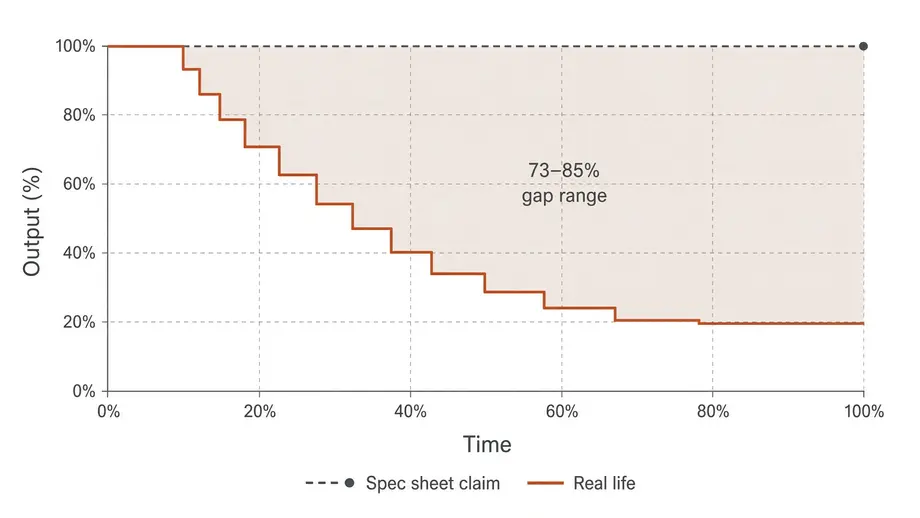
Flashlight runtime on a spec sheet is the ANSI FL1 time from 30 seconds after switch-on until output falls to 10% of that first reading, with a fresh battery in a lab. That is the condition the rating describes. On a 0 °C night with a battery that has seen about 200 charge cycles, plan on roughly 73% to 85% of it, and far less time at the headline brightness.
That gap is why a light can feel broken when it is working as designed. The Olight Baton 4 page lists 1,300 lumens and up to 30 days of runtime. Both numbers are real, but they sit at opposite ends of the mode list: 1,300 lumens lasts 1.5 minutes, and the 30 days belong to a 0.5-lumen Moonlight mode. If you bought for the first number and expected the second, the light will seem to die fast.
This table compares the flashlight runtime a spec sheet reports with what the same published figures work out to under everyday conditions. The real-life column is estimated from Olight's stage data and the battery sources cited below, not measured.
| Dimension | Spec sheet (ANSI FL1) | Real life | Which runs longer | How big the gap is |
|---|---|---|---|---|
| Battery | Fresh, fully charged | Part-charged, or a cell with about 200 cycles | Spec sheet | About 8% to 12% less capacity at 200 cycles (estimate below) |
| Temperature | Lab conditions; Olight lists a 0 to 40 °C working range | A 0 °C winter night | Spec sheet | About 8% to 17% less capacity at 0 °C (Battery University figures) |
| End point | Output falls to 10% of the 30-second reading | The moment the beam is too dim for your task | Spec sheet, if your task needs more than 10% | Warrior Ultra: the last 39 of 203.5 turbo minutes run at 250 lumens |
| Time at headline output | A small slice of the total | You notice the drop within minutes | Neither; both describe the same curve | Perun 3: 2 of 212 turbo minutes at 3,000 lumens (0.9%) |
| Mode use | One mode, left running | Switching up and down all night | Real life, if you drop to Medium | Warrior Ultra: 3.45 hours on High vs about 8.4 hours mixing High and Medium |
| Combined worst case | 100% of the rating | Aged cell at 0 °C | Spec sheet | 73% to 85% of the rating (Perun 3 Medium: 18.3 to 21.2 of 25 hours) |
📋 Table of Contents
- 1. What Does ANSI Runtime Actually Measure?
- 2. How to Read a Flashlight Runtime Curve: Flat, Step-Down and Tail
- 3. Runtime Claims vs Real Life: Three Olight Runtime Tables Decoded
- 4. Why Does My Flashlight Die So Fast?
- 5. How Much Runtime Do You Lose in the Cold?
- 6. How Much Runtime Does an Aging Battery Lose?
- 7. How Do You Make One Battery Last Hours Longer?
- 8. Which Flashlight Has the Longest Runtime?
- 9. Is 500 Lumen Very Bright?
- 10. How Long Does a Flashlight Stay On?
- 11. Buy Backwards: How Much Flashlight Runtime Do You Need?
- 12. Flashlight Runtime Action Checklist
- 13. FAQ
What Does ANSI Runtime Actually Measure?
ANSI runtime is a timer with a defined start and finish. It starts 30 seconds after you switch on a light with fresh batteries, when output is first recorded, and it stops when output drops to 10% of that reading. It does not measure how long the light stays at full brightness, and it does not tell you when the beam stops being useful for your task.
Streamlight's public summary of the ANSI/PLATO FL1 standard defines run time this way: "The duration of time from the initial light output value (that's 30 seconds after the light is turned on with fresh batteries) until the light output drops to 10% of the initial value." The full standard is sold by its publisher, so that summary is the practical reference. For all six FL1 numbers and what each one leaves out, see our explainer on ANSI FL1.
Olight's manuals state the test basis for the three lights in this guide. The Baton 4 user manual says its table was "tested per ANSI/PLATO FL 1-2019 standard in Olight's labs for reference," and the Perun 3 user manual carries the same line. The Warrior Ultra user manual cites ANSI/NEMA FL 1-2019. The same runtime format appears across Olight's range of flashlights, so the reading method below works on any of them.
The standard itself is changing. PLATO, the trade group that publishes FL1, announced the revised ANSI/PLATO FL 1-2025 standard on February 2, 2026, that adds a test method for "Short-Duration Elevated Brightness," the modes sold as turbo or boost. Until spec sheets carry that new rating, the step-down stages in a runtime table are your best guide to how long peak output lasts.
Note: The 10% end point means a light can still be glowing when its rated runtime is over. A light rated at 2,500 lumens reaches the end of its FL1 runtime at 250 lumens, which is still enough to walk by.
How to Read a Flashlight Runtime Curve: Flat, Step-Down and Tail
Read a flashlight runtime line as three segments. The flat segment is the headline output, held for a short, fixed time. The step-down segment is a lower level the light can hold for most of the battery. The tail is a final low level that runs until the FL1 clock stops. Olight writes the lumen levels as a chain, such as 1,300~600~300 lumens, with matching minutes such as 1.5 + 2.5 + 73.
Olight's manuals add the percentages behind those chains, which makes the curve easy to sketch. The Baton 4 manual lists Turbo at 100% for 1.5 minutes, 46% for 2.5 minutes and 23% for 73 minutes, and High at 100% for 7 minutes, 50% for 72 minutes and 10% for 16 minutes. The Warrior Ultra manual lists Turbo at 100% for 2.5 minutes, 32% for 162 minutes and 10% for 39 minutes.
This table lays out the three segments using the Baton 4 and Warrior Ultra manual figures.
| Segment | What happens | Baton 4 Turbo | Warrior Ultra Turbo | What to read from it |
|---|---|---|---|---|
| Flat | Headline output | 1,300 lm (100%) for 1.5 min | 2,500 lm (100%) for 2.5 min | How long a burst lasts |
| Step-down | Level held for most of the battery | 600 lm (46%) for 2.5 min, then 300 lm (23%) for 73 min | 800 lm (32%) for 162 min | Your real working brightness |
| Tail | Last level before the clock stops | No separate tail listed; the 73-minute 300 lm stage is the last one | 250 lm (10%) for 39 min | Reserve light, not working light |
A step-down also cuts reach. Beam distance under FL1 scales with the square root of candela, so if the beam shape stays the same, the Warrior Ultra's rated 320 meters falls to about 181 meters at 800 lumens: 320 × √(800 ÷ 2,500) = 320 × 0.566 = 181 m. Our guide to beam distance walks through that square-root rule.
Tip: When you compare two lights, skip the headline lumens and compare the second number in each chain and the minutes beside it. That pair describes the light you will actually use.
Runtime Claims vs Real Life: Three Olight Runtime Tables Decoded
All three lights spend less than 2% of their turbo runtime at the headline output, yet each delivers a steady working level for hours. The Perun 3 holds 3,000 lumens for 2 of its 212 turbo minutes, the Warrior Ultra holds 2,500 lumens for 2.5 of 203.5 minutes, and the Baton 4 holds 1,300 lumens for 1.5 of 77 minutes. The long part of each runtime is the step-down level.
This table lists the published runtime readings for the three lights, with the battery and the test basis each manual states.
| Light and battery | Mode | Output stages | Stage times | Rated total | Test basis in manual |
|---|---|---|---|---|---|
| Baton 4, 650 mAh 16340 (2.34 Wh) | Turbo | 1,300~600~300 lumens | 1.5 + 2.5 + 73 minutes | 77 min | ANSI/PLATO FL 1-2019, Olight's labs |
| Baton 4 | High | 600~300~60 lumens | 7 + 72 + 16 minutes | 95 min | Same |
| Baton 4 | Med | 60 lumens | 8 hours | 8 h | Same |
| Warrior Ultra, 5000 mAh 21700 (18 Wh) | Turbo | 2,500~800~250 lumens | 2.5 + 162 + 39 minutes | 203.5 min | ANSI/NEMA FL 1-2019, Olight's labs |
| Warrior Ultra | High | 800~250 lumens | 168 + 39 minutes | 207 min | Same |
| Warrior Ultra | Med | 200 lumens | 13 hours | 13 h | Same |
| Perun 3, 5000 mAh 21700 (18 Wh) | Turbo | 3,000~800~600 lumens | 2 + 180 + 30 minutes | 212 min | ANSI/PLATO FL 1-2019, Olight's labs |
| Perun 3 | High | 600~120 lumens | 300 + 30 minutes | 330 min | Same |
| Perun 3 | Med | 120 lumens | 25 hours | 25 h | Same |
The full lists go lower. The Baton 4 also lists Low at 12 lumens for 35 hours and Moon at 0.5 lumens for 30 days. The Olight Warrior Ultra (2,500 lumens, 26,000 candela, 320 m, IPX8, $139.99 regular price, September 2026) lists Low at 15 lumens for 130 hours and Moon at 1 lumen for 55 days. The Olight Perun 3 (3,000 lumens, 6,400 candela, 160 m, IP68, $89.99 regular price, September 2026) lists Low at 30 lumens for 89 hours, Moon at 5 lumens for 20 days, and red light at 60 lumens for 14 hours or 15 lumens for 70 hours. The Baton 4 is $54.99 (regular price, September 2026).
To see what a runtime line really delivers, multiply each stage's lumens by its minutes and add them up. That gives the total light in lumen-minutes; dividing by 60 gives lumen-hours, and dividing lumen-minutes by the total minutes gives the average output across the rated runtime. For the Warrior Ultra on Turbo: 2,500 × 2.5 + 800 × 162 + 250 × 39 = 6,250 + 129,600 + 9,750 = 145,600 lumen-minutes, or about 2,427 lumen-hours, averaging 145,600 ÷ 203.5 = 715 lumens.
This table applies that calculation to each mode. The figures are calculated from Olight's published stages, not measured.
| Light | Mode | Time at headline output | Share of rated runtime at headline | Average output over the runtime | Total light (lumen-hours) |
|---|---|---|---|---|---|
| Baton 4 | Turbo | 1.5 min | 1.9% | 329 lm | 423 |
| Baton 4 | High | 7 min | 7.4% | 282 lm | 446 |
| Baton 4 | Med | 8 h | 100% | 60 lm | 480 |
| Warrior Ultra | Turbo | 2.5 min | 1.2% | 715 lm | 2,427 |
| Warrior Ultra | High | 168 min | 81.2% | 696 lm | 2,403 |
| Warrior Ultra | Med | 13 h | 100% | 200 lm | 2,600 |
| Perun 3 | Turbo | 2 min | 0.9% | 792 lm | 2,800 |
| Perun 3 | High | 300 min | 90.9% | 556 lm | 3,060 |
| Perun 3 | Med | 120 lm for 25 h | 100% | 120 lm | 3,000 |
Two patterns stand out. First, each light has a fairly fixed light budget per charge: about 420 to 480 lumen-hours for the Baton 4 and about 2,400 to 3,060 for the two 21700 lights across Turbo, High and Med. Choosing a mode decides how fast you spend that budget, not how much you get. Second, the Medium modes deliver as much total light as Turbo or more, so running Medium costs you little in total light and gives you hours instead of minutes.
Why Does My Flashlight Die So Fast?
A flashlight that seems to die fast is usually reporting a normal step-down, a cold or aged battery, or a timer or sensor you did not know was on. Check four things in order: which mode you used, the air temperature, the battery's age, and any auto-off feature in the manual. A real fault looks different: dimming within seconds from a cold start, flicker, or a light that stays dim after cooling and recharging.
Some shutdowns are features. The Baton 4 manual describes an auto shut-off that can turn the light off after "two preset periods: a long period (9 minutes) and a short period (3 minutes)," set by double-pressing and holding the button. The Warrior Ultra manual says that in High, Turbo or Strobe, if something blocks the lens, brightness drops to prevent overheating, and adds: "The light will automatically turn off if the obstruction persists for over 1 minute." Olight's product page adds that a double or triple press of the side switch within 5 seconds disables that sensor dimming until the next time the light is switched on.
This checklist matches each symptom to its likely cause and the fix.
| Symptom | Likely cause | What to check or do |
|---|---|---|
| Bright for 1 to 3 minutes, then clearly dimmer | Normal turbo step-down | Compare with the stage times in the runtime table |
| Light turns off after exactly 3 or 9 minutes | Baton 4 auto shut-off timer is set | Review the auto shut-off steps in the Baton 4 manual |
| Warrior Ultra dims near a wall or in a holster, then shuts off | Proximity sensor responding to a blocked lens | Clear the lens, or double or triple press the side switch within 5 seconds |
| Every mode runs short on a winter night | Cold battery with temporarily reduced capacity | Keep the light in an inside pocket until needed |
| Every mode runs short, all year, after heavy use | Aged cell has lost capacity | Replace the cell; Olight lists a one-year warranty on its rechargeable batteries |
| The light never seems to start full | Charge did not finish | On the Baton 4 cable, red means charging and green means complete |
| Dims within seconds from cold, or flickers | Battery, contact or driver fault | Stop using it and contact the maker's support |
Warning: Do not try to extend runtime by warming a lithium-ion light on a heater, dashboard or stove. Olight's manuals list a working temperature of 0 to 40 °C for all three lights here, and heat shortens battery life.
How Much Runtime Do You Lose in the Cold?
At 0 °C (32 °F), expect roughly 8% to 17% less runtime than the rating, based on Battery University's cold-temperature figures for two common 18650 cells. The loss is temporary: capacity returns once the cell warms up. Colder air costs more, which is why Olight lists a 0 to 40 °C working range for the Baton 4, Warrior Ultra and Perun 3, and why a light kept in an inside pocket runs longer.
Battery University, the education site of battery-analyzer maker Cadex, explains: "Cold temperature increases the internal resistance and lowers the capacity." The same page says: "A battery that provides 100 percent capacity at 27°C (80°F) will typically deliver only 50 percent at –18°C (0°F)." It adds: "The reduced capacity at low temperature only applies while the cell is in that condition and will recover in room temperature." It also notes that warming a dying flashlight battery "in our jeans might provide additional runtime."
For 0 °C, Battery University lists specific figures for two Panasonic cells. Its Li-ion discharge page puts a high-capacity energy cell at about 83% of its 25 °C capacity at 0 °C, and a high-current power cell at about 92%. Olight does not say which cell type its customized batteries use, so the table below uses both figures as a range.
This table estimates Medium-mode runtime at 0 °C for each light by multiplying the rated hours by 0.83 and 0.92.
| Light | Medium mode, rated | At 0 °C, energy-cell figure (83%) | At 0 °C, power-cell figure (92%) |
|---|---|---|---|
| Baton 4 | 60 lm for 8 h | About 6.6 h | About 7.4 h |
| Warrior Ultra | 200 lm for 13 h | About 10.8 h | About 12.0 h |
| Perun 3 | 120 lm for 25 h | About 20.8 h | About 23.0 h |
Cold works differently on turbo. If a light steps down on temperature, cold air helps it shed heat and can delay the drop; if the step-down is timed, cold changes nothing there. Either way the battery delivers less in total, so plan cold-weather runtime from the Medium and Low lines, not from turbo.
Tip: Carry the light or its spare cell against your body and switch to the working mode as soon as you pull it out. Below 0 °C you are outside Olight's listed working range, so let the light warm up before relying on it.
How Much Runtime Does an Aging Battery Lose?
An aging lithium-ion cell loses capacity in small steps, and runtime shrinks with it. As a working estimate, a cell with about 200 full charge cycles holds roughly 88% to 92% of its new capacity, so a 25-hour rating becomes about 22 to 23 hours. By around 500 cycles, plan on about 80%. Heat and storage at full charge speed that loss up.
The estimate comes from two published data points. Battery University says: "Manufacturers take a conservative approach and specify the life of Li-ion in most consumer products as being between 300 and 500 discharge/charge cycles," and reports a Cadex lab run in which phone battery packs "started at a capacity of 88–94% and decreased to 73–84% after 250 full discharge cycles." That is a loss of 10 to 15 points of rated capacity over 250 cycles, or 8 to 12 points over 200 on a straight line. Taken from a cell that starts at its full rating, that leaves 88% to 92%. Cell maker Molicel lists its INR21700-P45B power cell at "500+ Cycles" with "80% retention" at a high rate; a straight-line fade from 100% to 80% over 500 cycles gives 92% at 200 cycles. Both routes land at about 88% to 92%, which is the working estimate used below.
This table applies those estimates to the two 21700 lights, alone and combined with the 0 °C figures above.
| Battery condition | Capacity factor | Perun 3 Medium (120 lm, rated 25 h) | Warrior Ultra Medium (200 lm, rated 13 h) |
|---|---|---|---|
| New, room temperature | 100% | 25 h | 13 h |
| About 200 cycles | 88% to 92% | 22.0 to 23.0 h | 11.4 to 12.0 h |
| About 500 cycles | About 80% | 20.0 h | 10.4 h |
| About 200 cycles at 0 °C | 73% to 85% (0.88 × 0.83 to 0.92 × 0.92) | 18.3 to 21.2 h | 9.5 to 11.0 h |
Storage matters as much as cycles. Battery University's storage table estimates that a cell kept at 25 °C holds 96% of its capacity after a year at 40% charge but only 80% at full charge, and 65% after a year at 40 °C and full charge. Keep spares part-charged in a cool drawer, not in a hot car. When a cell no longer holds its runtime, a replacement Olight 21700 Battery ($26.95 regular price, September 2026) fits both the Warrior Ultra and the Perun 3, which Olight lists among its compatible lights.
How Do You Make One Battery Last Hours Longer?
Spend your light budget on purpose: run the Medium mode as your default and use High or Turbo in short, planned bursts. Because each mode drains a known share of the battery per minute, you can add those shares up before you leave. On the Warrior Ultra, mixing 10 minutes of High with 50 minutes of Medium each hour stretches one charge from about 3.5 hours to about 8.4 hours.
Here is the method. For a mode that holds one level, the share of the battery used equals minutes used ÷ rated minutes. For a stepped mode, use its lumen-minute budget from the table above: share = minutes × lumens ÷ budget. Add the shares for one hour or one night, then divide 1 by the total to get how many hours or nights one charge covers. It is an estimate that treats the battery as a fixed tank of light.
- Warrior Ultra on High all night. The High line is 168 + 39 minutes, so the battery is done after 207 minutes, about 3.45 hours, and the last 39 of those minutes run at 250 lumens.
- Warrior Ultra, 10 minutes of High and 50 minutes of Medium per hour. High: 10 × 800 ÷ 144,150 = 5.55% per hour. Medium: 50 ÷ 780 = 6.41% per hour. Total 11.96% per hour, so one charge lasts 1 ÷ 0.1196 = about 8.4 hours, roughly five hours more.
- Perun 3 at camp, per night: 30 minutes of High, 3 hours of Medium, 1 hour of Low. High: 30 × 600 ÷ 183,600 = 9.80%. Medium: 180 ÷ 1,500 = 12.0%. Low: 60 ÷ 5,340 = 1.12%. Total 22.92% per night, so one charge covers 4.36 nights.
- Perun 3 at camp, 4.5 hours of High per night. 270 × 600 ÷ 183,600 = 88.2% per night, so the same charge covers about 1.1 nights.
The mode plan, not the battery, made the difference between one night and four. Two habits help: turn the light off between tasks instead of leaving it on Low, and use red light for close camp chores on the Perun 3, where 15 lumens of red runs 70 hours.
Safety note: High-output modes make the head hot. Do not leave a light running on High or Turbo in a pocket, bag or tent, and keep top modes away from children.
Which Flashlight Has the Longest Runtime?
The longest rated runtimes come from the lowest mode on the largest battery, so compare runtime at a brightness you will use. By rated figures, Olight's Marauder 3 lists up to 14 months in Moonlight mode from a built-in 31,900 mAh battery. Among the three lights here, the Warrior Ultra lists 55 days at 1 lumen, and the Perun 3 runs longest at a working level: 120 lumens for 25 hours.
Moonlight figures answer a different question from working runtime. A 1-lumen mode is useful as a night-light or a locator, but you cannot hike by it. For work, set a brightness first, then compare hours at that level: the Perun 3 gives 120 lumens for 25 hours, the Warrior Ultra 200 lumens for 13 hours, and the Baton 4 60 lumens for 8 hours.
Pocket lights can stretch runtime another way. Olight says the Baton 4 Premium Edition's 5,000 mAh charging case can fully charge the flashlight 5 times, "giving the flashlight a max runtime of 190 days." At the listed 30 days of Moonlight per charge, the charge in the light plus five from the case add up to 180 days (6 × 30), so read 190 days as Olight's headline maximum. Either way it rests on the lowest mode, so treat it as a standby number rather than a working one.
Is 500 Lumen Very Bright?
Yes, for close and mid-range tasks: 500 lumens lights a yard, a campsite or a dark room clearly. It is also the range where modern rechargeable lights hold output for hours rather than minutes. The Perun 3 runs 600 lumens for 300 minutes, and the Warrior Ultra runs 800 lumens for 168 minutes, which makes about 500 to 800 lumens a realistic sustained level for these two 21700 lights.
For comparison with household light, our guide to how bright is 2000 lumens sets lumen levels against everyday bulbs and headlights. For runtime, the useful point is that a 500-lumen class setting is where the step-down segment of a turbo curve sits, so a light with a strong second stage gives you that brightness without any mode juggling.
Lower modes cover close work for far longer. The Perun 3 lists 120 lumens for 25 hours and 30 lumens for 89 hours, and the Baton 4 lists 60 lumens for 8 hours. Choose the lowest mode that lets you see the task clearly, and save 500 lumens and up for looking farther out.
How Long Does a Flashlight Stay On?
For the three rechargeable lights in this guide, one charge lasts from about an hour to several weeks, depending on the mode. The Baton 4's Turbo line ends after 77 minutes, its 60-lumen Medium runs 8 hours, and its 0.5-lumen Moonlight runs 30 days. Larger 21700 lights stretch each figure: the Warrior Ultra runs 13 hours at 200 lumens and 55 days at 1 lumen.
The time printed on the box is the FL1 time to 10% of the starting output, so the light may keep glowing a little past it at a level below that end point. It also assumes a fresh charge. If you charged to half, expect about half, and if the light has sat for months, top it up first. On the Warrior Ultra, the manual says the lowest indicator on the right glows red when battery power is below 10% while the light is on.
Buy Backwards: How Much Flashlight Runtime Do You Need?
Work out the flashlight runtime you need by starting from the job, then dividing by three real-life factors: temperature, battery age and a reserve. The formula is rated hours needed = hours of use ÷ (temperature factor × age factor × reserve factor). Using 0.83 at 0 °C, 0.88 for a 200-cycle cell and 0.8 for a 20% reserve, a 6-hour winter night needs about 10.3 rated hours.
The factors come from the sections above: 1.00 at room temperature or 0.83 at 0 °C, and 0.88 at about 200 cycles or 0.80 at about 500. The reserve factor is our own planning rule. Keeping 20% in hand means you are not relying on the last, dimmest part of the curve.
Two worked examples:
- A long power outage. The U.S. Energy Information Administration reports that U.S. electricity customers experienced "approximately five and one-half hours of electricity interruptions in 2022," and Florida customers averaged 19.1 hours. Planning for 19.1 hours indoors with a 200-cycle cell: 19.1 ÷ (1.00 × 0.88 × 0.8) = 19.1 ÷ 0.704 = 27.1 rated hours. The Perun 3's 25-hour Medium falls just short, so run Low (30 lumens, 89 hours) for moving around the house, or keep a second charged cell, which doubles the rated figure to 50 hours on Medium. For the 5.5-hour national average, 5.5 ÷ 0.704 = 7.8 rated hours, which the Baton 4's 8-hour Medium just covers.
- A 6-hour winter night at 0 °C. 6 ÷ (0.83 × 0.88 × 0.8) = 6 ÷ 0.584 = 10.3 rated hours at about 200 lumens. The Warrior Ultra's 13-hour Medium clears it, with about 7.6 usable hours (13 × 0.584). The Baton 4 does not: its 8-hour Medium works out to about 4.7 usable hours at 60 lumens, so it is the wrong main light for a long cold night.
Ready.gov's power outage advice says: "Have flashlights for every household member." More lights also spread the drain across several batteries. For hands-free outage and camp light, the Perun 3 is the overall pick in our roundup of the best headlamps.
This table matches common needs to the light whose published figures fit best, with the limit that matters for each.
| Who you are | Best fit | Official figure that fits the job | Limit to know |
|---|---|---|---|
| Pocket carry for short tasks and errands | Baton 4 | 60 lm for 8 h; 52.5 g with battery; Moon 30 days | Turbo line ends at 77 min; 2.34 Wh cell is short for long cold nights |
| Patrol, long walks, reach at a steady level | Warrior Ultra | 800 lm for 168 min; 200 lm for 13 h; 26,000 cd | 178 g; proximity sensor dims or turns off the light if the lens stays blocked |
| Camping, hands-free work, outages | Perun 3 | 120 lm for 25 h; 30 lm for 89 h; red 15 lm for 70 h | 150 g; 3,000 lm lasts 2 min |
| Owners of a 21700 light who need a longer run | Olight 21700 Battery as a spare | 5000 mAh, 3.6 V; a second charged cell restarts the runtime table | Spares fly in carry-on only, with terminals protected |
Note: If you fly with a spare cell, the FAA says spare lithium ion batteries "must be carried in carry-on baggage only," and adds: "The battery terminals must be protected from short circuit." Olight lists the Warrior Ultra and Perun 3 cells at 18 Wh, well under the FAA's 100 Wh per-battery limit.
Flashlight Runtime Action Checklist
Before you trust a flashlight runtime figure, read the whole mode line, not the headline. Then adjust it for your conditions and plan your modes. These seven steps turn a spec sheet into a number you can rely on in the field.
- Find the second number in the turbo or high chain and its minutes. That is your working brightness.
- Note where the chain ends. If the last stage is 10% to 25% of the headline, count it as reserve light.
- Multiply rated hours by 0.83 to 0.92 for a 0 °C night.
- Multiply again by 0.88 to 0.92 for a cell with about 200 cycles, or by 0.80 near 500.
- Keep a 20% reserve, then compare the result with the hours you need.
- Plan bursts: add up each mode's share of the battery before a long night.
- Carry a charged spare if the math comes up short, and store spares part-charged and cool.
FAQ
Changelog
- September 23, 2026: First published.