Olight makes or sells the products discussed here. Olight specs and prices come from its product pages as of September 2026; laws and safety rules come from the government sources linked in each section.
⚡ TL;DR
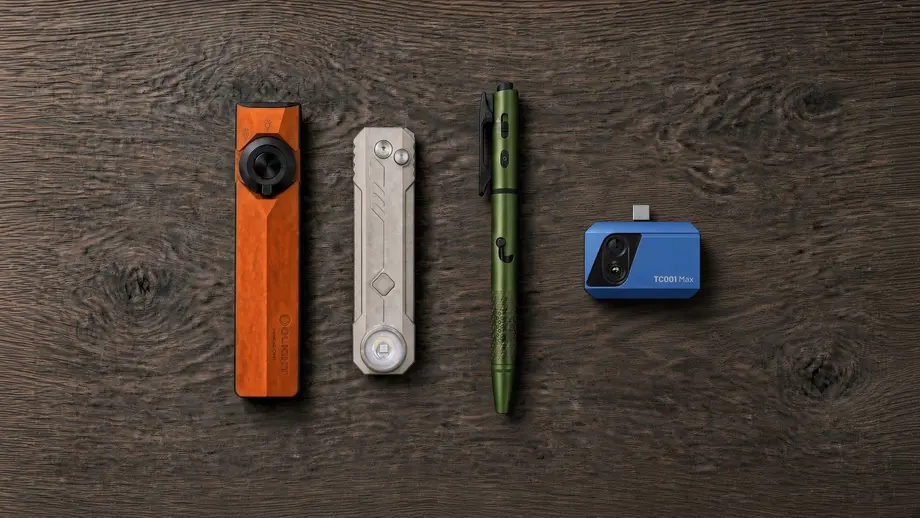
Unique EDC gear for men is worth buying when one item replaces two things you already carry and you reach for it at least a few times a week. The best candidates are a multi-source flat flashlight (flood, UV and green laser), a knife and flashlight combo, a pen light with a laser and a phone thermal camera.
This table lists the four upgrades, what each one is for, and the minimum spec that makes it worth pocket space.
| Use | Recommended type | Key spec floor | Recommended model |
|---|---|---|---|
| Main pocket light that also checks stains, bills and gear | Multi-source flat flashlight | 1,000+ lumen flood, 365 nm UV, laser 5 mW or less, IPX7 | Olight ArkPro (1,500 lumens, 365 nm UV, ≤5 mW green laser, 4.05 oz) |
| Cutting boxes and zip ties, then seeing into a dark cabinet | Knife and flashlight combo | Locking blade under your state's limits, 300+ lumen light, USB-C | OKNIFE LK (2.48 in M390 blade, 400-lumen light, 3 oz) |
| Writing, pointing at slides, finding a keyhole | Pen with light and laser | Class 3R (≤5 mW) laser or lower, 100+ lumen clip light | O'Pen 3 (120 lumens, Class 3R laser, 1.18 oz) |
| Finding a hot breaker, a cold draft or a dragging brake | Phone thermal camera | 256 × 192 native sensor, 25 Hz, no internal battery | TC001 Max (256 × 192, 25 Hz, <40 mK, about 1 oz) |
Most "unique EDC" lists fail the same way. They fill your pocket with a titanium fidget spinner, a novelty keychain tool and a bottle opener you use twice a year. A month later the drawer is full and your real carry is still a phone, keys, a knife and a light. The upgrades above are different because each one answers a job you already do: cutting and seeing in the dark, checking something your eyes can't see, or pointing at something across a room.
The hard questions come after you decide to buy. Is a green laser legal to carry? Can the knife go through airport security? Is a thermal camera for a phone a toy? Is a $110 flashlight worth it when a $20 light turns on too? The sections below answer each one with Olight's published specs, state and federal law, and some simple math you can check.
📋 Table of Contents
- 1. What Is the Coolest EDC Gear?
- 2. Unique vs Gimmick: Run a 30-Day Use Count
- 3. Multi-Source Flat Lights: Where Do UV and a Green Laser Actually Get Used?
- 4. Knife and Flashlight Combos: Is a Knife Light Legal to Carry in Your State?
- 5. Pen Lights With a Laser: Is the O'Pen 3 Worth Pocket Space?
- 6. Phone Thermal Cameras: Will You Actually Use One Every Day?
- 7. Safety Limits for Lasers, UV and Lithium Batteries
- 8. What Specs Does Each Carry Situation Need?
- 9. Unique EDC Gear for Men Compared: Weight, What It Replaces, Price
- 10. What Are the Essential Items for EDC for Men?
- 11. What Are the Best Brands of EDC Gear?
- 12. Common Mistake: Thinking More Expensive Means More Unique
- 13. FAQ
What Is the Coolest EDC Gear?
The coolest EDC gear is gear that does something your phone can't and replaces at least one other item. By that test, a multi-source flat flashlight, a knife with a built-in light, a pen with a light and laser, and a plug-in phone thermal camera beat novelty gadgets. Each one solves a daily job, and each one still gets used after the first month.
"Cool" usually means one of three things in EDC forums: rare materials, clever mechanisms, or a capability you don't normally have in a pocket. The first two wear off fast. The third lasts, because every time the tool does its job you notice it. A 365 nm UV beam that shows a pet stain on the carpet, or a thermal image that shows which outlet is running hot, keeps earning its place.
Use these three questions before any "cool" purchase:
- What job does it do that nothing in my pocket does now? If the answer is "looks good," skip it or buy it as a display piece.
- What does it replace? A tool that replaces two items keeps your carry weight flat.
- When will I use it this week? Name the day and the task. If you can't, the item is a gimmick for you, even if it is a great tool for someone else.
Unique vs Gimmick: Run a 30-Day Use Count
The line between unique gear and a gimmick is how often you use it. Count every real use for 30 days, divide the price by the count, and keep anything that falls under about $1 per use by the end of its first year. Items you never touch after the first week go back in the box, no matter how good they look.
A use counts only when the item did a job. Turning a flashlight on to admire the beam does not count. Finding a dropped earbud under a car seat does. Keep the tally in your phone's notes app, one line per item, and add what the item replaced that day. At the end of 30 days you have your own data instead of a reviewer's opinion.
This worksheet shows how to set up the count. Fill in your own numbers; the example uses are prompts, not results.
| Item | Uses in days 1–10 | Uses in days 11–20 | Uses in days 21–30 | What it replaced | Keep? |
|---|---|---|---|---|---|
| Multi-source flashlight | Tally | Tally | Tally | Phone light, UV light, laser pointer | Keep if 20+ uses |
| Knife and light combo | Tally | Tally | Tally | Separate knife and small light | Keep if 15+ uses |
| Pen light with laser | Tally | Tally | Tally | Pen, penlight, slide clicker | Keep if 15+ uses |
| Phone thermal camera | Tally | Tally | Tally | Guesswork, a service call | Keep if it found one real problem |
Note the thermal camera row. It is the one item on this list where a single use can pay for itself, such as finding a failing connection before it becomes a service call. Judge it by problems found, not by daily count.
To see what "under $1 per use" means in practice, this table divides each item's regular price by the number of uses in a year at three rates.
| Item (regular price, Sept. 2026) | Once a week (52 uses) | Three times a week (156 uses) | Once a day (365 uses) |
|---|---|---|---|
| O'Pen 3, $79.99 | $1.54 | $0.51 | $0.22 |
| ArkPro, $109.99 | $2.12 | $0.71 | $0.30 |
| OKNIFE LK, $124.99 | $2.40 | $0.80 | $0.34 |
| TC001 Max, $309.00 | $5.94 | $1.98 | $0.85 |
The takeaway: the three pocket items clear $1 per use at three uses a week. The thermal camera only clears it with near-daily use, so buy it when you have a trade, a house project or an older home that gives it regular work.
Multi-Source Flat Lights: Where Do UV and a Green Laser Actually Get Used?
A multi-source flat light earns its price when you use more than the white beam. The 365 nm UV reveals pet urine, scorpions, invisible ink on bills and some leak-detection dyes. The green laser points at a spot across a room, a warehouse shelf or a star chart. If you only need white light, a simpler light costs less and does the same job.
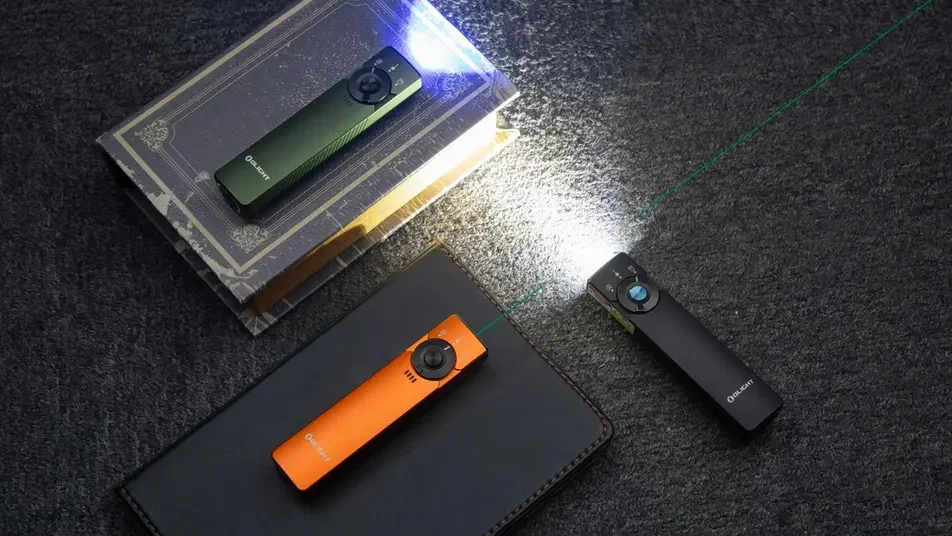
The Olight ArkPro flat EDC flashlight packs four sources into a flat unibody: a 1,500-lumen flood, an 800-lumen spot, a 365 nm UV light at up to 1,200 mW and a green laser rated at ≤5 mW. It weighs 4.05 oz (115 g), measures 4.88 × 1.06 × 0.63 in, carries an IPX7 rating and charges by USB-C or Olight's magnetic cable. The regular price was $109.99 as of September 2026. The ArkPro series lineup also includes the ArkPro Ultra, which lists a 1,700-lumen flood and was $129.99.
Here is where each source earns its place in a normal week.
- Flood (up to 1,500 lumens): Under the car hood, in a crawl space, around a campsite. A wide beam lights the whole work area so you are not chasing a hotspot.
- Spot (up to 800 lumens, 672 ft / 205 m): A yard at night, the far end of a parking lot, a trail sign.
- UV (365 nm): Carpets after a new puppy, hotel bedding checks, the security strip on a bill, a fluorescent dye test on an A/C line. For a full list, see what a 365 nm UV flashlight reveals.
- Green laser (510 to 530 nm): Pointing at a slide, a leak on a ceiling, a box on a top shelf or a constellation. It shows location, not light, so it does nothing to help you see in the dark.
Beam numbers make more sense as light on a target. Illuminance in lux equals candela divided by distance squared. The ArkPro's 10,640 candela works out like this; see candela vs lumens vs lux for the method.
| Distance | Lux from 10,640 cd | Practical reading |
|---|---|---|
| 10 m (33 ft) | About 106 lux | Enough to read a sign or a label |
| 25 m (82 ft) | About 17 lux | Enough to tell what is moving across a yard |
| 50 m (164 ft) | About 4 lux | Shapes and movement, little detail |
| 205 m (672 ft, rated beam distance) | About 0.25 lux | Faint; the rated beam distance ends where light falls to this level |
Runtime tells you whether the light keeps up with a week of small jobs. Olight lists the Med flood at 100 lumens for 13 hours. At 10 minutes a day, that is about 78 days of use from one full charge if Med were the only mode you used. Moon mode, at 1 lumen, is rated for 14 days of continuous use, which makes the ArkPro a reasonable nightlight on a camping trip.
Limits of the ArkPro. Its working temperature is listed as 0 to 45 °C (32 to 113 °F), so it is not the light for ice fishing or a winter truck glovebox. At 4.05 oz, it is heavier than a small keychain light, and it hangs lower in a dress-pants pocket. If you want white light only, a clip light is a lighter and cheaper choice. The Oclip 2 Pro clip flashlight lists a floodlight with up to 530 lumens at 2.66 oz for $54.99.
Knife and Flashlight Combos: Is a Knife Light Legal to Carry in Your State?
Whether you may carry a folding knife with a built-in light depends on your state, your city and the building you walk into, and no buying guide can settle that for you. Knife statutes turn on blade length, how the blade opens and whether the knife is concealed. Read your state's current statute text before you carry, then follow posted rules at courthouses, schools and airports.
The Olight OKNIFE LK knife and flashlight combo puts a 2.48 in (62.9 mm) Bohler M390 tanto blade and a 400-lumen USB-C rechargeable light in one 3 oz (86 g) body. It opens with a flipper tab and locks with a button lock. Its overall length is 6.3 in, and the handle is 0.65 in thick. The regular price was $124.99, with a timed sale price of $106.24 on Olight's page in late September 2026.
The pain point it solves is simple: you open a package in a dim garage and need a third hand for your phone light. With a combo, the light and blade are in the same hand. The trade-off is that you can't use the light as a separate tool while the knife is in use, and the light points where the handle points.
Knife law varies more than any other part of your carry. This table quotes the statute text that applies to a folding knife like the OKNIFE LK (listed blade length 2.48 in) and notes what that text does and does not settle. It is general information, not legal advice, and it does not tell you the knife is legal to carry anywhere.
| Jurisdiction | What the statute text says | What the text does and does not settle |
|---|---|---|
| Federal facilities | 18 U.S.C. § 930, subsection (g)(2), says "dangerous weapon" "does not include a pocket knife with a blade of less than 2½ inches in length." | Olight lists the blade at 2.48 in, only 0.02 in under that figure, and the statute does not say how a blade is measured. Courthouses and other federal buildings also screen for knives under their own rules. Leave the knife outside. |
| California: dirk or dagger | Penal Code 16470 says a folding knife "that is not prohibited by Section 21510" is a dirk or dagger "only if the blade of the knife is exposed and locked into position." Penal Code 21310 punishes anyone who "carries concealed upon the person any dirk or dagger." | The 16470 wording only covers a folding knife that is not a switchblade under 17235 and 21510 (next row). It does not answer the switchblade question on its own. |
| California: switchblade | Penal Code 17235 covers blades "two or more inches in length" released by "a flick of a button," "flip of the wrist," "the weight of the blade" or "any type of mechanism whatsoever." Its exclusion names only knives opened with "thumb pressure applied solely to the blade of the knife or a thumb stud attached to the blade," with a detent. Penal Code 21510 bars carrying a switchblade with a blade two or more inches long. | The OKNIFE LK opens with a flipper tab and uses a button lock. The exclusion does not mention flipper tabs, so the law is not clear on this design. Treat it under the stricter reading, or do not carry it in California. |
| Texas | Penal Code 46.01 says "Location-restricted knife" means "a knife with a blade over five and one-half inches," and Section 46.03 lists places where those knives are barred. | A 2.48 in blade is shorter than the 5½ in figure in that definition. The same chapter defines "knife" broadly, and schools and businesses can post their own rules. |
| Airports | The TSA knives rule lists knives as "Carry On Bags: No" and "Checked Bags: Yes," with sharp objects "sheathed or securely wrapped." | Pack the knife in checked luggage only. The page adds that "the final decision rests with the TSA officer." |
One check applies to any button-lock folder in California. If pressing the lock button lets the blade swing open under its own weight, that behavior matches the statute's "weight of the blade" wording. Do not carry a knife that does this in California. Test it with the blade pointed away from you before the knife ever goes in your pocket.
Warning: Knife laws change, and cities can add their own rules. Read the current statute for your state and city before you carry, and follow posted rules at schools, courthouses, government buildings and private businesses. Where the text is unclear for your knife, follow the stricter reading or leave the knife at home.
Limits of the OKNIFE LK. Olight lists a single 400-lumen white main light plus RGB ambient light, with no UV or laser, so it does not replace a multi-source light. A thick 0.65 in handle carries more bulk than a slim folder. If your workplace bans blades, see what workplaces let you carry and carry a light-only setup.
Pen Lights With a Laser: Is the O'Pen 3 Worth Pocket Space?
A pen with a light and laser is worth pocket space if you write, present or inspect things every day. It replaces a pen, a small penlight and a slide pointer in one 1.18 oz item. If you rarely write by hand or give presentations, the laser becomes a novelty and a standard pen plus a small flashlight costs less.
The Olight O'Pen 3 pen light with green laser lists a 120-lumen white clip light, a two-stage red light, a red SOS mode, a 0.4-lumen pen-tip light for writing in the dark, and a green laser with two levels: Class 3R at ≤5 mW and Class 1R at ≤0.39 mW. It is 6.10 in long and 0.5 in in diameter, and charges by a hidden USB-C port in about 1 hour. The regular price was $79.99, with a sale at $71.99 on September 24, 2026.
Run the laser numbers against a work week. Olight rates the Class 3R laser at 3 hours and the Class 1R level at 7.5 hours. If you point for about 10 minutes in each of five meetings a week, that is 50 minutes a week, so a full charge covers roughly three and a half weeks of presentations on 3R alone. The lower 1R level stretches that to about nine weeks and is the safer choice in a small conference room.
The pen-tip light answers a small but real pain: signing a restaurant check or a delivery form in low light. At 0.4 lumens it lights the paper without glare, and Olight rates it at 26 hours.
Limits of the O'Pen 3. The 120-lumen clip light is a close-range tool with a 46 ft (14 m) beam distance, so it will not light a yard. Its working temperature is listed at 0 to 40 °C. Keep it away from children: the laser is a real laser, and a Class 3R beam should never be treated as a toy.
Phone Thermal Cameras: Will You Actually Use One Every Day?
A phone thermal camera gets daily use if you work on houses, cars or electrical gear, and occasional use for everyone else. It shows heat differences your eyes can't see: a warm breaker, a cold window draft, a wet ceiling spot, a hot bearing. For most men the right test is whether it will find one real problem a month, not whether it comes out every day.
The TC001 Max phone thermal camera, sold by Olight's OSelect line, plugs into an iPhone or Android phone (and Windows devices) with USB-C and Lightning adapters and needs no battery of its own. Its native sensor is 256 × 192 (49,152 pixels); TOPDON's TISR processing enhances that to 512 × 384. Olight lists a 25 Hz frame rate, <40 mK sensitivity, a 56° × 42° field of view and a range of -4 °F to 1,022 °F. The price was $309.00 as of September 2026.
A 256 × 192 sensor spreads its pixels across a wider scene as you step back. This table uses the listed 56° × 42° field of view to show how much each pixel covers at common distances.
| Distance to target | Scene width × height | One pixel covers about | Good for |
|---|---|---|---|
| 0.5 m (1.6 ft) | 0.53 × 0.38 m | 2 mm (0.08 in) | A single breaker lug, a circuit board |
| 1 m (3.3 ft) | 1.06 × 0.77 m | 4 mm (0.16 in) | An outlet, a pipe joint, a brake rotor |
| 3 m (9.8 ft) | 3.19 × 2.30 m | 12 mm (0.49 in) | A window frame, a wall section |
| 10 m (33 ft) | 10.6 × 7.7 m | 42 mm (1.6 in) | A roof line, an animal at the edge of the yard |
The rule that follows: get close. A small hot spot that fills less than a pixel gets averaged with its cooler surroundings. The TC001 Max focuses as close as 0.2 m (0.66 ft).
Accuracy also matters for anything you plan to act on. Olight lists ±2 °C or ±2% of reading, whichever is larger. Below 100 °C that is ±2 °C (±3.6 °F); at a 300 °C exhaust manifold it is ±6 °C (±10.8 °F). Treat the reading as a comparison between two spots, not a lab number.
These legal, practical uses keep the camera out of the drawer:
- Home energy checks: The Department of Energy's Energy Saver guide notes that a home energy professional "may conduct a thermographic inspection to find air leaks in the home." You can do a first pass yourself on a cold night.
- Electrical panels and outlets: Look for one breaker or plug running warmer than its neighbors, then call a licensed electrician. See thermal imaging for electricians for how pros read a panel.
- Cars: A brake that runs hotter than the other side after a drive can point to a dragging caliper.
- Plumbing and roofs: A cool, damp patch on drywall can show a slow leak.
- Wildlife on your own property: Find the raccoon under the deck before you reach in.
Safety note: A thermal camera is not a medical device. The FDA regulates thermal imaging systems intended to measure a person's surface skin temperature as medical devices. Do not use a phone thermal camera to check anyone for fever. Use it only on your own property or with permission, and never to look into other people's homes.
Limits of the TC001 Max. It is rated IP54 and for a 1 m (3.28 ft) drop, so it is not a rain-soaked jobsite tool. It works from -10 to 50 °C (14 to 122 °F). It depends on your phone, so a dead phone means no thermal camera. At $309.00 it is the priciest item here by a wide margin.
Safety Limits for Lasers, UV and Lithium Batteries
Three rules cover most of the risk in this kit. Never aim a laser at people, animals, cars or aircraft. Never look into a UV emitter or shine it on skin for long. Keep spare lithium batteries away from keys and coins that can short them. These rules come from federal and state law and from FDA and FAA guidance.
Lasers. The FDA's laser hazard class chart says a Class IIIa (IEC 3R) laser "can be momentarily hazardous when directly viewed," and that risk rises with optical aids like binoculars. Knowingly aiming a laser pointer at an aircraft or its flight path is a federal crime under 18 U.S.C. § 39A, punishable by up to 5 years in prison. The FAA says pilots reported 12,840 laser strikes in 2024. California's Penal Code 417.27 also bars aiming a laser pointer into another person's eyes or a moving vehicle "with the intent to harass or annoy," and bars students from having one on elementary or secondary school grounds without a valid school-related purpose.
UV. Both the ArkPro and many UV lights use 365 nm, which is UVA. The FDA explains that UVA rays can reach the middle layer of your skin. Point the beam at the surface you are checking, not at faces or bare skin.
Batteries. The FAA's rules for passengers and batteries say spare lithium batteries and power banks must be "protected from damage and short circuit" and carried on, not checked. In a pocket, the same logic applies: loose cells should never ride next to keys or coins.
This table collects the safety rules in one place.
| Item | Risk | Rule to follow | Source |
|---|---|---|---|
| Green laser (ArkPro ≤5 mW; O'Pen 3 Class 3R ≤5 mW) | Eye injury, dazzling pilots and drivers | Never at eyes, pets, cars or aircraft; use the lower level indoors | FDA class chart; 18 U.S.C. § 39A |
| 365 nm UV | Skin and eye exposure | Don't look into the emitter; avoid skin exposure | FDA UV page |
| Folding knife | State and building rules | Read your state statute; if the text is unclear for your knife, follow the stricter reading or leave it home; checked bags only when flying | Statutes and TSA above |
| Spare lithium cells | Short circuit, heat | Case them; keep away from keys and coins; carry-on only when flying | FAA PackSafe |
| Thermal camera | Misuse on people | Buildings, machines and property only; no fever checks | FDA thermal notice |
Tip: If you own both a laser light and a laser pen, carry only one of them on a given day. Two lasers in two pockets double the chance of an accidental beam in a car or at a restaurant.
What Specs Does Each Carry Situation Need?
Each carry situation needs a different mix of brightness, runtime and water resistance. An office carry needs little light and no blade. A garage or trade carry needs a high-lumen flood, a knife and a thermal camera. A camping carry needs runtime and water resistance more than peak lumens. Match the gear to the places you actually go.
This table gives spec floors by situation. They are practical guidelines, not industry standards.
| Situation | White light | Runtime to look for | Water rating | Blade | Best add-on |
|---|---|---|---|---|---|
| Office and meetings | 100+ lumens | A week of short uses | Splash-resistant | Often banned; check policy | Laser pen, Class 1R level indoors |
| Commute and parking lots | 300+ lumens, 150+ m throw | 1 hour on medium | IPX4 or better | Check city rules | Multi-source flat light |
| Home and garage | 1,000+ lumen flood | 2+ hours on high | IPX4 or better | Useful for boxes and ties | Thermal camera, UV light |
| Trades and inspections | 1,000+ lumen flood | A full shift of intermittent use | IPX7 | Often required | Thermal camera |
| Camping and fishing | 300+ lumens plus moon mode | Several nights | IPX7 | Useful | Red light, UV for scorpions |
| Air travel | Any | Any | Any | Checked bag only | Light with a lockout mode |
Unique EDC Gear for Men Compared: Weight, What It Replaces, Price
This comparison shows the four items side by side: weight, size, what each replaces and the regular price in September 2026. Read the "replaces" column first. An item that swaps out two things you already carry is the one that keeps your pocket from filling up. Weights and sizes come from Olight's product pages.
| Item | Weight | Size | Replaces | Regular price |
|---|---|---|---|---|
| ArkPro | 4.05 oz (115 g) | 4.88 × 1.06 × 0.63 in | Flashlight, UV light, laser pointer | $109.99 |
| OKNIFE LK | 3 oz (86 g) | 6.3 in overall, 0.65 in thick | Folding knife, small flashlight | $124.99 |
| O'Pen 3 | 1.18 oz (33.5 g) | 6.10 in long, 0.5 in diameter | Pen, penlight, slide pointer | $79.99 |
| TC001 Max | About 30 to 33 g (about 1 oz) | 2.8 × 1.6 × 0.5 in | A standalone thermal camera | $309.00 |
| All four | About 265 g (9.3 oz) | Up to nine separate items | $623.97 |
Two numbers stand out. The OKNIFE LK, knife included, weighs 29 g less than the ArkPro alone. And the full kit of all four items weighs about 9.3 oz, so pick the one or two that match your week instead of carrying everything. The TC001 Max weight shows 30 g in Olight's spec table and 33 g in its highlights, so the table gives both.
What Are the Essential Items for EDC for Men?
The essential everyday carry (EDC) items for most men are a phone, a wallet, keys, a small flashlight, a pocket knife or multi-tool where legal, and a pen. Add a watch or a small first-aid kit if your day calls for them. Everything else, including the unique gear in this guide, is an upgrade on that base.
Start with the base and fix its weak points before you add anything unusual. The phone flashlight is usually the first weak point: it drains the battery you need for calls and maps, and you can't hold it in your teeth while both hands work. A dedicated light is the most common first upgrade for that reason.
Use this order when you build or rebuild a carry:
- Phone, wallet, keys. Slim the wallet first; it is often the heaviest item.
- Light. A small rechargeable light with a low mode for close work.
- Blade or tool. A folding knife or multi-tool that fits your state's and your workplace's rules.
- Pen. A pen that writes on a receipt held against a wall.
- One upgrade. Pick the single unique item that matches a job you do each week.
For step 2, Olight groups its pocket lights on one EDC flashlights page. If you prefer the flat-light shape, see flat EDC flashlights compared.
What Are the Best Brands of EDC Gear?
There is no single best EDC brand; the best brand depends on the category. Knife buyers often look at Benchmade, Spyderco and Kershaw. Multi-tool buyers often start with Leatherman and Victorinox. For flashlights, Olight, Streamlight and Fenix are common picks. Choose by warranty, parts support and specs published on the maker's own site.
A brand name matters less than three checks you can do yourself:
- Published specs. Look for lumens, candela, runtime by mode and a water rating on the maker's page. Missing runtimes are a red flag.
- Charging. USB-C or a magnetic cable you can replace. A proprietary cable you lose ends the tool's life.
- Service. A written warranty and a way to reach support in your country.
Olight's pages list runtimes by mode, IP ratings and, for the thermal camera, a full sensor spec table, which is why this guide uses them for the math above. For the knife category, the OKNIFE LK lists blade steel, blade length and thickness, which are the specs that matter for both cutting and legal carry.
Common Mistake: Thinking More Expensive Means More Unique
The most common mistake is treating price as a measure of usefulness. A $300 item used twice a year costs more per use than a $20 item used daily, and an expensive novelty still ends up in a drawer. Buy on the job the item does and the item it replaces, then choose the price tier.
Here are the other mistakes that turn unique gear into clutter, with the fix for each.
- Buying a laser for a job you don't have. Fix: name the room where you will point at something. If you can't, skip the laser.
- Carrying a knife you can't legally carry. Fix: read your state statute and your employer's policy before you buy the knife.
- Buying a thermal camera to look "tactical." Fix: list three problems at home or at work it could find. Buy it when you have them.
- Stacking two items that do the same job. Fix: if the knife has a light, the next item should not be a small white-only light.
- Ignoring pocket fit. Fix: check the weight and thickness against the pants you wear most. A 0.63 in thick light rides differently in dress pants than in work pants.
FAQ
Changelog
- September 21, 2026: First published.