Olight makes some of the products discussed here. Olight specs and prices come from its product pages as of September 2026; safety, health and legal facts come from the government and nonprofit sources linked in each section.
⚡ TL;DR
Self defense for seniors works best when it starts with three habits: don't fall, don't open the door to strangers, and be able to call for help in seconds. A lit doorway, a phone or medical alert button you actually wear, a loud whistle and a small flashlight do more for most older adults than any weapon or fighting move.
This table turns that answer into a starter kit you can set up in an afternoon.
| Purpose | Recommended type | Minimum spec to look for | Example |
|---|---|---|---|
| See who is at the door | Porch light you can switch on from inside, plus a peephole or video doorbell | Lights the visitor's face, not yours | Any fixture on an indoor switch or motion sensor |
| Walk safely at night | Pocket flashlight with a low and a medium mode | A mode of about 60 lumens that runs several hours | Olight Baton 4 (Med 60 lumens, 8 hours) |
| Find your way to the bathroom | Plug-in nightlight and a lamp you can reach from bed | Turns on before your feet touch the floor | CDC Check for Safety checklist items |
| Call for help if you fall | Phone kept on your body, or a medical alert button | Works from the floor, not just from the table | Cell phone in a pocket or a wearable help button |
| Get attention when you can't shout | Emergency whistle on a keyring or lanyard | Light enough to carry every day | Olight Titanium Emergency Whistle (7g) |
| Stop a stranger at the threshold | Deadbolt and a door you keep closed | A rule, not a gadget | Verify every visitor by phone first |
Most safety advice for older adults starts in the wrong place. Online self-defense videos assume quick reactions, good balance and strong wrists. For someone with arthritis, a new hip or a cane, that advice can leave both the older reader and their adult children more worried than before.
The good news is that the most common risks are easier to manage. Falls alone lead to about 4.5 million emergency department visits by older adults each year, according to the CDC. Scammers mostly work through the phone, email and the front door rather than force. The sections below cover each risk with steps you can take this week, using guidance from the CDC, police departments, the FCC and other public sources.
📋 Table of Contents
- 1. Why Is Staying Upright More Important Than Fighting Back?
- 2. Door Lighting, the Peephole and the Closed-Door Rule
- 3. Out and About: Routes, Companions and Help Devices
- 4. How Do You Call for Help When Something Goes Wrong?
- 5. Is Pepper Spray a Good Idea for Older Adults?
- 6. What a Flashlight Really Does: Seeing and Being Seen
- 7. What Is the Best Home Defense Weapon for Elderly Individuals?
- 8. What Is the Best Way to Defend Yourself?
- 9. Five Things Adult Children Can Do
- 10. What Are Some Things I Can Do to Help Lonely Seniors?
- 11. Self Defense for Seniors: A 15-Minute Safety Check for Tonight
- 12. FAQ
Why Is Staying Upright More Important Than Fighting Back?
Staying upright matters more than fighting back because a fall is the most likely way an older adult gets hurt. The CDC reports that more than one out of four people 65 and older falls each year, and that falling once doubles the chance of falling again. Any self-defense plan that ignores balance, lighting and footwear misses the biggest risk.
The CDC's older adult falls data adds context that belongs in every family conversation:
- Less than half of older adults who fall tell their doctor.
- About 37% of those who fall report an injury that needed medical treatment or limited their activity for at least a day.
- Falls are the most common cause of traumatic brain injuries for older adults.
- Fear of falling can lead people to cut back on activity, which makes them weaker and raises their chances of falling.
That last point matters for personal safety too. A person who stops walking to the mailbox, stops going to the store after 4 p.m. and stops answering the door is not safer. They are more isolated, and they have fewer people around to ask, "Does this call sound right to you?" The goal is steady, confident movement, not staying inside.
Balance also decides what "self defense" can even mean. A push, a grab at a purse or a quick turn to get away can end in a fall if the person was unsteady to begin with. So the first defensive skill is being hard to knock over: strong legs, good shoes, both hands free when you walk, and enough light to see the ground.
The CDC's guide for family caregivers lists fall-prevention steps that also make a home easier to move through at night. It recommends activities that improve balance and strengthen legs, such as Tai Chi, an eye exam at least once a year, handrails and lights on all staircases, and making sure the home "has lots of light."
Tip: If you are worried about balance, ask your doctor about a fall risk check before you sign up for any self-defense class. Ask the class instructor how they adapt drills for people with joint replacements, osteoporosis or a cane.
Door Lighting, the Peephole and the Closed-Door Rule
The safest way to handle a stranger at your door is to never open it until you know who they are and why they came. Light the step so you can see their face, look through a peephole or video doorbell, talk through the closed door, and call the company they claim to represent using a number you already have.
Police crime prevention guides say the same thing in short, firm rules. The Pendleton, Oregon Police Department's safety tips tell residents to "Install a peephole," to "Never let a stranger in for ANY reason," and to "Ask service people to show identification and telephone the company to verify service calls."
The door rule is really a scam rule. The FBI reports in its 2024 Internet Crime Report announcement that people over 60 "suffered the most losses at nearly $5 billion and submitted the greatest number of complaints." The most reported crime type was phishing and spoofing, where someone pretends to be a person or company you trust. A stranger at the door can run the same trick face to face, and the same defense works: don't act on the spot, and call back on a number you already have.
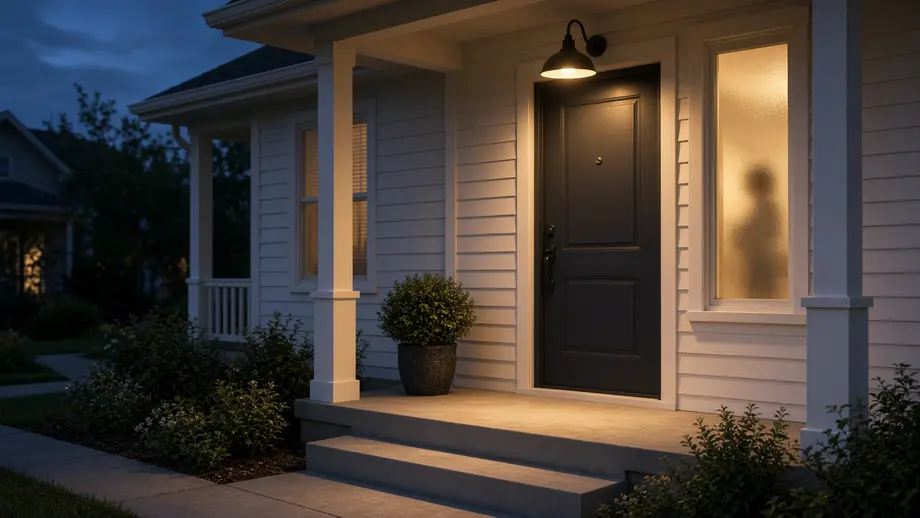
Lighting is the other half of door safety. Your porch light should shine on the visitor, not on you. A light behind the visitor, or no light at all, leaves you looking at a dark shape through a small lens. A light above and slightly in front of the door puts the visitor's face in view, which also helps a video doorbell record a usable image.
Research on outdoor lighting backs up the instinct to keep entrances bright. An NBER summary of a New York City street lighting study found that serious nighttime crimes fell 60 percent near new lighting towers in public housing, with a more conservative community-wide estimate of at least 36 percent. The researchers note that the temporary lights were unusually bright, so a porch bulb is not a guarantee. It does help you see.
This table gives you a script for the most common knocks.
| Who says they are at the door | What to say through the closed door | What to do next |
|---|---|---|
| Utility or cable worker you didn't call | "I didn't schedule a visit. Please leave a card." | Call the company at the number on your bill |
| Police officer | "Please hold your badge to the peephole. I'm calling the station to confirm." | Call 911 or the non-emergency number; dispatch can confirm |
| Delivery driver who needs a signature | "Please leave it at the door." | Open only after the driver leaves, or ask a neighbor |
| Person asking to use your phone or bathroom | "I'll call someone for you. Please wait outside." | Make the call yourself with the door locked |
| Contractor offering a deal on repairs | "No, thank you." | Don't sign or pay at the door; talk to family first |
| Anyone who won't leave or tries the handle | "I'm calling the police now." | Call 911, move away from the door and turn on lights |
Note: You never owe a stranger an open door. It is not rude to talk through the door, and a real worker, officer or delivery driver will wait while you check.
Out and About: Routes, Companions and Help Devices
For walks, errands and parking lots, older adults stay safest by choosing lit routes, walking with someone when possible, keeping both hands free and carrying two ways to get help: a charged phone and a whistle. A small everyday carry flashlight in a pocket covers the dark stretch between the car and the door, and the uneven curb you didn't see.
The NHTSA pedestrian safety page reports that 7,080 pedestrians were killed in 2024. Its tips include walking on sidewalks whenever they are available, walking facing traffic when there is no sidewalk, and crossing in "a well-lit area where you have the best view of traffic" when there is no crosswalk. Police advice from Pendleton adds: walk with another person if possible, avoid isolated areas, and approach your car or home with your keys already in your hand.
Different outings call for different light. This table sets the minimums for each one.
| Sub-scenario | What the light needs to do | Brightness that works | Runtime to aim for | Water resistance |
|---|---|---|---|---|
| Hallway and bathroom at night | Show the floor without waking you fully | Low, around 10 to 15 lumens, or a nightlight | All night on a nightlight; minutes on a flashlight | Not needed |
| Porch and keyhole | Find the lock and see the step | Low to medium, 12 to 60 lumens | A few minutes per use | Light rain |
| Evening walk or dog walk | Show curbs, cracks and roots 10 to 20 feet ahead | Medium, about 60 lumens | At least a 30-minute walk, better several walks | Rain |
| Parking lot or garage | Check the car and the ground around it | Medium, with a brief higher mode for distance | A few minutes | Rain |
| Power outage | Move through the house and find supplies | Low to medium | Several hours total | Not needed |
A companion is still the best safety device. If you walk alone, tell one person your route and your expected return time, and text them when you are home. That habit turns a fall on a quiet street from hours alone into a phone call within the hour.
How Do You Call for Help When Something Goes Wrong?
The fastest way to call for help is a voice call to 911 from a phone you keep on your body, not on the kitchen counter. Add a backup for times you can't reach or speak into a phone: a medical alert button, text-to-911 where your area supports it, or an emergency whistle that neighbors and passersby can hear.
The FCC is clear about the order. Its guide to text-to-911 says to "always make a voice call to 911 during an emergency whenever possible," and that text-to-911 is "only currently available in certain locations." If you text where it isn't available, carriers must send a bounce-back message telling you to use another method.
This table compares the main ways to get help and where each one falls short.
| Method | Best for | Limits to know | What it costs |
|---|---|---|---|
| Cell phone voice call to 911 | Any emergency where you can talk | Useless if it's on the table and you're on the floor | Your existing phone plan |
| Text-to-911 | Times you can't speak safely or have a speech or hearing disability | Only in some areas; voice is more reliable | Your existing phone plan |
| Medical alert button with a monitoring center | Falls and medical events at home, especially for people who live alone | Must be worn and charged; fall detection is not perfect | NCOA cites about $20 to $34 a month, plus about $10 for fall detection |
| Emergency whistle | Getting attention from neighbors or people nearby | Only works if someone is close enough to hear | About $16 for a titanium model |
| Daily check-in call or text | Noticing when someone has gone quiet | Only as good as the person on the other end | Free |
Medical alert systems deserve a clear-eyed look. The National Council on Aging's review of medical alert systems with fall detection states that "No fall detection is 100% accurate, and all medical alert systems include a disclaimer stating this." It also notes that wrist-worn devices can be less accurate than those worn on a belt or necklace, because natural arm movement can set off false alarms. A button only helps if it is on you in the shower and at 3 a.m.
A whistle fills a different gap. Utah's Be Ready guide to signaling explains that a whistle "can carry much further than the sound of a human voice and takes a lot less effort than shouting," and that "As long as you can breathe, you can blow a whistle." Three blasts are the universal signal of distress.
The Olight Titanium Emergency Whistle weighs 7g and measures 0.35 in across and 2.09 in long, and it costs $15.99 as of September 2026. At that size it can live on the same ring as your house keys, so it goes wherever you go. Its limit is the same as every whistle's: it calls attention, not responders. Keep it next to a phone plan, not in place of one.
Safety note: If you fall and are not sure whether you are hurt, stay down for a moment and call for help from where you are. The CDC notes that head injuries from a fall can be very serious, especially for people taking medicines like blood thinners, and that an older person who falls and hits their head should see their doctor right away.
Is Pepper Spray a Good Idea for Older Adults?
Pepper spray can be legal for older adults to carry, but it is a poor first choice for many. State laws set rules on who may buy it and how big the canister can be. It can also blow back into your own face, and it can cause more severe breathing effects in people with asthma or COPD. Check your state's current law before you buy any spray.
Poison Control explains the medical side in its article on how dangerous pepper spray is. Effects usually last 20 to 30 minutes but can last several hours, and "People with lung conditions, such as asthma or COPD, can have more severe breathing effects when pepper spray is inhaled." If the spray is used indoors, the article says to open doors and windows to air out the area right away. For many older adults, a spray fired in a hallway or a car is as likely to affect the user as anyone else.
State laws differ in who can buy spray, how much, and where you can get it. This table shows two examples from the official statute text, to show how much the rules vary.
| State | What the statute says | Source |
|---|---|---|
| California | Anyone may buy, possess or use tear gas "solely for self-defense purposes," except people with felony or assault convictions, people addicted to narcotics and minors. Canisters may not hold more than 2.5 ounces net weight of aerosol spray, and each must carry a label with its expiration date. | California Penal Code 22810 |
| New York | A "self-defense spray device" is allowed only for people 18 or older without prior felony or assault convictions, and only for use where physical force would be legally justified. Sellers are limited to licensed firearms dealers, licensed pharmacists or other state-approved vendors, and no more than two devices may be sold at one time to a single buyer. | New York Penal Law 265.20 |
| Your state | Rules on age, canister size, where you can buy and where you can carry differ. | Your state legislature's website, or call your local police non-emergency line |
If you still want to carry spray, keep a few points in mind. Spray has an expiration date, so replace it on schedule. Keep it out of reach of grandchildren. Store it where you can reach it without digging through a bag. Practice with an inert trainer canister if the maker sells one, never with the real thing indoors.
Warning: Any self-defense tool can be taken from you or used against you. If a device takes two hands, good grip strength or quick aim, it may not be right for you. Talk with your family and doctor before you rely on one.
What a Flashlight Really Does: Seeing and Being Seen
For older adults, a flashlight is a safety tool for seeing and being seen, not a weapon. It shows the curb, the icy step and the dropped keys. It lets you check the back seat before you get in the car, and it makes you visible to drivers on a dark street. That is why it belongs on the list with the phone and the whistle.
This guide doesn't teach striking with a light, and we don't recommend it. A flashlight's defensive value is simpler: light lets you notice trouble early, choose another route and reach a lit, busy place. A light already in your hand also means you aren't fumbling in a bag at the car door.
The Olight Baton 4 shows what "small but useful" looks like in numbers. Olight lists it at 2.48 x 0.83 x 0.83 in and 1.85oz (52.5g) with the battery, with an IPX8 waterproof rating. Its product page lists it at $54.99 as of September 2026, the price shown for the default option. This table turns its official modes into everyday uses.
| Mode (Olight spec) | Output | Runtime (Olight spec) | Everyday use | What that runtime means |
|---|---|---|---|---|
| Moon | 0.5 lumens | 30 days | Finding the light itself in a dark room; looking at a sleeping pet | Too dim for stairs |
| Low | 12 lumens | 35 hours | Bathroom trips, keyholes, reading a label | About 105 uses of 20 minutes each |
| Med | 60 lumens | 8 hours | Evening walks, dog walks, parking lots | About 24 walks of 20 minutes each |
| High | 600~300~60 lumens | 7 + 72 + 16 minutes | Checking a yard or a long driveway | Short bursts |
| Turbo | 1,300~600~300 lumens | 1.5 + 2.5 + 73 minutes | Reading a street sign or house number far away | Steps down quickly; not a walking mode |
We calculated one more number from Olight's specs. The Baton 4 lists 7,225 candela, so at Turbo it puts about 778 lux on a spot 10 feet away (7,225 divided by 3.048 m squared). That is plenty to read a house number or check a far corner of a lot. For walking, the Med mode matters more than the peak, because its 8-hour runtime covers a week of evening walks.
The Charging Case for Baton 4 ($39.99 as of September 2026) addresses a real problem for older users: remembering to charge. Olight says the case can fully charge the Baton 4 five times, for a "max runtime of 190 days," and can charge a phone from its USB-C port in an emergency. Olight also says you can "press the button to light up the flashlight directly" while it sits in the case, so a bedside case can double as a night light switch.
Now the limits. The Baton 4 is small, and its side switch sits on a light about the length of an index finger. For someone with severe arthritis, a tremor or low vision, a bigger light with a large button may be easier to use. It also charges only from its MCC 1A magnetic charging cable, not a standard phone cable, so a lost cable means no charging until it is replaced. If that sounds like your parent, pick a light you can test in the hand first. Our guide to household flashlights for the elderly compares easier-grip options, and the Baton series page lists other sizes.
Tip: Set a rule for night trips: switch on the light before you stand up. A phone screen is not enough; our explainer on phone flashlights vs real flashlights covers why a dedicated light is easier to aim and holds up longer.
What Is the Best Home Defense Weapon for Elderly Individuals?
For most older adults, the best home defense tools are not weapons at all: a solid deadbolt, a door you keep closed, bright entry lighting, a phone within reach of the bed and a plan to call 911. Anything designed to hurt someone requires strength, training, safe storage and legal knowledge, and those demands grow harder with age.
Some older adults already own firearms or other defensive tools and have trained with them for years. That is a personal decision governed by state and local law, and it comes with duties, such as secure storage when grandchildren visit and honest checks of vision, grip and reaction time. This guide does not recommend any weapon. Talk with a certified instructor and check your state's laws if you are considering one.
A strong home plan works whether or not a weapon is involved. This order of steps, built from the guidance above, is a good start:
- Keep doors locked, including during the day.
- Put a lamp or flashlight and a phone within reach of the bed.
- Light every entrance, and keep hallway nightlights on at night.
- If you hear a break-in, stay in a room you can lock, call 911 and stay on the line.
- Turn lights on rather than walking into a dark room to investigate.
Our home defense flashlight checklist covers where to stage lights in the house so you never search in the dark.
What Is the Best Way to Defend Yourself?
The best way to defend yourself is to avoid the confrontation, create distance and get help fast. That means noticing trouble early, leaving before it reaches you, getting behind a locked door or into a busy, well-lit place, and calling 911. Physical resistance is a last resort, and for many older adults it carries more risk than it removes.
Police crime prevention guidance reflects the same order. Pendleton police advise residents to go "immediately to a safe place" if they are suspicious of a person or circumstance. That advice doesn't depend on strength, speed or training, which is why it suits older adults so well.
This checklist covers the five moves that matter most, in order:
- Notice. Put the phone away while walking, and look up at parking lots and entrances before you reach them.
- Leave. Cross the street, go back into the store or wait in your locked car.
- Announce. Say "Back off" or "I'm calling the police" loudly. Blow three blasts on a whistle.
- Call. Dial 911 and stay on the line. Describe where you are and what you see.
- Give up property. A purse, wallet or phone is not worth a fall or an injury.
If you want to learn more, look for a personal safety class designed for older adults through a senior center, a community college or your local police department. Good classes focus on awareness, voice and escape, and they ask about your health before any physical drill.
Five Things Adult Children Can Do
Adult children can make a parent safer without taking away their independence. Five steps cover most of the risk: fix the lighting, set up a way to call for help, agree on a door rule, build a check-in routine and handle scam defense together. Each one takes an afternoon, and none of them requires your parent to fight anyone.
This table gives each step a concrete first action.
| Step | First action this week | Why it helps |
|---|---|---|
| 1. Fix the lighting | Walk the house at night with the CDC Check for Safety list; add nightlights and a bedside lamp | Fewer falls and faster, safer trips to the door |
| 2. Set up help | Put 911 and your number on speed dial; decide on a phone pouch or a medical alert button | Help arrives even if they can't reach a table |
| 3. Agree on a door rule | Write "I don't open the door for people I didn't expect" on a card by the door | Makes saying no easier and scripted |
| 4. Build a check-in routine | Pick a daily call or text time, and a plan if it's missed | A fall or illness is found in hours, not days |
| 5. Handle scams together | Agree that any request for money, gift cards or passwords gets a call to you first | Cuts off the most common way seniors lose money |
The CDC's Check for Safety checklist makes step 1 concrete. It recommends a lamp close to the bed "where it's easy to reach," a light and light switch at the top and bottom of the stairs, and nightlights along the path to the bathroom. It notes that "Some nightlights go on by themselves after dark," and that you can buy light switches that glow.
Note: Ask before you change things. Older adults are more likely to keep a routine they chose than one handed to them, and a light they helped pick is a light they'll use.
What Are Some Things I Can Do to Help Lonely Seniors?
You can help lonely seniors by making contact regular and useful: a call at the same time every day, a standing ride to church or the store, an invitation to a class, and help with small household jobs such as changing a burned-out stairway bulb. Regular contact eases loneliness and also means someone notices quickly when something is wrong.
The CDC's page on social isolation and loneliness risk factors reports that "About 1 in 3 adults in the U.S. report feeling lonely." It lists older adults and adults living alone among the groups loneliness may affect more, and warns that isolation and loneliness raise the risk of serious mental and physical health conditions.
Loneliness and safety are linked in practical ways. A person who talks with family daily is more likely to mention the "grandson" who called asking for bail money. A neighbor who waves every morning notices when the newspaper stays on the porch. Here are simple ways to help:
- Offer rides to places with people: a library program, a senior center lunch or a Tai Chi class.
- Teach one phone skill per visit, such as video calls or blocking a number.
- Take on the ladder jobs, like changing bulbs, so they don't climb.
- Walk with them in the evening, with a flashlight, so dark streets feel less limiting.
- Ask their opinion and let them help you. Being needed is a strong cure for isolation.
Self Defense for Seniors: A 15-Minute Safety Check for Tonight
You can cover the basics of self defense for seniors in about 15 minutes tonight: test the porch light, check the peephole, charge and pocket the phone, put a light by the bed, clip a whistle to your keys and agree on tomorrow's check-in time. Each step removes one way a bad night can start.
Use this list, and repeat it when the clocks change each spring and fall:
- Turn on the porch light from inside and check that it lights a visitor's face.
- Look through the peephole or open the doorbell app to make sure the view is clear.
- Walk from bed to bathroom in the dark and note any spot where you can't see the floor.
- Put a lamp or charged flashlight and a phone where you can reach them from bed.
- Clip a whistle to the keyring you carry every day.
- Check the phone's emergency contacts and put 911 and a family member on speed dial.
- If you carry pepper spray, check its expiration date and your state's current rules.
- Choose a daily check-in time with one person, and write it on the fridge.
FAQ
Changelog
- September 21, 2026: First published. Olight specs and prices checked September 24, 2026.