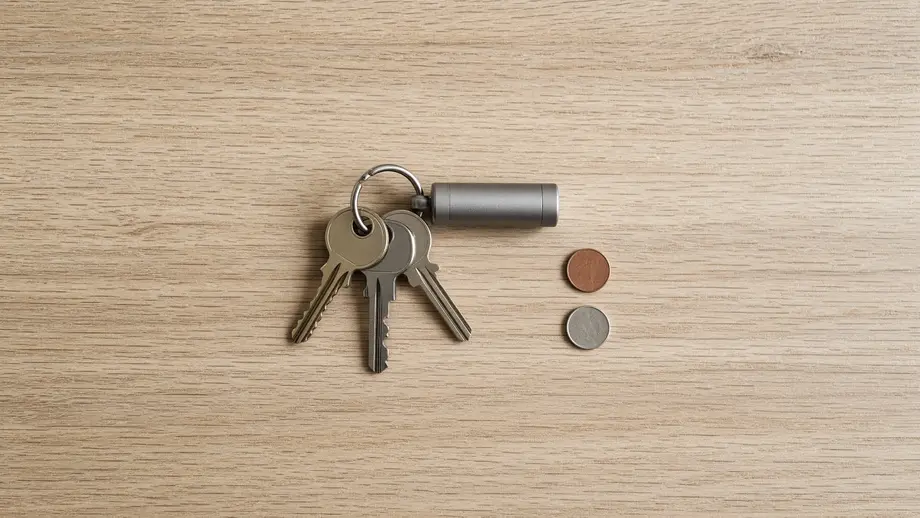
Olight makes some of the lights discussed here. Olight specs and prices come from its product pages and user manuals as of September 2026; other brands' specs come from their makers. The lux, watt-hour, and lumen-minute figures are our own arithmetic from those published numbers.
⚡ TL;DR
A keychain flashlight typically puts 50 to 180 lumens into a body of about 20 grams, and 80 to 180 lumens covers keyholes, dropped items, and the walk from car to door. The tiny battery sets the limit, not the LED. The i1R 2 Pro's 3.7-volt, 130 mAh cell stores under half a watt-hour, so more lumens always means fewer minutes. Choose the charging method and switch first, then lumens.
This table matches the jobs a keychain flashlight actually does to the spec that matters most for each one.
| Use | Recommended type | Key spec floor | Olight example |
|---|---|---|---|
| Finding a keyhole or lock at night | Any keychain light with a low mode | 5 lumens at arm's length is enough | i1R 2 Pro (5-lumen Low) |
| Searching under a car seat or in a bag | Floody beam, instant on | 50 to 90 lumens | imini 2 or iUltra |
| Walking from the car to the door | Focused beam that reaches the path | About 90 lumens, 500 candela | i3E EOS or i1R 2 Pro |
| Reading a breaker panel or meter in a dark room | Rechargeable light with a steady output | 80+ lumens, 20+ minutes | iUltra or i1R 2 Pro |
| Rarely used, must work after months in a drawer | AAA battery light | Replaceable cell | i3E EOS |
| Hands-free work on a car or under a sink | Magnetic base | Magnet plus 50+ lumens | iUltra or imini 2 |
| More than 20 minutes of real use | Clip light, not a keychain light | 500+ lumens, 500+ mAh battery | Oclip 2 Pro |
Most people who want a keychain flashlight share the same two complaints. The key ring is already heavy, and one more item makes the pocket bulge and the keys scratch everything. Then the tiny light they add turns out dim, dies after a few weeks, or switches on by itself in the pocket. This guide explains why those problems happen and how to pick a light that avoids them. If you want a shopping list instead, browse Olight's keychain flashlights collection.
📋 Table of Contents
- 1. How Much Light Does a Keychain Flashlight Need?
- 2. What Are the Uses of a Keychain Flashlight?
- 3. Why Does Battery Size Cap Lumens and Runtime on a Key Ring?
- 4. How Heavy Can a Keychain Flashlight Be Before You Take It Off?
- 5. Rechargeable, AAA, or Disposable: Which Key Ring Light Power Source Is Best?
- 6. Why Is Real Runtime So Different From the Rating?
- 7. Will a Keychain Flashlight Survive a Year on Your Key Ring?
- 8. What Is the Most Powerful Keychain Flashlight?
- 9. What Is the Brightest Keychain Flashlight Available?
- 10. Olight Keychain Flashlights Compared: Lumens, Weight, Runtime, Price
- 11. Your Keychain Flashlight Checklist
- 12. FAQ
How Much Light Does a Keychain Flashlight Need?
A keychain flashlight needs about 80 to 180 lumens for most tasks, and far less for a keyhole. At half a meter, a light rated 500 candela puts about 2,000 lux on the lock, which is more than you need. The number that matters on a key ring is a usable low mode plus enough candela to light a path about 10 feet ahead.
Lumens measure total light output. Candela measures how intense the center of the beam is, and lux measures how much light lands on a surface. Our guide to beam distance and candela explained covers the math. The short version is the inverse-square rule: lux equals candela divided by distance in meters, squared.
To give that number a yardstick, the OSHA construction illumination standard sets 5 foot-candles as the minimum for indoor "warehouses, corridors, hallways, and exitways." Five foot-candles is about 54 lux. It is a workplace minimum, not a flashlight rule, but it is a fair benchmark for "bright enough to walk and read a label."
This table applies that benchmark to each light's published peak intensity. The "54 lux reach" column is how far out the center of the beam still meets the hallway minimum.
| Light (Olight spec) | Peak intensity | Lux at 0.5 m (keyhole) | 54 lux reach (hallway minimum) | ANSI beam distance check |
|---|---|---|---|---|
| i1R 2 Pro | 580 cd | About 2,320 lux | About 3.3 m (10.8 ft) | 48.2 m calculated vs 48 m listed |
| i3E EOS | 500 cd | About 2,000 lux | About 3.0 m (10.0 ft) | 44.7 m calculated vs 44 m listed |
| iUltra | 196 cd | About 780 lux | About 1.9 m (6.3 ft) | 28.0 m calculated vs 28 m listed |
| imini 2 | 115 cd | About 460 lux | About 1.5 m (4.8 ft) | 21.4 m calculated vs 21 m listed |
| Oclip 2 Pro (for comparison) | 3,906 cd | About 15,600 lux | About 8.5 m (28 ft) | 125 m calculated vs 125 m listed |
The last column is a check on the method. The ANSI/PLATO FL 1 standard defines beam distance as "the distance from the device at which the light beam is 0.25 lux," as Streamlight explains in its ANSI/PLATO FL 1 overview. Twice the square root of candela gives that distance, and each result matches Olight's listed figure.
Two conclusions follow. First, every light here is far brighter than a keyhole needs, so a low mode saves battery without costing you anything. If the i1R 2 Pro's beam keeps its shape at Low, its 5 lumens works out to roughly 16 candela, or about 64 lux at half a meter. Second, the floody 50- and 80-lumen lights reach only about 5 to 6 feet at hallway brightness. They are close-range tools, which is fine for a bag or a car seat and thin for a dark driveway.
What Are the Uses of a Keychain Flashlight?
The uses of a keychain flashlight are short, close-range tasks: finding a keyhole, searching under car seats and in bags, reading labels or breaker panels, checking a tire or a pet's paw, and getting from the car to the door. It is a backup light that is always with you. It is not a light for long hikes or long power outages.
This list runs from the jobs most people meet most often to the rarest. The order is an editorial estimate for someone who drives, has a front door, and carries a bag:
- Keyholes and locks. Front doors, mailboxes, padlocks, and car doors in unlit lots.
- Dropped items. An earring under the car seat, a pill on the floor, a coin in the gap by the console.
- The inside of a bag. Purses, backpacks, and glove boxes are dark even in daylight.
- Reading small print. Labels, receipts, restaurant menus, serial numbers, and the back of a router.
- The walk from the car to the door. A focused light shows steps, curbs, and ice.
- Quick checks. A tire sidewall, a leak under a sink, a pet's paw, or a noise in the yard.
- The first minutes of a power outage. Enough to find the real flashlight, the breaker panel, or the candles.
A phone flashlight can handle some of these, but it ties up the phone and drains the battery you may need for a call. Our comparison of a phone flashlight vs a real flashlight goes through the differences. This table sets out the spec floor for each keychain task.
| Task | Lumens needed | Runtime that matters | Water rating that matters | Best switch type |
|---|---|---|---|---|
| Keyhole or lock | 5 to 50 | Seconds per use | Rain (IPX6 is fine) | Any |
| Under a car seat or in a bag | 50 to 90 | 1 to 2 minutes per use | Low priority | Instant, one-handed |
| Car to door | 90 to 180 | 2 to 5 minutes per use | Rain and snow | Twist or pull, with a focused beam |
| Label or breaker panel | 50 to 100 | 5 to 10 minutes | Low priority | Any, with a magnet a plus |
| Tire or leak check | 80 to 180 | 5 to 15 minutes | Puddles and splashes | Magnetic base helps |
| Start of a power outage | 50 to 180 | 30 to 60 minutes | Low priority | Any light you already carry |
Why Does Battery Size Cap Lumens and Runtime on a Key Ring?
Battery size caps a keychain flashlight because light is paid for with stored energy, and a key ring cell stores very little. The i1R 2 Pro's 130 mAh, 3.7-volt cell holds about 0.48 watt-hours. That budget covers about 23 minutes at 180 lumens or 12 hours at 5 lumens. A brighter LED only spends the same budget faster.
A good way to see the budget is lumen-minutes: output multiplied by rated runtime. It ignores the gradual dimming inside each rating, so treat it as a rough gauge. Still, the pattern across Olight's published numbers is hard to miss.
This table converts each light's official battery and runtime figures into energy and lumen-minutes. Olight lists the i1R 2 Pro's cell at 3.7 volts, and the iUltra user manual rates its 10180 cell at 3.7 V and 0.296 Wh. Where Olight gives only milliamp-hours (the imini 2 and the Oclip 2 Pro), we assume the 3.6 to 3.7 volts per cell that Battery University's guide to nominal battery voltages gives for lithium-ion. For the NiMH row we use 1.2 volts per cell, the consumer NiMH rating in the same guide and on Energizer's NH12 NiMH AAA datasheet. Those rows are approximations, so read them as ranges rather than exact values.
| Light (Olight spec) | Battery | Stored energy | Max output and rated runtime | Lumen-minutes at max | Weight | Lumen-minutes per gram |
|---|---|---|---|---|---|---|
| i1R 2 Pro | 3.7V 130mAh 10220 Li-ion, built in | About 0.48 Wh | 180 lumens, 23 minutes | 4,140 | 22 g | About 190 |
| i3E EOS, alkaline | 1 AAA alkaline | Not published | 90 lumens, 45 minutes | 4,050 | 19.4 g | About 210 |
| i3E EOS, NiMH | 1 AAA NiMH (900 mAh in Olight's rating) | About 1.1 Wh (1.2 V assumed) | 90 lumens, 70 minutes | 6,300 | About 20.9 g | About 300 |
| iUltra | 10180 80mAh lithium | About 0.30 Wh (0.296 Wh per user manual) | 80 lumens, 50 minutes | 4,000 | 20 g | About 200 |
| imini 2 | 10180 80mAh lithium | About 0.29 to 0.30 Wh (3.6 to 3.7 V assumed) | 50 lumens, 60 minutes | 3,000 | 19.5 g | About 150 |
| Oclip 2 Pro (clip light) | 600 mAh | About 2.2 Wh (3.6 to 3.7 V assumed) | 530~300~100 lumens, 1+58+5 minutes | 18,430 | 75.5 g | About 240 |
The NiMH row swaps the 11.5-gram alkaline cell for a NiMH AAA of about 13 grams, the typical weight Energizer lists for its NH12 cell, which puts the light at roughly 20.9 grams.
Three rules of thumb come out of the table:
- Every keychain light here stores roughly 3,000 to 6,300 lumen-minutes. Twice the lumens means about half the minutes. A 180-lumen light and a 90-lumen light carry about the same total light.
- Each gram carried buys roughly 150 to 300 lumen-minutes. To get four times the light budget, carry roughly four times the weight. The Oclip 2 Pro has about 4.5 times the i1R 2 Pro's lumen-minutes and weighs about 3.4 times as much.
- Chemistry matters as much as size. Olight's own i3E EOS user manual rates the same light at 45 minutes on alkaline and 70 minutes on a NiMH cell, a 56 percent gain from the same AAA shell.
Cell names tell you the size. Battery University's guide to battery cell types notes that a 26650 cell has "a diameter of 26mm," and the same code runs through smaller cells: a 10180 is 10 mm across and about 18 mm long, and a 10220 about 22 mm long. Energizer's E92 AAA datasheet lists a maximum of 10.50 by 44.50 mm and a typical volume of 3.8 cubic centimeters. Battery University puts an 18650 at about 16 cubic centimeters, over four times a AAA, which is why real pocket lights use bigger cells.
How Heavy Can a Keychain Flashlight Be Before You Take It Off?
No standard sets a gram limit for key rings, but the lights that stay on key rings are small: the four Olight keychain lights in this guide weigh 19.4 to 22 grams, less than two AAA batteries. Weight on a key ring matters more than weight in a pocket, because it swings, hits your knee, and pulls on the ignition key in cars that still use one.
That last point is a real safety issue, not a comfort one. In a 2014 recall filing with NHTSA, General Motors wrote that "if the key ring is carrying added weight and the vehicle goes off road or experiences some other jarring event, or if the driver unintentionally bumps the key ring or items attached to the key ring with their knee, the key may unintentionally move away from the 'run' position." Even after the repair, GM's ignition recall FAQ advises: "We advise you keep no more than a few essential items and the RKE transmitter (if equipped) on the key ring."
Safety note: If your car uses a turn key, keep the key ring light and follow your vehicle maker's owner's manual or recall notice about key ring weight. Check your VIN for open recalls before you add anything.
Energizer's datasheets give a handy unit of weight. An E92 alkaline AAA typically weighs 11.5 grams and an L92 lithium AAA 7.6 grams. That makes the battery about 59 percent of the i3E EOS's 19.4-gram weight with the alkaline cell. Olight's i3E EOS manual lists L92 as a compatible battery, and swapping to it brings the light to about 15.5 grams.
Here is a rule-of-thumb framework for how much light to hang on which key ring. It is an editorial guide, not a published limit.
| Key ring type | Suggested light weight | Why | Olight fit |
|---|---|---|---|
| Turn-key ignition ring | Under about 25 g, or move the light to a detachable clip | Weight and knee contact can move the key, per the GM filing above | i3E EOS, iUltra, imini 2, i1R 2 Pro |
| Push-start car fob ring | Up to about 25 g on the ring | Nothing to turn, but the ring still swings and scratches | Any of the four |
| House keys only, carried in a pocket | About 20 g feels like one more key | Pocket bulk grows faster than weight | i1R 2 Pro or i3E EOS |
| Bag, belt loop, or carabiner | 50 to 80 g | The bag carries the weight | Oclip 2 Pro |
For scale, the Olight Pink Mascot Keychain, a PVC and zinc alloy figure Olight sells, weighs 46 grams and gives no light at all. It is more than twice the weight of any of the four keychain lights above, so if your ring already carries charms like it, the light is not the heavy part.
Rechargeable, AAA, or Disposable: Which Key Ring Light Power Source Is Best?
A rechargeable keychain flashlight is best if you use it weekly and have USB-C chargers around. A AAA keychain light is best if it sits unused for months or you want spare power anywhere. Disposable coin-cell lights are the weakest choice: dimmer, not rechargeable, and a swallowing hazard around children. Match the power source to how often you actually turn it on.
This table lays out the tradeoffs with the Olight model that represents each type.
| Power source | Olight example | Charge or swap | Strengths | Weak spots |
|---|---|---|---|---|
| Built-in Li-ion with a port | i1R 2 Pro | USB-C port revealed by unscrewing the tail; up to 100 minutes to full charge (user manual) | Highest output of the four, sealed body rated IPX8 | Needs a cable; you cannot swap in a spare cell |
| Built-in Li-ion with an integrated plug | iUltra | Built-in USB-C plug; flip cover lets you charge on the key ring; about 60 minutes to full (user manual) | No cable; charge from a phone charger, laptop, or car | IPX6, not immersion rated; 0 to 40°C working range |
| Built-in Li-ion with a plug in the magnetic cap | imini 2 | Integrated USB plug on the magnetic cap | No cable, magnetic base | 50 lumens, IPX6 |
| One AAA cell | i3E EOS | Swap in seconds; alkaline, NiMH, or L92 lithium | Batteries sold everywhere; long shelf life with lithium | No low mode; alkaline can leak in storage |
| Coin cells (generic lights) | None | Replace the whole cell or the whole light | Cheapest | Low output, short runtime, ingestion hazard |
A few details from the source documents are worth knowing:
- Shelf life. Energizer lists a 10-year shelf life at 21°C for the E92 alkaline and 25 years for the L92 lithium. For a car or emergency kit, a lithium AAA is the lower-maintenance choice.
- Leaks. Olight's i3E EOS user manual tells you to "take out the battery if you are storing the flashlight for a long period of time to prevent the battery from leaking."
- Storage of built-in batteries. The iUltra user manual says, "Before long-term storage, please fully charge the product," and warns not to separate the light from its charging tail cap for a long time, because "it could cause battery damage."
- Charge current. The iUltra manual lists a 5 V, 0.16 A input. That is under one watt, so any USB-C phone charger or laptop port is more than enough.
For a longer comparison beyond key rings, see Olight's guide to rechargeable flashlights vs flashlights with disposable batteries.
Warning: Keep coin-cell and small-battery lights away from young children. The iUltra user manual warns that if the small battery is swallowed, "it can cause severe internal burns in just 2 hours and may lead to death." Under Reese's Law, the CPSC's button cell FAQ says compartments holding replaceable button or coin batteries must require "a tool or at least two independent and simultaneous hand movements to open."
Why Is Real Runtime So Different From the Rating?
Keychain flashlight runtime differs from the rating mainly because of how runtime is defined. ANSI/PLATO FL 1 counts until output falls to 10 percent of its starting value, while Olight's i1R 2 Pro manual counts only to 50 percent. Either way, the light dims gradually, cold weather and partial charges cut the total, and short bursts rarely add up the way a lab run does.
Streamlight's summary of the standard defines run time as the time "until the light output drops to 10% of the initial value," measured from 30 seconds after turn-on with fresh batteries. Olight's i1R 2 Pro user manual states that "the output brightness will decrease as the battery power decreases" and that "the running time is the time when the brightness attenuates to 50% of the initial value after the battery is fully charged." A 50 percent cutoff is the stricter of the two, so the 23-minute High rating ends while the light is still at about 90 lumens. Our guide to thermal step-down in flashlights explains why lights step down in the first place.
This table lists the common reasons a keychain light seems to die early and what to do about each.
| Reason | What happens | What to do |
|---|---|---|
| Runtime counted to 10 or 50 percent | The rating includes a dimmer tail you may not count as "working" | Plan on the first half of the rated time at full brightness |
| Partial charge | You start at 60 percent, not 100 | Top up the light when you charge your phone |
| Cold | Alkaline AAA cells lose capacity; Energizer rates the E92 from -18°C (0°F) | Use an L92 lithium AAA, rated to -40°C, or keep the light in an inner pocket |
| Heat or cold outside the working range | The iUltra lists a 0 to 40°C working temperature | Don't count on it straight out of a freezing car |
| High drain on alkaline | Energizer's E92 capacity chart falls as discharge current rises | Use NiMH in the i3E EOS; Olight rates it 70 minutes vs 45 on alkaline |
| Accidental activation | The light burns its battery in your pocket | See the next section |
| Self-discharge and age | A light charged months ago is not full | Recharge or replace on a schedule, such as when clocks change |
The practical takeaway: for any small flashlight, count on about half its rated runtime at full brightness from a partly used battery. With the i1R 2 Pro, that is still about 10 to 12 minutes of bright light, which covers several weeks of keyholes and car seats.
Will a Keychain Flashlight Survive a Year on Your Key Ring?
A keychain flashlight survives a year on a key ring if its switch resists pocket activation, its attachment point is metal and tight, and its water rating matches your weather. Scratches are cosmetic. The failures that end a light's time on the ring are a dead battery from pocket activation, a lost light from a worn ring, and water in a light that was never rated for immersion.
Accidental activation. Twist-head lights such as the i1R 2 Pro and i3E EOS turn on when the head or tail rotates. The i1R 2 Pro manual says to "slightly tighten the tailcap clockwise to turn on the light and access low mode" and to "fully tighten the tailcap to access high mode," so a small twist in the pocket can start Low. Pull-to-activate lights such as the iUltra and imini 2 turn on when the body leaves the magnetic base or cap. That avoids twisting, but a strong tug in a tight pocket can still pull the halves apart.
Tip: After turning a twist-head keychain light off, give the head a slightly longer turn in the off direction than you need. The extra gap means a small bump in the pocket won't reach the contact point. Check that the light still turns on easily before you rely on it.
Wear on the body. Keys are hard metal and grind against anything on the ring. Olight says the iUltra's OAL aluminum is "1.73× harder than 6061" aluminum and calls it scratch-resistant. Olight makes no such claim for the other three, so expect their finish to show key marks. That rarely affects function, but it is worth knowing if the light is a gift.
Losing the light. Split rings and thin lanyards are the usual weak links. The i3E EOS comes with a key grip ring and the imini 2 with a key chain. Check the ring gap every few months, and replace a stretched ring or a frayed cord right away.
Water. Olight rates the i1R 2 Pro and i3E EOS at IPX8, and the iUltra and imini 2 at IPX6. Keystone Compliance, a testing lab, explains in its guide to IPX7 and IPX8 immersion ratings that the IP Code's immersion tests are IPX7 and IPX8, and that IPX8 covers "continuous immersion beyond 1 meter depth." An IPX6 light handles rain and splashes, but it is not rated for a dunk in a puddle or a trip through the washing machine.
Warning: Don't shine any flashlight into someone's eyes. Olight's user manuals warn that it "may cause temporary blindness, or permanent damage to the eyes." Children should use these lights only with adult supervision.
What Is the Most Powerful Keychain Flashlight?
By lumens, one of the most powerful lights sold as a keychain light is Nitecore's T4K, which its maker lists at 4,000 lumens from a built-in 1,000 mAh battery. It also weighs 77 grams with its clip, about four times the Olight keychain lights in this guide. Among those four, the i1R 2 Pro is the most powerful at 180 lumens.
Nitecore's T4K product page calls it a "Quad-Core Intelligent Keychain Light" and lists 4,000 lumens, 10,900 cd, a 209-meter beam, and 77 g (2.72 oz) with the clip included. It also lists an "Advanced Temperature Regulation" module. Nitecore does not list watt-hours. At the 3.6 to 3.7 volt lithium-ion nominal voltage cited above, its 1,000 mAh cell holds roughly 3.6 to 3.7 watt-hours, about seven and a half times the i1R 2 Pro's battery.
That is the tradeoff in one line: more power on a key ring means a larger battery, and a larger battery means more weight. At 77 grams, the T4K weighs about what the 75.5-gram Oclip 2 Pro does. Past about 50 grams, a light usually rides better clipped to a bag, a belt, or a collar than swinging from an ignition key.
"Powerful" should also mean output you can hold. The lumen-minutes table above shows that small cells spend their budget quickly at high output. Any light this small has to limit how long it stays at its peak, both to save the battery and to manage heat.
What Is the Brightest Keychain Flashlight Available?
The brightest keychain flashlight depends on which brightness you mean. By total output, Nitecore lists its T4K at 4,000 lumens. By beam intensity among Olight's keychain lights, the i1R 2 Pro leads the four in this guide at 580 candela and a 48-meter beam. For a key ring, the more useful question is which light stays bright enough for your task.
Lumens and candela rank lights differently. The i3E EOS has half the lumens of the i1R 2 Pro (90 vs 180) but 500 candela against 580, because its lens focuses the light into a tighter beam. The imini 2 and iUltra spread their light wide, so they reach only 21 to 28 meters but light a whole car footwell at once.
For most key ring tasks, look at three numbers together:
- Candela for reach. About 500 cd lights a path about 10 feet out at hallway brightness.
- Lumens for how much area you light at once.
- Runtime at that output for how long it lasts. A burst you can hold for only a few minutes is not the brightness you will live with.
If your real question is "the brightest light I can carry every day," you have outgrown the key ring. A flat or round pocket light carries a much bigger cell; our look at whether a flat flashlight or a round one rides better covers how each carries.
Olight Keychain Flashlights Compared: Lumens, Weight, Runtime, Price
The four Olight key ring lights in this guide span 50 to 180 lumens and 19.4 to 22 grams. The i1R 2 Pro is the brightest and rechargeable, the i3E EOS runs on a AAA, the iUltra adds a cable-free USB-C plug and a magnet, and the imini 2 is the simplest magnetic light. The Oclip 2 Pro is the step up once a keychain light is no longer enough. If you want a ranked shortlist rather than the tradeoffs, see our best keychain flashlights picks.
This table collects Olight's published specs for each model as of September 2026. Prices are regular (non-sale) prices.
| Spec (Olight) | i1R 2 Pro | i3E EOS | iUltra | imini 2 | Oclip 2 Pro |
|---|---|---|---|---|---|
| Max output | 180 lumens | 90 lumens | 80 lumens | 50 lumens | 530 lumens |
| Modes | High 180, Low 5 | Single output | Single output | Single output | Flood, spot, red, several levels |
| Runtime | 23 min High, 12 h Low | 45 min alkaline, 70 min NiMH (user manual) | 50 minutes | 60 minutes | Up to 144 hours at 1 lumen |
| Peak intensity | 580 cd | 500 cd (user manual) | 196 cd | 115 cd | 3,906 cd |
| Beam distance | 48 m | 44 m | 28 m | 21 m | 125 m |
| Weight | 22 g | 19.4 g | 20 g | 19.5 g | 75.5 g |
| Battery | 130mAh 10220, built in | 1 AAA | 10180 80mAh | 10180 80mAh | 600 mAh |
| Charging | USB A-C cable | Replace the AAA | Built-in USB-C plug | Integrated USB plug | USB-C, MCC |
| Switch | Twist | Twist | Pull from magnetic base | Detach from magnetic cap | Side switch |
| Water rating | IPX8 | IPX8 | IPX6 | IPX6 | IP66 |
| Regular price (September 2026) | $21.99 | $12.99 | $29.99 | $19.99 | $54.99 |
Olight i1R 2 Pro for the most light on a ring. The hard part of a keychain light is getting a useful low mode and real reach from 22 grams. The Olight i1R 2 Pro keychain flashlight has both: 180 lumens and 580 cd on High, and a 5-lumen Low that Olight rates at 12 hours. It is IPX8 rated and charges over USB-C. The limits: you need its cable to charge it, the twist switch can start Low in a tight pocket, and High lasts 23 minutes by a 50 percent rule.
Olight i3E EOS for a light that waits in a drawer. A rechargeable light left alone for a year is often flat when you need it. The Olight i3E EOS AAA keychain flashlight takes a AAA you can buy anywhere and accepts NiMH or L92 lithium cells. At $12.99 it is the least expensive of the four, and its 500 cd beam reaches about as far as the i1R 2 Pro's. The limits: it has one output and no low mode, and the included alkaline cell should come out for long storage.
Olight iUltra for charging without a cable. Lost cables are the most common reason rechargeable key ring lights die. The Olight iUltra OAL keychain flashlight has a built-in USB-C plug under a flip cover, so it charges on the ring from a phone charger or laptop. It turns on when you pull it from its magnetic base, which also sticks to steel for hands-free use. The limits: 80 lumens and 196 cd make it a close-range light, it is IPX6 rather than IPX8, and its 0 to 40°C working range rules out a winter glove box.
Olight imini 2 for the simplest magnetic light. Some people want one output and nothing to learn. The Olight imini 2 rechargeable mini flashlight turns on when you pull the body off its magnetic cap, and charges through the plug built into that cap. The limits: at 50 lumens and 115 cd, it is the dimmest light here and suits bags and car seats more than dark paths. If you walk unlit streets, pick the i3E EOS or i1R 2 Pro instead.
Olight Oclip 2 Pro for when a keychain light is not enough. If you use your key ring light for more than a few minutes at a time, the battery math in this guide works against you. The Olight Oclip 2 Pro clip flashlight clips to objects up to 14 mm thick, such as a collar, strap, or MOLLE webbing, and hangs from loops and carabiners. By the lumen-minutes table above, its 600 mAh battery delivers about 4.5 times as much light as the i1R 2 Pro. The limit: at 75.5 grams, it does not belong on an ignition key. Clip it to your bag and keep a small light on the ring. The Oclip 2 user manual adds a caution for anyone with an implanted heart device: "If you have an ICD or pacemaker, avoid close or prolonged contact with this product to prevent possible interference."
Your Keychain Flashlight Checklist
Use this checklist before you buy a keychain flashlight and again every few months after. It covers the five things that decide whether a key ring light is still working a year from now: the power source, the switch, the weight, the water rating, and the attachment. Each item takes a minute or less.
- Decide how often you will use it. Weekly means rechargeable; a few times a year means AAA with a lithium cell.
- Check the candela rating. About 500 cd lights a path about 10 feet ahead at hallway brightness.
- Add the light's weight to your key ring. On a turn-key ignition ring, keep the light around 25 grams or less.
- Pick a switch that suits your pocket: twist heads for loose pockets, magnetic pull designs for bags and fobs.
- Match the water rating to your weather. Choose IPX8 if the keys ever go near a lake, pool, or washing machine.
- Put the charger where you charge your phone, or keep a spare AAA in the car.
- Every few months, check the split ring, recharge or swap the battery, and turn the light on once.
- If you need light for more than 20 minutes at a time, add a clip light rather than a bigger keychain light.
FAQ
Changelog
- September 22, 2026: First published.