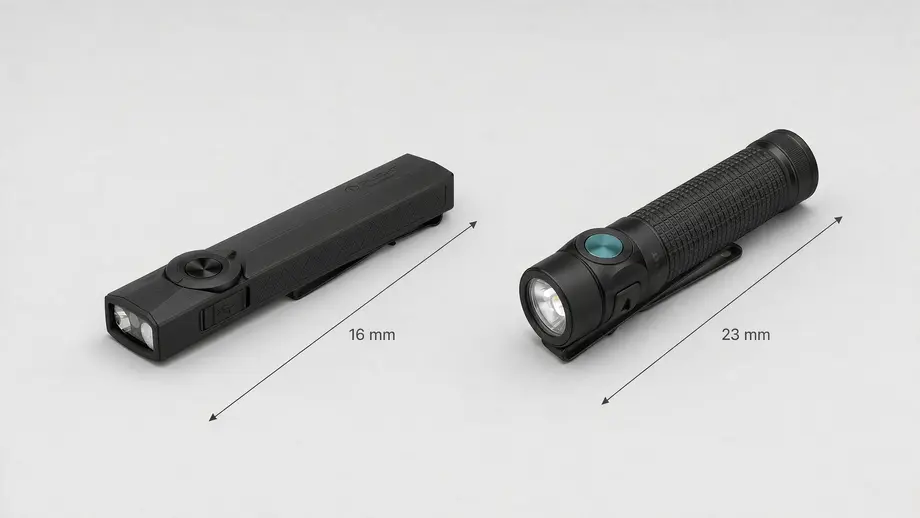
Olight makes some of the lights discussed here. Olight specs and prices come from its product pages and user manuals as of September 2026; other brands' specs come from their makers. Volumes, ratios, and pocket-fit figures are our own arithmetic from those published numbers.
⚡ TL;DR
A flat flashlight carries better than a round one in slim or women's jeans and on long sits, because it cannot roll and sits thinner: the flat Olight ArkPro is about 30% thinner than the round Baton 4 Pro at the same weight. A round light wins when you want the most battery per gram, a tail switch, or the shortest body.
This table compares the flat Olight ArkPro with the round Olight Baton 4 Pro, two lights that weigh within 1 gram of each other, so shape is the main thing that changes.
| Dimension | Flat: ArkPro | Round: Baton 4 Pro | Which is better | By how much |
|---|---|---|---|---|
| Thickness against your leg | 16 mm (0.63 in) | 23 mm (0.9 in) diameter | Flat | 7 mm thinner, about 30% |
| Width | 27 mm (1.06 in) | 23 mm (0.9 in) | Round | 4 mm narrower |
| Length | 124 mm (4.88 in) | 111 mm (4.37 in) | Round | 13 mm shorter |
| Weight | 115 g (4.05 oz) | 114 g (4.02 oz) | Tie | 1 g |
| Outer volume (our math) | 53.6 cm³ | 46.1 cm³ | Round | About 14% smaller |
| Battery energy | 7.4 Wh (2,000 mAh, 3.7 V) | About 12.6 Wh (3,500 mAh, 3.6 V 18650) | Round | About 70% more energy |
| Moonlight runtime | 14 days at 1 lumen | 100 days at under 1 lumen | Round | About 7 times longer |
| Max output | 1,500 lumens | 1,600 lumens | Tie | 100 lumens |
| Peak intensity | 10,640 candela | 10,000 candela | Tie | 6% |
| Light sources | Flood, spot, 365 nm UV, green laser | White only | Flat | 3 extra sources |
| Sits still on a table | Yes, rests on its broad face | Needs its included L stand | Flat | No rolling |
| Price (regular price, September 2026) | From $99.99 | $69.99 | Round | $30 less |
The pattern is simple. The flat body buys you a thinner, stable, multi-source light. The round body buys you battery, a shorter length, and a lower price.
If you have ever had a round light roll under a car seat, press a hard ridge into your thigh during a long drive, or print through slim jeans, you already know the problem. The other side of the story is cost: a flat light often costs more, and you may not be sure the pocket comfort is worth it. This guide puts numbers on both sides using only published specs.
📋 Table of Contents
- 1. Is a Flat Flashlight Better Than a Round One?
- 2. Why Flat Flashlights?
- 3. How Does Each Shape Behave When You Sit, Climb Stairs, and Run?
- 4. Does Thickness or Width Matter More for Comfort?
- 5. Do Flat Flashlights Run Hotter or Dim Sooner on Turbo?
- 6. Deep-Carry or Standard Clip: Which Way Should the Light Ride?
- 7. Who Should Pick a Round Flashlight Instead?
- 8. Olight Flat Lineup: Sizes, Weights, and Ratios Compared
- 9. Who Makes the Best Flat Flashlight?
- 10. Which Flat Flashlight Is the Best in 2026?
- 11. Your Flat vs Round Decision Checklist
- 12. FAQ
Is a Flat Flashlight Better Than a Round One?
A flat flashlight is better for pocket comfort, and a round flashlight is better for battery life per gram. At the same 115 g weight, the flat ArkPro is 16 mm thick against the round Baton 4 Pro's 23 mm, but it stores about 7.4 Wh against about 12.6 Wh. Pick flat if the light lives in a jeans pocket. Pick round if runtime matters more.
Brightness does not decide the question. The ArkPro lists 1,500 lumens and 10,640 candela; the Baton 4 Pro lists 1,600 lumens and 10,000 candela. Peak intensity sets how bright a spot looks at distance. At 10 meters, lux equals candela divided by 100, so both lights put roughly 100 lux on a target 10 meters away. If you want the full formula, our guide to candela vs lumens vs lux walks through it.
Where the two shapes really differ is in how they spend the same 115 grams:
- The flat body spends it on area. It spreads the mass over a broad face, so it lies flat against your leg and cannot roll.
- The round body spends it on battery. A cylindrical 18650 cell fills a round tube with little wasted space, so more of the weight is stored energy.
- The flat body also spends it on features. The ArkPro fits four light sources behind one wide face, which a thin round head has no room for.
So the honest answer is conditional. The table above tells you which condition applies to you.
Why Flat Flashlights?
People choose flat flashlights because the shape solves three pocket problems at once: it adds less thickness against the thigh, it cannot roll off a table or truck seat, and its broad face leaves room for extra light sources. The cost is less battery for the same weight: the flat ArkPro stores 7.4 Wh in 115 g, while the round Baton 4 Pro stores about 12.6 Wh in 114 g.
Fenix, which sells both shapes, describes the rolling problem on its flat flashlight collection page: "Round flashlights roll off tables, truck beds, and workbenches… and flat flashlights stay put." Olight's own round Baton 4 Pro ships with an L stand in the box, which is one way to solve rolling on a round body.
The second reason is thickness. The pocket fabric has to stretch over whatever you put in it. A light that is 16 mm thick lifts the fabric 7 mm less than one that is 23 mm thick. On slim jeans, that difference decides whether the light shows as a clean rectangle or a round bulge.
The third reason is features. Olight's flat lights stack several emitters side by side on one face:
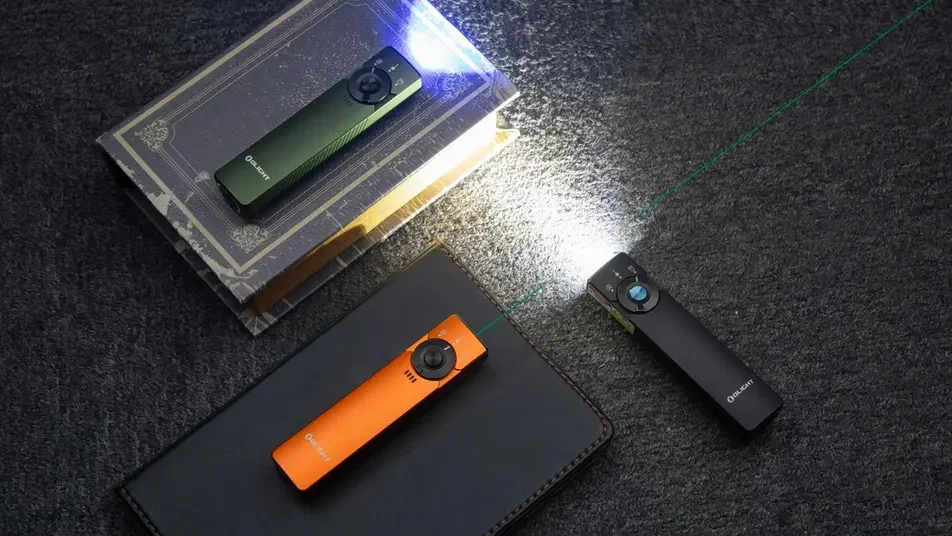
- ArkPro and ArkPro Ultra: pure flood, spotlight, 365 nm UV, and a green laser.
- Arkfeld Pro: white light, 365 nm UV, and a Class 3R green laser.
- Round Baton 4 Pro: one white emitter behind a TIR optic.
If you only ever need white light, the extra sources add cost you will not use. If you check hotel sheets with UV or point at a whiteboard with a laser, one flat light replaces two or three tools.
How Does Each Shape Behave When You Sit, Climb Stairs, and Run?
A flat light rides flat against your thigh and moves less when you sit or walk, because its broad face grips the fabric. A round light is shorter and lighter in small sizes, so it bounces less when you run, but its curved side can press a ridge into your leg when you sit. Length matters most when sitting; weight matters most when running.
The walkthrough below is geometry, not a lab trial. It uses each light's published length, thickness, and weight to show where the stress points are.
Sitting at a desk or driving. When you sit, the front of the pocket folds at the hip crease. A long rigid light has to bridge that fold. The ArkPro is 124 mm long and the Baton 4 Pro is 111 mm, so the flat light bridges 13 mm more. The flat face spreads its load over about 33.5 cm² (124 × 27 mm); the round body touches your leg along a narrow line. Flat usually feels better for a long drive, as long as the light is short enough to clear the fold.
Climbing stairs. Each step lifts your thigh and pushes the top of the light toward the pocket opening. A flat light can only slide along its broad face. A round body can also turn on its long axis, so the clip is the only thing holding its orientation. Either way, clip the light so it sits low in the pocket (see the clip section below).
Running for a bus or jogging. A heavier light carries more momentum each time your leg changes direction, so mass is the number to watch. The 52.5 g Baton 4 weighs less than half of the 115 g ArkPro, and at 63 mm it is about half the length. If you run with a light in a pocket, a short round light moves less than any full-size flat one.
Kneeling or crouching. Deep knee bends pull fabric tight across the thigh. Thickness then matters more than length. At 16 mm, the flat light is the easier of the two here.
Tip: Try your planned carry with the light off for one day before you decide. Sit, drive, climb stairs, and kneel once. If you notice the light, move it to the other pocket or change the clip side before you blame the shape.
Does Thickness or Width Matter More for Comfort?
Thickness matters more than width for pocket comfort, because thickness is how far the light lifts the fabric off your leg. Width adds only a few millimeters to a pocket that is several inches wide. The flat ArkPro is 4 mm wider than the round Baton 4 Pro but 7 mm thinner, so it trades a small width gain for a larger thickness cut.
Pocket depth is the other limit, and it varies more than most people expect. The data journalism site The Pudding measured front pockets in 80 pairs of jeans from 20 popular US brands, all with a 32-inch waist, and published the raw pocket measurements. In its article on women's jeans pockets, it reports that "the pockets in women's jeans are 48% shorter and 6.5% narrower than men's pockets."
The data set records front pocket depth on the side away from the zipper, measured from the top rivet down to the lowest point of the pocket. We averaged that figure: 18.1 cm (7.1 in) for men's jeans and 13.2 cm (5.2 in) for women's. Then we counted how many pockets are at least as deep as each light is long. This table is the result.
| Light | Shape | Length | Thickness | Men's jeans deep enough, outer side (of 40) | Women's jeans deep enough, outer side (of 40) |
|---|---|---|---|---|---|
| Olight Baton 4 | Round | 63 mm | 21 mm | 40 | 40 |
| Streamlight Wedge XT | Flat | 108 mm | Not listed | 40 | 39 |
| Olight Baton 4 Pro | Round | 111 mm | 23 mm | 40 | 38 |
| Olight Arkfeld Pro | Flat | 120 mm | 16 mm | 40 | 34 |
| Olight ArkPro / ArkPro Ultra | Flat | 124 mm | 16 mm | 40 | 27 |
| Nitecore EDC27 UHi | Flat | 135.3 mm | Not listed | 39 | 13 |
The takeaway is clear. In men's jeans, every light in the table except the 135 mm Nitecore fits the outer-side depth of all 40 pockets. In women's jeans, length becomes the limit. A 124 mm flat light fits in about two of three pairs; a 135 mm flat light fits in about one of three. The Pudding measured unworn jeans in stores, so a pocket on your body can hold a little less.
The same data shows why flat shapes help in shallow pockets. When a light is too long to sink fully, part of it rides above the pocket edge. A 16 mm slab lies flat along the seam; a 23 mm cylinder stands out more.
Note: Pocket depth varies by cut, rise, and brand. Measure your own pocket on the side away from the zipper, from the top rivet to the lowest point of the pocket bag, then compare it with the light's length before you buy.
Do Flat Flashlights Run Hotter or Dim Sooner on Turbo?
Flat flashlights do not run hotter by shape alone; a flat body has more outer surface for its volume, which helps it shed heat. The ArkPro has about 30% more surface area than the round Baton 4 Pro. On paper, both still step down within minutes: the ArkPro from 1,500 to 520 lumens after 4 minutes, and the Baton 4 Pro from 1,600 to 600 lumens after 2 minutes.
The physics favors area. Georgia State University's HyperPhysics page on heat conduction gives the rate of heat flow as thermal conductivity times area times temperature difference, divided by thickness. The formula describes heat moving through a barrier, but the area term is the point here: at the same temperature difference, more outer area lets more heat leave.
Here is how the two bodies compare. We treated the flat light as a box and the round light as a cylinder, which slightly overstates the flat light's area because its edges are rounded.
| Measure (our math from official dimensions) | Flat: ArkPro | Round: Baton 4 Pro |
|---|---|---|
| Outer volume | 53.6 cm³ | 46.1 cm³ |
| Outer surface area | About 115 cm² | About 88.5 cm² |
| Surface area per cm³ | 2.15 | 1.92 |
| Turbo (Olight) | 1,500~520 lumens, 4 + 140 minutes | 1,600~600 lumens, 2 + 198 minutes |
| High (Olight) | 520~100 lumens, 155 + 10 minutes | 600~120 lumens, 200 + 20 minutes |
| Battery energy | 7.4 Wh | About 12.6 Wh |
Read the Turbo row this way: the ArkPro holds its peak about 2 minutes longer, and then both settle near the same level. The flat body's extra area does not buy a higher sustained output on paper. Step-down timing also depends on firmware and battery, so shape is only one factor. For the full explanation, see our guide to why flashlights dim on turbo.
The pocket is where heat matters most. A pocket traps heat against your leg. The Olight user manual for the ArkPro Series says: "Do not put a hot light into any type of fabric bag or fusible plastic container." It also advises: "When the product gets hot, please switch to low brightness or turn it off temporarily," and warns against activating "the maximum brightness mode multiple times continuously."
Warning: After a turbo burst, hold the light in your hand or set it down for a minute before you pocket it. A warm light pressed against fabric has nowhere to shed heat, whatever its shape.
Deep-Carry or Standard Clip: Which Way Should the Light Ride?
Choose deep carry if you want the light low and mostly hidden in the pocket, and a standard clip position if you want more of it above the edge to grab. Neither is better in general. Olight's spec tables for the ArkPro and Baton 4 Pro do not list clip carry depth, so check product photos against your own pocket.
Here is what each approach changes in daily use:
- Deep carry. The light sinks below the pocket edge, and mostly the clip shows. That only works if the light is shorter than your pocket is deep, so use the depth table above before you commit.
- Standard clip. Part of the light rides above the pocket edge. That part is easier to reach and to find by feel, and it is also the part other people can see.
- Head up or head down. This depends on where the buttons sit on your light. The ArkPro's center button is on its broad face and its side button is on the edge, so neither orientation hides them. Use the lockout (see the tip below) rather than counting on clip direction to stop accidental activation.
- No clip at all. A holster on a belt moves the light off your thigh entirely.
Olight's parts pages show how this plays out on specific models. The Baton 4 comes with its pocket clip included in the box. Olight sells a replacement Arkfeld Pro Clip for $3.99, so a bent clip is a cheap fix. For the ArkPro family, Olight sells the ArkPro Series Holster for $9.99, which Olight says "can clip onto your belt or attach with 3M adhesive to walls or vehicles." It weighs 33.5 g, so it adds real mass.
If your pockets are too shallow for any clip, a clip light rides on the outside instead. The Olight Oclip 2 Pro is 60.2 mm long and weighs 75.5 g. Olight says its clip "grips objects up to 14 mm thick, including collars, straps, and MOLLE webbing," with a 115° head tilt and a 360° rotating clip. Its limits: it tops out at 530 lumens, and it is rated IP66 against IPX7 on the flat Ark lights. It costs $54.99 (regular price, September 2026). The Oclip 2 user manual adds a caution for anyone with an implanted heart device: "If you have an ICD or pacemaker, avoid close or prolonged contact with this product to prevent possible interference."
Tip: The ArkPro Series manual says its lockout works "When off, long press center button (2 s)," and unlocking takes a 1-second long press. Lock the light before it goes into a pocket with keys or coins. The same manual notes the switch "is magnetically sensitive," so keep it away from strong magnets such as magnetic wallets.
Who Should Pick a Round Flashlight Instead?
Pick a round flashlight if you have large hands, work in gloves, want the longest runtime per gram, or need the smallest possible light. A round body gives a full grip and often a tail switch you can press with a gloved thumb. In the pair compared here, the round 18650 light also holds more battery for its weight: about 0.11 Wh per gram for the Baton 4 Pro against 0.064 Wh for the ArkPro.
The runtime gap is large. The Baton 4 Pro lists 155 hours on its 15-lumen Low; the ArkPro lists 72 hours on the same 15-lumen Low with the flood lens. That is more than twice the runtime at the same setting. For a light that sits in a glove box or a go-bag for months, that matters more than pocket comfort.
This table sorts common carry situations by the shape that fits them best.
| Situation | Better shape | Why |
|---|---|---|
| Slim or women's jeans, all-day pocket carry | Flat | 16 mm thick; lies flat along the seam |
| Office clothes where printing matters | Flat | Thin profile, stable in dress pockets |
| You also want UV or a pointer | Flat | ArkPro and Arkfeld Pro add UV and a green laser |
| Gloves at work or in winter | Round | Tail switch and round grip are easier with gloves |
| Large hands, long tasks | Round | A cylinder fills the hand; flat bodies can feel thin |
| Longest runtime per gram | Round | About 70% more Wh per gram in the Baton 4 Pro |
| Smallest light in this guide with 1,000+ lumens | Round | Baton 4: 63 mm, 52.5 g, 1,300 lumens |
| Jogging with the light in a pocket | Round (short) | Half the mass bounces less |
| Children using the light (with adult supervision) | Round, white-light only | No laser; simpler controls |
| No usable pocket | Clip light | Oclip 2 rides on a collar or strap |
Gloves deserve a closer look. Olight lists the ArkPro's controls as "Central Button & Selector & Side Switch": a button in the middle of the face, a rotating selector for the light source, and a side button that its user manual assigns to the laser and UV. That layout gives you more functions, but a thick glove makes a small rotating selector harder to turn. The Baton 4 Pro lists "Side Switch & Tail Switch" and has no selector to turn. Round lights across the Olight Baton series share that compact tube layout.
Olight Flat Lineup: Sizes, Weights, and Ratios Compared
The four Olight flat lights in this guide come in two lengths, 120 mm and 124 mm, and all share the same 27 mm width and 16 mm thickness. They weigh 111 g to 120 g. The ArkPro Ultra is the brightest at 1,700 lumens; the Arkfeld Pro is the lightest at 111 g. The table adds round Olight lights and two other brands for scale.
This table lists official dimensions, weight, and output, plus lumens per gram and outer volume calculated from those figures.
| Model | Shape | Size (L × W × H) | Weight | Max output | Lumens per gram (our math) | Outer volume (our math) | Price (regular price, September 2026) |
|---|---|---|---|---|---|---|---|
| ArkPro | Flat | 124 × 27 × 16 mm | 115 g | 1,500 lumens | 13.0 | 53.6 cm³ | From $99.99 |
| ArkPro Ultra | Flat | 124 × 27 × 16 mm | 120 g | 1,700 lumens | 14.2 | 53.6 cm³ | $129.99 |
| Arkfeld Pro | Flat | 120 × 27 × 16 mm | 111 g | 1,300 lumens | 11.7 | 51.8 cm³ | $89.99 |
| Arkfeld Ultra | Flat | 120 × 27 × 16 mm | 119 g | 1,400 lumens | 11.8 | 51.8 cm³ | $119.99 |
| Baton 4 Pro | Round | 111 × 23 mm | 114 g | 1,600 lumens | 14.0 | 46.1 cm³ | $69.99 |
| Baton 4 | Round | 63 × 21 mm | 52.5 g | 1,300 lumens | 24.8 | 21.8 cm³ | $54.99 |
| Oclip 2 Pro | Clip | 60.2 × 28 × approx. 35 mm | 75.5 g | 530 lumens | 7.0 | Not comparable | $54.99 |
| Nitecore EDC27 UHi | Flat | 135.3 mm long, 31.4 mm head | 122 g | 3,100 lumens | 25.4 | Thickness not listed | Not compared |
| Streamlight Wedge XT | Flat | 108 mm long | 74.28 g | 500 lumens | 6.7 | Thickness not listed | Not compared |
Three things stand out. First, all four Olight flats have the same 16 mm thickness, so choosing among them is about length, features, and material, not pocket profile. Second, lumens per gram favors small round lights and high-output flats; the Baton 4 and the Nitecore EDC27 UHi both pass 24 lumens per gram. Third, peak lumens per gram says nothing about runtime, which is where the round 18650 body pulls ahead.
The Nitecore and Streamlight figures come from each maker's page: the Nitecore EDC27 UHi lists 3,100 lumens, 135.3 mm length, a 31.4 mm head, and 122 g; the Streamlight Wedge XT lists 500 lumens, 4.25 inches (10.80 cm), and 2.62 ounces (74.28 grams). Neither page lists thickness, so we did not compute their volume.
Safety note: All four Olight flat lights in this table (ArkPro, ArkPro Ultra, Arkfeld Pro, and Arkfeld Ultra) include a green laser that Olight lists as Class 3R; the ArkPro and Arkfeld Pro list a maximum of 5 mW. The FDA's laser hazard class table says a 3R laser "can be momentarily hazardous when directly viewed." Never aim it at people, pets' eyes, vehicles, or aircraft; the FAA says pointing a laser at an aircraft "is a federal crime." Do not give laser models to children. The ArkPro Series user manual also warns: "Do not look directly at the light source or shine it into your eyes" because it can damage them. The 365 nm UV emitters on all four models call for the same care: don't look into the emitter, and avoid skin and eye exposure. Our explainer on what a UV flashlight is covers safe UV use.
Who Makes the Best Flat Flashlight?
No single brand makes the best flat flashlight for everyone. Olight, Nitecore, Fenix, and Streamlight all sell flat EDC lights, and each leads on a different spec. Nitecore's EDC27 UHi lists the highest output here at 3,100 lumens; Streamlight's Wedge XT is the lightest at 74.28 g; Olight's ArkPro series packs the most light sources. Judge by thickness, battery, and switch layout.
Use these five questions to compare any flat light, whatever the brand:
- How thick is it? Look for a published thickness. If a maker lists only length and head size, you cannot judge pocket profile from the page.
- How long is it compared with your pocket? Compare the length with the depth of your shallowest pocket, using the depth check above.
- How much energy does it store? Watt-hours tell you more than lumens. Multiply mAh by voltage and divide by 1,000 if the maker lists only mAh.
- What does Turbo drop to, and when? Read the full runtime line, such as "1,500~520 lumens, 4 + 140 minutes," not just the peak.
- Which extra sources do you need? UV and a laser add cost and safety rules. If you need only white light, a simpler light costs less.
Olight's flat lights stand out on the last point. The Olight ArkPro combines a 1,500-lumen flood, an 800-lumen spot reaching 205 m, 1,200 mW of 365 nm UV, and a green laser, with USB-C and magnetic charging. Its limitation is the one this guide keeps finding: 7.4 Wh is less stored energy than a round 18650 light of the same weight.
Which Flat Flashlight Is the Best in 2026?
The best flat flashlight in 2026 depends on your main task. For the most features, choose the ArkPro Ultra. For the best value with UV and a laser, choose the Arkfeld Pro at $89.99. For a pocket too shallow for a 124 mm light, choose the 120 mm Arkfeld Pro. If you do not need UV or a laser, a round Baton 4 Pro gives more runtime for less money.
Here is each pick, written as problem, spec, limit, and alternative.
For the most light sources and the toughest shell: ArkPro Ultra. The challenge with a pocket light is scratches from keys and coins. The Olight ArkPro Ultra uses O-aluminum that Olight says is "1.73x as hard as standard 6061 aluminum alloy," and raises the flood to 1,700 lumens. The limit: at 120 g it is the heaviest Olight flat here, and at $129.99 it costs $60 more than the Baton 4 Pro. If you need neither the hard shell nor the extra 200 lumens, the standard ArkPro is the same size.
For value with UV and a pointer: Arkfeld Pro. The Olight Arkfeld Pro pairs 1,300 lumens with 900 mW of 365 nm UV and a Class 3R green laser, at 111 g and 120 mm. The limit: its 2,608 candela gives about 26 lux at 10 meters, a quarter of the ArkPro's 106 lux, so it is a close-range light. Some colors were sold out on September 24, 2026.
For shallow pockets: Arkfeld Pro again. Its 120 mm length fits the outer-side depth of 34 of 40 women's jeans pockets in the depth table, against 27 for the 124 mm ArkPro.
When a flat light is the wrong choice. If the light will sit in a truck or go-bag for months, or you wear gloves, the round Olight Baton 4 Pro fits better. It stores about 12.6 Wh and lists 100 days on moonlight, at $69.99. Its limit is the one this article started with: a 23 mm cylinder that can roll and prints more in slim pockets.
A note on the Arkfeld Ultra: its regular price is $119.99, but five of its colors were listed as sold out on September 24, 2026, so check stock before you plan around it. For more EDC options, browse Olight's range of flat flashlight models and other pocket-carry lights.
Your Flat vs Round Decision Checklist
Use this checklist to decide in five minutes. It turns the numbers above into steps you can do at home with a ruler and the jeans you wear most. If three or more answers point the same way, buy that shape. If they split, pick the shape that fixes your biggest complaint about your current light.
- Measure the side of your most-worn front pocket away from the zipper, from the top rivet to the bottom. If it is under 12.4 cm, skip 124 mm lights.
- Ask whether the light prints or presses into your leg today. If yes, lean flat.
- Count how often you charge. If a weekly charge is a chore, lean round for the extra Wh.
- Check whether you wear gloves for work. If yes, lean round with a tail switch.
- List the extra sources you would use in a month. If UV or a pointer makes the list, lean flat.
- Decide on deep carry or a standard clip before you order, and check the light's length against your pocket.
- For laser models, set a rule at home: no aiming at eyes, vehicles, or aircraft, and no use by children.
- After any turbo burst, let the light cool in your hand before it goes back in your pocket.
FAQ
Changelog
- September 22, 2026: First published.