Olight makes the lights compared here. Specs and regular prices come from Olight's US product pages and user manuals as of September 2026. The timelines, per-dollar figures and heat estimates below are calculations from those published numbers, not lab measurements.
⚡ TL;DR
The brightest flashlight under $100 at the 10-minute mark, on Olight's published runtime figures, is the Olight Perun 3: 3,000 lumens for 2 minutes, then 800 lumens for 180 minutes, for $89.99. If you need reach rather than floodlight, the Baton Ultra keeps 600 lumens and the longest beam. Peak lumens alone will not tell you which light stays bright.
Here is the problem most buyers hit. Lights under $100 advertise anything from 1,300 to 3,000 lumens, and every one of them drops to a fraction of that within a few minutes. You are standing in a dark basement looking for the breaker panel, or walking the edge of a campsite 50 meters out, and the number on the box has already stopped being true. This guide compares five Olight lights under $100 on what they hold at 30 seconds, 3 minutes and 10 minutes, what each dollar buys in sustained light, and how far each beam still reaches after the drop.
This summary table shows which brightest flashlight under $100 wins on each measure that matters, and by how much, using Olight's published specs.
| Dimension | Winner | Runner-up | Margin |
|---|---|---|---|
| Peak output | Perun 3, 3,000 lumens | Baton Ultra, 1,800 lumens | 67% more |
| Output at 3 minutes | Arkfeld Pro, 1,300 lumens | Perun 3, 800 lumens | 63% more |
| Output at 10 minutes | Perun 3, 800 lumens | Baton 4 Pro and Baton Ultra, 600 lumens | 33% more |
| Total light in the first 10 minutes | Perun 3, 12,400 lumen-minutes | Baton 4 Pro, 8,000 lumen-minutes | 55% more |
| Peak beam distance | Baton Ultra, 300 m | Baton 4 Pro, 200 m | 100 m farther |
| Sustained lumens per dollar | Perun 3, 8.9 lumens per $ | Baton 4 Pro, 8.6 lumens per $ | 4% more |
| Smallest and lightest | Baton 4, 52.5 g | Arkfeld Pro, 111 g | Less than half the weight |
📋 Table of Contents
- 1. Which Brightest Flashlight Under $100 Stays Brightest After 10 Minutes?
- 2. The Most Powerful Flashlight Under $100: Five Candidates and Their Specs
- 3. Why Does a 3,000-Lumen Flashlight Only Hold Turbo for 2 Minutes?
- 4. Throw vs Flood: Which Light Reaches 50 Meters After Step-Down?
- 5. Sustained Lumens per Dollar: What Is the Best Flashlight Under 100 Dollars?
- 6. How Hot Do High-Lumen Flashlights Get, and Where Is the Safety Line?
- 7. Common Mistakes When Comparing Peak Lumens
- 8. What Is the Cheapest and Brightest Flashlight Available?
- 9. What Is the Brightest Flashlight I Can Legally Own?
- 10. Which Flashlights Are the Brightest?
- 11. Who Should Buy Which Light: A Scenario Checklist
- 12. FAQ
Which Brightest Flashlight Under $100 Stays Brightest After 10 Minutes?
The Olight Perun 3 stays brightest after 10 minutes. Its published turbo line is 3,000 lumens for 2 minutes, then 800 lumens for 180 minutes. The Baton 4 Pro and Baton Ultra settle at 600 lumens, the Arkfeld Pro at 420 lumens and the Baton 4 at 300 lumens. At 3 minutes the ranking flips: the Arkfeld Pro still holds 1,300 lumens.
To build the timeline below, each light's official turbo line was split into its stages and read at three points. Thirty seconds is when the ANSI/PLATO FL1 standard takes its first reading. A one-page summary of the standard from Streamlight defines run time as the time "from the initial light output value (that's 30 seconds after the light is turned on with fresh batteries) until the light output drops to 10% of the initial value." Olight's manuals for the Perun 3, Baton 4 and Arkfeld Pro state that their figures were "tested per ANSI/PLATO FL 1-2019 standard in Olight's labs for reference."
This table reads each light's published turbo stages at the 30-second, 3-minute and 10-minute marks. The figures are Olight's own FL1 ratings, taken at room temperature with a full battery; nothing here was re-measured.
| Light (regular price, September 2026) | Turbo line (Olight) | Stage times (Olight) | At 30 seconds | At 3 minutes | At 10 minutes | 10-minute level as % of peak |
|---|---|---|---|---|---|---|
| Perun 3 ($89.99) | 3,000~800~600 lumens | 2 + 180 + 30 minutes | 3,000 lm | 800 lm | 800 lm | 27% |
| Baton 4 Pro ($69.99) | 1,600~600 lumens | 2 + 198 minutes | 1,600 lm | 600 lm | 600 lm | 38% |
| Baton Ultra ($99.99) | 1,800~600 lumens | 1.5 + 198 minutes | 1,800 lm | 600 lm | 600 lm | 33% |
| Baton 4 ($54.99) | 1,300~600~300 lumens | 1.5 + 2.5 + 73 minutes | 1,300 lm | 600 lm | 300 lm | 23% |
| Arkfeld Pro ($89.99) | 1,300~420 lumens | 4 + 126 minutes | 1,300 lm | 1,300 lm | 420 lm | 32% |
A single reading at 10 minutes hides how much light you got on the way there. Adding up lumens times minutes across the first 10 minutes gives a fairer total. The Perun 3 delivers about 12,400 lumen-minutes, an average of 1,240 lumens. The Baton 4 Pro averages 800 lumens, the Baton Ultra 780 and the Arkfeld Pro 772, thanks to its long 4-minute turbo. The Baton 4 averages 525 lumens.
Note: Stage times are nominal. Olight's manuals say the ratings are for reference, and a warm room, a gloved hand or a half-charged battery can shorten the first stage. Treat the table as a ranking, not a stopwatch.
The Most Powerful Flashlight Under $100: Five Candidates and Their Specs
Five Olight lights meet the brief of a bright main light under $100 at regular price: the Perun 3 headlamp-flashlight, the Baton 4 Pro, the Baton Ultra, the Baton 4 and the flat Arkfeld Pro. Peak output runs from 1,300 to 3,000 lumens and beam distance from 102 to 300 meters. Battery energy is the least advertised difference, and it varies almost eightfold.
The Olight Perun 3 is a headlamp-flashlight that ships with a headband, a magnetic tail, a clip and a lanyard, so it works as a headlamp or a handheld flashlight. Olight lists 3,000 lumens, 6,400 candela, 160 m, IP68 and a 5000 mAh battery that its manual rates at 18 Wh. The Olight Baton 4 Pro is a 111 mm pocket light with a side switch and a tail switch, rated at 1,600 lumens, 10,000 candela, 200 m and IPX8. The Olight Baton Ultra shares its 3,500 mAh battery but uses Olight's own EIP 1 LED for 1,800 lumens, 22,500 candela and 300 m.
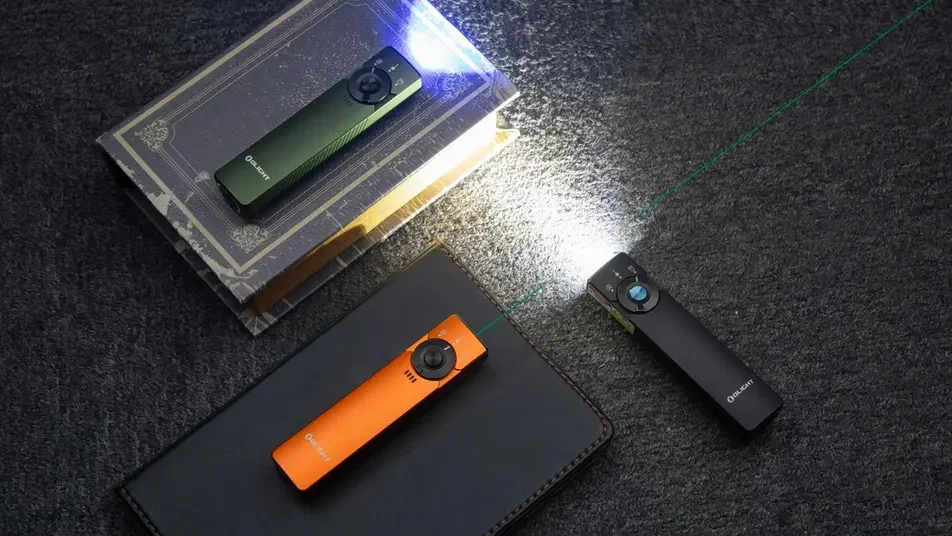
The Olight Baton 4 is the smallest at 63 mm and 52.5 g, with 1,300 lumens and 170 m from a 650 mAh cell that its manual rates at 2.34 Wh. The Olight Arkfeld Pro is a flat 3-in-1 light: 1,300 lumens of white light, a 365 nm UV light and a Class 3R green laser, with a built-in 1500 mAh battery rated at 5.55 Wh.
This table puts the published specs side by side. Battery energy comes from each user manual; the Baton 4 Pro and Baton Ultra manual lists 12.6 Wh.
| Spec | Perun 3 | Baton 4 Pro | Baton Ultra | Baton 4 | Arkfeld Pro |
|---|---|---|---|---|---|
| Regular price (September 2026) | $89.99 | $69.99 | $99.99 | $54.99 | $89.99 |
| Max output | 3,000 lm | 1,600 lm | 1,800 lm | 1,300 lm | 1,300 lm |
| Max intensity | 6,400 cd | 10,000 cd | 22,500 cd | 7,225 cd | 2,608 cd |
| Beam distance | 160 m | 200 m | 300 m | 170 m | 102 m |
| Battery energy | 18 Wh | 12.6 Wh | 12.6 Wh | 2.34 Wh | 5.55 Wh |
| Weight with battery | 150 g | 114 g | 115 g | 52.5 g | 111 g |
| Water rating | IP68 | IPX8 | IPX8 | IPX8 | IPX7 |
| Carry style | Headband, magnet, clip | Pocket, tail switch | Pocket, tail switch | Pocket, clip | Flat body, pocket carry |
Two details on price. The Baton 4 product page shows $54.99 for the OD Green option and describes both a standard and a Premium Edition with a charging case, so check which version is in your cart. The Baton Ultra is listed at a regular $99.99 on the shared Baton Ultra and Baton 4 Pro page. You can compare other sizes across the Baton series flashlights, and the full range of Olight flashlights covers lights above $100.
Why Does a 3,000-Lumen Flashlight Only Hold Turbo for 2 Minutes?
A 3,000-lumen flashlight holds turbo for about 2 minutes because its LED turns most of its power into heat, and a 150-gram body cannot shed that heat as fast as turbo makes it. The driver then cuts output to a level the body can sustain. That planned drop is thermal step-down, and every light in this comparison uses it.
The heat share is large. A U.S. Department of Energy fact sheet on the thermal management of white LEDs says LEDs "convert only 15%-25% of the power into visible light; the remainder is converted to heat." The same sheet lists "color shift and reduced light output" as the short-term effects of excess heat. The sheet also notes that LEDs are rated at a junction temperature of 25°C but typically run at 60°C or more, so "white LEDs will provide at least 10% less light than the manufacturer's rating," and more when thermal design is poor. That rating is for the bare LED chip. A flashlight's FL1 lumen figure is read from the finished light 30 seconds after switch-on, so the heat losses of those first 30 seconds are already inside it. LEDs have improved since that 2007 sheet, but a handheld light still has to get rid of most of its input power as heat. Our thermal step down flashlight guide covers the physics of that drop in detail.
The published numbers suggest a pattern you can use. Divide each light's lumen-hours over its full turbo run by its battery watt-hours and you get an average efficiency in lumens per watt. Divide the 10-minute level by that figure and you get the power the light can hold, which can be compared with its weight.
This table works through that estimate. It assumes the whole battery is used by the end of the rated turbo run and ignores driver losses, so treat the watts as approximate.
| Light | Lumen-hours in the full turbo run | Implied efficiency | Power at the 10-minute level | Sustained power per 100 g | Sustained lumens per 100 g |
|---|---|---|---|---|---|
| Perun 3 | 2,800 | 156 lm/W | about 5.1 W | 3.4 W | 533 lm |
| Baton 4 Pro | 2,033 | 161 lm/W | about 3.7 W | 3.3 W | 526 lm |
| Baton Ultra | 2,025 | 161 lm/W | about 3.7 W | 3.2 W | 522 lm |
| Baton 4 | 423 | 181 lm/W | about 1.7 W | 3.2 W | 571 lm |
| Arkfeld Pro | 969 | 175 lm/W | about 2.4 W | 2.2 W | 378 lm |
The four round lights land within a narrow band: about 3.2 to 3.4 watts of sustained power per 100 grams, or roughly 520 to 570 sustained lumens per 100 grams. That gives you a quick rule of thumb for any round light in this class. Weigh it, and expect roughly 5 sustained lumens per gram, whatever the peak figure says. The flat Arkfeld Pro sits lower at about 378 lumens per 100 grams, which fits a thin body that also houses a laser and a UV emitter.
Tip: A turbo line with three stages, such as the Baton 4's "1,300~600~300 lumens" over "1.5 + 2.5 + 73 minutes," has a short middle step. Plan around the last big number, 300 lumens for 73 minutes, not the first.
Throw vs Flood: Which Light Reaches 50 Meters After Step-Down?
All five lights still reach 50 meters after they step down, on a simple inverse-square estimate. The Baton Ultra keeps the longest beam, about 173 m at its 600-lumen level, followed by the Baton 4 Pro at about 122 m. The Perun 3 and Baton 4 fall to about 82 to 83 m, and the Arkfeld Pro to about 58 m.
Beam distance under FL1 is the point where the beam falls to 0.25 lux, according to the Streamlight summary. Because illuminance falls with the square of distance, the rated distance works out to two times the square root of the rated candela. Olight's figures fit that rule exactly: 2 × √6,400 = 160 m for the Perun 3 and 2 × √22,500 = 300 m for the Baton Ultra. Our guide to beam distance explains the math behind candela and lux.
This table estimates what each beam does after the drop, assuming candela falls in proportion to lumens. Lux at 50 m is candela divided by 50 squared.
| Light | Candela per lumen | Peak lux at 50 m | Candela at the 10-minute level | Lux at 50 m after step-down | Estimated reach after step-down |
|---|---|---|---|---|---|
| Perun 3 | 2.1 | 2.6 lux | about 1,700 cd | 0.68 lux | about 83 m |
| Baton 4 Pro | 6.3 | 4.0 lux | about 3,750 cd | 1.5 lux | about 122 m |
| Baton Ultra | 12.5 | 9.0 lux | about 7,500 cd | 3.0 lux | about 173 m |
| Baton 4 | 5.6 | 2.9 lux | about 1,670 cd | 0.67 lux | about 82 m |
| Arkfeld Pro | 2.0 | 1.0 lux | about 840 cd | 0.34 lux | about 58 m |
Candela per lumen is the quickest way to read a beam from a spec sheet. A low ratio, like the Perun 3's 2.1 or the Arkfeld Pro's 2.0, means a wide flood that lights a campsite or a room with no tight hotspot. A high ratio, like the Baton Ultra's 12.5, means a tight beam that reaches the tree line but lights less of the ground at your feet. For a campsite perimeter, the Perun 3's flood covers more ground inside 50 m. For spotting a trail marker or a fence line beyond 100 m, the Baton Ultra is the clear pick.
Sustained Lumens per Dollar: What Is the Best Flashlight Under 100 Dollars?
The best flashlight under 100 dollars for sustained brightness per dollar is the Perun 3, at about 8.9 lumens per dollar at its 10-minute level. The Baton 4 Pro is close behind at 8.6 and costs $20 less. The Baton Ultra, Baton 4 and Arkfeld Pro return 6.0, 5.5 and 4.7 lumens per dollar, because each trades sustained output for reach or size.
Peak lumens per dollar is the number most ads imply, and it tells a different story. By that measure the Perun 3 leads at 33.3 lumens per dollar and the Baton 4 comes second at 23.6. But the Baton 4 spends its peak in 90 seconds, and its 2.34 Wh battery is less than a fifth of the Baton 4 Pro's 12.6 Wh.
This table ranks all five on peak and sustained value at regular price. The last column is the cost of every 100 lumens you can hold past the 10-minute mark.
| Light | Regular price | Peak lumens per $ | Sustained lumens per $ | Cost per 100 sustained lumens | Battery Wh per $10 |
|---|---|---|---|---|---|
| Perun 3 | $89.99 | 33.3 | 8.9 | $11.25 | 2.0 Wh |
| Baton 4 Pro | $69.99 | 22.9 | 8.6 | $11.67 | 1.8 Wh |
| Baton Ultra | $99.99 | 18.0 | 6.0 | $16.67 | 1.3 Wh |
| Baton 4 | $54.99 | 23.6 | 5.5 | $18.33 | 0.4 Wh |
| Arkfeld Pro | $89.99 | 14.4 | 4.7 | $21.43 | 0.6 Wh |
Value depends on what you are paying for. The Baton Ultra's extra $30 over the Baton 4 Pro buys no extra sustained lumens, but it more than doubles peak candela, from 10,000 to 22,500. The Arkfeld Pro's lower score reflects the UV light and laser you also get. If your only goal is the most light for the longest time, the Perun 3 and Baton 4 Pro are the two to shortlist.
How Hot Do High-Lumen Flashlights Get, and Where Is the Safety Line?
A high-lumen flashlight can get hot enough on turbo to be uncomfortable or to burn skin at the head, which is why every light here steps down on its own. Olight's Baton 4 Pro and Baton Ultra manual warns: "Do not touch the high-temperature warning area on the surface, as it may cause skin burns." The safe habit is short bursts, then a lower mode.
The DOE sheet makes the same point from the other side: "LEDs won't burn your hand like some light sources, but they do produce heat." In a small light, the heat goes into the metal you are holding. Olight's safety sheet for the Arkfeld Pro lists the practical rules. It says "Do not activate the maximum brightness mode multiple times continuously to prevent the high temperature on the surface," and "Do not put a hot light into any type of fabric bag or fusible plastic container." It also describes the protection built in: "The built-in thermister monitors the temperature of the light in real time and suppresses overheating by reducing the output."
The Arkfeld Pro sheet also warns that you should not cover the light outlet at close range, because the energy "may damage the product's light emitting components, and even cause external objects to burn." That matters most with a light switched on in a pocket or pressed face-down on a couch. Operating range is limited too: the Baton 4 manual lists 0 to 40 °C and the Baton 4 Pro manual 0 to 45 °C.
Warning: Do not leave a high-output light on turbo in a pocket, bag or closed car. Olight's Arkfeld Pro sheet says not to store, charge or use the light "in a car where the temperature inside may exceed 60°C." Use the lockout mode described in each manual when you carry the light.
Safety note: The Arkfeld Pro's green laser is Class 3R (5 mW). The FDA's page on laser products and instruments says a Class IIIa or 3R laser "can be momentarily hazardous when directly viewed." Never point it at people, animals' eyes or aircraft, and keep laser models away from children. The same light carries a 365 nm UV emitter, and its safety sheet says: "Do not look directly at the light source with the naked eye." Keep UV light off skin and out of eyes.
Common Mistakes When Comparing Peak Lumens
The biggest mistake is comparing peak lumens across lights of different sizes. Peak is a number the light holds for 90 seconds to 4 minutes, while the level you live with depends on body mass and battery energy. A 52-gram light and a 150-gram light can both advertise over 1,000 lumens, yet one holds 300 lumens and the other 800.
These are the errors that most often lead to a disappointing purchase, with the fix for each:
- Reading only the first number. In "3,000~800~600 lumens," the 800 is what you get for three hours. Read the second number first.
- Treating total runtime as turbo runtime. Under FL1, runtime runs until output falls to 10% of the 30-second reading. The Perun 3's turbo line totals 212 minutes, but only 2 of them are at 3,000 lumens.
- Equating lumens with reach. The Arkfeld Pro and Baton 4 share a 1,300-lumen peak, but the Baton 4's 7,225 candela reaches 170 m to the Arkfeld Pro's 102 m.
- Ignoring battery energy. Watt-hours set how long the sustained stage lasts. The Baton 4 Pro's 12.6 Wh carries 600 lumens for 198 minutes; the Baton 4's 2.34 Wh carries 300 lumens for 73 minutes.
- Expecting full turbo on a low battery. The Arkfeld Pro safety sheet says the light reaches its highest level only "when the remaining battery power is sufficient (4 or more power indicators)."
- Buying peak for close work. Reading a breaker label at arm's length needs tens of lumens, not thousands. Olight's Medium modes run from 60 to 120 lumens across these lights.
The honest summary is that a higher peak buys you a brighter first two minutes. A heavier body and a bigger battery buy you the rest of the night.
What Is the Cheapest and Brightest Flashlight Available?
Among these five under-$100 lights, the cheapest is the Olight Baton 4 at $54.99, with a 1,300-lumen peak and 170 m of throw. The most light per dollar goes to the Perun 3 at $89.99, which delivers 3,000 lumens at peak and holds 800 lumens at 10 minutes. Cheap and bright rarely means bright for long.
The Baton 4 earns its price as a pocket light. It is 63 mm long and weighs 52.5 g, Olight describes it as "almost shorter than your index finger," and its Moonlight mode runs for 30 days. Its limit is the small cell: after 4 minutes it holds 300 lumens, the lowest sustained level in this group. If you want a similar pocket light with a longer sustained stage, the Baton 4 Pro costs $15 more and carries a battery more than five times larger, 12.6 Wh against 2.34 Wh.
If your budget stops near $55, the Baton 4 is the brightest option in this comparison. If it stretches to $70, the Baton 4 Pro doubles the sustained output. At $90, the Perun 3 adds another third on top of that.
What Is the Brightest Flashlight I Can Legally Own?
In the U.S., the federal rules that limit how bright a consumer light can be apply to lasers, not LED flashlights. The FDA states that "LEDs (Light Emitting Diodes) are different from laser diodes and are not subject to the Federal laser product performance standard." The legal limits on ordinary flashlights are about how and where you use them.
Three kinds of use rules come up most often. First, lasers: the FAA says "pointing a laser at an aircraft is a federal crime," and its laser laws page notes civil penalties "of up to $11,000 per violation." That applies to the Arkfeld Pro's green laser, not to its white light. Second, spotlighting wildlife: some states restrict shining lights into fields and woods at night even when you carry no weapon, and the rules vary by state and season. Minnesota's statute says that from two hours after sunset until sunrise "a person may not cast the rays of a spotlight, headlight, or other artificial light on a highway, or in a field, woodland, or forest to spot or locate a wild animal" (Minn. Stat. 97B.081). Wisconsin's rule, quoted by its Department of Natural Resources, is narrower in time: "No person may use or possess with intent to use a light for shining wild animals between 10 p.m. and 7 a.m. from Sept. 15 to Dec. 31." Both have exceptions, so read the full text. Our guide to hunting with a light laws covers how those rules differ. Third, local rules on nuisance light or on lights fitted to vehicles, which you should check with your state or city.
Before you carry a bright light into fields or woods at night, check your state wildlife agency's current regulations, even if you are not hunting.
Which Flashlights Are the Brightest?
The brightest flashlights by lumens are large searchlight-class lights that cost far more than $100; in Olight's own range, the Marauder 3 is rated at 25,000 lumens. Under $100, on Olight's ANSI FL1 ratings, the brightest by peak lumens is the Perun 3 at 3,000 and the brightest by candela is the Baton Ultra at 22,500.
"Brightest" has two meanings, and an FL1 spec sheet reports both. The Streamlight summary of ANSI/PLATO FL1 defines light output as "the total quantity of emitted overall light energy," reported in lumens, and peak beam intensity as "the brightest part of the beam," reported in candela. NIST draws the same line for everyday lighting: lumens tell you "how much light it puts out in total," while the candela measures "how brightly the light source will appear to your eye if you look directly at it."
In practice, lumens decide how well a room or campsite is lit and candela decides reach. A light can win one and lose the other: the Perun 3 has 67% more peak lumens than the Baton Ultra, but the Baton Ultra has 3.5 times the candela and 140 m more throw.
This table ranks the five lights under $100 on each FL1 measure, quoting Olight's figures exactly as published.
| FL1 measure (unit) | What it tells you | 1st | 2nd | 3rd | Lowest of the five |
|---|---|---|---|---|---|
| Light output (lumens) | Total light for rooms and campsites | Perun 3, 3,000 lumens | Baton Ultra, 1,800 lumens | Baton 4 Pro, 1,600 lumens | Baton 4 and Arkfeld Pro, 1,300 lumens |
| Peak beam intensity (candela) | Hotspot brightness and reach | Baton Ultra, 22,500 candela | Baton 4 Pro, 10,000 candela | Baton 4, 7,225 candela | Arkfeld Pro, 2,608 candela |
| Beam distance (meters to 0.25 lux) | Where the beam stops being useful | Baton Ultra, 984 ft (300 m) | Baton 4 Pro, 656 ft (200 m) | Baton 4, 557 ft (170 m) | Arkfeld Pro, 334 ft (102 m) |
| Sustained turbo stage (lumens) | Working brightness after step-down | Perun 3, 800 lumens | Baton 4 Pro and Baton Ultra, 600 lumens | Arkfeld Pro, 420 lumens | Baton 4, 300 lumens |
When you compare any two lights, check that both makers state FL1 ratings. A lumen figure with no stated standard may not have been measured the same way, so the two numbers are not a fair match.
The most powerful flashlight under $100 depends on the job, and it is worth being clear about the trade-off. For flood, pick lumens; for reach, pick candela; for a long night, pick the sustained level. For a broader list sorted by use case and price, see our roundup of the best flashlights. For a feel of what these outputs look like, this guide shows how bright 2,000 lumens is in everyday settings.
Who Should Buy Which Light: A Scenario Checklist
Choose by where you will stand and how long the light must stay on. For hands-free work or a long night, the Perun 3 wins on sustained lumens. For reach from a pocket, the Baton Ultra. For the best balance of price and runtime, the Baton 4 Pro. For the smallest carry, the Baton 4. For a light that also has UV and a laser, the Arkfeld Pro.
This table matches common buyers with the light that fits them best, and the reason.
| If you are... | Choose | Why | Watch out for |
|---|---|---|---|
| A homeowner planning for outages | Perun 3 | Headband keeps both hands free at the breaker panel; 120 lumens for 25 hours | Wide beam, so it reaches only 160 m at peak |
| A camper lighting a 50 m perimeter | Perun 3 or Baton 4 Pro | Highest sustained lumens; Baton 4 Pro adds a tighter beam | Perun 3 CRI is 70 per its manual, so colors look flatter |
| Someone who checks fence lines or trail markers | Baton Ultra | 22,500 cd and about 173 m of reach even after step-down | Costs $30 more than the Baton 4 Pro for the same 600 sustained lumens |
| A daily pocket carrier on a budget | Baton 4 | 52.5 g, 1,300-lumen peak, 30 days on Moonlight | 300 lumens after 4 minutes; small 2.34 Wh cell |
| Someone who wants white light, UV and a laser | Arkfeld Pro | 4-minute turbo, 365 nm UV, flat pocket body | Lowest sustained output and throw here; laser is Class 3R |
Two scenarios show how the numbers play out in practice.
The 2 a.m. basement run. The power is out and you need to reach the breaker panel. Use Low or Medium on the stairs, not turbo; a Perun 3 on Medium gives 120 lumens for 25 hours. At the panel, the headband leaves both hands free. At 1 meter, the Perun 3 on Medium puts roughly 250 lux on the labels by the same candela-per-lumen estimate used above, more than enough to read them. The federal preparedness site Ready.gov advises that you "have flashlights for every household member," so a second, cheaper light for someone else in the house is worth planning. The U.S. Fire Administration's candle fire safety page is blunter: "Use flashlights, not candles, if you have a power outage."
The campsite perimeter. You want to check the edge of camp about 50 meters out for 10 minutes. After step-down, the Baton 4 Pro still puts about 1.5 lux on a target at 50 m and the Perun 3 about 0.68 lux, both well above the 0.25-lux line FL1 uses to define beam distance. Use turbo in 30-second bursts when you hear something, then drop back so the light does not heat up.
Your action checklist for picking the brightest flashlight under $100:
- Write down the job: close work, a room, a 50 m perimeter or a 150 m fence line.
- Read the second number in each turbo line; that is your working brightness.
- Compare candela per lumen to choose flood or throw.
- Check battery watt-hours in the manual; bigger batteries hold the sustained stage longer.
- Divide the sustained level by the price to compare value.
- Set lockout for carry, and never point a laser at people, animals or aircraft.
FAQ
Changelog
- September 22, 2026: First published.