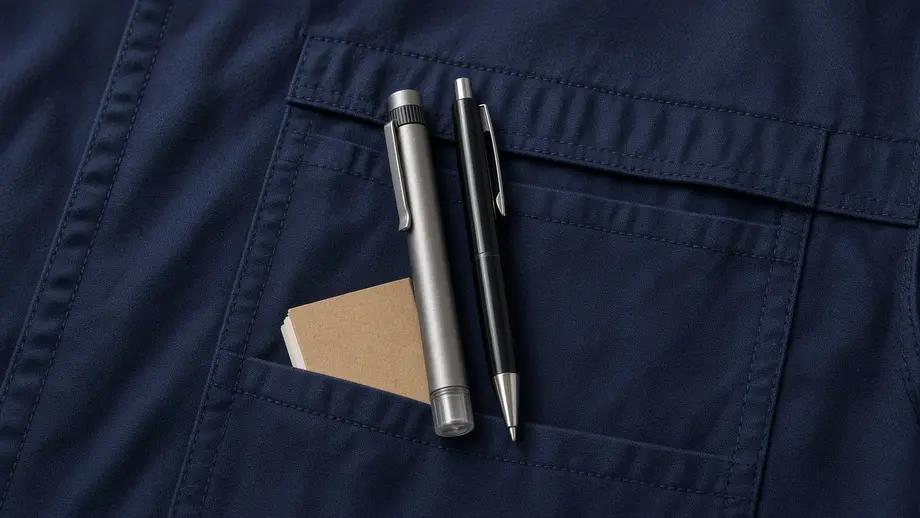
Olight makes some of the lights discussed here. Olight specs and regular prices come from its product pages as of September 2026; other makers' specs come from their own pages. The lux and runtime figures are our own arithmetic from those published ratings, not measurements.
⚡ TL;DR
A pen light earns its chest-pocket spot because it is there the second you need to see into something close: a pupil, a breaker panel, an engine bay, a crawlspace joist. At one foot, a 120-lumen pen light rated at 14 meters puts roughly 540 lux on the target, enough for most close checks. Anyone who works with patients or children should carry a model without a laser.
This gear list matches each job to the kind of light it needs, the minimum spec worth paying for, and a model that fits.
| Job | What the light does | Recommended type | Spec floor to look for | Model that fits |
|---|---|---|---|---|
| Nurse (exams) | Pupil checks, eye-movement tests, mouth and nose checks | Laser-free medical penlight | A small beam you can aim at one pupil; no laser | The penlight your facility issues |
| Nurse (night rounds, non-clinical) | Checking IV lines and pump screens, finding items, walking dim halls | Laser-free pocket light with a very low mode | About 5 lumens on Low; no laser; pocket clip | Olight i3T 2 EOS on its 5-lumen Low, never used for exams |
| EMT or paramedic | Pupil checks during patient assessment | Laser-free medical penlight, plus a separate scene light | No laser; spare batteries or a charge plan | A medical penlight, with a flashlight for the scene |
| Electrician | Reading labels and wire colors inside panels | Pen light plus a hands-free light | Enough output to light the space before you reach in | Olight O'Pen 3 for labels; Oclip 2 Pro clipped on for the work area |
| Mechanic | Looking for cracks, leaks and loose fasteners in tight spaces | Pen light used with an inspection mirror | Low modes you can angle at 5 to 45 degrees | Olight O'Pen 3 |
| Quality inspector | Checking small parts, markings and color codes | Pen light held close, plus good area light | About 215 to 1,076 lux at the part, by task contrast; a stated color temperature | O'Pen 3 at 6 inches: Low for high-contrast checks, Medium for fine detail |
| Home inspector | Crawlspaces, attics, panels and water stains | Pen light plus a clip light or headlamp | Water and impact ratings on the hands-free light | Oclip 2 Pro, with a pen light for spot checks |
📋 Table of Contents
- 1. Why Do People Carry a Pen Light at Work?
- 2. How Do Nurses, EMTs, Electricians and Inspectors Use a Pen Light?
- 3. How Many Lumens Does a Pen Light Need for Close Work?
- 4. When Does Color Rendering Matter More Than Brightness?
- 5. What Is the Green Laser on a Pen Light For?
- 6. Which Workplace Rules Affect the Pen Light You Carry?
- 7. Is the Writing Pen a Gimmick? Refills, Ink and Pencil Tips
- 8. Will One Charge Last a Shift? Runtime Math by Job
- 9. Is It Pin Light or Pen Light?
- 10. What Is the Best Pen Light on the Market?
- 11. Is a Milwaukee Pen Light Worth the Cost?
- 12. O'Pen Series and Oclip 2: Where Each Fits and Where It Doesn't
- 13. Your Pen Light Checklist Before the Next Shift
- 14. FAQ
Why Do People Carry a Pen Light at Work?
People carry a pen light at work because it rides in the same pocket as a pen, so it is always within reach for close checks. A pen light is the right tool when the target sits within about a foot and you need a small, aimable beam. Clinicians use one for pupils, while trades use one for labels, gaps and hidden fasteners. It does not replace area lighting.
Most complaints about pen lights fall into two camps. The first is a pen light that is really a toy: a dim bulb, a clip that snaps, a switch that turns on in the pocket. The second is a clever pen that cannot write well, so it ends up in a drawer. The fix for both is to buy for the job, not for the spec sheet.
Merriam-Webster defines a penlight as "a small flashlight resembling a fountain pen in size or shape." That shape is the whole point. It clips to a scrub pocket, a shirt placket or a clipboard, and it points like a finger. The rest of this guide covers how six jobs use that shape and where the limits are.
How Do Nurses, EMTs, Electricians and Inspectors Use a Pen Light?
Each job uses a pen light for a different close-range task. Nurses and EMTs check pupils and eye movement, and night-shift nurses also need a dim, laser-free light for rounds. Electricians read breaker labels and wire colors. Mechanics and quality inspectors look for cracks, leaks and markings. Home inspectors check stains, joists and panel interiors. The sections below cite the textbook, exam guide or rule that describes each task.
Nurses: pupil checks at arm's length
Nursing textbooks treat the penlight as a basic assessment tool. Open RN's Nursing Skills textbook, in its chapter on assessing cranial nerves, tells the nurse to "Stand 1 foot in front of the patient" and have them follow the penlight with their eyes in every direction. For pupils, it says to "Dim the lights of the room before performing this test," then approach from the side and "shine the penlight on one pupil."
Two practical points follow. The work happens at about one foot, so a nurse needs control and aim, not reach. And the room is dim, so a light that is too bright makes the check harder, not easier.
For those checks, carry the penlight your facility issues or approves. The Olight O'Pen models in this article are general-purpose pen lights with green lasers, and they are not diagnostic instruments, so they do not belong in patient care.
Night-shift nurses: a laser-free light for rounds, not exams
A night shift also has plenty of light work that is not an exam: tracing an IV line to the pump, reading a label on a bag, finding a dropped cap under a bed, or walking a dim hallway without switching on the room lights and waking a patient. For that non-clinical work, a small laser-free flashlight with a very low mode does the job. It is not a diagnostic penlight, and it should never stand in for one.
The Olight i3T 2 EOS laser-free pocket flashlight ($19.99 regular price, September 2026) fits that role. It has no laser. Its Low mode is 5 lumens and Olight rates it at 21 hours; High is 200~100 lumens. It is 3.5 inches (89 mm) long, weighs 1.47 oz (41.8 g), runs on one included AAA battery, is rated IPX8, and its clip is built for deeper pocket carry, Olight says. Olight says both the soft-press and full-press activation can be set as the default mode, so you can set it up to come on at Low first.
Here is what 5 lumens means at the bedside. Olight rates the i3T 2 EOS at 963 candela at 200 lumens. If candela scales with output, Low is about 24 candela, or roughly 96 lux at 50 cm (20 in). That is about what the O'Pen 3 puts out on Medium at the same distance, enough to read a pump screen or a bag label, from a light aimed at one spot instead of the whole room. At about 1.5 hours of light-on time per 12-hour shift, an example figure, 21 hours of Low covers roughly 14 shifts per battery.
Its limits: the light is cool white (Olight lists 5,700K to 6,700K), there is no red mode, and a full press can bring up the 200-lumen High if you have not set the default to Low. Olight's older i3T EOS sibling has the same 5-lumen Low for 16 hours at $17.99. The imini 2 keychain light is a poorer fit here, because Olight lists only a single 50-lumen output. Whichever you carry, check your unit's policy on personal equipment and clean it the way your unit requires. Our guide to what trades, clinics and offices let you carry covers how to read those policies.
EMTs and paramedics: a penlight on the exam list
The penlight is standard EMT equipment. The National Registry of Emergency Medical Technicians' EMT psychomotor examination users guide (Maine EMS version) lists a "Penlight" in the equipment for both the trauma and the medical patient assessment stations. The medical station also lists "Scratch paper and pencil/pen" on the same list.
That pairing explains why a pen that lights up appeals to EMS crews. But the clinical rule is the same as for nurses: use a laser-free medical penlight for the patient, and keep a separate, brighter flashlight for the scene. A pen light lights a pupil, not a roadside.
Electricians: light the space before you reach
For electricians, lighting is a written safety rule, not a comfort item. OSHA's electrical work-practice standard, 29 CFR 1910.333, says employees "may not enter spaces containing exposed energized parts, unless illumination is provided that enables the employees to perform the work safely." It adds: "Employees may not reach blindly into areas which may contain energized parts."
A pen light helps you read a panel schedule, a breaker label or a faded wire color from outside the enclosure. The same rule also covers what you carry. Section 1910.333(c)(8) bars conductive items such as "watch bands, bracelets, rings, key chains" if they might contact exposed energized parts, and (c)(6) says conductive materials in contact with your body must be handled so they cannot contact energized parts.
Warning: Most pen lights, including the O'Pen 3 and O'Pen Glow, have aluminum bodies and conduct electricity. Never use a pen light to point at, probe or hold near exposed energized parts. Light the space with a hands-free light set up before work starts, keep the pen light clipped where it cannot fall into an open panel, and follow your employer's electrical safety program.
Mechanics: the flashlight-and-mirror habit
Aircraft mechanics learn the pen light technique from the FAA. Its advisory circular AC 43-204, Visual Inspection for Aircraft, says "The flashlight and the mirror are standard tools which should accompany the inspector on all inspections." For surface cracks, it says the light "should be directed at a 5- to 45-degree angle," with the reflected beam kept out of your eyes.
The same circular says a 10-power magnifying glass should be used to confirm a suspected crack. A pen light is a good fit for this method because its slim body slips behind a bracket and angles easily. The low-angle trick also works on car engines: light raking across a surface throws a shadow off any ridge, crack or wet seep.
Tip: Hold the pen light low and to the side, not straight at the part. A beam aimed head-on flattens the surface and bounces glare back at you. A raking beam makes cracks and texture stand out.
Quality inspectors: small parts need more light on the task
Quality inspectors use a pen light to put extra light right on a small part. AC 43-204 reprints the Illuminating Engineering Society's illuminance categories: 20 to 50 foot-candles for visual tasks "of high contrast or small size," 50 to 100 for "medium contrast or small size," and 100 to 200 for "low contrast or very small size."
Converted to metric, that is about 215 to 538 lux, 538 to 1,076 lux and 1,076 to 2,153 lux. OSHA's construction minimum for shops is 10 foot-candles, about 108 lux, so a pen light held close tops up the difference on the part. The FAA circular also notes that accurate color identification is required for many inspection tasks, including color-coded wiring and penetrant indications, which is why color quality matters as much as brightness.
Home inspectors: visual checks with simple tools
Home inspection is a visual job by definition. Washington's home inspection standards of practice, WAC 308-408C, describe the inspection as assessing the home "using visual observations, simple tools and normal homeowner operational controls." They direct inspectors to check "Subfloor crawlspaces and basements for indications of flooding and moisture penetration."
That makes a light the most basic tool in the bag. A pen light works for a stain on a ceiling, a label on a water heater or a look inside a panel after the cover comes off. For a whole crawlspace, you need both hands, so pair it with a clip light or headlamp.
Safety note: Washington's rules do not require inspectors to enter crawlspaces with an access opening less than 18 by 24 inches, or areas that, in the inspector's opinion, are hazardous to their health and safety. A better light is never a reason to crawl into a space you would otherwise skip.
This table sums up what each job asks of the light: working distance, light level, runtime pattern and exposure.
| Job | Typical working distance | Light level to aim for | Runtime pattern | Water and impact exposure | Laser |
|---|---|---|---|---|---|
| Nurse (exams) | About 1 ft, in a dim room | Low and controllable | Many short bursts per shift | Wiped, not rinsed | Never |
| Nurse (night rounds) | Arm's length, in a dark room or hall | About 5 lumens, aimed at one spot | Short, frequent looks all night | Wiped, not rinsed | Never |
| EMT or paramedic | About 1 ft, indoors or outdoors | Low for pupils; separate scene light | Short bursts, long idle time | Rain, drops | Never |
| Electrician | 1 to 3 ft, outside the enclosure | Enough to read labels and wire colors | Short looks, often in dark rooms | Dust, drops | Only for pointing at a wall or drawing, never near people |
| Mechanic | 6 in to 2 ft, at an angle | Low to medium, raking | Long stretches under a hood or wing | Fluids, drops | Rarely useful |
| Quality inspector | 6 in to 1 ft | 215 to 1,076 lux on the part, by contrast | An hour or more per shift | Clean bench | Useful for pointing out a defect on a screen or board |
| Home inspector | 1 ft to 10 ft | Medium, hands-free for crawlspaces | Long stretches in crawlspaces and attics | Dust, damp, drops | Useful for pointing out a ceiling stain to a client |
How Many Lumens Does a Pen Light Need for Close Work?
About 100 lumens is plenty for close work, because distance matters more than output. Illuminance equals candela divided by distance squared. A pen light rated at 14 meters of beam distance has about 49 candela under the ANSI FL1 method, which works out to roughly 540 lux at 30 cm (about 1 ft) and 2,180 lux at 15 cm.
Here is the math, so you can check it on any spec sheet. Under ANSI FL1, beam distance is the distance at which the beam falls to 0.25 lux, so candela equals (beam distance ÷ 2)². For the Olight O'Pen 3, which Olight rates at 120 lumens and 46 ft (14 m), that is 7² = 49 candela. The O'Pen 3 user manual lists 50 cd, so the formula and Olight's rating agree within rounding; the table below uses the manual's 50 cd. Our explainer on how candela, lumens and lux relate walks through the formula step by step.
This table estimates what the O'Pen 3's four white-light levels put on a target at four working distances, starting from the manual's 50 cd on High and assuming candela scales with lumens in the same beam.
| O'Pen 3 mode (Olight rating) | Est. candela | 15 cm (6 in) | 30 cm (1 ft) | 50 cm (20 in) | 1 m (3.3 ft) |
|---|---|---|---|---|---|
| High, 120 lumens | 50 | 2,222 lux | 556 lux | 200 lux | 50 lux |
| Medium, 60 lumens | 25 | 1,111 lux | 278 lux | 100 lux | 25 lux |
| Low, 20 lumens | 8.3 | 370 lux | 93 lux | 33 lux | 8.3 lux |
| Moon, 2 lumens | 0.8 | 37 lux | 9.3 lux | 3.3 lux | 0.8 lux |
Read the table against the IES categories above. At 30 cm, High sits just above the 538-lux line for medium-contrast work. Move to 15 cm and even Medium clears 1,000 lux. Halving the distance quadruples the light, so leaning in does more than buying a brighter light.
For scale, OSHA's construction lighting rule, 29 CFR 1926.56, sets minimums of 5 foot-candles for general construction areas (about 54 lux), 10 for shops and electrical equipment rooms (about 108 lux) and 30 for first aid stations and offices (about 323 lux). Those are room minimums. A pen light at one foot puts several times that on the one spot you are looking at.
More output can backfire. Milwaukee rates its 2105 penlight at 43 meters of beam distance, which works out to about 462 candela if that figure follows FL1. At one foot, that is roughly 5,100 lux, far more than a label needs and enough to cause glare off shiny metal. It is a good trait for reaching the back of a deep cabinet, and a poor one for close reading.
When Does Color Rendering Matter More Than Brightness?
Color rendering matters more than brightness whenever the job is to tell colors apart: wire insulation, color-coded tubing, penetrant marks, water stains or rust. A light with poor color rendering makes similar colors harder to tell apart. For these tasks, a moderate, accurate light beats a bright one with a strong blue or green cast.
The FAA's AC 43-204 describes color rendering as a light source's "ability to render the color of objects in a natural or familiar way," usually expressed as a color rendering index (CRI) that compares a lamp with a reference source of the same color temperature. The higher the number, the closer the match. If you want the background, read our explainer on what CRI measures.
Pen light makers rarely publish CRI. Olight lists color temperatures but no CRI for the O'Pen line: 6500K for the O'Pen 3's clip light and 5000K for its tip light, and 5700K for the O'Pen Glow's clip light and 4000K for its tip light. Milwaukee says its penlight's TRUEVIEW output is "optimized for high color accuracy" but does not list a number either.
Without a published CRI, use a field check instead:
- Look at the same colored item, such as a red and a brown wire, under daylight or good shop light, then under your pen light.
- If two colors that are easy to tell apart in daylight look alike under the pen light, don't trust that light for color calls.
- For critical color work, confirm under the area lighting your procedure specifies, and use the pen light only to find the spot.
Note: Color temperature is not the same as color rendering. AC 43-204 explains that the lower the Kelvin number, the warmer the light looks, and "the higher the number, the bluer or cooler the color." A stated Kelvin figure tells you the tint, not how accurate the colors will look.
What Is the Green Laser on a Pen Light For?
The green laser on a pen light is a pointer. It lets you show someone exactly which crack, stain, breaker or line on a drawing you mean, from across a room or up on a ceiling. It is not an alignment or leveling laser, it does not measure anything, and it has no place in patient care or around children.
Real uses at work look like this: a home inspector pointing a client to a ceiling stain, a quality lead pointing at a defect on a large board during a review, or a trainer pointing at a part on a projected drawing. In each case, the laser lands on a surface, never on a person.
Olight describes the O'Pen 3's laser as a Class 3R green laser pointer with two brightness levels. Its spec sheet lists the higher level at no more than 5 mW with a 3-hour runtime and the lower level at no more than 0.39 mW with a 7.5-hour runtime. Olight describes the O'Pen Glow's laser only as a "green pointer beam" and does not list a class.
Warning: The FDA's consumer guidance on laser pointers warns that "The light energy from a laser pointer aimed into the eye can be more damaging than staring directly into the sun." Its advice is plain: "Never aim or shine a laser pointer at anyone" and "Don't buy laser pointers for your children." Keep laser pen lights out of clinical areas, classrooms and anywhere children can pick them up, and never aim one at people, animals, vehicles or aircraft.
For nurses, EMTs and anyone else in patient care, the choice is simple: carry a laser-free penlight. Both O'Pen models Olight sells in September 2026 have a green laser, so we do not recommend either for clinical use. For non-clinical night rounds, a laser-free pocket light such as the i3T 2 EOS covered in the nursing section above is the better Olight fit.
Which Workplace Rules Affect the Pen Light You Carry?
Four sets of rules shape what a pen light should do at work: OSHA's electrical work practices, OSHA's construction lighting minimums, FDA guidance on laser pointers and state home inspection standards. None of them names a brand or a lumen figure. They tell you when you need light, what you must not carry near live parts and where a laser does not belong.
This table turns each rule into a plain action you can take with the light in your pocket.
| Rule or source | What it says | What to do with your pen light |
|---|---|---|
| OSHA 29 CFR 1910.333(c)(4) | Illumination must let employees work safely near exposed energized parts; no reaching blindly | Light the space before you reach in; a pen light is for reading, not probing |
| OSHA 29 CFR 1910.333(c)(6) and (c)(8) | Conductive materials and articles must not contact exposed energized parts | Treat an aluminum pen light like a key chain: keep it clipped and away from live parts |
| OSHA 29 CFR 1926.56 | Minimum area lighting from 3 to 30 foot-candles by area | A pen light is a task light; it does not make a dark room compliant |
| FDA laser pointer guidance | Never aim a laser pointer at anyone; don't buy them for children | Laser off, or a laser-free model, in patient care and around kids |
| FAA AC 43-204 | Flashlight and mirror are standard inspection tools; light at 5 to 45 degrees for cracks | Carry a mirror with the pen light and use a low angle |
| Washington WAC 308-408C | Home inspections use visual observation and simple tools; tight or dangerous crawlspaces are excluded | Use a hands-free light for crawlspaces, and skip any space the rules exclude |
Employer policy sits on top of all of these. Hospitals, plants and job sites often set their own rules on lasers, metal tools near panels and personal gear, so check before you bring a new light on shift.
Is the Writing Pen a Gimmick? Refills, Ink and Pencil Tips
The writing pen is not a gimmick if you write on the job. Clinicians chart and label, EMS crews note vitals, and inspectors mark up checklists, often in the same moment they need light. A pen light that writes well saves one item in a crowded pocket. It only works if refills are easy to find, so check refill options before you buy.
Olight sells two refills for its O'Pen line. The O-Refill ($9.99 regular price, September 2026, three per pack) is listed for the O'Pen 3, O'Pen Glow, O'Pen 2, O'Pen Pro, O'Pen Mini and O'Pen Mini 2. The Olight O-gel ink refill ($9.99 regular price, September 2026, three per pack) is black gel ink and measures 75.9 × 5.74 mm.
Match the refill to the conditions you write in:
- Everyday forms and labels: the O'Pen 3 product page separates a newer gel ink refill from the older ballpoint refill, so pick the type you prefer and buy the matching pack.
- Checklists that may get wet: test your ink on your own forms before relying on it; Olight doesn't publish water-resistance data for either refill.
- Pencil for drafting and layout: Olight also sells an eight-pack of replaceable pencil tips for the O'Pen Mini 2 series, rated to shorten only 1.46 mm after 600 meters of writing. It was listed as unavailable on September 24, 2026.
The O'Pen 3 also has a 0.4-lumen tip light, and the O'Pen Glow has a 0.2-lumen one. That is enough to light the paper under the pen tip in a dark truck cab or control room without lighting up the whole space, which is why the tip light often matters more at night than the main beam does.
Will One Charge Last a Shift? Runtime Math by Job
A rechargeable pen light usually lasts a shift if you match the mode to the task. Pen-sized batteries are small: Olight's O'Pen 3 holds 130 mAh and runs 14 minutes on High before dropping to 60 lumens for 25 more. On Low (20 lumens), it runs 2 hours 20 minutes, which covers most inspection shifts if you work close.
The table below uses example workloads, not measurements, and the O'Pen 3's rated runtimes to show which mode fits each pattern.
| Example workload | Light-on time | Mode that gives enough light | O'Pen 3 rated runtime | Verdict |
|---|---|---|---|---|
| Quality inspector: 200 high-contrast parts × 20 s at 6 in | About 67 min | Low, 20 lm (about 363 lux at 15 cm) | 2 h 20 min | Fits one shift with margin |
| Same inspector, fine low-contrast detail at 6 in | About 67 min | Medium, 60 lm (about 1,089 lux) | 60 min | Falls about 7 min short; charge at lunch |
| Same inspector on High at 1 ft | About 67 min | High, 120 lm (about 544 lux) | 14 + 25 min | Runs out mid-shift |
| Home inspector: 45 min of spot checks per inspection | 45 min | Medium, 60 lm | 60 min | One inspection per charge |
| Electrician: 10 panel label checks × 1 min | 10 min | High, 120 lm | 14 + 25 min | Fits easily |
| Writing notes in a dark cab with the tip light | 1 h | Tip light, 0.4 lm | 26 h | Weeks between charges |
The pattern is clear. Holding the light closer and using a lower mode gives the same light on the part and several times the runtime. Olight says the O'Pen 3's USB-C port charges it fully in about an hour, so a lunch break covers a recharge.
If your job keeps a light on for hours, as in crawlspaces or under a car, a pen light is the wrong primary light. Use a hands-free clip light or headlamp for the area, and save the pen light for the spot you need to point at.
Is It Pin Light or Pen Light?
It is pen light, or penlight as one word. The name comes from the shape: Merriam-Webster defines a penlight as "a small flashlight resembling a fountain pen in size or shape." "Pin light" is not the dictionary name for this tool; it is usually a mishearing of pen light, so search for "pen light" or "penlight" to find the right products.
Both spellings mean the same thing, and this guide uses them interchangeably. One useful distinction is between a plain penlight, which only lights, and a pen light pen, which writes and lights. The O'Pen line is the second kind, so it competes with a pen and a penlight at once.
What Is the Best Pen Light on the Market?
The best pen light depends on the job, not on the lumen count. For patient care, the best choice is a laser-free medical penlight your facility approves. For trades and inspection, look for 100 to 120 lumens, a low mode, a clip that holds, and a water rating if you work outdoors. If you write all day, pick one with a pen built in.
Use these questions to narrow the field:
- Is it for patients? If yes, rule out any model with a laser, and follow your facility's equipment list.
- How close do you work? Within a foot, 100 to 120 lumens is plenty; see the lux table above.
- Do you need it to write? If yes, a pen light pen saves a pocket slot. If not, a plain penlight is lighter and simpler.
- Will it get wet or dropped? Look for a published water rating and impact rating. Many pen-sized lights list neither.
- Batteries or USB-C? AAA cells swap in seconds on a long call; built-in batteries need a charge plan.
- Can you see colors accurately under it? Run the red-and-brown wire check above.
A model that answers all six well for your job is the best one for you. A model that tops a brightness chart but fails question 1 or 4 is not.
Is a Milwaukee Pen Light Worth the Cost?
A Milwaukee pen light is worth the cost for trades that need a tough, water-sealed light running on AAA batteries. Milwaukee rates its 2105 penlight at 100 lumens, 43 meters of beam distance, IP67 and "over 3 hours" of continuous runtime on two AAA batteries. A 2017 Tools in Action review put its price at about $20 at The Home Depot; Milwaukee's page lists no price, so check a current retailer before you compare.
The Milwaukee penlight's product page lists a few job-site features: a "protective rubber bite zone" for two-handed tasks, an on/off and momentary-on button, a removable metal clip, an impact- and chemical-resistant lens, and a limited lifetime warranty that excludes batteries.
What it does not do matters too. It does not write, it has no low mode listed, and its narrow, far-reaching beam (about 462 candela by the FL1 math) is more than close work needs. The same review from Tools in Action called it "a clean clear light that isn't crazy on your eyes," but for pupil checks, use a medical penlight instead.
So the value question comes down to your pocket. If you want one light that survives a wet job site and takes AAA cells from any store, the Milwaukee is good value. If you also want to write, see in the dark at a desk, or point with a laser, a pen light pen does more per pocket slot, at a higher price.
O'Pen Series and Oclip 2: Where Each Fits and Where It Doesn't
The Olight O'Pen 3 fits trades, inspectors and office work where you want a pen, a 120-lumen light and a laser pointer in one. The O'Pen Glow suits desk-based workers who like a charging base, when it is in stock. The Oclip 2 Pro covers the hands-free work a pen light can't. None of these three belongs in patient care; for non-clinical night rounds, see the laser-free i3T 2 EOS in the nursing section.
Olight O'Pen 3: pen, light and pointer in one
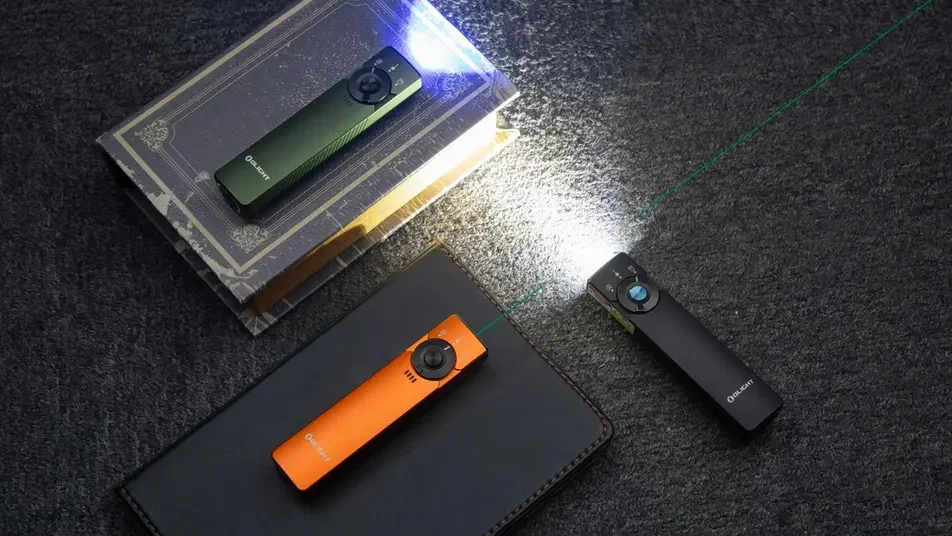
The Olight O'Pen 3 multifunctional pen light ($79.99 regular price, September 2026) has a 120-lumen white clip light, a two-stage red light, a red SOS mode, a 0.4-lumen tip light and a green laser. It is 6.10 inches long, 0.5 inch in diameter and weighs 1.18 oz (33.5 g), with an A6061-T6 aluminum body and a spring-loaded clip. Olight lists office and other job sites, outdoor use and daily carry.
The job-site problem it solves is pocket space: one item covers writing, close light and pointing. Its limits are real. Olight lists no water rating, and its working temperature is 0 to 40°C (32 to 104°F), so don't leave it in a freezing truck or on a hot dashboard. The laser rules it out for clinics and classrooms. For a full rundown of its modes, see our O'Pen 3 feature overview.
Olight O'Pen Glow: a desk pen with a dock
The Olight O'Pen Glow ($79.99 regular price, September 2026) has a clip light adjustable from 5 to 120 lumens, a 0.2-lumen tip light and a green pointer beam on its own switch. It charges in a base, so it can sit ready on a desk between uses, and its upper part is rated IPX4.
It fits an office, a front desk or a control room, where the pen lives in its dock between uses. Its 110 mAh battery is smaller than the O'Pen 3's, and its rated runtimes are shorter: 14 + 21 minutes on High and 45 minutes on Medium, against 14 + 25 and 60 for the O'Pen 3. On September 24, 2026, its default OD Green color showed only a "Notify me" button and Blue was listed as sold out, so the O'Pen 3 is the in-stock choice for a team order.
Oclip 2 Pro: the hands-free partner
The Olight Oclip 2 Pro clip light ($54.99 regular price, September 2026) handles the job a pen light can't: lighting a work area while both hands are busy. It has a floodlight up to 530 lumens, a spotlight rated at 125 m and 3,906 candela, and a 40-lumen red light. Its clip grips objects up to 14 mm thick, including collars and straps, and it has tail and clip magnets.
For a crawlspace, an attic or an under-sink repair, clip it to your collar or stick it to a steel surface, then aim it with the 115° head tilt and 360° clip rotation. It is rated IP66 with 2-meter drop resistance, and its 100-lumen Medium floodlight runs 3 hours 45 minutes. Its limits: at 60.2 × 28 × 35 mm and 75.5 g, it is too bulky for a scrub pocket, and it does not write. Its aluminum body also calls for the same care near live parts as a pen light. You can browse more pocket options among Olight EDC flashlights. The Oclip 2 user manual adds a caution for anyone with an implanted heart device: "If you have an ICD or pacemaker, avoid close or prolonged contact with this product to prevent possible interference."
Your Pen Light Checklist Before the Next Shift
A good pen light setup comes down to a short checklist: match the light to the job, keep lasers away from patients and children, know your runtime, and carry a hands-free light for anything longer than a quick look. Run through the list below before your next shift and fix any gap you find.
- Clinical work: carry the laser-free penlight your facility issues; leave laser pen lights at home.
- Night rounds: use a laser-free pocket light on its lowest mode for lines, labels and hallways, and never for exams.
- Electrical work: light the space before you reach in; keep metal pen lights clipped and away from exposed energized parts.
- Inspection work: carry a mirror, work at a low angle, and hold the light at 6 inches to 1 foot rather than switching to High.
- Color calls: check your light against daylight on a red and a brown wire before trusting it.
- Runtime: use Low for long inspection sessions and charge at lunch; a pen light is not a crawlspace light.
- Writing: keep a spare refill pack in your bag, and test the ink on your own forms.
- Laser: point only at surfaces, and check your employer's policy before carrying one on shift.
FAQ
Changelog
- September 22, 2026: First published.