Prices, colorways and challenge details were checked on the Olight US store and O-Community on September 23, 2026. Colorways sell out and come back, and prices change, so the product pages and the community post are the record.
⚡ TL;DR
Orange gear earns a place in a fall kit because it is easy for other people to spot and easy for you to find again. Fluorescent orange does its work in daylight and twilight, which is when hunting-season clothing rules apply and when a dropped light disappears into leaf litter. After dark, color stops helping and output takes over.
This table sorts what orange actually does from what people assume it does.
| What orange does | Where it works | Where it doesn't |
|---|---|---|
| Makes you conspicuous to other people | Daylight, overcast days and twilight | After dark, when only light output and retroreflective material show up |
| Helps you find a dropped light | Grass, gravel, dirt, snow, dark car interiors | Orange leaf litter, where the contrast collapses |
| Satisfies hunting-season clothing law | Only as clothing, in the area your state specifies | An orange flashlight body counts for nothing toward those rules |
| Marks a light as yours in a shared pack | Any light level, once you know what you're looking for | Any situation where someone else also carries orange |
📋 Table of Contents
- 1. Why Does Fluorescent Orange Show Up So Well in Daylight?
- 2. Why Do Hunters Wear Blaze Orange if Deer Can't See It?
- 3. How Much Blaze Orange Does Your State Require?
- 4. When Does Orange Stop Working?
- 5. What Changes in Your Kit as the Days Get Shorter?
- 6. Which Olight Lights Come in Orange?
- 7. How Do I Join the Fall for Orange Challenge?
- 8. FAQ
Why Does Fluorescent Orange Show Up So Well in Daylight?
Fluorescent material takes in ultraviolet and short-wavelength visible light and re-emits it as visible light, so the fabric sends back more light in its own color band than falls on it. That is why a fluorescent orange vest looks like it is lit from inside on an overcast morning, while a plain orange one looks flat.
High-visibility clothing standards are built on that split. The International Safety Equipment Association describes hi-vis apparel as combining "fluorescent materials for daytime visibility with retroreflective materials to enable workers to be seen at night," and says ANSI/ISEA 107 sets performance for "the combined use of fluorescent and retroreflective materials to make a person conspicuous in all light conditions, day and night." Fluorescent orange-red is one of the background colors the standard covers.
Two consequences follow, and both matter in October. Fluorescent material is at its most useful in the flat light of dawn, dusk and heavy cloud, which is exactly when people are walking in and out of the woods. And fluorescence fades. Wisconsin's hunting regulations say outright that "faded or stained blaze orange or fluorescent pink clothing is unsafe and may not meet legal requirements." A vest that has spent four seasons in a truck window is not the vest you bought.
Why Do Hunters Wear Blaze Orange if Deer Can't See It?
Because the color is aimed at other hunters, not at the deer, and deer vision is the reason it can be that loud without costing you anything.
Deer are dichromats. University of Georgia researchers Karl V. Miller and Gino D'Angelo, writing for the National Deer Association, put it plainly: "Deer would not perceive the longer wavelengths of color, so the oranges and reds have turned to brown or gray." Their answer to the question in the headline was no. Blaze orange does not look to a deer the way it looks to you.
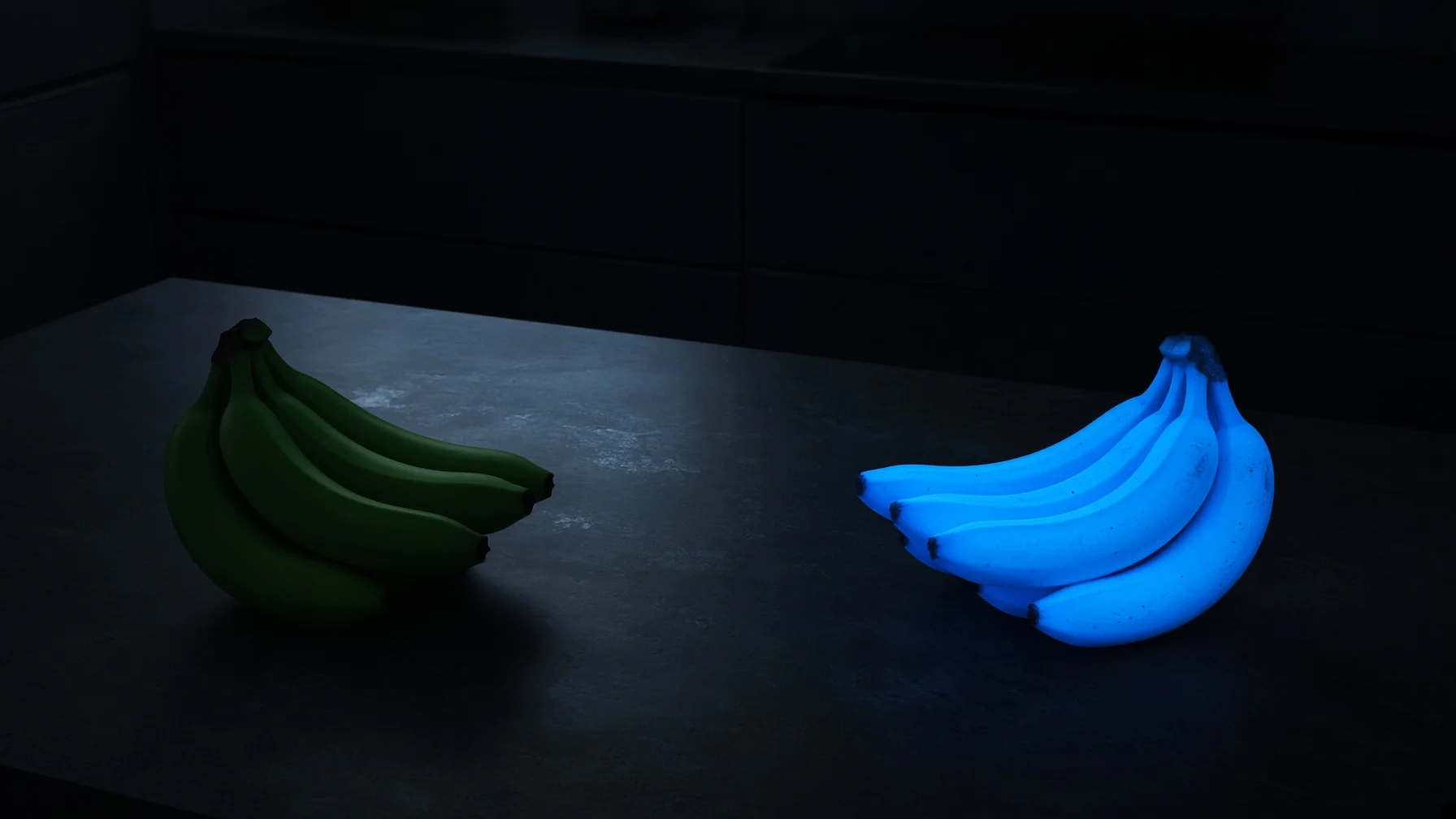
The same article points at something most hunters never think about. A deer's lens is clear and its retina lacks the yellow pigment that filters ultraviolet light in human eyes, so deer see into the near-UV. Miller and D'Angelo note that a new, unwashed pair of camouflage pants can glow to a deer because of the "UV enhancers" in laundry detergent. Optical brighteners are the same compounds that make white laundry light up under a black light flashlight. Your orange vest is invisible to the deer. Your detergent may not be.
How Much Blaze Orange Does Your State Require?
It varies, and the number is specified in different units from state to state, so read the current regulations for the state you are hunting in rather than carrying over a rule from somewhere else.
| State | What the rule specifies | Notes |
|---|---|---|
| Wisconsin | At least 50% of outer clothing above the waist must be blaze orange or fluorescent pink whenever and wherever a firearm deer season is in progress; a hat, if worn, must also be at least 50% | Applies to hunting any game except waterfowl. Camo-blaze is legal if 50% or more of the material qualifies; the DNR recommends 100% solid |
| Pennsylvania | A minimum of 250 square inches of fluorescent orange on head, chest and back combined, visible from 360 degrees, during firearms deer season | An orange hat plus an orange vest satisfies it |
Wisconsin is also where the fluorescent pink option started, and it added a second lawful color rather than replacing orange. The two state rules above are examples of how the requirements are written, not a summary of national law.
Note: Hunting regulations change between seasons, and several states set different rules for different seasons, for ground blinds and for public versus private land. Check your state wildlife agency's current regulations before the season opens.
When Does Orange Stop Working?
Orange has four failure modes, and knowing them is more useful than knowing that the color works. It stops at dark, it loses contrast against fall leaves, it reads differently to people with color vision deficiency, and it fades with age. None of those is a reason to skip orange. All of them are reasons not to let orange be the only thing doing the work.
It stops at dark. Fluorescence needs light coming in. Once the sun is down, a fluorescent vest is just a dull vest, which is why the hi-vis standards pair it with retroreflective tape for night work. A flashlight, a headlamp or a marker light is what makes you visible after twilight ends.
It loses contrast against fall foliage. This is the awkward one for a color named after autumn. Majid Sarmadi, a textile scientist at the University of Wisconsin–Madison, compared blaze orange and blaze pink hats against common forest greens and oranges with a spectrophotometer and found pink held up better against colored leaves. That work was preliminary and was not published in a peer-reviewed journal, so treat it as a reason to think about your background rather than a settled result. The practical version needs no study: an orange light dropped on an orange leaf bed is hard to see, and a lanyard is cheaper than a second flashlight.
Not everyone sees it the same way. According to the National Eye Institute, about 1 in 12 men has color vision deficiency, and the most common type makes red and green hard to tell apart. Orange sits in that region. If you hunt or work with a partner, don't assume that the color alone has done the communicating.
It fades. Covered above, and worth repeating because it is the failure that creeps up on you. Check the vest in daylight, not in the garage.
What Changes in Your Kit as the Days Get Shorter?
The window in which color does any work shrinks fast through the fall, so the balance shifts from being seen to being able to see. These are sunset and end-of-civil-twilight times for Chicago from the U.S. Naval Observatory, which gives a sense of the slope anywhere at similar latitudes.
| Date (2026) | Sunset | Civil twilight ends |
|---|---|---|
| September 21 | 7:49 p.m. | 8:17 p.m. |
| October 11 | 7:15 p.m. | 7:43 p.m. |
| October 31 | 6:46 p.m. | 7:15 p.m. |
| November 1 | 5:45 p.m. | 6:13 p.m. |
| November 30 | 5:21 p.m. | 5:52 p.m. |
Three weeks of fall costs about half an hour of evening light. Then daylight saving time ends on November 1 and takes another full hour off the clock in one night, which is the change people actually notice: the walk back to the car that was comfortable last weekend is done in the dark this weekend.
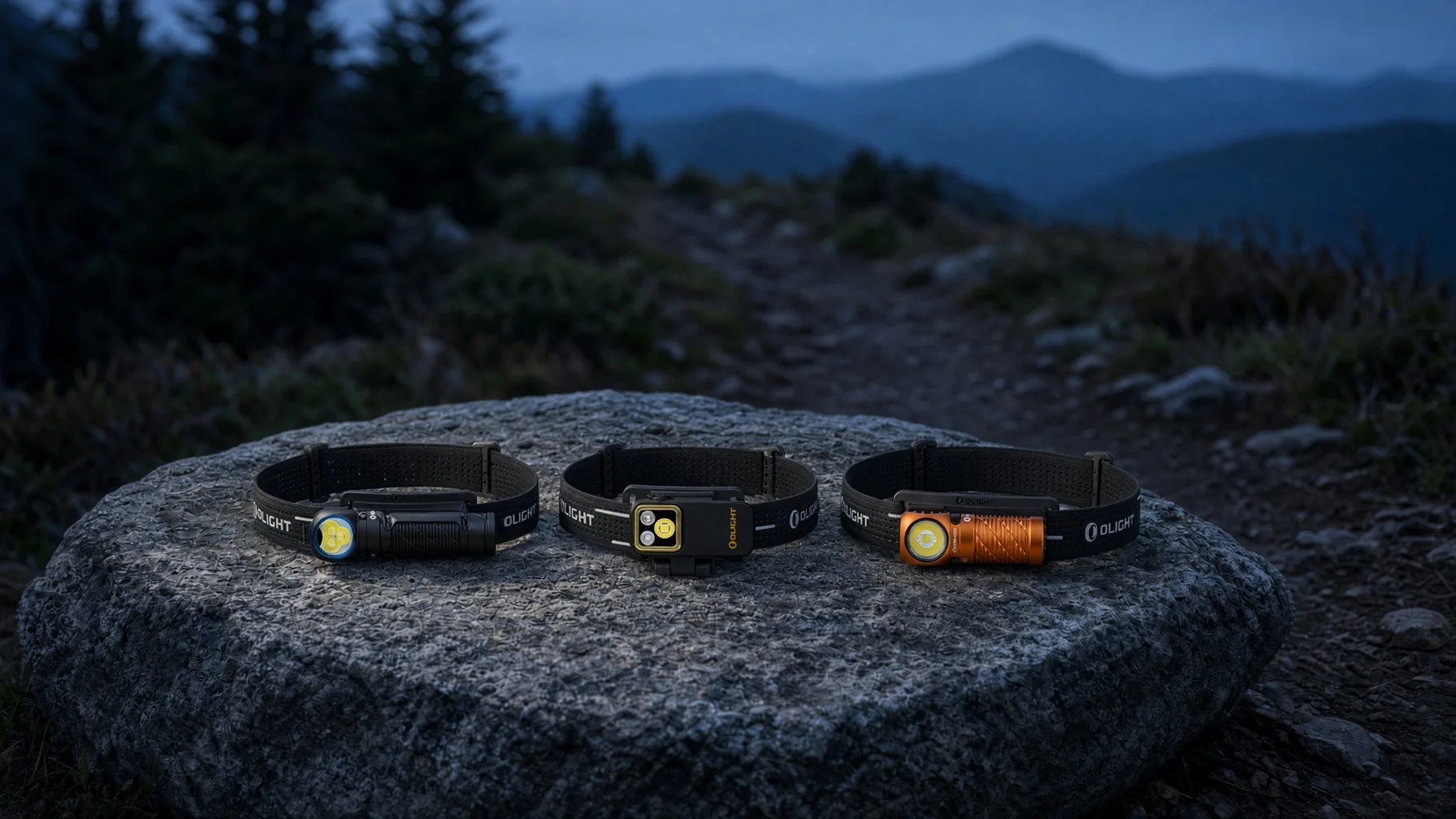
Two things follow. A light stops being optional in October, including for errands that were daylight errands in August. And a hands-free option earns its keep once you are setting up camp, field dressing or working on a vehicle in the dark; our guide to the best headlamps covers how to choose one. If you are deciding what to carry more broadly, our best flashlights guide sorts current models by use case.
Which Olight Lights Come in Orange?
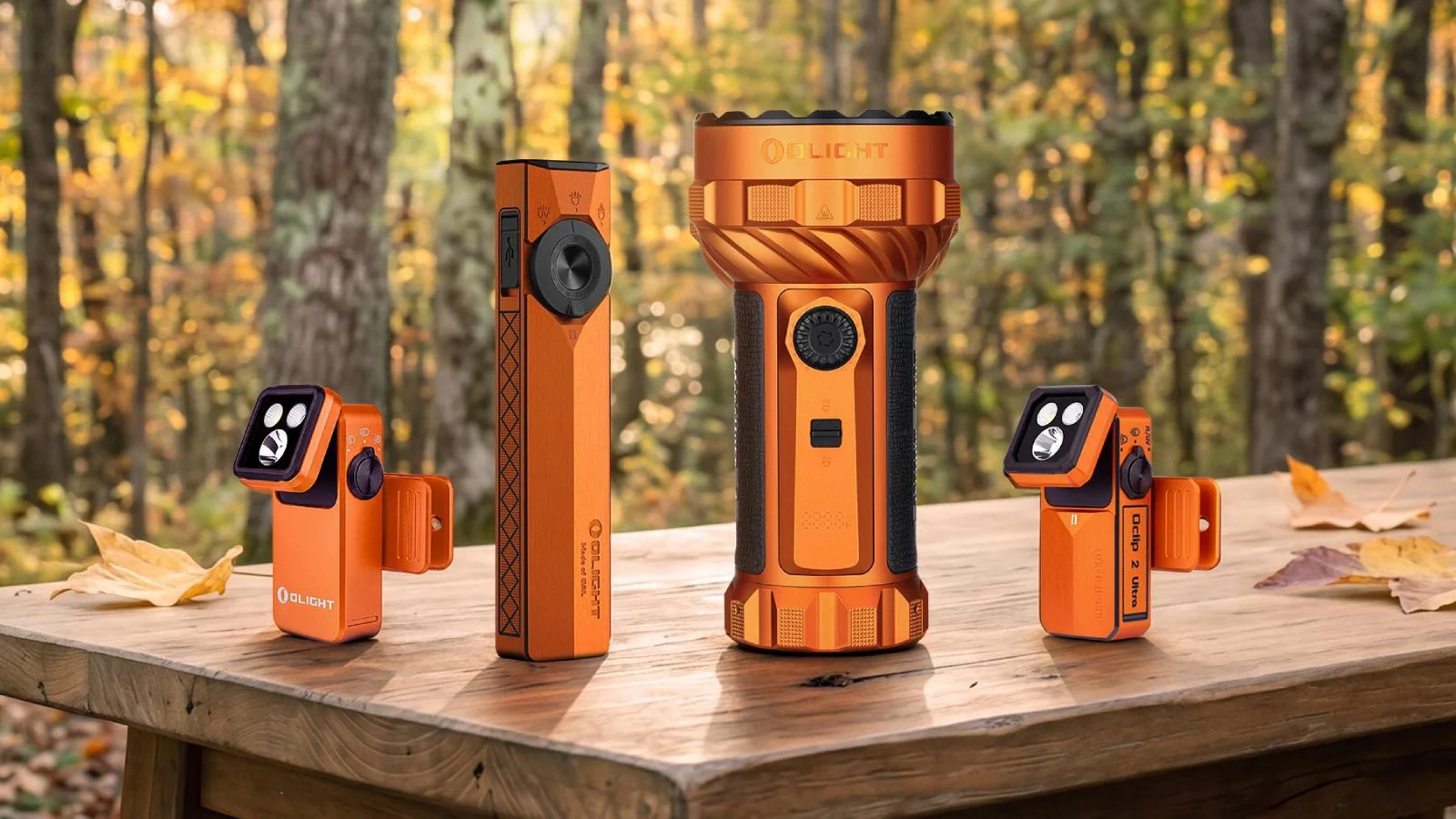
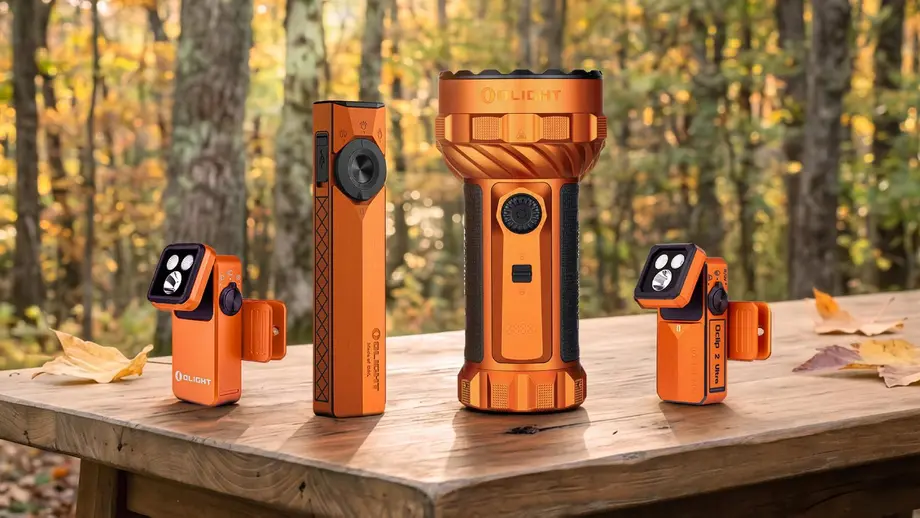
Fourteen models are listed in an orange colorway and in stock on the Olight US store, from a $15.99 keychain light to a 25,000-lumen handheld. Three of them, the Oclip 2 Pro, Oclip 2 Ultra and Marauder 3, went on sale on September 19, 2026, two days before the challenge opened. Prices were checked on September 23, 2026, and some are sale prices.
| Light | Orange colorway | What it's for | Price |
|---|---|---|---|
| imini 2 | Orange | 50-lumen keychain light with a built-in USB plug | $15.99 |
| Oclip Pro S | Orange | Clip-on with 600-lumen white, UV and RGB | $39.99 |
| Oclip 2 Pro | Orange, Orange Spider | Clip-on with a 530-lumen flood, 125 m spot and red light | $49.99 |
| Max Pump 3 | Orange | Camp air pump with a built-in light | $56.99 |
| Baton 4 Pro | Orange CW | 1,600-lumen dual-switch EDC | $62.99 |
| ArkPro Lite | Orange | Flat-body EDC, the entry point of the ArkPro series | $69.99 |
| Oclip 2 Ultra | Amber Orange | Clip-on with a 580-lumen flood, 130 m spot, red and 800 mW UV | $69.99 |
| O'Pen 3 | Orange | Penlight with 120-lumen white, red modes, a tip light and a green laser | $71.99 |
| Arkfeld Pro | Orange CW | Flat EDC with 1,300-lumen white, 900 mW 365 nm UV and a green laser | $89.99 |
| ArkPro | Orange CW | Flat EDC with a 1,500-lumen flood, spot, 365 nm UV and a green laser | $99.99 |
| Seeker 4 Pro | Orange CW | 4,600-lumen flood-heavy handheld, 260 m | $111.99 |
| ArkPro Ultra | Amber Orange CW | 1,700-lumen flood, 800-lumen spot at 205 m, UV and a green beam | $129.99 |
| Marauder Mini 2 | Orange | 10,000-lumen flood and a 750 m spot in a 133 mm body | $219.99 |
| Marauder 3 | Orange | 25,000-lumen flood and a 1,000 m spot | $369.99 |
Several older models were sold in orange and are currently out of stock in that color, including the i3T 2 EOS, i1R 2 Pro, the original Oclip, Baton 4, Perun 3, Perun 3 Mini and Marauder Mini. If a color is not selectable on the product page, that is the current answer rather than a site error, and colorways do come back.
Two notes on reading that list. Orange is not one color across the range: the ArkPro and ArkPro Lite use Orange CW, while the ArkPro Ultra and Oclip 2 Ultra use Amber Orange, a deeper, browner shade. And the Premium versions of several models cost more because they add accessories, not because the color changes.
Tip: If the point of buying orange is to stop losing the light, the color pays off most on a light you put down a lot, such as a clip-on, a headlamp or a camp light. A pocket light spends its life in a pocket, where the color does nothing.
How Do I Join the Fall for Orange Challenge?
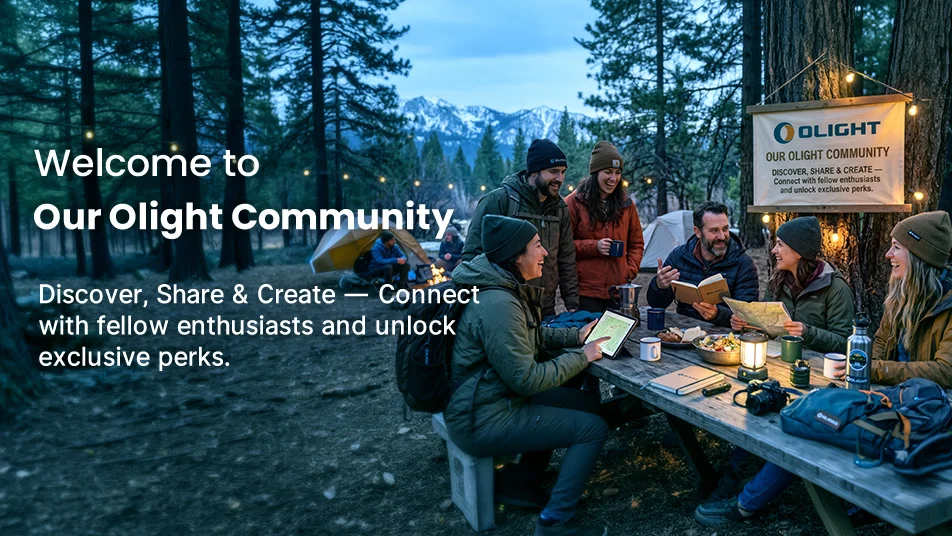
Post an orange product from your collection in the Collectors' Club on O-Community with the hashtag, and leave the post up until winners are announced. Olight's Fall for Orange Challenge post carries the official rules, and it is the version to follow if any detail below has since changed. This summary is current as of September 23, 2026.
| Detail | What the post says |
|---|---|
| Where to post | The Collectors' Club on O-Community |
| What to post | A post featuring an orange product from your collection |
| Hashtag | #OCommunityFallForOrange |
| Challenge period | September 21, 2026, 6:00 p.m. EDT to September 27, 2026, 9:00 p.m. EDT |
| Prize | The 10 eligible posts with the most likes each win one Arkfeld UV (Orange) CW |
| Winners announced | Within five days after the challenge ends |
| Limits | One entry and one prize per member; only valid likes received before the end count |
| Disqualification | Fake or manipulated engagement; ties are broken by random selection among the tied entries |
Keep the post visible for the whole period. A post taken down or edited into something else is not eligible. The Arkfeld UV is not currently sold on the Olight US store, so the prize is not a light you can go buy instead.
Note: Challenge dates and rules are set by Olight's community team and can be updated in the post itself. Read the post before entering, and treat it as the authority over any summary, including this one.
FAQ
Changelog
- September 2026: First published. Olight US store prices, colorways and product highlights checked September 23, 2026. Challenge details reflect the O-Community post as of September 23, 2026. Sunset times from the U.S. Naval Observatory.