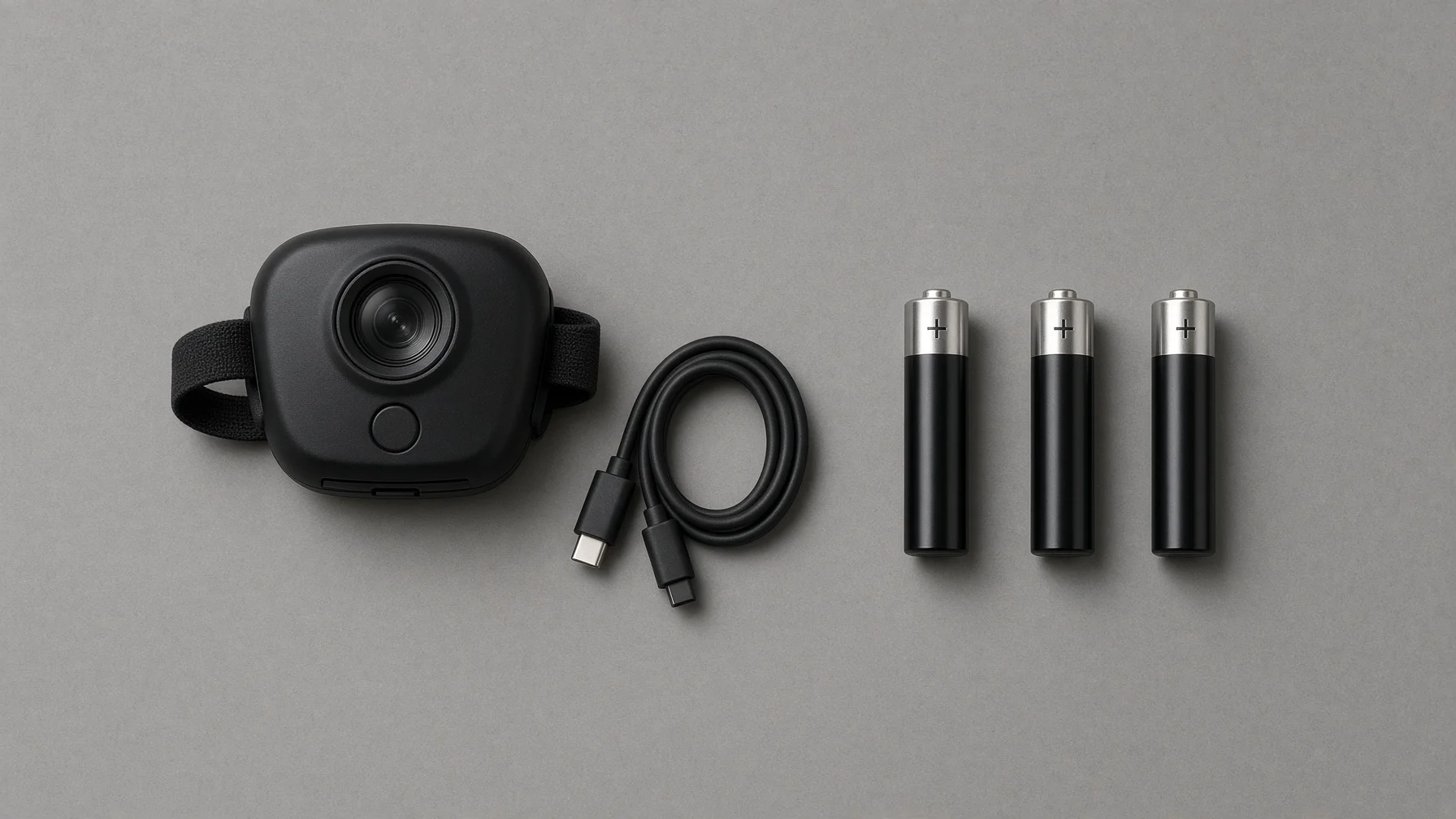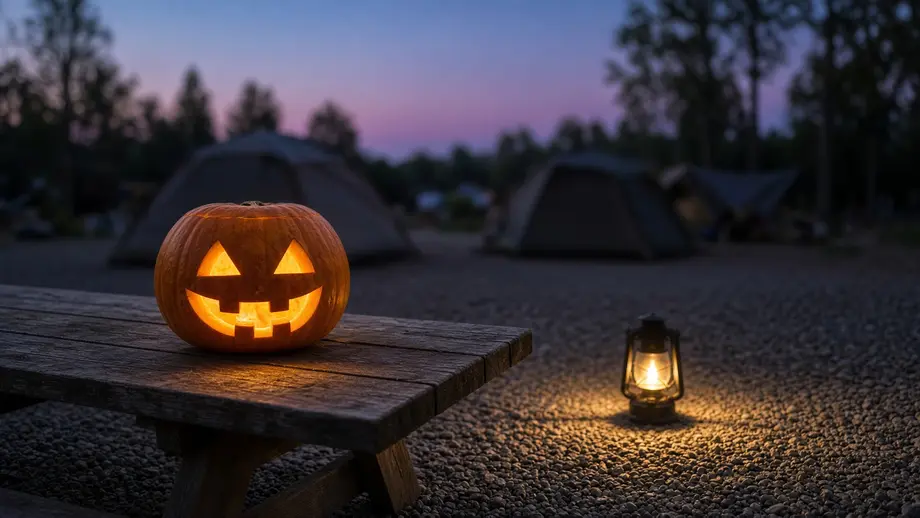
Olight makes some of the lights discussed here. Olight specs and prices come from its product pages and user manuals as of September 2026; fire, traffic and campground rules come from NFPA, Safe Kids Worldwide, the American Academy of Pediatrics, the National Park Service regulations in the eCFR, and the other sources linked in each section. The distance, runtime and brightness math is our own arithmetic from those published figures.
⚡ TL;DR
The best lantern for Halloween at a campground has no flame. Put a rechargeable ambient light in the pumpkin, one low, warm glow at your site entrance, a low-output keychain light or red clip light on each child, and a floodlight on the adult who walks on the vehicle side with the beam aimed at the ground.
This table is the lantern for Halloween kit for a campground loop: what each light does, the spec floor that matters, and an Olight model that meets it.
| Job on the loop | Recommended light type | Key spec floor | Olight example |
|---|---|---|---|
| Pumpkin or jack-o'-lantern glow | Flameless 360° ambient light | Warm low mode; 3+ hours on one charge; rain rating | Sphere Ambient Light (Sphere C) |
| Campsite entrance and steps | Low, warm ambient light set on the ground | 1 to 75 lumens, dimmable; timer or app control | Sphere Ambient Light (Sphere C) |
| Child's hand light (supervised, about age 8 and up) | Twist keychain light, no strobe, no laser | A 5-lumen low that runs the whole loop | i1R 2 Pro |
| Being seen from behind on the camp road | Steady red clip light on the back of the bag or jacket | Steady red mode rated for 3+ hours | Oclip |
| Adult loop leader | Tilting clip floodlight | 100-lumen flood for 3+ hours; red mode | Oclip 2 Pro |
You already know the three headaches. A candle in a pumpkin sits a few feet from dry leaves, straw bales and a campfire ring. The camp road has no streetlights, and trucks and RVs still roll through at dinnertime. And any light you set out at your site seems to shine straight into the neighbor's tent. This guide handles all three with published rules and simple math, not guesswork.
📋 Table of Contents
- 1. Lantern for Halloween at a Campground: The Short Answer
- 2. How Is a Campground Trick-or-Treat Different From a Neighborhood?
- 3. What Should You Put in a Pumpkin Lantern for Halloween?
- 4. Lantern Ideas for Halloween That Work at a Campsite
- 5. How Do You Light a Campsite Entrance Without Glaring at Neighbors?
- 6. How Bright Should a Kid's Light Be for Campground Trick-or-Treating?
- 7. Leading the Loop: How Should Adults Carry and Aim a Flashlight?
- 8. Common Mistakes: Brighter Is Safer, and Reflective Tape Is Enough
- 9. What Is a Pumpkin Lantern Called?
- 10. What Are the Halloween Trends for 2026?
- 11. Where Can I Buy Lanterns?
- 12. Your Campground Halloween Lighting Checklist
- 13. FAQ
Lantern for Halloween at a Campground: The Short Answer
For a campground Halloween, a lantern for Halloween should be a flameless, rechargeable light that runs through the whole trick-or-treat loop on one charge. Use low, warm light at the site, steady low light on children, and one brighter floodlight carried by an adult. Keep flames in the fire ring, and keep strobes and lasers off the loop entirely.
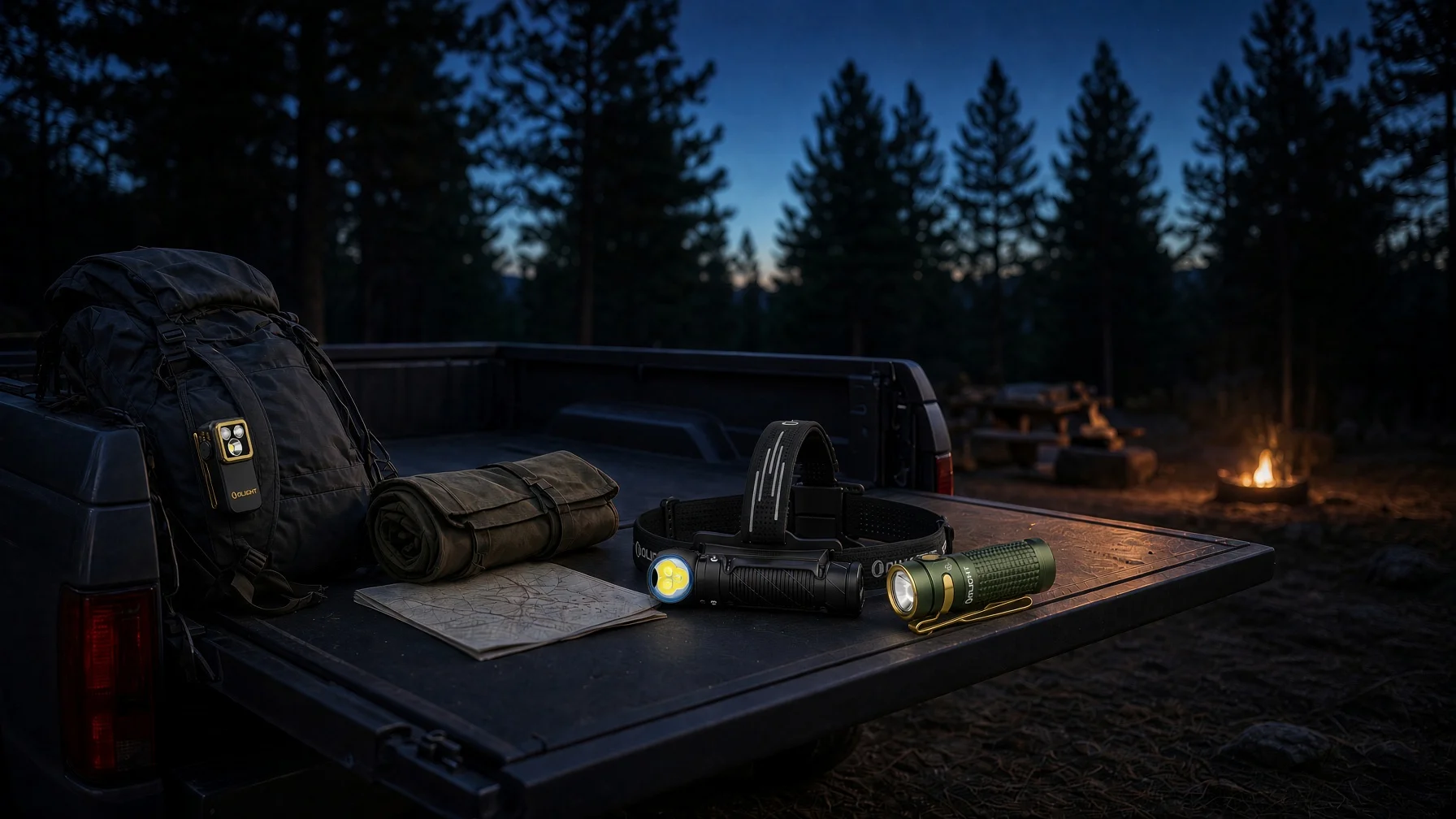
The split matters because each light has a different job. The pumpkin and the site entrance only need to glow and mark where the path is. Children need a light that shows the next step and tells a driver something small is moving. The adult needs enough light to see the road edge, tree roots and tent stakes. Olight's range of camping flashlights covers those jobs, but the plan below works with any brand that publishes its runtimes.
This table sets the output, runtime and weather needs for each part of a campground Halloween night. The lumen ranges are starting points drawn from the lights discussed here, not a standard.
| Part of the night | Output that works | Runtime need | Weather need | Notes |
|---|---|---|---|---|
| Pumpkin lantern | 1 to 10 lumens, diffused | One loop, about 3 hours | Rain and dew | Warm white or a static color |
| Site entrance and steps | 1 lumen to 75 lumens, dimmable | Dusk to the 10 p.m. noise cutoff | Rain | Set on the ground, not at eye height |
| Child's hand light | 5 lumens low; high only for short checks | The whole loop on low | Rain | No strobe, no laser, adult nearby |
| Rear marker on a child | Steady red, about 4 lumens | The whole loop | Splashes | Clipped facing backward |
| Adult leader | 100 lumens flood; 10 lumens low | 3+ hours at 100 lumens | Rain | Beam aimed down the road edge |
Safety note: Every light in this guide is for supervised use. An adult should walk the loop with young children, carry the brightest light, and decide when a child's light is on or off.
How Is a Campground Trick-or-Treat Different From a Neighborhood?
A campground trick-or-treat loop has no sidewalks, no streetlights, and a shared road where cars, trucks and RVs back into sites. Porch lights are replaced by lanterns and campfires, so light levels jump from glare to darkness every few yards. Kids walk on the same gravel the vehicles use, and the adults usually know the route less well than their own street.
Speed is the part families underestimate. National Park Service rules set a default limit of 15 miles per hour within campgrounds. State, county and private campgrounds set their own limits, so read the posted sign at the entrance. Fifteen miles per hour sounds slow. It is 22 feet per second, so a driver who looks away for two seconds travels about 44 feet without seeing your child.
This table shows how many seconds a vehicle needs to reach a child at common campground speeds. It is plain arithmetic (1 mph = 0.447 m/s), and it explains why lights and reflective tape should make a child noticeable at 30 meters, not just at the bumper.
| Vehicle speed | Distance covered per second | Seconds to cover 30 m (98 ft) | Seconds to cover 10 m (33 ft) |
|---|---|---|---|
| 5 mph | 7.3 ft (2.2 m) | 13.4 | 4.5 |
| 10 mph | 14.7 ft (4.5 m) | 6.7 | 2.2 |
| 15 mph | 22 ft (6.7 m) | 4.5 | 1.5 |
Read the last row carefully. At 15 mph, a child who is first noticed at 10 meters is 1.5 seconds from the front of the car. The same child noticed at 30 meters gives the driver 4.5 seconds. Light does its job when it buys those extra seconds.
Campgrounds add one hazard neighborhoods rarely have: reversing. Safe Kids Worldwide's Halloween safety tips tell families to "Watch for cars that are turning or backing up." An RV backing into a pull-through site has large blind spots, so the adult should stop the group and wait until it is parked.
What Should You Put in a Pumpkin Lantern for Halloween?
Put a battery-powered or rechargeable light in a pumpkin lantern for Halloween, never a candle, when you are at a campground. NFPA advises families to "Use glow sticks or battery-operated candles for jack-o'-lanterns and other Halloween decorations." A flameless light will not ignite dry leaves or straw, and it can stay lit while you walk the loop.
The fire data explains the advice. On its Halloween fire safety page, NFPA reports that from 2020 to 2024 there was an average of 835 home structure fires per year that began with decorations. It adds that "Nearly half (47%) of these fires occurred because the decorations were too close to a heat source, such as a candle or hot equipment," and that about one-third were started by candles. Those are home fires, but a campsite puts decorations even closer to heat: a fire ring, a lantern stove, a propane heater.
This table compares the common ways to light a pumpkin at a campsite.
| Light inside the pumpkin | Flame risk | Runtime you can plan | Rain | Best use |
|---|---|---|---|---|
| Wax candle | Open flame near leaves and fabric | Depends on the candle | Blows out | Avoid at campsites |
| Battery tea light | None | Often unlisted | Varies | A short evening, if checked at home first |
| Glow stick | None | Varies by product | Fine | Backup inside the pumpkin, or worn by kids |
| Rechargeable ambient light | None | Published by the maker | Rated models handle rain | All weekend with recharging |
| Flashlight dropped in lens-first | None, but heat can build if the lens is blocked | Published | Depends on rating | Avoid on high modes |
That last row matters. Olight's Oclip user manual says: "Do not obstruct the lens, or else the energy emitted from the light may cause the object to burn." A bright flashlight pressed face-down against the pumpkin flesh is the wrong tool. A diffused light that glows in every direction is the right one.
The Sphere in a pumpkin. The pumpkin's problem is an even glow for hours without a flame. The Olight Sphere Ambient Light (currently sold as Sphere C) has a 360-degree light-emitting surface, a 1-lumen white low that runs 40 hours, and colored lights rated at 10 lumens for 5 hours. Its white light is 2800K with CRI 80, per the Sphere C user manual, which gives a warm, candle-like tone. It is rated IP56 with 1.5 m impact resistance, and it costs $17.99 (regular price, September 2026).
It is 60 mm (2.36 in) across and 54.5 mm (2.15 in) tall. The American Academy of Pediatrics' pumpkin and trick-or-treat guidance say to let small children draw faces with markers and to "Leave the carving and cutting to the adults." An adult should cut the pumpkin's opening at least 7 cm (about 2.75 in) wide so it fits with room for your fingers. Better still, cut the opening in the bottom and set the carved pumpkin over the light. You never reach into a wet pumpkin in the dark.
The limits: at 75 lumens it is a glow, not a path light. The Sphere C manual also says "Do not expose the product to fire as it may cause the battery to ignite," lists a working temperature of 0 to 40°C, and says "Do not use as a ball for hitting or throwing." The same manual's battery section says: "Keep new and used batteries away from children." Treat the Sphere as a decoration an adult places and moves, not a toy for young children. Keep the pumpkin away from the fire ring, bring the light inside on a frosty night, and do not let kids toss it.
This table turns the Sphere C's published runtimes into a plan for a 3-hour (180-minute) loop and a two-night weekend. It is arithmetic from Olight's figures, not a field measurement.
| Sphere C mode (Olight figures) | Output | Published runtime | Battery used by one 180-minute loop | Two 4-hour nights (480 minutes) |
|---|---|---|---|---|
| White low | 1 lumen | 40 hours | 8% | 20%: no recharge needed |
| Colored lights high | 10 lumens | 5 hours | 60% | 160%: recharge between nights |
| Red light high | 11~2 lumens | 580 + 320 minutes | 20% | 53%, still at 11 lumens throughout |
| White high | 75~22 lumens | 100 + 150 minutes | Holds 75 lumens for 100 minutes, then 22 | Exceeds 250 minutes: recharge daily |
The pattern is simple. Colored and white-high modes need a charge every afternoon. White low and red high can cover a whole Halloween weekend on one charge.
Lantern Ideas for Halloween That Work at a Campsite
The best lantern ideas for Halloween at a campsite are flameless and portable: a carved pumpkin over a rechargeable light, a clear jar with a small light inside, a light hung from a tree limb in a paper bag, or a string of battery lights along the site's edge. Each one should survive rain, stay off the fire ring, and pack away in minutes.
A few ideas that suit a campsite better than a front porch:
- Bottom-cut jack-o'-lantern. Carve from the bottom, set it over a small ambient light, and lift the whole pumpkin to switch modes.
- Jar lantern on the picnic table. A clear glass jar with tissue paper or frosting inside hides a small light and spreads its glow.
- Pumpkin row along the site path. Two or three pumpkins at ankle height mark the edge of your site without shining at anyone.
- Magnet mount on the RV step. The Sphere's magnetic base sticks to metal, so a steel step or trailer tongue becomes a glowing marker at shin height.
- Color theme across several sites. Olight says the Sphere app supports "group control for up to 100 Spheres" and countdown timers, which lets a camp host set every light to one color and switch them off together.
Two limits to plan around. The Sphere C manual gives the maximum app control distance of one light as 25 meters in an open area, so control a loop's lights from the middle of the route, not from your tent. And when the light is off, it goes to sleep after 30 minutes and cannot be reached by the app until you press the switch or charge it.
How Do You Light a Campsite Entrance Without Glaring at Neighbors?
Light a campsite entrance with one low, warm light set on the ground and aimed at the path, never at eye height. DarkSky and the Illuminating Engineering Society's lighting principles say to use light "only if it is needed," to direct it "so that it points downward," and to keep it "no brighter than necessary." At a campsite, that means a few lumens at your steps.
Their Five Principles for Responsible Outdoor Lighting add two more steps that fit a campground: "Use controls such as timers" and "Use warmer-color lights where possible." A warm 2800K glow on a timer satisfies both.
Here is why a glowing lantern bothers neighbors far less than a flashlight. Illuminance (lux) equals intensity in candela divided by distance squared. If the Sphere's 75 lumens spread evenly in every direction (an assumption; its real pattern is not published), its intensity is 75 ÷ 4π, about 6 candela. This table compares that with two handheld lights pointed straight at a tent.
| Light and how it is aimed | Intensity (candela) | Lux at 1 m | Lux at 5 m | Lux at 10 m |
|---|---|---|---|---|
| Sphere C white high, glowing on the ground (6 cd assumed) | about 6 | about 6 | about 0.24 | about 0.06 |
| Sphere C white low, 1 lumen (0.08 cd assumed) | about 0.08 | about 0.08 | about 0.003 | under 0.001 |
| i1R 2 Pro high, pointed at a neighbor's tent | 580 | 580 | 23 | 5.8 |
| Oclip 2 Pro spotlight at maximum, pointed at a neighbor's tent | 3,906 | 3,906 | 156 | 39 |
At 10 meters, the i1R 2 Pro's focused beam puts roughly 100 times more light on a tent wall than the Sphere at full output. The Oclip 2 Pro's spotlight at maximum puts about 650 times more. The lesson for campground etiquette: diffused glows are fine; pointed beams are what wake people up.
Set up the entrance in this order:
- Place the ambient light on the ground at the first step or the edge of the gravel pad, not on the table.
- Start at 1 lumen. Raise the brightness only until you can see the step edge from 2 meters away.
- Walk to the road and look back. If you can see the light itself from the neighbor's picnic table, move it behind a pumpkin or a cooler.
- Set the app's countdown timer to switch it off at 10 p.m. National Park Service rules prohibit unreasonable noise between 10:00 p.m. and 6:00 a.m., which makes 10 p.m. a natural end to the event.
Tip: Charge every light the afternoon before the loop, while there is still daylight to find cables. A light that will not turn on at 4 p.m. will not turn on at 7 p.m.
How Bright Should a Kid's Light Be for Campground Trick-or-Treating?
A kid's light for campground trick-or-treating should be dim enough to use at arm's length from a friend's face and steady enough to last the loop. About 5 lumens on low shows gravel and tent lines at the child's feet. Use higher output only for short checks. Add reflective tape so headlights pick the child up, and skip strobes and lasers.
Two jobs get mixed up here: seeing and being seen. Safe Kids advises families to "Have kids carry glow sticks or flashlights to help them see and be seen by drivers," and to "Decorate costumes and bags with reflective tape or stickers." NFPA's Halloween tips also say to "Provide children with flashlights to carry for lighting or glow sticks as part of their costume." Reflective tape only works when a headlight hits it, so it helps with drivers but does nothing for the child's view of the ground. A small light handles the ground.
i1R 2 Pro as the child's hand light. A child's problem is keeping a light on all loop without blinding friends. The Olight i1R 2 Pro has a 5-lumen low rated at 12 hours, which covers any trick-or-treat loop, and a 180-lumen high rated at 23 minutes. Olight lists "Strobe: NO" and an IPX8 rating, and it weighs 0.78 oz (22 g). It costs $21.99 (regular price, September 2026).
Olight's user manual describes the control: "Slightly tighten the tailcap clockwise to turn on the light and access low mode. Fully tighten the tailcap to access high mode." Practice the half-twist at home. The limit is the high mode: at 580 candela, it puts about 580 lux on a face at 1 meter. The same manual warns: "DO NOT shine the light directly into human eyes." Keep this light for older children who follow the point-it-down rule, and let the adult carry anything brighter. For how small lights trade runtime for size, see Olight's guide to the keychain flashlight, and browse its keychain flashlights to compare other small models.
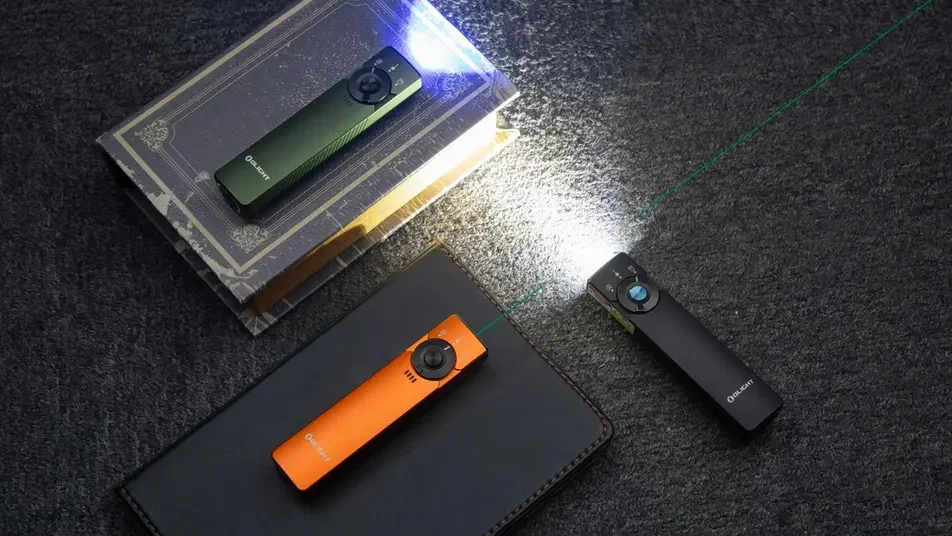
Oclip as a steady red rear marker. On a camp road, drivers often come up behind the group. The original Olight Oclip has a red light rated at 4 lumens for 5 hours and a clip that Olight says "can clamp objects up to 14mm thick." Clip it to the back of a treat bag or jacket, facing backward, in steady red. It costs $29.99 (regular price, September 2026) and is rated IPX5.
The limits are real. The Oclip's white strobe runs at 13 Hz at 300 lumens, according to Olight. The Epilepsy Society's page on photosensitive epilepsy says "Between 3-30 hertz (flashes per second) are the common rates to trigger seizures." An adult should set the red mode before the walk and keep white strobe off. The Oclip manual also says a quick triple press while the light is on starts a white beacon, so clip it where small fingers are not playing with the button, and check it at each stop. Olight lists a red strobe at 1 Hz, but a steady red is the calmer choice on a crowded loop. The Sphere lists a red flash mode without a flash rate, so use its steady modes when children are near.
For the full runtime math on neighborhood candy routes, see Olight's guide to Halloween flashlights for kids.
Warning: Do not give children any light with a laser pointer, and do not hang lights around a child's neck. Clip them to the treat bag or a jacket zipper instead.
Leading the Loop: How Should Adults Carry and Aim a Flashlight?
The adult should walk on the vehicle side of the group, a step ahead, with a hands-free floodlight clipped to the chest strap and tilted down. Aim the beam center at the ground about 3 meters (10 feet) ahead. That lights roots, stakes and the road edge for the whole group without shining into faces or into oncoming windshields.
Where the camp road has no path, follow the pediatricians' rule for streets without sidewalks. The AAP says to "walk at the far edge of the roadway facing traffic," and to "Always go with young children on their neighborhood rounds." Keep the children on the inside edge and put yourself between them and the lane.
The angle is simple trigonometry. From a chest clip at about 1.3 m (an assumed height for an average adult), the beam center must tilt down about 23 degrees to land 3 meters ahead, and about 15 degrees to land 5 meters ahead. A light that tilts lets you set that angle once.
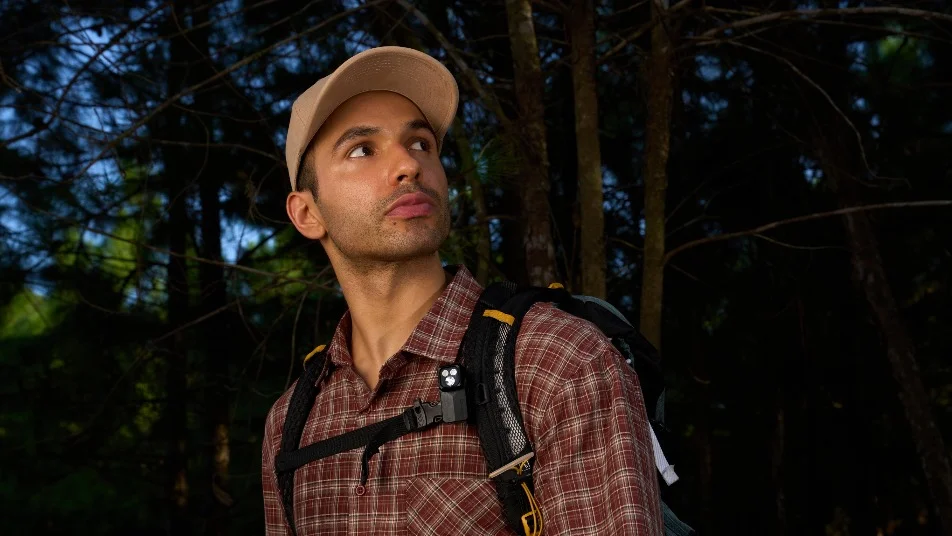
Oclip 2 Pro as the loop leader's light. The adult's problem is holding a child's hand, a candy bag and a light at once. The Olight Oclip 2 Pro pairs "a 115° head tilt with 360° clip rotation," and Olight says its clip "grips objects up to 14 mm thick, including collars, straps, and MOLLE webbing." Its 100-lumen floodlight medium runs 3 hours 45 minutes, its 10-lumen low runs 25 hours, and its red light high gives 40 lumens for 4 hours. It is rated IP66 with 2.0 m impact resistance. The Oclip 2 user manual adds a caution for anyone with an implanted heart device: "If you have an ICD or pacemaker, avoid close or prolonged contact with this product to prevent possible interference."
This setup plan uses those published runtimes for a 180-minute loop:
- Walking the camp road: floodlight medium, 100 lumens. 180 of 225 minutes uses 80 percent of the battery.
- Mixed plan: 2 hours on floodlight low (120 of 1,500 minutes, 8 percent) plus 1 hour on medium (60 of 225 minutes, 27 percent) uses about 35 percent.
- Waiting at a lit campsite: switch to red high, 40 lumens, so you do not light up the hosts' faces.
The limits: it weighs 2.66 oz (75.5 g) and costs $54.99 (regular price, September 2026), more than the i1R 2 Pro and Oclip together ($51.98). Its 530-lumen turbo floodlight and strobe are adult modes; leave them off on the loop. If you already own a headlamp, it can do the same job, but a headlamp points wherever you look, which is usually at the kids.
This table turns the rules that apply on a campground Halloween night into actions. National Park Service rules apply in national parks; state, county and private campgrounds post their own, so read the rules at your site office.
| Source | What it says | What you do on the loop |
|---|---|---|
| NFPA | "Use glow sticks or battery-operated candles for jack-o'-lanterns" | Flameless light in every pumpkin |
| NFPA | "Keep Halloween decorations away from open flames and other heat sources" | No hay bales or pumpkins near the fire ring or stove |
| NFPA | "Teach children to stay away from open flames, including jack-o'-lanterns with candles in them" | Walk kids past campfires on the far side of the road |
| NPS, 36 CFR 2.13 | Prohibits "Lighting or maintaining a fire, except in designated areas or receptacles" and "Leaving a fire unattended" | Put the campfire out or post an adult before you leave for the loop |
| NPS, 36 CFR 2.13 | Prohibits "Using stoves or lanterns in violation of established restrictions" | During a fire ban, check whether fuel lanterns are allowed |
| NPS, 36 CFR 4.21 | 15 mph limit "within all school zones, campgrounds, picnic areas" | Assume a car covers 22 feet every second; stop the group when one approaches |
| Safe Kids | "Join kids under age 12 for trick-or-treating" | One adult per small group, carrying the brightest light |
| Safe Kids | "Watch for cars that are turning or backing up" | Stop and wait for RVs to finish parking |
The fire rules come from the eCFR text of 36 CFR 2.13, which also lets a superintendent close a park to fires "During periods of high fire danger."
Common Mistakes: Brighter Is Safer, and Reflective Tape Is Enough
The two most common mistakes on a campground loop are handing kids the brightest light in the camp and assuming reflective tape covers visibility on its own. Bright beams dazzle other children and oncoming drivers. Tape only shines when a headlight hits it, so it does nothing for the child's footing and little for a driver whose headlights point elsewhere.
Other mistakes to fix before dark:
- Candles "just for the photo." Most jack-o'-lantern photos happen at dusk, when kids crowd around. Use the flameless light for photos too.
- Lanterns at face height. A hanging lantern at eye level glares at everyone who walks past. Lower it to the ground or behind a pumpkin.
- Strobes as "safety lights." Flashing white light in a crowd is hard to look at, and strobe rates of 3 to 30 Hz are common seizure triggers.
- One charge for the whole weekend. Colored and high modes drain fastest; recharge them each afternoon.
- Lights left on after the loop. A glowing site at midnight bothers neighbors. Use a timer.
- Headlamps on young children. They point at every face the child turns toward.
What Is a Pumpkin Lantern Called?
A pumpkin lantern is called a jack-o'-lantern. Merriam-Webster defines a jack-o'-lantern as "a lantern made of a pumpkin usually cut to resemble a human face." The same word also names a poisonous glowing mushroom, which explains some confusing search results. At a campground, the lantern part should be a flameless light, not a candle.
You will also see "pumpkin lantern," "carved pumpkin" and "Halloween lantern" used for the same thing. A faux foam or plastic pumpkin with a built-in light is still a jack-o'-lantern in everyday use. Foam pumpkins travel better in a camper, and they can be reused next year.
What Are the Halloween Trends for 2026?
Halloween 2026 trends point to a longer, value-minded season. The National Retail Federation's 2026 survey expects spending of $13.5 billion, above last year's record $13.1 billion, with 74% of consumers planning to celebrate. Top activities are handing out candy (61%), dressing in costume (50%), decorating the home or yard (42%) and carving pumpkins (42%). Nearly half (47%) are using AI tools to support their Halloween shopping.
Several findings in the NRF 2026 Halloween survey matter for campers:
- Decorations are a big line. NRF expects $4.3 billion on decorations, bought by 78% of shoppers.
- Reuse is in. 34% plan to look for items they "can reuse in future years or repurpose for other occasions or settings." A rechargeable camp light that doubles as a pumpkin light fits that trend better than single-use candles.
- The season starts early. 49% begin shopping in September or earlier, which lines up with October campground Halloween weekends.
- Costumes. For children, 4.6 million plan to dress as Spider-Man; for adults, witch (4.8 million) and vampire (4.2 million) lead. Dark costumes are common, so reflective tape still matters.
Where Can I Buy Lanterns?
You can buy Halloween lanterns at discount stores, specialty Halloween and costume shops, online retailers, and brand stores. NRF's 2026 survey finds discount stores (39%) are the top destination for Halloween purchases, followed by specialty Halloween or costume stores (32%) and online (27%). For a campground, buy a lantern with a published runtime and water rating, not just a look.
Use this checklist before you buy any lantern for a campsite, from any store:
- No flame. Battery or rechargeable only.
- A published runtime for the mode you will use most. If the box does not list one, you cannot plan the loop.
- A water rating. Dew and drizzle are normal on October nights.
- A low mode. 1 to 10 lumens keeps the site calm.
- A warm color option. DarkSky recommends warmer-color light where possible.
- A way to mount it. A flat base, a hook or a magnet.
For light that doubles as regular camp lighting after Halloween, see Olight's guide to the LED camping lantern, and its kit lists for the best lights for festival camping, which use the same runtime-first approach.
Your Campground Halloween Lighting Checklist
Use this checklist on the day of the campground Halloween event. It covers charging, the pumpkin, your site, the children and the loop itself. Work through it in the afternoon, while you can still see the road, and your lantern for Halloween will be glowing, charged and safe before the first knock on your camper door.
- Early afternoon: charge every light. Charge the adult's clip light last so it starts full.
- Pumpkin: an adult cuts the opening in the bottom, at least 7 cm wide. Set it over a flameless light, away from the fire ring.
- Site entrance: one warm light on the ground at the first step, starting at 1 lumen. Set a timer for 10 p.m.
- Children: reflective tape on the front and back of each costume and bag. A low-output light in hand, a steady red light on the back.
- Adult: floodlight clipped to the chest, tilted about 23 degrees down to hit the ground 3 meters ahead.
- Campfire: put it out or leave an adult with it before the loop starts.
- On the road: adult on the vehicle side. Stop the group for any moving or reversing vehicle.
- After the loop: switch off site lights by 10 p.m. and put everything on charge for the next night.
FAQ
Changelog
- September 22, 2026: First published.