Olight makes some of the lights discussed here. Olight specs and prices come from its product pages as of September 2026; safety guidance comes from NHTSA, the National Safety Council, the American Academy of Pediatrics, and the other sources linked in each section. The runtime and brightness math is our own arithmetic from those published figures.
⚡ TL;DR
The best Halloween flashlights for kids are small, low-glare lights that clip or hang on the treat bag, turn on with one simple motion, and have no strobe or laser. A tiny keychain light will not run for three straight hours, so kids use it on demand while a parent carries a clip light that can stay on all night.
This table sets out Halloween flashlights for kids and the parent's kit in one place: what each light does, the minimum spec that matters, and a model that meets it.
| Job on Halloween night | Recommended light type | Key spec floor | Olight example |
|---|---|---|---|
| Kid's light for steps and driveways (ages 5 to 8, adult present; not for toddlers) | Keychain light, one mode, no strobe | 50 lumens; about 1 hour on demand; hangs on the bag | imini 2 |
| Kid's light for older trick-or-treaters (8 to 12) | Keychain light with a low mode | A low mode of about 5 lumens that runs 12 hours | i1R 2 Pro |
| Parent's hands-free light | Clip light with several levels | 100 lumens for 3+ hours, or 10 lumens for 12+ hours | Oclip 2 Pro |
| Being seen by drivers | Reflective tape plus a glow stick or light | Tape on front and back of costume and bag | Any light plus tape |
| Backup | A second small light in the parent's pocket | Charged the same day | Oclip or iUltra |
If you have ever watched a store-bought pumpkin light fade to a dull orange before the second block, you know the problem. The other two are just as familiar: kids swing the beam into each other's eyes, and parents end up juggling a candy bag, a phone, and a small hand. This guide fixes all three with runtime math from published specs, not guesses.
📋 Table of Contents
- 1. Halloween Flashlights for Kids: The Short Answer
- 2. Will a Kid's Flashlight Last a 3-Hour Trick-or-Treat Route?
- 3. How Bright Should a Kid's Halloween Flashlight Be?
- 4. What Are Some Good Flashlights for Children?
- 5. What Are Some Cool Flashlights for Kids?
- 6. The Parent's Light: Clip It On and Keep Both Hands Free
- 7. Why Do Novelty Halloween Flashlights Fade Before the Night Ends?
- 8. Are Glow Sticks and Reflective Tape Enough?
- 9. Trick-or-Treat Route Safety: What NHTSA, NSC, and the AAP Say
- 10. What Are Some Good Halloween Goodies for Kids?
- 11. Your Halloween Night Light Checklist
- 12. FAQ
Halloween Flashlights for Kids: The Short Answer
For most families, the right Halloween flashlights for kids are a small, single-button or twist light for each child and a hands-free clip light for the adult. Pick kid lights of 50 to 80 lumens with no strobe. Pick a parent light that can run a medium or low mode for at least three hours. Add reflective tape to every costume.
Why split the job? Kids need a light that shows the next step and makes them visible. They do not need a beam that reaches the end of the block. Small keychain flashlights can do that job, but tiny lights have tiny batteries. The adult light is the one that has to last the whole route, because it covers the dark stretches between porch lights.
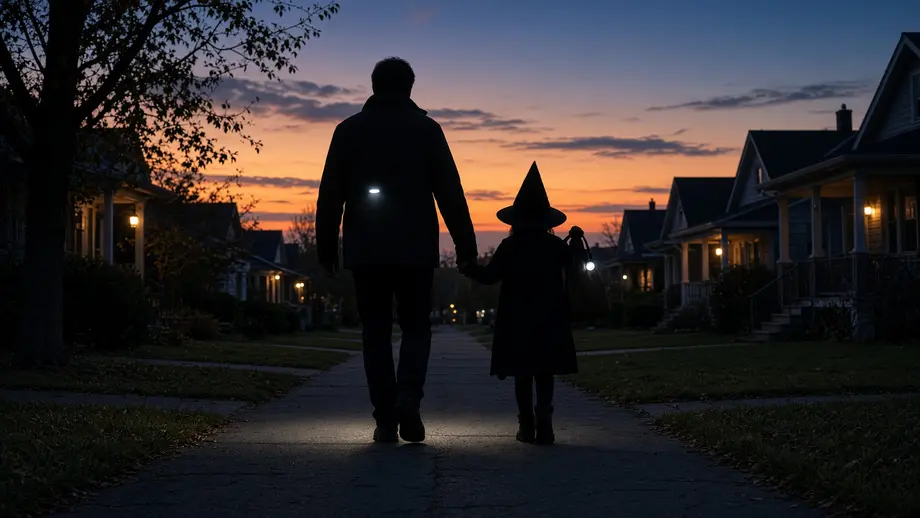
Safety groups put the flashlight near the top of their Halloween lists. The American Academy of Pediatrics tells parents to "encourage everyone to use a flashlight after dark" in its Halloween safety tips for families. Safe Kids Worldwide's trick-or-treat safety tips put it plainly: "Have kids carry glow sticks or flashlights to help them see and be seen by drivers."
Safety note: Every light in this guide is for supervised use. A responsible adult should walk with young children, keep the brighter light, and decide when a child's light is on or off.
Will a Kid's Flashlight Last a 3-Hour Trick-or-Treat Route?
Most kid-size keychain lights will not last a 3-hour trick-or-treat route if left on the whole time. The Olight imini 2 runs 60 minutes at 50 lumens, and the iUltra runs 50 minutes at 80 lumens. Used only for steps, driveways, and dark gaps, either one fits the night. Lights with a low mode, such as the i1R 2 Pro's 12-hour low, can stay on.
Three hours is a realistic plan, not a worst case. The same Safe Kids tips say: "Popular trick-or-treating hours are 5:30 p.m. to 9:30 p.m." That is a four-hour window. Most families spend part of that window walking. So we budgeted 180 minutes.
This table divides a 180-minute route by each light's published runtime. A result under 100 percent means one full charge covers the route with that mode left on. It is arithmetic from Olight's figures, not a field measurement.
| Light and mode (Olight figures) | Output | Published runtime | Share of battery used by 180 minutes on | Verdict for a 3-hour route |
|---|---|---|---|---|
| imini 2, single mode | 50 lumens | 60 minutes | 300% | On demand only: about 20 minutes of light per hour |
| iUltra, single mode | 80 lumens | 50 minutes | 360% | On demand only: about 17 minutes of light per hour |
| i1R 2 Pro, low | 5 lumens | 12 hours | 25% | Can stay on all night |
| i1R 2 Pro, high | 180 lumens | 23 minutes | 783% | Short bursts only |
| Oclip, low | 10 lumens | 12 hours | 25% | Can stay on all night |
| Oclip, medium | 100 lumens | 90 minutes | 200% | Half the route, then drop to low |
| Oclip, red constant | 4 lumens | 5 hours | 60% | Can stay on all night |
| Oclip 2 Pro, floodlight low | 10 lumens | 25 hours | 12% | Can stay on all night |
| Oclip 2 Pro, floodlight medium | 100 lumens | 3 hours 45 minutes | 80% | Covers the route with 45 minutes spare |
| Oclip 2 Pro, red light high | 40 lumens | 4 hours | 75% | Covers the route |
Here is how an on-demand plan works for a child with an imini 2. Say your route has 30 houses and the light is on for about one minute at each one, for the driveway and the steps. That is 30 minutes, half of the 60-minute runtime. The other half covers dark gaps between houses. The numbers are an example; count your own street's houses and adjust.
For the parent, mix modes. Two hours of Oclip 2 Pro floodlight low (120 of 1,500 minutes, 8 percent) plus one hour of medium (60 of 225 minutes, 27 percent) uses about 35 percent of the battery. You finish the night with most of a charge left for the walk home or a dropped glove in the grass.
Tip: Charge every light the afternoon of Halloween, not the night before. Then do a quick check at home: turn each light on, count to ten, and switch it off. A light that will not come on at home will not come on at the curb.
How Bright Should a Kid's Halloween Flashlight Be?
A kid's Halloween flashlight should be bright enough to show a step or a curb a few feet ahead, and dim enough that it does not dazzle a friend's eyes. About 50 to 80 lumens is plenty for a child. The parent's light can go to 100 lumens for unlit stretches. Skip anything with a white strobe or a laser.
Lumens are total light output. Candela tells you how hard the center of the beam hits something. Divide candela by the square of the distance in meters, and you get lux on the target. For the terms in more depth, Olight's guide to how bright 2000 lumens is walks from 10 to 10,000 lumens.
Now apply the math to a friend's face at arm's length, about 1 meter. The imini 2's 115 candela puts about 115 lux there. The Oclip's 1,156 candela puts about 1,156 lux there, ten times more. The Oclip 2 Pro at its 3,906-candela maximum puts about 3,906 lux there, 34 times the imini 2. That is why the high-output lights stay with the adult. Olight's own i1R 2 Pro user manual puts the rule in capital letters: "DO NOT shine the light directly into human eyes. This may cause temporary blindness, or permanent damage to the eyes."
This table matches each part of the route to the output and runtime it needs. Treat the lumen ranges as a starting point based on the lights above, not a standard.
| Part of the route | What you need to see | Output that works | Runtime need | Weather need |
|---|---|---|---|---|
| Sidewalk under streetlights | Nothing extra; be seen | Low (5 to 10 lumens) or light off | Hours | Light rain |
| Driveway and porch steps | Edges of steps, pumpkins, hoses | 50 to 100 lumens, aimed at feet | Short bursts | Light rain |
| Unlit stretch between houses | Curb, uneven grass, parked cars | 100 lumens from the adult's light | 30 to 60 minutes | Light rain |
| Street crossing | Being seen by drivers | Any steady light plus reflective tape | Seconds | Light rain |
| Waiting at a busy door | Your group, not faces | Beam pointed down | Minutes | None |
For rain, check the water rating. The imini 2 and iUltra are rated IPX6, the Oclip IPX5, the i1R 2 Pro IPX8, and the Oclip 2 Pro IP66. Any of those handles a drizzle on the walk. None of them is meant to be left in a puddle, and a child does not need to test that.
Warning: Do not hand a child a light with a built-in laser pointer. The FDA's guidance on laser toys and kids' safety says "Never aim or shine a laser directly at any person or animal" and "Do not buy laser pointers for children or allow children to use them as toys."
Strobe is the other feature to leave off on Halloween. A fast white strobe in a crowd is hard to look at, and the UK's Epilepsy Society explains photosensitive epilepsy this way: "Between 3-30 hertz (flashes per second) are the common rates to trigger seizures." It adds that most people who develop it "are between the age of 7 and 19 years old." The Oclip's white strobe runs at 13 Hz per Olight, so keep it out of the kid rotation. The imini 2 and i1R 2 Pro list no strobe at all.
What Are Some Good Flashlights for Children?
Good flashlights for children are small, light, and hard to misuse. Look for one simple way to turn the light on, no strobe or laser, 50 to 80 lumens or a low mode, a built-in rechargeable battery, a way to hang it from a bag, and a water rating. The light should weigh under an ounce so a small child can carry it for hours.
Use these checks before you buy any kid's light, from any brand:
- One simple control. A pull, a twist, or one button. A child in gloves and a costume should not need to click through five modes.
- No strobe, no laser, no UV. Those features belong on adult lights.
- A sealed battery or a screwed battery door. The National Capital Poison Center's button battery guidance notes that button batteries power "toys, games, flashing jewelry," and that "severe damage can occur in just 2 hours" if one sticks in the esophagus.
- A way to attach it. A key ring on the treat-bag handle beats a loose light that ends up in the bushes.
- A published runtime. If the maker will not tell you how long it runs, you cannot plan the night.
This table sorts the small Olight options by what matters on a child's night out. The iUltra row is there as the adult's backup, for the reason given below.
| Model (Olight) | Output | Runtime | Weight | Control | Strobe | Water rating | Price (September 2026) |
|---|---|---|---|---|---|---|---|
| imini 2 | 50 lumens | 60 minutes | 0.69 oz (19.5 g) | Pull the body from the magnetic cap | No | IPX6 | $19.99 regular price |
| iUltra | 80 lumens | 50 minutes | 0.71 oz (20 g) | Pull to turn on, snap back to turn off | Not listed | IPX6 | $29.99 regular price |
| i1R 2 Pro | 180 lumens high, 5 lumens low | 23 minutes high, 12 hours low | 0.78 oz (22 g) | Twist the tailcap: slightly for low, fully for high | No | IPX8 | $21.99 regular price |
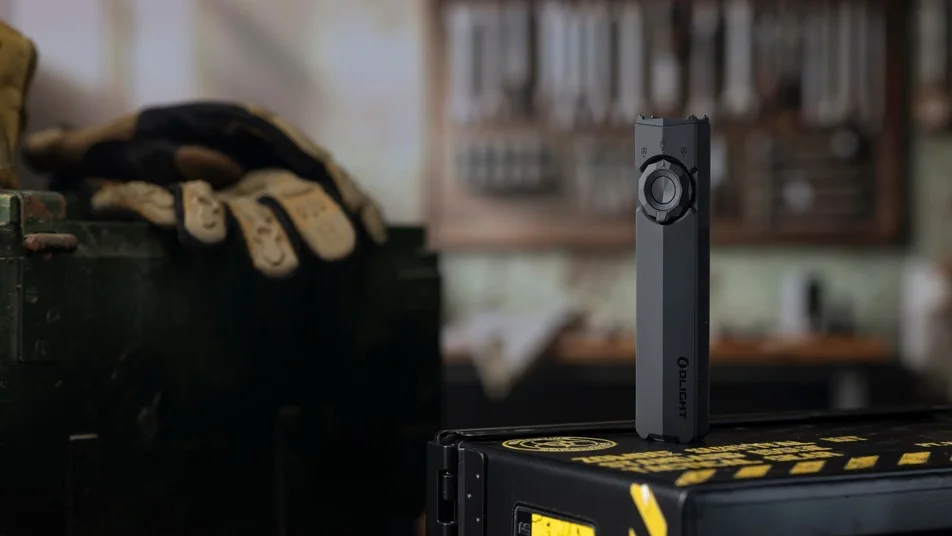
imini 2 for younger kids. The hard part with a five-year-old is getting the light on and off without help. The Olight imini 2 rechargeable mini flashlight turns on when you pull the body from its magnetic cap, has one 50-lumen output, and lists "Strobe: No." It charges through a USB plug on the cap. Its magnetic cap and separate USB port cover are small parts, so hang the light from the treat bag and keep it away from toddlers. The other limit is runtime: 60 minutes, so it works as an on-demand light only. If your child will leave it on the whole walk, pick the i1R 2 Pro.
i1R 2 Pro for older kids who want it on the whole time. The Olight i1R 2 Pro keychain flashlight has a 5-lumen low that Olight rates at 12 hours, which covers any candy route. Olight's user manual explains the twist: tighten the tailcap slightly to turn it on in low, tighten it fully for high, and twist it counterclockwise to turn it off. Practice the half-twist at home so the light starts on low. The limit: the 180-lumen high lasts 23 minutes and is bright enough to bother other kids up close, so teach the "point it at your feet" rule before you leave.
iUltra for the parent's pocket, not the child's. Olight says the Olight iUltra OAL keychain flashlight is made from an aluminum "1.73× harder than 6061" and delivers 80 lumens, "60% brighter than the imini 2." That toughness makes it a good backup when a kid's light runs down. But Olight's iUltra user manual says to "Keep the product out of reach of children to prevent accidental swallowing," so the adult keeps it and lights the steps for the child. It also has the shortest runtime of the three at 50 minutes and costs $29.99 (regular price, September 2026).
For more on picking a first light for a child year-round, see Olight's kids flashlight guide.
What Are Some Cool Flashlights for Kids?
The coolest flashlights for kids are the ones they can work by themselves and feel proud to carry. A light that turns on when you pull it apart, a twist-on light that feels like an adult's tool, or a light in a bright color all fit. Cool should never mean a laser, a strobe, or a beam bright enough to blind a friend.
Kids like three things in a light, and all three are safe to give them:
- A trick to turning it on. The imini 2 turns on when you pull the body from its magnetic cap. The i1R 2 Pro turns on with a twist, and a slight twist versus a full twist picks low or high. Both are fun to do and easy to understand.
- A color that is theirs. In September 2026, Olight's product page lists the imini 2 in Dream Blue. A color that differs from a sibling's light also helps you sort a pile of costumes and treat bags at the end of the night.
- A real tool, not a toy. An aluminum light on their own key ring feels grown-up. That pride makes kids more likely to follow your rules about where to point it.
A good rule of thumb: if you would not want the beam pointed at your own eyes from arm's length, it is not a kid's light. Olight's guide to choosing a keychain flashlight covers how much light fits on a key ring and why small lights trade runtime for size.
The Parent's Light: Clip It On and Keep Both Hands Free
The parent's Halloween light should clip to a jacket, strap, or bag so both hands stay free for a small hand, a candy bag, and a phone. It needs a medium mode that lasts the full route and a low mode for sidewalks. A red mode helps when you want to see without lighting up faces at the door.
Oclip 2 Pro as the all-night adult light. The problem at night is holding a light while holding a child. The Olight Oclip 2 Pro EDC clip flashlight has a clip that "grips objects up to 14 mm thick, including collars, straps, and MOLLE webbing," a 115° head tilt, and 360° clip rotation, so you can aim the beam at the sidewalk ahead instead of at the kids. Its 100-lumen floodlight medium runs 3 hours 45 minutes, and its 10-lumen low runs 25 hours. Its red light has a 40-lumen high rated at 4 hours and a 4-lumen low rated at 27 hours. It is rated IP66 with 2.0 m impact resistance. The Oclip 2 user manual adds a caution for anyone with an implanted heart device: "If you have an ICD or pacemaker, avoid close or prolonged contact with this product to prevent possible interference."
The limits are real. At 2.66 oz (75.5 g), it is about four times the weight of an imini 2, fine on a jacket but heavy for a child's collar. At $54.99 (regular price, September 2026), it costs more than an imini 2 and an i1R 2 Pro together ($41.98). And its 530-lumen turbo and strobe are for adult use only; keep it on low or medium on the route.
Oclip as the budget adult light or the backup. The original Olight Oclip clip light costs $29.99 (regular price, September 2026), weighs 1.06 oz (30 g), and has a 10-lumen low that runs 12 hours plus a 4-lumen red that runs 5 hours. Its limit: medium lasts 90 minutes, so you drop to low for the second half of the route. It is also a good first clip light for a responsible 11- or 12-year-old, with an adult setting the mode and the strobe left off.
To compare every clip model, browse the Olight Oclip series of clip-on lights.
Where to clip it matters as much as which light you buy:
- On the chest strap of a jacket, tilted down: lights the sidewalk three to four steps ahead of you and your kids.
- On the candy bag handle: lights the ground at the child's feet and makes the bag visible to drivers.
- On a stroller or wagon handle: frees both hands for a toddler and keeps the beam low.
Note: The Oclip 2 Pro is an adult light with a 530-lumen turbo and a strobe. Keep it on the adult, and let children use it only with you holding it and setting the mode.
Why Do Novelty Halloween Flashlights Fade Before the Night Ends?
Novelty Halloween lights often fade early because they pack a tiny battery into a costume-shaped shell, and many packages list no runtime at all. Without a runtime number, you cannot tell if a light will last 20 minutes or three hours. Tiny batteries also mean tiny margins: even Olight's 80 mAh keychain cells give only 50 to 60 minutes.
Compare what you know about each type. Olight publishes the battery (a 10180 80 mAh cell in the imini 2 and iUltra) and the runtime at its one output. A pumpkin-shaped light from a party-favor bag usually tells you neither. That is not proof it will fail, but it means you are guessing.
You can take the guessing out of it at home. Run this simple kitchen-counter check the weekend before Halloween:
- Put fresh batteries in, or charge it fully.
- Turn it on at 5 p.m. and set it on the counter pointing at a wall.
- Check it at 6, 7, and 8 p.m. Note whether the spot on the wall is still bright, dim, or gone.
- If it is dim by 6 p.m., plan to carry spare batteries or a second light.
Also check how the batteries go in. If a child can open the battery door with a fingernail, the batteries are within reach of younger siblings. The Poison Center advises calling the National Battery Ingestion Hotline at 1-800-498-8666 or Poison Control at 1-800-222-1222 right away if a child swallows one.
Warning: Keep button-cell novelty lights and small keychain lights away from babies and toddlers. The AAP notes that "small toys or temporary tattoos can be a choking hazard," and the Poison Center's advice on a swallowed battery is two words: "Don't delay."
Are Glow Sticks and Reflective Tape Enough?
Glow sticks and reflective tape help drivers see your child, but they do not light the ground. A glow stick will not show a raised sidewalk slab, a garden hose, or the edge of a porch step. Use tape and glow sticks for visibility, and a flashlight for seeing. Safety groups recommend both.
The National Safety Council's Halloween costume and traffic tips say: "If children are allowed out after dark, fasten reflective tape to their costumes and bags, or give them glow sticks." The AAP adds: "Plan costumes that are bright and reflective," with "reflective tape or striping to costumes and trick-or-treat bags."
Reflective tape only works when a light hits it, usually a car's headlights. That is why it helps with drivers. It does nothing for your child's view of the path. The flashlight covers that half.
Here is how to set up a dark costume so it works both ways:
- Two strips of reflective tape on the front and two on the back, at the height of a car's headlights.
- A strip on each side of the treat bag, since the bag swings out ahead.
- A glow stick or small light on the bag handle, so the child is visible from the side.
- A flashlight in hand or clipped, pointed down, for steps and driveways.
Trick-or-Treat Route Safety: What NHTSA, NSC, and the AAP Say
The core Halloween route rules from national safety groups are simple: an adult goes with young children, kids walk on sidewalks or face traffic, streets are crossed at corners or crosswalks, and everyone stays in familiar, well-lit areas. Lights and reflective gear help, but only if the route and the adult supervision are right.
The stakes are high. The National Safety Council, citing Safe Kids Worldwide, warns that "Children are more than twice as likely to be hit by a car and killed on Halloween than on any other day of the year," and that "Lack of visibility because of low lighting at night also plays a factor in these incidents." NHTSA's pedestrian safety page reports that 7,080 pedestrians were killed in traffic crashes in 2024.
This table turns each agency's wording into what you do on the night.
| Source | What it says | What you do with a flashlight in hand |
|---|---|---|
| NSC | "A responsible adult should accompany young children on the neighborhood rounds" | The adult carries the brightest light and walks on the street side |
| NSC | "Instruct children to travel only in familiar, well-lit areas and stick with their friends" | Plan the route in daylight; skip dark cut-throughs |
| NHTSA | "Children under 10 should not be allowed to cross the street alone" | Hold hands at crossings; the light points at the road, not at drivers |
| NHTSA | "If there is no sidewalk, walk facing traffic and as far from traffic as possible" | The adult's light faces oncoming cars on the traffic side |
| NHTSA | "If you can't see the driver, the driver can't see you" | Wait for eye contact before crossing, even with lights on |
| AAP | "Only go to homes with a porch light on and, ideally, a well-lit pathway" | Use the kid's light for the driveway and steps, then switch it off |
| AAP | "Avoid mid-block crossings, where child pedestrian injuries are much more common" | Walk to the corner, even if the next house is across the street |
| Safe Kids | "Join kids under age 12 for trick-or-treating" | Older kids in a group carry a light each plus a charged phone |
NHTSA's own Halloween safety tips remind drivers that "Children may be unaware of traffic and dart into the street unexpectedly," and tell pedestrians to "create a 'buddy system' to get each other home safely and prevent walking alone."
Timing is on your side in 2026. According to NIST, daylight saving time in 2026 runs until "November 1 at 2 a.m." Halloween falls on Saturday, October 31, so clocks have not yet shifted back that night. The time change the next morning brings darker evening commutes; Olight's guide to what changes when daylight saving time ends covers that.
Safety note: Teach one rule before you leave the house: lights point at the ground or at the road, never at faces or at drivers. Practice it in the driveway for a minute so it sticks.
What Are Some Good Halloween Goodies for Kids?
Good Halloween goodies for kids include both treats and small non-food items. The AAP suggests non-edible goodies for children with food allergies, such as glow sticks, spider rings, vampire fangs, pencils, bubbles, bouncy balls, finger puppets, whistles, bookmarks, stickers, and stencils. A small flashlight can be a family gift for the night itself.
The AAP explains why non-food treats matter: "Halloween is one of the trickiest days of the year for children with food allergies." It also advises you to "wait until children are home to sort and check treats before eating them." A light helps with that last part: a flashlight on the kitchen table makes it easier to read small wrappers after a long night.
If you are handing out treats at your door, the same guidance applies to your house. The AAP says to "remove tripping hazards on your porch and in your yard" and to "check outdoor lights and replace burned-out bulbs." For a jack-o'-lantern, it suggests "a battery-operated flameless candle, flashlight or glow stick instead of a candle."
For families who want a light that outlasts the holiday, a small rechargeable light makes a good pre-Halloween gift for an older child's own key ring. Give it with the same rule you use on the route: pointed at the ground, never at faces.
Your Halloween Night Light Checklist
Use this checklist on October 31 to get every child lit, visible, and home on time. It covers charging, costume tape, the route, and the rules you set before the first doorbell. Work down it in order in the afternoon, and you will not be searching for a charger or a dead light at 7 p.m.
- Early afternoon: charge the Halloween flashlights for kids first. Charge the parent's clip light last so it starts full.
- Costume check: put reflective tape on the front and back of each costume and on both sides of each treat bag.
- Attach lights: hang each kid's light from the treat bag handle or a zipper pull, not around the neck.
- Set modes: put the parent's light on low for sidewalks. Leave strobe and turbo off all night.
- Plan the route: familiar, well-lit streets with sidewalks; crossings at corners. Set a time to be home.
- Teach the light rule: point at the ground, never at faces or drivers.
- On the route: kids' lights on for driveways, steps, and dark gaps, off under streetlights.
- At 7:30 p.m.: check each kid's light. If one is dim, switch it off and let the adult light the way with the backup iUltra or Oclip.
- At home: sort treats under good light before anyone eats, then put the lights on to charge.
FAQ
Changelog
- September 22, 2026: First published.