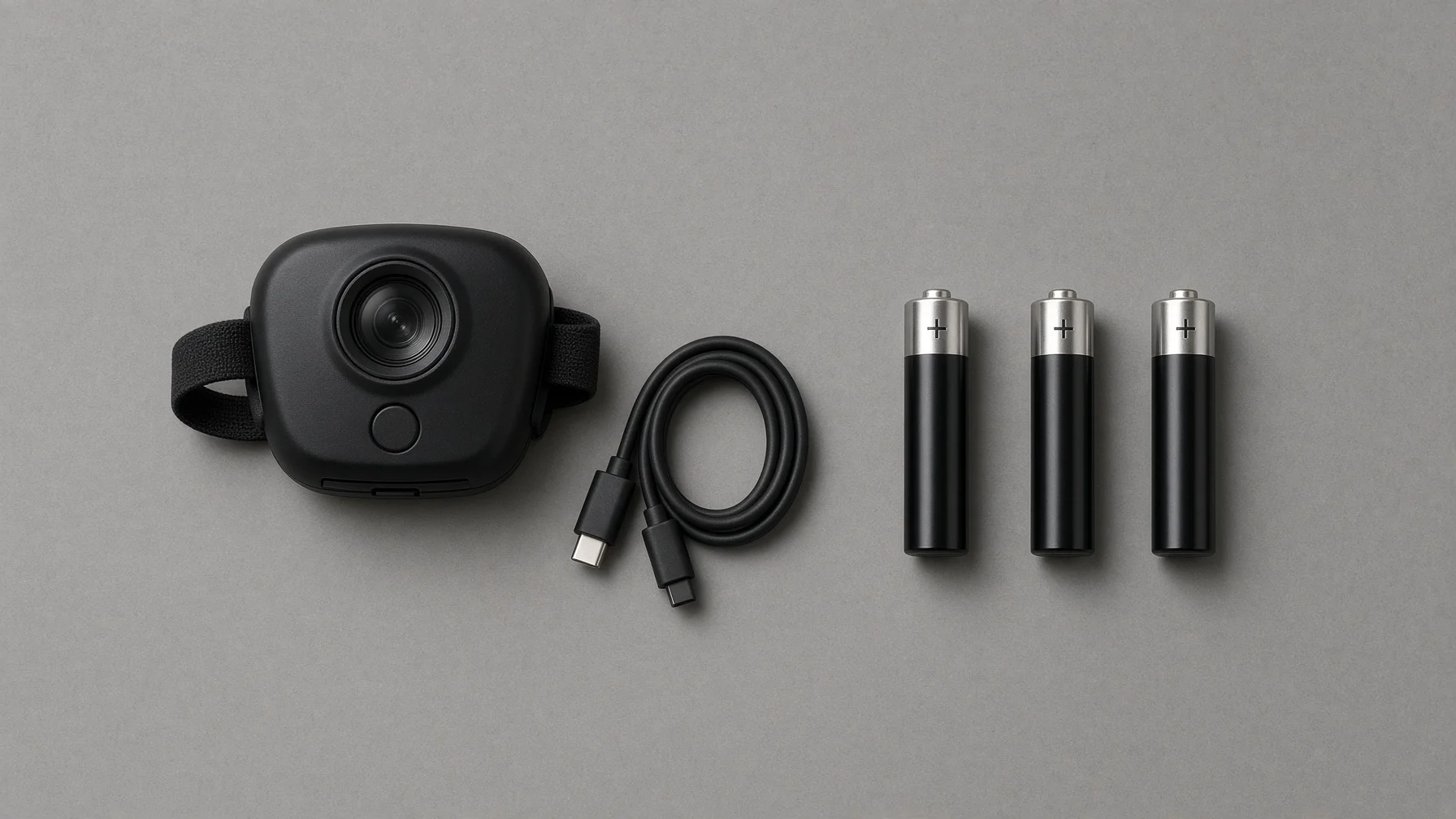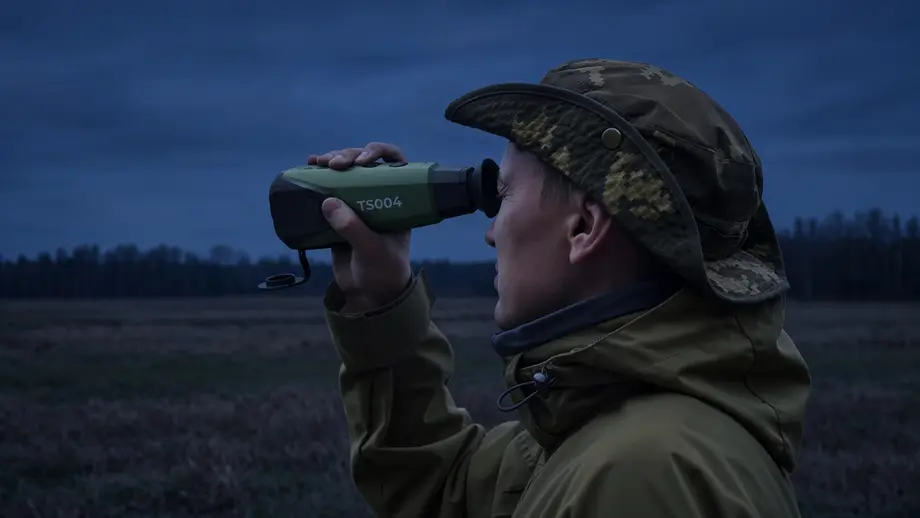
Olight sells some of the gear discussed here. Olight specs and prices come from its product pages and user manuals as of September 2026; other brands' specs come from their makers, and laws come from the state sources linked in each section.
⚡ TL;DR
A thermal monocular under $500 with a 256x192 sensor can show a warm deer several hundred yards away, but it only shows enough detail to recognize one much closer. With the Olight TS004 and its 13 mm lens, a deer fills about 8 pixels at roughly 120 meters. Pick the TS004 to scan fields past 50 yards; pick the wide-angle TC001 Max for close, wide views.
This summary table shows how the TS004, a thermal monocular under $500, compares with Olight's TC001 Max phone thermal camera on the points that decide what you see at night.
| Dimension | TS004 thermal monocular | TC001 Max phone thermal camera | Better for distance | How big the gap is |
|---|---|---|---|---|
| Sensor | 256 x 192, 12 μm pixels | 256 x 192, 12 μm pixels | Tie | None |
| Lens and field of view | 13 mm, 13.5° x 10.10° | 3.2 mm, 56° x 42° | TS004 | About 4x more pixels across the same target |
| Deer recognition range (8 pixels, calculated) | About 123 m | About 30 m | TS004 | About 4x farther |
| Scene width at 100 m | About 24 m | About 96 to 106 m | TC001 Max | About 4x wider view |
| Frame rate | 50Hz | 25 Hz | TS004 | 2x more frames per second |
| Water and cold | IP67 | IP54, works down to 14°F (-10°C) | TS004 | Immersion-rated vs splash-rated |
| Temperature readout | Not listed | -4°F to 1,022°F with ±2°C or ±2% accuracy | TC001 Max | Only the TC001 Max measures temperature |
| Regular price (September 2026) | $499.00 | $309.00 | TC001 Max | $190 less |
The frustrating part of shopping in this price band is that every listing claims a long range. One box says 410 meters, another says 500, and the forum post you just read says the image turns to mush past 75 yards. Both can be true, because "detection" means seeing a few warm pixels, not seeing a coyote. The sections below turn the spec sheet into distances you can plan around. If you are still building the rest of a night kit, Olight groups its throw-focused hunting flashlights in one collection.
📋 Table of Contents
- 1. How Far Can a Thermal Monocular Under $500 See?
- 2. Detection vs Recognition vs Identification: What Is the Difference?
- 3. What Does 256x192 Resolution Deliver at 50, 100, 200 and 400 Meters?
- 4. Resolution, Lens Focal Length and Refresh Rate: What Does Each One Change?
- 5. Thermal Monocular Price vs Specs: Under-$500 Models Compared
- 6. How Do Fog, Rain and Humidity Affect a Thermal Monocular?
- 7. Detection Range Is Not Seeing Range: Five Common Mistakes
- 8. Can You Use a Thermal Monocular for Night Hunting?
- 9. What Is the Best Thermal Monocular for Under $500?
- 10. What Is the Best Cheapest Thermal Monocular?
- 11. Is a Thermal Monocular Worth It?
- 12. FAQ
How Far Can a Thermal Monocular Under $500 See?
A thermal monocular under $500 with a 256x192 sensor typically detects a person-size heat source out to several hundred meters, but it recognizes what that heat source is at a fraction of that range. For the TS004, Olight lists a detection distance of 410m and an identification distance of 91m. The spread between those two numbers is the whole story of this price tier.
Olight's product page says the TS004 offers "detection capabilities of up to 410 meters and providing clear detail visibility within 100 yards." Those numbers line up: 91 meters is about 100 yards. Olight does not state the target size behind them, so treat them as best-case figures on a clear, cold night with a warm target against cool ground.
In practice, three questions decide your useful range:
- How big is the animal? A coyote is smaller than a deer, and a deer is shorter than a standing person, so each has its own range.
- How much warmer is it than the background? A deer against frosty grass stands out more than a deer against sun-warmed rocks at dusk.
- What is between you and it? Fog, rain and brush all cut the range. So does glass: you cannot scan through a truck window.
The next two sections turn the first question into numbers, and the weather section covers the other two.
Detection vs Recognition vs Identification: What Is the Difference?
Detection means you can tell something warm is there. Recognition means you can tell what kind of thing it is, such as a deer rather than a person. Identification means you can tell which specific thing it is, such as a buck rather than a doe. Each step needs more pixels across the target, so each one happens at a shorter distance than the last.
Teledyne FLIR's engineering team defines the three levels the same way in its article on how thermal resolution affects range: detection means "determining that an object is present," recognition means "classifying the object type," and identification means "distinguishing the specific object." The same article warns that pixel thresholds "should be treated as planning approximations rather than fixed rules."
The thresholds trace back to John Johnson's 1958 work for the U.S. Army Engineering Research and Development Laboratories at Fort Belvoir. A 2003 Optical Engineering paper by researchers from RTI and FLIR Systems on resolution requirements for thermal and video imagers lists the generally accepted criteria: 1 cycle across the target for detection, 4 for recognition and 8 for identification. One cycle (a line pair) takes 2 pixels, which gives these working numbers:
| Task | Cycles (line pairs) across the target | Pixels across the target | What it means on a farm at night |
|---|---|---|---|
| Detection | 1.0 | About 2 | "Something warm is out by the fence line" |
| Recognition | 4.0 | About 8 | "That is a coyote, not a calf or a dog" |
| Identification | 8 | About 16 | "That is a buck with antlers" or "that is my neighbor" |
Treat these thresholds as the point where a task becomes possible, not certain. At the calculated recognition distance, you will still guess wrong some of the time. For any decision that matters, such as whether to walk toward an animal, get closer than the calculated number.
What Does 256x192 Resolution Deliver at 50, 100, 200 and 400 Meters?
At 100 meters, a TS004 pixel covers about 9 cm (3.6 in), so a standing person spans about 20 pixels, a deer about 10 and a coyote about 5. That means a person is easy to recognize at 100 meters and just clears the identification line, a deer is right at the edge of recognition, and a coyote is only a detected warm spot. At 400 meters, even a person spans just 5 pixels.
The math behind that is simple enough to run on any spec sheet. Each pixel sees a small angle called the instantaneous field of view (IFOV), which FLIR describes as "the angular portion of the scene represented by a single pixel." You can calculate it yourself: IFOV equals pixel pitch divided by focal length. The TS004 manual lists 12 μm pixels and a 13 mm lens, which gives 0.92 mrad, the same IFOV the manual prints.
To get pixels on target, divide the target's height by the distance times the IFOV. This table does that for three common targets. It uses Olight's published TS004 optics and these target heights: a standing adult at 1.8 m (an assumption), a whitetail at 0.91 m (36 inches) at the shoulder, the average height cited in a Cornell-led technical guide to managing white-tailed deer, and a coyote at 0.5 m (about 20 inches, an assumption for a medium-dog-size animal).
| Distance | Standing person (1.8 m) | Deer (0.91 m at shoulder) | Coyote (0.5 m) | What you can expect with the TS004 |
|---|---|---|---|---|
| 50 m (55 yd) | 39 pixels | 20 pixels | 11 pixels | Recognize all three; identify a person or deer |
| 100 m (109 yd) | 20 pixels | 10 pixels | 5 pixels | Identify a person; recognize a deer; detect a coyote |
| 200 m (219 yd) | 10 pixels | 5 pixels | 3 pixels | Recognize a person; detect a deer or coyote |
| 400 m (437 yd) | 5 pixels | 2.5 pixels | 1.4 pixels | Detect a person or deer; a coyote may not register |
Now flip the math around to find the distance at which each task becomes possible. These are calculated planning ranges for a clear night with good heat contrast, not measured results.
| Target | Detection (2 pixels) | Recognition (8 pixels) | Identification (16 pixels) |
|---|---|---|---|
| Standing person | About 975 m | About 244 m | About 122 m |
| Deer | About 493 m | About 123 m | About 62 m |
| Coyote | About 271 m | About 68 m | About 34 m |
This is why forum posts about budget thermal read so differently. The hunter who says a 256 sensor is "fine inside 100 yards" and the listing that says 410 meters are both describing the same sensor, just different tasks. For the most common farm job, telling a coyote from a neighbor's dog, plan on roughly 70 meters (about 75 yards) with a 13 mm lens.
Tip: Use the TS004's 1x/2x/4x/8x digital zoom to check a warm spot, not to extend your range. Digital zoom enlarges the same pixels. At 8x, the 800x600 display shows only 32 of the sensor's 256 columns, each stretched across about 25 display pixels.
Resolution, Lens Focal Length and Refresh Rate: What Does Each One Change?
Resolution sets how many pixels you get, focal length sets how narrow a slice of the scene each pixel covers, and refresh rate sets how smoothly moving animals appear. At a fixed resolution, a longer lens adds range but narrows the view. Refresh rate does not add range, but it keeps a running coyote from jumping across the screen.
Resolution. A 256x192 sensor has 49,152 pixels, 2.56 times as many as a 160x120 sensor (19,200 pixels). The next common step up, 384x288, has 110,592 pixels, 2.25 times more than 256x192. All three options compared below use 256x192.
Focal length. The same 256x192 sensor behaves very differently behind different lenses. The TC001 Max uses a 3.2 mm lens, so each pixel covers about 3.75 mrad, four times wider than the TS004's 0.92 mrad. A deer at 100 meters spans about 2.4 pixels on the TC001 Max and about 10 on the TS004. The TC001 Max, in turn, sees a scene about four times wider.
Refresh rate. Frame rate is how often the image updates. At 50Hz, a new frame arrives every 20 milliseconds; at 25 Hz, every 40; at 9 Hz, every 111. The 9 Hz figure matters because U.S. export rules treat thermal cameras with "a maximum frame rate equal to or less than 9 Hz" as a separate category, as the federal export regulation at 15 CFR 744.9 shows. Check the frame rate on any listing before you buy.
Here is what that looks like with a moving animal. Assume a coyote trotting at 10 mph (about 4.5 meters per second, an assumption for a steady trot). At 100 meters through a 13 mm lens, it moves about 1 pixel between frames at 50Hz, about 2 pixels at 25 Hz and about 5 pixels at 9 Hz. At 9 Hz, a trotting animal appears to hop across the screen instead of gliding.
This table sums up which spec to weigh for each job.
| Spec | What it changes | What to look for under $500 | When it matters most |
|---|---|---|---|
| Sensor resolution | Total pixels, and so detail at any range | 256x192 or better | Every job |
| Focal length | Pixels on target and width of view | 9 to 13 mm for fields; 3 to 7 mm for close, wide views | Scanning past 100 yards |
| IFOV | Ground each pixel covers | About 1.3 mrad or finer for field work | Telling a coyote from a dog |
| Frame rate | Smoothness of moving targets | 25 Hz or 50 Hz; avoid 9 Hz for moving animals | Watching animals move |
| NETD | Sensitivity to small heat differences | Lower is better; the models below list 40 mK or less | Humid nights, low contrast |
| Battery | Time in the field | 7 hours or more | All-night livestock checks |
| Water rating | Survives rain and dunkings | IP67 | Wet grass, creek crossings |
Thermal Monocular Price vs Specs: Under-$500 Models Compared
Under $500, the main trade-off is lens width against reach. The TS004's 13 mm lens gives the most pixels on a distant target among the options below, and its 50Hz rate and IP67 body suit field use. The RIX Pocket K2 matches the TS004's $499 price with a wider 9 mm lens, a lighter body and a longer warranty, while Olight's TC001 Max trades reach for a wide view.
This table sets their published specs side by side, with each maker's own site as the source and prices checked in September 2026.
| Spec | Olight TS004 | RIX Pocket K2 | Olight TC001 Max |
|---|---|---|---|
| Type | Handheld monocular | Handheld monocular | Phone-attached thermal camera |
| Sensor | 256 x 192, 12 μm | 256 x 192, 12 μm | 256 x 192, 12 μm |
| Lens | 13 mm | 9 mm | 3.2 mm |
| Field of view | 13.5° x 10.10° | 19.4° horizontal | 56° x 42° |
| IFOV (pitch ÷ focal length) | 0.92 mrad | 1.33 mrad | 3.75 mrad |
| Deer recognition, calculated | About 123 m | About 85 m | About 30 m |
| Frame rate | 50Hz | 50 Hz | 25 Hz |
| Maker's detection claim | 410m | About 512 yd | Not listed |
| Battery | 5000mAh, up to 11 hours | Replaceable 18650, up to 7 hours | Powered by the phone |
| Water rating | IP67 | IP67 | IP54 |
| Weight | 330g (0.728lbs) | 0.44 lb | 30g (0.06lbs) |
| Price, September 2026 | $499.00 (regular price) | $499.00 (RIX site) | $309.00 (regular price) |
RIX's specs come from its Pocket K2 product page, which also lists a 12μm sensor with NETD under 25mK, a 0.32-inch 800x600 OLED display, electronic image stabilization and a 3-year warranty. It claims a longer detection distance than the TS004 even though its wider lens puts fewer pixels on a distant target. That gap is a reminder that detection claims are not calculated to one shared standard, so compare IFOV instead.
The TS004 is the one to pick if you scan open ground. Its 13 mm lens is the longest here, which puts about 44 percent more pixels on a target than the Pocket K2's 9 mm lens. The trade-off is a narrow view: at 100 meters you see a strip about 24 meters wide, so sweeping a large field takes many overlapping looks. The TS004 thermal imaging monocular also records video with audio through the TopInfrared app, stores files on 32GB of memory and has a built-in LED flashlight.
Know its limits before you buy. The TS004 manual says the infrared camera "comes with a fixed focus," so you adjust only the diopter for your eye, not the lens for distance. It has no visible-light camera, and the manual's warranty is TOPDON's one-year limited warranty, shorter than the 3 years RIX lists for the Pocket K2. The TOPDON name appears because the TS004 comes through Olight's OSelect gear line, which also carries products from partner brands such as TOPDON.
How Do Fog, Rain and Humidity Affect a Thermal Monocular?
Fog, rain and wet air shorten a thermal monocular's range because water droplets scatter the heat signal before it reaches the lens. The calculated ranges above assume a clear night. In light fog you often still see farther than your eyes can, but in steady rain or dense fog, plan to work at half the distance or less and lean on closer checks.
Teledyne FLIR's guide to what thermal imaging can and cannot see through puts it plainly: "Fog and rain have the potential to severely limit the range of a thermal camera due to the scattering of radiation off water droplets." It adds that "in many circumstances, thermal cameras can penetrate fog much more successfully than visible light cameras or the human eye."
Olight's product page says the TS004 "effectively penetrates fog and dense vegetation." Read that as a better view than your eyes get in light fog, and as seeing heat through gaps in cover. It does not mean the camera sees through a solid screen of leaves. FLIR states that "thermal imaging cannot see through trees (or wood)," and a wall of wet brush shows up at its own temperature.
This field guide turns those limits into planning adjustments. The ranges are rules of thumb built on the calculations above, not measurements.
| Condition | What happens to the image | Planning adjustment |
|---|---|---|
| Clear, cold, calm night | Strongest contrast between animals and ground | Use the calculated ranges |
| Dusk after a sunny day | Rocks, dirt and tin roofs still glow | Wait an hour after sunset, or confirm with a white light |
| Light fog or high humidity | Image softens, contrast drops | Cut expected recognition range by about half |
| Steady rain | Range drops and the lens beads with water | Work close, wipe the lens, favor IP67 gear |
| Brush and tall grass | Heat shows only through gaps | Walk closer or scan from high ground |
| Behind glass | You see your own reflection | Step out of the truck; FLIR notes "glass acts like a mirror for infrared radiation" |
Warning: The TS004 manual says: "Do not point the thermal monocular at the sun or other strong energy sources for a long period of time. Otherwise there might be damage to the detector in the monocular." Keep the lens off the sunset while you wait for dark.
Detection Range Is Not Seeing Range: Five Common Mistakes
The most common mistake with a budget thermal is reading the detection number as the distance at which you will see an animal clearly. Detection means a couple of warm pixels. For a TS004, the gap between a 410m detection claim and a coyote you can actually recognize at about 68 meters is roughly six times.
Here are five mistakes, and what to do instead:
- Buying on the detection claim. Makers do not publish the target size or contrast behind that number. Fix: calculate IFOV (pixel pitch divided by focal length) and compare that across models.
- Using digital zoom as if it were a longer lens. Zoom enlarges pixels but adds no detail. Fix: find the heat at 1x, then use 2x or 4x only to look at shape and movement.
- Trusting the image at dusk. Sun-warmed ground and rocks can look like bedded animals. Fix: wait for the ground to cool, or confirm with a white light before you act.
- Assuming a blank screen means nothing is there. Brush and terrain hide heat. Fix: scan from high ground and walk the cover in close lanes.
- Switching color palettes mid-scan. The TS004 manual lists Bird, White Hot, Black Hot, Red Hot and Fusion palettes, and a log looks different in each. Fix: pick White Hot or Black Hot and keep it all night.
Note: Match your white light to the job. A thermal monocular finds the heat; a light confirms what it is. If you are pricing that part of the kit, our hunting light price guide breaks down what each budget tier buys after dark.
Can You Use a Thermal Monocular for Night Hunting?
It depends on your state, your target species and whether you are holding a weapon. Some states allow thermal during set night seasons for coyotes and foxes, some allow it only for landowners controlling nuisance animals, and some ban it while you carry a firearm or bow. Using a thermal monocular to watch wildlife without a weapon is treated differently than using one to hunt.
These examples show the range of state rules. They are not a template for your state, and rules change every season, so read your current regulations before you go out.
| State | What the rule says | Source |
|---|---|---|
| North Dakota | Red fox, gray fox and coyote may be hunted at any hour from Nov. 23 through May 31, 2027, on foot after dark, and hunters can use "night vision, artificial light, thermal vision, and infrared light equipment" | North Dakota Game and Fish 2026 season outlook |
| Oklahoma | Landowners, lessees and designated agents may use a thermal imaging device while controlling nuisance coyotes and feral swine at night; thermal devices are banned on ODWC-owned or managed lands | Oklahoma general hunting regulations |
| Minnesota | A person "may not possess night vision or thermal imaging equipment while taking wild animals" or while possessing a firearm, bow or other implement, with listed exceptions | Minnesota Statutes 97B.086 |
| Washington | Hunting big game with night vision equipment, defined to include thermal imaging devices, while holding a firearm, bow or crossbow is spotlighting big game | RCW 77.15.450 |
| Oregon | Illegal to use a thermal device to hunt, locate or scout for hunting, or to recover or track wildlife | ODFW guidance on tech during hunting seasons |
Oregon's wording shows why recovery needs its own check. ODFW says using thermal "when recovering harvested wildlife or tracking an injured animal" is illegal "as tracking and recovery are considered hunting." If recovery is your main use, read our guide on the thermal monocular for deer recovery before the season opens. For lights as well as thermal, our state-by-state look at hunting with a light laws covers spotlighting rules.
Safety note: Oklahoma's rule says its night provisions "do not authorize the use of headlights, thermal devices, night vision equipment, or spotlights from a public roadway." Never scan fields from a road, and always confirm what is behind your target with a white light before any shot.
What Is the Best Thermal Monocular for Under $500?
For scanning open ground, the best thermal monocular under $500 is one with a 256x192 sensor behind the longest lens you can find, a 50Hz frame rate and an IP67 body. The Olight TS004 fits that profile with a 13 mm lens, 0.92 mrad IFOV, 50Hz, IP67 and up to 11 hours of battery at $499.00 (regular price, September 2026).
The lens is what separates it from other 256x192 options. With 13 mm, a deer stays recognizable to about 123 meters by the Johnson math, compared with about 85 meters for a 9 mm lens such as the Pocket K2's. Olight's spec sheet adds a drop rating of 2.0m, a 0.32 inch 800x600 OLED display and an AI algorithm that "can identify people and vehicles."
This table matches common users to the better choice between the two Olight options.
| Who you are | Better choice | Why |
|---|---|---|
| Farmer checking a pasture fence line for coyotes | TS004 | 13 mm lens recognizes a coyote about four times farther than the TC001 Max |
| Hunter scanning cut fields where night hunting is legal | TS004 | 50Hz keeps moving animals smooth; IP67 handles wet grass |
| Wildlife watcher on a woodlot edge, under 30 yards | TC001 Max | 56° view keeps a close animal in frame; costs $190 less |
| Homeowner who also checks drafts, breakers and pipes | TC001 Max | Measures temperature from -4°F to 1,022°F; the TS004 does not |
| Anyone out in freezing, wet weather for hours | TS004 | IP67 and a built-in battery vs IP54 and a 14°F low limit |
| Buyer who wants to identify animals past 100 yards | Neither | A 256x192 sensor runs out of pixels; plan a larger budget |
What Is the Best Cheapest Thermal Monocular?
The best cheapest thermal option is the one that still puts enough pixels on the animals you care about at the distance you actually work. For close-range use, under about 30 meters, a phone-attached 256x192 camera such as the Olight TC001 Max at $309.00 (regular price, September 2026) does the job for much less than a monocular.
A value check helps here. Divide the price by the calculated deer recognition range to get the cost of each meter of useful range. The TS004 works out to about $4.06 per meter ($499.00 ÷ 123 m). The TC001 Max works out to about $10.30 per meter ($309.00 ÷ 30 m). The RIX Pocket K2 lands near $5.87 per meter ($499.00 ÷ 85 m).
So the cheapest device is not the cheapest per meter. If your fence line is 100 meters away, the TS004 gives more useful range for each dollar. If you mostly look across a backyard or a barn, the TC001 Max thermal imager is the better buy, with a 56° x 42° view that keeps a close animal in frame.
Be honest about the TC001 Max's limits outdoors. It depends on your phone, its IP54 rating covers splashes rather than immersion, and Olight lists its working temperature range as 14°F to 122°F, which rules out many winter nights. It is not a good choice for coyote calling in January.
Is a Thermal Monocular Worth It?
A thermal monocular is worth it if you regularly need to find warm animals in the dark across open ground: checking livestock, watching for predators, or scanning fields where night hunting is legal. It is not worth it if you mainly need to see blood, read tracks or identify animals past about 100 yards, because a 256x192 sensor cannot do those jobs.
Use this five-question check before you spend $300 to $500:
- Do you go out after dark at least a few times a month? If not, a good flashlight covers most jobs.
- Are your targets usually 30 to 150 meters away? That is the sweet spot for a 13 mm lens on 256x192.
- Is it legal to carry thermal for what you do? Check your state's rules, especially if you carry a firearm or bow.
- Do you need to see color or fine detail? Thermal shows heat, not blood color or tracks, so you still need a white light.
- Can you live with a narrow view? The TS004 sees a strip about 24 meters wide at 100 meters, so scanning takes time.
If you answered yes to the first three and understand the last two, a 256x192 monocular will change how you check a property at night. Before you buy a thermal monocular under $500, run this action list:
- Write down the distance to the far edge of the ground you check most.
- Calculate IFOV for each model (pixel pitch ÷ focal length) and your recognition range for the animal you care about.
- Confirm your state's current rules on thermal, lights and weapons.
- Choose 50 Hz or 25 Hz over 9 Hz if you watch moving animals.
- Pack a white light to confirm every heat signature before you act.
FAQ
Changelog
- September 22, 2026: First published. Olight specs and prices reflect Olight's product pages and manuals as of September 2026; RIX specs and price reflect RIX's product page as of September 2026.