Olight makes some of the lights discussed here. Olight specs and prices come from its product pages and user manuals as of September 2026; battery storage figures come from Energizer and Duracell technical documents, and safety guidance comes from the federal and fire-safety sources linked in each section. The outage math is our own arithmetic.
⚡ TL;DR
Good hurricane supplies storage keeps your lights working through the months they sit unused. On the Gulf Coast, store batteries outside your flashlights, keep the kit in an airtight bin in an interior closet rather than a hot garage or attic, and check it four times a year. Plan one personal light per person plus one long-running room light.
This table is the short version of the hurricane supplies storage plan: what each light in a hurricane kit does, the minimum spec to look for, and one Olight model that meets it.
| Job in the kit | Recommended type | Minimum spec to look for | Olight pick (September 2026) |
|---|---|---|---|
| Personal light for each household member | Rechargeable pocket flashlight | 50+ lumens for 8 hours; IPX8; a lockout so it can't switch on in the bin | Baton 4 (60 lumens for 8 hours, IPX8, button lock) |
| Room light for the whole household | High-capacity flashlight with a floodlight mode | 50 lumens for 80+ hours on one charge | Marauder Mini 2 (50 lumens floodlight for 83 hours) |
| Hands-free light for cooking, cleanup, and repairs | Clip light with magnets and a tilting head | Low mode that runs a full night; tilts and clips | Oclip 2 Pro (10 lumens for 25 hours, 115° head tilt) |
| Backup light that shares your spare cells | Single-AAA keychain light | Runs on a battery you already stock; IPX8 | i3E EOS (one AAA, 90 lumens for 45 minutes on alkaline, IPX8) |
| Spare cells for AA and AAA devices | Lithium primaries or low-self-discharge NiMH | Long shelf life, stored outside devices | Ostation Series AA/AAA Batteries Pack (over 70% charge retention after 12 months, per Olight) |
Most people on the coast know this story. You bought a flashlight and a pack of batteries after the last storm, put them in a tote in the garage, and forgot them. Two summers later the power goes out, and the light won't turn on. The batteries have leaked, the contacts are crusted, or the rechargeable is flat. The fix is less about which light you buy and more about how and where you store it.
📋 Table of Contents
- 1. Hurricane Supplies Storage: The Short Answer
- 2. When Is Hurricane Season on the Gulf Coast?
- 3. How Do Humidity and Salt Air Damage Stored Lights?
- 4. How Should You Store Hurricane Supplies in a Humid Climate?
- 5. Why Shouldn't You Store Batteries Inside Your Flashlights?
- 6. Which Batteries Hold Up Best in Storage: Alkaline, Lithium or NiMH?
- 7. Where to Store Disaster Kits?
- 8. How Much Light Do You Need for a 3-, 7- or 14-Day Outage?
- 9. Which Olight Lights Fit a Coastal Emergency Kit?
- 10. Are Candles or an Indoor Generator Safe During a Hurricane Outage?
- 11. When Should You Check Your Emergency Kit?
- 12. How to Do a Pre-Season Kit Recheck, Step by Step
- 13. What Are the Best Snacks to Stockpile for a Hurricane?
- 14. What to Stockpile in Case of WW3?
- 15. A Check Card to Tape on Your Storage Bin
- 16. FAQ
Hurricane Supplies Storage: The Short Answer
The enemy of hurricane supplies is the storage period, not the storm. Lights spend months in a hot, humid space and fail from leaking batteries, corroded contacts, and slow self-discharge. Store batteries outside devices, seal everything in an airtight bin with desiccant, keep the bin in a cool interior room, and check it on a fixed schedule.
Ready.gov's guide to building a disaster supplies kit gives the basic packing rule: "store items in airtight plastic bags and put your entire disaster supplies kit in one or two easy-to-carry containers such as plastic bins or a duffel bag." Its checklist lists a flashlight and extra batteries next to water, food, and a weather radio. Its power outage page goes further: "Have flashlights for every household member."
Small rechargeable EDC flashlights make good personal lights for that list, but only if they come out of storage charged and dry. This guide adds the part most checklists skip: how to keep those lights ready through a Gulf Coast summer. The hurricane supplies storage plan has four parts:
- Store batteries outside devices, and lock out rechargeable lights.
- Seal the kit against moisture and keep it off the floor.
- Choose a storage spot by temperature, flood risk, and access, in that order.
- Tie your checks to dates you already track, so they actually happen.
When Is Hurricane Season on the Gulf Coast?
The Atlantic hurricane season, which includes the Gulf, runs from June 1 to November 30, according to the National Hurricane Center. The season peaks on September 10, with most activity between mid-August and mid-October. Your kit therefore sits unused for about six months a year, and it rides out the hottest, most humid months before the peak arrives.
The NHC's tropical cyclone climatology page states that "The Atlantic hurricane season runs from June 1 to November 30" and that the Atlantic basin includes the Atlantic Ocean, the Caribbean Sea, and the Gulf. It adds that "The peak of the Atlantic hurricane season is September 10, with most activity occurring between mid-August and mid-October." Based on 1991 to 2020 data, an average season has 14 named storms, 7 hurricanes, and 3 major hurricanes.
The timing matters for storage. A kit packed in early June has already sat through three months of summer heat by the September peak. A kit packed after last year's storm has sat for a full year. That is why this plan puts a check right before the peak, not only at the start of the season.
Ready.gov's hurricane preparedness page also warns that "Hurricanes are not just a coastal problem," because rain, wind, and flooding can reach far inland. If you live an hour or two from the water, the same storage rules apply to you.
How Do Humidity and Salt Air Damage Stored Lights?
Humidity damages stored lights in two ways. Moisture condenses on metal parts, which corrodes battery contacts, springs, and switch parts. Heat and temperature swings stress the batteries themselves, which speeds self-discharge and raises the risk of leakage. Salt air near the coast adds to the first problem. Both paths work slowly, so you rarely see the damage until you need the light.
The first path is moisture on metal. The EPA's guide to mold, moisture, and your home advises you to "keep indoor humidity below 60 percent (ideally between 30 and 50 percent) relative humidity." It also points out that rust on a pipe "is an indicator that condensation occurs." The same thing happens inside a damp tote. Warm, wet air meets a cooler metal surface, water condenses, and contacts start to corrode.
The second path is the battery. Energizer's alkaline handbook and application manual says that "extreme temperature cycling can cause a failure of the battery seal integrity thereby increasing the potential for leakage." A garage that swings from a cool night to a hot afternoon puts batteries through that cycle every day. The same manual warns: "Don't put batteries or battery-powered devices in hot places – elevated temperatures increase the self-discharge of batteries."
Here is how each failure shows up when you open the kit:
- Crusty white or blue-green deposits on contacts: a leaked alkaline cell. Clean the contacts and replace the batteries.
- Light flickers or needs a tap to turn on: corroded contacts or springs. Clean them and dry the light fully before reloading.
- Rechargeable light is completely dead: the cell drained in storage. Charge it and check that it holds a charge over the next few days.
- Musty smell or spots on packaging: the bin is too humid. Replace the desiccant and move the bin to a drier room.
How Should You Store Hurricane Supplies in a Humid Climate?
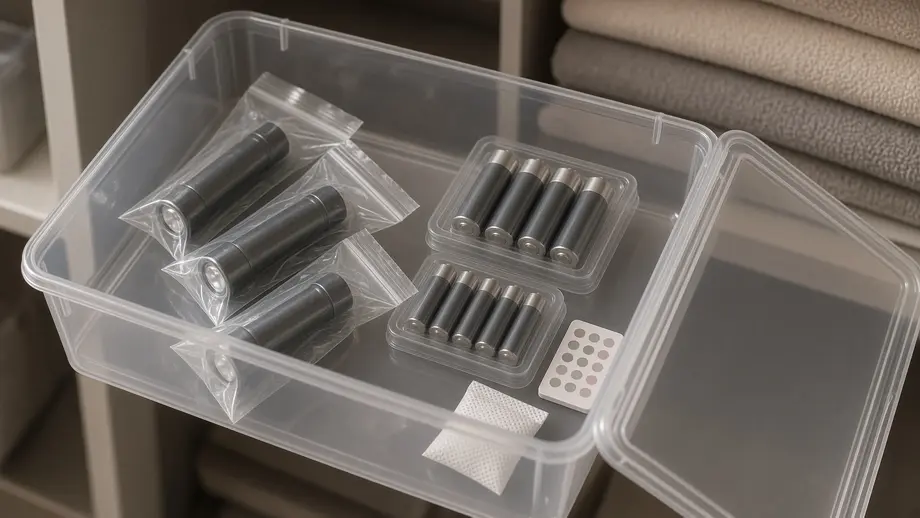
Store hurricane supplies in a sealed plastic bin with fresh desiccant, with smaller items in zip-top bags inside it. Keep the bin off the floor in an interior, air-conditioned room. Batteries stay in their original packaging, outside every device. Add a cheap hygrometer card so you can see whether humidity inside the bin stays below the 60 percent the EPA recommends for indoor air.
Duracell's battery care, use, and disposal guide says to "Store batteries, in their original packaging, in a dry place and at normal room temperature until ready to use." The original packaging keeps loose cells from touching each other or metal objects, which Duracell warns can short them so they "may leak, overheat or rupture."
This packing order works for a standard 50- to 70-quart bin:
- Put a desiccant pack and a humidity indicator card at the bottom of the bin.
- Bag each flashlight on its own in a zip-top bag, with its batteries removed.
- Bag the spare batteries in their retail packaging, grouped by size.
- Put chargers, cables, and the manuals in a separate bag.
- Put food, water, and first aid in a second bin, so opening the light bin doesn't let humid air into everything.
- Tape the check card from the end of this guide to the lid.
Tip: Recharge or replace desiccant each time you open the bin. Many silica gel packs change color when saturated. If yours don't, write the date on each pack and swap them at every quarterly check.
Where the bin sits matters as much as what is in it. Put it on a shelf, not the floor, so a small leak or a wet mop doesn't reach it. Keep it away from exterior walls, where condensation is more likely. A closet shelf in an interior hallway checks every box.
Why Shouldn't You Store Batteries Inside Your Flashlights?
You shouldn't store batteries inside flashlights because devices can draw a small current even when switched off, and a drained cell is more likely to leak. Duracell tells users not to leave batteries in a device that won't be used for several months. Energizer says to remove batteries from devices stored for extended periods and to inspect battery compartments every few months for leaks.
Duracell's wording is direct: "DON'T – Leave batteries in your device if you suspect it will not be used for several months. Many devices don't power off completely when switched off and, after time, may cause the batteries inside to leak." Energizer's handbook adds: "Do store batteries in a cool, dry place at normal room temperature. Remove batteries from devices that will be stored for extended periods." Olight's i3E EOS user manual gives the same advice for its AAA keychain light: "take out the battery if you are storing the flashlight for a long period of time to prevent the battery from leaking."
A leaked alkaline cell can ruin a cheap flashlight. The corrosion eats the spring and the contact plate, and cleaning doesn't always bring it back. If you do find a leak, Duracell's battery FAQ recommends working in a well-ventilated area and wearing "household gloves and glasses." Remove the residue from the contacts with a toothbrush or cotton swab. Make sure the device is completely dry before you insert a new battery.
Rechargeable lights with built-in or custom cells are different. You usually can't remove the battery, and you don't need to. Instead, lock the switch so the light can't turn on in the bin and drain itself. The Olight user manual for the Baton 4 explains the lockout: with the light off, "press and hold the button (for about 2 seconds) until the Moonlight mode turns on and off." A single press then shows the battery level without turning the light on. That makes the quarterly check a two-second job.
Warning: Never mix old and new batteries, or different brands and chemistries, in one device. Energizer warns this "can cause rupture or leakage, resulting in personal injury or property damage." Replace every cell in a device at the same time.
Which Batteries Hold Up Best in Storage: Alkaline, Lithium or NiMH?
Lithium primary AA and AAA cells hold up best in long storage. Energizer rates its lithium AA at a 25-year shelf life at 21°C and storage up to 60°C, against a 10-year shelf life for its alkaline AA. Alkaline cells lose about 3 percent of their capacity per year at 20°C, and more in heat. Low-self-discharge NiMH cells work if you recharge them on a schedule.
This table compares the three AA and AAA chemistries you are most likely to stock, using Energizer's datasheets and handbooks and Olight's figures for its NiMH pack.
| Chemistry | Shelf life (maker's figure) | Recommended storage temperature | Leak and heat notes | Best use in a hurricane kit |
|---|---|---|---|---|
| Alkaline (Energizer E91 AA) | 10 years at 21°C | -40°C to 50°C (alkaline handbook) | Loses about 3% capacity per year at 20°C; heat cycling can break the seal | Everyday spares you rotate each year |
| Lithium iron disulfide (Energizer L91 AA) | 25 years at 21°C | -40°C to 60°C | Energizer rates leakage resistance "Superior"; about 95% capacity after 20+ years | Long-term spares that sit untouched |
| NiMH rechargeable (Olight Ostation pack) | Over 70% charge retention after 12 months (Olight) | Room temperature, per Duracell and Energizer general guidance | Needs a charger and power to refill | Devices you use often and recharge between storms |
| Built-in Li-ion (rechargeable flashlights) | Depends on the light; top up at each check | Olight lists 0 to 40°C working temperature for the Baton 4 | Lock the switch to stop drain in storage | Personal and room lights |
Energizer's L91 lithium AA datasheet lists a storage temperature of "-40°C to 60°C (-40°F to 140°F)" and a shelf life of "25 years at 21°C." Its E91 alkaline AA datasheet lists "10 years at 21°C." Energizer's lithium handbook says the lithium cell "will retain approximately 95% of its capacity after 20+ years of storage." It also warns that temperatures above 60°C can make the label shrink and expose the steel can to short circuits.
Here is what those percentages mean for cells you already own. An alkaline AA bought three years ago and kept near 20°C holds roughly 91 percent of its capacity (100 minus 3 × 3). The same cell in a hot garage will do worse, because Energizer says warm temperatures speed the chemical reactions that drain it. A 2,100 mAh Ostation NiMH AA that keeps over 70 percent after 12 months still holds at least 1,470 mAh (2,100 × 0.70). That is plenty, but only if you recharge it at each quarterly check.
Energizer's handbook also gives a simple health test. Under a load of about 10 ohms, a fresh alkaline cell "will typically test at about 1.5 volts," and one that tests at 1.1 volts "has approximately 20% service remaining." A basic battery tester does the same job at the quarterly check.
Where to Store Disaster Kits?
Store your disaster kit in a designated place that every household member knows, on a shelf in a cool interior room. Ready.gov says to keep the home kit ready "in case you have to leave your home quickly" and to prepare supplies for home, work, and cars. On the Gulf Coast, an interior closet usually beats a garage or attic, because it stays cooler, drier, and reachable.
Ready.gov's kit page is specific about location: "Keep this kit in a designated place and have it ready in case you have to leave your home quickly. Make sure all family members know where the kit is kept." For work, it says to "Be prepared to shelter at work for at least 24 hours." For the car, "keep a kit of emergency supplies in your car."
This table compares the three places people most often store hurricane supplies. It uses the maker storage limits above and federal guidance, not a timed trial, so treat it as a decision guide.
| Location | Heat | Humidity | Flood risk | Access during a storm | Verdict for lights and batteries |
|---|---|---|---|---|---|
| Attached garage | Often well above room temperature in summer | High, and swings with the weather | Lowest level of many homes | Easy to reach, but it is also where a generator or car exhaust can build up | Avoid for batteries and lights; fine for tools and plastic sheeting |
| Attic | Usually the hottest space in the house in summer | Varies; condensation risk as it cools | Low | Poor; Ready.gov says not to climb into a closed attic during flooding | Avoid; heat speeds self-discharge and access is unsafe |
| Interior closet or hall shelf | Close to your air-conditioned room temperature | Close to indoor levels, which the EPA suggests keeping below 60% | Moderate; use a high shelf | Best; often next to the interior room where you shelter | Best choice for the light and battery bin |
| Car trunk | Can get very hot in summer sun | Varies | Car may be moved or flooded | Useful during evacuation | Keep a small secondary kit; rotate batteries often |
Two federal warnings shape this table. Ready.gov's hurricane page advises you to "Take refuge in a designated storm shelter or an interior room for high winds." It also says: "Do not climb into a closed attic. You may become trapped by rising flood water." A kit in the attic is a kit you can't safely reach. A kit in the room where you shelter is already in your hands.
The garage has one more problem. CDC guidance on carbon monoxide poisoning says: "Never use a generator inside your home or garage, even if doors and windows are open." If your plan is to run to the garage for flashlights during an outage, you may be walking toward a hazard that is easy to miss.
Keep a second, smaller kit by the door you would evacuate through, with one flashlight per person and a spare set of cells. Ready.gov's hurricane page says you may have to evacuate quickly if you live in an evacuation zone.
How Much Light Do You Need for a 3-, 7- or 14-Day Outage?
Plan about 4 hours of personal light per person per night, plus about 5 hours of room light for the household. A 7-day outage then needs 28 hours of personal light per person and 35 hours of room light. One Baton 4 charge covers two nights at 60 lumens. One Marauder Mini 2 charge covers about 16 nights of room light at 50 lumens.
These are planning assumptions, not a rule. They assume the household is awake for about 5 hours after dark and that each person needs a personal light for about 4 of those hours. Adjust them for your home and the season. The runtimes come from Olight's published specs, and Olight's Baton 4 manual notes its figures follow the ANSI/PLATO FL 1-2019 standard.
This table turns those assumptions into charges needed for three outage lengths.
| Outage length | Personal light hours per person | Baton 4 charges at Medium (60 lumens, 8 hours) | Room light hours for the household | Share of one Marauder Mini 2 charge at 50-lumen floodlight (83 hours) | Oclip 2 Pro charges at Low (10 lumens, 25 hours) |
|---|---|---|---|---|---|
| 3 days | 12 | 1.5 | 15 | 18% | 0.5 |
| 7 days | 28 | 3.5 | 35 | 42% | 1.1 |
| 14 days | 56 | 7 | 70 | 84% | 2.2 |
Here is how to read it for a family of four facing a 7-day outage. Each person's personal light needs 3.5 Baton 4 charges, so the household needs 14 charges in total, or a way to recharge. One Marauder Mini 2 on its 50-lumen floodlight covers the room light for the week and still has more than half its charge left. Without a recharge source, a single-charge personal light won't last the week.
That makes a recharge source part of the lighting plan. The Baton 4 Premium Edition comes with a charging case that Olight says "can fully charge the Baton 4 flashlight 5 times." With the charge in the light, that is 6 full charges, or 48 hours at Medium. That covers 12 nights at 4 hours each, or 6 nights for two people sharing one case. Dropping to the 12-lumen Low mode, rated 35 hours per charge, stretches one charge to almost 9 nights.
Brightness is the other lever. Running every light on its brightest setting cuts runtime hard. The Baton 4's 1,300-lumen Turbo is rated "1.5 + 2.5 + 73 minutes" as it steps down. Its 60-lumen Medium runs 8 hours. For walking a dark hallway or reading, 60 lumens is plenty. Save high output for checking the yard or the roofline.
This table matches common outage tasks to a brightness level, runtime target, and water rating. Use it to pick the mode before you turn the light on.
| Outage task | Brightness to use | Runtime target | Water rating to look for |
|---|---|---|---|
| Night trip to the bathroom or a child's room | 1 to 5 lumens, or red light | All night | Any |
| Reading, eating, board games | 50 to 150 lumens, pointed at the ceiling or a wall | 4 to 5 hours per night | Any |
| Cooking on an outdoor grill or camp stove | 100 lumens, hands-free | 1 hour | IP66 or better for rain |
| Checking the yard, roof, or storm damage after the storm | 600 lumens or more | Short bursts | IPX8 for rain and puddles |
| Signaling or marking your location | Strobe or red light | As needed | IPX8 |
Tip: Bounce a floodlight off a white ceiling to light a whole room. A 50-lumen beam aimed straight up spreads more evenly than a 500-lumen beam aimed across the room, and it runs many times longer.
Which Olight Lights Fit a Coastal Emergency Kit?
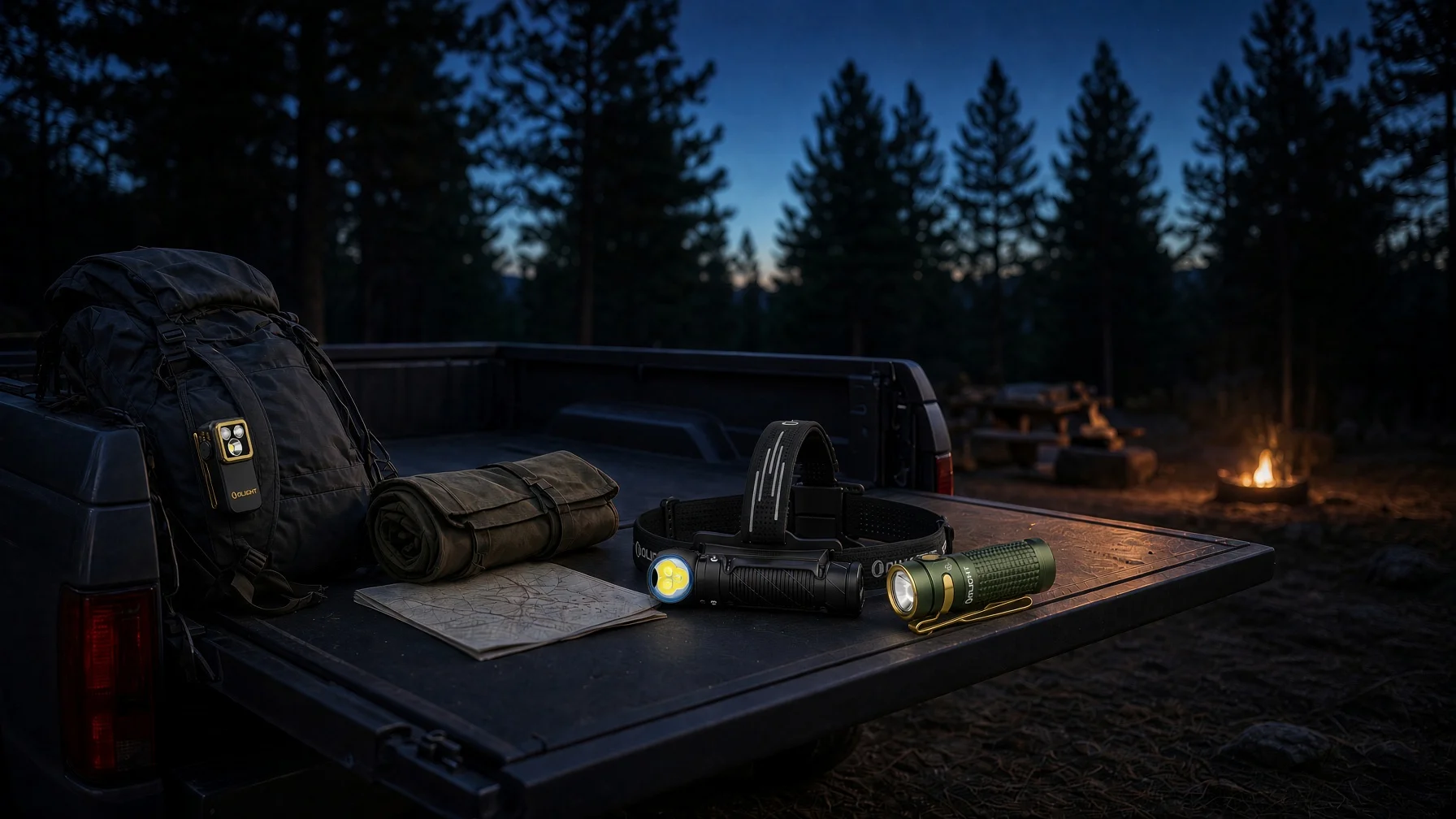
The best Olight lights for a coastal emergency kit combine a lockout or long standby, a sealed body, and modes that run for days. The Baton 4 covers personal light, the Marauder Mini 2 covers room light, the Oclip 2 Pro covers hands-free tasks, and the i3E EOS runs on a AAA you already stock. Each has limits worth knowing before you buy.
These four fit the jobs in the tables above, and each one solves a different storage problem.
Baton 4 for each person's light. In a hurricane kit, the risk is a personal light that drained itself or got wet. The Olight Baton 4 EDC flashlight is rated IPX8. Its manual describes a button lock that shows the battery level with one press. Olight lists Medium at 60 lumens for 8 hours, Low at 12 lumens for 35 hours, and Moon at 0.5 lumens for 30 days. The Premium Edition's case holds a 5000mAh battery and "can also charge your mobile devices for emergencies with its USB-C port." The limits: the Standard Edition charges only through its MCC magnetic cable, and the user manual lists a working temperature of 0 to 40°C. It lists at $54.99 (regular price, September 2026, OD Green option). Some colors were sold out on September 24, 2026.
Marauder Mini 2 for the room light. One light has to carry the household for many nights. The Olight Marauder Mini 2 compact flashlight runs a customized 7,500 mAh, 27.75 Wh battery. Olight lists 50 lumens of floodlight for 83 hours, a 5-lumen red light for 8.5 days, and a 5-lumen side light for 10 days. It charges by USB-C or MCC and is rated IPX8. The limits: it weighs 16.38 oz and costs $219.99 (regular price, September 2026). Its 10,000-lumen maximum is far more than an outage needs. It also lists a working temperature of 0 to 40°C, so keep it out of the attic. If you mainly need area light, a smaller floodlight run on its low mode can do the job for less money.
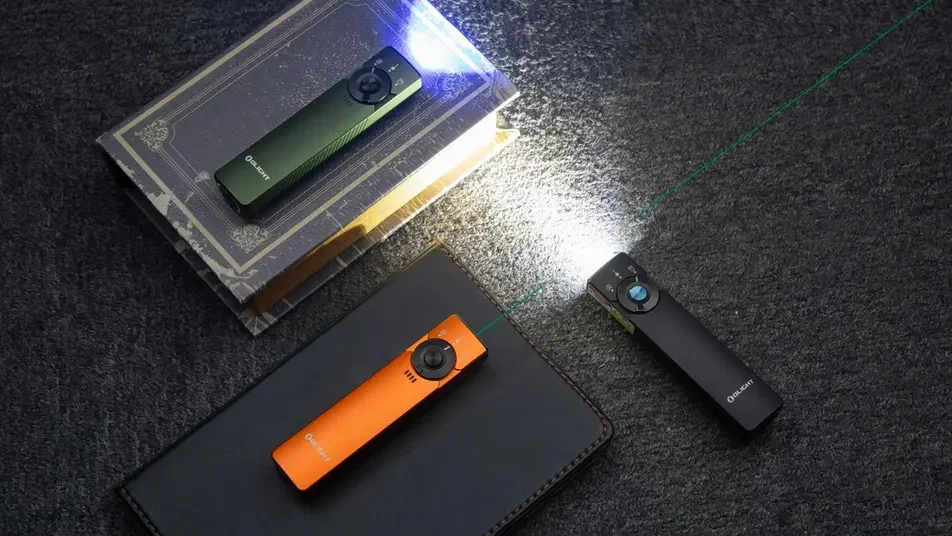
Oclip 2 Pro for hands-free work. Cooking, carrying debris, or fixing a tarp takes two hands. The Olight Oclip 2 Pro clip light has a 115° head tilt, a 360° rotating clip that grips up to 14 mm, and tail and clip magnets. Its Low floodlight runs 10 lumens for 25 hours, and it has a 40-lumen red light rated 4 hours. The Premium version adds a 1,000 mAh charging dock that Olight says gives "twice the total runtime." The limits: it is rated IP66 with 2-meter drop resistance, not IPX8, so it should not be dunked. Its 600 mAh battery also won't carry a long outage without recharging. It lists at $54.99 (regular price, September 2026).
i3E EOS as the backup on a AAA. A backup light is only useful if you have batteries for it. The Olight i3E EOS keychain flashlight runs on a single AAA, puts out 90 lumens, and is rated IPX8. It weighs 0.68 oz and costs $12.99 (regular price, September 2026). The limit: Olight's user manual rates it at 90 lumens for 45 minutes on an alkaline AAA and 70 minutes on a NiMH AAA, so it can't be your main light. Store its AAA cell outside the light, like every other primary battery. For more on small lights, see our guide to keychain flashlights.
If you already own AAA or AA gear, the Olight Ostation Series AA/AAA Batteries Pack offers NiMH cells: AA at 2100mAh and AAA at 950mAh. Olight rates the AA cell for "a cycle life of over 300 times and a charge retention over 70% after 12 Months." A four-pack of AAA lists at $5.49 (regular price, September 2026). The limit: you need an Ostation charger and power to refill them, so pair them with lithium primaries for the long-term reserve. Our comparison of rechargeable flashlights vs flashlights with disposable batteries covers that choice in more depth.
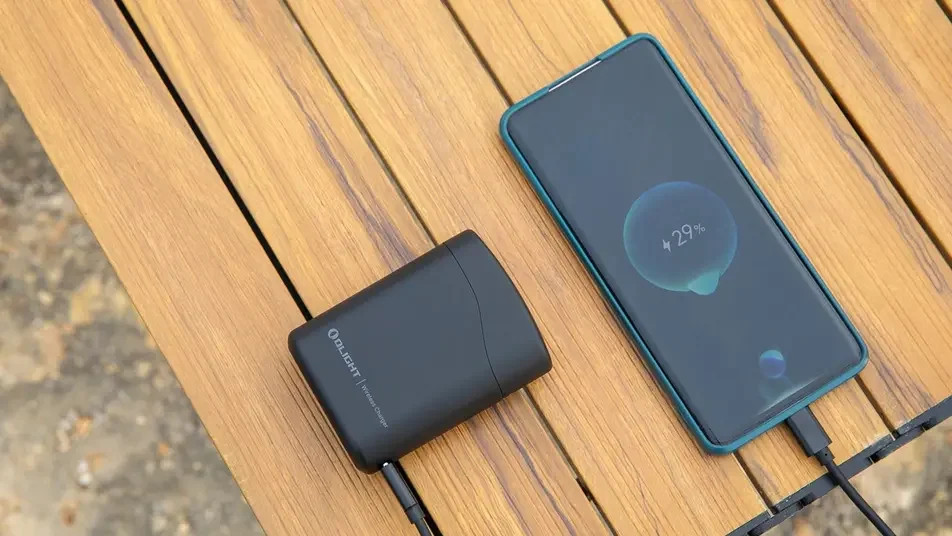
For recharging after the lights run down, Olight also sells the TOPDON V3000 jump starter. Olight lists a 60W USB-C port, USB Quick Charge 3.0, IP54, and operation from 14°F to 104°F, at $199.00 (regular price, September 2026). The limit: Olight's page doesn't publish its battery capacity in watt-hours, so you can't count how many flashlight charges it holds.
Are Candles or an Indoor Generator Safe During a Hurricane Outage?
No. Candles cause thousands of home fires a year, and a generator used indoors or in a garage can kill with carbon monoxide within minutes. The U.S. Fire Administration says to use flashlights, not candles, in a power outage. CDC and CPSC say to run generators outdoors only, at least 20 feet from windows, doors, and vents.
NFPA's candle fire statistics for 2020 to 2024 show an annual average of 5,894 home structure fires with candles as the heat source. Those fires caused an average of 63 civilian deaths and 532 injuries a year. Over one-third started in the bedroom. The U.S. Fire Administration's candle fire safety page puts the fix plainly: "Use flashlights, not candles, if you have a power outage."
Generators are the bigger threat after a storm. The CPSC's 2026 warning, ahead of hurricane season, says "Portable generators are one of the leading causes of post-storm carbon monoxide deaths." It adds that carbon monoxide "can kill within minutes, often before victims recognize symptoms." The CDC says more than 400 Americans die each year from unintentional CO poisoning not linked to fires.
Safety note: Never run a portable generator inside your home, garage, basement, crawlspace, or shed, even with doors or windows open. Operate it outdoors only, at least 20 feet from the house, with exhaust aimed away from windows, doors, and vents. Install battery-operated or battery-backup CO alarms on every level and outside sleeping areas, as the CPSC advises. If an alarm sounds, get outside and call 911.
The CPSC also names flashlights in its prep list: supplies should include "batteries, flashlights and working backup power equipment." A light that runs 80 hours on one charge removes most of the reasons people reach for candles.
When Should You Check Your Emergency Kit?
Check your hurricane kit four times a year, and tie each check to a date you already track. The two clock changes, the June 1 start of hurricane season, and the run-up to the September 10 peak make a quarterly schedule you won't forget. Energizer recommends inspecting battery compartments every few months, and CDC ties CO alarm battery checks to clock changes.
The CDC's carbon monoxide guidance says to "Check CO detector batteries when you change the time on your clocks each spring and fall." That habit is already on many calendars, so hang the flashlight check on it. Ready.gov's kit page adds a yearly review: "Re-think your needs every year and update your kit as your family's needs change."
This schedule pairs each check with a habit you already have:
| When | Anchor habit | What to do with the lights |
|---|---|---|
| Spring clock change (March) | CO and smoke alarm check | Full check: top up rechargeables, test each light, replace desiccant |
| Before June 1 | Hurricane season start | Full pre-season recheck (next section); rotate alkaline spares |
| Late August, before the September 10 peak | Back-to-school week | Quick check: battery level on each light, humidity card, desiccant |
| Fall clock change (November) | CO and smoke alarm check | Post-season check: dry and clean anything used, restock, recharge |
| After every storm or outage | Cleanup | Recharge everything, replace used cells, re-bag and re-seal |
For a rechargeable light with a lockout, the check takes a few seconds. Press the button once to read the battery indicator, and charge it if the level has dropped. For AA and AAA spares, use a battery tester and follow Energizer's rule of thumb: a cell reading 1.1 volts under load has about 20 percent left.
How to Do a Pre-Season Kit Recheck, Step by Step
A complete pre-season recheck takes about 30 minutes before June 1. Open the bin, test and charge every light, inspect every battery compartment, replace desiccant, and restock anything used or expired. Then reseal the bin, put it back on its shelf, and confirm that everyone in the house knows where it is.
Work through this order so you don't miss a step:
- Open the bin somewhere dry and check the humidity card. If it reads high, move the bin to a drier room this year.
- Take out each flashlight. Look inside the battery tube and at the springs for white crust, green corrosion, or rust.
- Clean any deposits with a cotton swab, wearing gloves and glasses as Duracell advises, and let the light dry completely.
- Unlock each rechargeable light, run it for a minute on High, then fully charge it. Lock it again.
- Test every spare cell with a battery tester. Retire any below the tester's green zone.
- Check the date codes on alkaline packs. Move older packs into everyday use and buy fresh ones for the kit.
- Charge any power banks and the Baton 4 Premium case, if you have one.
- Replace the desiccant packs and reseal every bag.
- Put the bin back on its shelf and walk every household member to it.
Leave a charging cable for every rechargeable light inside the bin in its own bag. A dead light you can't charge is no better than a dead battery. Label each cable with the light it fits.
For a full family build that includes water, first aid, and food, see our survival kit under $100 guide. If you are choosing between headlamp types for the kit, our breakdown of rechargeable headlamp vs AAA compares cost and storage.
What Are the Best Snacks to Stockpile for a Hurricane?
The best hurricane snacks need no refrigeration, cooking, or water. Ready.gov suggests ready-to-eat canned meats, fruits, and vegetables, protein or fruit bars, dry cereal or granola, peanut butter, dried fruit, canned juices, and comfort foods. Pick foods your family already eats, keep at least a several-day supply, and store them in the same cool, dry spot as your lights.
Ready.gov's emergency food supplies page says to "Store at least a several-day supply of non-perishable food" and to "Choose foods your family will eat." Its kit page adds two storage rules that matter in a humid climate. "Keep canned food in a cool, dry place" and "Store boxed food in tightly closed plastic or metal containers."
Humidity affects food the same way it affects flashlights. Cans in a damp garage rust, and Ready.gov warns: don't "Eat foods from cans that are swollen, dented or corroded, even though the product may look safe to eat." Keep the food bin next to the light bin on an interior shelf, and include a manual can opener.
Food and light go together when the power is out. Eating by the light of a 50-lumen floodlight bounced off the ceiling is easier than juggling a flashlight. A clip light hooked to a cabinet handle lights the counter while you open cans. Ready.gov also notes the refrigerator keeps food cold for about four hours if unopened, and a full freezer for about 48 hours. That makes the first day of an outage the time to eat perishables, before you start on the snacks.
What to Stockpile in Case of WW3?
For a war or nuclear emergency, federal guidance points to the same basic kit as for a hurricane, plus a few additions. Ready.gov's radiation emergency guidance says to build a supply kit with a spare change of clothes for each person, a trash bag for contaminated clothing, and sealed food, water, and medicine. It also calls for a battery-powered or hand crank radio.
Ready.gov's page on radiation emergencies and nuclear explosions sums up the response this way: "get inside, stay inside and stay tuned." It says that after a detonation, "you will have 10 minutes or more to find an adequate shelter before fallout arrives." It also says to put as many walls as possible between you and the outside.
That advice has a lighting side. Sheltering deep inside a building or in a basement means sheltering in the dark, possibly for a long time, and possibly without power. The storage rules in this guide apply in full: a light for every person, batteries stored outside devices, and a kit kept where you would actually shelter. The water rule from Ready.gov's kit page, one gallon per person per day for several days, also applies here.
Keep the plan proportionate. The same kit that gets you through a Category 2 storm and a week without power covers most of what federal agencies recommend for any shelter-in-place event. Build it once, store it well, and keep it checked.
A Check Card to Tape on Your Storage Bin
Print or copy this card and tape it inside the lid of your light bin. It turns your hurricane supplies storage into a routine and covers the checks in this guide in the order you'll do them, so anyone in the house can run the quarterly check without reading the whole plan. Write the date and your initials each time you finish a check.
- Humidity card reads dry, and the desiccant is fresh.
- Every flashlight has no crust, rust, or green deposits on the springs and contacts.
- No primary batteries are stored inside any device.
- Each rechargeable light is charged, then locked.
- Spare cells test good and are in their original packs, grouped by size.
- A charging cable is bagged with each rechargeable light.
- There is one light per household member, plus one room light.
- A power bank or charging case is charged.
- The CO alarm on each level sounds when you press its test button.
- Everyone in the house knows where this bin lives.
FAQ
Changelog
- September 22, 2026: First published. Olight specs and prices checked September 24, 2026.