Olight makes the lights recommended here. Olight specs and prices come from its product pages and user manuals as of September 2026. Festival rules come from the festivals' own published policies. The battery, runtime, and cost figures are our own arithmetic from those published numbers, not field measurements.
⚡ TL;DR
The best lights for festival camping are a rechargeable clip light for walking and tent chores, plus a dim ambient light that marks your camp. For about $30, the Olight Oclip covers walking and the tent. For about $50, add the Sphere Ambient Light as a camp beacon. For about $100, step up to the Oclip 2 Pro and add an i1R 2 Pro keychain backup.
Two budget mistakes are easy to make on a first festival trip. You buy a bag of cheap throwaway lights that die by the second night, or you spend $150 on gear you never switch on. Then comes 2 a.m.: you are walking back from the last set through a field of identical tents, your phone is at 9 percent, and you need a light that lasts. This guide builds three kits at fixed budgets and does the battery math, so you know before you leave whether each kit will last the whole weekend.
This table sums up the best lights for festival camping by job and budget, using Olight regular prices as of September 2026.
| Scenario | Recommended model | Key spec | Price | Why |
|---|---|---|---|---|
| Tightest budget, one light does it all | Olight Oclip | 300 lm white, 4 lm red, 30 g, magnet and clip | $29.99 | Clips to a strap for the walk, sticks to a tent pole for chores |
| Finding your camp in the dark | Olight Sphere Ambient Light | 75 lm, 360° glow, up to 20 light options in the app, IP56 | $17.99 | A colored glow your crew can spot across the campground |
| Long walks and rain | Olight Oclip 2 Pro | 530 lm floodlight, 125 m spotlight, IP66, 115° head tilt | $54.99 | 3 h 45 min on its 100-lumen floodlight, about 2.5 times the Oclip's 90 minutes |
| Backup when the main light is dead | Olight i1R 2 Pro | 180 lm, 22 g, IPX8, 12 hours on Low | $21.99 | Rides on your key ring and needs no switch |
| Wearing the light on your head | Olight Oclip Pro S plus Oclip Series Headlamp Strap | 600 lm, strap listed as compatible | $39.99 + $7.99 | The strap fits the Oclip Pro S; it is not listed for the Oclip or Oclip 2 |
📋 Table of Contents
- 1. What Lighting Do You Need for Festival Camping?
- 2. How Many Lumens Do You Need for a Camping Light?
- 3. The 2026 Festival Camping Light Kits: $30, $50, and $100
- 4. Best Festival Camping Lights Compared: Price, Output, Charging, Weight
- 5. What Does the Extra Money Buy?
- 6. Will Your Lights Last a Whole Festival Without Charging?
- 7. Are Glow Sticks and Phone Flashlights Enough for Festival Camping?
- 8. Which Lights for Festival Camping Are Banned at the Gate?
- 9. What Are the Best Camp Lights for Outdoor Camping?
- 10. What Is the Best Camping Lantern Light?
- 11. What Are Some Good Lights for a Campsite?
- 12. How We Picked the Best Lights for Festival Camping
- 13. Festival Light Packing Checklist
- 14. FAQ
What Lighting Do You Need for Festival Camping?
Festival camping needs light for five jobs: walking between camp and the stages, doing chores inside the tent, marking your camp so friends can find it, late bathroom trips, and finding dropped items in grass. No single light does all five well. A clip or head-mounted light handles walking and chores, and a low-power ambient light handles marking. A small backup covers the rest.
Festival organizers say much the same. Electric Forest's Forest Prep Guide recommends "a flashlight (NOT your phone flashlight)" along with battery packs and phone chargers. It also suggests learning the venue in daylight, because the grounds look different after sunset. A phone light drains the one battery you need for tickets, maps, and finding your friends.
The five jobs pull in different directions. Walking needs a beam that reaches 20 to 50 meters ahead and a way to keep your hands free. Tent chores need a low, wide light that won't blind your tentmate. Marking needs a distinctive color that runs for hours. Browse Olight's camping flashlights and headlamps for the full range, but the kits below cover all five jobs at three prices.
This table maps each job to the light type and the spec that matters most.
| Job | When it happens | Light type | Spec to check |
|---|---|---|---|
| Walking to and from stages | Every night, often in crowds | Clip light or headlamp | A 100-lumen mode with long runtime |
| Tent chores | Changing, finding gear | Clip light on a magnet or loop | A 1 to 10 lumen low mode, red light |
| Marking your camp | Dusk until you sleep | Ambient light or lantern | Color options, multi-hour low mode |
| Bathroom trips | Once or twice a night | Any light already on you | Instant on, no fumbling |
| Finding dropped items | Random | Backup keychain light | Always on your key ring |
How Many Lumens Do You Need for a Camping Light?
For festival camping, you need far fewer lumens than the box suggests. About 1 to 10 lumens is enough inside a tent, about 100 lumens lights a campground path, and 300 lumens or more is only for searching a wide area. The bigger number to check is how long the light runs at 100 lumens, because that is the mode you will use most.
Those bands follow the mode steps Olight itself uses. The Oclip, for example, has 1.5-lumen Moon, 10-lumen Low, 100-lumen Medium, and a 300-lumen High that steps down to 180 lumens after one minute. The Oclip 2 Pro repeats the pattern at 1, 10, 100, 300, and 530 lumens. Brightness is not the limit at a festival. Runtime is.
This table is our rule of thumb for matching lumens to each festival task.
| Task | Lumens that work | Why more is worse |
|---|---|---|
| Reading or finding gear inside a tent | 1 to 10 | Brighter light reflects off tent walls and wakes your tentmate |
| Walking a lit main path | 10 | Where the venue lights the path, more light only drains the battery |
| Walking an unlit campground | 100 | Enough to see tent stakes and guy lines |
| Crossing a dark field or searching for a tent row | 300 to 530 | Short bursts only; high modes drain batteries fastest |
| Signaling your crew | Colored or red light, 1 to 10 | Color is easier to spot than brightness |
Red light helps at night. The National Park Service notes that night vision builds over 20 to 40 minutes, and "a dim red light is best for maximizing after-dark eye behavior" (NPS). The Oclip's 4-lumen red mode and the Oclip 2 Pro's 4-lumen red Low fit that advice for late tent trips.
The 2026 Festival Camping Light Kits: $30, $50, and $100
Each kit below is a complete answer at its price, built from Olight's in-stock US models at regular prices as of September 2026. The $30 kit is one clip light. The $50 kit adds a camp beacon for $47.98 total. The $100 kit upgrades the clip light and adds a backup for $94.97 total. Every light in all three kits charges over USB-C.
This table lists what each kit contains and what it costs.
| Kit | Contents | Total price | Total weight | Charging |
|---|---|---|---|---|
| $30 kit | Olight Oclip | $29.99 | 1.06 oz (30 g) | USB-C |
| $50 kit | Oclip + Sphere Ambient Light (Sphere C) | $47.98 | 4.34 oz (123 g) | USB-C (Sphere C ships without a cable) |
| $100 kit | Oclip 2 Pro + Sphere Ambient Light + i1R 2 Pro | $94.97 | 6.72 oz (190.5 g) | USB-C (the Oclip 2 Pro also takes Olight's MCC cable) |
| $100 alternative, head-worn | Oclip Pro S + Oclip Series Headlamp Strap + Sphere + i1R 2 Pro | $87.96 | Strap weight not listed | USB-C |
The $30 Kit: Olight Oclip
The hard part on a budget is getting walking light and tent light from one purchase. The Olight Oclip ($29.99, regular price, September 2026) solves it with a clip that grips objects up to 14 mm thick, a magnetic base, and two light colors. Clip it to a backpack strap for the walk, then stick it to a steel tent pole or hang it from the tent's gear loop.
The Oclip weighs 1.06 oz (30 g), puts out up to 300 lumens with a 68 m beam, and has a 4-lumen red light for late trips. Its user manual lists about 1.5 hours to charge.
The limit is runtime at walking brightness. The 100-lumen Medium mode is rated for 90 minutes, and the 300-lumen High holds only 1 minute before dropping to 180 lumens. Its IPX5 rating covers rain, but the manual warns not to immerse it. If your festival runs four nights, plan to charge it at least once (see the battery math below).
The $50 Kit: Add the Sphere Ambient Light
The Oclip can't do two jobs at once: if you take it to the stage, your camp goes dark. The Olight Sphere Ambient Light ($17.99, regular price, September 2026) fills that gap. It glows in 360 degrees, offers 7 options at the button and up to 20 in the Olight app, and its magnetic base holds it to a steel pole or other metal surface.
For festival camps, the app matters more than the brightness. Olight lists group control for up to 100 Spheres, music sync, and countdown timers. Set your crew's Spheres to one unusual color, and your camp stands out from the white lanterns around it. The Sphere C manual gives an app control range of 25 meters in open space.
Know its limits. At 75 lumens it is a marker and tent light, not a walking light, and it has no beam. The default Sphere C variant charges by USB-C, but Olight notes the cable is not included, so pack one. It is rated IP56 and 1.5 m drop resistant, so rain is fine, but its manual says to clean and dry it after wet use before charging.
The $100 Kit: Oclip 2 Pro, Sphere, and i1R 2 Pro
The $100 kit fixes the Oclip's two weak points: short runtime at walking brightness and a modest beam. The Olight Oclip 2 Pro ($54.99, regular price, September 2026) runs its 100-lumen floodlight for 3 hours 45 minutes. It also adds a 125 m spotlight, IP66 protection, and 2.0 m impact resistance.
Its 115° head tilt and 360° rotating clip let you clip it to a shoulder strap and aim the floodlight at the ground ahead, which is the closest thing to a headlamp without wearing one. Tail and clip magnets turn it into a work light on a steel pole. It weighs 2.66 oz (75.5 g), about 2.5 times the Oclip. The Oclip 2 user manual adds a caution for anyone with an implanted heart device: "If you have an ICD or pacemaker, avoid close or prolonged contact with this product to prevent possible interference."
The kit's third piece is the Olight i1R 2 Pro keychain light ($21.99, regular price, September 2026), 22 g with a 12-hour, 5-lumen Low mode and IPX8. You twist the tailcap to turn it on, so there is no button to press by accident in a pocket. Its 180-lumen High lasts only 23 minutes, so treat it as a backup, not a main light. Our keychain flashlight guide explains why a key ring light's battery sets that limit.
Note: Olight's Perun 3 Mini, a small headlamp that pops out of its mount to become a handheld flashlight, was the natural pick for this slot. Its standard version showed Sold Out at Olight's US store on September 24, 2026, so it is not in the kit.
If you want the light on your forehead, the head-worn alternative uses the Olight Oclip Pro S ($39.99, regular price, September 2026) with the $7.99 Oclip Series Headlamp Strap, which Olight lists as compatible with the Oclip Pro, Oclip Pro S, and Oclip Ultra. The Oclip Pro S also has red, green, and blue light for signaling. It includes a 365 nm UV beam, so never shine the UV at anyone's eyes or skin. For more head-worn options, see our best headlamp under $50 picks.
Best Festival Camping Lights Compared: Price, Output, Charging, Weight
On paper, the Oclip 2 Pro has the most reach and runtime, the Oclip is the best value, the Sphere is the only true camp marker, and the i1R 2 Pro is the lightest backup. The table below puts Olight's published specs side by side, so you can swap any light in or out of a kit and see what you gain or lose.
This table compares the best festival camping lights using Olight's published specs and regular prices as of September 2026.
| Light | Max output | Peak intensity | Beam distance | Runtime at about 100 lm | Lowest mode runtime | Weight | Water rating | Price |
|---|---|---|---|---|---|---|---|---|
| Olight Oclip | 300 lm | 1,156 cd | 68 m | 90 min (100 lm) | 30 h (1.5 lm) | 30 g | IPX5 | $29.99 |
| Olight Oclip 2 Pro | 530 lm (floodlight) | 3,906 cd | 125 m | 3 h 45 min (100 lm floodlight) | 144 h (1 lm) | 75.5 g | IP66 | $54.99 |
| Olight Oclip Pro S | 600 lm | 1,600 cd | 80 m | 3.5 h (100 lm) | 144 h (1 lm) | 53 g | IPX6 | $39.99 |
| Olight Sphere Ambient Light (Sphere C) | 75 lm | Not listed | Not a beam light | 100 + 150 min (75~22 lm) | 40 h (1 lm white) | 93 g | IP56 | $17.99 |
| Olight i1R 2 Pro | 180 lm | 580 cd | 48 m | 23 min (180 lm High) | 12 h (5 lm) | 22 g | IPX8 | $21.99 |
Two patterns stand out. The clip lights all run for days on their lowest mode, so none of them will leave you in total darkness if you drop to Moon. And the Oclip 2 Pro's advantage is not raw brightness; it is 2.5 times the Oclip's runtime at the 100-lumen level you actually walk with.
What Does the Extra Money Buy?
Going from $30 to $50 buys a second job: a camp marker that keeps working while your clip light is with you at the stage. Going from $50 to $100 buys endurance and toughness, not more brightness per dollar. Olight's regular prices work out to 10.0 lumens per dollar for the Oclip and 9.6 for the Oclip 2 Pro, almost the same.
This table breaks each upgrade into what you gain, using Olight's published specs.
| Upgrade | Added cost | What you gain | What you don't gain |
|---|---|---|---|
| $30 to $50 | $17.99 | A 360° colored camp marker, app group control, a second light if the Oclip dies | Any extra walking light |
| $50 to $100 | $46.99 | 100-lumen runtime from 90 min to 3 h 45 min; beam distance from 68 m to 125 m; IPX5 to IP66; a keychain backup | More lumens per dollar, or a headband |
| Oclip to Oclip Pro S with strap | $17.99 over the Oclip | True head wear, RGB signaling, 3.5 h at 100 lm | The Oclip 2 Pro's 125 m spotlight and IP66 rating |
The per-dollar math is simple: 300 lumens divided by $29.99 is 10.0, and 530 divided by $54.99 is 9.6. The i1R 2 Pro gives 8.2 lumens per dollar and the Sphere 4.2, but those buy a different job. If money is tight, the $50 kit gives the biggest jump in usefulness per dollar. Spend on the $100 kit if your festival runs four or more nights, or if you walk long distances between camp and stages.
Will Your Lights Last a Whole Festival Without Charging?
With careful mode choice, the $100 kit's Oclip 2 Pro lasts about four nights on one charge, while the Oclip lasts one to five nights depending on how often you use 100 lumens. The Sphere lasts one to ten nights depending on its mode. The rule that matters most: the Oclip's 10-lumen Low runs eight times longer than its 100-lumen Medium, 12 hours versus 90 minutes.
We built a typical festival night to check this: 50 minutes of walking between camp, stages, and bathrooms; 30 minutes of tent chores on Low; and the camp marker on for 4 hours. Each light's share of battery per night is minutes used divided by Olight's rated runtime for that mode. Olight's manuals say its runtimes are rated per the ANSI FL 1 standard in Olight's labs, the Oclip's at 25°C (77°F), so real results will vary with heat, cold, and step-down.
This table shows how much of each battery one festival night uses, and how many nights a full charge covers.
| Light and mode plan | Battery used per night | Nights per charge |
|---|---|---|
| Oclip: walk 50 min on Medium (100 lm), tent 30 min on Low | 55.6% + 4.2% = 59.7% | About 1.7 |
| Oclip: walk 10 min on Medium, 40 min on Low; tent 30 min on Low | 11.1% + 9.7% = 20.8% | About 4.8 |
| Oclip 2 Pro: walk 50 min on Medium floodlight (100 lm), tent 30 min on Low | 22.2% + 2.0% = 24.2% | About 4.1 |
| Sphere C: 4 h on Colored Lights High (10 lm, rated 5 h) | 80% | About 1.25 |
| Sphere C: 4 h on Red Light High (11~2 lm, rated 580 + 320 min) | 26.7% | About 3.75 |
| Sphere C: 4 h on White Light Low (1 lm, rated 40 h) | 10% | About 10 |
| i1R 2 Pro: 30 min on Low (5 lm) as backup | 4.2% | About 24 |
How big a power bank does each kit need?
A 10,000 mAh power bank refills the $100 kit about four times, even with conservative losses. We converted each battery to watt-hours (mAh × volts ÷ 1,000). The Oclip holds 1.036 Wh and the Sphere C 2.59 Wh, per their manuals. The i1R 2 Pro's 130 mAh, 3.7 V cell holds 0.48 Wh. Olight lists the Oclip 2 Pro at 600 mAh without a voltage; assuming 3.7 V gives about 2.2 Wh.
That puts a full refill at about 3.6 Wh for the $50 kit and 5.3 Wh for the $100 kit. A 10,000 mAh bank is about 37 Wh at 3.7 V. If we assume only 60 percent of that reaches your lights after conversion losses, you still get about 22 Wh: roughly six refills of the $50 kit or four of the $100 kit.
You rarely need full refills, though. On the night profile above, the $100 kit burns about 1.25 Wh a night: 24.2% of the Oclip 2 Pro's 2.2 Wh, 26.7% of the Sphere's 2.59 Wh on Red Light High, and 4.2% of the i1R 2 Pro's 0.48 Wh. Four nights come to about 5 Wh, which leaves roughly 17 of the bank's 22 usable Wh for phones. The lights are the small load; your phone is the big one.
Tip: Charge in the shade or after dark. The Sphere C manual says the battery may fail to charge above 40°C (104°F), and both the Oclip and Sphere C manuals list a working range of 0 to 40°C. Electric Forest tells campers to expect "90+ full sun days" and warns that "most tents will get hot by mid-morning regardless of the amount of protection used."
Are Glow Sticks and Phone Flashlights Enough for Festival Camping?
No. Glow sticks and phone flashlights are two easy festival lighting mistakes. A glow stick glows once and cannot be switched off or recharged, and its dim glow is meant for marking, not for lighting a path. A phone flashlight drains the battery you need for tickets, maps, and texts. Use glow sticks as decoration, not as your light plan.
Glow sticks are not dangerous if used as intended, but they are not harmless toys either. Poison Control says glow sticks "are not poisonous," yet the liquid "can cause skin and eye irritation," and each one contains a small glass vial that breaks when you bend it. Its advice: do not cut them open, keep them out of mouths and away from pets, and throw away any that crack or leak.
Other common mistakes follow the same pattern: gear that looks cheap or fun at the store but fails at 2 a.m.
- Buying one bright flashlight and nothing else. When you take it to the stage, your camp is dark and your tentmate has nothing.
- Running a clip light on High for every walk. Olight's Oclip holds 300 lumens for only 1 minute; 100 lumens runs 90 minutes, and 10 lumens runs 12 hours.
- Leaving lights in a hot car between sets. The Oclip manual warns against placing, charging, or using it in a car that may exceed 60°C (140°F).
- Forgetting cables. The Sphere C ships without a USB-C cable, and the Oclip 2 Pro, Oclip, and i1R 2 Pro each come with their own cable in the box.
- Strobing people. The Oclip's 13 Hz white strobe is for emergencies, not the dance floor. Flashing lights in a crowd are rude at best.
Which Lights for Festival Camping Are Banned at the Gate?
Laser pointers and open flame are the two lighting items to check first on any festival's banned list. Electric Forest bans laser pointers both on its general list and in the venue, and bans candles, open flame, fuel generators, tiki torches, and flying lanterns. Burning Man does not permit handheld lasers in Black Rock City at all. Neither bans LED flashlights or lanterns, but check your own festival's current list.
This table turns the published rules we checked into what to pack and what to leave home.
| Item | What the rule says | What to do |
|---|---|---|
| Laser pointers | Electric Forest: "No laser pointers" in both its general and in-venue lists (Electric Forest) | Leave any light with a laser at home, including EDC lights with a built-in green laser |
| Handheld lasers | Burning Man: "Handheld lasers are not permitted in Black Rock City" (Burning Man Survival Guide) | Same: leave them home |
| Candles, open flame, tiki torches | Electric Forest bans grills, open flame, candles, and charcoal, with small Coleman-style camp stoves as the only exemption | Use battery lights in and around tents |
| Fuel generators | Electric Forest bans gas, diesel, and kerosene generators; "Solar generators are exempt" | Bring a power bank or solar generator to charge lights |
| Flying lanterns | Electric Forest bans "flying prayer lanterns" | Skip them |
| Totems with lights | Electric Forest allows totems up to 7 ft on light poles such as PVC | A light strapped to a totem marks your group; the Sphere's magnet will not grip PVC, so tie it on |
Laser rules exist for good reasons. The FDA warns that "the light energy from a laser pointer aimed into the eye can be more damaging than staring directly into the sun" (FDA). Pointing one at an aircraft is a federal crime, and the FAA says violators face fines of up to $32,646 per violation.
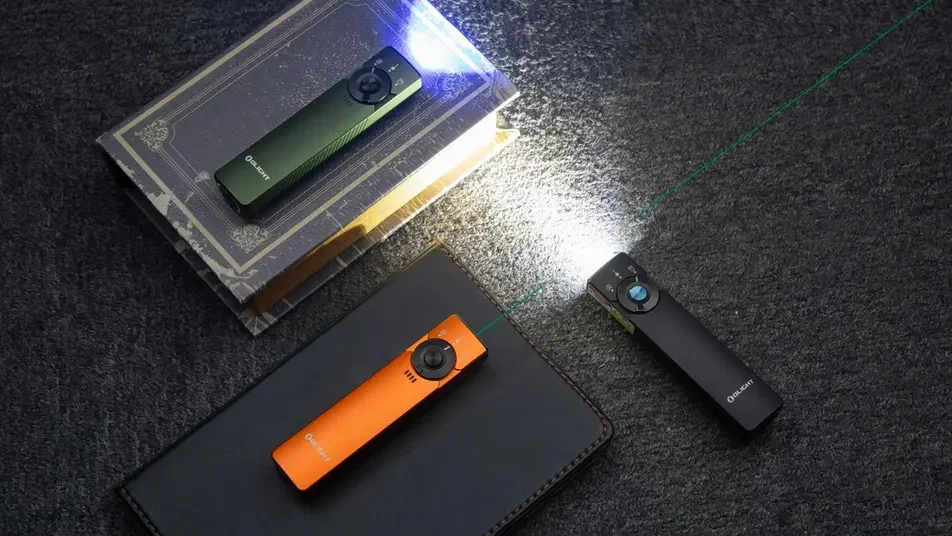
Warning: Some Olight EDC lights, such as the Arkfeld Pro, include a Class 3R green laser. Festival security may treat any laser as a laser pointer, so pack a laser-free light like the Oclip or Oclip 2 Pro instead.
What Are the Best Camp Lights for Outdoor Camping?
The best camp lights for outdoor camping come in pairs: a hands-free task light (a headlamp or clip light) and an area light (a lantern or ambient light) that stays at camp. At a festival, the Oclip or Oclip 2 Pro covers the task side and the Sphere covers the area side. For backpacking, where weight matters most, a headlamp alone often does both jobs.
What changes between a festival and a quiet campground is distance and crowds. At a festival you may walk a long way at night, in a crowd, and come back after the last set. That favors long 100-lumen runtime and a light you never need to hold. At a quiet campground, a brighter lantern for cooking matters more. For head-worn picks at any budget, see our roundup of the best headlamps.
What Is the Best Camping Lantern Light?
The best camping lantern light for a festival is a small, rechargeable, low-output lantern with color options, because at a festival a lantern's job is to mark your camp, not to light a picnic table. The Sphere Ambient Light fits that role at 75 lumens and 93 g. At a regular campground, where you cook and play cards by lantern light, a brighter lantern is the better buy.
This table compares lanterns and flashlights for the jobs they handle at a festival camp.
| Job | Lantern or ambient light | Flashlight or clip light |
|---|---|---|
| Lighting a whole tent or canopy | Better: 360° spread, no glare spot | Works if bounced off a tent wall |
| Marking camp from a distance | Better: colors and slow modes | Poor: a beam points one way only |
| Walking to the stage | Poor: no beam, hard to carry | Better: reach and hands-free clip |
| Sharing light with tentmates | Better | Worse: one beam, one direction |
| Searching the grass for keys | Poor | Better |
The Sphere's warm white is rated at 2,800 K and CRI 80 in its manual, which gives the tent a softer look than a cool-white flashlight. For brighter options and fuel-free lanterns across budgets, see our guide to the best camping lanterns.
What Are Some Good Lights for a Campsite?
Good lights for a campsite are a mix of three things: a hands-free light for each person, one shared area light, and a small backup. A group of four can share two Spheres for the camp and canopy, give each person a clip light, and keep one keychain light in the cooler bag for emergencies. That covers every job without anyone holding a phone light in their teeth.
Placement matters as much as the lights. Hang the area light high, such as on a canopy frame or totem, so it lights the space without shining into anyone's eyes. Stick a magnetic light to a car door or steel pole near the tent entrance so you can find the zipper. And light yourself when you walk: Burning Man's bicycle guide warns that at night "If your bike isn't lit, no one can see you," and the same goes for anyone walking between camps.
The Olight Oclip series page shows every clip light in the range if you want to give each crew member a different model.
How We Picked the Best Lights for Festival Camping
We picked the best lights for festival camping from Olight's in-stock US lineup by matching published specs to the five festival jobs, then fitting them into three budgets at regular prices. We did not field-test these lights. Every runtime, battery, and cost figure in this guide is calculated from Olight's product pages and user manuals, and the method is laid out below.
This table explains what we compared, where each number came from, and how we used it.
| What we compared | Source | How we used it | Checked |
|---|---|---|---|
| Output, candela, beam distance, runtime, weight, water rating | Olight US product pages (Technical Details) | Copied as published; no rounding of Olight figures | September 24, 2026 |
| Prices and stock | Olight US product pages | Regular prices only; Sold Out models excluded | September 24, 2026 |
| Battery capacity, charge time, temperature limits | Olight user manuals (Oclip, Sphere C, i1R 2 Pro) | Converted to watt-hours; Oclip 2 Pro voltage assumed at 3.7 V | September 2026 |
| Battery used per night | Our night profile (50 min walking, 30 min tent, 4 h marker) | Minutes used divided by Olight's rated runtime for that mode | September 2026 |
| Festival rules | Electric Forest and Burning Man published policies | Quoted directly; readers should check their own festival | September 25, 2026 |
The main limits: rated runtimes come from lab conditions, and cold, heat, and step-down all shorten real runtime. We plan to add field measurements to this guide once they have been taken.
Festival Light Packing Checklist
Use this list the week before you leave. It turns the kits and battery math above into a short set of steps, and it works for any of the best lights for festival camping, not only Olight's.
- Pick your kit: $30 if you camp one or two nights, $50 for a crew weekend, $100 for four or more nights or long walks.
- Charge every light fully at home, and check that each one turns on.
- Pack one USB-C cable per light, plus a 10,000 mAh power bank. The Sphere C ships without a cable.
- Set a crew color for your Spheres in the app before you leave, while you have Wi-Fi and time.
- Walk on 10 lumens where there is venue light and switch to 100 lumens only on dark ground.
- Use red light inside the tent after midnight.
- Charge in the shade or at night, never in a hot car.
- Leave laser lights, candles, and flying lanterns at home.
- Put a keychain backup on your key ring so you always have light, even if your main light is dead.
- Flying to the festival? Pack power banks in your carry-on. The FAA's PackSafe rules for lithium batteries say spare lithium batteries and power banks "must be carried in carry-on baggage only," with a 100 Wh per-battery limit.
FAQ
Changelog
- September 22, 2026: First published.