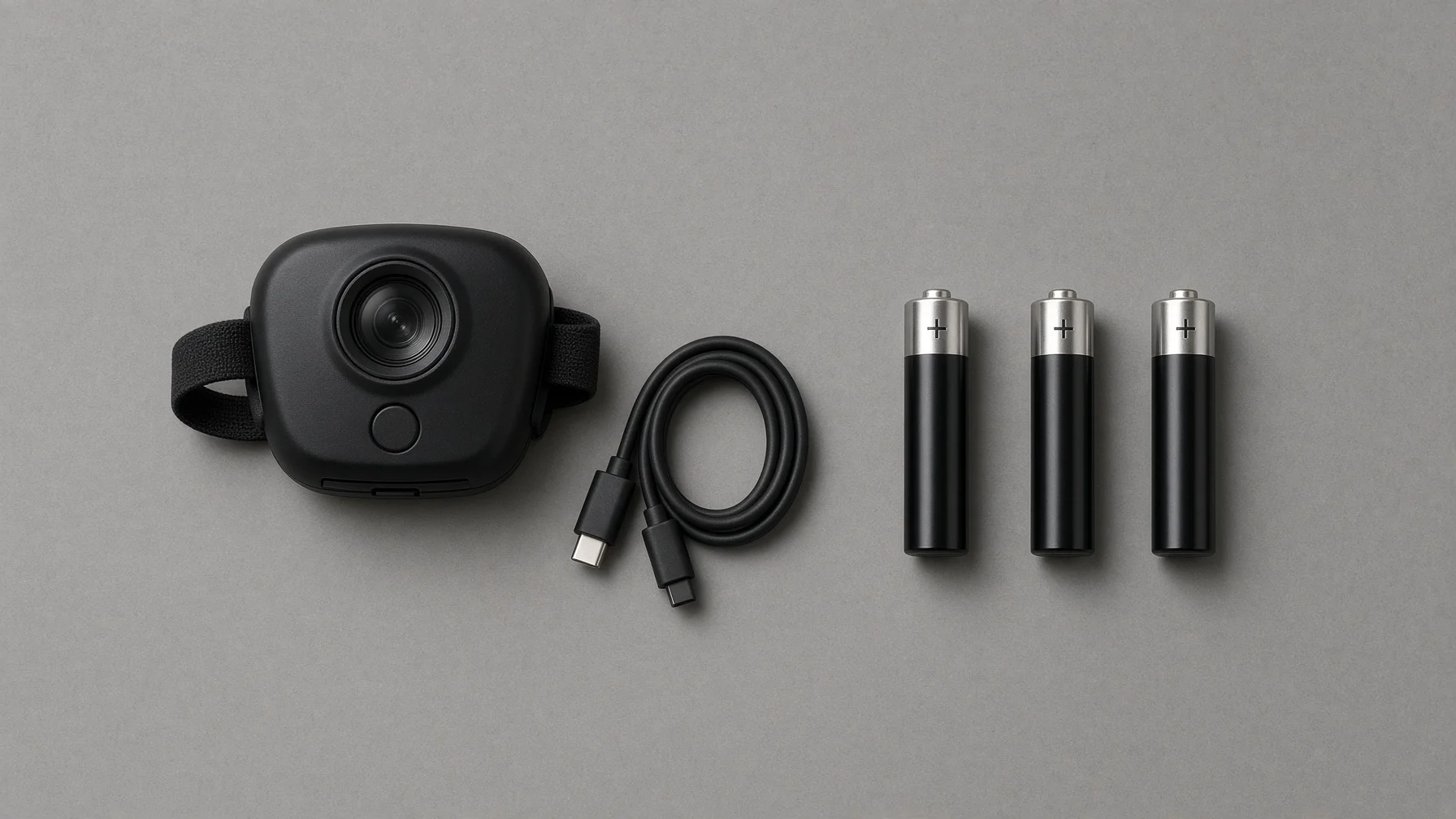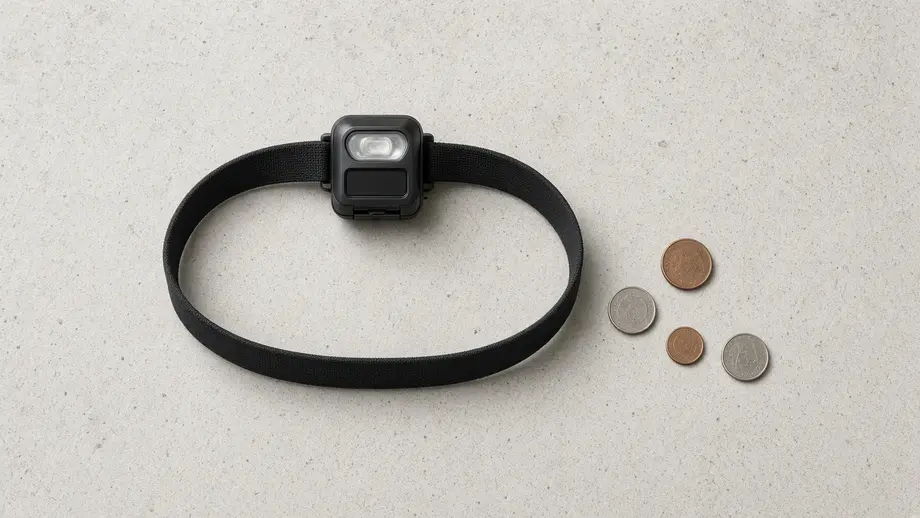
Olight makes the lights discussed here. Olight specs and regular prices come from its US product pages and user manuals as of September 2026. Calculations are our own and are labeled as estimates where they rely on an assumption.
⚡ TL;DR
The best headlamp under $50 for most people is a clip light on a head strap: the Olight Oclip Pro S plus the Oclip Series Headlamp Strap costs $47.98 at regular prices. It gives 600 lumens, red light, IPX6 water resistance and 3.5 hours at 100 lumens. Choose the $29.99 Oclip to spend less, or a dedicated headlamp for long camp nights.
This table gives the best headlamp under $50 by use, with regular prices from Olight's US store in September 2026.
| Use | Pick | Key specs (Olight) | Price (regular, September 2026) | Why |
|---|---|---|---|---|
| Best overall under $50 | Oclip Pro S + Oclip Series Headlamp Strap | 600 lm, 1,600 cd, 80 m, 53 g light, IPX6, red 40 lm / 4 lm | $47.98 ($39.99 + $7.99) | Strap officially lists it as compatible; 100 lm lasts 3.5 hours |
| Best under $40 | Oclip + Oclip Series Headlamp Strap (see fit note) | 300 lm, 1,156 cd, 68 m, 30 g light, IPX5, red 4 lm | $37.98 ($29.99 + $7.99) | Lightest light here; Olight offers the strap as a bundle on the Oclip page |
| Best under $30 | Oclip on a cap brim | 300 lm, clip grips up to 14 mm, red 4 lm, 10 lm for 12 hours | $29.99 | No strap to buy; the clip rides on a brim or pack strap |
| Car fixes under $50 | Oclip Pro S as a magnetic work light | 600 lm, clip, hang or magnet mount, 10 lm for 27 hours | $39.99 | Sticks to steel so both hands stay on the job |
Two lights sit just over budget and come up later as step-ups: the Oclip 2 Pro at $54.99 (regular price, September 2026) for its 115° tilting head, and the Perun 3 headlamp at $89.99 (regular price, September 2026) for all-evening runtime.
If you run before sunrise, set up a tent after dark or lie under a car to change oil, you have probably met the two common budget-headlamp problems. Either the light bounces and presses on your forehead, or the battery quits halfway through the job. A clip light on a strap solves part of that for less money. It also brings trade-offs that most buying guides skip, and this guide works through them with numbers.
📋 Table of Contents
- 1. What Is the Best Affordable Headlamp?
- 2. Dedicated Headlamp vs Clip Light on a Strap: Weight, Tilt and Runtime
- 3. Best Headlamp Under $50 Kits: What Each Combination Costs
- 4. Best Headlamp Under $50 Compared: Lumens, Candela, Runtime, Weight
- 5. How Many Lumens Do You Need for a Good Headlamp?
- 6. What Does Red Light Do on a Night Run or at Camp?
- 7. How Do You Stop a Clip-On Headlamp From Bouncing?
- 8. Common Mistake: Buying the Brightest Headlamp Under $50
- 9. What Is the Most Powerful Flashlight Under $50?
- 10. What Headlamps Do Navy SEALs Use?
- 11. When Should You Spend More Than $50 on a Headlamp?
- 12. Which Kit Fits Runners, Campers and Car Fixes?
- 13. How This Guide Compared the Kits
- 14. FAQ
What Is the Best Affordable Headlamp?
The best affordable headlamp is one that holds a useful 100 lumens for your whole activity, has a red mode and stays comfortable. Under $50, the Olight Oclip Pro S on the Oclip Series Headlamp Strap fits that brief at $47.98. It runs 3.5 hours at 100 lumens, 26 hours on 4-lumen red and weighs 53 g with its battery.
Olight sells two ways to get a light on your head at this price. One is a dedicated headlamp from its headlamps range; the other is a clip light from the Olight Oclip series worn on a strap. The two dedicated headlamps in Olight's US store in September 2026, the Perun 3 Mini at $64.99 and the Perun 3 at $89.99, both list above $50, so the clip-light kit is the way to stay under budget.
Brand matters less than three numbers: the runtime at the level you will actually use, the lowest red setting and the weight on your head. The rest of this guide compares those numbers across the kits and shows when it makes sense to pay more. For a wider field that includes other brands, see our roundup of the best headlamps.
Dedicated Headlamp vs Clip Light on a Strap: Weight, Tilt and Runtime
A dedicated headlamp usually has a tilting bracket, a larger battery and a band built for it. A clip light on a strap costs less, weighs less and comes off your head to become a work light or pocket light. The trade-off is runtime: small clip lights hold 100 lumens for 1.5 to 3.75 hours, while the Perun 3 headlamp holds 120 lumens for 25 hours.
This table compares the two formats on the points that decide comfort and usefulness.
| Factor | Clip light on a strap (Oclip family) | Dedicated headlamp (Perun 3) |
|---|---|---|
| Light weight with battery | 30 g to 75.5 g | 150 g (as listed) |
| Aiming | Strap angle; the Oclip 2 Pro adds a 115° head tilt | Bracket on the headband |
| Battery | Built-in cell; Oclip is 280 mAh, Oclip Ultra is 580 mAh (user manuals) | 5000 mAh 21700 cell |
| Runtime near 100 lumens | 90 minutes to 3 hours 45 minutes | 25 hours at 120 lumens |
| Off-head use | Clip, magnet, hang | Clip, magnetic tail, lanyard |
| Price of the kit | $37.98 to $54.99 | $89.99 |
Weight on the forehead is only part of comfort. How tight you pull the band and how the load sits matter too, which our guide to headlamp comfort covers in detail. A lighter light lets you run the strap looser, and a looser strap is what stops the red pressure mark after an hour.
Olight lists the weight of the light itself, not the strap. The Oclip Series Headlamp Strap page doesn't publish a strap weight, so no total head weight appears in this guide.
Best Headlamp Under $50 Kits: What Each Combination Costs
Three kits stay at or under $50 at regular prices: the Oclip with the strap at $37.98, the Oclip Pro S with the strap at $47.98, and either light clipped to a cap brim for $29.99 or $39.99. The Oclip 2 Pro costs $54.99, and the Oclip Ultra was unavailable in September 2026. Each kit below starts with what it solves and ends with its limits.
Oclip Pro S With Headlamp Strap: Best Overall ($47.98)
The problem at this price is getting enough runtime and a real red mode in a light small enough to wear. The Olight Oclip Pro page now sells the Oclip Pro S at $39.99 (regular price, September 2026). It lists 600 lumens, 1,600 candela, 80 m, IPX6 and 53 g with its battery. Its Medium mode holds 100 lumens for 3.5 hours, and its low red mode gives 4 lumens for 26 hours.
The Oclip Series Headlamp Strap costs $7.99 (regular price, September 2026), and Olight states it "is compatible with the Oclip Pro, Oclip Pro S and Oclip Ultra." That official fit is the main reason this kit ranks first. The Pro S also has green, blue and a 365 nm UV mode, which help with marking gear and checking for stains. Never look into the UV beam or point it at anyone's eyes.
Limits: the beam is wide for its output. At 100 lumens its reach works out shorter than the cheaper Oclip's, as the comparison below shows. Olight lists its white light at 5700 to 6500 K, and the Pro S page gives no color rendering figure. The user manuals for the original Oclip and Oclip Pro list CRI 70, so don't rely on these lights for judging wire colors.
Oclip With Headlamp Strap: Best Under $40 ($37.98)
The Olight Oclip costs $29.99 (regular price, September 2026) and weighs 30 g with its battery, the lightest option here. It gives 300 lumens, 1,156 candela, 68 m and IPX5. Medium is 100 lumens for 90 minutes, Low is 10 lumens for 12 hours, and red is 4 lumens for 5 hours. Its clip grips objects up to 14 mm thick, so it also rides on a cap brim.
Note: Olight's Oclip page offers the headlamp strap as a recommended bundle, but the strap's own compatibility line names only the Oclip Pro, Oclip Pro S and Oclip Ultra. If you want an officially listed fit, choose the Pro S kit. If you already own an Oclip, a cap brim or a pack shoulder strap works without buying anything.
Limits: 90 minutes at 100 lumens is short for a camp evening. The Oclip user manual also says that below 0°C (32°F) the light runs only in its low and medium modes.
Oclip 2 Pro: Worth the Extra $4.99 for Car Fixes ($54.99)
The hard part of engine-bay and under-sink work is aiming light past hoses and pipes. The Olight Oclip 2 Pro adds a 115° head tilt and a 360° rotating clip. It has tail and clip magnets, IP66, a 2.0 m impact rating and a 600 mAh battery. It offers a 530-lumen floodlight, a spotlight rated to 125 m and red light at 40 or 4 lumens.
Limits: at $54.99 (regular price, September 2026) it breaks the budget, and the Oclip Series Headlamp Strap page doesn't list the Oclip 2 series as compatible. Treat it as a clip-anywhere work light first; for a head-worn kit, the Pro S is the safer buy.
Oclip Ultra: Strap-Compatible but Unavailable
The Oclip Ultra is on the strap's compatibility list. It pairs a 530-lumen floodlight (505 candela, 45 m) with a 450-lumen spotlight (4,225 candela, 130 m) and an 800 mW UV light. Olight's US store showed it as unavailable with a Notify me button in September 2026, and its spec sheet lists no red light mode, so it isn't a pick in this guide.
Best Headlamp Under $50 Compared: Lumens, Candela, Runtime, Weight
Compare budget headlamps on candela and runtime at 100 lumens, not maximum lumens. In the table below, the Oclip 2 Pro has the most reach at 125 m and the Oclip is the lightest at 30 g. The Pro S has the best runtime under $50, holding 100 lumens for 3.5 hours. Every beam distance matches Olight's candela rating using the standard formula.
This table puts every model in this guide side by side using Olight's published specs and regular prices in September 2026.
| Model | Max lumens | Candela | Beam distance | Runtime near 100 lm | Red light | Weight with battery | Water rating | Price |
|---|---|---|---|---|---|---|---|---|
| Oclip | 300 | 1,156 | 68 m | 100 lm, 90 min | 4 lm, 5 h | 30 g | IPX5 | $29.99 |
| Oclip Pro S | 600 | 1,600 | 80 m | 100 lm, 3.5 h | 40 lm 3.5 h; 4 lm 26 h | 53 g | IPX6 | $39.99 |
| Oclip 2 Pro | 530 (flood) | 3,906 | 125 m | 100 lm, 3 h 45 min | 40 lm 4 h; 4 lm 27 h | 75.5 g | IP66 | $54.99 |
| Oclip Ultra | 530 flood / 450 spot | 505 / 4,225 | 45 m / 130 m | 100 lm flood, 3.5 h | None listed | 55 g | IPX6 | Unavailable |
| Perun 3 | 3,000 | 6,400 | 160 m | 120 lm, 25 h | 60 lm 14 h; 15 lm 70 h | 150 g (as listed) | IP68 | $89.99 |
| Oclip Series Headlamp Strap | n/a | n/a | n/a | n/a | n/a | Not published | n/a | $7.99 |
The ratings hold together. Pelican's summary of the ANSI/NEMA FL 1 flashlight standard defines beam distance as the distance where the beam falls to 0.25 lux, which Pelican describes as roughly a full moon "on a clear night in an open field" (Pelican). Because illuminance falls with the square of distance (HyperPhysics, Georgia State University), beam distance equals 2 × √candela. That gives 2 × √1,156 = 68 m for the Oclip, 80 m for the Pro S, 125 m for the Oclip 2 Pro and 160 m for the Perun 3, matching every listed figure. Our explainer on beam distance covers the units.
Money per lumen tells a similar story. The Oclip kit costs about $0.13 per maximum lumen, the Pro S kit $0.08, the Oclip 2 Pro $0.10 and the Perun 3 $0.03. The Perun 3 wins on value per lumen, but only if you need that much light and can spend $89.99.
How Many Lumens Do You Need for a Good Headlamp?
For walking and camp chores, 10 to 100 lumens is enough; for running, aim for a beam that lights the ground at least 10 seconds ahead of you. At a 10:00-per-mile pace, that means roughly 27 m of usable beam. On a budget clip light, that usually takes 100 lumens or more, not the maximum setting.
The "seconds ahead" figure is our own estimate. It uses two steps. First, the usable reach at any mode is 2 × √candela. Second, we assume candela scales with lumens within one beam, because Olight lists candela only at maximum output. A 10:00 mile is 2.68 m per second and a 7:00 mile is 3.83 m per second.
This table shows how many seconds of ground each light previews at common settings, as an estimate.
| Light and setting | Estimated candela | Estimated reach to 0.25 lux | Seconds ahead at 10:00/mile | Seconds ahead at 7:00/mile |
|---|---|---|---|---|
| Oclip, High after step-down (180 lm) | 694 | 52.7 m | 19.6 | 13.8 |
| Oclip, Medium (100 lm) | 385 | 39.3 m | 14.7 | 10.3 |
| Oclip, Low (10 lm) | 39 | 12.4 m | 4.6 | 3.2 |
| Oclip Pro S, High after step-down (180 lm) | 480 | 43.8 m | 16.3 | 11.4 |
| Oclip Pro S, Medium (100 lm) | 267 | 32.7 m | 12.2 | 8.5 |
| Oclip 2 Pro, spotlight Medium (90 lm) | 879 | 59.3 m | 22.1 | 15.5 |
| Perun 3, Medium (120 lm) | 256 | 32.0 m | 11.9 | 8.4 |
Two things stand out. The cheaper Oclip reaches farther than the Pro S at the same 100 lumens, because its beam is tighter. The Pro S spreads its light wider, which suits a tent or engine bay. Low modes near 10 lumens give under 5 seconds of warning at a jogging pace, which is fine for camp but not for a trail run.
For ground-level speed work and longer events, our guide to the best headlamp for ultra running goes deeper on runtime across a full night.
What Does Red Light Do on a Night Run or at Camp?
Red light lets you see nearby tasks without undoing the dark adaptation your eyes build up. The National Park Service says human night vision "can become as good as a cat's, if we let our eyes adjust for at least 45 minutes in the dark," and it advises putting a red filter on any flashlight you use. On a clip light, red mode does that job without a filter.
The National Park Service gives that advice for reading star charts and finding your way around. At a campsite, the same logic applies to finding the tent zipper or reading a stove dial without blinding the person next to you.
Here is how the red modes compare in practice:
- Oclip: 4 lumens for 5 hours. Enough for one evening of tent chores, but plan to charge daily.
- Oclip Pro S: 40 lumens for 3.5 hours or 4 lumens for 26 hours. The 40-lumen setting is bright enough to walk a campground path.
- Oclip 2 Pro: 40 lumens for 4 hours or 4 lumens for 27 hours.
- Perun 3: 60 lumens for 14 hours or 15 lumens for 70 hours.
On a run, red has a second use: being seen. The Oclip adds a red strobe at 1 Hz and a white beacon, and Olight describes these modes as a way to "ensure that users stay visible in critical moments." Clip a second light on the back of a pack in strobe mode and keep the head light on white for the ground.
Safety note: The National Highway Traffic Safety Administration counted 7,080 pedestrians killed in U.S. traffic crashes in 2024. It lists "walking or jogging in the road in the same direction as traffic" as a common crash type and advises you to walk facing traffic where there is no sidewalk (NHTSA). A headlamp helps drivers see you, but running against traffic helps you see them.
How Do You Stop a Clip-On Headlamp From Bouncing?
Keep the light low and close to your forehead, snug the strap only until it stops sliding, and aim the beam 10 to 15 steps ahead rather than at the horizon. A light that sits high on the band acts like a lever and bounces more. Lighter lights help most: the 30 g Oclip moves less mass than a 150 g headlamp.
This fit checklist comes from how the strap, clip and body weight interact. It is setup guidance, not a lab result.
- Put the strap on before the light. Set it level just above your eyebrows, then clip the light to the center of the band.
- Push the clip all the way down so the light body rests on the strap, not above it.
- Tighten until the strap doesn't slide when you nod hard, then stop. Over-tightening is what leaves the pressure mark.
- Tilt the strap, not your head, until the brightest part of the beam lands about 10 to 15 steps ahead.
- Choose a medium mode before the run. Changing modes mid-stride is when most people knock the angle loose.
- Run the first 200 m under a street light and adjust once. After that, leave it.
Tip: If bounce still bothers you, clip the light to a pack shoulder strap at chest height. Olight lists the Oclip and Oclip 2 Pro clips as gripping objects up to 14 mm thick. A lower light also casts longer shadows on roots and curbs, which makes them easier to spot. The Oclip 2 user manual adds a caution for anyone with an implanted heart device: "If you have an ICD or pacemaker, avoid close or prolonged contact with this product to prevent possible interference."
Common Mistake: Buying the Brightest Headlamp Under $50
Maximum lumens on a small clip light last about a minute. The Oclip holds 300 lumens for 1 minute, then drops to 180 lumens for 60 minutes. The Oclip Pro S holds 600 lumens for 1 minute, then 300 lumens for 50 minutes. Buy for the mode you will use for hours, usually 10 to 100 lumens, and check that runtime.
That step-down is written into Olight's own runtime ratings, such as "600~300~100 lumens" for the Pro S Turbo. It protects the light from heat and the small battery from drain. It also means a two-hour camp evening is decided by the medium and low modes.
This table estimates how much battery a two-hour evening uses on each light. It divides the time in each mode by that mode's rated runtime, which ignores cold weather and battery age, so treat it as a planning figure.
| Plan for a 2-hour evening | Oclip | Oclip Pro S | Oclip 2 Pro | Perun 3 |
|---|---|---|---|---|
| 2 hours at about 100 lm | Not possible (90 min rating) | About 57% of the battery | About 53% | About 8% at 120 lm |
| 1 hour at 100 lm + 1 hour at 10 lm | About 75% | About 32% | About 31% | About 5% (120 lm + 30 lm) |
| 2 hours on low red (4 lm) | About 40% | About 8% | About 7% | About 3% on 15-lm red |
The takeaway: the Oclip can cover an evening only if you drop to Low for part of it. The Pro S and Oclip 2 Pro can finish a full two hours at 100 lumens with charge to spare. The Perun 3 covers a whole weekend without charging.
Warning: Olight's manuals tell you not to look into the light or shine it at anyone's eyes. That matters most with a head-worn light, because you turn your head toward the people you talk to. Drop to red or Low before you turn around at camp.
What Is the Most Powerful Flashlight Under $50?
In Olight's US store in September 2026, the brightest light at or under $50 regular price is the Oclip Pro S at 600 lumens for $39.99. It also leads on reach at 80 m, with the $29.99 Oclip at 68 m. Just past the limit, the Baton 4 lists 1,300 lumens and 170 m at $54.99 (regular price, September 2026).
"Powerful" can mean two specs. Lumens measure total light, and candela measures how intense the center of the beam is, which sets how far it reaches. A flood-style light like the Pro S puts out more lumens but reaches less far per lumen than a tighter beam.
For a head-worn kit, 600 lumens is more than you will use for long. The question to ask is how long the light holds the level you need, which the table in the previous section answers. If you mainly want a handheld light for a night run, our guide to flashlights for night running compares handheld options.
What Headlamps Do Navy SEALs Use?
The U.S. Navy doesn't publish a standard-issue headlamp for SEALs, so any brand sold as "SEAL issue" is a claim you can't check against an official source. What you can copy is the principle behind low-light work: use the least light that does the job and keep a red mode ready, so your night vision survives between tasks.
For a civilian runner or camper, that translates into habits rather than a model number. Start on the lowest mode that works, switch to red at camp, and save high output for short scans. Every light in this guide has a white mode at 10 lumens or less, and all except the Oclip Ultra list a red mode.
You can also borrow the timing that weather forecasters use. The National Weather Service says that during evening civil twilight "in many cases, artificial lighting is not needed," while in nautical twilight "detailed outdoor activities are likely curtailed without artificial illumination" (National Weather Service). Turn your light on at the end of civil twilight, not at sunset, and your eyes keep adapting for longer.
When Should You Spend More Than $50 on a Headlamp?
Spend more than $50 when you need light for hours, not minutes. A clip light holds 100 lumens for 1.5 to 3.75 hours; the Olight Perun 3 holds 120 lumens for 25 hours on its 5000 mAh 21700 battery. Multi-night camping, overnight shifts and power outages all favor the bigger battery. It also includes a headband and IP68 sealing.
The Olight Perun 3 costs $89.99 (regular price, September 2026). It lists 3,000 lumens, 6,400 candela, 160 m and 150 g. The light lifts out of the band to work as a flashlight with a magnetic tail and clip. Olight notes that the metal mounting bracket "is expected to scratch the body of the torch if taken in / out repeatedly."
The Perun 3 Mini would be the in-between choice at $64.99, but its default Orange CW version showed Sold Out on Olight's US store in September 2026, and Olight noted that its Premium versions were sold out. If you see it back in stock, it lists 100 lumens for 4.5 hours and weighs 54 g with its battery.
Stay under $50 if your nights are short. Two 5K loops, a half-hour of tent setup or a brake-pad swap all fit inside one charge of the Oclip Pro S at 100 lumens.
Which Kit Fits Runners, Campers and Car Fixes?
Runners should take the Oclip Pro S on its strap or the 30 g Oclip, set to Medium, with a red strobe on the back. Campers want the longest red runtime, so the Pro S kit fits best under $50. For car fixes, the Oclip Pro S sticks to steel at $39.99; the Oclip 2 Pro adds a tilting head for $4.99 over budget.
Use these setup checklists as a starting point.
Runner kit (about $48):
- Oclip Pro S on the Oclip Series Headlamp Strap, set to Medium (100 lumens, 3.5 hours).
- A second clip light on the back of your pack or waistband on red strobe.
- Reflective clothing, and run facing traffic on roads without sidewalks.
- Charge after every run; the Oclip manual lists about 1.5 hours to charge.
Camp kit (about $48):
- Oclip Pro S on the strap for chores, switched to 4-lumen red after dinner (26 hours).
- Hang the light from a tent loop on 10 lumens as a reading light (27 hours).
- A USB-C cable and a small power bank for trips longer than two nights.
Car-fix kit ($39.99, or $29.99 on a tighter budget):
- Oclip Pro S magnet-mounted to the hood or a fender, set to Medium (100 lumens, 3.5 hours).
- On a tighter budget, the Oclip also clips, hangs or attaches magnetically, at 300 lumens maximum.
- If you can stretch to $54.99, the Oclip 2 Pro's 115° tilting head aims past hoses, with a floodlight for the engine bay and a spotlight for deep bolts.
Whichever kit you pick, the best headlamp under $50 is the one that still has charge when the job ends. Check the runtime at 100 lumens and at low red before you buy, and charge after every outing.
Tip: Magnets hold best on flat, clean steel. Wipe off grit before you stick the light to a hood, and keep it away from hot exhaust parts.
How This Guide Compared the Kits
This guide compares published ratings, not field trials. Every Olight number comes from Olight's US product pages or user manuals, checked in September 2026, and every calculation shows its formula. Where a calculation needs an assumption, such as candela scaling with lumens, the section says so and the result is labeled an estimate.
This table sets out what was compared, where the number came from and how it was used.
| Item compared | Source | How it was used |
|---|---|---|
| Lumens, candela, beam distance, runtime | Olight product page specs | Copied as listed, including step-down sequences |
| Battery capacity, CRI, cold-weather limits, charge time | Olight user manuals | Used for fit notes and runtime context |
| Beam distance check | ANSI/NEMA FL 1 as summarized by Pelican | 2 × √candela compared with each listed distance |
| Seconds of preview | Our calculation | Reach at each mode ÷ running speed |
| Battery used per evening | Our calculation | Minutes in each mode ÷ rated runtime |
| Kit price | Olight regular prices | Light price + $7.99 strap where compatible |
Note: Runtime figures are Olight's ratings under standard conditions. The Oclip manual states its tests are "performed indoors" at 25°C, and cold nights will shorten them.
FAQ
Changelog
- September 22, 2026: First published. Olight specs, regular prices and stock status checked in September 2026.