Olight makes the lights compared here. Olight specs and prices come from its product pages as of September 2026; wildlife, legal and ballistics information comes from the agencies and publications linked in each section.
⚡ TL;DR
The best rifle light for hog hunting pairs a wide, even spill with enough reach for your field, plus a pressure switch under your support hand. Among five Olight weapon lights compared on official specs, the Odin S is the best overall pick: 1,500 lumens, 15,600 candela, IPX8, a screw-locking rail clamp and a CR123A backup. The Odin reaches farther.
This table sums up which light fits which hog setup, using Olight's published specs and regular prices as of September 2026.
| Scenario | Recommended light | Key specs (Olight) | Price (regular) | One-line reason |
|---|---|---|---|---|
| Best overall for most hog rifles | Odin S | 1,500 lumens, 15,600 candela, 250 m, IPX8 | $149.99 | Wide usable spill, recoil-rated clamp, pressure switch included, CR123A backup |
| Long crop fields, 100 yards and beyond | Odin | 2,000 lumens, 22,500 candela, 300 m, IPX8 | $159.95 | The most light on target at 100 yards among the white-only lights here |
| Lighter carbine or short barrel | Odin Mini | 1,250 lumens, 14,400 candela, 240 m, IPX8 | $139.95 | Shortest and lightest Odin, with similar spill to the Odin S |
| Night vision users | Odin IR | 1,000 lumens, 38,960 candela, 150 mW IR, IPX8 | $169.95 | White light and an IR illuminator on one switch |
| Not recommended for rifles | Baldr Pro R | 1,350 lumens, 10,000 candela, 200 m, IPX4 | $169.95 | A pistol light with a green laser; short runtime and a lower water rating |
Anyone who has sat over a rooted-up field knows the problem. You hit the switch, one hog is lit, and the rest of the sounder is gone into the dark before you can find the second animal. Or your thumb misses the pressure pad, the first shot window closes, and after a few magazines the light has crept loose on the rail. This guide takes those problems one at a time.
📋 Table of Contents
- 1. What Is the Best Rifle Light for Hog Hunting?
- 2. Why Does Spill Width Matter When a Sounder Scatters?
- 3. Rifle Lights for Hog Hunting Compared: Candela, Lumens, Runtime
- 4. What Color Light Is Best for Hog Hunting?
- 5. What Is the Best IR Light for Hog Hunting?
- 6. Where Should You Mount the Pressure Switch on a Hog Rifle?
- 7. Common Mistake: Buying for Throw and Ignoring Spill
- 8. What Is the Best Caliber of Rifle for Hog Hunting?
- 9. Is Night Hog Hunting Legal? State Rules and Landowner Permission
- 10. How to Check a Rifle Light Before Hog Season
- 11. FAQ
What Is the Best Rifle Light for Hog Hunting?
The best rifle light for hog hunting is one that lights the whole group, not only the hog in the crosshairs. For most shots inside 100 yards, that means a weapon light around 1,500 lumens with 15,000 candela or more, a waterproof body, a remote pressure switch and a mount that holds under recoil. The Olight Odin S meets all of those specs.
Night work is where hog control pays off. The Texas Parks and Wildlife Department's wild pig page says wild pigs "are generally active at dusk and dawn," but human activity and weather can push them into nocturnal feeding, and night shooting "is highly effective in agricultural fields." The same page puts the U.S. wild pig population at an estimated 6.9 million in 2016, with 2.6 million in Texas alone.
That is why a hog light has a different job from a home defense light. It has to work at 30 to 150 yards, in dew and mud, on a rifle that may be resting on shooting sticks, and it has to help you identify every animal before any shot. Use these five questions to judge any rifle light for hogs:
- Spill: Does the beam light the edges of the group, or only one hog?
- Reach: Is there enough light on target at your longest legal, safe shot?
- Switch: Can your support hand find the pressure pad in the dark without moving?
- Mount: Does the clamp lock, and does it stay put after a range session?
- Endurance: Will the battery last a long sit, and is there a backup?
Why Does Spill Width Matter When a Sounder Scatters?
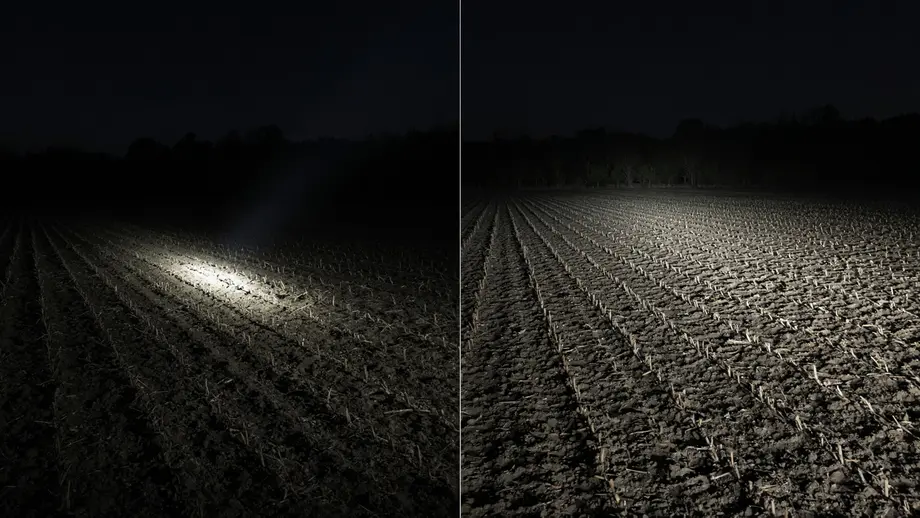
Spill width matters because hogs travel in groups, and a group can break apart the moment a light comes on. A tight beam shows you one animal and leaves the rest in darkness, so you lose the chance to identify a second target and confirm what is behind it. Wide, usable spill keeps the whole group and the backstop in view.
A sounder is a family group of sows and young pigs, and control programs are built around removing all of it. The Arkansas Cooperative Extension Service notes that shooting a few feral hogs in a group "does little to control their numbers and typically 'educates' survivors to avoid humans." It recommends removing the whole sounder, and it lists night shooting with a thermal scope as an effective way to remove hogs "a few at a time," especially ones that avoid traps.
How wide does your light need to be? This table uses simple geometry to show the angle, in degrees, needed to cover a group of a given width at a given distance. Olight does not publish beam angles, so treat this as a way to judge a beam in your own yard, not a spec match.
| Group spread across the field | At 25 yards | At 50 yards | At 75 yards | At 100 yards |
|---|---|---|---|---|
| 10 yards wide | 23° | 11° | 8° | 6° |
| 20 yards wide | 44° | 23° | 15° | 11° |
| 30 yards wide | 62° | 33° | 23° | 17° |
The pattern is simple: close shots need the widest light. At 25 yards, a group 20 yards wide fills 44 degrees, far wider than the bright center of a weapon light beam. Spill has to do that work. At 100 yards, the same group fits in 11 degrees, and reach starts to matter more than width.
Olight's specs give a rough way to compare how much of each light's output goes beyond the hotspot. Divide lumens (total output) by candela in thousands (hotspot intensity). A higher number means more light spread outside the center. This ratio is our own rough indicator, not an Olight or ANSI rating.
| Light | Lumens | Candela | Lumens per 1,000 candela | Beam character |
|---|---|---|---|---|
| Baldr Pro R | 1,350 | 10,000 | 135 | Floodiest, but short reach |
| Odin S | 1,500 | 15,600 | 96 | Broad spill with a strong center |
| Odin | 2,000 | 22,500 | 89 | Broad spill with the most center punch of the white-only lights |
| Odin Mini | 1,250 | 14,400 | 87 | Similar shape to the Odin, less output |
| Odin IR (white) | 1,000 | 38,960 | 26 | Tight, long-reaching beam |
Olight describes the Odin S beam as "a bright central beam with substantial peripheral light, covering both short & medium ranges," which fits the ratio. The Odin IR's white beam is the opposite: it throws far but lights a narrow slice of the field.
Rifle Lights for Hog Hunting Compared: Candela, Lumens, Runtime
For hog hunting, compare rifle lights on candela for reach, lumens for spill, and runtime at the level you will actually use. Among Olight's weapon lights, the Odin puts the most white light on a hog at 100 yards, the Odin S balances spill, recoil hold and battery backup, and the Odin IR adds an infrared illuminator for night vision.
This table collects Olight's official specs and regular prices for the five lights, checked on September 24, 2026. For the full range of weapon lights, see Olight's rail mount lights collection.
| Spec (Olight) | Odin S | Odin | Odin Mini | Odin IR | Baldr Pro R |
|---|---|---|---|---|---|
| Max output | 1,500 lumens | 2,000 lumens | 1,250 lumens | 1,000 lumens | 1,350 lumens |
| Max intensity | 15,600 candela | 22,500 candela | 14,400 candela | 38,960 candela | 10,000 candela |
| Beam distance | 820 ft (250 m) | 984 ft (300 m) | 787 ft (240 m) | 1312 ft (400m) | 656 ft (200 m) |
| High mode runtime | 1,500~650~300 lumens, 3.5 + 110 + 18 minutes (included battery) | 2,000 ~ 1,000 ~ 760 ~ 300 lumens, 2 + 9 + 125 + 24 minutes | 1,250~900~700~200 lumens, 6 + 11 + 39 + 14 minutes | 1,000~450~200~120 lumens, 3 + 165 + 22 + 33 minutes | 1,350~500~300 lumens, 1.5+40+13 minutes (green beam off) |
| Battery | 3500mAh 18650 or CR123A batteries | 5000mAh 21700 | 2040mAh 18500 | 5000mAh 21700 | Built-in 1000mAh |
| Weight | 6.81 oz (193 g) | 7.62 oz (216 g) | 6.21 oz (176 g) | 7.65 oz (217 g) | 4.44 oz (126 g) |
| Waterproof | IPX8 | IPX8 | IPX8 | IPX8 | IPX4 |
| Switch | Tail switch plus included pressure switch | Magnetic tail switch plus included magnetic remote switch | Tail switch plus included ROD-7 magnetic remote switch | Magnetic tail switch plus included sROD-7 wire switch | Rear switches |
| Price (regular) | $149.99 | $159.95 | $139.95 | $169.95 | $169.95 |
Olight's beam distances follow the ANSI FL1 method, which measures how far the beam travels before it falls to 0.25 lux. Our guide to candela vs lumens vs lux explains the math. For hunting, a more useful number is how much light reaches the hog. This table divides each light's candela by the distance squared.
| Light at max output | Lux at 25 yards | Lux at 50 yards | Lux at 100 yards | Lux at 150 yards |
|---|---|---|---|---|
| Odin IR (white) | 74.6 | 18.6 | 4.7 | 2.1 |
| Odin | 43.1 | 10.8 | 2.7 | 1.2 |
| Odin S | 29.9 | 7.5 | 1.9 | 0.8 |
| Odin Mini | 27.6 | 6.9 | 1.7 | 0.8 |
| Baldr Pro R | 19.1 | 4.8 | 1.2 | 0.5 |
These are hotspot figures at full output, before any step-down. At 150 yards, only the Odin and the Odin IR still put more than 1 lux on the target. That does not make every 150-yard shot a good idea. Identification, backstop and your own skill set the real limit.
Olight Odin S: Best Overall Rifle Light for Hog Hunting
The hard parts of hog work are recoil, weather and a long night. The Olight Odin S answers with a screw-locking rail clamp that Olight says "offers reliable stability even under intense recoil," an improved magnetic pressure switch with "a securely fitting screw cap," and an IPX8 rating. It runs on its 3500mAh 18650 or on two CR123A batteries, so a spare pair of CR123A cells in your pack covers a dead battery. On CR123A, output drops to 1000~550~300 lumens, with 10+45+26 minutes on High.
The limits: its 15,600 candela puts about 1.9 lux on a hog at 100 yards, less than the Odin. Stock is also uneven. On September 24, 2026, Olight's page listed the M-LOK Desert Tan and Picatinny Matte Black versions as sold out, leaving the M-LOK Matte Black version available.
Olight Odin: More Reach for Long Fields
Wide crop fields push shots past 100 yards. The Olight Odin is rated at 2,000 lumens and 22,500 candela, which works out to about 2.7 lux at 100 yards, about 44 percent more than the Odin S. It ships with a slide rail mount with a mechanical lock and a magnetic remote switch with a locking ring. Its 5000mAh 21700 battery gives the longest High mode chain of the white-only lights here, 160 minutes in total.
The limits: the 2,000-lumen level lasts 2 minutes before stepping to 1,000 lumens, and Olight does not say whether that timer resets between presses. Plan around 1,000 and 760 lumens, not the headline figure. It uses one custom battery, so bring a charged spare. The regular price is $159.95; on September 24, 2026, the page showed a time-limited sale price of $95.97.
Olight Odin Mini: Lighter Setup for Carbines
Short, light carbines get front-heavy fast. The Odin Mini is the smallest of the family at 4.55 in (115.5 mm) and 6.21 oz (176 g), and its lumen-to-candela ratio is close to the Odin S. It ships with an M-LOK rail mount, a ROD-7 magnetic remote switch and a pressure switch mount, so the switch setup below applies to it too. The limit is endurance. Its 2040mAh 18500 battery runs High for 6 + 11 + 39 + 14 minutes, about 70 minutes in total, so it suits short sits more than all-night watches. Its regular price is $139.95, and the page showed a $97.96 sale price on September 24, 2026.
Olight Odin IR: For Night Vision Hog Hunting
The Olight Odin IR combines a 1,000-lumen white light with a 150 mW infrared illuminator. Its regular price is $169.95; on September 24, 2026, the page showed a time-limited sale price of $84.97. See the IR section below for when an IR light makes sense and when a thermal device is the better tool.
Olight Baldr Pro R: Why It Is Not the Right Rifle Light
The Olight Baldr Pro R is a good pistol light but a poor hog rifle light. Olight lists it for GL and PIC rails and for law enforcement and tactical use. Its built-in 1000mAh battery runs High for 1.5+40+13 minutes, it is rated IPX4 against IPX8 for the Odin family, and its box does not include a remote pressure switch. The user manual adds two limits for a long sit: the top level runs about one minute before stepping down to 500 lumens, and once the battery falls to about 50%, maximum output drops to 500 lumens.
Its green laser also brings safety and legal questions, covered below. The manual rates it Class 3R under IEC 60825-1, with a 510 to 530 nm wavelength and 5 mW maximum output, which sits near the pig's 556 nm cone peak discussed in the next section. Put it on a handgun, and pick an Odin model for the rifle.
What Color Light Is Best for Hog Hunting?
White light is best for identifying a hog and shooting it, because it shows true color, sex, size and whatever stands behind the animal. Red light is least likely to spook hogs while you scan, since pigs are least sensitive to long wavelengths. Green is a middle ground: bright to your eyes, but close to the pig's peak sensitivity.
The science comes from a study of the domestic pig, the same species as wild hogs. In Visual Neuroscience, researchers Jay Neitz and Gerald Jacobs found two classes of cones in the pig's eye with peak sensitivity at 439 nm and 556 nm. The authors conclude that pigs have "the requisite retinal basis for dichromatic color vision."
This table translates those two cone peaks into what each light color means on a hog hunt.
| Light color | How it relates to pig cone peaks (439 and 556 nm) | Best use on a hog hunt |
|---|---|---|
| Red | Longer wavelengths sit well beyond the 556 nm peak | Scanning and approaching with less chance of spooking the group |
| Green | Sits close to the 556 nm peak | Scanning at distance when you accept more risk of being seen |
| White | Covers both peaks and everything between | Identifying every animal and the backstop before the shot |
The study measured where sensitivity peaks, not where it stops, so a bright red beam is less visible to hogs, not invisible. All four Odin models here emit white light only. If you want a red scanning light, carry it separately and switch to white for the identification and the shot. Olight's hunting lights collection covers handheld and long-throw options for that scanning job. For a deeper look at colors for other game, see our hunting flashlight light color guide.
Tip: Treat every press of the white light as a chance to educate the group. Scan with red light, thermal or binoculars, and turn the white light on only when you are ready to identify each animal and, if everything checks out, take the shot.
What Is the Best IR Light for Hog Hunting?
The best IR light for hog hunting is an infrared illuminator matched to a night vision scope or monocular that can see its output. IR light is invisible to the naked eye, so it only helps if your optic is IR-sensitive. A combined white and IR weapon light, like the Olight Odin IR, lets you scan in infrared and switch to white for identification.
The Odin IR is rated for a 150 mW IR beam on High, with 22.5 hours of runtime, and 30 mW on Low, with 91 hours. Olight says its remote switch has "Two-level modes for both indoor and outdoor use," and the box includes a Picatinny rail mount and an sROD-7 wire remote switch. Olight does not publish the IR wavelength, so check it against your night vision device before you buy.
Night vision and thermal do different jobs. Night vision amplifies available light and needs an IR illuminator on dark nights. Thermal imaging reads heat, needs no illuminator and picks warm bodies out of cover, but it shows shapes rather than detail. Many hog hunters use thermal to find the group and white light or night vision to confirm what each animal is. Our guide to thermal monoculars for deer recovery explains how thermal detection works in the field.
Note: IR and thermal use is regulated in some places. Oklahoma lists night vision, thermal imaging and infrared technology as legal under its private land night hunting exemption for feral hogs, but that exemption has conditions. Texas sets no required means and methods for hogs on private land. Check your own state before you add IR.
Where Should You Mount the Pressure Switch on a Hog Rifle?
Mount the pressure switch where your support hand already rests when you shoot, not where it looks tidy on the handguard. For standing or kneeling shots, that is usually under your support thumb or fingertips on the handguard. For shots off a bipod or shooting sticks, your support hand may be on the stock, so the switch must move with it.
Most missed first shots with a remote switch come from a mismatch between the switch location and the hold. This table matches common hog shooting positions to switch placement.
| Shooting position | Where the support hand sits | Where to put the pressure switch | Watch out for |
|---|---|---|---|
| Standing or kneeling, freehand | On the handguard, arm extended | On the side of the handguard under your thumb, at the 9 o'clock position for a right-handed shooter | Pressing it by accident as you grip harder under recoil |
| Shooting sticks | Near the front of the handguard, over the sticks | Where your thumb lands when the rifle sits in the yoke | The stick yoke pressing the switch |
| Bipod from a blind or tower | Often on the stock or a rear bag | On the handguard close to the receiver, or use the tail switch | A switch you cannot reach without breaking your position |
| Vehicle or window rest (where legal) | Either on the rest or the stock | Handguard, close to your hand on the rest | The door frame pressing the switch |
The cable matters as much as the switch. These steps keep it quiet and out of the way:
- Route the cable along the handguard, not across the top. A loop over the top can catch on a scope turret or a rest.
- Keep it clear of the bolt handle and ejection port. Work the action with an empty rifle and watch the cable.
- Tie it down. The Odin box includes two self-locking bands and the Odin S box includes four. Use them to hold the cable against the rail.
- Leave no slack loop past the switch. Slack snags on brush on the walk in.
- Practice with gloves. Cold nights mean thicker gloves and less feel for the pad.
The Olight ROD-7 is Olight's magnetic remote pressure switch for the Odin, Odin Mini, Odin Turbo, Warrior X Turbo and Javelot Turbo. The Odin Mini already ships with one, and the Odin, Odin S and Odin IR ship with their own remote switches, so a separate ROD-7 is a spare or a second switch for another position. It lists at $32.95, but its page showed "Notify me" on September 24, 2026, so it was not in stock. For more on switch styles, see our guide to the remote pressure switch for a tactical flashlight.
Warning: A pressure switch is not a scanning tool for a loaded rifle. Every time you press it, you point the muzzle where the light goes. Scan with a separate light or with binoculars and a thermal device, and bring the rifle up only on animals you have already identified.
Common Mistake: Buying for Throw and Ignoring Spill
The most common mistake hog hunters make with rifle lights is buying the longest beam distance on the box. Beam distance measures the hotspot, not how wide the light spreads. Most night hog shots are at feeders, food plots and field edges inside 100 yards, where spill decides whether you see the second hog and the backstop.
This list pairs common mistakes with a fix for each one.
- Buying on beam distance alone. Fix: compare lumens per 1,000 candela as well, and check the beam in your own yard at your typical shot distance.
- Planning around the turbo level. Fix: read the step-down chain. The Odin runs 2,000 lumens for 2 minutes, then 1,000 lumens for 9 minutes, then 760 lumens for 125 minutes.
- Mounting the light where the barrel or suppressor casts a shadow. Fix: move the light forward on the rail so the bezel sits near the end of the handguard, and check for a dark band in the beam.
- Never checking the mount. Fix: paint witness marks across the screws and the rail, and look at them after every range session.
- Relying on one custom battery. Fix: carry a charged spare, or choose the Odin S so CR123A cells can serve as backup.
- Aiming the rifle to see what made a noise. Fix: identify with a handheld light, binoculars or thermal first.
Runtime also deserves a real plan. If you light the field for 20 seconds every 15 minutes during a 6-hour sit, that adds up to 24 activations and 8 minutes of light. That total is longer than the top step of every light here, which lasts 1.5 to 6 minutes, so expect most of that light to come from the second step down unless the timer resets between presses.
What Is the Best Caliber of Rifle for Hog Hunting?
There is no single best caliber for hog hunting. A centerfire deer cartridge you shoot accurately, with a bullet that penetrates, will handle most hogs. The .308 Winchester is a common all-around choice. Light .22 centerfire rounds work for precise head shots but are marginal for body shots on big boars. Shot placement matters more than cartridge.
Veteran hunting writer Craig Boddington lays this out in Petersen's Hunting's guide to picking ammo for boar. He calls the .308 Winchester "a fine choice for almost any pig anywhere in the world." For body shots, he writes, ".22 centerfires aren't enough for clean kills," and 6mm and .25 caliber rounds are "marginal for body shots on large boars." His summary: "how well you place the shot is a lot more important than what you are shooting."
This table sums up how the cartridge questions hunters ask most often fit a night hog setup.
| Question hunters ask | Short answer | What it means for your light |
|---|---|---|
| Is 5.56 or .308 better for hogs? | .308 gives more margin on big boars; 5.56 needs careful placement and tough bullets | Either way, you need enough light to see the exact aiming point |
| Is .308 overkill for hogs? | No; it is a common choice for big boars | More muzzle blast and recoil make a locking mount more important |
| Is 300 Blackout good for hogs? | A .30 caliber round built for short barrels; keep shots close and use a bullet made for big game | Short shots favor a wide beam like the Odin S |
| Will a 9mm stop a wild hog? | Boddington suggests a .44 Magnum or larger for handguns | A pistol light like the Baldr Pro R belongs with a sidearm, not as your main rifle light |
Caliber also has a legal side. Oklahoma's hog regulations say that during open big game gun or muzzleloader seasons, anyone chasing hogs with a rifle or handgun larger than .22 caliber rimfire must hold the license for that season, unless exempt.
Is Night Hog Hunting Legal? State Rules and Landowner Permission
Night hog hunting with a light is legal on private land in Texas and Oklahoma, but the two states get there differently. Texas sets no hunting hours or required methods for feral hogs on private property. Oklahoma requires a night hunting exemption tied to the landowner. Rules also change for public land and deer season, so check your state's current regulations and carry written permission.
This table compares the two states using each state's wildlife agency regulations and, for Texas, the statute text. It is a summary for comparison, not legal advice, and it was checked against the 2026-27 rules on September 24, 2026.
| Rule | Texas | Oklahoma |
|---|---|---|
| Season and limits on private land | No closed season, hunting hours, bag or possession limit for feral hogs | Year-round in daylight with permission; no daily limit |
| License on private land | Not required with landowner consent (Parks and Wildlife Code 42.002(c)); Hunter Education requirements apply | Not required, except the big game season license when using a rifle or handgun larger than .22 rimfire, or a slug gun, during open big game gun or muzzleloader seasons |
| Who may hunt at night on private land | Anyone with landowner permission; state night hunting limits cover protected game, not feral hogs | The deed-holding landowner or written designee with a night hunting exemption; outside the 16-day deer gun season, other hunters may shoot under it with a copy of the exemption and written permission |
| Spotlights, weapon lights, night vision, thermal, IR | No required means and methods for hogs on private land; lighting a game animal such as a deer is unlawful | Night vision, thermal, infrared scopes and spotlights, including those mounted on firearms, are listed as legal under the exemption |
| During deer season | Hogs stay legal, but a deer caught in the beam is never a legal target | During the 16-day deer gun season, only the landowner, designee or their family may night shoot, and the exemption holder must be present |
| Public land | License required; the license exemption covers only the landowner's land, and each public area has its own rules | No shooting hogs at night on public land |
| Game warden contact | No notice rule for hogs; TPWD asks night hunters of nongame species to call the local game warden as a courtesy | Encouraged outside deer gun season; advance notice required during it |
| Roads | No hunting from or across a public road | No shooting from, to, on or across a public roadway |
The Texas column rests on three official sources. TPWD's Outdoor Annual page on nongame and exotic species says "No hunting license is required to hunt feral hogs on private property with landowner authorization," and that on private property there are "no required means and methods of take, state bag or possession limits, or closed seasons (hunting hours)" on exotic and other non-protected species. Parks and Wildlife Code Chapter 62 limits night hunting (Section 62.004) and hunting with a light (Section 62.005) to protected game animals and birds, and Section 42.002(c) lets a landowner, or anyone with the landowner's consent, take feral hogs on that land without a license.
The Oklahoma column comes from the ODWC hog regulations and its feral hog FAQ. The regulations add a second route for farmers: outside deer gun seasons, a landowner or agricultural lessee with an agricultural exemption permit from the Oklahoma Tax Commission, or their written agent, may control depredating hogs day or night with a headlight, thermal imaging device, night vision or a spotlight, but not from a public road.
Hogs share fields with deer, and the light rules do not. TPWD's means and methods rules make it unlawful to hunt "with the aid of artificial light of any form that casts or reflects a beam of light onto or otherwise illuminates a game animal or bird." If a deer walks into your beam, it is not a legal target. The same page bans shooting across a property line without written permission from the owner of the land the bullet crosses, and any means or method banned by county or city ordinance.
Note: Hog rules change often, and counties and cities can add their own limits. Before your first night out each season, read your state agency's current hog page, confirm any permit or exemption is in your pocket, and call the local game warden if you are unsure.
Identification is the rule that never changes. TPWD's hunter education course tells hunters to "Be sure of your target and what is in front of and beyond your target" and to "Never shoot at a sound or movement." At night, that means confirming each animal is a hog, that no livestock, dog or person is in the group or behind it, and that the ground behind the hog will stop a bullet.
Safety note: Before a night hunt, walk the field in daylight. Note houses, roads, barns, livestock pens and rises that could hide what is beyond the target. Agree on firing lanes with anyone hunting with you, and never shoot at a hog on a ridge or skyline.
How to Check a Rifle Light Before Hog Season
Check a rifle light before hog season by confirming four things at home and on the range: how wide the usable beam is at your shot distance, whether the mount holds after firing, whether your hand finds the switch without looking, and how long the battery lasts at the level you use. Each check needs simple gear and one evening.
This table lays out a repeatable check you can run yourself. It is a method for your own setup, not a record of results.
| Check | Equipment | Method | How many times |
|---|---|---|---|
| Usable beam width | Tape measure, two stakes or reflective markers | Pace off your usual shot distance at night, then move a marker sideways until you can no longer tell a hog-sized shape from the background | Once for each light and distance |
| Mount security | Paint pen, the wrench from the box | Mark across the screws and rail, fire a normal range session, then check the marks and try to rock the light by hand | After every range session |
| Switch access | Unloaded rifle, your hunting gloves, shooting sticks or bipod | In the dark, from each position you use, bring the rifle up and press the switch without looking | 20 presentations for each position |
| Runtime at your level | Fully charged battery, phone timer | Run the light at the level you hunt with, in short bursts, and note when it steps down | Once per battery |
| Weather readiness | Spray bottle, cold night | Wet the light and switch cable, then confirm the switch still works; check gloves and cold hands | Once before the season |
Dry work with the rifle belongs at home only with the rifle unloaded and no ammunition in the room. Use the range for anything that involves firing.
FAQ
Changelog
- September 21, 2026: First published. Olight specs and prices checked September 24, 2026.