



TL;DR: A flashlight size chart helps compare a light’s length, widest diameter, and weight basis with the storage space you actually use. A 60.5 mm keychain light and a 133 mm broad-head model show why length alone can mislead. Lumens describe output, not size. Measure the opening and depth before choosing.
📋 Table of Contents
- 1. Fast answer: compare more than length
- 2. Read a flashlight size chart correctly
- 3. Olight size chart: keychain to searchlight
- 4. What dimensions matter in a flashlight?
- 5. Choose a size for the place it will be carried
- 6. What counts as a medium flashlight?
- 7. How battery format affects the package
- 8. Does a smaller flashlight make a better everyday carry light?
- 9. How size, output, heat, and runtime fit together
- 10. A practical flashlight sizing method
- 11. What are the different sizes of flashlights?
- 12. What is the best medium-sized flashlight?
- 13. How many lumens do you need for a good flashlight?
- 14. Frequently Asked Questions
- 15. Conclusion
Fast answer: compare more than length
Flashlight size is the complete storage envelope: length, widest head diameter, body diameter, and weight under a stated battery basis. Those numbers help a shopper compare a light with a pocket, pouch, pack compartment, or vehicle slot. Measure the actual storage place first, then compare the entire flashlight profile, rather than only its length or lumen rating.
| Size reference | Example | Listed dimensions | Weight basis |
|---|---|---|---|
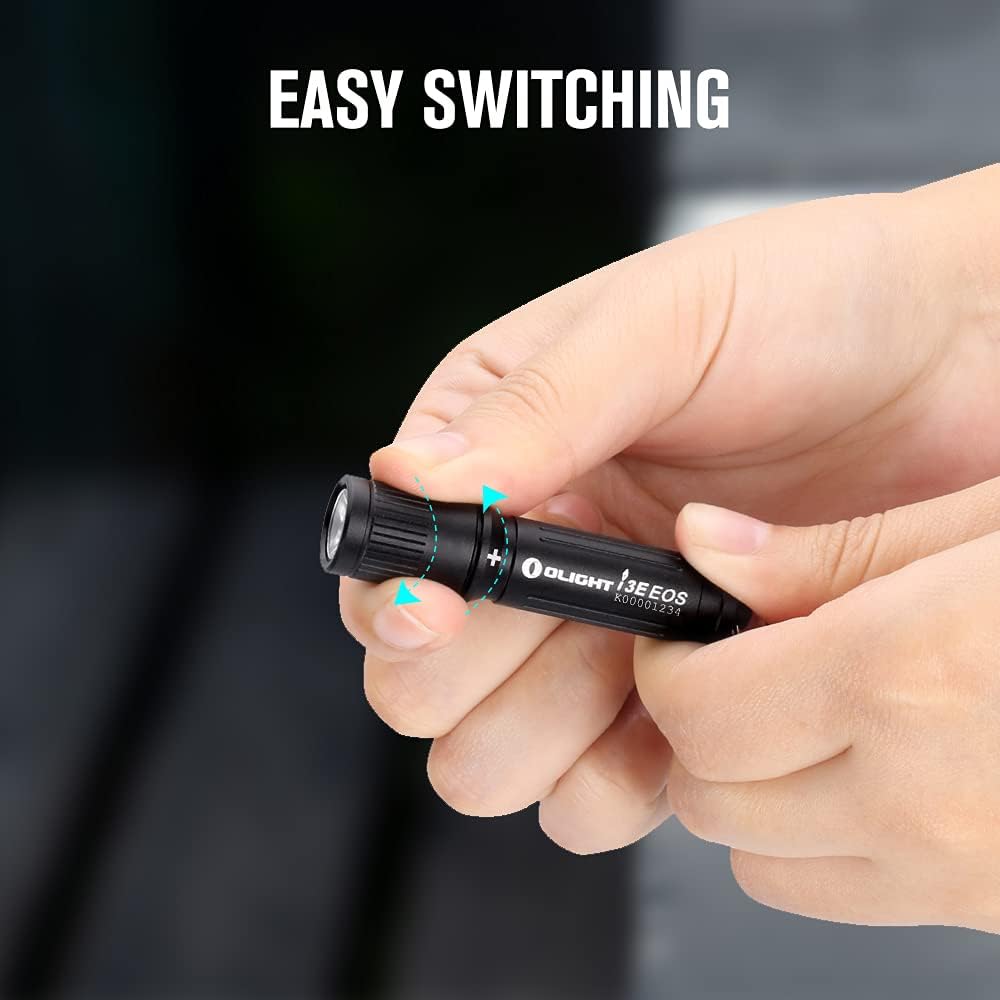
| Keychain | i3E EOS | 60.5 mm long; 14 mm head | 19.4 g, included battery |
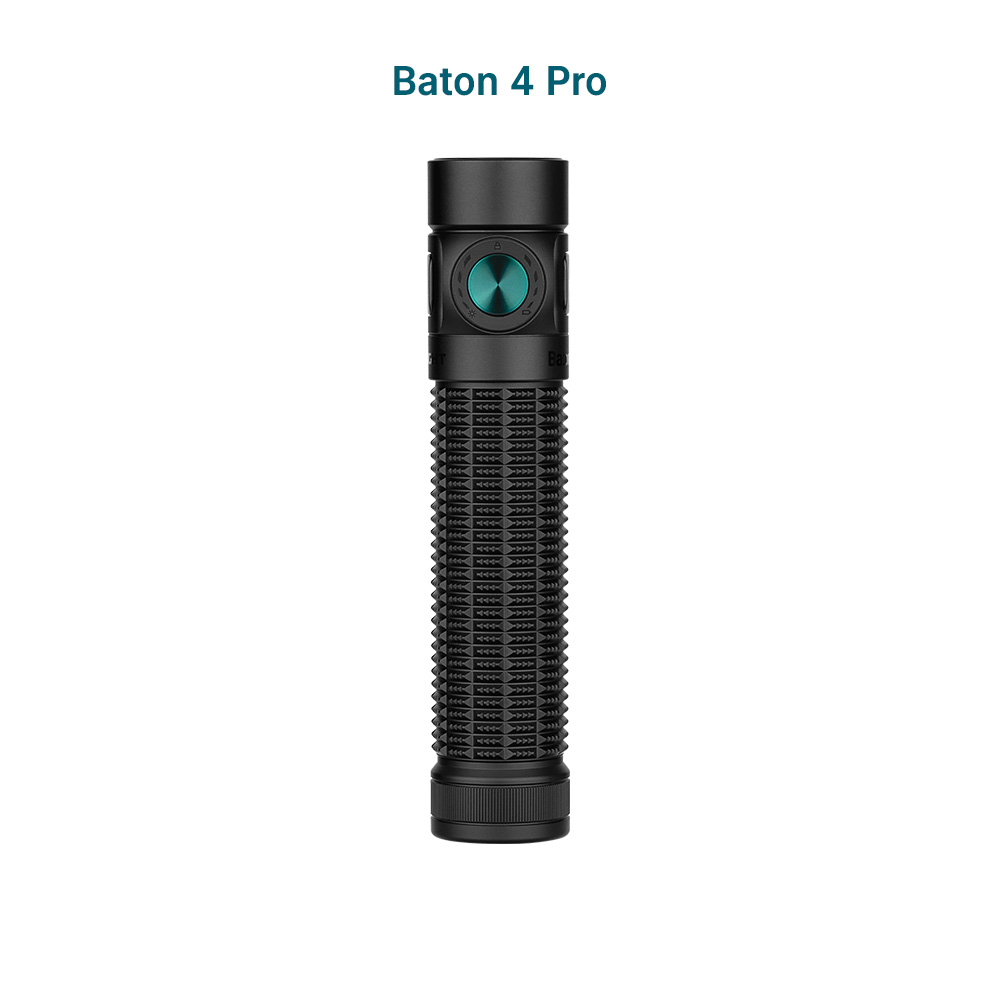
| Compact handheld | Baton 4 Pro | 111 mm long; 23 mm body | 114 g with battery included |
| Longer handheld | Warrior 3S | 139 mm long; 29.5 mm body | 176 g, including battery |
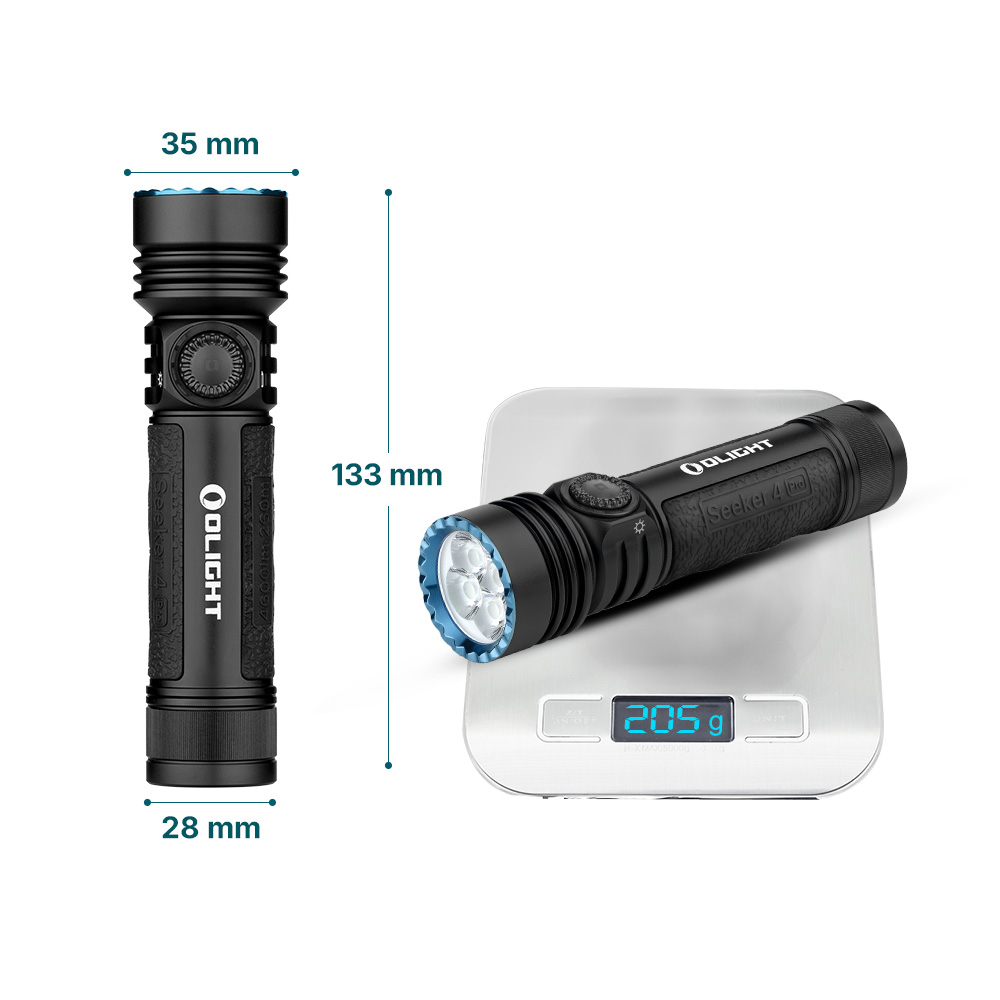
| Broad-head handheld | Seeker 4 Pro | 133 mm long; 35 mm head | 205 g standard finish; 350 g Silver-Plated Bronze, battery included |
| Large-head form | Marauder Mini 2 | 133 mm long; 66 mm head | 465 g, battery included |
Read a flashlight size chart correctly
A flashlight size chart is a comparison tool, not a promise that a light will fit every pocket. Length tells how much straight-line space the body needs. Head diameter tells whether the widest end can pass through an opening. Weight tells how much mass the carry system must support. Battery type can help explain why two lights with similar lengths feel very different, but the battery label alone does not tell you the complete size.
The most useful comparison keeps units and measurement bases consistent. The chart below uses millimeters and grams as the primary units, with inches and ounces where the cited U.S. product information supplies them. Dimensions are Olight-published product specifications. A value marked “not listed” is deliberately omitted rather than estimated from a product photo.
| Comparison term | What it describes | How to use it | What it cannot tell you alone |
|---|---|---|---|
| Length | End-to-end body dimension | Compare with the usable depth of a pocket, pouch, drawer, or vehicle slot | Whether the head or tail will pass through an opening |
| Head diameter | Widest front section | Compare with the narrowest opening of a pouch or compartment | How comfortable a light feels in a particular hand |
| Body diameter | Width of the main tube or handle | Compare with a sleeve, organizer loop, or grip preference | Whether a clip or attached accessory adds width |
| Weight | Mass under the maker’s stated conditions | Compare carry burden among lights and check support hardware | How the light balances in the hand or moves in a pocket |
| Battery format | The power source family or included pack | Understand charging and replacement requirements | A complete measurement of the flashlight’s body |
A product page may show length and diameter in inches, millimeters, or both. When a value is converted, rounding can make the figures look slightly inconsistent: 4.37 inches is approximately 111 millimeters, while 5.24 inches is approximately 133 millimeters. That is ordinary rounding, not a second body size. Use the manufacturer’s paired values when provided, and do not compare a rounded inch figure from one listing with a high-precision metric value from another as though the difference were meaningful.
The most common chart-reading mistake is to reduce size to a single “small, medium, or large” label. A short light with a broad head can be harder to store in a narrow sleeve than a longer, slimmer one. A light can also feel compact in a backpack but substantial on a key ring. Size is a relationship between the product and its carrying place, rather than a universal verdict printed on the box.
Olight size chart: keychain to searchlight
The following examples show a useful span of forms without treating informal size labels as a fixed industry standard. The dimensions and weights are Olight-published specifications. Check the exact model and finish because variants can differ.
| Olight model | Length | Head diameter | Body diameter | Listed weight and basis | Battery information shown by source | Carry location to assess |
|---|---|---|---|---|---|---|
| i3E EOS | 60.5 mm / 2.38 in | 14 mm / 0.55 in | 12.5 mm / 0.49 in | 19.4 g / 0.68 oz; manual says included battery | One AAA battery in package | Key ring or small organizer sleeve |
| Baton 4 Pro | 111 mm / 4.37 in | Not listed in cited specification table | 23 mm / 0.90 in | 114 g / 4.02 oz, battery included | Customized 3.6 V, 3,500 mAh 18650 rechargeable battery | Pocket or compact pouch; measure the opening |
| Warrior 3S | 139 mm / 5.47 in | Not listed in captured U.S. page | 29.5 mm / 1.16 in | 176 g / 6.21 oz; including battery | Customized 3.6 V, 5,000 mAh 21700 rechargeable battery | Holster or backpack sleeve; check accessory setup |
| Seeker 4 Pro | 133 mm / 5.24 in | 35 mm / 1.38 in | 28 mm / 1.10 in | 205 g standard finishes; 350 g Silver-Plated Bronze, battery included | Customized 3.6 V, 5,000 mAh 21700 lithium-ion battery | Wide-opening pouch or vehicle organizer |
| Marauder Mini 2 | 133 mm / 5.24 in | 66 mm / 2.60 in | 43 mm / 1.69 in | 465 g / 16.38 oz; battery included | Customized 3.7 V, 7,500 mAh, 27.75 Wh, 32650 rechargeable lithium battery | Backpack compartment or vehicle kit; check width and mass |
For readers comparing the wider flashlight lineup, the rechargeable flashlight collection and pocket flashlight selection provide broader starting points. For a related overview of body shapes and where they can be carried, see flashlight types by body shape. The product links for this chart appear once each in the product cards below.
The carry column gives places to measure, not a promise that any light fits every pocket, pouch, or organizer.
The table makes one point especially clear: equal length does not mean equal storage needs. The Seeker 4 Pro and Marauder Mini 2 are both listed at 133 mm long, but the Marauder Mini 2’s head diameter is 66 mm versus 35 mm for the Seeker 4 Pro, and its listed weight is 465 g versus 205 g for a standard Seeker 4 Pro finish. A compartment sized only by length could accommodate the number on paper while still being too narrow or awkward for the wider light. Check all three dimensions and the item’s weight.
The i3E EOS is the keychain-scale reference in this set. Its listed 60.5 mm length and 14 mm head diameter describe a compact cylinder with an AAA battery. That does not mean it should be treated as a substitute for a larger light in every task; it simply shows what a notably small body looks like in a product specification. The Baton 4 Pro, at 111 mm and 114 g with battery included, is longer and heavier than the keychain reference, with a 23 mm body. That is a meaningful jump in physical presence even before a reader compares brightness or runtime.
The Warrior 3S and Seeker 4 Pro sit in a more substantial handheld range by their listed lengths and battery formats. Their similar 21700 battery class does not make their bodies identical: the Warrior 3S is listed at 139 mm long with a 29.5 mm body, while the Seeker 4 Pro is 133 mm long and 28 mm at the body, but has a 35 mm head. The head measurement matters when a light needs to slide into an organizer sleeve or pass through a narrow opening.
The Marauder Mini 2 demonstrates why “searchlight” should not be interpreted as simply “longer flashlight.” It is listed at the same 133 mm length as the Seeker 4 Pro, yet has a much broader head and body and a higher listed mass. A larger head can make an otherwise short package occupy more volume. When comparing large-output forms, account for the extra width and weight rather than judging by length alone.
Product choices in context
These are specification examples that make the size categories concrete. Each card states why its form may be useful to compare and keeps the purchase link with its one product-detail reference. Check the current U.S. listing and selected configuration before ordering.

What dimensions matter in a flashlight?
Length is the first check, not the final check
Length is easy to compare because it is one number. Put a ruler against the storage area you plan to use and measure the usable depth, rather than the outside dimension of the pocket or pouch. A pocket may taper, curve, or stop short of the seam. A vehicle compartment may have a lip or divider that reduces the available space. A pack side pocket can be elastic, but its opening and depth still determine what can be inserted and removed conveniently.
Measure the product from the front of the head to the tail end using the official value as a starting point. If a pocket has 120 mm of clear internal depth, a 139 mm light is longer than that available space; no amount of optimistic product photography changes the arithmetic. If the product is shorter than the measured depth, width and access still need checking. Avoid claims such as “fits most jeans” unless a specific pocket and test have actually been measured.
Head diameter and body diameter answer different questions
The body diameter describes the main tube or grip area. The head can be wider. For a sleeve or loop, check the narrowest opening and the widest point that must pass through it. On the Seeker 4 Pro, for instance, the listed body diameter is 28 mm and the head is 35 mm. An opening that accepts a 28 mm tube may still not accept a 35 mm head.
Head width also changes how a product sits when laid flat. A broad head can prevent the body from resting flush against a narrow surface or may occupy the neighboring space in a compartment. This is not inherently a disadvantage; it is simply part of the complete shape. When the product includes a holster, charging dock, clip, or protective case, check accessory dimensions separately. The body chart does not include the added volume of every accessory.
Weight needs a stated basis
A weight without context is easy to misread. Some listings state “including battery”; others may call the value net weight without spelling out battery inclusion in that line. A light with its battery installed is the practical carry weight for many readers. A shipping weight includes packaging and should not be compared as though it were the bare product. A weight measured with a holster attached should identify that accessory.
The i3E EOS manual gives 19.4 g with the included battery. The Warrior 3S, Baton 4 Pro, and Seeker 4 Pro U.S. product details also provide battery-included weights. Keeping the basis visible makes the chart more useful for estimating what a reader will carry.
When two models are compared, distinguish absolute mass from carry experience. A 50 g increase may be noticeable on a key ring because it moves with keys; the same increase can matter less in a padded backpack compartment. That is a reason to test the actual carry arrangement, not a promise that a particular person will or will not notice the difference.
Choose a size for the place it will be carried
Pants pocket
Start with three checks: usable depth, opening width, and how the pocket moves while walking or sitting. Measure the pocket inside the garment with it lying flat, then check how the opening behaves when worn. Do not use the garment’s labeled size as a substitute for measuring the actual pocket. A rigid flashlight may sit differently from a phone because its cylindrical shape can press against seams or rotate as the fabric moves.
A pocket clip or holster changes the way a light is retained. It may improve access, but it can also change where the head sits and how the fabric bears the load. Before relying on a clip, confirm the exact accessory comes with or is compatible with the chosen model. A product’s page, package contents, and user manual are better sources for this detail than assumptions based on a similar-looking flashlight.
Waist pack or organizer pouch
A pouch is easier to evaluate if its internal length and narrowest opening are known. Measure from the closed end to the zipper or closure, then measure across the opening. If the pouch has internal dividers, check the compartment rather than the outer shell. Leave enough room to draw the light out without catching the head or tail on nearby items.
For a heavier model, consider the pouch’s closure and the way it is attached. A zipper pocket may hold the light securely but make fast access slower. An open sleeve can be quick to reach but may need a retention strap. This is an equipment-layout decision, not a product performance claim. The relevant question is whether the complete light and intended accessory fit the pocket you actually use.
Backpack side pocket
Side pockets vary widely: some are deep and narrow, others are broad mesh pockets with a compression cord. Check the opening and depth, and consider whether the light could slide out when the pack tips. A larger flashlight may be better placed in an internal compartment or a dedicated sleeve if the outer pocket is shallow. The listed body dimensions give a starting point, while the backpack’s construction decides the actual fit.
If the light is stored beside a water bottle, cooking gear, or other hard objects, account for abrasion and impact. Use the product’s provided case or a suitable divider where appropriate, and follow the manufacturer’s storage guidance. Do not infer that a light is protected from every impact simply because its body is metal or its product page gives a water-resistance rating; those describe separate conditions.
Vehicle storage
A flashlight intended for a car should be easy to retrieve and should not interfere with pedals, controls, airbags, or normal vehicle operation. A door pocket, center console, seat-back organizer, and glove compartment have different shapes. Measure the exact compartment, including the opening and any internal obstruction. If the light is kept in a hot or cold vehicle, consult the manual for the product’s temperature and storage guidance rather than assuming all batteries tolerate the same conditions.
A larger head may prevent a light from lying in a narrow channel even when the product’s length is short enough. A long slim light can fit one slot but not another. For a vehicle emergency kit, also consider whether the charger or spare battery is stored nearby and whether the selected light is still accessible after other kit items are packed.
What counts as a medium flashlight?
“Medium-sized flashlight” is a shopping phrase, not a universal dimensional standard. One retailer may use “medium” for a light around the length of a hand; another may classify a larger head or battery family differently. A useful practical definition is relative: a medium handheld is larger than a keychain light, yet still intended to be managed as a handheld tool rather than stored as a large searchlight. Always compare the exact model dimensions instead of assuming the label sets a consistent boundary.
Among the examples here, the Baton 4 Pro at 111 mm offers a compact handheld reference, while the Warrior 3S at 139 mm is longer and has a thicker body. The Seeker 4 Pro has a 133 mm length but a wider 35 mm head than its 28 mm body. Those comparisons help explain why “medium” is not captured by length alone. They do not establish a best size for every hand or task.
The best medium-sized flashlight is the one whose dimensions, controls, battery/charging setup, and output range match the intended job and carrying location. For frequent pocket carry, a reader may prioritize body diameter and weight. For home utility, a wider grip or larger battery format may be an acceptable tradeoff. For a vehicle emergency kit, storage security and temperature guidance may matter more than a few millimeters of length.
Hand size also deserves a real-world check. If possible, handle the product in person or compare its printed dimensions against an object you can hold. A paper outline at the product’s stated length and width is a simple way to estimate volume; it is not a substitute for testing grip texture, switch reach, or balance. Product photos can be useful, but perspective and image cropping make them poor rulers.
How battery format affects the package
Battery size is one factor in a flashlight’s overall dimensions, but the light’s optical system, reflector or lens arrangement, body design, controls, charging method, and accessory interfaces contribute too. The chart shows that the i3E EOS uses one AAA battery, Baton 4 Pro is listed with a 3.6 V 3,500 mAh 18650 rechargeable battery, and Warrior 3S and Seeker 4 Pro use a customized 21700 pack in the cited product information. Marauder Mini 2 is listed with a customized 32650 rechargeable pack. These formats correspond to different product designs; they do not by themselves predict an exact body length or runtime.
Battery chemistry and model compatibility matter. Use only the battery type approved for the exact flashlight and follow the manufacturer’s charging and replacement instructions. A cell that looks similar may have a different chemistry, protection circuit, terminal shape, or voltage. Never treat diameter and length alone as proof of electrical compatibility. This chart is about physical comparison, not permission to substitute batteries.
A built-in or customized rechargeable battery can change how replacement and charging work. A product may support more than one charging route, such as a USB-C connection and a magnetic cable, but that does not mean every cable or battery is interchangeable. Check the exact manual for the product and generation. For storage planning, include the charging cable, stand, holster, or case only if it will travel with the flashlight.
Does a smaller flashlight make a better everyday carry light?
Not automatically. Small size can make a light easier to attach to keys or reserve space for, but a tiny light may not offer the grip, control layout, battery arrangement, or output profile a particular task calls for. A larger model may be more comfortable for repeated handheld use or provide additional operating modes, but it asks for more storage space and adds mass. These are tradeoffs to match to daily habits, not a ranking where one size wins.
A useful EDC decision starts with the task that actually occurs. If the usual need is finding a lock, locating an item in a bag, or checking a dark corner briefly, the reader may value fast access and compact storage. If the light is used for longer walks, home maintenance, or outdoor work, battery and control considerations may carry more weight. These examples explain how to frame the choice; they do not assert that any particular model is proven best for every user.
Think about retrieval as well as storage. A light that fits at the bottom of a deep bag may be physically portable but inconvenient to reach. A clip may improve access but be uncomfortable in a specific pocket. A keychain light can be available whenever the keys are present, while also making the key ring heavier. The most suitable setup is the one that is both carried and accessible when needed.
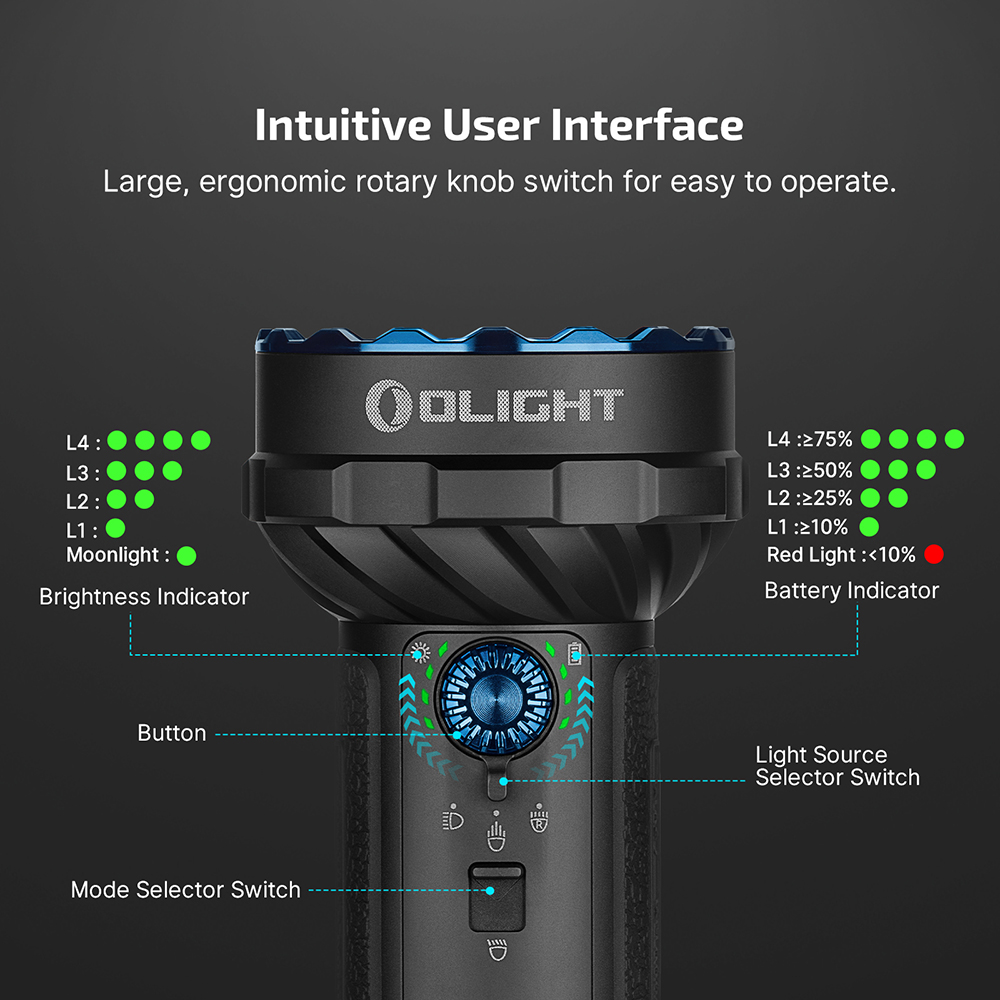
For product selection, compare exact specifications first and use product images to understand controls or accessories. The Baton 4 Pro page lists a side switch and tail switch; the Warrior 3S package contents include a holster and pocket clip; the Seeker 4 Pro details describe its charging options. Those facts can inform a carry plan, but the buyer should verify the exact selected SKU and included accessories on the current U.S. detail page before purchase.
How size, output, heat, and runtime fit together
A flashlight’s physical size and its lumen rating answer different questions. Lumens describe light output; they do not directly tell a reader how far a beam reaches, how broad it appears, how long a mode lasts, or how much space the light occupies. A search-oriented beam and a broad flood beam can produce different visual results even when a headline lumen figure is similar. Product specifications should be read by mode and conditions, not reduced to one maximum number.
Olight product pages list Baton 4 Pro at a maximum 1,600 lumens, Warrior 3S at 2,300 lumens, Seeker 4 Pro at 4,600 lumens, and Marauder Mini 2 at 10,000 lumens. These are manufacturer-published maximum performance figures for the named models; each belongs to its listed product and output mode. Product manuals and detail pages include staged modes and runtime information, so use the exact source for the model selected.
Heat and power management affect how output behaves over time. Inspect the published mode and runtime tables and read the notes associated with each high-output step. For longer use, a lower working mode may be more relevant than a brief maximum. More lumens are not automatically better if the light is too large to carry or if the selected output is unnecessary for the task.
How many lumens do you need for a good flashlight? There is no single number that defines “good.” Start with the viewing distance, field of view, surrounding surfaces, task duration, and whether the light must be carried continuously. Use manufacturer mode tables to understand the choices, and remember that beam intensity and beam pattern matter alongside lumens. Select a light with useful lower modes and controls that suit the task, rather than buying solely by the largest printed figure.
A practical flashlight sizing method
Use this sequence before choosing a model:
- Name the carry location. Pick the actual pocket, pouch, pack compartment, drawer, or vehicle slot. “EDC” is not a measurement.
- Measure usable length. Check the inside depth and account for seams, dividers, closures, or a curved compartment.
- Measure the opening and narrowest point. Compare with both body and head diameter. For a product with a larger head, measure the widest end separately.
- Compare weight on the same basis. Prefer battery-included weight when that reflects how the light will be carried. Use the manufacturer’s stated basis; here, all listed flashlight weights include the battery.
- Include accessories. A holster, clip, protective case, charging stand, or cable can change the storage plan. Check whether it is included or sold separately on the exact product page.
- Match battery and charging to the routine. Confirm the battery type and approved charger in the manual. Do not substitute cells based only on physical fit.
- Choose output after size. Once the carry constraint is clear, compare beam use, output modes, runtime, controls, and charging against the intended task.
- Re-check the selected SKU. Colors, bundles, and product generations can differ. Confirm the current U.S. product detail page and package contents at checkout.
A paper template can help. Draw a rectangle using the published length and widest diameter, then wrap it into a cylinder approximation or use a rolled strip to check a pouch opening. Use the outline to estimate volume. It cannot reproduce the exact grip shape, clip, texture, balance, or accessories. If the carry experience is important, handling the flashlight or testing the actual bag is more reliable than relying on a picture.
Common flashlight size-chart mistakes
Before choosing a light from a chart, use these checks to separate a genuinely useful specification from a number that can mislead a storage or carry decision.
| Mistake | Better reading | Why it matters |
|---|---|---|
| Comparing length only | Compare length, widest head, body diameter, and weight | A short wide-head model can need more space than a longer slim model |
| Treating “medium” as a standard | Use exact manufacturer dimensions | Retailer size labels are not consistent measurements |
| Comparing bare weight to battery-included weight | Record the stated weight basis | The numbers describe different carry configurations |
| Assuming battery format predicts length | Use the actual model dimensions | Design and optical layout also affect the body |
| Treating maximum lumens as sustained output | Read mode and runtime details for that model | Peak and working levels answer different questions |
| Assuming a product photo is to scale | Use the listed specifications | Camera perspective and cropping distort apparent size |
| Claiming a pocket fit without a pocket test | Measure the actual pocket and light | Garments and pouches differ, even when labels match |
These checks make a flashlight size chart useful beyond this five-model comparison. They also prevent a familiar shopping surprise: a light that looked small on a product page but has a head too wide for the sleeve already in the drawer. The fix is simple: measure the storage space, compare the whole profile, and check the weight basis before deciding.
What are the different sizes of flashlights?
Flashlights are often described informally as keychain, compact handheld, full-size handheld, or large searchlight forms. Those labels are not a universal dimensional standard. Compare manufacturer-listed length, head diameter, body diameter, and weight. In the Olight examples above, the 60.5 mm i3E EOS shows a keychain-scale form, the 111 mm Baton 4 Pro is a compact handheld reference, and the 133 mm Marauder Mini 2 illustrates a short but broad-headed large-output form. The length alone does not define the storage envelope.
What is the best medium-sized flashlight?
There is no single best medium-sized flashlight for every person or task. First decide where it will be carried, then compare the exact product dimensions and weight with that space. The Baton 4 Pro and Warrior 3S provide different handheld references in this chart: the former is listed at 111 mm and 114 g with battery included, while the latter is 139 mm and 176 g including battery. Both figures include their batteries, so their listed weights can be compared on the same stated basis. The right choice depends on carry access, controls, power system, output needs, and the actual storage location. Verify the exact product and included accessories on the current U.S. page.
How many lumens do you need for a good flashlight?
The needed lumen level depends on the viewing distance, beam pattern, task, environment, and how long the light must operate. A good flashlight is not defined by maximum lumens alone. Compare the product’s useful modes and their runtime details, and consider whether a flood, throw, or combined beam suits the task. Use the exact official specifications for a model; do not interpret a peak output as a promise of continuous operation at that level.
Frequently Asked Questions
Conclusion
A useful flashlight size chart compares the complete package: length, head diameter, body diameter, and weight under a clear battery basis. The Olight examples span a compact AAA keychain light, compact and full-size handheld forms, and a broad-headed light of the same listed length as a slimmer handheld. For a confident choice, measure the place where the flashlight will ride, compare the widest point as well as length, account for accessories, and use the manual’s battery and charging guidance. Then weigh output modes and runtime against the real task. That process turns “Will this fit?” from a guess into a checkable decision.
Changelog
- November 19, 2026: Product information and buying guidance reviewed.




