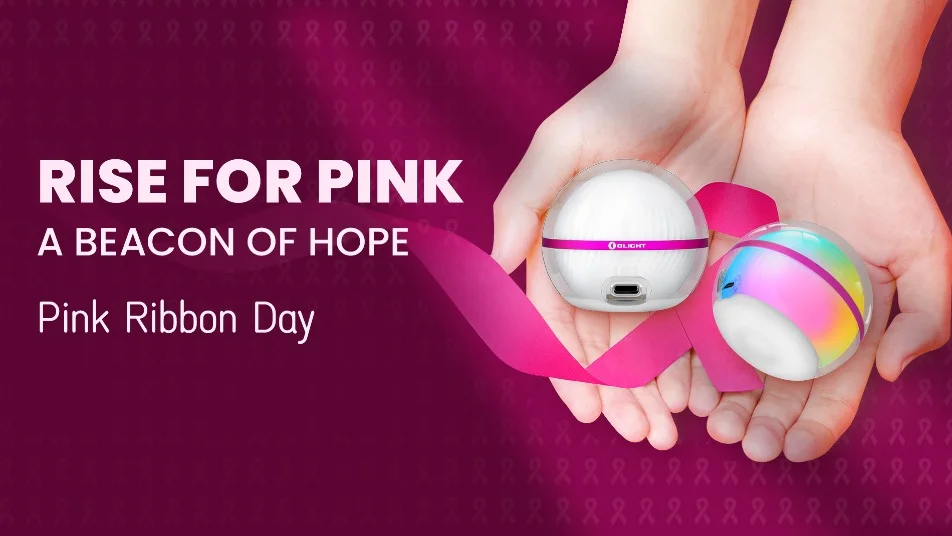
Olight makes the lights discussed here. Olight specs, regular prices and manual quotes come from its US product pages and user manuals as listed in fall 2026. The energy-per-gram figures, step counts and form scores below are calculations and counts from those published numbers, not measurements.
⚡ TL;DR
Different flashlight types are best sorted by body shape, because the shape decides where a light rides: pocket, clip, belt, head or table. That carry spot sets what the light can do before lumens matter. Pick the form from how you carry it, then compare output within that form, using weight and battery watt-hours as the first two numbers.
Most first-time buyers compare lumens across tabs and end up with the wrong shape. A 1,800-lumen tube that never leaves the drawer, a clip light that points at the sky from a shirt pocket, or a 462 g searchlight bought for dog walks. This guide sorts nine body shapes by carry method, with Olight's official sizes and weights, a scenario table and a checklist.
This table gives the quick answer on different flashlight types: the one to start with for each carry spot, with one Olight example.
| Where the light rides | Flashlight type to start with | Olight example (official specs) | Regular price |
|---|---|---|---|
| Front pants pocket | Straight tube | Baton Ultra: 113 x 23 mm, 115 g, 1,800 lm | $99.99 |
| Slim pocket or waistband | Flat body | ArkPro: 124 x 27 x 16 mm, 115 g, 1,500 lm | $99.99 |
| Collar, strap or pack | Clip light with a tilting head | Oclip 2 Pro: 60.2 x 28 x approx. 35 mm, 75.5 g, 530 lm | $54.99 |
| Head, steel surface or hand | Right angle light with headband | Perun 3: 116.8 mm, 150 g, 3,000 lm | $89.99 |
| Belt holster or truck | High-power handheld | Marauder Mini: 130 mm, 462 g, 7,000 lm | $199.99 |
📋 Table of Contents
- 1. Quick Answer: Which Flashlight Type Should You Buy?
- 2. The Nine Different Flashlight Types at a Glance
- 3. How Much Battery Does Each Flashlight Type Carry per Gram?
- 4. Flashlight Type Specs: What to Compare and What Counts as Enough
- 5. Which Flashlight Type Is Best to Carry in Your Pocket Every Day?
- 6. Right Angle or Clip Light: Which Frees Your Hands Better?
- 7. How Fast Can Each Flashlight Type Go From Carry to Light?
- 8. Are Multi-Source and Bidirectional Lights a Separate Flashlight Type?
- 9. Common Mistakes: A Tactical Tube for Everything, a Keychain Light as Your Main Light
- 10. Reverse Lookup: Which Flashlight Type Fits Your Scenario?
- 11. Safety Boundaries: Lasers, Magnets, Heat and Water
- 12. What Are the Five Different Types of Light?
- 13. How Many Lumens Is a Very Good Flashlight?
- 14. Which Flashlight Do Navy SEALs Use?
- 15. Your Flashlight Type Checklist
- 16. FAQ
Quick Answer: Which Flashlight Type Should You Buy?
Buy the flashlight type that matches where the light will ride. A straight tube or flat light belongs in a pocket, a clip light or right angle light frees your hands, and a high-power handheld lives on a belt or in a vehicle. Once the form is set, compare sustained output, runtime and battery size inside that form, not across forms.
Forms differ by more than size. Across the nine Olight examples in this guide, weight runs from 22 g to 462 g, a 21-fold spread, and battery energy runs from about 0.48 Wh to 24 Wh.
You can browse every body shape in Olight's full range of flashlights, then filter by the carry spot you chose.
The Nine Different Flashlight Types at a Glance
The nine different flashlight types by body shape are the straight tube, flat body, right angle, clip light, keychain light, pen light, headlamp-convertible, high-power handheld and camp two-way light. Each one is defined by how it attaches to you or to a surface.
This table lists the nine flashlight types with Olight's official dimensions, weights and peak outputs.
| Type (handheld flashlights and wearables) | Olight example | Size (Olight) | Weight (Olight) | Peak output |
|---|---|---|---|---|
| 1. Straight tube | Baton Ultra | 113 x 23 mm | 115 g | 1,800 lm, 300 m |
| 2. Flat body | ArkPro | 124 x 27 x 16 mm | 115 g | 1,500 lm, 205 m |
| 3. Right angle | Perun 3 | 116.8 mm long, 28 mm head | 150 g | 3,000 lm, 160 m |
| 4. Clip light | Oclip 2 Pro | 60.2 x 28 x approx. 35 mm | 75.5 g | 530 lm, 125 m |
| 5. Keychain light | i1R 2 Pro | 51.3 mm long | 22 g | 180 lm, 48 m |
| 6. Pen light | O'Pen 3 | 156 mm long, 12.7 mm wide | 33.5 g | 120 lm, 14 m |
| 7. Headlamp-convertible | Perun 3 Mini | 64.3 x 22 x 20.6 mm | 54 g | 1,250 lm, 155 m |
| 8. High-power handheld | Marauder Mini | 130 mm long, 65.6 mm head | 462 g | 7,000 lm, 600 m |
| 9. Camp two-way | Prowess | 143 mm long, 49 mm head | 269 g | 5,000 lm front, 800 lm rear |
The O'Pen 3 length is with the tip retracted, per Olight. The Oclip 2 Pro page lists its throw as "426.5 ft (125 m)," but 125 m works out to about 410 ft; 426.5 ft is the figure Olight gives for the Oclip 2 Ultra's 130 m. This guide uses the metric value.
How Much Battery Does Each Flashlight Type Carry per Gram?
Round tubes and right angle lights built around one large cylindrical cell carry the most battery energy per gram: about 11 to 12 Wh per 100 g on Olight's ratings. Clip, keychain and pen lights carry 1.4 to 2.9 Wh per 100 g, because the clip, head and housing weigh more relative to their small cells. That number tells you how much runtime a shape buys for the weight you carry.
Each Wh figure comes from Olight's manual or product page; where Olight lists only mAh and volts, Wh is calculated as volts x amp-hours.
This table divides each example's rated battery energy by its official weight, based on Olight's rated figures, not measured.
| Type and example | Battery energy | Weight | Wh per 100 g |
|---|---|---|---|
| Right angle: Perun 3 | 18 Wh (manual) | 150 g | 18 / 150 x 100 = 12.0 |
| Straight tube: Baton Ultra | 12.6 Wh (manual) | 115 g | 12.6 / 115 x 100 = 11.0 |
| Camp two-way: Prowess | 3.6 V x 5 Ah = 18.0 Wh (calculated) | 269 g | 18 / 269 x 100 = 6.7 |
| Flat body: ArkPro | 7.4 Wh (manual) | 115 g | 7.4 / 115 x 100 = 6.4 |
| High-power handheld: Marauder Mini | 24 Wh (product page) | 462 g | 24 / 462 x 100 = 5.2 |
| Headlamp-convertible: Perun 3 Mini | 2.34 Wh (manual) | 54 g | 2.34 / 54 x 100 = 4.3 |
| Clip light: Oclip 2 Pro | 2.22 Wh (manual) | 75.5 g | 2.22 / 75.5 x 100 = 2.9 |
| Keychain: i1R 2 Pro | 3.7 V x 0.13 Ah = 0.48 Wh (calculated) | 22 g | 0.48 / 22 x 100 = 2.2 |
| Pen light: O'Pen 3 | 0.48 Wh (calculated) | 33.5 g | 0.48 / 33.5 x 100 = 1.4 |
Two patterns stand out. First, the Perun 3 carries about 4.1 times the energy per gram of the Oclip 2 Pro (12.0 / 2.9). Second, the two biggest lights are not the most efficient: the Marauder Mini and Prowess spend weight on wide heads, cooling fins and extra emitters.
The Oclip 2 Pro has a workaround. Olight says the Premium version "includes the 1,000 mAh Mobile Charging Dock for automatic top-ups and twice the total runtime," and its manual rates the dock at 3.7 Wh.
Flashlight Type Specs: What to Compare and What Counts as Enough
Compare flashlight types on six specs: weight, length or thickness, battery energy, peak and sustained output, water rating and hands-free mounts. Across the nine Olight examples, weight spans 22 to 462 g and output spans 120 to 7,000 lumens. The right range depends on the carry spot, so judge each spec against where the light will ride.
This table lists each spec, its unit, the range across the nine forms, and how to judge whether it is enough.
| Concept | Unit | Range across the nine Olight examples | How to judge enough |
|---|---|---|---|
| Weight with battery | g | 22 g (i1R 2 Pro) to 462 g (Marauder Mini) | Pocket or clip: under about 120 g |
| Length or thickness | mm | 16 mm thick (ArkPro) to 156 mm long (O'Pen 3) | Fits your pocket depth or strap |
| Battery energy | Wh | 0.48 Wh to 24 Wh | More Wh, longer runtime |
| Peak output | lumens | 120 lm to 7,000 lm | Read the level after Turbo |
| Beam distance | m | 14 m to 600 m | Rated to 0.25 lux under the ANSI/PLATO FL 1 method |
| Water rating | IP code | IP66 to IP68 or IPX8 | IP66 here means no immersion, per the manuals |
| Hands-free mounts | count | 0 to 4 listed on the product page | Count only listed mounts |
Olight's manuals cite ANSI/PLATO FL 1-2019 (ANSI/NEMA FL 1-2009 for the Marauder Mini). PLATO has since issued ANSI/PLATO FL 1-2025, which adds a separate method for brief Turbo modes. Under it, "Runtime is measured from the start of the mode until output drops to 90% of the highest measurement recorded during the first 10 seconds." So treat peak lumens as a short burst. For beam distance, Streamlight's FL1 summary defines it as "The distance from the device at which the light beam is 0.25 lux."
Which Flashlight Type Is Best to Carry in Your Pocket Every Day?
A straight tube is the best pocket flashlight type for most people, because a round body holds the most battery for its size and slides into any front pocket. Choose a flat body if round lights print or roll in slim pants, a keychain light if pockets are already full, and a pen light if you carry a pen anyway.
The Olight Baton Ultra flashlight ($99.99 regular price for the default Olive Green; the Baton 4 Pro on the same page is $69.99) shows what a tube can carry. Olight rates it at 1,800 lumens, 22,500 candela and 300 m at 113 x 23 mm and 115 g, IPX8. Turbo runs 1,800~600 lumens for 1.5 + 198 minutes and Med 120 lumens for 18 hours 30 minutes. It has side and tail switches, MCC3 and USB-C charging, and an L Stand in the box. The Baton 4 Pro gives 1,600 lumens and 200 m at 114 g. The limit is weight. At 115 g it weighs more than five times a 22 g keychain light.
The Olight ArkPro flat flashlight is the flat answer. The series page opens on the ArkPro Ultra in Onyx Black CW at $129.99; the standard ArkPro in Matte Black CW is $99.99, some special editions are $109.99, and the ArkPro Lite is $69.99. The standard ArkPro's spec table lists 124 x 27 x 16 mm, 115 g, IPX7, a 1,500-lumen flood, an 800-lumen spot and 205 m. Its limit is the 7.4 Wh battery: Med runs 100 lumens for 13 hours on flood, against 18 hours 30 minutes at 120 lumens for the tube of the same weight. Our flat flashlight comparison covers thickness, rolling and clip position.
Keychain and pen lights are backup forms. The i1R 2 Pro gives 180 lumens and a 5-lumen Low for 12 hours at 22 g. Our keychain flashlight guide shows why a key ring battery caps runtime. The O'Pen 3 writes, adds a 120-lumen clip light and a laser, and our pen light guide covers who actually carries one.
Right Angle or Clip Light: Which Frees Your Hands Better?
A right angle light frees your hands better for long jobs, because it carries more battery and can switch between a headband, a steel surface and your hand. A clip light frees your hands better for short, mobile tasks, because it weighs about half as much and can be re-aimed on its mount. Decide by how long the job runs.
The Olight Perun 3 headlamp ($89.99 regular price in each listed color) is the long-job form. Olight lists a headband, magnetic tail, clip and lanyard in the box, rates it at 3,000 lumens, 160 m and IP68, and gives Med 120 lumens for 25 hours plus red light at 60 or 15 lumens. Its manual says to single press the switch to turn it on, and a 2-second hold from off locks it. The National Park Service's Ten Essentials list makes the same point for trails: "Items include flashlights, and headlamps. Headlamps are the recommended light source because they are hands-free." The limit is 150 g on your forehead, and Olight notes the headlamp bracket "is METAL - it is expected to scratch the body of the torch if taken in / out repeatedly."
The Olight Oclip 2 Pro clip light is the mobile form. The page defaults to Tidal Blue at $54.99 regular price; Black and Orange are $49.99, and the Premium versions with the charging dock are $74.99 (Black, Orange) or $79.99 (Tidal Blue). Olight says its "dual-axis system pairs a 115° head tilt with 360° clip rotation," and the clip "grips objects up to 14 mm thick, including collars, straps, and MOLLE webbing." Floodlight Medium runs 100 lumens for 3 hours 45 minutes. Two manual limits matter: "Do not immerse the product in water or other liquids, as it will damage the product," and below 0°C (32°F), "the white light is limited to Low and Medium modes."
The Olight Oclip Pro S clip-on flashlight ($39.99 regular price for the default Black; the original Oclip Pro is also $39.99) is the lighter, cheaper clip at 57 x 28 x 27 mm and 53 g. It fits the $7.99 Oclip Series Headlamp Strap, which Olight lists for the Oclip Pro, Oclip Pro S and Oclip Ultra. Our right angle flashlight guide compares the designs by job, and our best headlamps ranking covers head-worn lights.
Warning: If you clip an Oclip 2 or Oclip Pro S to a chest pocket or collar, read this first. Both manuals say, "If you have an ICD or pacemaker, avoid close or prolonged contact with this product to prevent possible interference." Wear it on a belt or pack strap instead.
How Fast Can Each Flashlight Type Go From Carry to Light?
A mounted form is fastest from carry to light: a clip light or headlamp needs one press, because it is already aimed. Pocket forms need two actions, draw and press, and multi-source lights may need a third to check the selector. Counted from Olight's manuals, the nine examples range from one to three actions before light reaches the target.
This table counts the actions each form needs from its usual carry spot (pocket, strap, head, key ring or holster) to white light, based on the steps in Olight's manuals and product pages, not timed.
| Type and example | Actions to white light (per Olight) | Count |
|---|---|---|
| Clip: Oclip 2 Pro | Single press side button (selector set to white) | 1 |
| Right angle: Perun 3 | Single press the switch | 1 |
| Straight tube: Baton Ultra | Draw, then press the tail button for High | 2 |
| Headlamp-convertible: Perun 3 Mini | Draw or reach up, single press | 1 to 2 |
| Keychain: i1R 2 Pro | Take out keys, tighten the tailcap | 2 |
| Camp two-way: Prowess | Reach, single press the switch | 2 |
| High-power handheld: Marauder Mini | Unholster, rotate the knob | 2 |
| Flat body: ArkPro | Draw, check the selector, single press the center button | 2 to 3 |
| Pen light: O'Pen 3 | Draw, set the selector to the clip light, press the button | 2 to 3 |
On the ArkPro and O'Pen 3, the selector also guards the laser, so checking it is a safety habit. On the Baton Ultra, Olight says the tail switch gives "quick access to High and Turbo modes with momentary and constant-on control."
Tip: Lock any light that rides loose in a pocket or bag. The Baton Ultra manual says, "When carrying or transporting, ensure the flashlight is locked to prevent accidental activation that could lead to fire hazards." The Oclip 2 manual says to press and hold the side button for more than 2 seconds from off to lock it.
Are Multi-Source and Bidirectional Lights a Separate Flashlight Type?
Multi-source and bidirectional lighting are features, not body shapes. A flat ArkPro with UV and a laser still carries like a flat light, and a clip light with UV still rides on a strap. Choose the form for carry first, then decide whether the extra sources are worth their weight and the extra selector step.
Olight lists the ArkPro with "Pure Flood, Spotlight, UV, Green Laser." The Oclip 2 Ultra ($69.99 standard, $94.99 Premium) adds UV rated at 800~300 mW to the clip form at 79.5 g. The Marauder Mini adds "Three RGB LEDs" to a high-power body.
The Prowess is the one case where a feature changes how you use the shape. Olight says it "illuminates both front and back with a simple toggle," with up to 5,000 lumens forward and an 800-lumen warm white 360-degree reverse light. Olight also says its holster, fixing bracket, detachable base and optional tripod make it "suitable for handheld flashlight, desk lamp, wall sconce, camping light, etc," so it works as a camp two-way light first. At 269 g and $139.99 regular price, it is a light you pack.
If UV is the feature you want most, our guide to the EDC flashlight with UV compares flat and clip-on layouts on UV output and runtime.
Common Mistakes: A Tactical Tube for Everything, a Keychain Light as Your Main Light
The two most common form mistakes are buying a big tactical tube as an all-purpose light and carrying a keychain light as your only light. The first fails hands-free jobs and gets left home. The second runs out early: Olight rates the i1R 2 Pro's High at 23 minutes per charge. Match the form to the job instead.
This table lists five common beliefs about flashlight types, the fact that corrects each one, and the basis.
| Belief | Fact | Basis |
|---|---|---|
| A high-lumen tactical tube does every job | It needs a hand. Tasks with both hands busy call for a headband, clip or magnet | Perun 3 box: headband, magnetic tail, clip |
| A keychain light can be your main light | About 0.48 Wh: bright modes run minutes | i1R 2 Pro: High 23 minutes, Low 5 lumens for 12 hours |
| More lumens means a better flashlight type | Peaks last minutes; the step-down level is what you use | Baton Ultra Turbo 1,800~600 lm for 1.5 + 198 min |
| A bigger light always runs longer | The Marauder Mini carries 5.2 Wh per 100 g, less than the 115 g Baton Ultra's 11.0 | Energy-per-gram table above |
| Every clip light is waterproof | The Oclip 2 Pro is rated IP66, and its manual forbids immersion | Oclip 2 manual: "Do not immerse the product in water or other liquids" |
Reverse Lookup: Which Flashlight Type Fits Your Scenario?
Start with the scenario, then read across. Close work with both hands points to a right angle light or clip light. Walking and searching point to a straight tube. Long-range searching points to a high-power handheld. Lighting a tent or table points to a camp two-way light.
This table maps common scenarios to the flashlight type that fits each one.
| Scenario | Flashlight type | Olight example and key spec |
|---|---|---|
| Changing a tire or working under a sink | Right angle | Perun 3: magnetic tail, Med 120 lm for 25 h |
| Dog walk or night commute | Clip light | Oclip 2 Pro: 75.5 g, red light |
| Daily pocket carry | Straight tube | Baton Ultra: 12.6 Wh, 115 g |
| Slim pants or a suit | Flat body | ArkPro: 124 x 27 x 16 mm |
| Search a field, barn or shoreline | High-power handheld | Marauder Mini: 600 m |
| Tent, table or power outage room light | Camp two-way | Prowess: 800 lm reverse light |
| Office or presentation | Pen light | O'Pen 3: 120 lm, 33.5 g |
| Keys only, no pocket room | Keychain | i1R 2 Pro: 180 lm |
Ready.gov's disaster supplies list includes a "Flashlight" and "Extra batteries" in a basic kit.
Safety Boundaries: Lasers, Magnets, Heat and Water
The safety boundaries depend on the form. Never aim a pen or flat light's laser at people, animals or aircraft. Keep magnetic clip lights off the chest of anyone with an implanted heart device. Keep every rechargeable form out of hot cars, and IP66 clip lights out of water. These rules come from Olight's manuals and U.S. agencies.
The ArkPro manual lists "Max Output: 5 mW @510 nm~530 nm Wavelength" and says, "Caution: Do not stare directly at the operating light source." The O'Pen 3 lists a Class 3R laser at 5 mW or less and a Class 1R setting at 0.39 mW or less. The FDA's laser pointer guidance warns, "The light energy from a laser pointer aimed into the eye can be more damaging than staring directly into the sun." The FAA says, "A laser can incapacitate pilots, putting thousands of passengers at risk every year," and that people who aim lasers at aircraft "face FAA fines of up to $32,646 per violation." The same FDA page advises, "Don't buy laser pointers for your children." The O'Pen 3 manual adds its own laser caution: "Use of controls or adjustments or performance of procedures other than those specified herein may result in hazardous radiation exposure."
Safety note: For magnetic forms, the FDA's page on magnets and implanted devices covers phones and smart watches, not flashlights, but its advice fits the same risk: "Do not carry consumer electronics in a pocket over the medical device."
Heat and water limits apply to every form. The Oclip 2 manual says, "Do not place, charge, or use this light in a car or other environment where the temperature may exceed 60°C," and the ArkPro, Baton Ultra and Marauder Mini manuals carry the same 60°C car warning. The same four manuals warn against looking into the light, which the Oclip 2 manual says "may cause temporary blindness or permanent damage to your eyes."
What Are the Five Different Types of Light?
There is no single official list of five. The U.S. Department of Energy discusses five electric light sources: incandescent, compact fluorescent (CFL), linear fluorescent, LED and OLED. In flashlights, LEDs have replaced almost everything else. The more useful "five types" on a modern light are its colors: white, red, green, blue and UV, which some Olight clip lights now carry in one body.
The U.S. Department of Energy's LED basics page explains why LEDs won the flashlight market. It lists LED traits including "compact size, long life, resistance to breakage and vibration, good performance in cold temperatures, lack of infrared or ultraviolet emissions, and instant-on performance." It adds, "A typical incandescent lamp lasts about 1,000 hours."
Color is where forms differ. Olight calls the Oclip Pro S a "5-in-1 Lighting System" with "up to 600 lm white light, UV, RGB (R/G/B), and multiple flashing modes." Because white LEDs emit no UV, per the DOE, UV always comes from a separate emitter.
How Many Lumens Is a Very Good Flashlight?
A very good flashlight has enough lumens for its form and holds a useful level after Turbo steps down. On Olight's ratings, that means about 100 to 200 lumens for keychain and pen lights, 300 to 600 sustained for clip and pocket lights, and 800 or more sustained for right angle and high-power handhelds. Peak lumens alone tell you little.
This table lists the peak output and the first sustained level after Turbo for one Olight example per form, from Olight's spec tables.
| Type | Olight example | Peak (Olight) | First level after peak (Olight) |
|---|---|---|---|
| Keychain | i1R 2 Pro | 180 lm | High runs 23 min |
| Pen | O'Pen 3 | 120 lm | 120~60 lm for 14 + 25 min |
| Clip | Oclip 2 Pro | 530 lm flood | 300 lm for 58 min |
| Straight tube | Baton Ultra | 1,800 lm | 600 lm for 198 min |
| Flat | ArkPro | 1,500 lm flood | 520 lm for 140 min |
| Right angle | Perun 3 | 3,000 lm | 800 lm for 180 min |
| High-power | Marauder Mini | 7,000 lm flood | 1,600 lm for 160 min |
Compare the last column within a form. Reach is a candela question: the Olight Marauder Mini high-power flashlight ($199.99 regular price in each listed color) gets its 600 m from 90,000 candela, not from its 7,000 lumens. Its limit is carry: 462 g rides in the included holster, not a pocket.
Which Flashlight Do Navy SEALs Use?
No public U.S. Navy document names one. Brand lists online come from retailers and forums, not the Navy. What the question usually means is "which form is built for hard use," and the answer there is a straight tube with a tail switch, held in one hand or mounted.
The tail switch is the reason. A tube light can be held in a fist and switched with the thumb, with momentary-on so light stops the instant you let go. Olight's Baton Ultra manual describes it this way: "Press and hold the tail button to keep Turbo; release to turn it off." For durability, read published ratings rather than stories: the Baton Ultra is rated IPX8, the Marauder Mini IPX8 and the Perun 3 IP68, and each manual names the FL 1 edition its figures follow.
Your Flashlight Type Checklist
Use this checklist to choose between different flashlight types in five minutes. It works for any brand that publishes weight, battery energy and sustained output, and each step points back to one of the tables above.
- Write down where the light will ride on most days: pocket, key ring, collar or strap, head, belt or table.
- Pick the form from the quick-answer table. If two carry spots matter, plan two lights rather than one compromise.
- Check weight against the carry spot: under about 120 g for pocket and clip forms, as light as possible for head use.
- Divide battery Wh by weight to see how much runtime the shape buys, using the energy-per-gram table.
- Compare the first level after Turbo, not the peak, inside the same form.
- Count the actions from carry spot to light, and lock any light that rides loose.
- Read the manual warnings for lasers, magnets, car heat and immersion before you choose where to wear it.
FAQ
Changelog
- September 26, 2026: First published.