Olight makes the lights discussed here. Olight specs, regular prices and manual quotes come from its US product pages and user manuals as of September and October 2026. The distance, energy, cost and weight figures below are calculations from those published ratings, not measurements.
⚡ TL;DR
An EDC flashlight with UV is a pocket light that adds an ultraviolet emitter to its white LED, so one body handles everyday lighting and fluorescence checks. Three numbers decide whether it is worth carrying: a stated 365 nm wavelength, UV output in milliwatts with a runtime, and a switch design that keeps UV from firing by accident.
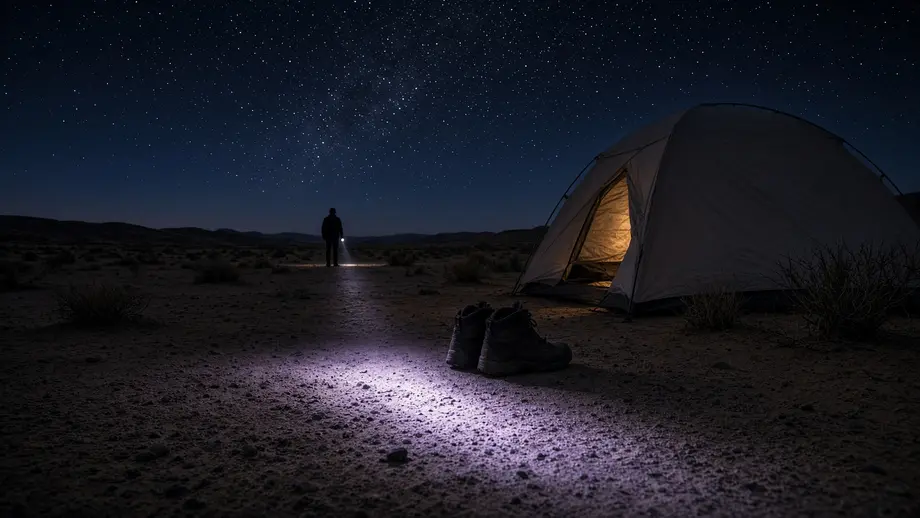
A separate UV light is one more thing to forget. So it is rarely with you when a bill looks odd at the register, a rental carpet smells of pets, or a boot sits outside the tent in scorpion country. The worry about two-in-one lights is just as real: a pocket body may carry weak UV, and UV that comes on by accident is easy to point at your own eyes. This guide answers both with Olight's published ratings, repeatable formulas and each manual's warnings.
This table gives the short answer for choosing an EDC flashlight with UV.
| Question | Short answer |
|---|---|
| Which wavelength? | 365 nm stated on the spec sheet. Olight lists 365 nm for the ArkPro Ultra, ArkPro and Arkfeld Pro, and 365–370 nm for the Oclip Pro S |
| How much UV? | Compare milliwatts plus runtime within one lineup. Olight's UV-equipped EDC lights are rated from 300 mW to 1,200 mW |
| Best overall | ArkPro Ultra, or the standard ArkPro with the same UV ratings for $30 less |
| Lightest and lowest cost | Oclip Pro S: 53 g, $39.99, and UV starts at Low 300 mW every time |
| What it can't do | Disinfect, or prove on its own that a bill, stain or stone is what you think |
📋 Table of Contents
- 1. What Is the Best EDC Flashlight With UV Light?
- 2. Flashlights With UV Light: Flat Multi-Light, Clip-On, or Two Lights
- 3. How Do You Read the UV Specs on an EDC Flashlight?
- 4. Is a Pocket Flashlight With UV Strong Enough?
- 5. Why Should the UV Mode Be Hard to Turn On by Accident?
- 6. Do UV Flashlights Really Work?
- 7. When Is a Two-in-One Enough, and When Do You Need a Dedicated UV Light?
- 8. Common Mistake: Judging UV Strength by How Purple the Beam Looks
- 9. UV and Laser Safety Boundaries for an EDC Light
- 10. What Flashlights Do Navy SEALs Carry?
- 11. Your EDC Flashlight With UV Checklist
- 12. FAQ
What Is the Best EDC Flashlight With UV Light?
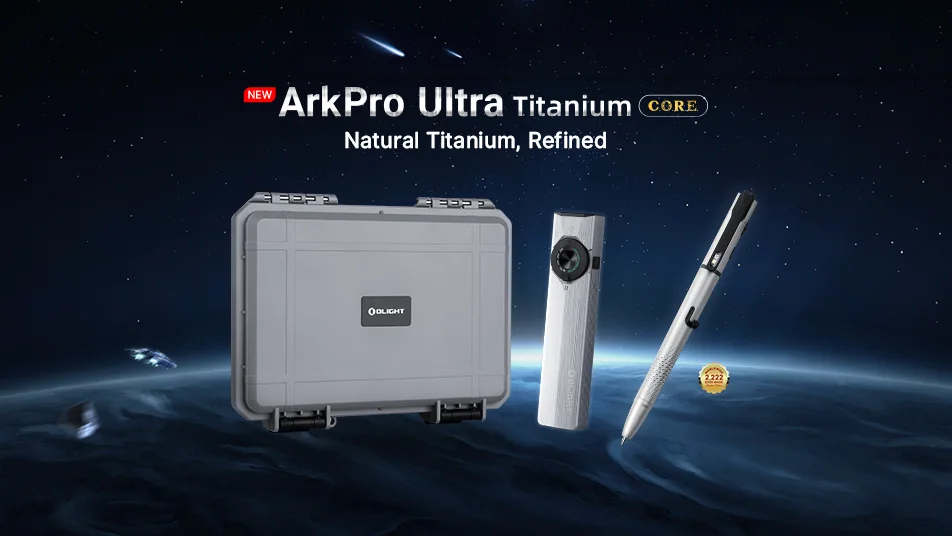
The best EDC flashlight with UV light for most people is Olight's ArkPro series. The ArkPro Ultra ($129.99) pairs a 1,700-lumen flood and an 800-lumen spot with 365 nm UV rated at 1,200~580 mW for 5 + 300 minutes, in a 16 mm thick, 120 g body rated IPX7. The Oclip Pro S ($39.99, 53 g) is the budget clip-on pick.
Olight sorts these lights into two families: flat EDC flashlights in the ArkPro series, and clip-on EDC lights in the Oclip series. Here is how five of Olight's current UV-equipped models split the job.
The Olight ArkPro Ultra flat EDC flashlight ($129.99, regular price for the default Amber Orange CW, September 2026) shares the highest rated UV energy per charge here with the standard ArkPro. It adds a 205 m spot beam, USB-C and magnetic charging, and a green laser rated at no more than 5 mW. Its UV Low mode holds 360 mW for 8 hours. The limits: at 120 g it weighs more than twice an Oclip, and the laser makes it a poor choice for a household where children might pick it up.
The Olight ArkPro flashlight ($99.99, regular price for the default Matte Black CW, September 2026) lists the same UV ratings: 1,200~580 mW for 5 + 300 minutes and 360 mW for 8 hours. It has a 1,500-lumen flood, a 6061 aluminum body instead of O-Aluminum, and weighs 115 g. If UV is the reason you are buying, it gives you the same UV output for $30 less.
The Olight Arkfeld Pro flat EDC flashlight ($89.99, regular price for the default OD Green CW, September 2026) combines 1,300 lumens, 365 nm UV and a Class 3R green laser in a 111 g body. Its spec table lists UV optical power as 560–900 mW, while its highlights say 900 mW. Olight does not publish a UV runtime for it, and it charges only through the MCC magnetic cable, in about 2.5 hours per the manual.
The Olight Oclip Pro S clip light ($39.99, regular price for the default Oclip Pro S in Black, September 2026) is 57 × 28 × 27 mm and 53 g. It carries 600 lumens of white light, red, green and blue light, and UV. Its highlights say "Pure 365 nm UV Light," and its spec table and manual give 365–370 nm. UV High runs 800~300 mW for 3 + 130 minutes, and UV Low runs 300 mW for 138 minutes. It has no laser. Its limit is water: IPX6, and the manual says, "Do not immerse the product in water or other liquids, as it will damage the product."
The Olight Oclip Ultra clip-on EDC light ($49.99, regular price for the default Olive Green, October 2026) adds a 530-lumen flood and a 450-lumen spot to an 800 mW UV emitter, in a 55 g O-Aluminum body rated IPX6. Its manual says UV "Power is 800mW with sufficient battery and 300mW when low." The gap is the wavelength: neither its manual nor its spec table gives a figure inside the 315–400 nm UVA band defined by the World Health Organization. Choose the Oclip Pro S if a stated 365 nm matters to you.
For how these compare with white-only pocket lights, see our best EDC flashlights ranking, which names the ArkPro as its flat, four-source pick.
Flashlights With UV Light: Flat Multi-Light, Clip-On, or Two Lights
You can carry UV three ways. A flat multi-light body puts UV next to a strong white beam behind one selector. A clip-on light puts UV into a small body that rides on a pocket, strap or cap brim. Or you carry two lights, a white EDC flashlight plus a small UV light. Each layout trades weight, reach and convenience differently.
This table compares the three layouts using Olight's current lights as examples.
| Layout | Olight examples | What you gain | What you give up |
|---|---|---|---|
| Flat multi-light body | ArkPro Ultra, ArkPro, Arkfeld Pro | Strongest rated UV, long white-light reach, IPX7, one charger | 111 to 120 g, a laser you must manage, a higher price |
| Clip-on with a selector | Oclip Pro S, Oclip Ultra | 53 to 55 g, hands-free on a clip or magnet, lowest price | Lower UV rating, IPX6 with no immersion, shorter UV runtime |
| Two lights | A white EDC light plus a clip-on UV light | Each light can be used or lent on its own | Two things to charge and remember |
The flat lights also carry a green laser. Our guide to the multi source flashlight covers when white light, UV and a laser in one body beat separate tools; this guide stays on the UV half.
How Do You Read the UV Specs on an EDC Flashlight?
Read the UV specs of an EDC flashlight in this order: peak wavelength in nanometers, UV optical power in milliwatts, runtime at each UV level, and water rating. Lumens don't apply, because lumens weight light by how bright it looks to the eye, and UV-A is almost invisible. If a spec is missing, or sits outside the UVA band, treat it as unknown rather than guessing.
This table explains each UV spec, its range on these lights, and how to judge it.
| Concept | Unit | Range on Olight's current UV EDC lights | How to judge enough |
|---|---|---|---|
| Peak wavelength | nm | 365 to 370 nm where stated | Look for 365 nm on the spec sheet; UVA runs 315–400 nm per WHO |
| UV optical power | mW | 300 to 1,200 mW | Higher mW puts more UV on the target at the same distance and beam angle |
| Step-down | mW~mW | 1,200~580 and 800~300 | The second number is what you work with after the first minutes |
| UV runtime | minutes or hours | 130 minutes to 8 hours | Multiply by power to get UV energy per charge |
| Beam angle | degrees | Not published | Without it, compare lights by ratios, not by exact irradiance |
| Water rating | IP code | IPX6 to IPX7 | IPX6 lights in this group are not for immersion, per their manuals |
The Oclip Pro S, Oclip Ultra and Arkfeld Pro manuals say their data were "tested per ANSI/PLATO FL 1-2019 standard in Olight's labs for reference." PLATO has since published ANSI/PLATO FL 1-2025. UV milliwatt ratings are each maker's own lab figures, so compare them within one lineup.
Is a Pocket Flashlight With UV Strong Enough?
A pocket flashlight with UV is strong enough for close checks, because distance changes the result more than milliwatts do. Light from a small source spreads with the square of distance. Moving from 20 cm to 10 cm puts four times as much UV on the target, the same gain as stepping from 300 mW to 1,200 mW. Pocket UV falls short on large areas and long sessions.
The physics is the inverse-square law. HyperPhysics at Georgia State University states that "Point sources of gravitational force, electric field, light, sound or radiation obey the inverse square law." A flashlight's optics only approximate a point source, and Olight does not publish UV beam angles, so the table below compares ratios, not measured irradiance.
This table shows the distance at which each UV level matches the Oclip Pro S Low mode at 10 cm, based on Olight's rated output and an equal beam angle, not measured.
| UV level (Olight rating) | Power ratio vs 300 mW | Equal-UV distance = 10 cm × √ratio |
|---|---|---|
| Oclip Pro S Low, 300 mW | 1.00 | 10.0 cm |
| ArkPro Ultra or ArkPro Low, 360 mW | 1.20 | 11.0 cm |
| Arkfeld Pro, low end of 560–900 mW | 1.87 | 13.7 cm |
| ArkPro Ultra or ArkPro High after step-down, 580 mW | 1.93 | 13.9 cm |
| Oclip Pro S High or Oclip Ultra, 800 mW | 2.67 | 16.3 cm |
| Arkfeld Pro, high end, 900 mW | 3.00 | 17.3 cm |
| ArkPro Ultra or ArkPro High, first 5 minutes, 1,200 mW | 4.00 | 20.0 cm |
After 5 minutes, the ArkPro Ultra's 580 mW matches the Oclip Pro S Low at 13.9 cm instead of 10 cm. On sustained work that is about 4 cm of working distance, not a different class of light. The most useful habit costs nothing: move the light closer and make the room darker.
Where the ArkPro series pulls ahead is energy per charge. This table multiplies each rated UV level by its runtime to show how much UV one charge delivers. The last column assumes ten 1-minute UV checks a day, a pattern you can change to match yours.
| Light and UV mode | Olight rating | UV energy per charge (W × minutes) | Days at ten 1-minute checks |
|---|---|---|---|
| ArkPro Ultra or ArkPro, High | 1,200~580 mW, 5 + 300 min | 1.2 × 5 + 0.58 × 300 = 180 W·min (3.0 Wh) | 305 ÷ 10 = 30.5 |
| ArkPro Ultra or ArkPro, Low | 360 mW, 8 h | 0.36 × 480 = 172.8 W·min (2.9 Wh) | 480 ÷ 10 = 48.0 |
| Oclip Pro S, High | 800~300 mW, 3 + 130 min | 0.8 × 3 + 0.3 × 130 = 41.4 W·min (0.69 Wh) | 133 ÷ 10 = 13.3 |
| Oclip Pro S, Low | 300 mW, 138 min | 0.3 × 138 = 41.4 W·min (0.69 Wh) | 138 ÷ 10 = 13.8 |
| Arkfeld Pro | 560–900 mW, runtime not published | Not calculable | Not calculable |
| Oclip Ultra | 800 mW, 300 mW when low, runtime not published | Not calculable | Not calculable |
On these ratings, one ArkPro charge carries about 4.3 times the UV energy of one Oclip Pro S charge (180 ÷ 41.4 = 4.35). The Oclip Pro S delivers 41.4 W·min in either mode, so Low changes how fast you spend that budget, not its size. Two weeks per charge is plenty for bills and hotel rooms, not for an hour of scorpion sweeping every warm night.
Why Should the UV Mode Be Hard to Turn On by Accident?
A UV mode should be hard to reach by accident because your eyes don't warn you about it. A white beam makes you squint and look away. UV-A looks dim, so it can shine into an eye without that reflex. That is why a good EDC flashlight with UV puts UV behind a selector, starts at a low level, and supports a lockout.
ICNIRP, the international commission on non-ionizing radiation, puts it this way on its LED guidance page: "Exposure to UV LEDs should be treated with the same precautions as exposure to traditional UV lamps since exposure to UV radiation (especially UVB and UVC) can cause skin or eye damage without the normal aversion responses associated with bright (i.e. visible) light." ICNIRP stresses UVB and UVC, but its advice covers UV LEDs as a group.
This table shows the path from off to UV, the starting UV level and the lockout for each light, per Olight's manuals and product pages.
| Light | From off to UV | UV level when it comes on | Lockout per manual |
|---|---|---|---|
| Oclip Pro S | Rotate the selector to UV, then single press | Low, 300 mW; "Brightness is not memorized in UV mode" | Press and hold about 2 seconds when off |
| Oclip Ultra | Rotate the selector to UV, then single press | 800 mW, or 300 mW when the battery is low | Press and hold about 2 seconds when off |
| Arkfeld Pro | Rotate the selector counterclockwise, then single press the center button | One level, 560–900 mW on the product page | Press and hold about 2 seconds; the active source blinks on and off to confirm |
| ArkPro Ultra and ArkPro | Rotate the selector to UV, then single press the center button | Not stated in the manual; a long press changes level | Long press the center button 2 seconds; long press 1 second to unlock |
Every light here puts UV behind a selector position, so a stray pocket press gives UV only if the selector was left there. The Oclip Pro S manual adds, "When turned on, the default output is Low (300 mW)," so it always opens at its lowest UV level. The Arkfeld Pro manual notes that when you lock it in UV mode, the UV light turns "on and then quickly off" to confirm the lockout. The emitter should face away from you as you lock it.
Tip: Leave the selector parked on white light when you pocket the light, and lock it. The Oclip Pro S manual says, "If the product is carried or transported, please lock it."
Do UV Flashlights Really Work?
Yes. UV flashlights really work for one job: making fluorescent materials glow so you can see them. A 365 nm EDC light will light up a U.S. bill's security thread, scorpions and many dried stains. What it can't do is tell you what the glowing thing is. Treat every glow as a lead, then check it with white light or a second test.
Three pocket-sized examples show both the value and the limit:
- Currency, the security thread only. The U.S. Currency Education Program says the $20 note's embedded thread "glows green when illuminated by ultraviolet light" on its $20 note page. Its $100 brochure says the thread "glows pink under ultraviolet light," but frames UV as one step: "To check the security features in the $100 note, feel the paper, tilt the note, and check with light."
- Scorpions. The National Park Service's bark scorpion page notes that bark scorpions glow under UV light, and explains why a pocket UV light helps: "Because they are nocturnal, and hard to see when they are still, bark scorpions are most commonly seen crossing trails at night." Our guide to desert camping at night builds a full camp routine around that check.
- Stains. A 2023 study in Scientific Reports notes that because the sensitivity and specificity of forensic light sources vary widely, "fluorescence detection using forensic light sources can only be used as a presumptive test and not to draw definite conclusions about the type and origin of the body fluid."
For the full list of what glows and why, see our UV flashlight explainer, and for what a black light misses, our black light flashlight guide.
When Is a Two-in-One Enough, and When Do You Need a Dedicated UV Light?
A two-in-one EDC light is enough when your UV checks are short, close and occasional: a bill at a register, a hotel bathroom, a boot before you put it on. Choose a dedicated UV setup when checks become long sessions over large areas, such as sweeping a yard for scorpions or hunting fluorescent minerals, where runtime and a wide UV beam decide the result.
This table sorts common situations into a decision you can make in advance.
| Situation | A two-in-one is enough when | Consider a dedicated UV light when |
|---|---|---|
| Cash and collectibles | You check a thread or a stamp now and then | You handle cash all day and need a fixed checking station |
| Travel and rentals | A quick look at a bathroom and bedding | You inspect many rooms a day as part of a job |
| Pets and cleaning | You are finding one fresh accident | You are mapping a whole room of old stains, which drains an Oclip's 138 minutes |
| Scorpions | You check boots, packs and a tent floor | You sweep walls and a yard every warm night |
| Minerals | You carry it on a casual walk | You are rockhounding for hours, where UV runtime per charge decides |
Another way to decide is to price the alternative: a white pocket light plus a clip-on UV light. This table compares that pair with the flat one-body lights on Olight's regular prices and published weights.
| Setup | Regular price (September 2026) | Carried weight | Rated UV energy per charge |
|---|---|---|---|
| Baton 4 plus Oclip Pro S (two lights) | $54.99 + $39.99 = $94.98 | 52.5 + 53 = 105.5 g | 41.4 W·min |
| Arkfeld Pro | $89.99 | 111 g | Not calculable |
| ArkPro | $99.99 | 115 g | 180 W·min |
| ArkPro Ultra | $129.99 | 120 g | 180 W·min |
On these numbers, the standard ArkPro costs $5.01 more than the pair and weighs 9.5 g more, yet carries about 4.3 times the rated UV energy per charge on one charger. The pair wins when you want to lend the white light, or want the Baton 4's IPX8 rating (per its product page) on your main light.
Common Mistake: Judging UV Strength by How Purple the Beam Looks
The most common mistake with an EDC flashlight with UV is judging UV strength by how bright and purple the beam looks. The purple you see is visible light leaking from the emitter; the UV itself is close to invisible, so a 365 nm beam can look dim while delivering more UV. Compare stated wavelength, milliwatts and runtime instead.
This table corrects five common beliefs about UV on pocket lights, with the source for each correction.
| Belief | Fact | Source |
|---|---|---|
| A brighter purple beam means stronger UV | Eyes respond weakly to UV-A, so UV output has to be read in mW, not judged by eye | ICNIRP notes UV lacks "the normal aversion responses associated with bright (i.e. visible) light"; Olight rates UV channels in mW |
| A UV flashlight disinfects | The FDA names UV-C as the disinfecting band; these lights are rated in UV-A near 365 nm | FDA: "UV-C radiation is a known disinfectant for air, water, and nonporous surfaces" |
| A glowing thread proves a bill is genuine | The thread is one feature among several | U.S. Currency Education Program: feel the paper, tilt the note, and check with light |
| A glow proves a stain is urine | Fluorescence is presumptive | Scientific Reports, 2023 |
| More lumens on the box means more UV | Lumens rate the white channel; UV is listed separately in mW | Olight spec tables for each light |
The FDA source for the disinfection row is its consumer update on ultraviolet wands, which also warns that some UV-C wands "may cause injury to the skin, eyes, or both after a few seconds of use." A 365 nm flashlight is a detection tool, not a disinfecting one.
UV and Laser Safety Boundaries for an EDC Light
The safety boundary for an EDC light with UV is simple. Never look into the UV or laser emitter, and never aim either at a person, an animal or an aircraft. Keep UV off bare skin, and follow each manual's water, heat and magnet warnings. The warnings below come from Olight's manuals and from U.S. agencies.
Warning: The Oclip Pro S, Oclip Ultra and ArkPro series manuals share the same caution: "Do not look directly at the light source or shine it into your eyes, as this may cause temporary blindness or permanent damage to your eyes." The Arkfeld Pro warning sheet adds a UV-specific line: "Ultraviolet light: Do not look directly at the light source with the naked eye (only for products containing this light source)."
Skin sensitivity varies from person to person. The FDA's UV radiation page says, "Certain oral and topical medicines, such as antibiotics, birth control pills, and benzoyl peroxide products, as well as some cosmetics, may increase skin and eye sensitivity to UV in all skin types." It also says, "Both UVA and UVB rays can cause damage to your skin."
The lasers need their own rules. The ArkPro series manual lists "Max Output: 5 mW @510 nm~530 nm Wavelength" and "Caution: Do not stare directly at the operating light source." The Arkfeld Pro warning sheet says, "Laser radiation: Avoid looking directly at 3R laser products with the naked eye (only for products containing this light source)." The FDA's laser pointer guidance says, "Never aim or shine a laser pointer at anyone" and "Don't buy laser pointers for your children." The FAA states, "Pointing a laser at an aircraft is a federal crime," and says pilots reported 10,993 laser strikes to the FAA in 2025.
Safety note: If you clip an Oclip Pro S or Oclip Ultra to a shirt pocket or chest strap, both manuals say: "If you have an ICD or pacemaker, avoid close or prolonged contact with this product to prevent possible interference." In cold weather, the Oclip Pro S manual says that "In environments below 0°C (32°F), the white light is limited to Low and Medium modes, and the UV light is limited to Low mode only."
For heat, the ArkPro series manual says, "Do not store, charge, or use this light in a car where the temperature inside may exceed 60°C or in similar environments."
This table maps each standard or rule named on these lights to what it means.
| Standard or rule (version) | What it covers | What it means for an EDC light with UV |
|---|---|---|
| IEC 62471:2006, Edition 1.0 | Per IEC, it "specifies the exposure limits, reference measurement technique and classification scheme" for photobiological hazards of lamps, "including LEDs but excluding lasers," from 200 nm to 3000 nm | It is the framework for rating UV and white LEDs; the Olight product pages and manuals reviewed here list no risk group, so follow the manual warnings |
| 21 CFR 1040.10 and 1040.11 | U.S. laser product performance rules | The ArkPro series and Arkfeld Pro manuals state compliance "except for conformance with IEC 60825-1 Ed. 3., as described in Laser Notice No. 56, dated May 8, 2019" |
| ANSI/PLATO FL 1-2019 (current edition FL 1-2025) | Standardized testing and reporting for portable lights | Olight's manuals cite the 2019 edition for their spec tables |
| Federal law on lasers and aircraft | Pointing a laser at an aircraft | The FAA calls it a federal crime |
The IEC scope text above comes from the IEC webstore listing for IEC 62471:2006, published July 26, 2006.
What Flashlights Do Navy SEALs Carry?
The U.S. Navy does not publish a buying list of flashlights for Navy SEALs, with or without UV, so the brand lists that circulate online are guesses, not Navy documents. What a civilian can copy is the habit behind duty gear: choose lights whose makers publish test-based durability, water and runtime figures.
For an EDC light with UV, that means the figures used throughout this guide: a stated wavelength, UV power with runtime, a water rating that matches your use, and a lockout. Our ANSI FL1 guide explains how impact, water resistance and runtime are defined on a spec sheet. Treat "military" wording on a box as marketing unless the maker names the test and the result.
Your EDC Flashlight With UV Checklist
Use this checklist to choose and carry an EDC flashlight with UV in a few minutes. Each step points back to a number or a manual line above, so you can repeat it for any light that publishes the same figures.
- Confirm the spec sheet states 365 nm. If the wavelength is missing or outside 315–400 nm, treat it as unknown.
- Find the UV rating in mW and its runtime, then multiply to get UV energy per charge.
- Decide on layout: flat multi-light for the most UV (ArkPro series, $99.99 to $129.99), clip-on for the lightest carry (Oclip Pro S, $39.99).
- Check the path from off to UV: a selector plus a press, a low starting level, and a lockout.
- Hold UV close and work in the dark; halving the distance quadruples the UV on the target.
- Treat every glow as a lead, and confirm it with white light or a second test.
- Never aim UV or a laser at eyes, people, animals or aircraft, and note the ICD, cold and immersion warnings for clip-on lights.
FAQ
Changelog
- September 26, 2026: First published.