Olight makes some of the lights discussed here. Olight specs and regular prices come from its US product pages and user manuals as of September 2026; other makers' specs come from their own websites. Every average, lux, glare and coverage figure below is geometry and arithmetic from those published numbers, not a field measurement.
⚡ TL;DR
What is the brightest camping lantern? On makers' spec sheets, work lanterns such as the Fenix CP50R reach 5,500 lumens, and Olight's brightest lantern setup, a Marauder Mini 2 under its Lampshade, peaks at 10,000 lumens for 2 minutes. For a group site, the brightness that counts is the output a light holds for 3 hours, spread wide and kept out of eyes.
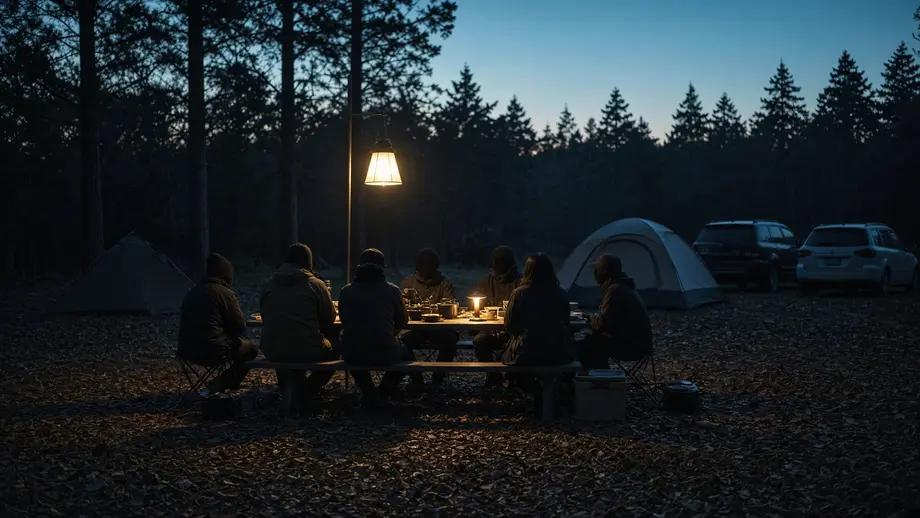
If you run camp for six or more people, dinner, dishes and a second tent all happen at once across a site about 10 m wide. You buy the brightest lantern on the shelf, hang it on a pole, and get squinting faces, hard shadows behind every person and a battery that steps down before the dishes are done.
This table answers what is the brightest camping lantern for a group by the number that decides each job, using Olight's ratings and our calculations from them.
| Question | Number to read | Olight example (rated) | What it means on a 10 m site |
|---|---|---|---|
| Brightest peak | Max lumens and its minutes | Marauder Mini 2 floodlight 10,000~2,500 lm, 2 + 90 min | A setup burst, not an evening setting |
| Brightest over a 3-hour evening | Average lumens across 180 minutes | Marauder Mini 2 floodlight 1,200 lm for 3 h (Level 3-1) | About 1,200 lm average, and still running at minute 180 |
| Brightest warm 360° light | Lumens, color temperature | Prowess reverse light 800 lm, 2,800 to 3,200 K | About 594 lm average over 3 hours |
| Glare at 10 m | Lux reaching an eye | A bare 1,200 lm source | About 0.95 lux, nearly 4 times the 0.25 lux that ends a rated beam |
| Site coverage | Share of lumens landing on 10 x 10 m | A bare lantern hung 2 m or 3 m up | About 33% at 2 m, 27% at 3 m |
📋 Table of Contents
- 1. Quick Answer: What Is the Brightest Camping Lantern for a Group Site?
- 2. Lumens vs Lux vs Lit Area at a Group Campsite
- 3. Super Bright Camping Lantern Options Compared: One Big Light, a Shaded Flashlight or Several Zones
- 4. How Long Does the Brightest Setting Last? Step-Downs, Heat and a 3-Hour Evening
- 5. How High Should You Hang a Camping Lantern? 2 m vs 3 m
- 6. Glare at 10 m: How Much Light Reaches Your Group's Eyes?
- 7. Are Several Medium Lanterns Better Than One Super-Bright Lantern?
- 8. What Is the Most Powerful Camping Lantern?
- 9. What Is the Brightest Camping Lamp?
- 10. How Many Lumens Should a Camping Lantern Be for a Group Site?
- 11. Common Myths: More Lumens Save Work, and a Shade Throws Away the Light
- 12. Safety Limits: Hot Heads, Tent Fabric and Kids
- 13. Your Group Campsite Lantern Checklist
- 14. FAQ
Quick Answer: What Is the Brightest Camping Lantern for a Group Site?
The brightest camping lantern for a group site is the one that holds the most light through the evening, not the one with the biggest peak. Among the Olight settings compared here, the Marauder Mini 2 floodlight at 1,200 lumens for 3 hours gives the most light that is still on at minute 180. Shade it, hang it low, and light the cooking and table zones with smaller lights.
Three facts drive that answer. Peak output is short: 10,000 lumens lasts 2 minutes. In the even-spread model used below, only a quarter to a third of a bare lantern's lumens lands inside a 10 x 10 m site. And a brighter lantern puts more glare in every eye.
The Marauder Mini 2 belongs to Olight's line of powerful Marauder series flashlights, which pair high floodlight output with low camp modes. To pick a lantern by budget for a smaller table, see our guide to the best lantern for camping; this guide sizes light for a whole group site.
Lumens vs Lux vs Lit Area at a Group Campsite
Lumens measure the total light a lantern emits. Lux measures the light landing on each square meter, so lux equals lumens divided by area. A lantern cannot give a site more average lux than its lumens divided by the site's area: 1,200 lumens spread over a 10 x 10 m site can never average more than 12 lux, even if every lumen landed.
The flashlight standard defines these terms. Streamlight's ANSI/PLATO FL1 summary calls light output "A measurement of the total quantity of emitted overall light energy," reported in lumens, and defines beam distance as "The distance from the device at which the light beam is 0.25 lux." Our lumens to lux chart covers beam-angle conversions for flashlights.
This table lists the numbers on a lantern box and how to judge whether each is enough for a group site.
| Concept | Unit | Typical camp range (Olight ratings here) | How to judge if it is enough |
|---|---|---|---|
| Light output | Lumens (lm) | 2 lm (Prowess reverse Low) to 10,000 lm (Marauder Mini 2 peak) | Read the level a light holds for hours, not the peak |
| Illuminance | Lux (lm per square meter) | Site averages of about 1 to 4 lux from one hung lantern (calculated below) | Divide lumens landing by area; compare zones, not the whole site |
| Beam distance | Meters to 0.25 lux | 245 m (Prowess forward), 265 m (Seeker Ultra) | A flashlight spec; a lantern needs area, not reach |
| Runtime | Minutes or hours per level | 3 hours at 1,200 lm to 20 days at 2 lm | Check the sequence covers dinner to quiet hours |
| Color temperature | Kelvin (K) | 2,800 to 3,200 K (Prowess reverse) to 6,500 K (Marauder Mini 2) | Warmer is gentler on dark-adapted eyes, per the NPS |
The last row matters for groups. The National Park Service's outdoor lighting principles say LEDs above 2,700 K emit more blue light, which "may reduce safety by creating discomfort glare -and impacting dark-adapted vision."
Super Bright Camping Lantern Options Compared: One Big Light, a Shaded Flashlight or Several Zones
A super bright camping lantern for a group comes in three shapes: one high-lumen work lantern, a powerful flashlight standing under a diffuser shade, or several medium lights placed by zone. The single big lantern is simplest, the shaded flashlight adds reach for searches, and zones put the most light on tasks with the least glare.
This table compares the three approaches on makers' published specs and regular prices as of September 2026.
| Approach | Example | Rated peak | What it holds | Glare control | Weight | Main weakness |
|---|---|---|---|---|---|---|
| One high-lumen lantern | Fenix CP50R work lantern | 5,500 lm | 240 h max runtime; steps down at 54 °C | Adjustable 2,700 to 6,500 K; one bright point | 759 g with batteries | One source lights faces and throws shadows |
| Bright flashlight plus shade | Olight Marauder Mini 2 + Lampshade ($219.99 + $9.99) | 10,000 lm floodlight | 1,200 lm for 3 h (Level 3-1) | Shade enlarges the glowing surface | 465 g plus the shade | Cool white 6,500 K; shade output not rated |
| Several medium lights by zone | Olight Prowess ($139.99) + Seeker Ultra ($169.99) | 800 lm reverse + 4,800 lm forward | 300 lm for 12.5 h (Seeker Ultra Med) | Each light low and close to its task | 269 g + 220 g | Two lights to charge and place |
Fenix specs come from its CP50R page; Olight rows use regular prices.
How Long Does the Brightest Setting Last? Step-Downs, Heat and a 3-Hour Evening
The brightest setting on a high-output light lasts minutes, then steps down to protect the light from heat. On Olight's ratings, the Marauder Mini 2's 10,000-lumen floodlight holds for 2 minutes, then runs 2,500 lumens for 90 minutes and ends. Its 1,200-lumen Level 3-1 holds for 3 hours, so it delivers more light over a full evening.
To compare settings the way a group uses them, we averaged each rated sequence over the first 60 and 180 minutes, treating each step as flat and counting zero light after the last one (FL1 runtime ends when output falls to 10% of its start). Take the Marauder Mini 2 Level 4-2 floodlight over 180 minutes: (10,000 x 2 + 2,500 x 90) / 180 = 245,000 / 180 = 1,361 lumens, with the light spent at minute 92.
This table shows each setting's average output, based on Olight's rated lumens and runtimes, not measured.
| Light and setting (Olight rating) | Rated sequence | Average, first 60 min | Average, first 180 min | Sequence ends at |
|---|---|---|---|---|
| Marauder Mini 2 floodlight Level 4-2 | 10,000~2,500 lm, 2 + 90 min | 2,750 lm | 1,361 lm | 92 min |
| Marauder Mini 2 floodlight Level 3-2 | 2,500~1,200~600 lm, 30 + 60 + 80 min | 1,850 lm | 1,083 lm | 170 min |
| Marauder Mini 2 floodlight Level 3-1 | 1,200~600~150 lm, 3 + 1 + 3 h | 1,200 lm | 1,200 lm | 7 h |
| Prowess forward Turbo | 5,000~1,200 lm, 3 + 140 min | 1,390 lm | 1,017 lm | 143 min |
| Seeker Ultra Turbo | 4,800~1,000~600 lm, 2.5 + 150 + 70 min | 1,158 lm | 992 lm | 222.5 min |
| Prowess reverse (360°) Turbo | 800 lm, then 75% and 50%, 20 + 135 + 55 min | 667 lm | 594 lm | 210 min |
Level 4-2 wins the 3-hour average on paper, but it leaves you dark at minute 92, halfway through dinner. Level 3-1 is the brightest setting that still runs at quiet hours. The NPS camp etiquette page says quiet hours are "typically for a range of time (such as 10 p.m. - 6 a.m.)," so a 7 p.m. dinner needs a 3-hour setting.
Heat is the reason for the steps. The Marauder Mini 2 manual says its data were produced "indoors under a room temperature of 25 degrees celsius with windless conditions," and that "runtime may vary depending on the external temperature and ventilation conditions." Our guide to why a thermal step down flashlight dims covers the mechanism.
Note: The revised ANSI/PLATO FL 1-2025 standard adds a turbo test in which, according to PLATO's summary, "Runtime is measured from the start of the mode until output drops to 90% of the highest measurement recorded during the first 10 seconds." The Olight manuals cited here use earlier editions: FL 1-2019 for the Prowess and Seeker Ultra, and ANSI/NEMA FL 1-2009 for the Marauder Mini 2.
How High Should You Hang a Camping Lantern? 2 m vs 3 m
Hang a group lantern at about 2 m rather than 3 m if your goal is light on the ground: in an even-spread model, about 33% of its lumens land inside a 10 x 10 m site at 2 m, against about 27% at 3 m. Height does little for glare at 10 m. Shielding and dimming do that job.
Assume a bare lantern that spreads light evenly in all directions, and treat the 100 square meter site as a circle of the same area (radius 5.64 m). The share of lumens that lands inside a circle of radius R below a light hung h meters up is (1 - h / √(h² + R²)) / 2. Half the light always goes above the horizon, which is the waste the NPS principles describe: "Globes or diffusers that hang below the light fixture emit a great deal of light upward into the sky causing an inordinate amount of glare that degrades visual performance and should be avoided."
This table shows where a bare lantern's light goes at three heights, based on that even-spread model, not measured. The same model gives the site averages in the next column for 1,200 lumens.
| Hang height | Share landing inside 10 x 10 m | Share leaving sideways past the site | Share going above the horizon | Site average from 1,200 lm |
|---|---|---|---|---|
| 1.5 m | 37.2% | 12.8% | 50% | 4.5 lux |
| 2 m | 33.3% | 16.7% | 50% | 4.0 lux |
| 3 m | 26.5% | 23.5% | 50% | 3.2 lux |
At 3 m, about 73.5% of a bare lantern's output leaves your site upward or sideways. That light lands on the next site's tents, which is why the NPS asks campers to "Keep lights shielded and pointing down."
Why doesn't height cut glare for people across the site? Glare depends on distance and on how close the light sits to your line of sight. For someone 10 m away, a lantern 1 m above their eye level is 10.05 m away, and one 2 m above is 10.20 m away. That drops the light at their eye by only 1% and 4%.
This table gives the angle between eye level and the lantern for different horizontal distances and heights above the eye (simple trigonometry, angle = arctan(height / distance)).
| Horizontal distance | 0.5 m above eye | 1 m above eye | 1.5 m above eye | 2 m above eye |
|---|---|---|---|---|
| 2 m (at the table) | 14.0° | 26.6° | 36.9° | 45.0° |
| 5 m (mid-site) | 5.7° | 11.3° | 16.7° | 21.8° |
| 10 m (site edge) | 2.9° | 5.7° | 8.5° | 11.3° |
Raising a lantern lifts it out of view at the table, but not at the site edge, where a shade or a lower level is the fix. The NPS describes a shielded fixture as one where "no portion of the bulb is visible at eye level."
Glare at 10 m: How Much Light Reaches Your Group's Eyes?
A bare lantern 10 m away puts roughly its lumens divided by 1,257 on each eye, in lux, under the even-spread model. That is about 0.95 lux from 1,200 lumens and about 8 lux from 10,000 lumens. Both are well above the 0.25 lux at which the FL1 standard ends a rated beam.
The formula is lux at the eye = lumens / (4π x distance²). At 10 m, 4π x 100 = 1,257. It treats the lantern as a bare point that spreads light evenly, with nothing between it and the eye.
This table estimates the light reaching an eye 10 m from a bare, evenly spreading source at each output, based on rated specs, not measured.
| Output (example setting) | Lux at an eye 10 m away | Compared with the FL1 0.25 lux beam threshold |
|---|---|---|
| 150 lm (Marauder Mini 2 floodlight Level 1-2) | 0.12 | About half |
| 300 lm (Seeker Ultra Med) | 0.24 | About equal |
| 800 lm (Prowess reverse Turbo) | 0.64 | About 2.5 times |
| 1,200 lm (Marauder Mini 2 floodlight Level 3-1) | 0.95 | About 3.8 times |
| 2,500 lm (Marauder Mini 2 floodlight Level 4-2 step) | 1.99 | About 8 times |
| 10,000 lm (Marauder Mini 2 floodlight peak) | 7.96 | About 32 times |
What does a shade change? The Lampshade measures 63 mm across and 115 mm tall. Seen from the side, it presents about 6.3 x 11.5 = 72.5 cm² of glowing surface, against about 34.2 cm² for the Marauder Mini 2's 66 mm head face (π x 3.3²). If treated as a cylinder, its side surface is about π x 6.3 x 11.5 = 227.6 cm², 6.7 times the head face. The same light spread over a surface 2.1 to 6.7 times larger is less intense to look at. Olight does not publish how much light passes through the shade, so we don't estimate it.
A shade is not a shield: it still sends light sideways and up. Pair the shade with a lower level for the evening, and keep peak output for short setup bursts. DarkSky and the Illuminating Engineering Society's Five Principles for Responsible Outdoor Lighting say: "Light should be no brighter than necessary."
Are Several Medium Lanterns Better Than One Super-Bright Lantern?
Yes, for most group sites. A light hung 1.5 m above a 3 x 3 m task zone puts about 1.87 lux on that zone per 100 lumens, while one lantern hung 3 m above a 10 x 10 m site puts about 0.27 lux on the site per 100 lumens. Per lumen, the zone light gives the task about 7 times more light.
The math uses the same even-spread model. For a 3 x 3 m zone, the equal-area radius is 1.69 m, and a light 1.5 m up lands 16.8% of its output there: 100 x 0.168 / 9 = 1.87 lux. For the whole site from 3 m, 100 x 0.265 / 100 = 0.27 lux. Zones also cut shadows, since each task is lit from its own side.
This zone plan shows one way to light a group site with Olight lights, using each product's rated levels.
| Zone | Size | Light and setting (Olight rating) | Placement | Why this setting |
|---|---|---|---|---|
| Cook and prep | About 3 x 2 m | Seeker Ultra Med, 300 lm for 12.5 h | In its holster on the fixing bracket, strapped beside the stove | Holster caps output below 600 lm; Med runs past quiet hours |
| Dining table | About 2 x 1 m | Prowess reverse light, stepless up to 800 lm, 2,800 to 3,200 K | On its detachable base at the table's center | Warm 360° light for faces and plates |
| Whole-site setup and cleanup | 10 x 10 m | Marauder Mini 2 floodlight Level 3-1, 1,200 lm for 3 h, under the Lampshade | About 2 m up, away from the table | Brightest setting that lasts to quiet hours |
| Tent row after dinner | Beside the tents | Same Marauder Mini 2, floodlight Level 2-1, 300~150 lm, 13 + 3 h | Low, shade on, set back from tent walls | Long runtime at a gentle level |
| Paths and latrine walks | On each person | Headlamps or handheld lights | Carried | A lantern lights you, not the path |
Olight publishes Prowess reverse runtimes only for the 800-lumen sequence and the 2-lumen Low (20 days). For how a full kit splits between headlamps, a camp light and a pocket light, see our guide to camping lighting.
What Is the Most Powerful Camping Lantern?
On the spec sheets checked for this guide, the most powerful dedicated camping lantern is a work lantern: Fenix rates its CP50R at 5,500 lumens and calls it "the most powerful lantern Fenix has ever built." Olight's most powerful lantern setup is the Marauder Mini 2 under its Lampshade, rated at 10,000 floodlight lumens for 2 minutes.
Neither is an evening setting. Fenix says that when the CP50R "reaches a temperature of 54°C/129.2°F or above, it will automatically step down a few lumens to reduce the temperature." It also carries a spotlight rated at 450 m, which a group site doesn't need. Compare the level a lantern holds for 3 hours instead.
What Is the Brightest Camping Lamp?
The brightest camping lamp from Olight is the Marauder Mini 2 standing under its $9.99 Lampshade, with floodlight levels up to 10,000 lumens and a 1,200-lumen level rated for 3 hours. The warmest bright lamp is the Prowess, whose 360° reverse light reaches 800 lumens at 2,800 to 3,200 K. Olight's US store listed no dedicated high-output lantern in September 2026.
Olight Marauder Mini 2 with the Olight Marauder Mini 2 Lampshade. The hard part of a group lamp is holding a lot of light for hours. The Marauder Mini 2 runs its floodlight at 1,200~600~150 lumens for 3 + 1 + 3 hours on Level 3-1, from a 27.75 Wh battery, and dims to a 1.5-lumen floodlight moonlight (50 days). The Lampshade is white polypropylene board, and Olight notes the package "includes the lampshade only." The limits: $229.98 for the pair, 465 g, a 6,500 K cool white floodlight, and no published output through the shade. For eyeshine and lost-gear searches with the same light, see our pick for the best spotlight for camping.
Olight Prowess bidirectional flashlight. The hard part of a table lamp is warm light that doesn't dazzle diners. Olight describes the Prowess reverse light as "Warm White 360° Reverse Light" with "smooth stepless dimming and a max output of 800 lumens," and its forward light reaches 5,000 lumens and 245 m. It stands on a detachable base, weighs 269 g with its 18 Wh battery and is rated IPX7. Its limits: the reverse light's 800-lumen sequence lasts 210 minutes in total, and its CRI is listed at 70.
Olight Seeker Ultra high-power flashlight. A cook zone needs aimed, long-running light. The Seeker Ultra runs Med at 300 lumens for 12.5 hours from a 20.9 Wh battery, and its manual says, "The light can be used as a lamp while mounted to the bracket." Its limits: it is a flashlight, not a diffuser, its white is listed at 5,700 to 7,000 K, and Olight notes that in the holster "its brightness automatically reduces to below 600 lumens for safety reasons."
How Many Lumens Should a Camping Lantern Be for a Group Site?
For a 10 x 10 m group site, one hung lantern needs roughly 400 lumens to average 1 lux across the site and about 1,100 lumens to average 3 lux, when hung 3 m up in the even-spread model. Beyond that, add zone lights rather than a brighter lantern, because every added lumen also reaches eyes at the site edge.
The planning formula comes from the coverage table: lumens needed = target average lux x area / share landing. At 3 m the share is 0.265, and at 2 m it is 0.333. For a single RV table, see our RV camping lantern guide.
This table converts a target site average into lumens for a bare lantern, based on the even-spread model, not measured.
| Target site average | Lumens at 3 m hang | Lumens at 2 m hang | Olight setting that reaches it |
|---|---|---|---|
| 1 lux | 1 x 100 / 0.265 = 377 lm | 1 x 100 / 0.333 = 300 lm | Prowess reverse at 400 lm and up |
| 2 lux | 755 lm | 601 lm | Prowess reverse Turbo, 800 lm |
| 3 lux | 1,132 lm | 901 lm | Marauder Mini 2 floodlight Level 3-1, 1,200 lm |
Groups rarely need the whole site at 3 lux; they need the table and the stove brighter than that, which is what zone lights do.
Common Myths: More Lumens Save Work, and a Shade Throws Away the Light
The most common myth is that one brighter lantern saves the work of placing several lights. It doesn't: in the even-spread model, a bare lantern hung 3 m up lands only about 27% of its lumens on a 10 x 10 m site, and its glare grows in step with its output.
This table sets each myth against the fact and its basis.
| Myth | Fact | Basis |
|---|---|---|
| The highest lumen number is the brightest lantern all night | The 10,000 lm Marauder Mini 2 floodlight averages 1,361 lm over 3 hours and ends at minute 92 | Olight ratings; averaging method above |
| Hanging higher stops glare | For people 10 m away, 1 to 2 m more height changes the light at the eye by only 1 to 4% | Inverse-square geometry above |
| A shade wastes most of the light | Olight publishes no transmission figure; what a shade does change is the glowing area, 2.1 to 6.7 times the head face | Lampshade and head dimensions from Olight |
| A fuel lantern is fine in the tent if it's turned down | The CPSC says not to use fuel-burning lanterns while sleeping in tents, campers and vehicles | CPSC Safety Alert 5008 |
The fuel myth is the dangerous one. The CDC's carbon monoxide page says, "Carbon monoxide (CO) is an odorless, colorless gas that kills without warning," and lists lanterns among its sources. The CPSC's camping equipment safety alert adds: "Do not use fuel burning portable heaters or lanterns while sleeping in enclosed areas such as tents, campers, and other vehicles."
Safety Limits: Hot Heads, Tent Fabric and Kids
High-output lights get hot, so keep bright lanterns and shaded flashlights off tent fabric and out of children's reach, and keep beams out of eyes. Fenix warns that the CP50R "will accumulate a significant amount of heat while operating."
Its other warnings fit any high-output lantern: "Do NOT place this lantern in the reach of children!" and "Do NOT place the lantern near flammable objects, high temperatures can cause objects to overheat and become flammable/ignite!" The Olight manuals for all three lights here list a working temperature of 0 to 40 °C.
Warning: The Marauder Mini 2 manual says, "Caution: Do not stare at operating light source," and the Seeker Ultra manual says, "Do not stare directly at the operating light source." Never aim a floodlight or a turbo beam across the site at faces.
For charging, the U.S. Fire Administration's battery safety page says of lithium-ion batteries: "Do not charge them at temperatures below 32 degrees F (0 degrees C) or above 105 degrees F (40 degrees C)."
Safety note: Use battery-powered lights inside tents and campers. Keep any fuel lantern outdoors, and switch it off before anyone goes to sleep.
Your Group Campsite Lantern Checklist
Use this checklist to answer what is the brightest camping lantern for your own group: the light that holds its level until quiet hours, hung low and shaded, with zone lights doing the close work. Each check needs only a spec sheet and a calculator.
- Read the level each light holds for 3 hours, not its peak. Average the rated steps over 180 minutes.
- Plan light by zone: cook, table, whole site and tent row, plus a headlamp or handheld light per person.
- Hang the site light about 2 m up, beside rather than above the table, and put a shade on it.
- Keep the whole-site light near 1,200 lumens or below; for more light on a task, add a zone light.
- Choose warm light for the table; use cool white for setup and searches.
- Check that every light's sequence runs from dinner to quiet hours, usually 10 p.m.
- Keep bright heads off fabric and away from children, and charge between 0 and 40 °C.
FAQ
Changelog
- September 26, 2026: First published.