Olight makes some of the lights discussed here. Olight specs and regular prices come from its US product pages and user manuals as of September 2026. Other lanterns' specs and list prices come from their makers' websites, checked in September 2026. The lux, runtime and value figures are our own arithmetic from those published numbers, not field measurements.
⚡ TL;DR
The best lantern for camping at about $20 is a small ambient light for a tent or a two-person site. At about $60, you get 250 to 430 lumens, roughly 7 to 16 Wh of battery and often a USB port for a phone. Spend $100 to $180 only if you need 650-plus lumens, immersion-proof sealing or jobsite toughness.
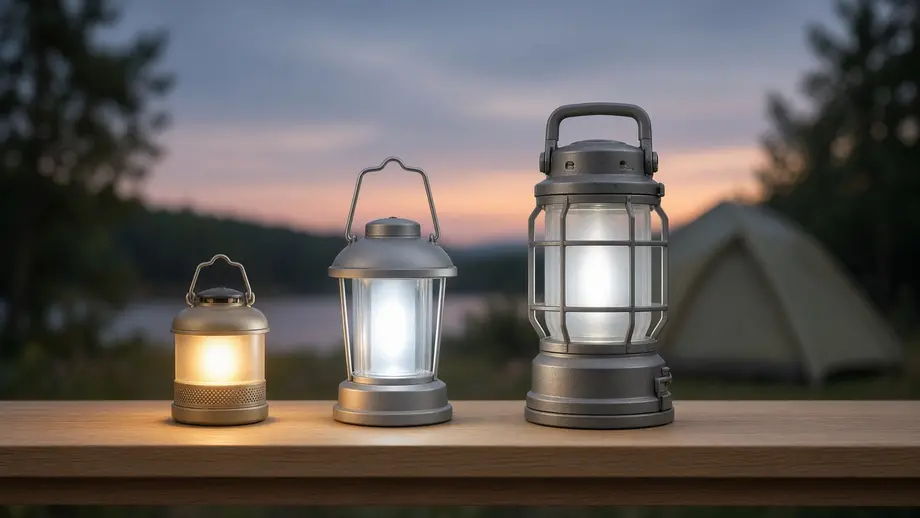
You are standing in front of a shelf of camp lanterns. One costs $18, one costs $60, and one costs $180. Every box promises hundreds of lumens and hundreds of hours. The boxes never say whether the extra money buys light you can use at the picnic table, a battery that lasts the weekend, a shell that survives a fall off the tailgate, or just a heavier handle. This guide breaks the price ladder into what each tier really adds, using makers' published specs and simple math you can check.
This table sums up the best lantern for camping at each price tier, using makers' published specs and list prices as of September 2026.
| Dimension | About $20 | About $60 | About $140 ($100 to $180) | Which tier wins | By how much |
|---|---|---|---|---|---|
| Max output | 60 to 75 lm | 250 to 430 lm | 650 to 5,500 lm | $140 | 650 lm is about 1.5 times the best $60 lantern and about 9 times the Sphere |
| Battery energy | 1.85 to 2.59 Wh | 7.2 to 16.3 Wh | About 28 to 43 Wh | $140 | About 1.7 to 2.7 times the biggest $60 battery |
| Battery per dollar | 0.06 to 0.14 Wh/$ | 0.13 to 0.27 Wh/$ | About 0.24 to 0.26 Wh/$ | $60 (narrowly) | 0.27 vs 0.26 Wh/$ at the top of each tier |
| Longest rated low-mode runtime | 35 to 40 h | 200 to 350+ h | 240 to 400 h | Tie: $60 and $140 | 350+ h vs 400 h at best |
| Table light at 1 m (estimate) | About 5 to 6 lux | About 20 to 34 lux | About 52 lux (650 lm) | $140 | About 1.5 times the best $60 lantern |
| Water resistance | IP56, or not listed | IPX4 to IP65 | IPX-7 to IP66 | $140 | Immersion (IPX7) vs splashing (IPX4) |
| Phone charging | No | Yes on the AlpenGlow 250 and Lighthouse Core | Yes | Tie: $60 and $140 | Same feature |
| Weight | 91 to 93 g | 122 to 363 g | 412 g (without batteries) to 759 g | $20 | 4 to 8 times lighter |
📋 Table of Contents
- 1. Quick Answer: Which Price Tier Is the Best Lantern for Camping?
- 2. Price Comparison: What $20, $60, and $140 Buy Side by Side
- 3. Where Does the Extra Money Go in a Camping Lantern?
- 4. Brightness Comparison: How Many Lumens Should a Camping Lantern Be?
- 5. Runtime Comparison: What Is the Best Long-Lasting Camp Lantern?
- 6. Durability Comparison: Rain, Drops, and Cold
- 7. How Can You Tell If Rated Lumens and Runtime Are Honest?
- 8. Which Tier Fits the Camp Table, the Tent, and the Path?
- 9. What Type of Lantern Is Best for Camping?
- 10. What Is the Best Camping Lamp?
- 11. Olight Picks at Each Price, and Where Olight Falls Short
- 12. Common Mistake: Is a Brighter Camping Lantern Always Better?
- 13. Before You Buy: A Camping Lantern Checklist
- 14. FAQ
Quick Answer: Which Price Tier Is the Best Lantern for Camping?
The best lantern for camping for two people on a weekend is a $20 ambient light plus the headlamps you already own. For a family that cooks and plays cards after dark, the $60 tier is the sweet spot: 250 to 430 lumens and, on the better-value models, 12 to 16 Wh of battery. The $100 to $180 tier pays off for big groups, wet trips and people who also want a work light.
The reason is where the money goes. From $20 to $60, you buy about 3 to 9 times the battery and 3 to 7 times the light, so the jump shows up at the table every night. From $60 to $140, battery per dollar stays flat, and the extra money buys a brighter peak, a tougher shell, a power-bank port or a spotlight. Those are real upgrades, but you only use them on some trips.
Olight's range of camping flashlights covers the task-light side of camp, and its Sphere ambient light covers the area side. The tiers below use Olight and three other makers, so you can compare like with like before you pay.
Price Comparison: What $20, $60, and $140 Buy Side by Side
At about $20, you get a 60- to 75-lumen glow light with 2 to 3 Wh of battery. At about $60, you get a 250- to 430-lumen lantern with 7 to 16 Wh and, on some models, a USB port. At $100 to $180, you get 650 to 5,500 lumens, 28 to 43 Wh, a waterproof or jobsite-grade shell, and power-bank output.
This table lists the published specs for nine lanterns across the three tiers, copied from each maker's product page with list prices checked in September 2026. It is a spec sheet comparison, not a field measurement.
| Lantern | List price | Max output | Longest rated runtime | Rated high-mode runtime | Battery | Water rating | Weight | USB output |
|---|---|---|---|---|---|---|---|---|
| Olight Sphere Ambient Light (Sphere C) | $17.99 | 75 lm | 40 h at 1 lm | 100 + 150 min at 75~22 lm | 700 mAh, 3.7 V (2.59 Wh) | IP56 | 93 g | No |
| Goal Zero Crush Light | $29.95 | 60 lm | 35 h at 6 lm | 3 h at 60 lm | 1.85 Wh | Not listed | 91 g | No |
| Fenix CL20R PRO | $54.95 | 400 lm | 320 h | Not listed on product page | 1,900 mAh, 3.8 V pack (7.2 Wh) or 3 AAA | IP65 | 122 g | Not listed |
| BioLite AlpenGlow 250 | $59.95 | 250 lm | Up to 200 h at 2.5 lm | 5 h | 11.8 Wh | IPX4 | 210 g | USB-A |
| Goal Zero Lighthouse Core | $59.95 | 430 lm | 350+ h (one side, low) | 4 h (both sides, high) | 16.3 Wh | Not listed | 0.8 lb | USB, 1 A |
| BioLite AlpenGlow 500 | $79.95 | 500 lm | Up to 200 h at 5 lm | 5 h | 23.6 Wh | IPX4 | 380 g | USB-A |
| Goal Zero Lighthouse 600 | $79.95 | 600 lm | 320 h (one side, low) | 2.5 h (both sides, high) | 18.98 Wh | Not listed | 498 g | USB, 7.5 W |
| Fenix CL30R | $109.95 | 650 lm | 400 h | Not listed on product page | Three 2,600 mAh 18650 cells | IPX-7 | 412 g without batteries | Yes |
| Fenix CP50R | $179.95 | 5,500 lm | 240 h | Not listed on product page | Two 6,000 mAh batteries | IP66 | 759 g with batteries | USB-A and USB-C |
Sources for each row: the Olight Sphere Ambient Light page and its user manual; Goal Zero's Crush Light, Lighthouse Core and Lighthouse 600 pages; BioLite's AlpenGlow 250 and AlpenGlow 500 pages; and Fenix's CL20R PRO, CL30R and CP50R pages.
Read the table by column, not by row. The max-output column climbs steeply with price. The longest-runtime column does not: a $55 lantern and a $110 lantern both claim a few hundred hours, because those numbers come from the dimmest setting. The two columns that separate the tiers in daily use are battery energy and the rated runtime on high.
Where Does the Extra Money Go in a Camping Lantern?
The extra money goes to battery, output and housing, in that order, and the value curve flattens after about $60. Our battery-per-dollar math puts the $20 tier at 0.06 to 0.14 Wh per dollar, the $60 tier at 0.13 to 0.27, and the $100 to $180 tier at about 0.24 to 0.26. Above $60, you pay for features, not for more stored energy per dollar.
Here is how the numbers work. Watt-hours equal amp-hours times volts, so the Sphere C's 700 mAh, 3.7 V cell holds 2.59 Wh, as its manual states. Divide by price: 2.59 ÷ $17.99 is 0.144 Wh per dollar. The Lighthouse Core's 16.3 Wh ÷ $59.95 is 0.272. Fenix does not print a voltage for the CL30R's three 2,600 mAh cells, so we assumed 3.6 V, the nominal voltage Fenix lists for the 21700 cells in its CP50R. That gives about 28.1 Wh and 0.255 Wh per dollar. Fenix does list voltages for the other two: 3.8 V for the CL20R PRO's 1,900 mAh pack, which works out to 7.2 Wh, and 3.6 V for the CP50R's two 6,000 mAh cells, which works out to 43.2 Wh.
This table runs the same division for every lantern with a published battery figure. Only the CL30R figure uses an assumed voltage.
| Lantern | Battery (Wh) | List price | Wh per dollar | Lumens per dollar |
|---|---|---|---|---|
| Goal Zero Crush Light | 1.85 | $29.95 | 0.062 | 2.0 |
| Fenix CL20R PRO | 7.22 (3.8 V per Fenix) | $54.95 | 0.131 | 7.3 |
| Olight Sphere C | 2.59 | $17.99 | 0.144 | 4.2 |
| BioLite AlpenGlow 250 | 11.8 | $59.95 | 0.197 | 4.2 |
| Goal Zero Lighthouse 600 | 18.98 | $79.95 | 0.237 | 7.5 |
| Fenix CP50R | 43.2 (3.6 V per Fenix) | $179.95 | 0.240 | 30.6 |
| Fenix CL30R | About 28.1 (assumed 3.6 V) | $109.95 | About 0.255 | 5.9 |
| Goal Zero Lighthouse Core | 16.3 | $59.95 | 0.272 | 7.2 |
| BioLite AlpenGlow 500 | 23.6 | $79.95 | 0.295 | 6.3 |
So what do you get for the jump from $60 to $110 or $180? The CL30R adds an IPX-7 rating, replaceable 18650 cells and a tripod socket, and Fenix describes it as having an "excellent cold-resistant design." The CP50R adds a spotlight that Fenix rates at 450 meters, a floodlight whose color temperature you can shift from 2700K to 6500K, and an IP66 aluminum shell. Its huge lumens-per-dollar figure comes from a work light built for roadsides and jobsites, not from a better camp table light.
The same logic works in reverse at the bottom. The Crush Light costs more than the Sphere C and stores less energy, but it folds to 15 mm thick and can recharge from its built-in solar panel in about 20 hours, according to Goal Zero. You pay for packability and off-grid charging, not for light.
Brightness Comparison: How Many Lumens Should a Camping Lantern Be?
A camping lantern should reach about 250 to 650 lumens if it lights a table for a family, and it should dim to 1 to 10 lumens for a tent. Where you hang it matters as much as the lumen number. By our estimate, a 250-lumen lantern hung 1 meter above a table puts more light on the plates than a 650-lumen lantern hung 2 meters up.
The math is the inverse square law: illuminance in lux equals intensity in candela divided by distance squared. Lantern makers do not publish candela, so we assumed each lantern spreads its lumens evenly in every direction. Under that assumption, intensity is lumens divided by 4π (about 12.57). A 250-lumen lantern gives about 19.9 candela, which is about 19.9 lux at 1 meter and about 5.0 lux at 2 meters. Real lanterns send more light sideways or down depending on the diffuser, so treat these as ballpark figures.
This table estimates the light that lands on a table directly below each lantern. It uses the even-spread assumption above and makers' maximum lumen ratings.
| Lantern (max output) | Estimated lux at 0.75 m | Estimated lux at 1 m | Estimated lux at 2 m |
|---|---|---|---|
| Goal Zero Crush Light (60 lm) | 8.5 | 4.8 | 1.2 |
| Olight Sphere C (75 lm) | 10.6 | 6.0 | 1.5 |
| BioLite AlpenGlow 250 (250 lm) | 35.4 | 19.9 | 5.0 |
| Fenix CL20R PRO (400 lm) | 56.6 | 31.8 | 8.0 |
| Goal Zero Lighthouse Core (430 lm) | 60.8 | 34.2 | 8.6 |
| BioLite AlpenGlow 500 (500 lm) | 70.7 | 39.8 | 9.9 |
| Goal Zero Lighthouse 600 (600 lm) | 84.9 | 47.7 | 11.9 |
| Fenix CL30R (650 lm) | 92.0 | 51.7 | 12.9 |
How much light is enough? There is no camping standard, but workplace rules give useful reference points. OSHA's construction illumination rule sets minimums in foot-candles: 3 for "access ways," 5 for "General construction area lighting," and 10 for shops that include "mess halls." One foot-candle is about 10.76 lux, so those minimums are about 32, 54 and 108 lux.
Run that backward and you get a lumen target for a table. To reach about 32 lux at 1 meter under the even-spread assumption, a lantern needs about 406 lumens. To reach about 54 lux, it needs about 676 lumens. At 2 meters, multiply by four: about 1,623 and 2,705 lumens. That is why the 400- to 650-lumen class is the practical "light the whole table" range, and why hanging height is the free upgrade.
Brightness is only half the question. For a sense of scale beyond lanterns, see how bright 2000 lumens is compared with everyday light sources.
Runtime Comparison: What Is the Best Long-Lasting Camp Lantern?
The best long-lasting camp lantern is the one with the most battery energy for the brightness you actually use, not the biggest "max runtime" on the box. Among the lanterns here that publish a high-mode runtime, the BioLite AlpenGlow 500 has the most rated lumen-hours on high (500 lumens for 5 hours), and the Fenix CL30R lists the longest maximum runtime at 400 hours.
"Max runtime" figures come from the lowest mode. The Lighthouse Core's 350-plus hours is on one side at low, while its both-sides high setting is rated at 4 hours. To compare lanterns at a useful setting, multiply the high-mode lumens by the high-mode hours to get a lumen-hour budget, then divide by the brightness you plan to use.
Take a 200-lumen table setting, which lights a table to about 16 lux at 1 meter under the even-spread assumption. This table estimates hours and 4-hour evenings at that setting. It assumes each lantern is as efficient at 200 lumens as on high; real runtime can differ in either direction.
| Lantern | Rated high mode | Lumen-hours on high | Estimated hours at 200 lm | Estimated 4-hour evenings |
|---|---|---|---|---|
| BioLite AlpenGlow 500 | 500 lm for 5 h | 2,500 | 12.5 | About 3 |
| Goal Zero Lighthouse Core | 430 lm for 4 h (both sides) | 1,720 | 8.6 | About 2 |
| Goal Zero Lighthouse 600 | 600 lm for 2.5 h (both sides) | 1,500 | 7.5 | About 1.9 |
| BioLite AlpenGlow 250 | 250 lm for 5 h | 1,250 | 6.25 | About 1.6 |
For a tent, the math flips in favor of small lights. The Sphere C's 1-lumen white low is rated at 40 hours, which covers ten 4-hour nights on one charge. Its white high is listed as 75~22 lumens with a runtime of 100 + 150 minutes, meaning about 100 minutes near 75 lumens and then about 150 minutes at a lower level. That is one evening at the table, not a weekend.
Tip: Plan runtime around your longest night, not the average. If one evening runs from 7 p.m. to 11 p.m. with a card game, that is the 4-hour block your lantern must cover without a recharge.
Durability Comparison: Rain, Drops, and Cold
Durability rises with price, but not evenly. The $20 Sphere C is rated IP56 and for a 1.5 m drop. The $60 lanterns here range from IPX4 splash resistance to IP65, and none of the $60 product pages we checked lists a drop height. The $110 CL30R is rated IPX-7 for immersion, and the $180 CP50R has an IP66 aluminum front case.
Two ratings matter at camp. Water resistance tells you what a lantern survives: as Olight's IP waterproof rating guide explains, the second digit 6 means water jets, 7 means temporary immersion and 8 means continuous submersion. IPX4 covers splashing, which handles rain on a covered table but not a lantern that rolls into a creek.
Impact resistance is a drop test. Under the ANSI/PLATO FL1 standard, as summarized in a Streamlight FL1 reference sheet, impact resistance is "The degree to which a portable light resists damage when dropped on a solid surface," and samples "must remain fully functional" to pass. A rated drop height is a maker's claim under that method, not a promise about every rock at every campsite.
Cold is the third stress. The Lighthouse 600 lists an operating range of 32 to 104°F (0 to 40°C), and the Sphere C manual lists a working temperature of 0 to 40°C. Olight's Oclip 2 manual says that below 0°C (32°F), "the white light is limited to Low and Medium modes." If you camp below freezing, keep lanterns in your sleeping bag or a jacket pocket until you need them.
How Can You Tell If Rated Lumens and Runtime Are Honest?
You can check a lantern's rated lumens and runtime in three steps: look for a stated test standard, read runtime as a curve rather than one number, and divide rated lumen-hours by battery watt-hours. If the implied efficiency is far above that of similar lanterns, the claim deserves suspicion. None of this requires a meter.
First, look for ANSI/PLATO FL1. The Sphere C manual states its data are "tested per ANSI/PLATO FL 1-2019 standard in Olight's labs for reference." Under FL1, run time is "The duration of time from the initial light output value (that's 30 seconds after the light is turned on with fresh batteries) until the light output drops to 10% of the initial value." A 40-hour rating can therefore include hours well below the starting brightness.
Second, look for step-down notation. When a maker writes "75~22 lumens" and "100 + 150 minutes," it is telling you the light drops from 75 to 22 lumens partway through. That is more honest than a single number. A box that lists only "up to 400 hours" tells you nothing about the brightness you will use.
Third, run the efficiency check. Multiply high-mode lumens by high-mode hours, then divide by battery watt-hours. The result is lumen-hours per watt-hour, which works out to lumens per watt. This table runs the check on the lanterns that publish all three numbers.
| Lantern | Lumen-hours on high | Battery (Wh) | Implied lumens per watt |
|---|---|---|---|
| BioLite AlpenGlow 250 | 1,250 | 11.8 | 106 |
| BioLite AlpenGlow 500 | 2,500 | 23.6 | 106 |
| Goal Zero Lighthouse Core | 1,720 | 16.3 | 106 |
| Goal Zero Crush Light | 180 | 1.85 | 97 |
| Goal Zero Lighthouse 600 | 1,500 | 18.98 | 79 |
| Olight Sphere C (75 lm for 100 min, then 22 lm for 150 min) | 180 | 2.59 | 69 |
These six cluster between about 70 and 106 lumens per watt. If a no-name lantern claims 1,000 lumens for 10 hours from a 20 Wh battery, that implies 500 lumens per watt, several times this cluster. Treat that claim as marketing until you see a test standard behind it.
The standard itself is changing. The Portable Lights American Trade Organization says its revised ANSI/PLATO FL 1-2025 standard adds "A formally expanded product scope covering area lights" and other portable lights, plus a test method for short "turbo" or "boost" modes. Expect lantern spec sheets to become easier to compare as makers adopt it.
Which Tier Fits the Camp Table, the Tent, and the Path?
Match the tier to the place. Inside a tent, a $20 ambient light at 1 to 10 lumens is the right tool, and more is worse. At the camp table, a $60 lantern at 250 to 430 lumens hung about 1 meter up does the job. On the path to the restroom, you need a directional light on your body, not a lantern.
This table matches each camp location with the tier and settings that fit it.
| Location | Best tier | Setting that works | Why |
|---|---|---|---|
| Inside the tent | About $20 | 1 to 10 lm, warm white or red | Tent walls reflect light; bright white wakes tentmates |
| Camp table, two people | About $20 to $60 | 75 to 250 lm, hung 0.75 to 1 m up | 75 lm at 0.75 m gives about 11 lux; 250 lm at 1 m gives about 20 lux |
| Camp table, family of four to six | About $60 | 250 to 430 lm, hung 1 m up | About 20 to 34 lux across the table's center |
| Group site or cooking station | $100 to $180 | 600 lm and up, or two $60 lanterns | Covers a wider area; the second lantern cuts shadows |
| Path to the restroom | A headlamp or clip light, any tier | About 100 lm, beam aimed down | A lantern lights you, not the ground ahead |
This table sorts buyers by who should pick each tier.
| Buyer | Pick | Skip |
|---|---|---|
| Backpacker or two-person tent camper | $20 tier, plus a headlamp | Heavy lanterns over 300 g |
| First family car-camping trip | $60 tier with a USB port | Paying for 5,500 lumens |
| Group camps, RV sites, rainy regions | $100 to $180 tier with IPX7 or IP66 | IPX4 lanterns left out in storms |
| Power outages at home as well as camping | $60 to $180 tier with USB output and a large battery | Lanterns without a published runtime |
| Kids' tent light (with adult supervision) | $20 tier, rounded, low-output | Lights with strobe modes |
For clip lights, headlamps and lanterns packed as a weekend kit, see our picks for the best lights for festival camping, which pair an ambient light with a hands-free task light in the same way.
What Type of Lantern Is Best for Camping?
A rechargeable LED lantern is the best type for tents, camp tables and family camping, because it gives dimmable light with no flame and no fumes. Pick one with a diffused 360° shell, a low mode of 10 lumens or less, a published runtime and a water rating. Add AAA or solar backup if you camp for a week without power.
Fuel lanterns still exist, and they carry a hazard LED lanterns do not. The CDC's carbon monoxide basics page says CO "is an odorless, colorless gas that kills without warning" and that it "is found in fumes produced any time you burn fuel in cars or trucks, small engines, stoves, lanterns, grills." The same page says, "Never use a portable gas camp stove indoors."
This table compares the main lantern types for a campsite.
| Lantern type | Strength | Weakness | Best use |
|---|---|---|---|
| Rechargeable LED | No flame or fumes; dimmable; USB charging | Needs a charge between trips | Tents, tables, family camping |
| LED with replaceable batteries | Spare cells restore full power in seconds | Cost and waste of disposable cells | Long trips without power |
| Hybrid LED (built-in pack plus AAA) | Recharges at home, runs on AAA in the field | More weight | Trips of unknown length |
| Solar collapsible LED | Recharges from the sun; packs flat | Low output; slow solar charging | Backpacking, emergency kits |
| Fuel (propane, liquid fuel) | No battery to charge | Produces CO; open flame; hot globe | Outdoors only, away from tents |
The Fenix CL20R PRO is an example of the hybrid type: Fenix says you can "Recharge the internal battery pack via USB-C or use AAA batteries for backup." The Crush Light is the solar example, rated at 2.5 hours to charge from USB and 20 hours from its built-in panel.
Warning: Never bring a fuel-burning lantern, stove or heater into a tent, camper or vehicle to light it or warm it up. Use a battery-powered LED lantern inside any shelter.
What Is the Best Camping Lamp?
The best camping lamp is a pair, not a single light: an area lantern that stays at the table or in the tent, and a hands-free headlamp or clip light that goes with you. A lantern lights everyone near it, while a headlamp lights where you look. One light cannot do both jobs well, and trying makes both worse.
In practice, a $20 ambient light plus a $50 to $60 clip light or headlamp covers a two-person site for about $75. The area light glows at the table while the task light goes with you to the restroom or the car. For head-worn picks at every budget, see our roundup of the best headlamps.
The split also protects night vision. The National Park Service notes that the eye's night-vision chemical, rhodopsin, "takes from 20 to 40 minutes" to build, that "It only takes a few seconds of bright light" to undo it, and that "a dim red light is best for maximizing after-dark eye behavior," in its article on dark adaptation and red flashlights. A low lantern plus red modes on your task light keep everyone's eyes adjusted.
Olight Picks at Each Price, and Where Olight Falls Short
Olight's in-stock US lineup covers the $20 and $60 tiers with three different approaches: the Sphere as a 360° ambient light, the Oclip 2 Pro as a hanging clip floodlight, and the OSelect Max Pump 3 as an air pump with a built-in camp light. We found no big-battery Olight lantern in stock in the $100 to $180 tier in September 2026.
This table lists the Olight options with their official specs and regular prices as of September 2026.
| Olight model | Tier | Key specs (Olight) | Regular price | Best job |
|---|---|---|---|---|
| Sphere Ambient Light (Sphere C) | About $20 | 75 lm max; 1 lm for 40 h; IP56; 1.5 m impact; magnetic base; 93 g | $17.99 | Tent, table glow, camp marker |
| Oclip 2 Pro | About $60 | 530 lm floodlight; 100 lm for 3 h 45 min; red 4 lm for 27 h; IP66; 2.0 m impact; 75.5 g | $54.99 | Hanging task light, path light |
| OSelect Max Pump 3 | About $60 | Air pump plus camp light; 4,500K; 7.215 Wh; 122 g | $60.99 | Inflating pads and lighting the tent |
Sphere at $20. The problem at the bottom of the price ladder is getting a light that runs for days and survives kids and weather. The Olight Sphere Ambient Light has a 360-degree light-emitting surface, a 1-lumen white low rated at 40 hours, and a red high listed as 11~2 lumens for 580 + 320 minutes on the Sphere C. It is rated IP56 with 1.5 m impact resistance, has a magnetic base, and its manual lists 2800K and CRI 80 for the white light.
Its limit is the table. At 75 lumens, it puts about 6 lux on a table 1 meter below it by our even-spread estimate, which is a glow, not task light. The Sphere C also ships without a USB-C cable, and its manual says, "Do not use as a ball for hitting or throwing, as it may cause irreversible damage." Around children, an adult should place it and handle the charging.
Oclip 2 Pro at $60. A hanging lantern wastes light upward and sideways. The Olight Oclip 2 Pro is a clip light, not a lantern, but its 115° head tilt and clip that "grips objects up to 14 mm thick" let you hang it from a canopy strap and aim its floodlight down at the table. Its floodlight medium is 100 lumens for 3 hours 45 minutes, and its low is 10 lumens for 25 hours.
The trade-off is spread and battery. It lights a pool, not a room, and its battery is 2.22 Wh according to its manual, less than the Sphere's 2.59 Wh. It is the light you unclip and carry to the restroom, which a lantern cannot do. The manual warns, "Do not obstruct the lens, or else the energy emitted from the light may cause the object to burn," so never rest it face-down on a tent wall or sleeping bag on a high mode.
Max Pump 3 at $60. On a car-camping trip, the pump and the tent light are both small jobs. The OSelect Max Pump 3, sold in Olight's OSelect outdoor gear line, is rated at 5 kPa and 500 L/min for inflating air mattresses. Olight lists its light at 4,500K with a luminous-flux line of "50lm - 200lm / 100lm / 300lm" and "up to 4- 11 hours of battery life." Its pump runtime is 25 minutes on high and 60 minutes on low from one 7.215 Wh battery.
Pump first, light second: every minute of inflation comes out of the same battery your light uses, so inflate at home or charge it after setup. Olight's page does not list a water rating, and the Max Pump 3 manual says to avoid "extremely cold, hot, or humid environments," so keep it under a canopy in rain. The manual also says, "Strong light can damage your eyes," and that children under 12 must use it under adult supervision. Its regular price is $60.99.
At $140, look elsewhere or build a system. For one bright, weatherproof lantern with a power-bank port, the $100 to $180 lanterns from other makers above are the honest answer. If you prefer to spread light around camp, the Sphere, Oclip 2 Pro and Max Pump 3 together cost $133.97 at regular prices and hold about 12 Wh combined (2.59 + 2.22 + 7.215). That is less than half the CL30R's estimated 28 Wh, but it puts light in the tent, at the table and on the path at the same time.
Common Mistake: Is a Brighter Camping Lantern Always Better?
No. A brighter lantern is only better if its light lands where you need it. Hung too high, a 650-lumen lantern puts less light on the table than a 250-lumen lantern hung low: about 12.9 lux at 2 meters versus about 19.9 lux at 1 meter, by our even-spread estimate. Glare into eyes and neighboring sites also rises with output.
The DarkSky and Illuminating Engineering Society Five Principles for Responsible Outdoor Lighting say light "should be no brighter than necessary," that you should aim it "so that it points downward," and that you should "Use warmer-color lights where possible." At camp, that means a dimmable lantern, hung low, set to the lowest level that lets you read a label.
Other mistakes that waste money:
- Buying by the "max runtime" number. It comes from the dimmest mode. Compare the rated high-mode hours instead.
- Hanging the lantern at eye level. It glares at every face at the table. Hang it above head height when seated, about 0.75 to 1 meter over the tabletop.
- One lantern for the whole site. Two $60 lanterns at opposite ends of a table cast fewer shadows than one $120 lantern in the middle.
- Leaving an IPX4 lantern out in a storm. Splash resistance is not immersion resistance. Bring it under the canopy.
- Using a lantern as a flashlight. Carrying a 360° light down a trail lights your own eyes more than the ground. Use a beam, and read about beam distance if you want to compare how far different lights reach.
Note: The same low, warm, downward rule works for seasonal decorations at a campsite. Our guide to a lantern for Halloween applies it to pumpkin lights and site entrances.
Before You Buy: A Camping Lantern Checklist
Use this checklist in the store or on a product page before you pay. It turns the tiers and math above into seven quick checks, and it works for any brand. If a lantern fails two or more checks, move to another model at the same price before you move up a price tier to find the best lantern for camping.
- Count your people and places. Two people and one tent: the $20 tier plus headlamps. A family table: the $60 tier. A group site or wet climate: the $100 to $180 tier.
- Find the battery in watt-hours. If only mAh is listed, multiply by the voltage and divide by 1,000. Aim for about 12 Wh or more for a family table.
- Read the rated high-mode runtime, not only the "up to" figure. Multiply lumens by hours to get lumen-hours.
- Check for a low mode of 10 lumens or less for the tent, and a red or warm option for late nights.
- Match the water rating to your weather. IPX4 for covered tables; IPX7 or IP66 if it will sit out in storms.
- Plan the hanging point. A hook, loop, magnet or tripod socket that lets you hang it 0.75 to 1 meter over the table.
- Pair it with a task light. A headlamp or clip light with a 100-lumen mode and red light covers every trip away from the table.
FAQ
Changelog
- September 23, 2026: First published.