Olight makes some of the lights discussed here. Olight specs and regular prices come from its US product pages and user manuals as of September 2026. The lux, lumen, battery and temperature figures below are our own arithmetic from published numbers, not field measurements.
⚡ TL;DR
The best RV camping lantern is a rechargeable LED light that can hang, stand and dim very low. Run about 150 to 300 lumens on the picnic table, 400 lumens or more (or an aimed clip light) from the awning hook, and 5 lumens or less inside the coach. A fuel lantern wins only on long stays with no power, and only outdoors.
This table sums up how a rechargeable RV camping lantern compares with a fuel lantern at the three spots where RVers use one.
| Dimension | Rechargeable LED lantern | Fuel lantern (propane or liquid fuel) | Which is better | By how much |
|---|---|---|---|---|
| Inside the coach | No flame, no combustion gas | Burns fuel; CDC lists lanterns among sources of carbon monoxide | Rechargeable | Zero CO vs a known CO source |
| Lowest setting for a night light | 0.5 lumen on the Sphere (red low) and on the Marauder Mini 2 (side light moonlight) | A mantle lantern turns down but still burns fuel | Rechargeable | Can run all night at under 1 lumen |
| Picnic table, 150 to 300 lumens | Set by button or dial; runs hours to days | Bright, but heat and flame sit at table height | Rechargeable | No hot globe near kids and food |
| Awning hook | Clip lights aim down; lanterns spread light all around | Hot globe under fabric | Rechargeable | No heat source under the awning fabric |
| Refueling | USB-C from shore power or a 12 V USB port | Buy and store fuel cylinders | Rechargeable for RVs with power | Under 4% of a 12 V, 100 Ah battery per full Marauder Mini 2 recharge (estimate) |
| Days with no power at all | Runs down | Swap a cylinder | Fuel, outdoors only | The one case where fuel wins |
📋 Table of Contents
- 1. Quick Answer: Which RV Camping Lantern Setup Works at Each Spot?
- 2. Where Do You Use an RV Camping Lantern Inside and Outside the Coach?
- 3. Rechargeable vs Fuel RV Lanterns: Which Is Safer Inside the Coach?
- 4. How Many Lumens Should I Get for a Camping Lantern?
- 5. Hooks, Bases, or Magnets: How Should You Mount RV Lantern Lights?
- 6. Common Mistake: Bringing a Fuel Lantern Into the Coach for Light or Heat
- 7. Charging a Camping Lantern With a USB Port: Shore Power or Vehicle USB?
- 8. How Long Does a Rechargeable Lantern Last as a Coach Night Light?
- 9. Which Rechargeable Camping Lantern Is the Brightest?
- 10. Where Can I Find a Cheap Camping Lantern?
- 11. Olight RV Lantern Picks and Where They Fall Short
- 12. Your RV Camping Lantern Checklist
- 13. FAQ
Quick Answer: Which RV Camping Lantern Setup Works at Each Spot?
An RV camping lantern setup that works uses two or three small rechargeable lights rather than one big one: a dimmable table light at 150 to 300 lumens, a clip light or brighter lantern hung from the awning, and a sub-1-lumen night light inside the coach. Each light stays at its spot, so you never carry a table-bright lantern into a sleeping coach.
That setup fixes the three common complaints: a lantern that only sits on a table is useless under the awning, one that cannot hang ends up on a chair arm glaring into eyes, and one that will not dim below 50 lumens is too bright for a coach whose walls sit a meter or two from your pillow.
This table matches each spot with the output range, attachment and Olight example covered later in this guide.
| Spot | Output that works | How it attaches | Light color | Olight example |
|---|---|---|---|---|
| Picnic table, dinner | 150 to 300 lm | Stands on the table | Diffused white (shade or globe) | Marauder Mini 2 with Lampshade; Sphere for glow |
| Under the awning, cards and chores | 400 lm or more from a lantern, or an aimed clip light | Hook, strap or awning arm clip | Any white; red for late nights | Oclip 2 Pro |
| Inside the coach, night light | 0.5 to 5 lm | Magnet, shelf or cup holder | Red or warm white | Sphere; Marauder Mini 2 side light |
| Setup night, inflating beds | 50 to 200 lm | Hangs by carabiner | 4,500K | OSelect Max Pump 3 |
Olight's range of outdoor and camping flashlights has more options. This guide stays on the lantern and where you put it; for the whole-rig kit (headlamps for each person, a light for the bathhouse walk and a long-reach flashlight), see our guide to the best RV camping lights.
Where Do You Use an RV Camping Lantern Inside and Outside the Coach?
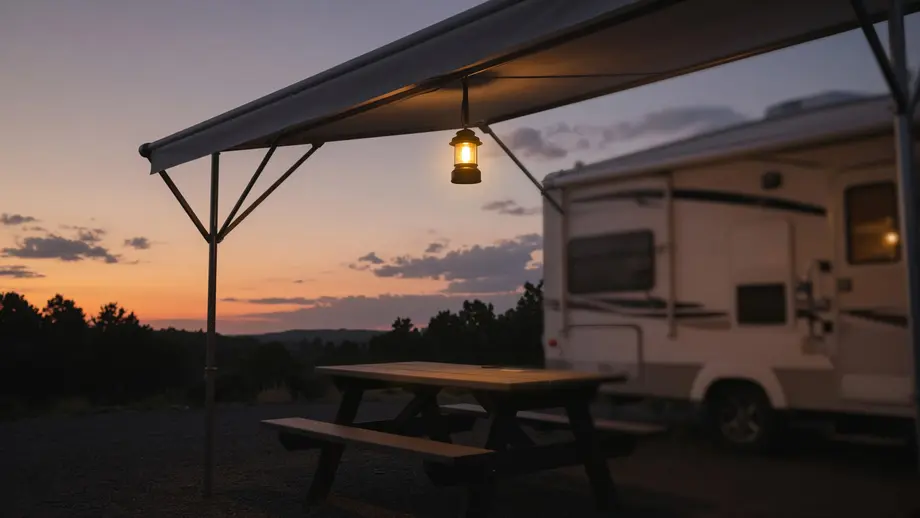
You use an RV camping lantern in three places on a typical evening: on the picnic table for dinner, under the awning after dinner, and inside the coach at bedtime. Each spot has a different distance to your eyes, mounting surface and brightness need, so one fixed setting fails at least two of them.
- Dinner at the picnic table, often beyond the porch light: enough light for plates and the grill end, no glare at eye level.
- Cards under the awning: the light has to hang above the table so it lights cards, not faces.
- Inside the coach: a bathroom trip or a waking child needs a few lumens at most; 100 lumens feels like a ceiling light.
Rechargeable vs Fuel RV Lanterns: Which Is Safer Inside the Coach?
Rechargeable RV lanterns are safer inside the coach because they burn nothing. The Centers for Disease Control and Prevention lists lanterns among the fuel-burning sources of carbon monoxide, and the Consumer Product Safety Commission tells campers not to use fuel-burning heaters or lanterns while sleeping in campers. A rechargeable LED lantern gives light and a little heat, but no combustion gas.
The CDC's carbon monoxide basics page names lanterns among fuel-burning CO sources and warns that "People who are sleeping, drunk, or under the influence of other substances can die from CO poisoning before they have symptoms." That is why a sleeping coach is the worst place for one.
The CPSC's 2024 safety alert on camping equipment (Publication 5008) states: "Since 2020, CPSC is aware of at least 12 people who died from carbon monoxide poisoning associated with camping equipment, including grills, lanterns and stoves." Its first rule: "Do not use fuel burning portable heaters or lanterns while sleeping in enclosed areas such as tents, campers, and other vehicles."
Rechargeable lights carry lithium-ion batteries with heat and charging limits, covered below. The U.S. Fire Administration's RV fire safety page reports that "From 2018 to 2020, there was an estimated average of 4,200 RV fires reported to U.S. fire departments each year." Among its tips: "Don't overload the electrical outlets." Spread your charging out rather than plugging every light into one power strip.
Safety note: Test the coach's CO alarm before each trip. The CDC advises installing "battery-operated or battery back-up CO detectors near every sleeping area in your home"; the same logic applies to the bunk and bedroom ends of a coach.
How Many Lumens Should I Get for a Camping Lantern?
For an RV, get a camping lantern that reaches at least 300 lumens and dims to 5 lumens or less. Use 150 to 300 lumens on the picnic table, 400 or more if the lantern hangs from the awning, and under 5 inside the coach. Hanging height changes the need more than any spec: every doubling of the drop to the table needs about four times the lumens.
Lumens measure total output; lux measures what lands on a surface (our explainer on beam distance covers the units). Converting takes a target and a geometry.
The target. No rule covers camp tables, but OSHA's construction lighting rule gives a published floor. Table D-3 in 29 CFR 1926.56 sets 3 foot-candles for general construction areas and accessways and 5 foot-candles for "General construction area lighting." One foot-candle is 10.764 lux, so those floors are about 32 and 54 lux. They are workplace minimums, not dinner standards, but a conservative bar.
The geometry. Assume the lantern hangs d meters above the center of a 6-foot (1.83 m) picnic table and spreads light evenly in all directions. Its intensity in candela is lumens ÷ 4π, and the lux at the table center is intensity ÷ d². So lumens = lux × 4π × d². At the table end, 0.915 m from center, light arrives at a slant from farther away, so the lux there is the center value × (d ÷ r)³, where r = √(d² + 0.915²).
Worked example for a 1.0 m drop: 32.3 lux at the center needs 32.3 × 12.566 × 1.0² = 406 lumens. At the table end, r = √(1.0 + 0.837) = 1.355 m, so the end gets (1.0 ÷ 1.355)³ = 0.402 of the center light, and 32.3 lux there takes 406 ÷ 0.402 = 1,011 lumens.
This table shows the lumens an evenly spreading lantern needs at three hanging heights. These are estimates from the even-spread assumption and OSHA's minimums, not measured values, and they ignore light bounced back from the awning fabric.
| Lantern height above tabletop | Table end gets this share of center light | Lumens for 32 lux (3 fc) at center | Lumens for 32 lux at the table end | Lumens for 54 lux (5 fc) at center | Lumens for 54 lux at the table end |
|---|---|---|---|---|---|
| 1.0 m (3.3 ft) | 40% | 406 | 1,011 | 676 | 1,684 |
| 1.5 m (4.9 ft) | 62% | 913 | 1,467 | 1,522 | 2,446 |
| 2.0 m (6.6 ft) | 75% | 1,623 | 2,159 | 2,705 | 3,598 |
Three rules follow from the table.
- Hang it low. Dropping a lantern from 2.0 m to 1.0 m above the table cuts the lumens needed at the center by four times. A short strap from the awning hook does more than a brighter lantern.
- Higher is more even. At 2.0 m the table end gets 75% of the center light; at 1.0 m, only 40%. If the grill end stays dark, a second small light there beats one very bright lantern overhead.
- Aim, don't spread. An even-spread lantern under an awning sends much of its output up into the fabric and toward the next site. A clip light with a tilting head, aimed at the table, puts more of its lumens where you eat.
Bugs are the other complaint about table light, and color is a weak fix. A 2016 study in Ecology and Evolution found that LEDs drew fewer insects than the other household light types it compared, but "no significant difference in attraction between the 'cool-' and 'warm-white' LEDs." Run the table light as dim as the task allows rather than counting on a warm color.
Our guide to the best lantern for camping compares what lumens cost at three price tiers; the table above answers how much an RV table needs for a given hook height.
Hooks, Bases, or Magnets: How Should You Mount RV Lantern Lights?
Mount RV lantern lights by the surface you have: hang from a hook or loop on the awning arm or rafter, stand on a flat table, or use a magnet only on steel. Magnets will not grip aluminum or fiberglass, so check the surface with a fridge magnet first. A light that holds its position stays out of your eyes and off the tabletop.
This table matches common RV surfaces with the attachment that works and the Olight feature that fits it, from Olight's product pages and manuals.
| RV surface or spot | Attachment that works | Olight feature | Check first |
|---|---|---|---|
| Awning rafter, arm or strap | Hook, carabiner or clip | Oclip 2 Pro clip "grips objects up to 14 mm thick"; Olight lists "loops, hooks, and carabiners" | Clip thickness vs the strap or bar |
| Picnic table | Flat base | Marauder Mini 2 with Lampshade as a table lamp; Sphere | The table is level and away from kids' elbows |
| Steel step, hitch or trailer tongue | Magnet | Sphere "strong magnet at the base"; Oclip 2 Pro tail and clip magnets | A fridge magnet sticks |
| Coach grab handle or cabinet knob | Lanyard or carabiner | Max Pump 3 carabiner; Marauder Mini 2 lanyard hole | The handle bears the weight without rattling |
- Match weight to the mount. A 465 g Marauder Mini 2 swinging from an awning strap will twist in a breeze; a 75.5 g Oclip 2 Pro barely moves.
- Keep the lens clear. The Oclip 2 manual warns, "Do not obstruct the lens, or else the energy emitted from the light may cause the object to burn." Never clip it face-down against awning fabric on a high mode.
- Take lights down before you retract the awning or drive. The Oclip 2 manual says, "If the product is carried or transported, please lock it," and the Marauder Mini 2 locks itself when it is off and untouched for 10 seconds, per its manual.
Common Mistake: Bringing a Fuel Lantern Into the Coach for Light or Heat
The most dangerous RV lantern mistake is carrying a lit propane or liquid-fuel lantern into the coach on a cold night, for light or warmth. A fuel lantern produces carbon monoxide, and the CPSC's guidance is plain: do not use fuel-burning heaters or lanterns while sleeping in campers. Use a rechargeable light inside.
The same CPSC alert says the rule "is especially important at high altitudes, where the risk of carbon monoxide poisoning is increased." The CDC adds a related rule for anyone tempted to warm the coach with the camp stove: "Never use a portable gas camp stove indoors."
The fix is a habit: switch the fuel lantern off outside before anyone goes in, bring a rechargeable light in on its lowest mode, and heat the coach with its installed, vented system. If anyone wakes with a headache, dizziness or nausea, leave the coach and see a doctor. The CPSC advises a doctor visit for cold or flu-like symptoms while camping, because CO poisoning "can easily be mistaken for a cold or flu."
Warning: Never use a fuel lantern, camp stove or portable heater inside a coach, tent or tow vehicle while anyone sleeps. Carbon monoxide has no color or smell.
Charging a Camping Lantern With a USB Port: Shore Power or Vehicle USB?
Charge from shore power or a wall-style USB-C charger when you can, and treat a vehicle USB port as a slower backup. A camping lantern with a USB port or USB-C input draws little energy: by our estimate, a full recharge of the Olight Marauder Mini 2 takes under 4% of the nominal energy in an example 100 Ah, 12 V house battery. Time, not energy, is the limit.
Energy. Take a 12 V, 100 Ah house battery as the example; it is our assumption, not a standard size, so scale the shares to your own bank (a 200 Ah bank halves them). It holds 12 × 100 = 1,200 Wh nominal, and less is usable. The three lights below hold 27.75 + 7.215 + 2.59 = 37.555 Wh, so refilling all of them uses 37.555 ÷ 1,200 = 3.1% before conversion losses. As an upper bound, the Marauder Mini 2 manual lists USB-C input at 5 V, 2.5 A and "About 3.5 hours" to full: 12.5 W × 3.5 h = 43.75 Wh, or 3.6%.
Time. Charging can never take less than battery energy ÷ port power. On a 5 W vehicle port, the Marauder Mini 2 needs at least 27.75 ÷ 5 = 5.55 hours even at perfect efficiency, so check the rating printed near your RV's USB sockets.
This table shows each light's charging budget from Olight's published ratings; battery shares are estimates against the 1,200 Wh example, not measurements.
| Light | Battery (Olight) | Charge input and time (Olight) | Share of a 1,200 Wh house battery | Minimum hours on a 5 W port |
|---|---|---|---|---|
| Marauder Mini 2 | 27.75 Wh (7,500 mAh, 3.7 V) | USB-C 5 V 2.5 A, about 3.5 h; optional MCC3 about 6.5 h | 2.3% (3.6% upper bound) | 5.55 |
| OSelect Max Pump 3 | 7.215 Wh (11.1 V, 650 mAh) | Type-C 5 V 3 A; time not listed | 0.6% | 1.44 |
| Sphere C | 2.59 Wh (700 mAh, 3.7 V) | USB-C, 5 W (5 V 1 A) adapter or larger recommended; no cable in box | 0.2% | 0.52 |
Heat is the real risk in an RV. The National Weather Service's heat safety page on vehicles says "a dark dashboard or seat can easily reach temperatures in the range of 180 to over 200°F." That is (180 − 32) × 5 ÷ 9 = 82.2°C to 93.3°C, or 22 to 33°C above the 60°C (140°F) in-car limit in two Olight manuals.
The Oclip 2 and Sphere C manuals both set 60°C as the ceiling for keeping a light in a car, and the Oclip 2 manual extends it to charging and use. Charging has a lower ceiling still: the Sphere C manual says that above 40°C its battery protection "may fail to charge the product," and Olight lists a 0~40℃ working temperature for the Marauder Mini 2. So charge in a shaded cabinet or on the dinette at room temperature, never on the dash.
Tip: For storage between trips, the Max Pump 3 manual says "Lithium-ion battery products should be charged at least every 3 months during storage."
How Long Does a Rechargeable Lantern Last as a Coach Night Light?
On its dimmest modes, a flashlight-sized lantern can run for weeks as a coach night light. Olight rates the Marauder Mini 2 side light moonlight at 0.5 lumens for 150 days, which is about 0.2% of the battery per 8-hour night. Its 5-lumen side light is rated at 10 days, or about 3.3% per night.
The math is hours used ÷ rated hours: 150 days × 24 = 3,600 hours, and 8 ÷ 3,600 = 0.22% per night. This table converts the Marauder Mini 2's lowest published modes into nights of coach use. These are estimates from Olight's rated runtimes, not measured; real runtime varies with temperature.
| Marauder Mini 2 mode (Olight) | Output | Rated runtime | Battery per 8-hour night | Approximate 8-hour nights per charge |
|---|---|---|---|---|
| Side light, moonlight | 0.5 lm | 150 days | 0.22% | 450 |
| Red light, moonlight | 1 lm | 35 days | 0.95% | 105 |
| Side light, Level 1 | 5 lm | 10 days | 3.3% | 30 |
| Red light, Level 1 | 5 lm | 8.5 days | 3.9% | 25 |
A night light should show the floor and the step without waking anyone. The Marauder Mini 2's white LEDs are listed at 6,500K in its manual, so in the coach use its red light or side light moonlight. The Sphere C's white light is listed at 2800K, and its red low of 0.5 lumen is rated at 25 hours, or about three 8-hour nights (25 ÷ 8 = 3.1) per charge.
One RV-specific note from the Sphere C manual: "The light adopts PWM regulation. Please keep it away from radios to avoid causing noise interference." Keep it away from a bedside weather radio.
Which Rechargeable Camping Lantern Is the Brightest?
The brightest rechargeable camping lanterns on makers' spec sheets reach thousands of lumens; Fenix, for example, rates its CP50R work lantern at 5,500 lumens. But brightness is the wrong first test for an RV lantern. The table math above shows placement matters more, and a light that cannot dim below 50 lumens fails inside the coach.
Compare the lumens a light can hold, not the first-minute peak. Olight rates the Marauder Mini 2 at 10,000~2,500 lumens on its top floodlight level for 2 + 90 minutes, and 1,200~600~150 lumens for 3 + 1 + 3 hours. It is a flashlight, but with the $9.99 Olight Marauder Mini 2 Lampshade it becomes a shaded table lamp (the white shade is 63 mm across and 115 mm tall). For an RV the test is two-sided: about 1,011 lumens reaches the 3 foot-candle floor at the table ends from a 1.0 m hook, and the same light must still dim for the coach.
Where Can I Find a Cheap Camping Lantern?
The cheapest useful rechargeable camping light in this guide is the Olight Sphere Ambient Light at $17.99 (regular price, September 2026). It makes a good coach night light and table glow, but at 75 lumens it will not light a picnic table for cooking. Our price guide linked above compares lanterns at about $20, $60 and $100 to $180.
Wherever you shop, check four things before you buy.
- A published runtime for each mode, not a single "up to" figure.
- A water rating for dew and rain at the awning edge. Olight rates the Sphere IP56 and pitches it for "camping in the rain," but keep it out of standing water: its manual notes that if it is "immersed in warm water for an extended period, the button functionality may be affected temporarily."
- A low mode of 1 lumen or less for the coach; the Sphere's white low is 1 lumen for 40 hours.
- The charging port and cable. The Sphere C charges by USB-C, but Olight notes that "The purchase of Sphere C will not include a USB-C cable."
If you camp without hookups, our comparison of rechargeable camping lights and solar lanterns covers charge times and cloudy days.
Olight RV Lantern Picks and Where They Fall Short
For most RVers, the Olight Sphere Ambient Light ($17.99) plus the Olight Oclip 2 Pro ($54.99) covers the coach, table glow and awning for $72.98. Add the Olight Marauder Mini 2 ($219.99) with its $9.99 Lampshade only if you also want a long-reach spotlight. The OSelect Max Pump 3 ($60.99) fits families who inflate air beds.
Our price guide points group and RV sites toward one $100 to $180 lantern with IPX7 or IP66 sealing. Here the answer differs because shore power or a 12 V battery refills small lights daily, so a light at each spot matters more than battery size; for a week without hookups, the big-battery lantern still fits better.
Sphere Ambient Light for the coach and table glow. The Olight Sphere Ambient Light has a 360-degree light-emitting surface, a 1-lumen white low (40 hours), a 0.5-lumen red low (25 hours on the Sphere C), a magnetic base, IP56 and 1.5 m impact resistance. Its limit is output: at 75~22 lumens for 100 + 150 minutes, it is a glow, not a cooking light. It looks like a ball, but its manual warns that the built-in lithium battery should not be dropped or hit, so an adult should place it around small kids.
Oclip 2 Pro for the awning hook. The Olight Oclip 2 Pro pairs "a 115° head tilt with 360° clip rotation" with a clip that grips straps up to 14 mm thick, so it aims down at the table. Its floodlight runs 100 lumens for 3 hours 45 minutes on Medium and 10 lumens for 25 hours on Low; it is rated IP66 with 2.0 m impact resistance. The limits: Medium lasts one evening, not a weekend, and although it is rated IP66, its manual prohibits immersion, so keep it off an awning edge where rain pools and runs off.
Marauder Mini 2 with Lampshade for the table and the campground. The Olight Marauder Mini 2 has floodlight levels of 150 lumens (27 hours) and 300~150 lumens (13 + 3 hours), a side light, red light, a 27.75 Wh battery and an IPX8 rating; the Lampshade package "includes the lampshade only." Its limits are cost and weight: $219.99 and 465 g is a lot for a table lamp unless you also use its 750 m spotlight. Its manual says, "Caution: Do not stare at operating light source." Olight's Marauder series flashlights include the rest of the family.
Max Pump 3 for setup night. The OSelect Max Pump 3 inflates an air mattress or a kid's air bed on arrival, then works as a small camp light. Its manual shows a built-in carabiner for a grab handle or awning strap and a 1/4 threaded nozzle that fits a tripod (sold separately). The catch in an RV is the shared 7.215 Wh battery: Olight rates the pump at 25 minutes on High and 60 minutes on Low, so inflate first and recharge before you count on the light. Its manual's warning list opens with "Do not use continuously for more than 10 minutes," adds "Do not leave the product unattended during use," and says children under 12 must use it under adult supervision.
This table shows who should pick which light, using Olight's specs and regular prices as of September 2026.
| RVer | Pick | Regular price | Why | Skip it if |
|---|---|---|---|---|
| Couple on weekend state park trips | Sphere + Oclip 2 Pro | $72.98 | Coach night light, table glow and an aimed awning light | You want one light to do everything |
| Family with kids in two bunks | 2 Spheres + Oclip 2 Pro + Max Pump 3 | $151.96 | Dim red in each bunk; adult-run pump and light for air beds | Kids under 12 would use the pump unsupervised |
| Rural or boondocking campers who check the site at night | Marauder Mini 2 + Lampshade | $229.98 | Table lamp by night, 750 m spotlight when something moves | Budget matters, or you never need reach |
| Minimalist with a small trailer | Sphere only | $17.99 | Night light and table glow | You cook at the table after dark |
Your RV Camping Lantern Checklist
Before your next trip, set up an RV camping lantern kit by spot, not by brightness: a dim light for the coach, a 150- to 300-lumen table light, and a hanging or clip light for the awning. Charge on shore power, keep lights out of the hot cab, and leave fuel lanterns outside.
- Coach: dims to 1 lumen or less, preferably red, aimed at the floor.
- Table: add a second small light at the grill end rather than one very bright light.
- Awning: hang as low as heads allow; halving the drop cuts the lumens needed about four times.
- Mounts: test steel with a fridge magnet; carry a carabiner for the rafter.
- Charging: shore power or a wall-style USB-C charger, never on the dash.
- Travel: take lights off the awning before retracting it, and lock them before driving.
- Storage: top up lithium-ion lights at least every 3 months.
FAQ
Changelog
- September 24, 2026: First published.