Olight makes the lights recommended here. Olight specs and regular prices come from its US product pages and user manuals as of September 2026. Trip counts, kit volumes and kit prices below are our own arithmetic from those published ratings, not measurements.
⚡ TL;DR
The best RV camping lights for most families are an Olight Perun 3 headlamp for each adult, a Sphere Ambient Light for the dinette or a child's bunk, and an Oclip 2 Pro clip light by the coach door. We compared four Olight lights across four RV jobs. The Perun 3 wins overall because one light works on your head, in your hand, and stuck to steel.
The coach has ceiling lights, but the picnic table, the sewer hookup and the 150-meter walk to the bathhouse do not. Buy too many lights and they crowd a drawer that already holds the leveling blocks; buy too few and a family of four passes one flashlight around at 10 p.m. This guide sizes, prices and stows a kit from the makers' published numbers.
This table sums up the best RV camping lights by job, using Olight regular prices as of September 2026.
| Scenario | Recommended model | Key specs (Olight ratings) | Price (regular, September 2026) | Why |
|---|---|---|---|---|
| Best overall, one per adult | Olight Perun 3 | 3,000 lm max; Med 120 lm for 25 h; red 15 lm for 70 h; IP68; 150 g | $89.99 | Headband, magnetic tail and clip let one light cover the coach, the patio and the bathhouse walk |
| Dinette, bunk or patio glow | Olight Sphere Ambient Light (Sphere C) | White 75~22 lm for 100 + 150 min; red 0.5 lm for 25 h; IP56; 93 g | $17.99 | A 360° glow for the table and a dim red night light for a child's bunk |
| Grab light by the coach door | Olight Oclip 2 Pro | 530 lm floodlight; flood 100 lm for 3 h 45 min; red 4 lm for 27 h; IP66; 75.5 g | $54.99 | Clips to a jacket or strap and tilts 115° to light your feet on the walk |
| Site edge, hookup post or a dark road | Olight Seeker 4 Pro | 4,600 lm; 16,895 cd; 260 m; Med 300 lm for 11 h; IPX8; 205 g | $139.99 | Reach for eyeshine, site numbers and the water spigot well past the patio |
📋 Table of Contents
- 1. Quick Answer: What Lights Does an RV Family Actually Need?
- 2. What Type of Lighting Is Best for an RV?
- 3. RV Camping Light Needs: Inside the Coach, on the Patio, and on the Walk
- 4. Best RV Camping Lights for 2026: Lanterns, Lantern Flashlights, Headlamps, and a Clip Light
- 5. How Did We Compare These RV Camping Lights?
- 6. How Many Bathhouse Trips Does One Charge Cover?
- 7. What Do RV Camping Light Kits Cost at Three Budgets?
- 8. How Should an RV Family With Kids Split the Lights?
- 9. Storage Space Is Tight: Which RV Camping Lights Earn a Drawer?
- 10. Common Mistake: One Big Flashlight for the Whole Family
- 11. Charging and Storage Habits: Shore Power, Cables, and a Hot Coach
- 12. What Is the Best Camping Light?
- 13. What Are the Best Tent Lights for Camping Next to the RV?
- 14. Your RV Lighting Checklist Before the First Trip
- 15. FAQ
Quick Answer: What Lights Does an RV Family Actually Need?
An RV family usually needs one ambient light for the table or bunk, one headlamp or small flashlight per person, and one long-reach flashlight shared by the adults. Choose rechargeable models you can top up on shore power. The three kits below cost $162.97 to $410.94 at Olight regular prices, and even the largest fits in under a liter of drawer space. Wired fixtures and awning LED strips are outside this list.
Olight groups its camping flashlights and headlamps on one page if you want to browse beyond these four picks. If your question is where one lantern should sit, our RV camping lantern guide covers hanging height and night-light modes; this guide sizes the whole kit.
What Type of Lighting Is Best for an RV?
The best lighting for an RV is LED: the coach's built-in fixtures for general light, plus battery-powered portable LED lights for the places those fixtures can't reach, such as the picnic table, the path and the hookup post. Keep fuel lanterns out of the coach. The CDC says, "Never use a charcoal grill, hibachi, lantern, or portable camping stove inside a home, tent, or camper."
That line comes from the CDC's guidance on protecting yourself during a power outage, which also advises, "Use battery-powered flashlights and lanterns, rather than candles, gas lanterns, or torches to minimize the risk of fire."
RV Camping Light Needs: Inside the Coach, on the Patio, and on the Walk
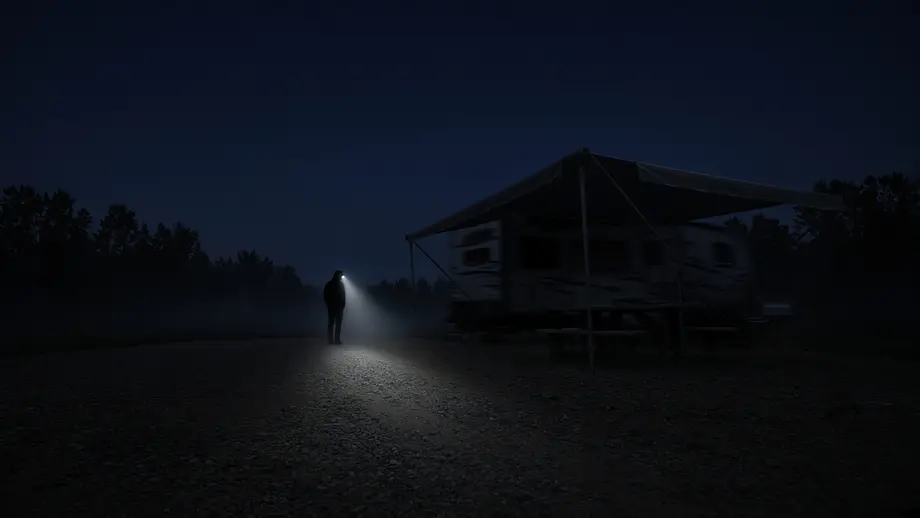
RV camping lights have four distinct jobs: soft light at the coach dinette, task light at the patio picnic table, a moving light for the walk to the bathhouse, and reach for checking the site edge or the hookup post. Each job wants a different beam and brightness, so one light rarely does all four well.
This framework assigns each RV task a light, a mode and the mistake to avoid, based on Olight's rated modes.
| RV task | What the light must do | Pick and mode (Olight rating) | Avoid |
|---|---|---|---|
| Coach dinette: cards, homework, a late snack | Warm, even glow without glare | Sphere, white high 75~22 lm | Aiming a high-output flashlight at the ceiling for an hour |
| Kids' bunk or dinette bed | Dim light for a 2 a.m. wake-up | Sphere, red low 0.5 lm (25 h) | White light that wakes the whole coach |
| Patio picnic table under the awning | Light on plates and the grill | Perun 3 on Med 120 lm, head tilted down, or Oclip 2 Pro flood 100 lm clipped to a strap | A beam pointed into the next site |
| Walk to the bathhouse, 150 m each way | Ground at your feet, both hands free | Perun 3 on Low 30 lm, or Oclip 2 Pro flood 10 lm | A phone flashlight that drains your map and camera |
| Hookup post, sewer connection, leveling | Hands-free close work | Perun 3 on Med 120 lm on the headband | Holding a flashlight in your teeth |
| Site edge, eyeshine, a lost dog leash | Reach past the patio light | Seeker 4 Pro on Med 300 lm, Turbo only briefly | Leaving Turbo or strobe on near other campers |
Best RV Camping Lights for 2026: Lanterns, Lantern Flashlights, Headlamps, and a Clip Light
The best RV camping lights for 2026 are four Olight models that split the work: the Perun 3 headlamp as the everyday light for each adult, the Sphere Ambient Light as the lantern-style glow, the Oclip 2 Pro as the grab light by the door, and the Seeker 4 Pro for reach.
None of the four is a lantern flashlight hybrid: the Sphere covers the lantern job, and the Perun 3's magnetic tail lets you stick it to steel and bounce its beam off a pale ceiling.
Olight Perun 3: Best Overall RV Camping Light
The hard part of RV lighting is busy hands: hose in one, wrench in the other, a child on your sleeve. The Olight Perun 3 headlamp comes with what Olight lists as a "Headband, magnetic tail, clip and lanyard," so it rides on your head at the sewer hookup and sticks to a steel step when you set it down.
Its modes suit RV life: Moon 5 lumens for 20 days, Low 30 lumens for 89 hours, Med 120 lumens for 25 hours, plus red at 15 lumens for 70 hours. Turbo's 3,000~800~600 lumens is far more than a campground needs. It is rated IP68, weighs 150 g and costs $89.99.
The limits: it charges only through the MCC3 magnetic cable in the box, and Olight notes, "Headlamp mounting bracket is METAL - it is expected to scratch the body of the torch if taken in / out repeatedly." At a shared table, tilt the head down before you turn to talk. For lighter options on camp chores, see our best camping headlamp guide, or browse Olight's rechargeable headlamps.
Olight Sphere Ambient Light: Best for the Dinette and the Bunk
The hard part inside a coach is glare from bare emitters. The Olight Sphere Ambient Light spreads light through a transparent shell with what Olight calls a "360-degree light-emitting surface design," and its Sphere C manual lists the white light at 2800K and CRI 80, a warm tone for the dinette.
The current US listing is the Sphere C (USB-C): white high 75~22 lumens for 100 + 150 minutes, white low 1 lumen for 40 hours, red low 0.5 lumens for 25 hours, IP56, 1.5 m impact resistance, 93 g, $17.99.
The limits: 75 lumens is table glow, not a path light, and the Sphere C ships without a USB-C cable. IP56 covers rain on the picnic table, and the manual warns against immersing it. For a brighter lantern on a big table, our best lantern for camping guide compares lanterns by price tier.
Olight Oclip 2 Pro: Best Grab Light by the Coach Door
The hard part of the bathhouse walk is that you decide to go at the last second. The Olight Oclip 2 Pro clip light clips to objects up to 14 mm thick, and Olight says, "Tail and clip magnets turn it into a magnetic work light." Its head tilts 115°, so it can point at the path while clipped to a shirt. The Oclip 2 user manual adds a caution for anyone with an implanted heart device: "If you have an ICD or pacemaker, avoid close or prolonged contact with this product to prevent possible interference."
The floodlight runs 100 lumens for 3 hours 45 minutes on Medium, 10 lumens for 25 hours on Low and 1 lumen for 144 hours on Moon; red runs 4 lumens for 27 hours. It is rated IP66 with 2.0 m impact resistance, weighs 75.5 g and costs $54.99.
The limit: the Oclip 2 user manual says, "Do not immerse the product in water or other liquids, as it will damage the product," so it is not a light for rinsing off at the dump station hose.
Olight Seeker 4 Pro: Best for the Site Edge and the Hookup Post at Night
The hard part at the site edge is reach past the patio light, to the spigot, the site post and whatever made that noise. The Olight Seeker 4 Pro flashlight is rated at 4,600 lumens, 16,895 candela and 260 m, with Med at 300 lumens for 11 hours and Low at 50 lumens for 60 hours.
The box includes a vertical holster, a holster fixing bracket and screws. The manual's bracket steps start with drilling holes for screw anchors, then the bracket's 3M adhesive, which it says to stick "on a flat and smooth wall or car panel." It charges by USB-C through the holster (an MCC3 cable is optional), and "When the flashlight is off, it will be locked if put back to the holster," which suits a light that rides by the door on travel days.
The limits: at $139.99 and 205 g it is the priciest and heaviest light here, mounting means screw holes in your coach, and its 13 Hz strobe has no place in a campground. If your sites are lit, buy a second Perun 3 instead.
This table compares the four RV camping lights side by side on Olight's rated figures and regular prices, as of September 2026.
| Model | Max output | Peak intensity | Beam distance | Runtime at a camp mode | Weight | Water rating | Price (regular) |
|---|---|---|---|---|---|---|---|
| Olight Perun 3 | 3,000 lm | 6,400 cd | 160 m | Low 30 lm: 89 h | 150 g | IP68 | $89.99 |
| Olight Sphere Ambient Light (Sphere C) | 75 lm | Not listed | Not listed | White low 1 lm: 40 h | 93 g | IP56 | $17.99 |
| Olight Oclip 2 Pro | 530 lm (floodlight) | 3,906 cd | 125 m | Flood low 10 lm: 25 h | 75.5 g | IP66 | $54.99 |
| Olight Seeker 4 Pro | 4,600 lm | 16,895 cd | 260 m | Low 50 lm: 60 h | 205 g | IPX8 | $139.99 |
How Did We Compare These RV Camping Lights?
We compared these RV camping lights on paper, from Olight's published ratings and user manuals, not in the field. Each light was matched to the four RV tasks above. Trip counts, kit volumes, cable counts and kit prices are arithmetic from those ratings, and every figure below names its source.
This evaluation-method table lists each measure, where the figure came from, the basis used and how many times it was applied.
| Measure | Source | Basis | Times applied |
|---|---|---|---|
| Output and runtime by mode | Olight US product page Specs tab | Olight's rated figures; the Sphere C manual says its figures follow ANSI/PLATO FL 1-2019 (the current edition is FL 1-2025) | Every mode quoted, cross-checked once against the user manual |
| Weight and stowed size | Olight product page Specs | Rated weight with battery; bounding box from listed dimensions | Once per light |
| Walking time to the bathhouse | FHWA MUTCD, 2009 edition, Section 4E.06 | 3.5 feet per second walking speed | One route: 150 m each way |
| Charging cables and times | Olight product pages and user manuals | Cable type, what is in the box, rated time to full | Once per light |
| Price | Olight US store product pages | Regular price, not promotions, September 2026 | Once per model |
| Safety and storage limits | Olight user manuals; U.S. Fire Administration | Quoted word for word | Each recommended model |
How Many Bathhouse Trips Does One Charge Cover?
One charge covers anywhere from 22 bathhouse trips to more than 500, depending on the light and mode. On a 150-meter walk each way, the Oclip 2 Pro's 100-lumen floodlight covers about 22 trips per charge, the Perun 3 on Low covers about 534, and the Seeker 4 Pro on Low covers about 360.
The 2009 edition of the Federal Highway Administration's Manual on Uniform Traffic Control Devices (Section 4E.06) sizes pedestrian clearance times to "a walking speed of 3.5 feet per second." That is 3.5 × 0.3048 = 1.067 m/s, so a 300-meter round trip takes 300 ÷ 1.067 = 281 seconds, about 4.7 minutes.
Real trips take longer (children, shoes, waiting outside), and the same section says a slower speed "should be considered" where slower walkers are common. So each trip is rounded up to 10 minutes of light: trips per charge = rated minutes ÷ 10.
This table converts each light's rated runtime into bathhouse trips per charge, based on Olight's rated runtimes, not measured.
| Light and mode (Olight rating) | Rated runtime | Minutes | Trips per charge (÷ 10 min) |
|---|---|---|---|
| Oclip 2 Pro, flood Medium 100 lm | 3 h 45 min | 225 | 22 |
| Oclip 2 Pro, flood Low 10 lm | 25 h | 1,500 | 150 |
| Oclip 2 Pro, red Low 4 lm | 27 h | 1,620 | 162 |
| Perun 3, Med 120 lm | 25 h | 1,500 | 150 |
| Perun 3, Low 30 lm | 89 h | 5,340 | 534 |
| Seeker 4 Pro, Med 300 lm | 11 h | 660 | 66 |
| Seeker 4 Pro, Low 50 lm | 60 h | 3,600 | 360 |
For a family: if four people each make two trips a night on one Oclip 2 Pro at Medium, that light lasts 22 ÷ 8 = 2.75 nights. A Perun 3 on Low covering one adult's two trips a night lasts 534 ÷ 2 = 267 nights on paper. The mode matters more than the model. These are rated continuous runtimes; short walks and cold weather change real results, so charge on a schedule.
What Do RV Camping Light Kits Cost at Three Budgets?
At Olight regular prices in September 2026, a two-person RV kit costs $162.97, a family-of-four kit costs $270.95, and the same family kit plus a long-reach flashlight costs $410.94. Per person, that is $81.49, $67.74 and $102.74. The family kit is the cheapest per person because the $17.99 Sphere does the kids' job.
This table prices three RV camping light kits and shows which RV jobs each one covers.
| Kit | Contents | Total (regular price) | Per person | RV jobs covered |
|---|---|---|---|---|
| Couple | 1 Perun 3 + 1 Oclip 2 Pro + 1 Sphere | $162.97 | $81.49 (2 people) | Coach, patio, walk, hookups |
| Family of four | 2 Perun 3 + 2 Sphere + 1 Oclip 2 Pro | $270.95 | $67.74 (4 people) | Coach, two bunks, patio, walk, hookups |
| Family of four plus reach | Family kit + 1 Seeker 4 Pro | $410.94 | $102.74 (4 people) | All of the above plus the site edge |
The sums: $89.99 + $54.99 + $17.99 = $162.97; 2 × $89.99 + 2 × $17.99 + $54.99 = $270.95; plus $139.99 = $410.94. The Seeker 4 Pro adds $139.99 for one job: buy it for unlit loops, boondocking or night dog walks. If you are weighing solar models, our comparison of rechargeable camping lights and solar lanterns covers charge times.
How Should an RV Family With Kids Split the Lights?
An RV family with kids should give each adult a headlamp, give each child a dim ambient light for the bunk, and keep the high-output flashlight with an adult. The Sphere's red low mode, 0.5 lumens for 25 hours, is enough to find the bathroom without waking the coach. Adults walk kids to the bathhouse.
Great Sand Dunes National Park notes in its Experience the Night guide that "Shining a bright flashlight will diminish your night vision for up to 30 minutes, limiting your view of the night sky and wildlife, and harming other visitors' experience."
If the family travels with a dog, the Sphere's manual adds: "Non-pet toy: Not for pets, as there is a risk of biting and damage."
Warning: The Perun 3 manual says, "Caution: Do not stare at operating light source." At 3,000 and 4,600 lumens, the Perun 3 and Seeker 4 Pro stay with adults, and any child using a light needs supervision.
Both have auto-off timers; the Seeker 4 Pro manual says it "comes with a long timer (9 minutes) and a short timer (3 minutes) for automatic light-off when in use," which helps if a light gets left on in a bunk.
Storage Space Is Tight: Which RV Camping Lights Earn a Drawer?
Portable RV camping lights take very little room. By bounding-box volume from Olight's listed dimensions, the four-person kit plus a Seeker 4 Pro takes about 798 cm³, under a liter, and weighs 766.5 g. The Sphere takes the most space per light at 196 cm³, the Oclip 2 Pro the least at 59 cm³.
Each light is treated as a box, which overstates round lights slightly. Sphere: 60 × 60 × 54.5 mm = 196.2 cm³. Perun 3: 28 × 28 × 116.8 mm (head diameter by length) = 91.6 cm³, headband not included. Oclip 2 Pro: 60.2 × 28 × 35 mm = 59.0 cm³. Seeker 4 Pro: 35 × 35 × 133 mm = 162.9 cm³, holster not included.
This table totals stowed volume and weight for each kit, based on Olight's listed dimensions and weights, not measured.
| Kit | Stowed volume (bounding box) | Weight (with batteries) | Compared with one 6 V lantern battery (440.4 cm³, 650 g) |
|---|---|---|---|
| Couple | 346.8 cm³ | 318.5 g | About 0.8 times the volume and half the weight |
| Family of four | 634.5 cm³ | 561.5 g | About 1.4 times the volume, 88.5 g lighter |
| Family of four plus reach | 797.5 cm³ | 766.5 g | About 1.8 times the volume, 116.5 g heavier |
The comparison point is an Energizer 529 6-volt lantern battery, which Energizer's product datasheet lists at a typical weight of 650 grams and a typical volume of 440.4 cubic centimeters. The five-light family kit weighs less than that one disposable battery.
Common Mistake: One Big Flashlight for the Whole Family
A common RV lighting mistake is packing one powerful flashlight for the whole family. It fails three ways: whoever leaves with it strands everyone else, its high modes drain fast as a shared walking light, and its reach is wasted at the dinette. Four modest lights beat one bright one.
The National Park Service makes the same point. Capitol Reef's stargazing safety tips say, "Bring a few extra light sources (cell phones do not count as a light source)." The trip table shows the cost: one shared Oclip 2 Pro on Medium lasts about 2.75 nights, while two Perun 3 headlamps on Low barely notice the same trips.
Note: If you already own one high-output flashlight, keep it as the site-edge light by the door and add a small light per person for the walks.
Charging and Storage Habits: Shore Power, Cables, and a Hot Coach
Charge RV camping lights on shore power the afternoon you arrive, in a shaded spot. The practical limits are cables and heat, not energy: the four lights here use three different charging setups, and one ships without a cable. Plan the cables before the trip and count the ports your coach and adapters offer.
This table lists how each light charges and what you need to pack, from Olight's product pages and user manuals.
| Light | Charges by | In the box | Rated time to full (Olight manual) | Pack |
|---|---|---|---|---|
| Olight Perun 3 | MCC3 magnetic cable only; USB Type-A plug, 5 V 2 A | MCC3 cable | Under 4 hours | A USB-A port or adapter for each Perun 3 |
| Olight Seeker 4 Pro | USB-C through the holster (5 V 2 A), or an optional MCC3 | USB-C cable and holster | About 3.5 hours by USB-C | The holster, mounted or packed |
| Olight Oclip 2 Pro | USB-C, or an optional MCC cable | USB-C cable | 1 h 30 min by USB-C | Nothing extra |
| Olight Sphere Ambient Light (Sphere C) | USB-C; 5 W (5 V 1 A) adapter or larger recommended | No cable | Not listed | Your own USB-C cable |
The cable count follows. The couple kit needs three cables (one MCC3, two USB-C, one of which you supply), the family kit five (two MCC3, three USB-C, two you supply), and the family-plus-reach kit six. With each light on its own port, the kit refills in one afternoon, since no listed time exceeds 4 hours. On one shared port, the couple kit's Perun 3 and Oclip 2 Pro alone can take up to about 4 + 1.5 = 5.5 hours in turn, plus the Sphere, whose time Olight doesn't list. Pack a multi-port charger.
Heat is the real storage issue. The Perun 3, Seeker 4 Pro and Sphere C manuals list a working temperature of 0-40°C, and the Oclip 2 manual lists 0~45°C for operating and charging. The Sphere C and Oclip 2 manuals also warn against leaving the light in a car that may exceed 60°C. A closed coach or storage bay in summer sun can pass those limits, so store lights in a shaded cabinet.
Safety note: The U.S. Fire Administration's battery fire safety page says, "You should store lithium-ion batteries at room temperature when possible." Between trips, bring the lights into the house rather than leaving them in a parked rig.
What Is the Best Camping Light?
The best camping light for most people is a rechargeable headlamp that also works as a handheld flashlight, because camp chores need both hands and a headlamp goes wherever you look. For RV camping, the Olight Perun 3 fits that description: 30 lumens for 89 hours on Low, red light, IP68, and a magnetic tail for setting it down on steel.
A lantern is the second-best single light: it lights the table and does nothing for the walk, which is why the kits pair a Sphere with a headlamp. In an RV, where the rig carries the weight and the site has steel, a magnetic headlamp that doubles as a flashlight is the best single choice.
What Are the Best Tent Lights for Camping Next to the RV?
The best tent lights for camping next to an RV are dim, battery-powered LEDs with a red mode, never fuel lanterns. For kids sleeping in a tent on the RV site, the Sphere on red low at 0.5 lumens for 25 hours gives enough light to find a shoe without lighting the tent wall for the whole campground.
The Consumer Product Safety Commission's page on portable heaters and camping equipment says, "Never use fuel-burning portable heaters or lanterns while sleeping in enclosed areas such as tents, campers and vehicles." Placement matters too: a light clipped high casts shadows of everyone inside onto the walls. For reading, the Oclip 2 Pro's 1-lumen Moon floodlight, rated at 144 hours, gives a small pool of light on a book.
Your RV Lighting Checklist Before the First Trip
Before your first RV trip, set up the lights at home, charge them, and give each a job and a place in the rig. This checklist builds the best RV camping lights kit you will actually use.
- Pick a kit size: couple ($162.97), family of four ($270.95), or family plus reach ($410.94), at Olight regular prices in September 2026.
- Give each light a home: Oclip 2 Pro and Seeker 4 Pro by the door, a Sphere in each bunk area, a Perun 3 with each adult.
- Pack the cables: an MCC3 per Perun 3, your own USB-C cable per Sphere C, and a multi-port charger.
- Set the walking mode: teach everyone to use Low for the bathhouse walk and save high modes for the site edge.
- Test the magnets on your rig's steel surfaces before the trip.
- Charge on shore power the afternoon you arrive, not in a closed coach in summer sun.
- Lock out lights before driving, and keep fuel lanterns and stoves outside the coach and any tent.
FAQ
Changelog
- September 24, 2026: First published.