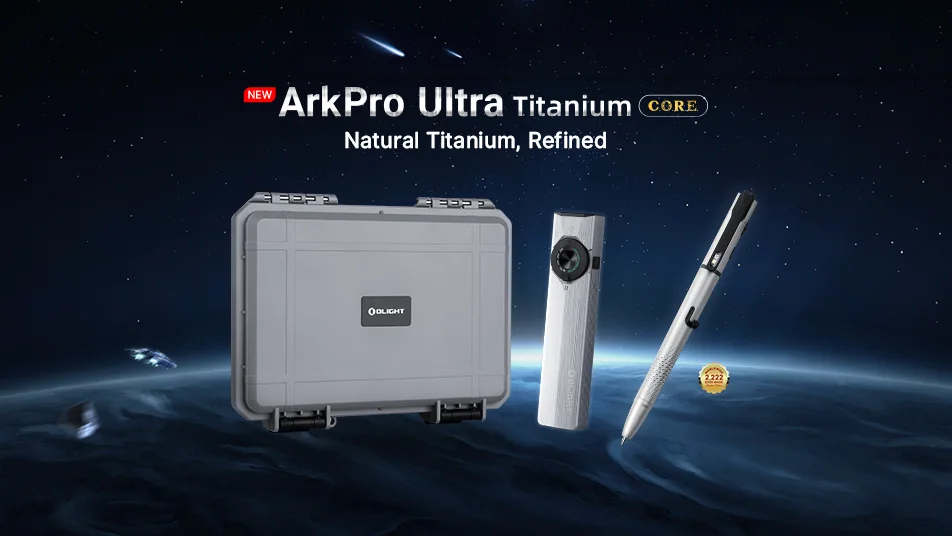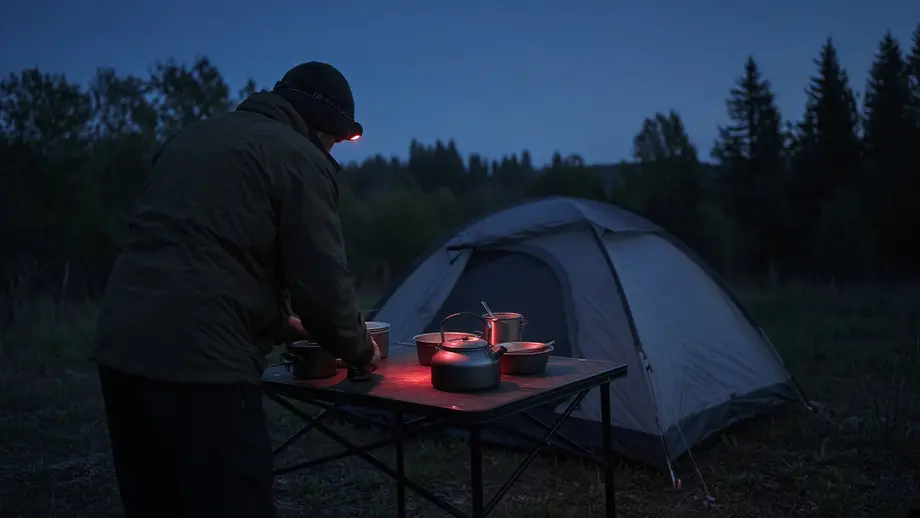
Olight makes four of the six headlamps discussed here. Specs, runtimes and regular prices come from each maker's product page, user manual or technical notice as of September 2026. Scores, illuminance figures and nights-per-charge are our own arithmetic from those published ratings, not measurements.
⚡ TL;DR
The best camping headlamp for most campers is the Olight Perun 3, $89.99 at regular price: about 20 camp nights per charge on our usage profile, IP68, a 5-lumen Moon and red light straight from off. We compared six headlamps and scored five on camp jobs. For weekend trips, the lighter Oclip Pro S on its headlamp strap ($47.98) edges it on the scorecard, 80 to 78.
This table gives the best camping headlamp for each camp situation, with Olight regular prices from its US store in September 2026.
| Scenario | Pick | Key specs (Olight ratings) | Price (regular, September 2026) | Why |
|---|---|---|---|---|
| Best overall, multi-night and wet camps | Olight Perun 3 | 30 lm for 89 h, 120 lm for 25 h, red 15 lm for 70 h, IP68, 150 g | $89.99 | Wins the tie-break among the top scores (78/100): about 20 nights per charge, IP68, red straight from off |
| Weekend trips and the lightest kit | Olight Oclip Pro S + Oclip Series Headlamp Strap | 1 lm Moon, 10 lm for 27 h, red 4 lm for 26 h, 53 g light, IPX6 | $47.98 ($39.99 + $7.99) | Top in-stock score (80/100): the dimmest white and red modes in the comparison |
| Cap wearers who want to aim the beam | Olight Oclip 2 Pro | 1 lm Moon, flood 10 lm for 25 h, red 4 lm for 27 h, 115° head tilt, IP66, 75.5 g | $54.99 | One selector twist goes to red; the head tilts down to your hands |
| Reading in the tent before sleep | Olight Perun 3 | 5 lm Moon for 20 days, 3- or 9-minute auto-off timer | $89.99 | The timer turns the light off if you fall asleep reading |
If you have camped with a cheap headlamp, you know the problems. The lowest setting still blinds your tentmate. Red light takes several clicks through white first. After two hours of cooking and dishes, the band leaves a line on your forehead. Marketing talks about maximum lumens, yet camp life happens at arm's length on the lowest settings. This guide scores headlamps on those camp jobs, and every calculation shows its formula so you can redo it for any light.
📋 Table of Contents
- 1. What's the Best Headlamp for Camping?
- 2. How We Scored Camping Headlamps: Five Camp Criteria and Weights
- 3. Best Camping Headlamp Comparison: Output, Candela, Runtime, Weight, Price
- 4. Olight Picks for Camping, Model by Model
- 5. Why Does the Lowest Mode Matter More Than Max Lumens?
- 6. How Many Lumens Should a Camping Headlamp Be?
- 7. How Do You Tell If a Headlamp's Red Light Is Easy to Use?
- 8. Cooking, Finding Gear and 2 a.m. Bathroom Trips: Which Mode for Each Camp Job
- 9. Rechargeable or Battery Headlamp for a Multi-Night Camp?
- 10. Common Mistake: Buying the Brightest Headlamp for Camping
- 11. What Headlamps Do Navy SEALs Use?
- 12. Camping Headlamp Safety: Eyes, Kids and Charging Heat
- 13. Your Best Camping Headlamp Checklist
- 14. FAQ
What's the Best Headlamp for Camping?
The best headlamp for camping is one with a white mode of 5 lumens or less, red light you can reach without passing through white, a wide beam for close work and a battery that lasts your trip. The Olight Perun 3 meets all four, lasts about 20 nights per charge on our profile and carries IP68, so it is our overall pick.
On the weighted camp score, the top four headlamps land within 2 points of each other, 78 to 80, which our method treats as a tie. The tie-break is multi-night runtime, then water rating, because a dead battery or a flooded light is the failure you can't fix at camp. The Perun 3 wins both: 20.2 nights against 4.2 to 4.9 for the others, and IP68 against IPX6 or IP66.
The Olight Oclip Pro S is the pick for weekend trips. It posts the top in-stock score, 80, on the two things campers complain about most: glare and fiddly red light. Its white Moon mode is 1 lumen, its red Low is 4 lumens for 26 hours, and the light weighs 53 g with its battery. The Oclip Series Headlamp Strap is listed by Olight as compatible with the Oclip Pro, Oclip Pro S and Oclip Ultra, so the kit is an official pairing, not a workaround. It runs 3.5 hours at 100 lumens, though, so a long weekend needs a top-up. Olight's full range of headlamps includes both.
For a general ranking across running, hiking and work, see our best headlamps guide; for kits by price, see the best headlamp under $50.
How We Scored Camping Headlamps: Five Camp Criteria and Weights
We scored each headlamp from 1 to 5 on five camp criteria, weighted them and scaled the total to 100. Low mode counts 25 percent, red light 20, close-range flood 20, comfort 15 and multi-night runtime 20. Maximum lumens and beam distance get zero weight, because nothing at a campsite needs them for more than a few seconds.
Each score comes from a published number or a manual instruction, never an in-person impression. Where a maker doesn't publish a figure, the light gets a neutral 3 on that criterion, and we say so. Totals within 3 points count as a tie, broken first by nights per charge and then by water rating. Sold-out models are scored for reference but can't be a pick. This table shows the scoring method.
| Criterion (weight) | Data source | Scoring rule | Why it matters at camp |
|---|---|---|---|
| Low mode (25%) | Lowest white output on the spec sheet | 5: 2 lm or less; 4: 3 to 7 lm; 3: 8 to 10 lm; 2: 11 to 30 lm; 1: over 30 lm | A dim low mode lets you move in the tent without waking anyone |
| Red light (20%) | Spec sheet plus the maker's manual | 1 point for any red; +1 for two red levels; +1 if the lowest red is 5 lm or less; +2 if the manual shows steady red reached from off without passing through white (+1 if it depends on a memorized color) | Red is only useful if you can reach it half-asleep |
| Close-range flood (20%) | Peak candela divided by maximum lumens | 5: 1.5 cd/lm or less; 4: 1.5 to 2.5; 3: 2.5 to 4; 2: 4 to 8; 1: over 8; unpublished: 3 | Fewer candela per lumen means a wider, more even beam at arm's length |
| Comfort (15%) | Listed weight and listed head-strap compatibility | 5: 55 g or less; 4: 56 to 80 g; 3: 81 to 100 g; 2: 101 to 150 g; 1: over 150 g; capped at 3 if no head strap is listed as compatible | Less mass on the forehead means less pressure over a two-hour evening |
| Multi-night runtime (20%) | Rated runtimes on our camp-night profile (see the runtime section) | 5: 10 nights or more; 4: 5 to 9.9; 3: 3 to 4.9; 2: 2 to 2.9; 1: under 2 | Fewer charges on a trip means fewer dead lights at 2 a.m. |
The candela-per-lumen rule follows from how beam ratings work. Under the ANSI/PLATO FL 1 standard, Peli explains that beam distance is "the distance from the device at which the light beam is 0.25 lux," so a light that puts fewer candela into each lumen spreads that output wider.
Best Camping Headlamp Comparison: Output, Candela, Runtime, Weight, Price
Across the six headlamps, maximum output runs from 400 to 3,000 lumens, but that spread matters little at camp. The bigger differences sit in the lowest modes, from 1 to 7 lumens, and in red light, from 2 to 15 lumens at the lowest setting. Weights run from 53 to 150 grams, and water ratings run from IPX4 to IP68.
The best camping headlamp comparison below uses each maker's official ratings. Two candela figures are marked as derived, because Petzl and BioLite publish beam distance but not candela. We worked them back from the FL 1 definition: candela = (beam distance ÷ 2)².
| Headlamp | Max output | Peak intensity | Beam distance | Middle-mode runtime | Weight (as listed) | Water rating | Price (September 2026) |
|---|---|---|---|---|---|---|---|
| Olight Oclip Pro S (+ strap) | 600 lm | 1,600 cd | 80 m | 100 lm for 3.5 h | 53 g light with battery | IPX6 | $47.98 ($39.99 + $7.99) |
| Olight Perun 3 | 3,000 lm | 6,400 cd | 160 m | 120 lm for 25 h | 150 g | IP68 | $89.99 |
| Olight Oclip 2 Pro | 530 lm flood; 400 lm spot | 3,906 cd (spot) | 125 m | Flood 100 lm for 3 h 45 min | 75.5 g with battery | IP66 | $54.99 |
| Olight Perun 3 Mini (CW) | 1,250 lm | 6,000 cd | 155 m | 100 lm for 4.5 h | 54 g with battery | IPX8 | $64.99, listed as sold out |
| Petzl TIKKA CORE | 450 lm | About 1,406 cd (derived) | 75 m | 100 lm for 7 h | 84 g | IPX4 | $62.95 |
| BioLite Range 400 | 400 lm | About 2,025 cd (derived) | 90 m | Not listed (6 h on High) | 75 g | IP67 | $59.95 |
The Petzl TIKKA CORE figures are for its CORE rechargeable pack; on three AAA cells Petzl rates it at 350 lumens and 12 hours at 100 lumens. The BioLite Range 400 lists 1.5 lumens for 200 hours on low and 400 lumens for 6 hours on high, with a red flood mode whose output isn't listed.
The Olight Perun 3 Mini is scored below for reference, but Olight's US store showed its default Orange CW version as sold out when checked on September 24, 2026, so it isn't a pick. The BioLite isn't scored, because its red output and middle-mode runtime aren't published.
This scorecard applies the method table to the five scorable headlamps.
| Headlamp | Low mode (25%) | Red light (20%) | Close-range flood (20%) | Comfort (15%) | Multi-night runtime (20%) | Camp score (of 100) |
|---|---|---|---|---|---|---|
| Olight Oclip Pro S + strap | 5 (1 lm) | 4 | 3 (2.67 cd/lm) | 5 (53 g light; strap weight not listed) | 3 (4.2 nights) | 80 |
| Olight Perun 3 Mini | 5 (2 lm) | 5 | 2 (4.8 cd/lm) | 5 (54 g) | 3 (4.9 nights) | 80 |
| Olight Perun 3 | 4 (5 lm) | 4 | 4 (2.13 cd/lm) | 2 (150 g) | 5 (20.2 nights) | 78 |
| Olight Oclip 2 Pro | 5 (1 lm) | 5 | 3 (flood candela unpublished) | 3 (75.5 g, cap brim only) | 3 (4.3 nights) | 78 |
| Petzl TIKKA CORE | 4 (7 lm) | 2 | 3 (3.13 cd/lm, derived) | 3 (84 g) | 5 (10.2 nights) | 69 |
Worked total for the Oclip Pro S kit: (5 × 25 + 4 × 20 + 3 × 20 + 5 × 15 + 3 × 20) ÷ 5 = (125 + 80 + 60 + 75 + 60) ÷ 5 = 400 ÷ 5 = 80. The top four finish within 2 points, so the tie-break decides the overall pick: the Perun 3's 20.2 nights per charge and IP68 put it ahead of the Oclip Pro S kit's 4.2 nights and IPX6. Read the columns, not only the total: if you camp two nights at a time and count grams, the Oclip Pro S column is the one that matches your trips.
Olight Picks for Camping, Model by Model
Each pick below follows the same pattern: the camp problem it solves, the Olight rating that solves it, where it falls short and what to choose instead. The Perun 3 leads overall and for long or wet trips, the Oclip Pro S kit for weekend chores, and the Oclip 2 Pro for campers who live in a ball cap. None of them is the right light for every camper.
Olight Perun 3: Best Overall Camping Headlamp for Multi-Night Trips and Wet Camps
The Olight Perun 3 is the pick when you camp longer than a weekend or near water. Its 5,000 mAh 21700 battery runs 30 lumens for 89 hours and 120 lumens for 25 hours, the red Low runs 15 lumens for 70 hours, and it carries an IP68 rating. It lifts out of its included headband to work as a handheld light with a magnetic tail.
Where it falls short: at a listed 150 g, it is almost three times the Oclip Pro S, and its lowest red is 15 lumens, brighter than the 4-lumen reds on the Oclips. It charges through the MCC3 magnetic cable, so pack that cable, because a spare USB-C cord won't fit it. The Perun 3 belongs to the Olight Perun series, which groups Olight's dedicated headlamps.
Olight Oclip Pro S With Oclip Series Headlamp Strap: Best for Weekend Camp Chores
The problem at camp is too much light too close. The Oclip Pro S answers with a 1-lumen Moon mode for 144 hours and a 10-lumen Low for 27 hours, and its red Low is 4 lumens for 26 hours. At 53 g with its battery, it is the lightest scored light, and it posts the top in-stock score.
Where it falls short: 100 lumens lasts 3.5 hours, so plan to recharge by USB-C every few nights. Its user manual says not to immerse it in water, so keep it for rain, not river crossings. Its red sits behind a selector and a memorized color, which we cover in the red-light section. It also has an 800 mW UV mode, so keep the selector off UV around kids and never look into that beam.
Olight Oclip 2 Pro: Best on a Cap Brim
The Olight Oclip 2 Pro suits campers who already wear a ball cap. Its clip grips objects up to 14 mm thick, its head tilts 115° to aim at your hands, and one selector switches between a 530-lumen floodlight, a 125-meter spotlight and red light. The flood runs 10 lumens for 25 hours and the red runs 4 lumens for 27 hours.
Where it falls short: Olight doesn't list the Oclip Series Headlamp Strap as compatible with the Oclip 2 series, so without a cap you need another place to clip it. Its IP66 rating covers heavy spray, but the Oclip 2 manual says not to immerse the light. Like the Oclip Pro S, it lasts about four camp nights per charge.
Olight Perun 3 Mini: Top Score, Currently Sold Out
The Olight Perun 3 Mini tied for the top score, with a 2-lumen Moon, 5-lumen red Low and 54 g weight. Olight's US store listed the default version as sold out on September 24, 2026. Its tight 4.8 candela per lumen also makes it the least floody light scored here, so if it returns, weigh that against the low weight.
Petzl TIKKA CORE and BioLite Range 400: The Non-Olight Reference Points
The TIKKA CORE scores well on runtime, 7 lumens for 110 hours, and has a 2-lumen red, but reaches red from white. The BioLite Range 400 shows why published data matters: without a red output or middle-mode runtime, you can't plan a night around it.
Why Does the Lowest Mode Matter More Than Max Lumens?
The lowest mode matters more because most camp light is used within one meter of your face or your tentmate's. Our estimate for the Olight Perun 3 puts its 30-lumen Low at about 64 lux at 1 meter, roughly 250 times the 0.25 lux that the FL 1 standard uses to mark the end of a beam. A 1-lumen Moon mode drops that to under 3 lux.
The method: we assume each mode keeps the same beam shape as the maximum, so candela scales with lumens. Mode candela = rated peak candela × (mode lumens ÷ maximum lumens). Then the inverse square law, which HyperPhysics at Georgia State University describes as light at 2 meters being one fourth as much as at 1 meter, gives lux = candela ÷ distance². These are estimates based on Olight's rated lumens and candela, not measured.
Worked example for the Perun 3 Moon mode: 6,400 cd × (5 ÷ 3,000) = 10.7 cd. At 1 meter, 10.7 ÷ 1² = 10.7 lux. At 2 meters, across a family tent, 10.7 ÷ 4 = 2.7 lux. For the Oclip Pro S Moon: 1,600 cd × (1 ÷ 600) = 2.7 cd, or 2.7 lux at 1 meter.
The same Peli page describes 0.25 lux as "approximately the equivalent of the light emitted from the full moon." So even a 5-lumen Moon mode, aimed at a face 1 meter away, is roughly 40 full moons of light on that face. That is why the first thing to check on a camping headlamp is how dim it goes.
DarkSky and the Illuminating Engineering Society state the same idea in their Five Principles for Responsible Outdoor Lighting: "Use the lowest light level required."
Tip: Before your trip, find the button pattern that starts your headlamp in its lowest mode, and practice it in a dark room. On the Oclip Pro S, the manual says to press and hold from off for about 1 to 2 seconds for Moonlight.
How Many Lumens Should a Camping Headlamp Be?
A camping headlamp should reach at least 100 to 300 lumens for walking and setup, but most camp chores need only 10 to 30 lumens at arm's length. By our estimate, 10 lumens from the Oclip Pro S puts about 107 lux on a cutting board 50 cm away, close to the 10 foot-candles OSHA sets as the minimum for mess halls on construction sites.
That OSHA reference comes from its construction lighting rule, 29 CFR 1926.56, Table D-3, which lists minimum illumination in foot-candles while work is in progress: 3 for accessways and field maintenance areas, 5 for general construction area lighting, 10 for construction plant and shops (a row that includes mess halls and indoor toilets), and 30 for first aid stations, infirmaries and offices. These are work-site minimums, not camping rules, but they give a sense of scale. NIST's conversion table sets 1 foot-candle at 10.76391 lux.
This table estimates the light each mode puts on a camp table 50 cm away, using the same method as above, based on Olight's rated lumens and candela, not measured.
| Light and mode | Estimated candela | Lux at 50 cm | Foot-candles at 50 cm | Closest OSHA Table D-3 minimum |
|---|---|---|---|---|
| Oclip Pro S, Moon 1 lm | 2.7 cd | 10.7 lux | 1.0 fc | Below 3 fc |
| Perun 3 Mini, Moon 2 lm | 9.6 cd | 38.4 lux | 3.6 fc | 3 fc (access ways) |
| Perun 3, Moon 5 lm | 10.7 cd | 42.7 lux | 4.0 fc | 3 fc (access ways) |
| Oclip Pro S, Low 10 lm | 26.7 cd | 106.7 lux | 9.9 fc | About 10 fc (mess halls) |
| Perun 3 Mini, Low 10 lm | 48 cd | 192 lux | 17.8 fc | Above 10 fc |
| Perun 3, Low 30 lm | 64 cd | 256 lux | 23.8 fc | Near 30 fc (first aid stations) |
| Perun 3 Mini, Medium 100 lm | 480 cd | 1,920 lux | 178.4 fc | About 6 times 30 fc |
The takeaway: a 10- to 30-lumen setting covers cooking prep and dishes, while the Perun 3 Mini's 100-lumen Medium puts about 18 times the mess-hall minimum on the table (178.4 ÷ 10). The extra light bounces off pots and cutting boards into your eyes, and it drains the battery faster. On the Oclip Pro S, 10 lumens lasts 27 hours and 100 lumens lasts 3.5 hours: 27 ÷ 3.5 = 7.7 times the drain.
Save 100 lumens and above for walking, pitching a tent and scanning for a dropped stake. Beam width matters too. Petzl rates the TIKKA CORE's wide beam at 36°, which by our geometry lights a circle about 32 cm across at 50 cm: 2 × 0.5 m × tan(18°) = 0.32 m. That covers a cutting board, not a whole camp table.
How Do You Tell If a Headlamp's Red Light Is Easy to Use?
A red light is easy to use when you can reach steady red from off without flashing white first, when it has a level of 5 lumens or less, and when it lasts at least one full night. Read the manual before you buy: some headlamps reach red directly, while others require white first or land on a flashing red mode.
The reason is dark adaptation. The FAA's Pilot's Handbook of Aeronautical Knowledge, chapter 17, says "The rods can take approximately 30 minutes to fully adapt to darkness," and that "A bright light, however, can completely destroy night adaptation." The National Park Service puts it bluntly in a night hiking article: "If you turn on your regular, white light - even for a second - it will take another 30 minutes for your eyes to correct your night vision."
This table lists how each scored headlamp reaches red, based on its maker's manual or technical notice.
| Headlamp | How to reach steady red from off | Passes through white? | Red levels (runtime) |
|---|---|---|---|
| Olight Perun 3 | Double press the switch (red Low) | No | 15 lm (70 h), 60 lm (14 h) |
| Olight Perun 3 Mini | Double press the button, per its manual | No | 5 lm (19 h), 45 lm (150 min) |
| Olight Oclip 2 Pro | Turn the selector to red, then single press | No | 4 lm (27 h), 40 lm (4 h) |
| Olight Oclip Pro S | Turn the selector to RGB, then single press; it wakes in the last memorized color and level | No, but may wake in green or blue | 4 lm (26 h), 40 lm (3.5 h) |
| Petzl TIKKA CORE | Turn on white, then hold the button 2 seconds | Yes | 2 lm (60 h) |
Two details are easy to miss. The Perun 3 user manual says, in its red-light section, "When the flashlight is off, double press the switch to access Low," meaning red Low, and a double press in red toggles between the two red levels. On the Oclip Pro S, a double press from off does something else: its user manual says, "When the light is off, quickly double press the button to enter Red Flashing." That flashing mode is a signal, not a tent light.
For the Oclip Pro S, the fix is a habit. Before bed, turn the selector to RGB and set red Low, then switch off. Its manual says that on the RGB side, "the light activates at the last memorized brightness level," so the next press at 2 a.m. starts in dim red. The Petzl TIKKA CORE technical notice shows red reached by holding the button for 2 seconds from white lighting, which means a brief flash of white first.
Note: Red light doesn't make color judgment easy. The same FAA chapter tells pilots reading maps and checklists to "use a dim white light flashlight." For checking whether food is cooked or reading a colored trail map, a white Moon or Low mode is the better tool.
Cooking, Finding Gear and 2 a.m. Bathroom Trips: Which Mode for Each Camp Job
Match the mode to the job and distance: red or Moon inside the tent, 10 to 30 lumens for cooking and gear at arm's length, and 100 lumens or more only when you walk. This playbook turns the calculations above into settings for three common camp scenes, using Olight's rated modes.
Scene 1: Dinner at the camp table. Tilt the lamp down so the beam lands on the cutting board, not your partner's face across the table. Use Low: 10 lumens on the Oclip Pro S or Oclip 2 Pro flood, 30 lumens on the Perun 3. If steam fogs the view or the beam reflects off a pot, drop a level rather than raising one. Check doneness under white, not red.
Scene 2: Finding the spare stove canister in the car. Use Medium for a minute, then drop back to Low. On the Oclips, 100 lumens runs 3.5 to 3.75 hours, so each minute counts.
Scene 3: A 2 a.m. bathroom trip. Start in red Low inside the tent, keep it red until you are outside and the door is zipped, then switch to white Low for uneven ground. Use Medium only if the path crosses roots or rocks. Return in red. On the Perun 3, red Low is one double press from off.
Scene 4: Reading before sleep. The Perun 3 manual describes a flashlight timer that turns the light off after 3 or 9 minutes, set with a double press and hold while the light is on. Set Moon at 5 lumens, start the 9-minute timer and the light won't run all night if you doze off.
The National Park Service's After Dark tips add a backup rule: "Always have a light source, or better yet, two or three!" It also warns that "A cell phone is NOT an appropriate light source." A second light for the tent or table, such as a lantern, also takes pressure off the headlamp battery; our guide to the best lantern for camping compares the options by price.
Rechargeable or Battery Headlamp for a Multi-Night Camp?
For a weekend of two or three nights, any rechargeable headlamp scored here lasts without a top-up. For longer trips, battery size decides it: by our estimate the Perun 3 covers about 20 camp nights per charge, the TIKKA CORE about 10, and the Oclip Pro S, Oclip 2 Pro and Perun 3 Mini about 4 to 5. A AAA-compatible light adds a fallback when no power is available.
Our camp-night profile assumes 2 hours of chore light on the white Low mode, 30 minutes of walking light near 100 lumens and 30 minutes on the lowest red. Each segment uses its share of a full charge: hours used ÷ rated runtime. We add the three shares, and nights per charge = 1 ÷ that total. These are estimates based on each maker's rated runtimes, not measured, and they assume runtimes add up linearly.
Worked example for the Perun 3: 2 ÷ 89 + 0.5 ÷ 25 + 0.5 ÷ 70 = 0.0225 + 0.0200 + 0.0071 = 0.0496, or 5.0 percent per night. Then 1 ÷ 0.0496 = 20.2 nights.
This table applies the same profile to each scored headlamp.
| Headlamp | Low for 2 h | Near 100 lm for 0.5 h | Red for 0.5 h | Share of charge per night | Nights per charge | Charge used on a 3-night trip |
|---|---|---|---|---|---|---|
| Olight Perun 3 | 30 lm, 89 h rating (2.2%) | 120 lm, 25 h (2.0%) | 15 lm, 70 h (0.7%) | 5.0% | 20.2 | 14.9% |
| Petzl TIKKA CORE (CORE pack) | 7 lm, 110 h (1.8%) | 100 lm, 7 h (7.1%) | 2 lm, 60 h (0.8%) | 9.8% | 10.2 | 29.4% |
| Olight Perun 3 Mini | 10 lm, 30 h (6.7%) | 100 lm, 4.5 h (11.1%) | 5 lm, 19 h (2.6%) | 20.4% | 4.9 | 61.2% |
| Olight Oclip 2 Pro | Flood 10 lm, 25 h (8.0%) | Flood 100 lm, 3.75 h (13.3%) | 4 lm, 27 h (1.9%) | 23.2% | 4.3 | 69.6% |
| Olight Oclip Pro S | 10 lm, 27 h (7.4%) | 100 lm, 3.5 h (14.3%) | 4 lm, 26 h (1.9%) | 23.6% | 4.2 | 70.8% |
The table shows that walking light, not chore light, drains the small clip lights. Cut the 30-minute walking segment to 15 minutes and the Oclip Pro S goes from 4.2 to about 6 nights: 2 ÷ 27 + 0.25 ÷ 3.5 + 0.5 ÷ 26 = 0.1647, and 1 ÷ 0.1647 = 6.1.
A power bank changes the math for longer trips. The FAA's lithium battery guidance says, "To calculate Wh, multiply the battery voltage by the Amp hours (Ah)." The Perun 3's 3.6 V, 5,000 mAh cell holds 3.6 × 5.0 = 18 Wh. Assume a 10,000 mAh bank with 3.6 V cells, or 36 Wh. That is at most 36 ÷ 18 = 2 Perun 3 refills, 36 ÷ 2.22 = 16 Oclip 2 Pro refills (2.22 Wh per its manual) or 36 ÷ 4.5 = 8 CORE-pack refills. Conversion losses make the real numbers lower, so treat these as ceilings.
Charging time matters at a campsite outlet or in a car. The Perun 3 manual lists under 4 hours on its MCC3 cable; Olight's Oclip 2 manual lists 1 hour 30 minutes by USB-C; and Petzl lists about 3 hours 30 minutes for the TIKKA CORE. For the full cost-and-cold comparison between battery types, see our guide to the rechargeable headlamp versus AAA.
Common Mistake: Buying the Brightest Headlamp for Camping
The most common mistake is choosing a camping headlamp by maximum lumens. Turbo output is usually a short burst: the Perun 3's 3,000 lumens lasts 2 minutes before stepping down to 800 lumens for 180 minutes. At camp, that burst lights nothing you need, while the lowest mode and red light decide how pleasant every evening is.
The latest revision of the flashlight standard reflects this. PLATO, which maintains the standard, says ANSI/PLATO FL 1-2025 adds a separate test for short-duration Turbo and Boost modes, helping consumers "distinguish a brief burst of maximum output from performance that can be sustained over a longer period." When you shop, read the runtime row for the mode you will use, not the headline lumens.
Here are four other mistakes and their fixes:
- Judging comfort by weight alone. Band tension and balance matter too; see our headlamp comfort guide.
- Assuming red means dim. The Perun 3's lowest red is 15 lumens, nearly four times the Oclips' 4 lumens. Check the red lumen figure, not only the word "red."
- Forgetting the charging cable. A borrowed USB-C cord won't charge the Perun 3's MCC3 magnetic port.
- Ignoring the water rating for river or lake camps. IPX4 to IP66 covers rain and splashes; only IP67, IP68 and IPX8 ratings in this comparison describe immersion, and both Oclip manuals say not to immerse those lights. Our best headlamp for fishing guide covers shoreline and dock use.
What Headlamps Do Navy SEALs Use?
We found no public U.S. Navy source that names a headlamp issued to SEALs, so treat any "SEAL-issue" label as marketing you can't verify. The idea worth borrowing is light discipline. The FAA's pilot handbook says airfield maintenance personnel "should practice light discipline with headlights and flashlights," because bright light resets night vision that takes about 30 minutes to rebuild.
At a campsite, light discipline means the least light that does the job, pointed down and away from faces. Rangers ask for the same at dark-sky events. Joshua Tree National Park's etiquette page says, "Do not use bright white flashlights or headlamps at any program. We ask that you only use red lights." It also notes that "It takes 20-30 minutes for the human eye to maximize its ability to see in very low light conditions."
For a camper, choose a headlamp with a 5-lumen-or-lower white mode, a red Low of 5 lumens or less, and a documented way to reach red from off. In this comparison, the Oclip 2 Pro and the Perun 3 Mini meet all three. The Perun 3 reaches red directly but at 15 lumens. The Oclip Pro S meets them when red is its memorized color.
Camping Headlamp Safety: Eyes, Kids and Charging Heat
Treat a headlamp like any bright light source: don't shine it into eyes, give children a low mode and adult supervision, and never leave a hot light in a sleeping bag or a hot car. The makers' own warnings cover each point, and they apply to every headlamp in this comparison.
Olight's Oclip 2 user manual warns, "Do not look directly at the light source or shine it into your eyes, as this may cause temporary blindness or permanent damage to your eyes." The Perun 3 manual carries a shorter caution: "Do not stare at operating light source." Tilt your head down before you turn to talk to someone.
Kids next. The Petzl TIKKA CORE notice says the lamp is "not recommended for children under 3 years old" and that "Children under 12 years old using this headlamp must do so under responsible adult supervision." It adds, "There is a risk of retinal damage from the emission of blue light, particularly in children." For any headlamp, set Moon or red before handing it to a child, and supervise. The Oclip 2 manual also says, "Keep new and used batteries away from children."
Safety note: The Oclip 2 manual says, "Do not put a hot light into any type of fabric bag or fusible plastic container," and "Do not activate Turbo mode multiple times in succession to avoid surface overheating." At camp, that means letting a headlamp cool before it goes into a sleeping bag, tent pocket or stuff sack.
The U.S. Fire Administration's battery safety page advises, "Do not charge them at temperatures below 32 degrees F (0 degrees C) or above 105 degrees F (40 degrees C)," and "Don't put lithium-ion batteries in direct sunlight or keep them in hot cars." It also says to stop using a battery "if you notice an odor, change in color, too much heat, change in shape, leaking or odd noises."
Warning: Olight's Oclip 2 manual says, "Do not place, charge, or use this light in a car or other environment where the temperature may exceed 60°C." Don't leave a headlamp charging on a dashboard during a summer afternoon at camp.
Your Best Camping Headlamp Checklist
Use this checklist to pick the best camping headlamp for your trips and set it up before you leave. It turns the scorecard, the lux estimates and the nights-per-charge math into eight steps you can finish in one evening at home.
- Count your nights between charges. Up to four nights: the Oclip Pro S kit or Oclip 2 Pro covers it on our profile. Five or more nights, or no power: the Perun 3, or pack a power bank.
- Check the lowest white mode. Aim for 5 lumens or less. The Oclip Pro S and Oclip 2 Pro go to 1 lumen; the Perun 3 goes to 5.
- Check red access in the manual. Look for steady red from off without white. Practice it in the dark twice.
- Decide head or hat. If you won't wear a cap in the tent, choose a light with a listed head strap: the Oclip Pro S with the Oclip Series Headlamp Strap, or the Perun 3 with its included headband.
- Match the water rating to the site. Rain: IPX6 or better. River, lake or canoe camps: IP68, such as the Perun 3.
- Pack the right cable. USB-C for the Oclips; the MCC3 magnetic cable for the Perun 3.
- Set the night mode before bed. Red Low on the Perun 3 is a double press; on the Oclip Pro S, leave the RGB side on red Low before you switch off.
- Bring a second light. Follow the National Park Service advice to carry two or three light sources.
FAQ
Changelog
- September 23, 2026: First published.