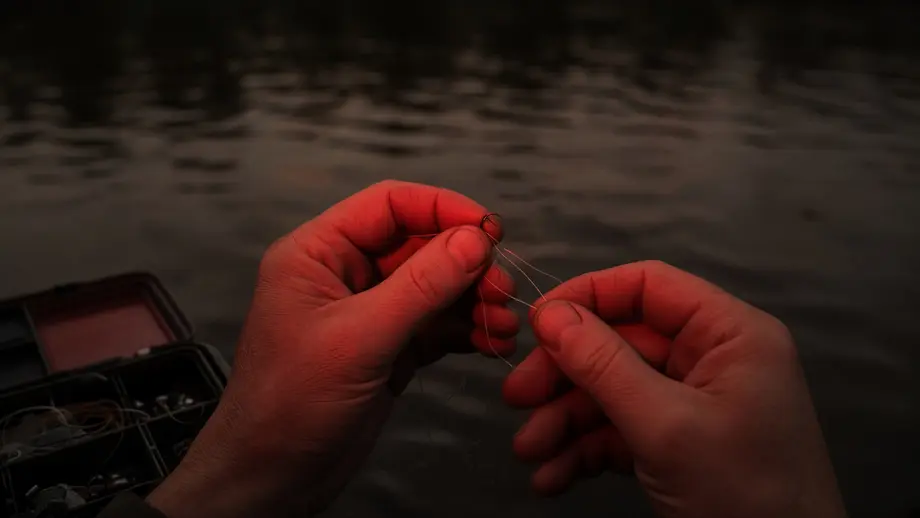
Olight makes the lights discussed here. Olight specs and regular prices come from its US product pages and user manuals as of September 2026. The beam, illuminance and runtime figures are our own arithmetic from those published ratings, and each one shows its formula and assumptions.
⚡ TL;DR
The best headlamp for fishing under $100 is the Olight Perun 3, $89.99 (regular price, September 2026). Of the four in-stock Olight lights compared here, it is the only one rated IP68, and it runs 70 hours on 15-lumen red. On a tighter budget, the $29.99 Oclip on a cap brim covers bait and knots, and the $54.99 Oclip 2 Pro adds a 115° tilting head.
This table gives the best headlamp for fishing at each price tier, using Olight's regular US prices in September 2026.
| Scenario | Pick | Key specs (Olight ratings) | Price (regular, September 2026) | Why |
|---|---|---|---|---|
| Best overall, and for anglers who might drop it in the water | Olight Perun 3 | 3,000 lm, 6,400 cd, 160 m, IP68, red 60 lm / 15 lm, 150 g | $89.99 | Only immersion-rated pick in stock; 15 lm red for 70 h |
| Best on a cap brim with an aimable head | Olight Oclip 2 Pro | 530 lm flood, 3,906 cd spot, 125 m, IP66, 115° head tilt, red 40 lm / 4 lm, 75.5 g | $54.99 | Tilts down to your hands; spot reaches a bobber at 90 lm |
| Best head-strap kit under $50 | Olight Oclip Pro S + Oclip Series Headlamp Strap | 600 lm, 1,600 cd, 80 m, IPX6, red 40 lm / 4 lm, 53 g light | $47.98 ($39.99 + $7.99) | Strap officially lists the Pro S as compatible |
| Best budget pick | Olight Oclip on a cap brim | 300 lm, 1,156 cd, 68 m, IPX5, red 4 lm, 30 g | $29.99 | Lightest light here; 10 lm lasts 12 h |
Every one of these picks lists at or under $100. The Perun 3 Mini ($64.99) would fit between the tiers, but Olight's US store showed its default version as sold out on September 24, 2026, so it isn't a pick here.
If you fish from a pier, a jetty or a riverbank after dark, you know the routine. You need both hands to thread a worm, retie a leader or back a treble hook out of a catfish's lip. The cheap headlamp in your tackle bag either blasts white light into your eyes off the line, points at the horizon because the head won't tilt down, or quits after one splash. Spending more doesn't fix that by itself, because the extra money often buys thousands of lumens you will never switch on at the water.
This guide sorts fishing headlamps by what the money buys: a real red mode, a head you can aim at your hands, a water rating that matches how wet you get, and a battery that lasts the whole night. Every figure comes from Olight's published ratings, and the math is shown so you can redo it for any light.
📋 Table of Contents
- 1. What a Fishing Headlamp Has to Do: Hands, Bobber, Walk Back
- 2. Fishing Headlamp Price Tiers: What $29.99, $54.99 and $89.99 Buy
- 3. Fishing Headlamp Comparison: Red Light, Head Angle, Water Rating, Weight
- 4. Olight Picks at Each Price
- 5. What Is the Best Headlamp for Fishing at Night?
- 6. What Color Headlamp Is Best for Fishing?
- 7. Do Headlamps Spook Fish or Draw Bugs?
- 8. Clip Light on a Cap or Headband Headlamp: What Should a Hat-Wearing Angler Choose?
- 9. Is a Brighter Headlamp Better for Fishing?
- 10. State Rules on Using Lights While Night Fishing
- 11. What Are the Best Headlamps for Fishing?
- 12. How This Comparison Was Built
- 13. FAQ
What a Fishing Headlamp Has to Do: Hands, Bobber, Walk Back
A fishing headlamp does three jobs. It lights your hands at 30 to 50 cm for bait, knots and hooks. It reaches a bobber or rod tip 10 to 20 m out when you need to check a bite. And it lights the path back to the car over rocks and wet planks. The close job matters most, because it takes up most of your time under the light.
Most of your night is spent with the light pointed down at your hands. That is why the three features that matter most for shore fishing are a low mode, a red mode and a head you can aim down. Raw output only matters for the walk back and for checking something far out, and even then a middle mode is usually enough, as the calculations below show.
Here is how the three jobs translate into specs you can check on any product page.
| Job | Distance | What to check | Why |
|---|---|---|---|
| Baiting, tying knots, unhooking | 30 to 50 cm | A 10 to 30 lumen white mode, a red mode, a head that tilts down | Close light doesn't need to be bright, and it shouldn't glare back off the line |
| Checking a bobber, line or rod tip | 10 to 20 m | Candela, not lumens | Reach depends on peak intensity |
| Walking back over rocks or a pier | 5 to 30 m ahead | A 100+ lumen mode with an hour or more of runtime | Lets you see footing without draining the battery |
| Rain, spray, a slip into the water | Any | The IP rating, then the user manual's warnings | IPX5 or IP66 handles spray; only immersion ratings cover a dunk |
If you shop for Olight lights, the headlamps category covers the dedicated headband models, and the clip lights covered below sit on a cap brim or a strap instead.
Fishing Headlamp Price Tiers: What $29.99, $54.99 and $89.99 Buy
Olight's regular US prices for the lights discussed here run from $29.99 for the Oclip to $89.99 for the Perun 3. The Oclip Pro S with its strap costs $47.98, the Oclip 2 Pro costs $54.99, and the Perun 3 Mini lists at $64.99 but showed as sold out on September 24, 2026. All six products list at or under $100.
Each step up the price ladder adds something specific. From $29.99 to $47.98, you get a strap that officially fits, a brighter 40-lumen red mode, and about 5.2 times the runtime on 4-lumen red (26 hours on the Oclip Pro S versus 5 hours on the Oclip). From $47.98 to $54.99, you gain the 115° tilting head and an IP66 rating. From $54.99 to $89.99, you gain the IP68 rating, a 21700 battery and 70 hours of low red light.
This table lists each price step and what it adds, using Olight's September 2026 regular prices.
| Tier | Light | Price | What the step adds |
|---|---|---|---|
| Entry | Oclip | $29.99 | White and red light, 14 mm clip, magnet, 30 g |
| Strap kit | Oclip Pro S + strap | $47.98 | Official head-strap fit, 40 lm red, 26 h low red, IPX6 |
| Aimable clip | Oclip 2 Pro | $54.99 | 115° head tilt, 360° clip rotation, floodlight and spotlight, IP66 |
| Compact headlamp | Perun 3 Mini | $64.99 | IPX8, 54 g; default version sold out on September 24, 2026 |
| Full headlamp | Perun 3 | $89.99 | IP68, 5,000 mAh 21700 battery, 15 lm red for 70 h, headband included |
One way to compare value is cost per hour of low red light, since red is the mode that runs most of the night. The formula is price ÷ rated hours on the lowest red mode. That gives $29.99 ÷ 5 = $6.00 per hour for the Oclip, $47.98 ÷ 26 = $1.85 for the Oclip Pro S kit, $54.99 ÷ 27 = $2.04 for the Oclip 2 Pro and $89.99 ÷ 70 = $1.29 for the Perun 3. The most expensive light is the cheapest to run on red per charge.
Fishing Headlamp Comparison: Red Light, Head Angle, Water Rating, Weight
The four in-stock picks split into two groups. The Oclip, Oclip Pro S and Oclip 2 Pro are clip lights of 30 to 75.5 g rated IPX5 to IP66 against spray. The Perun 3 is a 150 g headlamp rated IP68. Only the Oclip 2 Pro publishes a head tilt angle, and only the Perun 3 is rated for immersion.
This comparison table lists Olight's published specs for each model; lumens are maximum output and the price is the regular September 2026 price.
| Model | Max lumens | Candela | Beam distance | White runtime near 100 lm | Red light (high / low) | Head angle | Water rating | Weight | Price |
|---|---|---|---|---|---|---|---|---|---|
| Oclip | 300 | 1,156 cd | 68 m | 100 lm for 90 min | 4 lm for 5 h (one level) | Fixed; aimed by the brim or clip | IPX5 | 30 g | $29.99 |
| Oclip Pro S (+ strap) | 600 | 1,600 cd | 80 m | 100 lm for 3.5 h | 40 lm for 3.5 h / 4 lm for 26 h | Aimed by the mount; no tilt angle published | IPX6 | 53 g (light) | $47.98 |
| Oclip 2 Pro | 530 flood / 400 spot | 3,906 cd | 125 m | 100 lm flood for 3 h 45 min | 40 lm for 4 h / 4 lm for 27 h | 115° head tilt, 360° clip rotation | IP66 | 75.5 g | $54.99 |
| Perun 3 | 3,000 | 6,400 cd | 160 m | 120 lm for 25 h | 60 lm for 14 h / 15 lm for 70 h | Set in the included headband; no tilt angle published | IP68 | 150 g | $89.99 |
You can check each beam distance yourself. The ANSI/NEMA FL 1 standard, as summarized by Pelican's flashlight standards page, defines beam distance as the distance at which the beam falls to 0.25 lux, "approximately the equivalent of the light emitted from the full moon." Because illuminance equals candela divided by distance squared, beam distance works out to 2 × √candela. The Oclip gives 2 × √1,156 = 68 m, the Oclip Pro S 2 × √1,600 = 80 m, the Oclip 2 Pro 2 × √3,906 = 125 m, and the Perun 3 2 × √6,400 = 160 m. All four match Olight's listed distances.
Olight Picks at Each Price
Each pick below starts with the fishing problem it solves, then the official spec that solves it, then its limits and the alternative if it doesn't fit how you fish. All four were in stock at Olight's US store on September 24, 2026, at the regular prices shown.
Olight Perun 3: Best Overall ($89.99)
The problem on a jetty or a boat is that a light can end up in the water. The Olight Perun 3 is rated IP68, and its 5,000 mAh 21700 battery runs red light for 14 hours at 60 lumens or 70 hours at 15 lumens. White light runs 30 lumens for 89 hours, 120 lumens for 25 hours and 5 lumens for 20 days. Its Turbo steps from 3,000 to 800 to 600 lumens over 2 + 180 + 30 minutes.
The light lifts out of the included headband to work as a handheld flashlight with a magnetic tail, which helps when you need to search the rocks for a dropped lure. Olight also lists fishing among its uses.
Limits: at a listed 150 g, it is five times the Oclip's 30 g, and the light body rides on the front of the band; our guide to headlamp comfort explains how to set a front-heavy lamp so it doesn't press. Olight notes that the headlamp mounting bracket is metal and "is expected to scratch the body of the torch if taken in / out repeatedly." The 3,000-lumen Turbo is more than you need at the water. Its user manual lists a working temperature of 0 to 40°C.
Olight Oclip 2 Pro: Best Aimable Clip Light ($54.99)
The complaint about cheap headlamps is a head that won't tilt far enough down to light your hands. The Olight Oclip 2 Pro pairs "a 115° head tilt with 360° clip rotation," and Olight says to "set the angle once and it holds." Its clip grips objects up to 14 mm thick, which covers most cap brims.
A selector switches between a floodlight of up to 530 lumens, a spotlight rated at 3,906 candela and 125 m, and red light. Red runs 40 lumens for 4 hours or 4 lumens for 27 hours. The floodlight runs 100 lumens for 3 hours 45 minutes and 10 lumens for 25 hours. It carries IP66 and a 2.0 m drop rating.
Limits: its user manual says "Do not immerse the product in water or other liquids, as it will damage the product," so IP66 means spray and jets, not a dunk. At 75.5 g, it is heavy for a soft brim. The manual also notes that between 0°C and 10°C "the white light Turbo will be unavailable," and that below 0°C white light is limited to Low and Medium. It also advises anyone with an ICD or pacemaker to avoid close or prolonged contact with the product.
Olight Oclip Pro S With Strap: Best Head-Strap Kit ($47.98)
If you don't wear a cap, a clip light needs something to ride on. The Oclip Series Headlamp Strap costs $7.99, and Olight states it "is compatible with the Oclip Pro, Oclip Pro S and Oclip Ultra." The Olight Oclip Pro S costs $39.99 and lists 600 lumens, 1,600 candela, 80 m, IPX6 and 53 g with its battery.
Its red light runs 40 lumens for 3.5 hours or 4 lumens for 26 hours, and white light runs 100 lumens for 3.5 hours and 10 lumens for 27 hours. It also has green, blue and a 365 nm UV mode. Never look into the UV beam or point it at anyone's eyes.
Limits: IPX6 covers spray and jets, and the Oclip Pro S user manual says "Do not immerse the product in water or other liquids," so keep it off your head when you wade. Olight doesn't publish a tilt angle for the strap mount, so aiming depends on how you set the strap. The wide beam reaches shorter than the Oclip 2 Pro's spotlight. For a wider look at strap kits, see our pick for the best headlamp under $50.
Olight Oclip on a Cap Brim: Best Budget Pick ($29.99)
The budget problem is getting red light and a usable low mode for the price of a bag of lures. The Olight Oclip costs $29.99, weighs 30 g and clips onto objects up to 14 mm thick. It gives white light up to 300 lumens and red light at 4 lumens. Its 10-lumen Low runs 12 hours, and its 1.5-lumen Moonlight runs 30 hours.
Limits: this is the one light here to leave home when you go wading or kayak fishing. It is rated IPX5, and its user manual says "Do not immerse the product in water or other liquid as it will damage the product." Its red light has one level and runs 5 hours, which won't cover a long night by itself. The 100-lumen Medium lasts 90 minutes. Below 0°C, its manual limits it to Low and Medium. The Oclip Series Headlamp Strap's compatibility list doesn't name the original Oclip, so the brim is the safer mount. You can compare the whole family on the Olight Oclip series page.
What Is the Best Headlamp for Fishing at Night?
The best headlamp for fishing at night is one that lasts your whole session on its low modes. Rated runtimes let you check that before you go. For a five-hour session of 4 hours on low red and 1 hour on white at about 100 lumens, the Perun 3 uses about 10% of a charge, the Oclip 2 Pro about 42%, and the Oclip only finishes if you switch to its 10-lumen Low.
Here is the method, so you can plug in your own session. Each mode drains a share of the battery equal to the hours you use it divided by its rated runtime. Add the shares; if the total is under 1.0, the light lasts the night.
This table shows the session math for a 4-hour red plus 1-hour white night, using Olight's rated runtimes.
| Light | Red share (4 h) | White share (1 h) | Total | Sessions per charge |
|---|---|---|---|---|
| Perun 3 | 4 ÷ 70 = 0.057 (15 lm red) | 1 ÷ 25 = 0.040 (120 lm) | 0.097 | About 10.3 |
| Oclip 2 Pro | 4 ÷ 27 = 0.148 (4 lm red) | 1 ÷ 3.75 = 0.267 (100 lm flood) | 0.415 | About 2.4 |
| Oclip Pro S | 4 ÷ 26 = 0.154 (4 lm red) | 1 ÷ 3.5 = 0.286 (100 lm) | 0.440 | About 2.3 |
| Oclip, white on Medium | 4 ÷ 5 = 0.800 (4 lm red) | 1 ÷ 1.5 = 0.667 (100 lm) | 1.467 | Runs flat before the night ends |
| Oclip, white on Low | 4 ÷ 5 = 0.800 (4 lm red) | 1 ÷ 12 = 0.083 (10 lm) | 0.883 | About 1.1 |
Treat these as estimates. They assume the battery drains in proportion to rated runtime, which the step-down in higher modes and cold weather both upset. The Oclip manual notes that runtime "may vary depending on the external temperature and ventilation conditions." Keep 20% or more in reserve for the walk back.
Tip: Charge the night before, not the morning of. A light that sat half-charged in the truck all day starts your session with a smaller reserve than the table assumes.
What Color Headlamp Is Best for Fishing?
Red is the best headlamp color for most fishing tasks at night, because a dim red light lets your eyes stay adapted to the dark while you bait and tie. Switch to white only when you need true colors or to see farther: checking a lure color, spotting a snag on the bottom, or walking back. All four picks here have red light.
The reason is chemistry. An article on the National Park Service website about dark adaptation explains that night vision depends on rhodopsin, which "takes from 20 to 40 minutes for humans to start benefiting from," and that "it only takes a few seconds of bright light" to break it down. It adds that "deep red lights do not trigger the neutralization of the rhodopsin," and that "a dim red light is best for maximizing after-dark eye behavior."
That favors the lowest red setting you can work with. The Perun 3's lowest red is 15 lumens, and the three clip lights go down to 4 lumens. Olight doesn't publish candela for its red modes, so red brightness at your hands can't be calculated from the product pages; start on the lowest level and step up only if you can't see the knot.
This table matches common fishing tasks to a color and a starting level.
| Task | Color | Starting level on these lights |
|---|---|---|
| Threading bait, tying knots | Red | 4 lm red (Oclip family) or 15 lm red (Perun 3) |
| Unhooking a fish, handling hooks | Red, or white Low if you can't see the barb | 10 lm white Low, or 30 lm on the Perun 3 |
| Choosing a lure color, checking line for nicks | White | 10 to 30 lm white |
| Checking a bobber 10 to 20 m out | White, briefly | A 90 to 120 lm mode (see the calculation below) |
| Walking back over rocks | White | 100 to 120 lm |
Do Headlamps Spook Fish or Draw Bugs?
There's no single answer for fish, because species react to light differently, and none of the sources below settles whether a brief headlamp beam spooks a given fish. Light does attract insects, and blue-rich white light usually draws more than red. The practical rule is to keep beams off the water you are fishing and use red at your hands.
A 2017 review of recreational fishing at night, archived by NOAA, notes that the "sensory physiology of some species makes them vulnerable to capture at night," and that some places restrict night fisheries, for example with "no use of artificial lights." Light can also attract fish rather than scare them. Georgia's Wildlife Resources Division has written in a Georgia fishing report that "night fishing at a Georgia Public Fishing Area is improved by all the installed lighting at docks and piers."
For insects, a 2015 study in Philosophical Transactions of the Royal Society B on LED spectrum and insect attraction states that "ultraviolet and blue light are usually most attractive to arthropods," though the "degree of attraction varies among orders." Where Olight lists a color temperature for these lights, the white LEDs are cool white (5,700 to 6,700 K for the Perun 3, 5,700 to 6,500 K for the Oclip and Oclip Pro S), so switching to red at your hands is a reasonable way to draw fewer bugs to your face.
If you want to see how this plays out at your own spot, keep a simple log: count insects around your head after 30 minutes on red one night and 30 minutes on low white another, with similar weather. One night is one observation, not a result, but a few nights will tell you what your spot does.
Clip Light on a Cap or Headband Headlamp: What Should a Hat-Wearing Angler Choose?
If you already fish in a ball cap, a clip light on the brim is the lightest setup and costs the least: the Oclip weighs 30 g and costs $29.99. If you fish bareheaded, in a hood, or anywhere you might go in the water, a headband headlamp such as the Perun 3 is the safer mount, because a strap and an IP68 rating keep it on you and working.
A brim light also puts the beam where your eyes already look, and it is easy to aim down at your hands by tilting your head. The catch is weight on a soft brim: the 75.5 g Oclip 2 Pro can make a floppy brim sag, which is where its 115° tilt helps you correct the angle.
This checklist sorts the choice by how you fish.
- You wear a stiff-billed cap and fish from a pier or bank: Oclip ($29.99) or Oclip 2 Pro ($54.99) on the brim.
- You wear a beanie or hood in cold weather: Oclip Pro S on the strap ($47.98), or the Perun 3 headband over the hood.
- You wade, kayak or fish slippery rocks: Perun 3 on its headband, with the lanyard attached when you take it off.
- You fish long nights of four hours or more: Perun 3; see the session math above.
- You want one light that also works as a work light in the truck: any of the clip lights, since each has a magnet.
For more on rigging a brim light from the bank or a jetty, see Olight's guide to hat clip lights for shore fishing. For how these picks compare with other headlamps at any price, see our roundup of the best headlamps.
Is a Brighter Headlamp Better for Fishing?
No. A brighter headlamp isn't better for fishing, because most of the work happens within arm's length, where 10 to 30 lumens is plenty and more light just glares back off monofilament and wet hands. What helps at a distance is candela, not lumens, and even there a middle mode usually reaches a bobber with light to spare.
You can check this with the inverse-square law: illuminance in lux equals candela divided by distance in meters squared. Olight publishes candela only at maximum output, so the estimates below assume candela scales with lumens within the same beam. That is an assumption, and the result is the center of the beam only.
At your hands, 40 cm away (0.4² = 0.16), the Oclip's 10-lumen Low gives about 1,156 × 10 ÷ 300 = 38.5 cd, or 38.5 ÷ 0.16 = 241 lux. The Perun 3's 30-lumen Low gives about 6,400 × 30 ÷ 3,000 = 64 cd, or 400 lux. For comparison, OSHA's construction illumination rule sets 10 foot-candles (about 108 lux) for shops and 30 foot-candles (about 323 lux) for offices and first aid stations. A low mode already puts shop-level light on your knot.
This table estimates center-beam light at the bobber, 15 m out (15² = 225), in each light's middle mode.
| Light and mode | Estimated candela | Lux at 15 m | Versus 0.25 lux (full-moon level) |
|---|---|---|---|
| Oclip 2 Pro, spotlight 90 lm | 3,906 × 90 ÷ 400 = 879 cd | 3.9 | About 16 times |
| Oclip, Medium 100 lm | 1,156 × 100 ÷ 300 = 385 cd | 1.7 | About 7 times |
| Oclip Pro S, Medium 100 lm | 1,600 × 100 ÷ 600 = 267 cd | 1.2 | About 5 times |
| Perun 3, Medium 120 lm | 6,400 × 120 ÷ 3,000 = 256 cd | 1.1 | About 5 times |
The Oclip 2 Pro's spotlight at 90 lumens puts more light on a bobber than the Perun 3 does at 120 lumens, because the spotlight packs its output into a tighter beam. That is why a 3,000-lumen rating tells you little about fishing performance.
Warning: Don't sweep a bright beam across other anglers or boats. Olight's manuals warn that looking directly at the light "may cause temporary blindness or permanent damage to your eyes," and a person dazzled on a wet pier can lose their footing.
State Rules on Using Lights While Night Fishing
Most anglers can use a headlamp to see what they are doing, but a few rules target using light to attract or spot fish. Minnesota, for example, bans lights used "to lure or attract fish," with narrow exceptions. Rules vary by state, water and species, so read your state wildlife agency's current fishing regulations before a night trip.
Minnesota statute 97C.335 says "A person may not use artificial lights to lure or attract fish or to see fish in the water while spearing," with exceptions that allow "a lighted artificial bait with hooks attached to the end of a fishing line" and a lighted decoy for spearing. It also says these restrictions do not apply to bow fishing. A headlamp pointed at your own hands isn't luring fish, but a bright beam aimed into the water to draw baitfish may be treated differently.
The NOAA-archived review cited above notes that in some jurisdictions "fishing is prohibited at night," which is a separate question from lights. Some waters close at night even where lights are legal, so check the hours for your specific lake, river or park as well.
This checklist covers what to look up before you go.
- Night fishing hours for your water body, including park and pier closing times.
- Whether lights, lighted lures or underwater lights are allowed for your target species.
- Any special rules for spearing, bowfishing or gigging if you do those after dark.
- Boating light rules if you fish from a boat, since a headlamp doesn't replace navigation lights.
What Are the Best Headlamps for Fishing?
The best headlamps for fishing under $100 are the Olight Perun 3 ($89.99) for all-night runtime and IP68 protection, the Oclip 2 Pro ($54.99) for a brim light that tilts 115° toward your hands, the Oclip Pro S on its strap ($47.98) for a light head kit, and the Oclip ($29.99) for a 30-gram budget brim light.
Here is the short version of how to choose the best headlamp for fishing among them.
- Decide how wet you get. If the light could go in the water, only the IP68 Perun 3 is rated for it. The clip lights are for spray and rain.
- Decide where the light rides. A stiff cap brim suits the Oclip or Oclip 2 Pro. No cap means the strap kit or the Perun 3.
- Check your session length against runtime. Use the share method above; the Perun 3 covers about ten 5-hour nights per charge, the Oclip about one.
- Make sure red light has a low level. All four have one; the Perun 3's lowest is 15 lumens and the clip lights go down to 4.
- Ignore peak lumens. Compare candela if you need reach, and low-mode runtime for everything else.
How This Comparison Was Built
No field trial was run for this guide. Every Olight number comes from its US product pages and user manuals as of September 24, 2026, and every calculation uses those ratings with its formula shown, so you can check it or redo it with your own numbers.
This table lists what was checked, the source and the method.
| Check | Source | Method | Count |
|---|---|---|---|
| Output, candela, beam distance, runtimes, weight, water rating | Olight US product pages (Specs tab) | Copied as published, including step-down notation | 5 products |
| Price and stock | Olight US store, September 24, 2026 | Regular price only; sold-out models excluded from picks | 5 products and 1 strap |
| Warnings, temperature limits, battery details | Olight user manuals | Quoted from the English text | 3 manuals |
| Beam distance cross-check | ANSI/NEMA FL 1 definition via Pelican | 2 × √candela against listed distance | 4 lights |
| Lux at hands and at a bobber | Inverse-square law | Candela ÷ distance², with candela scaled by lumens as a stated assumption | 6 estimates |
| Runtime per session | Rated runtimes | Hours used ÷ rated hours, summed per mode | 5 scenarios |
Safety note: Night fishing risk comes more from wet footing and cold water than from the light itself. Keep a light on you at all times near the water, attach a lanyard when you take a headlamp off your head, and let someone know where you are fishing and when you'll be back.
FAQ
Changelog
- September 23, 2026: First published.